
Cell Based Immunotherapy Market Overview:
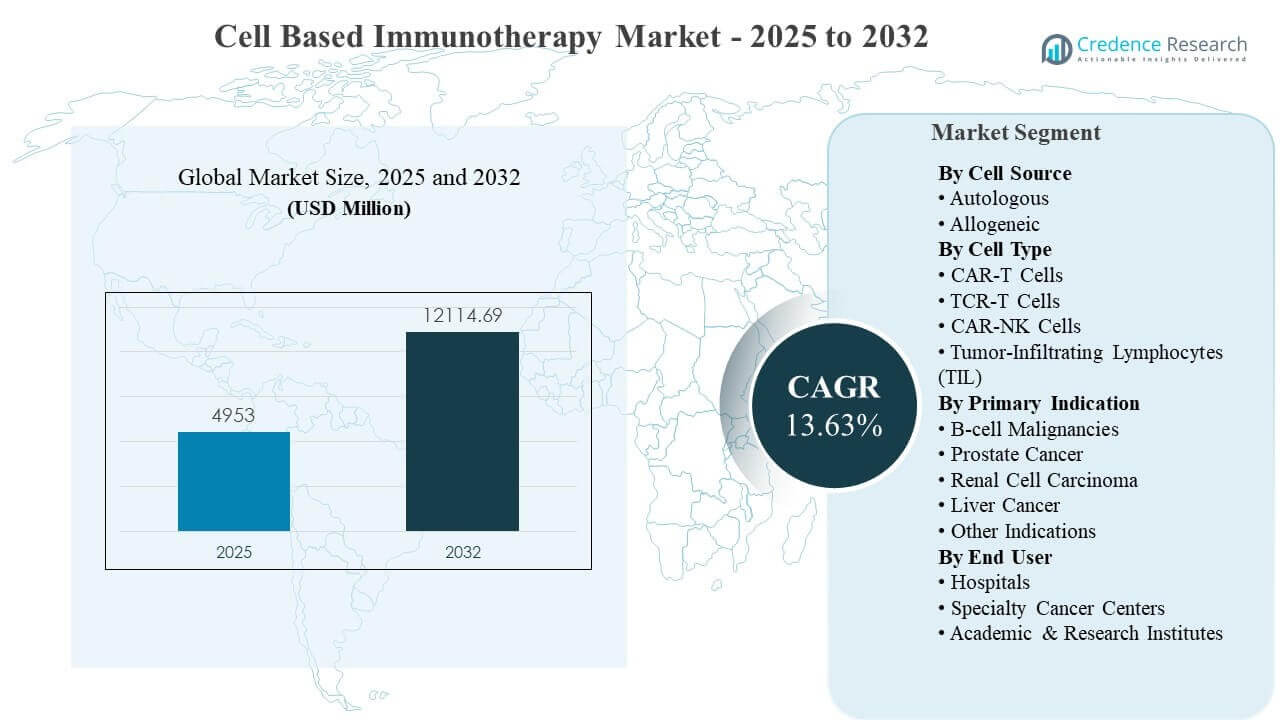
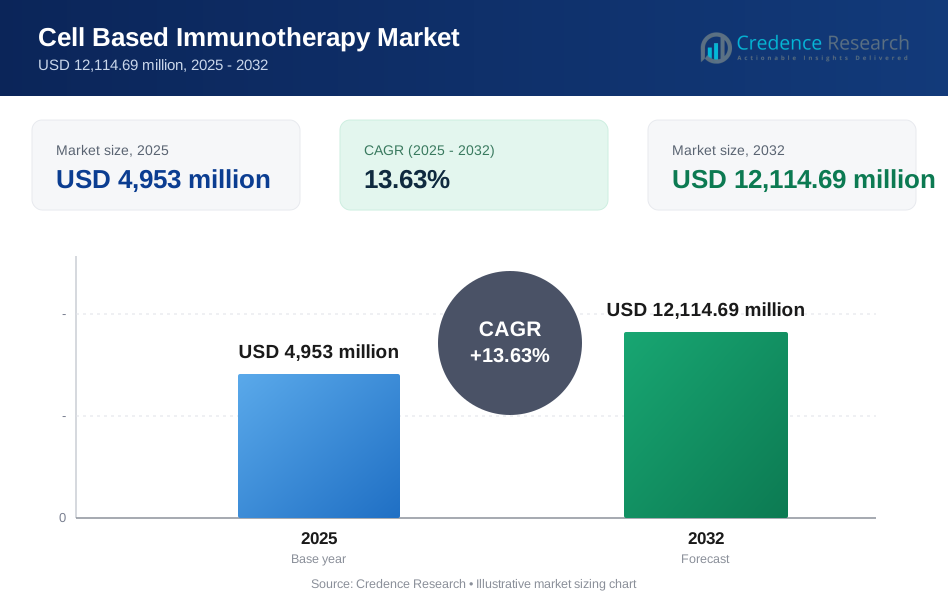
The global Cell Based Immunotherapy Market size was estimated at USD 4,953 million in 2025 and is expected to reach USD 12,114.69 million by 2032, growing at a CAGR of 13.63% from 2025 to 2032. Cell Based Immunotherapy Market expansion is being propelled by rising clinical adoption of engineered cell therapies in hematologic oncology, supported by deeper physician familiarity, broader treatment-center readiness, and increasingly standardized care pathways for patient selection and adverse-event management. North America continues to set the pace for commercialization and treatment capacity, and Asia Pacific is advancing quickly as manufacturing capabilities and trial activity expand across major healthcare systems.
| REPORT ATTRIBUTE | DETAILS |
|---|---|
| Historical Period | 2020-2024 |
| Base Year | 2025 |
| Forecast Period | 2026-2032 |
| Cell Based Immunotherapy Market Size 2025 | USD 4,953 million |
| Cell Based Immunotherapy Market, CAGR | 13.63% |
| Cell Based Immunotherapy Market Size 2032 | USD 12,114.69 million |
Key Market Trends & Insights
- The Cell Based Immunotherapy Market is projected to rise from USD 4,953 million (2025) to USD 12,114.69 million (2032) at 13.63% CAGR (2025–2032).
- Autologous therapies accounted for the largest share of 68.90% in 2025, reflecting strong clinical maturity and established treatment workflows.
- CAR-T Cells represented 60.85% of 2025 revenue, supported by expanding clinical utilization in oncology centers.
- Hospitals held 66.80% share in 2025, driven by intensive monitoring capability and multidisciplinary infrastructure requirements.
- North America contributed 39.75% of 2025 revenue, while Asia Pacific is positioned for faster expansion over the coming years due to rising manufacturing capacity, growing clinical trial activity, and improving treatment-center readiness.
Segment Analysis
Cell Based Immunotherapy Market demand is shaped by high clinical value in refractory cancers and by the increasing number of specialized centers able to deliver complex cell therapies. Patient-specific workflows, chain-of-custody requirements, and intensive monitoring needs continue to concentrate utilization in high-capability hospital settings. Pricing intensity and payer scrutiny are influencing contracting structures, site selection, and patient referral networks. At the same time, innovation across cell engineering and manufacturing is widening the therapy landscape beyond early hematologic indications.
Cell Based Immunotherapy Market segmentation reflects an ongoing shift from purely patient-derived treatment models toward scalable platforms that can reduce lead times and broaden access. Programs focused on off-the-shelf approaches are accelerating as developers improve persistence, safety, and tumor-targeting performance. Cell Based Immunotherapy Market adoption is also supported by rising clinical experience with toxicity management and by improving operational playbooks across apheresis, conditioning regimens, and post-infusion monitoring.
By Cell Source Insights
Autologous accounted for the largest share of 68.90% in 2025. Autologous dominance is supported by established clinical protocols, wider physician confidence, and deeper commercial availability across major oncology centers. Autologous products also benefit from clearer patient selection pathways and more standardized delivery models in mature markets. Allogeneic development is gaining traction as next-generation platforms target shorter production timelines and broader patient reach.
By Cell Type Insights
CAR-T Cells accounted for the largest share of 60.85% in 2025. CAR-T leadership is reinforced by multiple commercial programs, expanding treatment experience, and strengthening delivery infrastructure across specialized centers. CAR-T cell therapy also benefits from improving manufacturing throughput and more refined toxicity management pathways. CAR-NK Cells, TCR-T Cells, and Tumor-Infiltrating Lymphocytes (TIL) are progressing as solid-tumor strategies and engineering approaches mature.
By Primary Indication Insights
B-cell Malignancies accounted for the largest share of 41.90% in 2025. B-cell malignancies lead due to strong clinical precedent, validated target biology, and higher concentration of certified centers for hematologic oncology delivery. Reimbursement pathways and treatment-center readiness are typically more mature for hematologic indications than for many solid tumors. Renal Cell Carcinoma, Prostate Cancer, and Liver Cancer are advancing as trial pipelines expand and as combination approaches improve response durability.
By End User Insights
Hospitals accounted for the largest share of 66.80% in 2025. Hospital leadership reflects ICU access, apheresis capability, and the need for multidisciplinary management of complex adverse events. Hospital systems also tend to be earlier adopters due to stronger staffing depth and established cellular therapy units. Specialty Cancer Centers are expanding rapidly as patient volumes rise and as care pathways become more standardized outside large academic hospitals.
Cell Based Immunotherapy Market Drivers
Expanding Oncology Use Cases And Clinical Adoption
Cell Based Immunotherapy Market growth is driven by expanding clinical adoption of engineered cell therapies across oncology care pathways. Treatment centers are increasing cellular therapy capacity through dedicated units, specialized staff, and standardized adverse-event management protocols. Clinical confidence is improving as real-world experience grows across patient selection, bridging strategies, and post-infusion monitoring. Cell Based Immunotherapy Market demand is also supported by expanding trial pipelines that widen the addressable population across multiple tumor types.
Improving Manufacturing Capacity And Supply Reliability
Cell Based Immunotherapy Market momentum is strengthened by manufacturing scale-up and improving supply reliability across commercial programs. Developers are expanding production networks, qualifying additional sites, and improving chain-of-identity controls to reduce operational risk. Process improvements in vector supply, cell expansion, and quality testing are helping shorten cycle times and increase batch consistency. Cell Based Immunotherapy Market commercialization benefits when capacity expansion reduces patient wait times and increases treatment throughput.
Technology Advances In Cell Engineering And Target Discovery
Cell Based Immunotherapy Market expansion is supported by advances in cell engineering, target discovery, and next-generation construct design. Innovations such as improved co-stimulatory designs, better persistence strategies, and refined antigen selection are helping address efficacy and durability goals. Solid-tumor development is advancing through improved trafficking, tumor microenvironment navigation, and combination strategies. Cell Based Immunotherapy Market growth accelerates as these advances improve response rates and reduce safety trade-offs.
- For instance, Allogene reported that its gene-edited allogeneic CD19 CAR-T program cema-cel/ALLO-501 achieved a 67% overall response rate and a 58% complete response rate with the selected Phase II regimen in relapsed or refractory large B-cell lymphoma, while the median duration of response reached 23.1 months, underscoring progress in next-generation cell engineering and durability optimization.
Increasing Investment And Ecosystem Maturity
Cell Based Immunotherapy Market development is fueled by sustained investment across biopharma pipelines, CDMO capacity, and hospital readiness programs. Strategic partnerships and licensing activity are increasing access to platforms, vectors, and manufacturing capability. Training programs and standardized center accreditation models are improving consistency across patient pathways. Cell Based Immunotherapy Market adoption rises when ecosystem maturity lowers operational friction for new treatment centers.
- For instance, Legend Biotech reported in March 2026 that CARVYKTI was available in 14 markets across 294 sites worldwide, that more than 10,000 clinical and commercial patients had been treated to date, and that the expanded Raritan manufacturing facility can support treatment of up to 10,000 patients annually, reflecting a more mature commercial and treatment-center ecosystem.
Cell Based Immunotherapy Market Challenges
Cell Based Immunotherapy Market expansion faces challenges from complex manufacturing workflows and supply constraints for patient-specific products. Treatment timelines can be impacted by capacity limits, logistics coordination, and variability in starting material quality. High operational complexity increases the burden on treatment centers and can restrict broader geographic rollout. Cell Based Immunotherapy Market cost intensity also drives payer scrutiny and tighter utilization management frameworks.
Cell Based Immunotherapy Market growth is also constrained by clinical safety risks and variability in patient outcomes across heterogeneous populations. Cytokine-related toxicities and neurologic adverse events require experienced clinical teams and strong inpatient monitoring capability. Limited access to accredited centers can create geographic disparities and referral bottlenecks. Cell Based Immunotherapy Market penetration improves when safety management becomes more standardized and when delivery expands beyond a small number of high-volume sites.
- For instance, in the pivotal ELIANA trial and subsequent real-world evidence, Kymriah demonstrated any-grade cytokine release syndrome (CRS) in 77% of treated pediatric B-ALL patients and grade ≥3 CRS in 48%, while any-grade neurologic events occurred in 40% (grade ≥3 in 13%). management protocols now mandate certified centers with ICU backup
Cell Based Immunotherapy Market Trends and Opportunities
Cell Based Immunotherapy Market innovation is shifting toward off-the-shelf platforms that can reduce lead times and broaden access. Allogeneic approaches, including engineered NK and T-cell platforms, are being developed to improve scalability and enable inventory-based distribution. Development programs are also focusing on better persistence and improved safety through refined engineering strategies. Cell Based Immunotherapy Market opportunity increases when scalable models reduce the operational burden on treatment centers.
- For instance, Allogene Therapeutics' cema-cel (ALLO-501) demonstrated in the Phase I UNIVERSAL trial that approximately 90% of patients received allogeneic CAR-T cells within 5 days of enrollment, representing a 4- to 6-week reduction compared to autologous manufacturing timelines, while enabling production of approximately 100 doses from a single manufacturing run.
Cell Based Immunotherapy Market opportunity is also expanding through solid-tumor progress and broader modality diversification. Tumor-Infiltrating Lymphocytes (TIL) and TCR-T pipelines are gaining attention as developers improve antigen selection and address tumor microenvironment barriers. Combination approaches with checkpoint inhibitors and targeted agents are becoming more common in clinical strategies. Cell Based Immunotherapy Market growth benefits when new indications expand the eligible population beyond hematologic cancers.
Regional Insights
North America
Cell Based Immunotherapy Market revenue in North America accounted for 39.75% in 2025, supported by strong reimbursement structures, higher center density, and established commercialization networks. The region benefits from deep clinical trial activity and high concentration of specialized oncology institutions. Manufacturing networks and distribution capability are generally more mature across the United States and Canada. North America remains the reference market for early adoption of next-generation programs.
Europe
Cell Based Immunotherapy Market revenue in Europe is estimated at 27.10% in 2025, supported by advanced oncology infrastructure in key Western European markets. Treatment capacity is rising as more hospitals develop accredited cell therapy units and expand staff training. Reimbursement and access conditions vary by country, which shapes uneven adoption across the region. Europe continues to expand as cross-border experience and standardized delivery pathways improve.
Asia Pacific
Cell Based Immunotherapy Market revenue in Asia Pacific is estimated at 23.60% in 2025, with rapid expansion supported by rising trial participation and increasing investment in advanced therapy manufacturing. Major economies are scaling treatment-center capability and strengthening clinical protocols for complex cell therapies. Access and reimbursement conditions remain uneven across countries, which impacts near-term penetration. Asia Pacific is positioned for faster growth as capacity expansion continues.
Latin America
Cell Based Immunotherapy Market revenue in Latin America is estimated at 5.85% in 2025, reflecting early-stage adoption concentrated in leading private and academic centers. Limited certified center coverage and constrained reimbursement pathways reduce broad access for high-cost therapies. Referral networks are developing, but patient volumes remain concentrated in a small number of major cities. Latin America opportunity increases as clinical infrastructure and payer models mature.
Middle East & Africa
Cell Based Immunotherapy Market revenue in Middle East & Africa is estimated at 3.70% in 2025, driven mainly by emerging capability hubs in select countries. Limited availability of specialized centers and variable coverage policies restrict wider adoption. Cross-border treatment travel remains a relevant pathway for complex cases in many markets. Middle East & Africa growth improves as investment increases in accredited centers and local manufacturing partnerships.
Competitive Landscape
Cell Based Immunotherapy Market competition is characterized by rapid innovation cycles, expanding manufacturing footprints, and active lifecycle management across approved cell therapy franchises. Leading players differentiate through deeper clinical evidence, broader indication strategies, and operational scale that supports reliable product supply. Partnerships with manufacturing specialists and regional expansion strategies are common as companies seek to improve capacity and reduce delivery friction. Pipeline breadth across CAR-T, TCR-T, CAR-NK, and TIL modalities is a key lever for long-term positioning.
Novartis AG maintains a strong footprint through continued development of engineered cell therapy capabilities and manufacturing readiness across key markets. Novartis AG strategic focus includes capacity reliability, clinical evidence expansion, and operational execution to support treatment-center throughput. Novartis AG also benefits from established relationships with leading oncology institutions and experience supporting complex cellular therapy workflows. This positioning supports resilience as competition increases across next-generation modalities.
The industry research and growth report includes detailed analyses of the competitive landscape of the market and information about key companies, including:
- Novartis AG
- Gilead Sciences
- Bristol-Myers Squibb
- Johnson & Johnson
- Legend Biotech
- Allogene Therapeutics
- bluebird bio
- Fate Therapeutics
- Adaptimmune Therapeutics
- Takeda Pharmaceutical
- Atara Biotherapeutics
- Autolus Limited
- Cellectis
- Iovance Biotherapeutics
Qualitative and quantitative analysis of companies has been conducted to help clients understand the wider business environment as well as the strengths and weaknesses of key industry players. Data is qualitatively analyzed to categorize companies as pure play, category-focused, industry-focused, and diversified; it is quantitatively analyzed to categorize companies as dominant, leading, strong, tentative, and weak.
Recent Developments
- In February 2026, Gilead Sciences announced its agreement to acquire Arcellx in a landmark $7.8 billion transaction to maximize the long-term potential of anito-cel (anitocabtagene autoleucel), a next-generation BCMA-directed CAR-T cell therapy for relapsed or refractory multiple myeloma.
- In October 2025, Avantor partnered with BlueWhale Bio to accelerate CAR-T manufacturing by addressing critical production bottlenecks, reducing variability, and shortening time-to-patient for immune cell therapies. This collaboration leverages BlueWhale's Synecta™ cell-derived extracellular vesicle platform and Avantor's mission-critical products and services to transform the manufacturing landscape for cell-based immunotherapies.
- In September 2025, Kytopen announced a collaboration with BlueWhale Bio to develop a non-viral manufacturing workflow that eliminates current bottlenecks in cell therapy production, potentially giving patients faster access to more effective, personalized treatments. This partnership aims to revolutionize cell therapy manufacturing by combining Kytopen's continuous flow cellular engineering technologies with BlueWhale's innovative manufacturing platform
Report Scope
| Report Attribute | Details |
| Market size value in 2025 | USD 4,953 million |
| Revenue forecast in 2032 | USD 12,114.69 million |
| Growth rate (CAGR) | 13.63% (2025–2032) |
| Base year | 2025 |
| Forecast period | 2026–2032 |
| Quantitative units | USD million |
| Segments covered | By Cell Source Outlook: Autologous, Allogeneic | By Cell Type Outlook: CAR-T Cells, TCR-T Cells, CAR-NK Cells, Tumor-Infiltrating Lymphocytes (TIL) | By Primary Indication Outlook: B-cell Malignancies, Prostate Cancer, Renal Cell Carcinoma, Liver Cancer, Other Indications | By End User Outlook: Hospitals, Specialty Cancer Centers, Academic & Research Institutes |
| Regional scope | North America, Europe, Asia Pacific, Latin America, Middle East & Africa |
| Key companies profiled | Novartis AG, Gilead Sciences, Bristol-Myers Squibb, Johnson & Johnson, Legend Biotech, Allogene Therapeutics, bluebird bio, Fate Therapeutics, Adaptimmune Therapeutics, Takeda Pharmaceutical, Atara Biotherapeutics, Autolus Limited, Cellectis, Iovance Biotherapeutics |
| No. of Pages | 330 |
Segmentation
By Cell Source
- Autologous
- Allogeneic
By Cell Type
- CAR-T Cells
- TCR-T Cells
- CAR-NK Cells
- Tumor-Infiltrating Lymphocytes (TIL)
By Primary Indication
- B-cell Malignancies
- Prostate Cancer
- Renal Cell Carcinoma
- Liver Cancer
- Other Indications
By End User
- Hospitals
- Specialty Cancer Centers
- Academic & Research Institutes
By Region
- North America
- U.S.
- Canada
- Mexico
- Europe
- Germany
- France
- U.K.
- Italy
- Spain
- Rest of Europe
- Asia Pacific
- China
- Japan
- India
- South Korea
- South-east Asia
- Rest of Asia Pacific
- Latin America
- Brazil
- Argentina
- Rest of Latin America
- Middle East & Africa
- GCC Countries
- South Africa
- Rest of the Middle East and Africa
Request a Free Sample
Fill in your details and we'll send you a free sample report.
- Sample data tables & charts
- Research methodology
Need a Custom Version of This Report?
Tailor the scope, geography, or segments to your exact requirements.
- Custom geography or segment scope
- Direct access to our analyst team
Frequently Asked Questions
What is the current market size of the Cell Based Immunotherapy Market?
What is the forecast value and growth rate for the Cell Based Immunotherapy Market?
Which segment is largest in the Cell Based Immunotherapy Market?
What factors are driving growth in the Cell Based Immunotherapy Market?
Who are the leading companies in the Cell Based Immunotherapy Market?
Which region leads the Cell Based Immunotherapy Market?
Table of Content
Chapter 1. Report Introduction
- 1.1 Report Description & Purpose
- 1.1.1 Report Title & Market Definition
- 1.1.2 Unique Selling Propositions (USP) & Key Differentiators
- 1.1.3 Value Proposition for Stakeholders
- 1.2 Research Objectives
- 1.2.1 Market Sizing Objectives (Volume & Revenue)
- 1.2.2 Segmentation Objectives
- 1.2.3 Competitive Intelligence Objectives
- 1.2.4 Forecast & Scenario Objectives
- 1.3 Report Scope
- 1.3.1 Cell Based Immunotherapy Scope – Types & Subtypes Covered
- 1.3.2 Geographic Scope – Regions & Countries Covered
- 1.3.3 Historical Period, Base Year & Forecast Period (2025; forecast to 2032)
- 1.3.4 Inclusions & Exclusions
- 1.4 HS Code & Classification Framework
- 1.5 Currency, Units & Pricing Basis
- 1.6 Target Stakeholders
- 1.7 Limitations & Assumptions
Chapter 2. Executive Summary
- 2.1 Global Cell Based Immunotherapy Market Snapshot
- 2.1.1 Market Size – Historical (2025) & Forecast (2025-2032) (2025: USD 4,953 million → 2032: USD 12,114.69 million)
- 2.1.2 Volume & Revenue – Global Totals
- 2.1.3 Key Market Highlights – Top Five Facts
- 2.2 Cell Based Immunotherapy Market Segmentation Snapshot
- 2.2.1 Market Split by Region – 2025 vs. 2032
- 2.3 Competitive Snapshot
- 2.3.1 Top 10 Players by Revenue Share – 2025
- 2.3.2 Top 10 Players by Volume Share – 2025
- 2.3.3 Recent Strategic Developments (18-Month Summary)
- 2.4 Key Investment Highlights & Strategic Conclusions
Chapter 3. Cell Based Immunotherapy Market Dynamics & Industry Analysis
- 3.1 Market Overview & Context
- 3.1.1 Cell Based Immunotherapy Market Position in the Broader Automotive Value Chain
- 3.1.2 OEM vs. Replacement Market Dynamics
- 3.1.3 Market Maturity & Development Stage by Region
- 3.2 Cell Based Immunotherapy Market Drivers
- 3.3 Cell Based Immunotherapy Market Restraints & Challenges
- 3.4 Cell Based Immunotherapy Market Opportunities
- 3.5 Porter's Five Forces Analysis
- 3.5.1 Threat of New Entrants
- 3.5.2 Bargaining Power of Suppliers
- 3.5.3 Bargaining Power of Buyers
- 3.5.4 Threat of Substitutes
- 3.5.5 Competitive Rivalry – Intensity Assessment
- 3.6 Cell Based Immunotherapy Value Chain Analysis
- 3.6.1 Upstream – Raw Material/Input Suppliers
- 3.6.1.1 Raw Material/Input 1
- 3.6.1.2 Raw Material/Input 2
- 3.6.1.3 Raw Material/Input 3
- 3.6.2 Midstream – Production/Manufacturing/Service Delivery
- 3.6.2.1 Production/Process Overview
- 3.6.2.2 Key Facility Locations & Capacity by Manufacturer
- 3.6.3 Downstream – Distribution & End Consumer
- 3.6.3.1 Primary Channel – B2B/OEM
- 3.6.3.2 Secondary Channels – Dealer, Retail, Online, Direct
- 3.6.4 Value Chain Profitability Analysis
- 3.6.1 Upstream – Raw Material/Input Suppliers
- 3.7 PESTEL Analysis
- 3.7.1 Political Factors
- 3.7.2 Economic Factors
- 3.7.3 Social Factors
- 3.7.4 Technological Factors
- 3.7.5 Environmental Factors
- 3.7.6 Legal Factors
- 3.8 Cell Based Immunotherapy Supply Chain Analysis
- 3.8.1 Raw Material/Input Supply Risk Assessment
- 3.8.2 Manufacturing Concentration Risk (Geographic Exposure)
- 3.8.3 Trade Disruption Impact Analysis
- 3.9 Regulatory & Policy Landscape
Note: The regulatory and policy landscape section covers regulations based on their applicability to the market, Cell Based Immunotherapy category, geography, and scope of the study. Only regulatory frameworks with a material impact on operations, compliance, trade, sustainability, or market access are analyzed in detail.
Chapter 4. Key Investment Pockets & Opportunity Analysis
- 4.1 Cell Based Immunotherapy Market Attractiveness Analysis
- 4.1.1 By Region – Investment Attractiveness Matrix (Volume × CAGR)
- 4.2 Absolute Revenue Growth Opportunity
- 4.2.1 By Region – Absolute USD Growth Through 2032
- 4.3 Incremental Volume Opportunity
- 4.3.1 By Region – Incremental Volume Through 2032
- 4.3.2 Segment – Incremental Volume
- 4.4 Emerging Submarket Opportunity Deep Dive (Subject to Applicability)
- 4.5 Emerging Market Opportunity Scorecards
- 4.5.1 United States
- 4.5.2 Europe
- 4.5.3 Asia
- 4.5.4 Middle East & Africa
Note: Emerging Market Opportunity Scorecards will be included based on relevance and strategic importance. Regions listed are indicative and may vary depending on data availability and market dynamics.
Chapter 5. Cell Based Immunotherapy Import-Export Analysis & Trade Flows
- 5.1 Global Trade Overview
- 5.1.1 Global Export Value by Country (2025)
- 5.1.2 Global Export Volume by Country (2025)
- 5.1.3 Global Import Value by Country (2025)
- 5.1.4 Global Import Volume by Country (2025)
- 5.1.5 Net Trade Balance by Country (2025)
- 5.2 Export Analysis – Segment
- 5.2.1 Type 1 (HS Code)
- 5.2.2 Type 2 (HS Code)
- 5.2.3 Type 3 (HS Code)
- 5.2.4 Type 4 (HS Code)
- 5.2.5 Type 5 (HS Code)
- 5.3 Import Analysis – Segment
- 5.3.1 Type 1 (HS Code)
- 5.3.2 Type 2 (HS Code)
- 5.3.3 Type 3 (HS Code)
- 5.3.4 Type 4 (HS Code)
- 5.3.5 Type 5 (HS Code)
- 5.4 Average Unit Trade Prices
- 5.4.1 Average Export Price – Segment & Country
- 5.4.2 Average Import Price – Segment & Source Country
- 5.4.3 Price Trends (2025)
- 5.5 Key Trade Route Analysis
- 5.5.1 Trade Route 1
- 5.5.2 Trade Route 2
- 5.5.3 Trade Route 3
- 5.5.4 Trade Route 4
- 5.5.5 Trade Route 5
- 5.6 Trade Policy Impact Assessment
- 5.6.1 US Anti-Dumping & Section 301 Tariffs
- 5.6.2 EU Customs Union Impact
- 5.6.3 Major Free Trade Agreements
- 5.6.4 USMCA Rules of Origin
Note: Trade policy analysis will be included only where relevant to the Cell Based Immunotherapy market.
Chapter 6. Competitive Landscape & Company Benchmarking
- 6.1 Cell Based Immunotherapy Market Concentration & Structure
- 6.1.1 Herfindahl-Hirschman Index (HHI) – vs. 2025
- 6.1.2 Tier 1, Tier 2 & Tier 3 Market Structure
- 6.1.3 Global, Regional & Local Player Dynamics
- 6.2 Cell Based Immunotherapy Market Share Analysis – 2025
- 6.2.1 Global Revenue Share by Company
- 6.2.2 Global Volume Share by Company
- 6.2.3 Regional Revenue Share
- 6.2.4 Market Share Evolution ( vs. 2025)
- 6.2.5 OEM Segment Share by Company
- 6.2.6 Replacement Segment Share by Company
- 6.3 Production/Delivery Capacity & Facility Analysis
- 6.3.1 Global Installed Capacity
- 6.3.2 Capacity Utilization Rates
- 6.3.3 Production/Output Volume
- 6.3.4 Facility Locations & Capacity Map
- 6.3.5 Planned Capacity Additions
- 6.4 Cell Based Immunotherapy Competitive Benchmarking Matrix
- 6.4.1 Revenue, Volume, CAGR & Profitability Comparison
- 6.4.2 Channel Revenue Mix
- 6.4.3 Geographic Revenue Exposure
- 6.4.4 R&D Intensity
- 6.4.5 Sustainability Maturity
- 6.5 Strategic Developments in Cell Based Immunotherapy (Last 24 Months)
- 6.5.1 Mergers, Acquisitions & Divestments
- 6.5.2 New Cell Based Immunotherapy Launches
- 6.5.3 Facility Expansions
- 6.5.4 Strategic Alliances, Joint Ventures & Partnerships
- 6.5.5 Distribution Expansion & Market Entry
- 6.5.6 Sustainability & ESG Initiatives
- 6.6 Competitive Strategy Mapping
- 6.6.1 Leader, Challenger, Follower & Niche Classification
- 6.6.2 Pricing Strategy Comparison
- 6.6.3 Channel Strategy Matrix
Note: Strategic developments are included based on their materiality and the availability of reliable information.
Chapter 7. Global Cell Based Immunotherapy Market – By Distribution Channel
- 7.1 Segment Overview
- 7.1.1 Volume & Revenue Split by Channel (2025 & 2032)
- 7.1.2 Channel Mix Evolution (2025-2032)
Chapter 8. Regional Market Analysis – Global Overview
- 8.1 Global Regional Overview
- 8.1.1 Regional Volume Share
- 8.1.2 Regional Revenue Share
- 8.1.3 Regional Volume by Region
- 8.1.4 Regional Revenue by Region
- 8.1.5 Regional Forecast Through 2032
- 8.2 Cross-Regional Segment Analysis
- 8.2.1 By Distribution Channel
- 8.2.2 By Brand/Price Tier
Chapter 9. North America Cell Based Immunotherapy Market
- 9.1 United States
- 9.2 Canada
- 9.3 Mexico
Chapter 10. Europe Cell Based Immunotherapy Market
- 10.1 Germany
- 10.2 France
- 10.3 Italy
- 10.4 United Kingdom
- 10.5 Spain
- 10.6 Poland
- 10.7 Russia
- 10.8 Netherlands
- 10.9 Belgium
- 10.10 Sweden
- 10.11 Denmark
- 10.12 Norway
- 10.13 Rest of Europe
Chapter 11. Asia Pacific Cell Based Immunotherapy Market
- 11.1 China
- 11.2 India
- 11.3 Japan
- 11.4 South Korea
- 11.5 Thailand
- 11.6 Indonesia
- 11.7 Vietnam
- 11.8 Malaysia
- 11.9 Australia
- 11.10 Rest of Asia Pacific
Chapter 12. Latin America Cell Based Immunotherapy Market
- 12.1 Brazil
- 12.2 Argentina
- 12.3 Colombia
- 12.4 Chile
- 12.5 Rest of Latin America
Chapter 13. Middle East Cell Based Immunotherapy Market
- 13.1 Saudi Arabia
- 13.2 United Arab Emirates
- 13.3 Turkey
- 13.4 Israel
- 13.5 Iran
- 13.6 Rest of the Middle East
Chapter 14. Africa Cell Based Immunotherapy Market
- 14.1 South Africa
- 14.2 Egypt
- 14.3 Nigeria
- 14.4 Morocco
- 14.5 Rest of Africa
Chapter 15. Cell Based Immunotherapy Company Profiles
- 15.1 [Company 01]
- 15.1.1 Company Overview
- 15.1.2 Key Management Personnel
- 15.1.3 Products & Services Portfolio
- 15.1.4 Financial Performance
- 15.1.5 Key Market Focus & Geographic Presence
- 15.1.6 Recent Developments & Strategic Initiatives
Note: The company profile list is preliminary and may change based on research findings, market developments, data availability, and client requirements.
Chapter 16. Appendices
- Appendix A – List of Abbreviations & Acronyms
- Appendix B – Industry Classification Code Reference – Full Series
- Appendix C – Production & Capacity Data Tables
- Appendix D – End-Use & Demand Base Tables
- Appendix E – Consumption & Replacement Rate Assumptions
- Appendix F – ASP Reference Tables
- Appendix G – Manufacturing & Facility Database
- Appendix H – Import-Export Data Tables
- Appendix I – Regulatory Summary Tables
- Appendix J – Primary Research Participant List (Anonymized)
- Appendix K – Primary Research Questionnaire Framework
- Appendix L – Data Sources & Bibliography
- Appendix M – Market Size Divergence & Source Comparison
Chapter 17. Research Methodology
- 17.1 Research Framework & Philosophy
- 17.2 Secondary Research – Sources, Hierarchy & Data Extraction
- 17.3 Data Modeling – Bottom-Up & Top-Down Market Sizing
- 17.4 Primary Research – Stakeholder Framework, LOI & Sample Sizes
- 17.5 Forecast Methodology – Regression, Scenario & Sensitivity Analysis
- 17.6 Quality Control – Four-Layer Validation Framework
- 17.7 Limitations & Standard Assumptions
- 17.8 Disclaimer
