
Contact Lenses Market Overview:
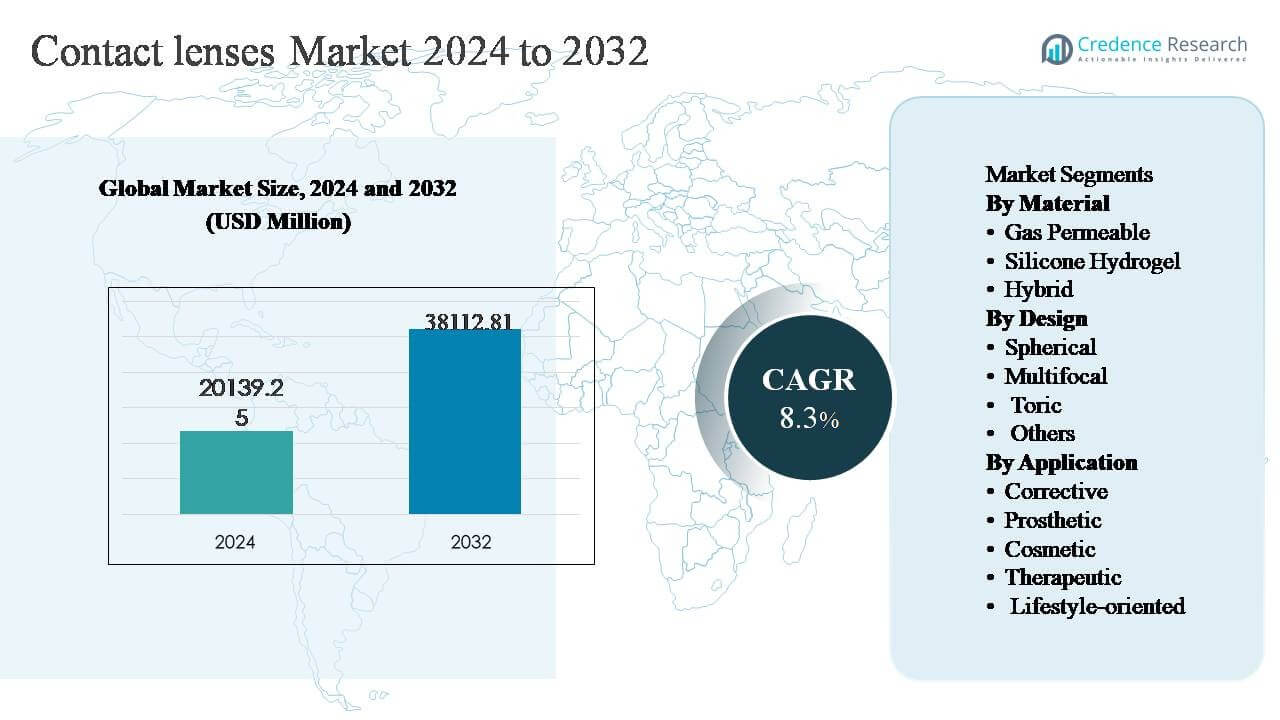
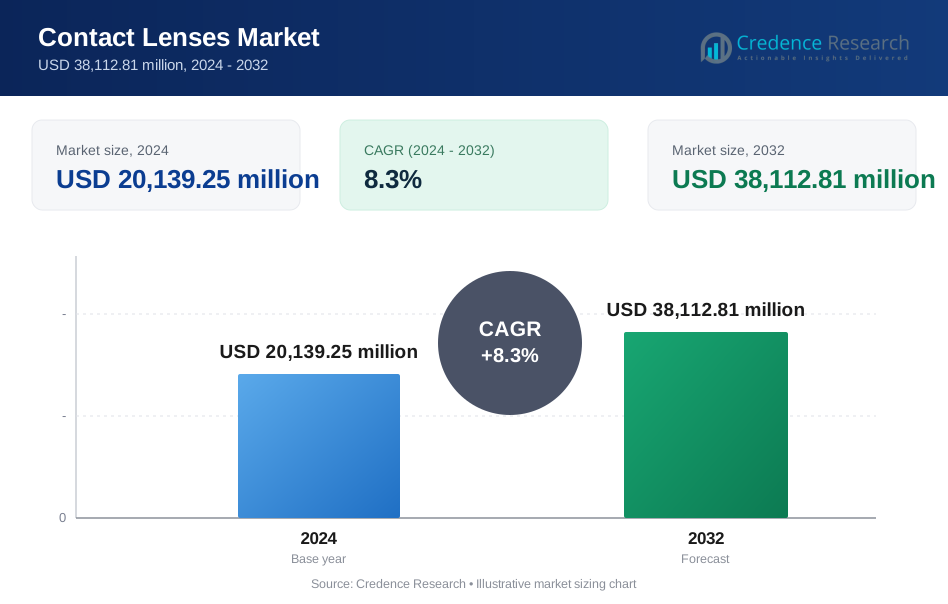
The global contact lenses market was valued at USD 20,139.25 million in 2024 and is projected to reach USD 38,112.81 million by 2032, expanding at a compound annual growth rate (CAGR) of 8.3% during the forecast period.
| REPORT ATTRIBUTE | DETAILS |
|---|---|
| Historical Period | 2020-2023 |
| Base Year | 2024 |
| Forecast Period | 2025-2032 |
| Contact Lenses Market Size 2024 | USD 20,139.25 million |
| Contact Lenses Market , CAGR | 8.3% |
| Contact Lenses Market Size 2032 | USD 38,112.81 million |
Contact Lenses Market Insights
- Market growth is primarily driven by the increasing prevalence of refractive errors, prolonged digital screen exposure, and strong demand for silicone hydrogel lenses, which represent the dominant material segment due to superior oxygen permeability and comfort.
- Key market trends include rapid growth in daily disposable and lifestyle-oriented lenses, expansion of multifocal and toric designs, and increasing penetration of cosmetic lenses among younger consumers, while silicone hydrogel and spherical lenses continue to hold leading segment shares.
- Competitive intensity remains high, with leading players focusing on material innovation, premium product launches, and strategic expansion in Asia Pacific, while North America leads regionally with about 39% market share, followed by Europe at nearly 27% and Asia Pacific at around 23%.
- Market expansion is moderated by risks of eye infections from improper usage and competition from spectacles and refractive surgeries, although improving eye care infrastructure in emerging regions continues to support long-term regional growth.
Contact Lenses Market Segmentation Analysis:
By Material:
By material, silicone hydrogel lenses dominate the contact lenses market, accounting for the largest market share due to their superior oxygen permeability, extended wear comfort, and reduced risk of hypoxia-related complications. These lenses are widely adopted for both daily and extended-wear applications, making them the preferred choice among eye care professionals and consumers. Gas permeable lenses retain a niche share, driven by demand for sharper vision and durability in specific clinical cases. Hybrid lenses support steady growth by combining the comfort of soft lenses with the optical precision of rigid materials.
- For instance, Johnson & Johnson Vision’s Acuvue Oasys 1-Day (senofilcon A) exhibits an oxygen transmissibility (Dk/t) of around 103-147 units in typical lens thicknesses, enabling greater oxygen delivery to the cornea compared with traditional hydrogel materials that generally range much lower in transmissibility.
By Design:
By design, spherical lenses hold the dominant market share, driven by their extensive use in correcting common refractive errors such as myopia and hyperopia. Their simple design, wide availability, and lower cost make them the first-line option for most users. Toric lenses represent a significant growth segment due to rising astigmatism prevalence and improved stabilization technologies. Multifocal lenses continue to expand steadily, supported by the aging population and increasing presbyopia incidence, while other specialty designs cater to customized and irregular corneal conditions.
- For instance, MYDAY Toric 30 and ACUVUE OASYS Contact Lenses for ASTIGMATISM utilize advanced ballast and stabilization designs that align the lens at precise axes (available in axis steps as fine as 10° up to 180°) and correct cylindrical power (often from -0.75 D up to -2.25 D or beyond in specialized fits), enabling clearer vision for patients with irregular corneal shapes.
By Application:
By application, corrective lenses represent the dominant sub-segment, capturing the majority market share as contact lenses are primarily used to address refractive vision disorders. High global incidence of vision impairment, combined with growing awareness and routine eye examinations, continues to drive demand. Cosmetic lenses follow, supported by fashion trends and social media influence, particularly among younger consumers. Therapeutic and prosthetic lenses maintain specialized demand in clinical eye care, while lifestyle-oriented lenses gain traction through sports, digital screen usage, and convenience-focused vision correction preferences.
Key Growth Drivers
Rising Prevalence of Refractive Errors and Vision Disorders
The increasing global incidence of refractive errors such as myopia, hyperopia, astigmatism, and presbyopia remains a primary growth driver for the contact lenses market. Extended screen exposure, urban lifestyles, and reduced outdoor activity are contributing to earlier onset and faster progression of vision problems across age groups. Contact lenses offer an effective and increasingly preferred alternative to spectacles, particularly among working professionals and younger consumers seeking convenience and aesthetic appeal. Regular vision screening programs and higher awareness of corrective eye care further support adoption. In aging populations, the growing prevalence of presbyopia is accelerating demand for multifocal and specialty lenses, reinforcing sustained market expansion across developed and emerging regions.
- For instance, the World Health Organization has documented that more than 2.6 billion people worldwide live with myopia, underscoring the scale of vision correction needs across age groups.
Advancements in Lens Materials and Wear Comfort
Continuous innovation in contact lens materials significantly drives market growth by improving safety, comfort, and usability. Silicone hydrogel technology has enhanced oxygen permeability, reduced dryness, and enabled extended wear options, increasing user satisfaction and compliance. Manufacturers are investing in moisture-lock technologies, UV protection, and surface treatments that minimize irritation and protein buildup. These improvements expand the addressable consumer base, including first-time users and individuals with sensitive eyes. Enhanced lens performance has also strengthened professional confidence among optometrists, encouraging broader prescription rates and repeat usage. As material science evolves, comfort-led differentiation continues to accelerate adoption across daily, weekly, and monthly lens categories.
- For instance, Alcon’s DAILIES TOTAL1® lenses use a water-gradient design in which the water content increases from 33% in the silicone hydrogel core to over 80% at the lens surface, enabling high oxygen delivery while maintaining a highly lubricious surface in direct contact with the eye.
Growing Preference for Convenience and Lifestyle-Oriented Vision Correction
Changing consumer lifestyles and demand for convenience are accelerating the shift toward contact lenses as a primary vision correction solution. Daily disposable lenses, in particular, are gaining traction due to hygiene benefits, reduced maintenance, and suitability for active and travel-oriented lifestyles. Athletes, digital professionals, and frequent travelers increasingly favor contact lenses over glasses for unrestricted movement and visual clarity. Additionally, lifestyle-oriented and cosmetic lenses appeal to younger demographics seeking personalization and self-expression. Expanding retail availability through optical chains and online platforms further improves accessibility, reinforcing the role of contact lenses as a mainstream, lifestyle-compatible vision care product.
Key Trends & Opportunities
Expansion of Daily Disposable and Premium Lens Segments
The market is witnessing a strong shift toward daily disposable and premium contact lenses, creating significant growth opportunities for manufacturers. Consumers increasingly prioritize hygiene, convenience, and comfort, driving demand for single-use lenses that eliminate cleaning and storage requirements. Premium lenses with enhanced moisture retention, blue-light filtering, and UV protection are also gaining adoption among digital device users. This trend enables companies to command higher margins while strengthening brand loyalty. As awareness of eye health improves, premiumization is expected to accelerate, particularly in urban and higher-income consumer segments.
- For instance, Bausch + Lomb’s INFUSE® daily disposable lenses utilize ProBalance Technology, incorporating electrolytes and moisturizers naturally found in tears to help maintain ocular surface stability during extended digital screen use lasting 12-16 hours per day.
Rising Adoption in Emerging Markets
Emerging economies present substantial growth opportunities due to improving healthcare infrastructure, increasing disposable incomes, and rising awareness of vision correction solutions. Urbanization and expanding middle-class populations are driving demand for contact lenses as lifestyle products rather than purely medical devices. Local manufacturing, affordable product offerings, and growing optometry networks support market penetration. Additionally, younger demographics in these regions are more open to cosmetic and lifestyle-oriented lenses, creating diversified demand beyond corrective use. Strategic expansion into emerging markets is expected to remain a key opportunity area for global players.
- For instance, CooperVision’s manufacturing facility in Costa Rica produces over 600 million contact lenses annually, focusing on the clariti® 1-day family of silicone hydrogel lenses. This high-volume output supports global supply for multiple high-growth regions, contributing to the company's total global production of approximately 2 billion lenses per year.
Key Challenges
Risk of Eye Infections and Compliance Issues
Despite technological advancements, the risk of eye infections and complications due to improper lens use remains a key challenge for the contact lenses market. Poor hygiene practices, overuse of extended-wear lenses, and lack of adherence to replacement schedules can lead to conditions such as microbial keratitis and corneal inflammation. These risks create hesitation among first-time users and result in regulatory scrutiny in several regions. Eye care professionals often emphasize cautious prescribing, which can limit rapid adoption. Addressing this challenge requires continuous consumer education, improved packaging instructions, and innovation focused on safety-enhancing materials.
Competition from Alternative Vision Correction Solutions
The contact lenses market faces ongoing competition from alternative vision correction options, particularly spectacles and refractive eye surgeries. Advanced eyewear designs, lightweight materials, and smart glasses innovations continue to improve the appeal of spectacles. Meanwhile, procedures such as LASIK and SMILE offer permanent vision correction, reducing long-term dependence on lenses. These alternatives can limit market growth, especially among higher-income consumers. To remain competitive, contact lens manufacturers must emphasize reversibility, lower upfront cost, safety, and lifestyle flexibility while continuously innovating to differentiate their products from permanent or device-based solutions.
Regional Analysis
North America
North America leads the global contact lenses market, accounting for approximately 38-40% of total market share. The region benefits from a high prevalence of refractive disorders, strong consumer awareness of eye health, and widespread adoption of advanced lens technologies such as silicone hydrogel and daily disposables. A well-established optometry network, favorable reimbursement for vision care, and strong presence of leading manufacturers further support market dominance. High adoption of premium, multifocal, and lifestyle-oriented lenses among working professionals and aging populations continues to drive sustained demand across the United States and Canada.
Europe
Europe represents the second-largest regional market, holding around 26-28% of global market share. Growth is supported by rising vision correction needs among aging populations and increasing acceptance of contact lenses as a lifestyle product. Countries such as Germany, the UK, and France show strong demand for multifocal and toric lenses, driven by presbyopia and astigmatism prevalence. Strict regulatory standards enhance product quality and safety, reinforcing consumer trust. Additionally, growing adoption of daily disposable lenses and steady innovation by regional manufacturers contribute to stable market expansion across Western and Northern Europe.
Asia Pacific
Asia Pacific is the fastest-growing region, capturing approximately 22-24% of the global contact lenses market. Rapid urbanization, increasing screen time, and a sharp rise in myopia particularly among younger populations are key demand drivers. Expanding middle-class income levels, growing awareness of vision care, and rising popularity of cosmetic and lifestyle-oriented lenses further fuel adoption. Markets such as China, Japan, South Korea, and India show strong momentum supported by improving access to optometry services and expanding retail and online distribution channels. The region offers significant long-term growth potential.
Latin America
Latin America accounts for nearly 6-7% of the global market share, with growth driven by improving healthcare access and increasing awareness of vision correction solutions. Brazil and Mexico dominate regional demand due to large populations and expanding optical retail networks. Adoption remains centered on corrective lenses, though cosmetic and lifestyle-oriented lenses are gaining traction among younger consumers. Economic volatility and affordability constraints moderate growth; however, rising urbanization and gradual improvement in disposable income levels are supporting steady expansion. Increased investment by global players is enhancing product availability across the region.
Middle East & Africa
The Middle East & Africa region holds approximately 4-5% of the global contact lenses market. Growth is supported by increasing prevalence of vision impairment, expanding private eye care facilities, and rising awareness of modern vision correction options. Gulf Cooperation Council countries lead demand due to higher disposable incomes and strong preference for premium and cosmetic lenses. In Africa, adoption remains limited but gradually improves with urbanization and better access to optometry services. Long-term growth is expected as healthcare infrastructure strengthens and awareness of contact lens benefits increases.
Contact Lenses Market Segmentations:
By Material
- Gas Permeable
- Silicone Hydrogel
- Hybrid
By Design
- Spherical
- Multifocal
- Toric
- Others
By Application
- Corrective
- Prosthetic
- Cosmetic
- Therapeutic
- Lifestyle-oriented
By Geography
- North America
- U.S.
- Canada
- Mexico
- Europe
- Germany
- France
- U.K.
- Italy
- Spain
- Rest of Europe
- Asia Pacific
- China
- Japan
- India
- South Korea
- South-east Asia
- Rest of Asia Pacific
- Latin America
- Brazil
- Argentina
- Rest of Latin America
- Middle East & Africa
- GCC Countries
- South Africa
- Rest of the Middle East and Africa
Competitive Landscape
The competitive landscape of the contact lenses market is characterized by the presence of large multinational corporations and specialized vision care companies competing through product innovation, brand strength, and extensive distribution networks. Leading players focus on advanced material technologies such as silicone hydrogel, moisture retention systems, and UV-protective coatings to differentiate their offerings. Companies are expanding daily disposable and multifocal portfolios to address evolving consumer preferences and aging demographics. Strategic initiatives include investments in research and development, geographic expansion in high-growth emerging markets, and partnerships with optometry chains and e-commerce platforms. Strong emphasis on practitioner engagement, clinical validation, and regulatory compliance reinforces brand credibility. Additionally, marketing strategies increasingly target lifestyle and cosmetic segments, while digital sales channels enhance consumer reach. Overall, competitive intensity remains high, driven by continuous innovation, premiumization, and efforts to strengthen long-term customer loyalty.
Key Player Analysis
- STAAR Surgical Company
- Abbott Medical Optics, Inc.
- SynergEyes, Inc.
- Seed Co., Ltd.
- Medennium
- X-Cel Specialty Contacts
Recent Developments
- In Aug 2025, STAAR Surgical and Alcon entered into a definitive agreement under which Alcon agreed to acquire STAAR Surgical, including STAAR’s EVO family of Implantable Collamer® Lenses (EVO ICL™) used for moderate to high myopia correction. This strategic move expands STAAR’s implantable lenses technology into Alcon’s broader vision care footprint.
- In Feb 2025, SEED Co., Ltd. announced participation in the development of an advanced multi-purpose smart contact lens platform, involving collaborations on curved substrate mounting and wireless communication/power technologies tailored for smart lens interfaces.
Report Coverage
The research report offers an in-depth analysis based on Material, Design, Application and Geography. It details leading market players, providing an overview of their business, product offerings, investments, revenue streams, and key applications. Additionally, the report includes insights into the competitive environment, SWOT analysis, current market trends, as well as the primary drivers and constraints. Furthermore, it discusses various factors that have driven market expansion in recent years. The report also explores market dynamics, regulatory scenarios, and technological advancements that are shaping the industry. It assesses the impact of external factors and global economic changes on market growth. Lastly, it provides strategic recommendations for new entrants and established companies to navigate the complexities of the market.
Request a Free Sample
Fill in your details and we'll send you a free sample report.
- Sample data tables & charts
- Research methodology
Need a Custom Version of This Report?
Tailor the scope, geography, or segments to your exact requirements.
- Custom geography or segment scope
- Direct access to our analyst team
Frequently Asked Questions
What is the current market size for Contact Lenses, and what is its projected size in 2032?
At what Compound Annual Growth Rate is the Contact Lenses market projected to grow between 2024 and 2032?
Which Contact Lenses segment held the largest share in 2024?
What are the primary factors fueling the growth of the Contact Lenses market?
Who are the leading companies in the Contact Lenses market?
Which region commanded the largest share of the Contact Lenses market in 2024?
Table of Content
Chapter 1. Report Introduction
- 1.1 Report Description & Purpose
- 1.1.1 Report Title & Market Definition
- 1.1.2 Unique Selling Propositions (USP) & Key Differentiators
- 1.1.3 Value Proposition for Stakeholders
- 1.2 Research Objectives
- 1.2.1 Market Sizing Objectives (Volume & Revenue)
- 1.2.2 Segmentation Objectives
- 1.2.3 Competitive Intelligence Objectives
- 1.2.4 Forecast & Scenario Objectives
- 1.3 Report Scope
- 1.3.1 Contact Lenses Scope – Types & Subtypes Covered
- 1.3.2 Geographic Scope – Regions & Countries Covered
- 1.3.3 Historical Period, Base Year & Forecast Period (2024; forecast to 2032)
- 1.3.4 Inclusions & Exclusions
- 1.4 HS Code & Classification Framework
- 1.5 Currency, Units & Pricing Basis
- 1.6 Target Stakeholders
- 1.7 Limitations & Assumptions
Chapter 2. Executive Summary
- 2.1 Global Contact Lenses Market Snapshot
- 2.1.1 Market Size – Historical (2024) & Forecast (2024-2032) (2024: USD 20,139.25 million → 2032: USD 38,112.81 million)
- 2.1.2 Volume & Revenue – Global Totals
- 2.1.3 Key Market Highlights – Top Five Facts
- 2.2 Contact Lenses Market Segmentation Snapshot
- 2.2.1 Market Split by Region – 2024 vs. 2032
- 2.3 Competitive Snapshot
- 2.3.1 Top 10 Players by Revenue Share – 2024
- 2.3.2 Top 10 Players by Volume Share – 2024
- 2.3.3 Recent Strategic Developments (18-Month Summary)
- 2.4 Key Investment Highlights & Strategic Conclusions
Chapter 3. Contact Lenses Market Dynamics & Industry Analysis
- 3.1 Market Overview & Context
- 3.1.1 Contact Lenses Market Position in the Broader Automotive Value Chain
- 3.1.2 OEM vs. Replacement Market Dynamics
- 3.1.3 Market Maturity & Development Stage by Region
- 3.2 Contact Lenses Market Drivers
- 3.3 Contact Lenses Market Restraints & Challenges
- 3.4 Contact Lenses Market Opportunities
- 3.5 Porter's Five Forces Analysis
- 3.5.1 Threat of New Entrants
- 3.5.2 Bargaining Power of Suppliers
- 3.5.3 Bargaining Power of Buyers
- 3.5.4 Threat of Substitutes
- 3.5.5 Competitive Rivalry – Intensity Assessment
- 3.6 Contact Lenses Value Chain Analysis
- 3.6.1 Upstream – Raw Material/Input Suppliers
- 3.6.1.1 Raw Material/Input 1
- 3.6.1.2 Raw Material/Input 2
- 3.6.1.3 Raw Material/Input 3
- 3.6.2 Midstream – Production/Manufacturing/Service Delivery
- 3.6.2.1 Production/Process Overview
- 3.6.2.2 Key Facility Locations & Capacity by Manufacturer
- 3.6.3 Downstream – Distribution & End Consumer
- 3.6.3.1 Primary Channel – B2B/OEM
- 3.6.3.2 Secondary Channels – Dealer, Retail, Online, Direct
- 3.6.4 Value Chain Profitability Analysis
- 3.6.1 Upstream – Raw Material/Input Suppliers
- 3.7 PESTEL Analysis
- 3.7.1 Political Factors
- 3.7.2 Economic Factors
- 3.7.3 Social Factors
- 3.7.4 Technological Factors
- 3.7.5 Environmental Factors
- 3.7.6 Legal Factors
- 3.8 Contact Lenses Supply Chain Analysis
- 3.8.1 Raw Material/Input Supply Risk Assessment
- 3.8.2 Manufacturing Concentration Risk (Geographic Exposure)
- 3.8.3 Trade Disruption Impact Analysis
- 3.9 Regulatory & Policy Landscape
Note: The regulatory and policy landscape section covers regulations based on their applicability to the market, Contact Lenses category, geography, and scope of the study. Only regulatory frameworks with a material impact on operations, compliance, trade, sustainability, or market access are analyzed in detail.
Chapter 4. Key Investment Pockets & Opportunity Analysis
- 4.1 Contact Lenses Market Attractiveness Analysis
- 4.1.1 By Region – Investment Attractiveness Matrix (Volume × CAGR)
- 4.2 Absolute Revenue Growth Opportunity
- 4.2.1 By Region – Absolute USD Growth Through 2032
- 4.3 Incremental Volume Opportunity
- 4.3.1 By Region – Incremental Volume Through 2032
- 4.3.2 Segment – Incremental Volume
- 4.4 Emerging Submarket Opportunity Deep Dive (Subject to Applicability)
- 4.5 Emerging Market Opportunity Scorecards
- 4.5.1 United States
- 4.5.2 Europe
- 4.5.3 Asia
- 4.5.4 Middle East & Africa
Note: Emerging Market Opportunity Scorecards will be included based on relevance and strategic importance. Regions listed are indicative and may vary depending on data availability and market dynamics.
Chapter 5. Contact Lenses Import-Export Analysis & Trade Flows
- 5.1 Global Trade Overview
- 5.1.1 Global Export Value by Country (2024)
- 5.1.2 Global Export Volume by Country (2024)
- 5.1.3 Global Import Value by Country (2024)
- 5.1.4 Global Import Volume by Country (2024)
- 5.1.5 Net Trade Balance by Country (2024)
- 5.2 Export Analysis – Segment
- 5.2.1 Type 1 (HS Code)
- 5.2.2 Type 2 (HS Code)
- 5.2.3 Type 3 (HS Code)
- 5.2.4 Type 4 (HS Code)
- 5.2.5 Type 5 (HS Code)
- 5.3 Import Analysis – Segment
- 5.3.1 Type 1 (HS Code)
- 5.3.2 Type 2 (HS Code)
- 5.3.3 Type 3 (HS Code)
- 5.3.4 Type 4 (HS Code)
- 5.3.5 Type 5 (HS Code)
- 5.4 Average Unit Trade Prices
- 5.4.1 Average Export Price – Segment & Country
- 5.4.2 Average Import Price – Segment & Source Country
- 5.4.3 Price Trends (2024)
- 5.5 Key Trade Route Analysis
- 5.5.1 Trade Route 1
- 5.5.2 Trade Route 2
- 5.5.3 Trade Route 3
- 5.5.4 Trade Route 4
- 5.5.5 Trade Route 5
- 5.6 Trade Policy Impact Assessment
- 5.6.1 US Anti-Dumping & Section 301 Tariffs
- 5.6.2 EU Customs Union Impact
- 5.6.3 Major Free Trade Agreements
- 5.6.4 USMCA Rules of Origin
Note: Trade policy analysis will be included only where relevant to the Contact Lenses market.
Chapter 6. Competitive Landscape & Company Benchmarking
- 6.1 Contact Lenses Market Concentration & Structure
- 6.1.1 Herfindahl-Hirschman Index (HHI) – vs. 2024
- 6.1.2 Tier 1, Tier 2 & Tier 3 Market Structure
- 6.1.3 Global, Regional & Local Player Dynamics
- 6.2 Contact Lenses Market Share Analysis – 2024
- 6.2.1 Global Revenue Share by Company
- 6.2.2 Global Volume Share by Company
- 6.2.3 Regional Revenue Share
- 6.2.4 Market Share Evolution ( vs. 2024)
- 6.2.5 OEM Segment Share by Company
- 6.2.6 Replacement Segment Share by Company
- 6.3 Production/Delivery Capacity & Facility Analysis
- 6.3.1 Global Installed Capacity
- 6.3.2 Capacity Utilization Rates
- 6.3.3 Production/Output Volume
- 6.3.4 Facility Locations & Capacity Map
- 6.3.5 Planned Capacity Additions
- 6.4 Contact Lenses Competitive Benchmarking Matrix
- 6.4.1 Revenue, Volume, CAGR & Profitability Comparison
- 6.4.2 Channel Revenue Mix
- 6.4.3 Geographic Revenue Exposure
- 6.4.4 R&D Intensity
- 6.4.5 Sustainability Maturity
- 6.5 Strategic Developments in Contact Lenses (Last 24 Months)
- 6.5.1 Mergers, Acquisitions & Divestments
- 6.5.2 New Contact Lenses Launches
- 6.5.3 Facility Expansions
- 6.5.4 Strategic Alliances, Joint Ventures & Partnerships
- 6.5.5 Distribution Expansion & Market Entry
- 6.5.6 Sustainability & ESG Initiatives
- 6.6 Competitive Strategy Mapping
- 6.6.1 Leader, Challenger, Follower & Niche Classification
- 6.6.2 Pricing Strategy Comparison
- 6.6.3 Channel Strategy Matrix
Note: Strategic developments are included based on their materiality and the availability of reliable information.
Chapter 7. Global Contact Lenses Market – By Distribution Channel
- 7.1 Segment Overview
- 7.1.1 Volume & Revenue Split by Channel (2024 & 2032)
- 7.1.2 Channel Mix Evolution (2024-2032)
Chapter 8. Regional Market Analysis – Global Overview
- 8.1 Global Regional Overview
- 8.1.1 Regional Volume Share
- 8.1.2 Regional Revenue Share
- 8.1.3 Regional Volume by Region
- 8.1.4 Regional Revenue by Region
- 8.1.5 Regional Forecast Through 2032
- 8.2 Cross-Regional Segment Analysis
- 8.2.1 By Distribution Channel
- 8.2.2 By Brand/Price Tier
Chapter 9. North America Contact Lenses Market
- 9.1 United States
- 9.2 Canada
- 9.3 Mexico
Chapter 10. Europe Contact Lenses Market
- 10.1 Germany
- 10.2 France
- 10.3 Italy
- 10.4 United Kingdom
- 10.5 Spain
- 10.6 Poland
- 10.7 Russia
- 10.8 Netherlands
- 10.9 Belgium
- 10.10 Sweden
- 10.11 Denmark
- 10.12 Norway
- 10.13 Rest of Europe
Chapter 11. Asia Pacific Contact Lenses Market
- 11.1 China
- 11.2 India
- 11.3 Japan
- 11.4 South Korea
- 11.5 Thailand
- 11.6 Indonesia
- 11.7 Vietnam
- 11.8 Malaysia
- 11.9 Australia
- 11.10 Rest of Asia Pacific
Chapter 12. Latin America Contact Lenses Market
- 12.1 Brazil
- 12.2 Argentina
- 12.3 Colombia
- 12.4 Chile
- 12.5 Rest of Latin America
Chapter 13. Middle East Contact Lenses Market
- 13.1 Saudi Arabia
- 13.2 United Arab Emirates
- 13.3 Turkey
- 13.4 Israel
- 13.5 Iran
- 13.6 Rest of the Middle East
Chapter 14. Africa Contact Lenses Market
- 14.1 South Africa
- 14.2 Egypt
- 14.3 Nigeria
- 14.4 Morocco
- 14.5 Rest of Africa
Chapter 15. Contact Lenses Company Profiles
- 15.1 [Company 01]
- 15.1.1 Company Overview
- 15.1.2 Key Management Personnel
- 15.1.3 Products & Services Portfolio
- 15.1.4 Financial Performance
- 15.1.5 Key Market Focus & Geographic Presence
- 15.1.6 Recent Developments & Strategic Initiatives
Note: The company profile list is preliminary and may change based on research findings, market developments, data availability, and client requirements.
Chapter 16. Appendices
- Appendix A – List of Abbreviations & Acronyms
- Appendix B – Industry Classification Code Reference – Full Series
- Appendix C – Production & Capacity Data Tables
- Appendix D – End-Use & Demand Base Tables
- Appendix E – Consumption & Replacement Rate Assumptions
- Appendix F – ASP Reference Tables
- Appendix G – Manufacturing & Facility Database
- Appendix H – Import-Export Data Tables
- Appendix I – Regulatory Summary Tables
- Appendix J – Primary Research Participant List (Anonymized)
- Appendix K – Primary Research Questionnaire Framework
- Appendix L – Data Sources & Bibliography
- Appendix M – Market Size Divergence & Source Comparison
Chapter 17. Research Methodology
- 17.1 Research Framework & Philosophy
- 17.2 Secondary Research – Sources, Hierarchy & Data Extraction
- 17.3 Data Modeling – Bottom-Up & Top-Down Market Sizing
- 17.4 Primary Research – Stakeholder Framework, LOI & Sample Sizes
- 17.5 Forecast Methodology – Regression, Scenario & Sensitivity Analysis
- 17.6 Quality Control – Four-Layer Validation Framework
- 17.7 Limitations & Standard Assumptions
- 17.8 Disclaimer
