
Content Delivery Network Market Overview
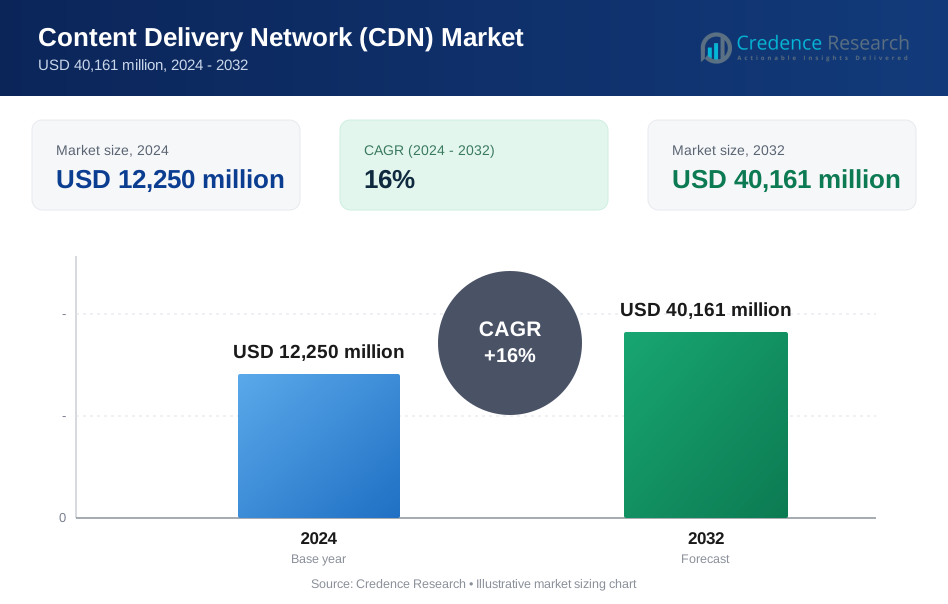
The Content Delivery Network (CDN) Market is projected to grow from USD 12,250 million in 2024 to USD 40,161 million by 2032, at a compound annual growth rate (CAGR) of 16%.
| REPORT ATTRIBUTE | DETAILS |
|---|---|
| Historical Period | 2020-2023 |
| Base Year | 2024 |
| Forecast Period | 2025-2032 |
| Content Delivery Network (CDN) Market Size 2024 | USD 12,250 Million |
| Content Delivery Network (CDN) Market, CAGR | 16% |
| Content Delivery Network (CDN) Market Size 2032 | USD 40,161 Million |
The Content Delivery Network (CDN) market is driven by the increasing demand for high-quality video content, rapid expansion of OTT platforms, and rising adoption of cloud-based services. The proliferation of online gaming, e-commerce, and live-streaming services also contributes to market growth, as businesses strive to deliver seamless user experiences with low latency and faster content delivery. Additionally, the growing importance of cybersecurity and data privacy has led to advancements in CDN security features, further fueling demand.
Key trends include the integration of AI and machine learning for traffic management, the rise of edge computing for improved content caching, and the increasing adoption of multi-CDN strategies to enhance performance and resilience. As internet penetration expands globally, the CDN market is poised for significant growth, particularly in emerging markets where mobile connectivity is surging. These factors position CDNs as essential infrastructure for supporting the next wave of digital content delivery and user engagement.
The Content Delivery Network (CDN) market is geographically diverse, with key regions including North America, Europe, Asia-Pacific, Latin America, and the Middle East and Africa. North America holds the largest market share, driven by high internet penetration and the presence of major CDN providers such as Akamai Technologies, Amazon Web Services, and Cloudflare. Europe follows closely, with strong demand in markets like the UK, Germany, and France.
Asia-Pacific is experiencing rapid growth, particularly in China, India, and Japan, driven by increasing internet users and online streaming. Latin America and the Middle East and Africa are emerging markets, with growing digital adoption and investments in improving connectivity. Key players like Fastly, Limelight Networks (Edgio), Tata Communications, and CDNetworks continue to expand their reach and capabilities across these regions.
Content Delivery Network Market Insights
- The Content Delivery Network (CDN) market is projected to grow from USD 12,250 million in 2024 to USD 40,161 million by 2032, at a CAGR of 16%.
- Increasing demand for high-quality video content and rapid expansion of OTT platforms are major growth drivers.
- Rising adoption of cloud-based services, online gaming, and e-commerce boosts the need for fast and seamless content delivery.
- Advancements in cybersecurity and data privacy are driving demand for CDN solutions with enhanced security features.
- Key trends include the integration of AI and machine learning for traffic management and the rise of edge computing for better content caching.
- Emerging markets, especially in Asia-Pacific, are seeing strong CDN growth due to expanding internet penetration and mobile connectivity.
- Major players in the market include Akamai Technologies, Amazon Web Services, Cloudflare, Fastly, and Tata Communications, leveraging global reach and performance optimization.
Content Delivery Network Market Drivers
Increasing Demand for High-Quality Video Content
One of the primary drivers of the Content Delivery Network market is the growing demand for high-quality video content, as streaming services, online video platforms, and OTT media push users to expect seamless playback without interruptions. For instance, Ericsson reported total monthly global mobile network data traffic reached 145 EB by Q1 2024 and noted that video traffic accounted for 73 percent of all mobile data traffic at the end of 2023, underscoring how video at scale stresses delivery performance and last-mile stability. The rise of 4K and 8K video resolutions, VR, and AR content further increases payload sizes and sensitivity to jitter, and Ericsson’s report explicitly factors in XR-type services including AR, VR, and mixed reality as a driver that could push traffic higher than current outlooks if adoption accelerates.
Expansion of Online Gaming and E-commerce
The rapid expansion of the online gaming and e-commerce sectors is another significant driver of the CDN market because both depend on globally consistent responsiveness and low-latency delivery. For instance, Sony reported an engaged PlayStation ecosystem with 97 million monthly active consoles and 3.8 billion total gameplay hours as of April 30, 2024, illustrating the scale of real-time, interaction-heavy traffic where small delivery delays can degrade user experience. Similarly, Amazon reported 2024 net sales of 637.959 billion and online stores net sales of 75.556 billion in Q4 2024 alone, reinforcing why large e-commerce platforms invest heavily in faster, more reliable content and application delivery across regions.
Adoption of Cloud-Based Services and Applications
The increasing adoption of cloud-based services, SaaS applications, and IoT solutions has led to a surge in demand for content delivery networks as enterprises distribute applications and data to users across geographies. For instance, Amazon reported AWS net sales of 107.556 billion in 2024, reflecting the scale at which cloud workloads must be delivered with low latency and high availability to support application performance and distributed workforces. As businesses continue to embrace digital transformation, CDNs become essential performance infrastructure that complements hyperscale cloud by bringing content, APIs, and security controls closer to end users.
Emphasis on Cybersecurity and Data Privacy
Growing concerns about cybersecurity and data privacy have further driven demand for CDN solutions with enhanced security features such as encryption, DDoS protection, and stronger request validation at the edge. For instance, Cloudflare reported mitigating 8.5 million DDoS attacks in the first half of 2024 and blocking 10.2 trillion HTTP DDoS requests plus 57 petabytes of network-layer DDoS traffic from reaching customer origin infrastructure, showing how threat volumes increasingly require always-on, automated, edge-based defenses. Cloudflare also highlighted that Gaming and Gambling saw the most attacks by HTTP DDoS request volume in Q2 2024, reinforcing security as a core differentiator for CDNs serving latency-sensitive digital services.
Content Delivery Network Market Trends
Integration of AI and Machine Learning
A significant trend in the Content Delivery Network market is the growing use of artificial intelligence and machine learning to improve decisioning across delivery and security, including automating detection and response and using traffic intelligence to reduce performance bottlenecks. For instance, Akamai states it provides cybersecurity solutions powered by AI and automation and also uses generative AI to speed identification and investigation of malicious or suspect activity, supported by a massively distributed network with more than 4,300 edge points of presence across over 700 cities and roughly 1,200 network partners that increases visibility into congestion and attack patterns. By applying these AI capabilities closer to users, CDNs can react faster to changing conditions and help sustain smoother delivery of content and applications in real time.
Adoption of Edge Computing
The rise of edge computing is another key trend shaping the CDN market as businesses push compute and logic closer to end users to reduce round-trip time and improve consistency for dynamic workloads. For instance, Amazon CloudFront reports 750+ points of presence in 100+ cities across 50+ countries, plus 1,140+ embedded points of presence across 300+ cities, and notes CloudFront Functions run at all edge locations and typically add under one millisecond latency while scaling instantly to millions of requests per second for lightweight operations such as header manipulation and redirects. This shift extends CDNs beyond caching into distributed execution, enabling personalization, security checks, and application acceleration at the edge rather than backhauling every request to centralized regions.
Increasing Focus on Multi-CDN Strategies
Organizations are increasingly adopting multi-CDN strategies to improve performance and resilience by routing users across separately administered delivery networks when conditions change. For instance, the IETF CDNI work describes an industry need to interconnect standalone CDNs so they can collectively behave as a single delivery infrastructure that supports end-to-end delivery through multiple CDNs to end users, and a measurement study documented Netflix using three CDNs for distribution in the US at the time of analysis, illustrating how large platforms can diversify delivery paths. As multi-CDN adoption grows, routing, observability, and policy control become more critical so traffic can be shifted quickly during localized degradation or outages without breaking user experience.
Growing Importance of CDN Security Features
As cyber threats continue to evolve, CDN providers are strengthening security features such as encryption, DDoS mitigation, and edge-based access control to protect data and services while maintaining performance. For instance, Cloudflare reported mitigating 8.5 million DDoS attacks in the first half of 2024 and blocking 10.2 trillion HTTP DDoS requests, showing why always-on edge defenses are increasingly treated as a core CDN requirement rather than an add-on. In parallel, major CDN platforms continue to standardize secure delivery at the edge, including TLS 1.3 support for HTTPS delivery and layered integration with DDoS and web application protections at the edge.
Content Delivery Network Market Challenges Analysis
High Infrastructure Costs and Operational Complexity
The Content Delivery Network (CDN) market faces significant challenges related to the high costs of infrastructure deployment and maintenance. Establishing a global CDN requires substantial investments in hardware, software, and networking equipment to ensure reliable and efficient content delivery across geographically dispersed regions. This financial burden is particularly challenging for smaller players and new entrants, who struggle to compete with larger, established providers that have already built extensive networks. Additionally, ongoing operational costs related to maintaining, upgrading, and scaling these networks can be substantial, especially as internet traffic and user demand continue to grow. Managing this complexity while maintaining optimal performance, particularly in emerging markets with limited infrastructure, adds another layer of difficulty for CDN providers seeking to expand their reach.
Intense Competition and Rising Security Threats
Intense competition in the CDN market is another major challenge, as an increasing number of providers, including telecom companies, cloud service providers, and content platforms, are entering the space. These new entrants often leverage their existing infrastructure and customer bases to provide CDN services, driving down prices and pressuring margins for all players. The widespread adoption of multi-CDN strategies by businesses, which allows them to switch between providers for better performance and redundancy, further complicates customer retention efforts. In addition, CDN providers must navigate an ever-evolving cybersecurity landscape. As cyberattacks, such as Distributed Denial of Service (DDoS) attacks, become more frequent and sophisticated, CDNs must invest heavily in security measures, including encryption, authentication, and network monitoring. Failing to meet these security challenges could result in data breaches, loss of customer trust, and damage to brand reputation, all of which could have long-term consequences in this competitive market. Balancing the need for innovation, security, and cost-efficiency remains a constant challenge for CDN providers seeking to maintain their competitive edge.
Content Delivery Network Market Opportunities
The Content Delivery Network (CDN) market presents significant opportunities as the demand for digital content continues to surge globally. The rapid expansion of streaming services, e-learning platforms, and online gaming offers immense potential for CDN providers to enhance content delivery performance across diverse industries. As more businesses transition to cloud-based services and remote operations, CDNs play a critical role in ensuring seamless access to applications and data. Emerging markets, particularly in Asia-Pacific, Latin America, and Africa, provide substantial growth prospects, where increased internet penetration and mobile usage are driving the need for faster, more reliable content delivery infrastructure.
Furthermore, the integration of advanced technologies such as artificial intelligence (AI), machine learning (ML), and edge computing presents additional opportunities for CDN providers to differentiate themselves. These technologies enable optimized traffic management, predictive analytics, and enhanced security, which are becoming crucial as data volumes increase and cyber threats evolve. The growing emphasis on low-latency connections for real-time applications, such as IoT, AR/VR, and live-streaming services, also opens new avenues for innovation and market expansion. By offering value-added services and focusing on cybersecurity and performance enhancements, CDN providers can capitalize on the increasing reliance on digital content and distributed networks in today’s fast-evolving digital landscape.
Content Delivery Network Market Segmentation Analysis:
By Type
The Content Delivery Network (CDN) market is segmented by type into traditional CDNs and cloud CDNs. Traditional CDNs are designed to deliver static and dynamic content using geographically distributed servers. However, cloud CDNs are gaining momentum due to their scalability, flexibility, and cost-effectiveness, particularly for businesses adopting cloud-based services and applications.
By Solution
In terms of solutions, the CDN market includes content acceleration, security solutions, and network optimization services. Content acceleration solutions focus on reducing latency and improving the speed of content delivery, while security solutions such as DDoS protection and encryption safeguard data. Network optimization services ensure efficient traffic management, reducing congestion and enhancing performance.
By Application
The CDN market serves various applications, including media and entertainment, online gaming, e-commerce, and healthcare. Media and entertainment lead in market share due to the growing demand for high-quality streaming, while online gaming and e-commerce are rapidly expanding segments, driven by the need for seamless, real-time user experiences.
Segments:
Based on Type
- Standard Content Delivery Network Market
- Video Content Delivery Network Market
Based on solution
- Media Delivery
- Web Performance Optimization
- Cloud Security
Based on Application
- OTT Streaming
- Network Optimization
- Website & API Management
- Analytics & Performance Monitoring
Based on the Geography:
- North America
- U.S.
- Canada
- Mexico
- Europe
- Germany
- France
- U.K.
- Italy
- Spain
- Rest of Europe
- Asia Pacific
- China
- Japan
- India
- South Korea
- South-east Asia
- Rest of Asia Pacific
- Latin America
- Brazil
- Argentina
- Rest of Latin America
- Middle East & Africa
- GCC Countries
- South Africa
- Rest of the Middle East and Africa
Regional Analysis
North America
North America is expected to dominate the Content Delivery Network (CDN) market, holding the largest market share in 2024, accounting for 35%. The region’s advanced infrastructure, high internet penetration, and the presence of major CDN providers like Akamai, Amazon Web Services (AWS), and Cloudflare contribute to its market leadership. The growing demand for OTT platforms, cloud-based services, and high-definition video content has fueled the adoption of CDN solutions in the United States and Canada. Additionally, the rapid growth of the e-commerce sector and increasing cybersecurity concerns are driving demand for CDN services in this region.
Europe
Europe is projected to hold a significant share of the CDN market in 2024, with an estimated market share of 25%. The region's mature digital ecosystem, coupled with stringent data privacy regulations such as GDPR, has led to increased demand for secure and efficient content delivery solutions. Key markets like the United Kingdom, Germany, and France are experiencing high demand for CDN services due to the expansion of media and entertainment platforms, online gaming, and digital advertising. The growing popularity of OTT streaming services, particularly in Western Europe, has further boosted the need for CDNs to ensure smooth content delivery and enhanced user experiences.
Asia-Pacific
The Asia-Pacific region is anticipated to witness the fastest growth in the CDN market, capturing 20% of the market share in 2024. The region’s rapid internet penetration, expanding mobile connectivity, and increasing consumption of digital content are key drivers of CDN adoption. Countries such as China, India, and Japan are leading the market, driven by the surge in online streaming, e-learning, and e-commerce platforms. The rising demand for low-latency connections and faster content delivery in these highly populous markets offers significant growth opportunities for CDN providers. Moreover, the region’s growing gaming industry and increasing use of cloud services contribute to the expanding CDN market.
Latin America
Latin America is expected to hold a smaller but growing share of the CDN market, with an estimated market share of 10% in 2024. The region is seeing increasing adoption of digital content delivery platforms, particularly in Brazil, Mexico, and Argentina, driven by the rising popularity of OTT services and online gaming. Although the region’s digital infrastructure is still developing, investments in improving internet connectivity and data centers are likely to support the expansion of CDN services. Latin America’s growing e-commerce industry and the increasing demand for mobile content also contribute to the region’s CDN market growth.
Middle East and Africa
The Middle East and Africa are expected to account for 10% of the CDN market share in 2024. This region is experiencing steady growth due to the rising use of digital platforms and content streaming services, particularly in the United Arab Emirates, Saudi Arabia, and South Africa. The expansion of broadband connectivity and mobile networks in this region, combined with the increasing demand for secure and efficient content delivery solutions, is driving the adoption of CDN services. Additionally, the rise of online gaming, e-commerce, and media consumption is creating new opportunities for CDN providers in the region.
Key Player Analysis
- Fastly, Inc. (U.S.)
- Google LLC. (U.S.)
- Cloudflare, Inc. (U.S.)
- Limelight Networks Inc. (Edgio) (U.S.)
- Tata Communications (India)
- Amazon Web Services, Inc. (U.S.)
- Imperva (Thales Group) (U.S.)
- CDNetworks Co. Ltd. (Singapore)
- Medianova, LLC (U.S.)
- Akamai Technologies (U.S.)
Competitive Analysis
The Content Delivery Network (CDN) market is highly competitive, with key players such as Akamai Technologies, Amazon Web Services, Inc., Fastly, Inc., Limelight Networks Inc. (Edgio), Google LLC, CDNetworks Co. Ltd., Cloudflare, Inc., Tata Communications, Medianova, LLC, and Imperva (Thales Group) dominating the landscape. These companies compete on factors such as network performance, global reach, security features, and value-added services. Akamai and Amazon Web Services lead with extensive global infrastructure and a broad service portfolio, while Cloudflare and Fastly are known for their cutting-edge security and performance optimization. For instance, Limelight Networks (Edgio) and Tata Communications focus on providing high-performance solutions tailored to media and gaming sector. CDNetworks and Medianova emphasize regional strength, while Imperva excels in offering robust security-focused CDN solutions. The competition is driven by innovation, with players constantly enhancing their offerings to meet the growing demand for faster, more secure content delivery.
Recent Developments in Content Delivery Network
- In November 2025, AWS announced three new CloudFront Functions capabilities (edge/REC metadata, raw query string retrieval, and advanced origin overrides) to enable more sophisticated edge logic and control over origin connections.
- In November 2025, Cloudflare announced it agreed to acquire Replicate to make it easier for developers to deploy and run AI models on Cloudflare’s platform.
- In June 2025, AWS announced a simplified Amazon CloudFront console experience that automates setup steps like TLS certificate provisioning, DNS configuration, and security settings (integrated with AWS WAF rule packs).
Market Concentration & Characteristics
The Content Delivery Network (CDN) market exhibits a moderate to high level of market concentration, with a few leading players, such as Akamai Technologies, Amazon Web Services, Cloudflare, and Fastly, dominating the landscape. These companies possess extensive global networks and advanced infrastructure, giving them a competitive advantage in terms of performance, scalability, and security. The market is characterized by rapid innovation, with providers continually enhancing their offerings through advanced technologies like edge computing, AI-driven traffic management, and multi-CDN strategies. Smaller players and new entrants face challenges in competing with established giants due to the high capital investment required for network expansion and maintenance. Despite this, the market remains dynamic, driven by the increasing demand for seamless content delivery, low-latency performance, and enhanced security. The growing adoption of cloud services and the proliferation of digital content across industries ensure continued opportunities for both large and niche CDN providers.
Content Delivery Network Market Report Coverage
The research report offers an in-depth analysis based on Type, Solution, Application and Geography. It details leading market players, providing an overview of their business, product offerings, investments, revenue streams, and key applications. Additionally, the report includes insights into the competitive environment, SWOT analysis, current market trends, as well as the primary drivers and constraints. Furthermore, it discusses various factors that have driven market expansion in recent years. The report also explores market dynamics, regulatory scenarios, and technological advancements that are shaping the industry. It assesses the impact of external factors and global economic changes on market growth. Lastly, it provides strategic recommendations for new entrants and established companies to navigate the complexities of the market.
Future Outlook
- The CDN market is expected to grow significantly, driven by the rising demand for high-quality streaming content.
- Increasing adoption of cloud-based applications will further boost CDN demand across industries.
- Emerging technologies like AI and machine learning will enhance traffic management and network efficiency in CDNs.
- Edge computing will play a key role in improving content delivery by reducing latency and enhancing user experiences.
- The growing importance of cybersecurity will lead to more investments in secure CDN solutions to protect data.
- Multi-CDN strategies will become more prevalent, allowing businesses to improve performance and resilience.
- The Asia-Pacific region is expected to witness the fastest growth in the CDN market, fueled by expanding internet usage.
- Continued growth in online gaming and e-commerce will drive demand for faster, low-latency content delivery.
- As global internet penetration increases, CDNs will expand into emerging markets, especially in Latin America and Africa.
- Collaboration between CDN providers and telecom companies will accelerate network expansion and global reach.
Request a Free Sample
Fill in your details and we'll send you a free sample report.
- Sample data tables & charts
- Research methodology
Need a Custom Version of This Report?
Tailor the scope, geography, or segments to your exact requirements.
- Custom geography or segment scope
- Direct access to our analyst team
Frequently Asked Questions
What is the current size of the Content Delivery Network Market?
What factors are driving the growth of the Content Delivery Network Market?
What are the key segments within the Content Delivery Network Market?
What are some challenges faced by the Content Delivery Network Market?
Who are the major players in the Content Delivery Network Market?
Table of Content
Chapter 1. Report Introduction
- 1.1 Report Description & Purpose
- 1.1.1 Report Title & Market Definition
- 1.1.2 Unique Selling Propositions (USP) & Key Differentiators
- 1.1.3 Value Proposition for Stakeholders
- 1.2 Research Objectives
- 1.2.1 Market Sizing Objectives (Volume & Revenue)
- 1.2.2 Segmentation Objectives
- 1.2.3 Competitive Intelligence Objectives
- 1.2.4 Forecast & Scenario Objectives
- 1.3 Report Scope
- 1.3.1 Content Delivery Network (CDN) Scope – Types & Subtypes Covered
- 1.3.2 Geographic Scope – Regions & Countries Covered
- 1.3.3 Historical Period, Base Year & Forecast Period (2024; forecast to 2032)
- 1.3.4 Inclusions & Exclusions
- 1.4 HS Code & Classification Framework
- 1.5 Currency, Units & Pricing Basis
- 1.6 Target Stakeholders
- 1.7 Limitations & Assumptions
Chapter 2. Executive Summary
- 2.1 Global Content Delivery Network (CDN) Market Snapshot
- 2.1.1 Market Size – Historical (2024) & Forecast (2024-2032) (2024: USD 12,250 million → 2032: USD 40,161 million)
- 2.1.2 Volume & Revenue – Global Totals
- 2.1.3 Key Market Highlights – Top Five Facts
- 2.2 Content Delivery Network (CDN) Market Segmentation Snapshot
- 2.2.1 Market Split by Region – 2024 vs. 2032
- 2.3 Competitive Snapshot
- 2.3.1 Top 10 Players by Revenue Share – 2024
- 2.3.2 Top 10 Players by Volume Share – 2024
- 2.3.3 Recent Strategic Developments (18-Month Summary)
- 2.4 Key Investment Highlights & Strategic Conclusions
Chapter 3. Content Delivery Network (CDN) Market Dynamics & Industry Analysis
- 3.1 Market Overview & Context
- 3.1.1 Content Delivery Network (CDN) Market Position in the Broader Automotive Value Chain
- 3.1.2 OEM vs. Replacement Market Dynamics
- 3.1.3 Market Maturity & Development Stage by Region
- 3.2 Content Delivery Network (CDN) Market Drivers
- 3.3 Content Delivery Network (CDN) Market Restraints & Challenges
- 3.4 Content Delivery Network (CDN) Market Opportunities
- 3.5 Porter's Five Forces Analysis
- 3.5.1 Threat of New Entrants
- 3.5.2 Bargaining Power of Suppliers
- 3.5.3 Bargaining Power of Buyers
- 3.5.4 Threat of Substitutes
- 3.5.5 Competitive Rivalry – Intensity Assessment
- 3.6 Content Delivery Network (CDN) Value Chain Analysis
- 3.6.1 Upstream – Raw Material/Input Suppliers
- 3.6.1.1 Raw Material/Input 1
- 3.6.1.2 Raw Material/Input 2
- 3.6.1.3 Raw Material/Input 3
- 3.6.2 Midstream – Production/Manufacturing/Service Delivery
- 3.6.2.1 Production/Process Overview
- 3.6.2.2 Key Facility Locations & Capacity by Manufacturer
- 3.6.3 Downstream – Distribution & End Consumer
- 3.6.3.1 Primary Channel – B2B/OEM
- 3.6.3.2 Secondary Channels – Dealer, Retail, Online, Direct
- 3.6.4 Value Chain Profitability Analysis
- 3.6.1 Upstream – Raw Material/Input Suppliers
- 3.7 PESTEL Analysis
- 3.7.1 Political Factors
- 3.7.2 Economic Factors
- 3.7.3 Social Factors
- 3.7.4 Technological Factors
- 3.7.5 Environmental Factors
- 3.7.6 Legal Factors
- 3.8 Content Delivery Network (CDN) Supply Chain Analysis
- 3.8.1 Raw Material/Input Supply Risk Assessment
- 3.8.2 Manufacturing Concentration Risk (Geographic Exposure)
- 3.8.3 Trade Disruption Impact Analysis
- 3.9 Regulatory & Policy Landscape
Note: The regulatory and policy landscape section covers regulations based on their applicability to the market, Content Delivery Network (CDN) category, geography, and scope of the study. Only regulatory frameworks with a material impact on operations, compliance, trade, sustainability, or market access are analyzed in detail.
Chapter 4. Key Investment Pockets & Opportunity Analysis
- 4.1 Content Delivery Network (CDN) Market Attractiveness Analysis
- 4.1.1 By Region – Investment Attractiveness Matrix (Volume × CAGR)
- 4.2 Absolute Revenue Growth Opportunity
- 4.2.1 By Region – Absolute USD Growth Through 2032
- 4.3 Incremental Volume Opportunity
- 4.3.1 By Region – Incremental Volume Through 2032
- 4.3.2 Segment – Incremental Volume
- 4.4 Emerging Submarket Opportunity Deep Dive (Subject to Applicability)
- 4.5 Emerging Market Opportunity Scorecards
- 4.5.1 United States
- 4.5.2 Europe
- 4.5.3 Asia
- 4.5.4 Middle East & Africa
Note: Emerging Market Opportunity Scorecards will be included based on relevance and strategic importance. Regions listed are indicative and may vary depending on data availability and market dynamics.
Chapter 5. Content Delivery Network (CDN) Import-Export Analysis & Trade Flows
- 5.1 Global Trade Overview
- 5.1.1 Global Export Value by Country (2024)
- 5.1.2 Global Export Volume by Country (2024)
- 5.1.3 Global Import Value by Country (2024)
- 5.1.4 Global Import Volume by Country (2024)
- 5.1.5 Net Trade Balance by Country (2024)
- 5.2 Export Analysis – Segment
- 5.2.1 Type 1 (HS Code)
- 5.2.2 Type 2 (HS Code)
- 5.2.3 Type 3 (HS Code)
- 5.2.4 Type 4 (HS Code)
- 5.2.5 Type 5 (HS Code)
- 5.3 Import Analysis – Segment
- 5.3.1 Type 1 (HS Code)
- 5.3.2 Type 2 (HS Code)
- 5.3.3 Type 3 (HS Code)
- 5.3.4 Type 4 (HS Code)
- 5.3.5 Type 5 (HS Code)
- 5.4 Average Unit Trade Prices
- 5.4.1 Average Export Price – Segment & Country
- 5.4.2 Average Import Price – Segment & Source Country
- 5.4.3 Price Trends (2024)
- 5.5 Key Trade Route Analysis
- 5.5.1 Trade Route 1
- 5.5.2 Trade Route 2
- 5.5.3 Trade Route 3
- 5.5.4 Trade Route 4
- 5.5.5 Trade Route 5
- 5.6 Trade Policy Impact Assessment
- 5.6.1 US Anti-Dumping & Section 301 Tariffs
- 5.6.2 EU Customs Union Impact
- 5.6.3 Major Free Trade Agreements
- 5.6.4 USMCA Rules of Origin
Note: Trade policy analysis will be included only where relevant to the Content Delivery Network (CDN) market.
Chapter 6. Competitive Landscape & Company Benchmarking
- 6.1 Content Delivery Network (CDN) Market Concentration & Structure
- 6.1.1 Herfindahl-Hirschman Index (HHI) – vs. 2024
- 6.1.2 Tier 1, Tier 2 & Tier 3 Market Structure
- 6.1.3 Global, Regional & Local Player Dynamics
- 6.2 Content Delivery Network (CDN) Market Share Analysis – 2024
- 6.2.1 Global Revenue Share by Company
- 6.2.2 Global Volume Share by Company
- 6.2.3 Regional Revenue Share
- 6.2.4 Market Share Evolution ( vs. 2024)
- 6.2.5 OEM Segment Share by Company
- 6.2.6 Replacement Segment Share by Company
- 6.3 Production/Delivery Capacity & Facility Analysis
- 6.3.1 Global Installed Capacity
- 6.3.2 Capacity Utilization Rates
- 6.3.3 Production/Output Volume
- 6.3.4 Facility Locations & Capacity Map
- 6.3.5 Planned Capacity Additions
- 6.4 Content Delivery Network (CDN) Competitive Benchmarking Matrix
- 6.4.1 Revenue, Volume, CAGR & Profitability Comparison
- 6.4.2 Channel Revenue Mix
- 6.4.3 Geographic Revenue Exposure
- 6.4.4 R&D Intensity
- 6.4.5 Sustainability Maturity
- 6.5 Strategic Developments in Content Delivery Network (CDN) (Last 24 Months)
- 6.5.1 Mergers, Acquisitions & Divestments
- 6.5.2 New Content Delivery Network (CDN) Launches
- 6.5.3 Facility Expansions
- 6.5.4 Strategic Alliances, Joint Ventures & Partnerships
- 6.5.5 Distribution Expansion & Market Entry
- 6.5.6 Sustainability & ESG Initiatives
- 6.6 Competitive Strategy Mapping
- 6.6.1 Leader, Challenger, Follower & Niche Classification
- 6.6.2 Pricing Strategy Comparison
- 6.6.3 Channel Strategy Matrix
Note: Strategic developments are included based on their materiality and the availability of reliable information.
Chapter 7. Global Content Delivery Network (CDN) Market – By Distribution Channel
- 7.1 Segment Overview
- 7.1.1 Volume & Revenue Split by Channel (2024 & 2032)
- 7.1.2 Channel Mix Evolution (2024-2032)
Chapter 8. Regional Market Analysis – Global Overview
- 8.1 Global Regional Overview
- 8.1.1 Regional Volume Share
- 8.1.2 Regional Revenue Share
- 8.1.3 Regional Volume by Region
- 8.1.4 Regional Revenue by Region
- 8.1.5 Regional Forecast Through 2032
- 8.2 Cross-Regional Segment Analysis
- 8.2.1 By Distribution Channel
- 8.2.2 By Brand/Price Tier
Chapter 9. North America Content Delivery Network (CDN) Market
- 9.1 United States
- 9.2 Canada
- 9.3 Mexico
Chapter 10. Europe Content Delivery Network (CDN) Market
- 10.1 Germany
- 10.2 France
- 10.3 Italy
- 10.4 United Kingdom
- 10.5 Spain
- 10.6 Poland
- 10.7 Russia
- 10.8 Netherlands
- 10.9 Belgium
- 10.10 Sweden
- 10.11 Denmark
- 10.12 Norway
- 10.13 Rest of Europe
Chapter 11. Asia Pacific Content Delivery Network (CDN) Market
- 11.1 China
- 11.2 India
- 11.3 Japan
- 11.4 South Korea
- 11.5 Thailand
- 11.6 Indonesia
- 11.7 Vietnam
- 11.8 Malaysia
- 11.9 Australia
- 11.10 Rest of Asia Pacific
Chapter 12. Latin America Content Delivery Network (CDN) Market
- 12.1 Brazil
- 12.2 Argentina
- 12.3 Colombia
- 12.4 Chile
- 12.5 Rest of Latin America
Chapter 13. Middle East Content Delivery Network (CDN) Market
- 13.1 Saudi Arabia
- 13.2 United Arab Emirates
- 13.3 Turkey
- 13.4 Israel
- 13.5 Iran
- 13.6 Rest of the Middle East
Chapter 14. Africa Content Delivery Network (CDN) Market
- 14.1 South Africa
- 14.2 Egypt
- 14.3 Nigeria
- 14.4 Morocco
- 14.5 Rest of Africa
Chapter 15. Content Delivery Network (CDN) Company Profiles
- 15.1 [Company 01]
- 15.1.1 Company Overview
- 15.1.2 Key Management Personnel
- 15.1.3 Products & Services Portfolio
- 15.1.4 Financial Performance
- 15.1.5 Key Market Focus & Geographic Presence
- 15.1.6 Recent Developments & Strategic Initiatives
Note: The company profile list is preliminary and may change based on research findings, market developments, data availability, and client requirements.
Chapter 16. Appendices
- Appendix A – List of Abbreviations & Acronyms
- Appendix B – Industry Classification Code Reference – Full Series
- Appendix C – Production & Capacity Data Tables
- Appendix D – End-Use & Demand Base Tables
- Appendix E – Consumption & Replacement Rate Assumptions
- Appendix F – ASP Reference Tables
- Appendix G – Manufacturing & Facility Database
- Appendix H – Import-Export Data Tables
- Appendix I – Regulatory Summary Tables
- Appendix J – Primary Research Participant List (Anonymized)
- Appendix K – Primary Research Questionnaire Framework
- Appendix L – Data Sources & Bibliography
- Appendix M – Market Size Divergence & Source Comparison
Chapter 17. Research Methodology
- 17.1 Research Framework & Philosophy
- 17.2 Secondary Research – Sources, Hierarchy & Data Extraction
- 17.3 Data Modeling – Bottom-Up & Top-Down Market Sizing
- 17.4 Primary Research – Stakeholder Framework, LOI & Sample Sizes
- 17.5 Forecast Methodology – Regression, Scenario & Sensitivity Analysis
- 17.6 Quality Control – Four-Layer Validation Framework
- 17.7 Limitations & Standard Assumptions
- 17.8 Disclaimer
