
Cranial And Facial Implants Market Overview:
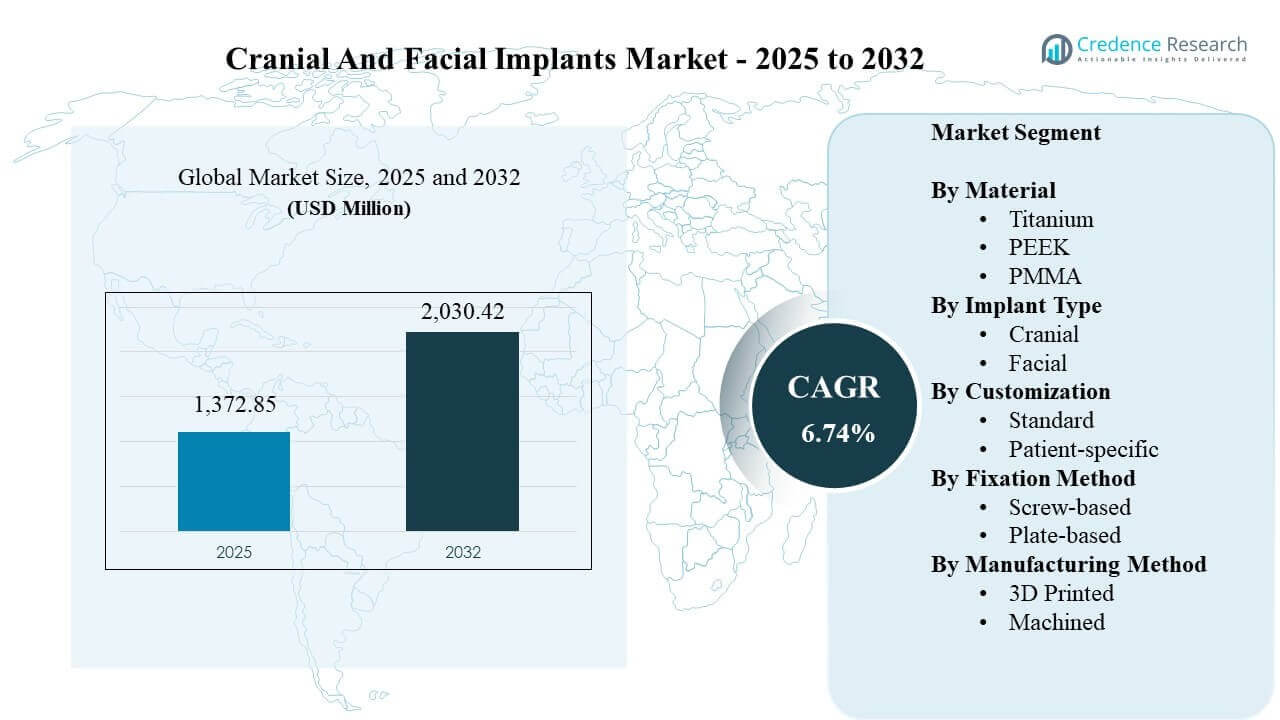
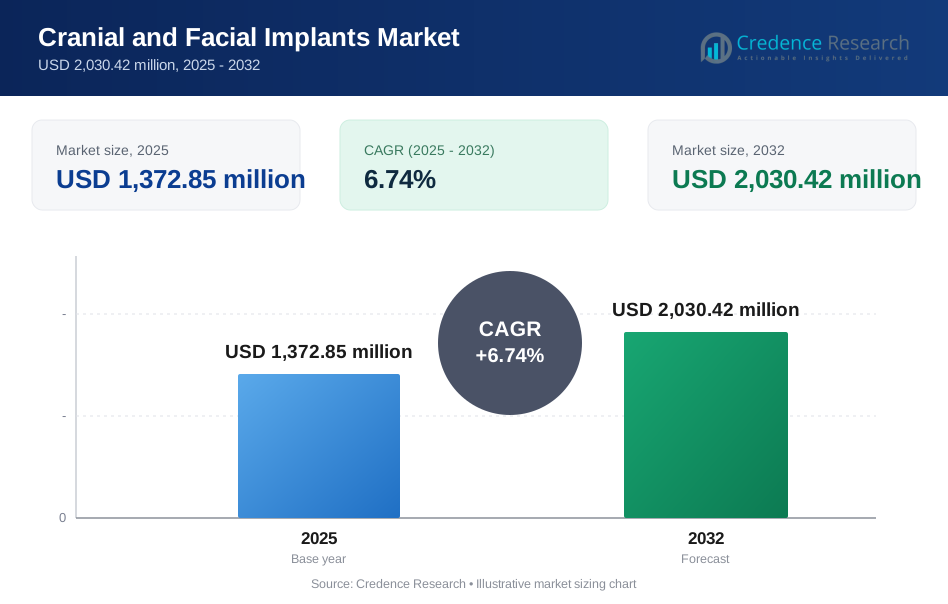
The global Cranial And Facial Implants Market size was estimated at USD 1,372.85 million in 2025 and is expected to reach USD 2,030.42 million by 2032, growing at a CAGR of 6.74% from 2025 to 2032. Demand is being reinforced by a rising volume of neurosurgical and cranio-maxillofacial reconstructions where clinicians prefer anatomically matched solutions that improve fit, stability, and cosmetic outcomes. Wider availability of preoperative CT-based planning, virtual surgical planning, and streamlined manufacturing workflows is improving case readiness for hospitals and shortening lead times for complex defect coverage across major care settings.
| REPORT ATTRIBUTE | DETAILS |
|---|---|
| Historical Period | 2020-2024 |
| Base Year | 2025 |
| Forecast Period | 2026-2032 |
| Cranial And Facial Implants Market Size 2025 | USD 1,372.85 million |
| Cranial And Facial Implants Market, CAGR | 6.74% |
| Cranial And Facial Implants Market Size 2032 | USD 2,030.42 million |
Key Market Trends & Insights
- The Cranial And Facial Implants Market is projected to reach USD 2,030.42 million by 2032, indicating sustained expansion of reconstructive casework and technology-enabled planning.
- The market is expected to grow at a 74% CAGR (2025–2032), supported by improving access to advanced surgery and broader use of digitally enabled workflows.
- North America accounted for 4% share in 2025, supported by established surgical infrastructure and higher adoption of premium reconstruction solutions.
- Patient-specific implants represented 6% share in 2025, reflecting strong surgeon preference for anatomically matched cranial and facial reconstruction.
- Polymer materials (PEEK/PMMA group) held 4% share in 2025, aided by imaging compatibility and lightweight characteristics for complex reconstructions.
Segment Analysis
The Cranial And Facial Implants Market is shaped by clinician preference for predictable reconstruction outcomes, which continues to shift purchasing toward digitally planned, anatomically optimized implants. Hospitals and specialty centers increasingly favor solutions that reduce intraoperative modification, lower revision risk, and support standardized fixation workflows across trauma, oncology, and congenital reconstruction pathways. As procedural complexity rises, product selection is influenced by implant fit, ease of placement, and compatibility with established instrumentation ecosystems.
Adoption is also supported by improvements in imaging, virtual surgical planning, and manufacturing scalability, enabling more reliable turnaround for high-precision implants. Patient-specific workflows strengthen clinical confidence in complex defect cases and elevate the importance of vendor capabilities in design iteration, quality assurance, and logistics. Over time, competitive differentiation is expected to concentrate around customization speed, material performance, and surgeon support across cranial and facial applications.
By Material Insights
PEEK/PMMA polymer group accounted for the largest share of 52.4% in 2025. Polymer implants benefit from favorable imaging characteristics and are often preferred when postoperative assessment requires clearer visualization. Lightweight design and machinability help manufacturers create intricate contours for cranial defects and midface reconstruction. Material selection also reflects the increasing use of digitally designed implants that prioritize precise anatomical conformity and stable fixation.
By Implant Type Insights
Cranial and facial implants are both supported by expanding reconstructive procedure volumes, though adoption patterns differ by clinical pathway and defect type. Cranial reconstruction demand is reinforced by trauma, tumor resections, and decompressive procedures that require reliable defect coverage. Facial reconstruction is supported by cranio-maxillofacial trauma management, revision surgeries, and functional and aesthetic restoration needs. Product selection is increasingly influenced by surgeon familiarity with vendor systems and the availability of planning support for complex anatomies.
By Customization Insights
Patient-specific implants accounted for the largest share of 85.6% in 2025. Customized designs improve anatomical fit and aesthetic outcomes, which is critical for irregular cranial defects and facial symmetry restoration. Digital planning reduces intraoperative bending and cutting, supporting faster case execution and more predictable implant seating. The segment also benefits from broader acceptance of CAD/CAM workflows and growing confidence in preoperative simulation for complex reconstructions.
By Fixation Method Insights
Fixation choices are typically guided by defect location, surgical approach, and surgeon preference, with screw-based and plate-based methods both remaining important in routine and complex reconstructions. Screw-based fixation is often favored where direct stabilization and simplified placement are priorities. Plate-based fixation continues to serve a broad range of cranio-maxillofacial trauma pathways and supports standardized instrument compatibility. As patient-specific implants expand, integrated fixation concepts that reduce intraoperative adjustments are becoming more relevant to procurement decisions.
By Manufacturing Method Insights
3D printing and machining both remain central to supply, with selection driven by implant complexity, lead time, and manufacturing scale. 3D printing supports complex geometries and highly customized contours, making it well suited to patient-specific cranial and facial reconstructions. Machined implants remain relevant for standardized designs and for programs prioritizing consistent cost and established validation pathways. Increasing digitization in surgical planning is expected to raise demand for manufacturing methods that can deliver consistent precision at clinically acceptable turnaround times.
Cranial And Facial Implants Market Drivers
Rising volume of reconstructive neurosurgery and cranio-maxillofacial trauma care
Growth in trauma care, tumor resections, and congenital defect corrections continues to lift procedural demand for cranial and facial reconstruction. Hospitals are treating more complex cases that require durable defect coverage and stable fixation. Improved access to specialist surgeons and tertiary centers strengthens referral volumes for reconstruction. Broader use of advanced imaging supports better surgical planning and implant selection. These factors collectively expand the addressable case base for implant manufacturers.
- For instance, Stryker’s FDA-cleared Facial iD System is indicated for orbital reconstructive and trauma surgery in patients aged 12 years and older, and its FDA documentation states that 10 different surgeon specialties may be involved in patient selection, implant definition, and procedural execution, reflecting the increasing multidisciplinary complexity of advanced cranio-maxillofacial reconstruction.
Shift toward patient-specific reconstruction to improve fit and predictability
Clinicians increasingly prefer patient-specific implants because better anatomical conformity supports more predictable clinical and cosmetic outcomes. Preoperative planning reduces intraoperative modification, which can streamline operating room time and reduce variability across cases. Patient-matched designs are particularly valuable for irregular defects where standard implants may require extensive adjustment. This driver also strengthens vendor importance in design support, quality assurance, and manufacturing reliability. The preference for customized solutions supports premium positioning across high-complexity cases.
Expansion of digital surgical planning and workflow integration
Virtual surgical planning, digital templating, and imaging-based design improve readiness for complex reconstructions and increase surgeon confidence in implant placement. Integration between planning tools and manufacturing improves the repeatability of implant geometry and fixation alignment. As hospitals modernize surgical suites, demand rises for implants that align with digitally enabled workflows. Digital collaboration between clinicians and manufacturers can shorten iteration cycles for difficult cases. Workflow improvements encourage broader adoption of advanced cranial and facial implant solutions.
- For instance, 3D Systems reported that its VSP solutions or anatomical services have supported more than 140,000 unique patient cases, and the company also stated that patient-specific surgical guides created within the VSP system have been shown to save surgeons and patients hours in the operating room, underscoring the operational value of digitally integrated planning and execution.
Material innovation supporting performance and postoperative management
Material selection is increasingly tied to clinical needs such as imaging follow-up, weight considerations, and implant handling in complex reconstruction. Polymer-based options gain relevance where imaging clarity is prioritized for postoperative assessment and monitoring. Titanium remains important where strength and long-term stability are primary considerations. Ongoing improvements in surface engineering and manufacturing precision raise surgeon confidence in long-term performance. Material-driven differentiation supports competitive positioning for vendors with broader portfolios.
Cranial And Facial Implants Market Challenges
The Cranial And Facial Implants Market faces challenges tied to procurement constraints and reimbursement variability across care settings. Patient-specific solutions can carry higher upfront costs, and budgeting cycles may delay adoption outside high-volume tertiary centers. Complex regulatory and quality requirements can extend validation timelines and increase manufacturing overhead. Clinical stakeholders also require robust training and planning support, which can strain vendor resources across geographies.
Operational challenges also persist around lead time management and coordination between surgical scheduling and implant delivery. For complex cases, design iteration and approvals can add time, particularly when imaging data quality is inconsistent. Supply continuity and sterilization logistics can affect hospital confidence, especially when programs rely on just-in-time inventory. Competitive differentiation therefore depends not only on product performance but also on dependable service, documentation, and responsiveness.
- For instance, Kelyniam states that it consistently delivers custom cranial and craniofacial implants within 24 to 48 hours of surgeon approval for rush or urgent cases, and notes that its patented, FDA-cleared IFS tabs can eliminate or reduce the need for cranial plating, reinforcing the service-speed and workflow reliability that many hospitals prioritize.
Market Trends and Opportunities
The market is trending toward broader adoption of digitally enabled, end-to-end workflows that connect imaging, planning, design, and manufacturing. Vendors that can provide rapid planning support and predictable delivery timelines are positioned to capture more high-complexity cases. Hospitals are also prioritizing solutions that reduce intraoperative steps and increase repeatability, strengthening the appeal of patient-specific implants. These trends create opportunities for integrated platforms that support both cranial and facial reconstruction pathways.
- For instance, Materialise states that after receiving the required case inputs it can organize a planning session within 24 hours, complete the design of a custom PEEK cranial implant in 48 hours, and ship the implant within 72 hours after design approval; Forbes also reported that the company produced more than 7,000 patient-specific implants and surgical guides in the U.S. in 2023, highlighting the scale and predictability of its end-to-end workflow.
Another opportunity is expansion in emerging markets as surgical capacity, trauma networks, and access to advanced imaging improve. As care systems invest in tertiary hospitals, demand rises for reconstruction solutions that meet international quality expectations. Local partnerships and scalable manufacturing strategies can help vendors broaden reach while maintaining compliance. Over time, portfolio breadth across materials, fixation options, and manufacturing methods becomes an important lever for differentiation.
Regional Insights
North America
North America accounted for 35.4% share in 2025, supported by high procedure volumes, strong neurosurgical and cranio-maxillofacial capabilities, and wider access to premium implants. Hospital systems in the region are more likely to adopt patient-specific reconstruction pathways where planning support and delivery reliability are critical. Established reimbursement structures and concentration of specialized surgical centers contribute to steady demand. Competitive intensity remains high due to broad vendor presence and mature procurement processes.
Europe
Europe held 27.2% share in 2025, driven by advanced surgical infrastructure across major Western European markets and stable utilization of reconstructive pathways. Demand benefits from structured clinical protocols and growing acceptance of digital planning in complex reconstructions. Public procurement environments can increase focus on value and documented outcomes, influencing adoption pace for premium solutions. Regional growth is supported by modernization of surgical capacity and continued investment in specialist care networks.
Asia Pacific
Asia Pacific accounted for 24.9% share in 2025, supported by improving access to advanced surgeries and expanding tertiary care capacity in major countries. Adoption is accelerating as imaging availability improves and hospitals build experience with digitally planned reconstructions. Demand is reinforced by rising trauma and oncology caseloads and increasing investment in medical device technology. Vendor success is often influenced by training support, distribution reach, and the ability to deliver reliable lead times at scale.
Latin America
Latin America represented 7.8% share in 2025, reflecting a smaller base and uneven penetration of premium, patient-specific solutions outside large urban centers. Demand is concentrated in leading private hospitals and referral centers where advanced reconstruction is more common. Economic sensitivity and procurement variability can limit rapid expansion, but steady improvements in surgical access support gradual growth. Vendors that offer strong service models and compatible instrumentation can improve adoption in high-volume centers.
Middle East & Africa
Middle East & Africa accounted for 4.7% share in 2025, with demand concentrated in GCC countries and select tertiary hospitals across the region. Uptake of advanced cranial and facial implants is supported by investments in specialty care and trauma services in major hubs. Adoption can be constrained by access variability and procurement cycles in developing markets. Growth opportunities exist where governments and private providers expand tertiary capacity and strengthen surgical pathways.
Competitive Landscape
Competition in the Cranial And Facial Implants Market is shaped by portfolio breadth across materials, customization capabilities, and surgeon support services. Vendors differentiate through planning responsiveness, manufacturing reliability, and integration with established fixation and instrumentation ecosystems. Patient-specific design workflows are a major competitive lever because they influence clinical confidence and operating room efficiency in complex reconstructions. Companies also compete on service models, including preoperative collaboration, documentation readiness, and delivery timelines for case-critical implants.
Stryker is positioned as a major participant through broad orthopedic and surgical portfolios that support adjacent reconstruction workflows and hospital procurement relationships. The company’s approach typically benefits from established distribution strength and integration with surgical instrumentation ecosystems used in trauma and reconstructive pathways. A wide installed base across hospitals supports cross-selling and standardization decisions for surgical teams. Continued focus on procedural efficiency and surgeon-aligned system design supports differentiation in competitive tenders.
The industry research and growth report includes detailed analyses of the competitive landscape of the market and information about key companies, including:
- Stryker
- Zimmer Biomet
- DePuy Synthes
- Medtronic
- KLS Martin
- Integra LifeSciences
- B. Braun
- OssDsign
- Renishaw
- Acumed
Qualitative and quantitative analysis of companies has been conducted to help clients understand the wider business environment as well as the strengths and weaknesses of key industry players. Data is qualitatively analyzed to categorize companies as pure play, category-focused, industry-focused, and diversified; it is quantitatively analyzed to categorize companies as dominant, leading, strong, tentative, and weak.
Recent Developments
- In April 2025, 3D Systems announced that, in collaboration with University Hospital Basel, its EXT 220 MED point-of-care solution was used to design and produce the world’s first Medical Device Regulation-compliant 3D-printed PEEK facial implant. In the same update, the company said the implant was successfully used in surgery on March 18, 2025, marking an important partnership-led advancement in facial reconstruction.
- In September 2025, Kelyniam Global received FDA 510(k) clearance for its Fusion Cranial and Craniofacial Implants, which are made from Biphasic Calcium Phosphate reinforced with PEEK. Kelyniam stated that this was the first time the FDA had cleared this material combination for use in cranial and craniofacial implants, and described it as the first totally new implant launched in the cranial and craniofacial market in eight years.
- In March 2026, Kelyniam Global reported in its 2025 financial results that it had secured FDA clearance for its Fusion biomaterial cranial and craniofacial implant platform. The company said the implant uses VESTAKEEP Fusion, a material that combines PEEK with biphasic calcium phosphate to improve bone cell attachment, osteointegration, and bone regrowth at the implant interface.
Report Scope
| Report Attribute | Details |
| Market size value in 2025 | USD 1,372.85 million |
| Revenue forecast in 2032 | USD 2,030.42 million |
| Growth rate (CAGR) | 6.74% (2025–2032) |
| Base year | 2025 |
| Forecast period | 2026–2032 |
| Quantitative units | USD million |
| Segments covered | By Material; By Implant Type; By Customization; By Fixation Method; By Manufacturing Method |
| Regional scope | North America, Europe, Asia Pacific, Latin America, Middle East & Africa |
| Key companies profiled | Stryker; Zimmer Biomet; DePuy Synthes; Medtronic; KLS Martin; Integra LifeSciences; B. Braun; OssDsign; Renishaw; Acumed |
| No. of pages | 330 |
Segmentation
By Material
- Titanium
- PEEK
- PMMA
By Implant Type
- Cranial
- Facial
By Customization
- Standard
- Patient-specific
By Fixation Method
- Screw-based
- Plate-based
By Manufacturing Method
- 3D Printed
- Machined
By Region
- North America
- U.S.
- Canada
- Mexico
- Europe
- Germany
- France
- U.K.
- Italy
- Spain
- Rest of Europe
- Asia Pacific
- China
- Japan
- India
- South Korea
- South-east Asia
- Rest of Asia Pacific
- Latin America
- Brazil
- Argentina
- Rest of Latin America
- Middle East & Africa
- GCC Countries
- South Africa
- Rest of the Middle East and Africa
Request a Free Sample
Fill in your details and we'll send you a free sample report.
- Sample data tables & charts
- Research methodology
Need a Custom Version of This Report?
Tailor the scope, geography, or segments to your exact requirements.
- Custom geography or segment scope
- Direct access to our analyst team
Frequently Asked Questions
What is the market size and forecast for the Cranial And Facial Implants Market?
What is the CAGR for the Cranial And Facial Implants Market?
What is the largest segment in the Cranial And Facial Implants Market?
What factors are driving growth in the Cranial And Facial Implants Market?
Which companies are leading in the Cranial And Facial Implants Market?
Which region leads the Cranial And Facial Implants Market?
Table of Content
Chapter 1. Report Introduction
- 1.1 Report Description & Purpose
- 1.1.1 Report Title & Market Definition
- 1.1.2 Unique Selling Propositions (USP) & Key Differentiators
- 1.1.3 Value Proposition for Stakeholders
- 1.2 Research Objectives
- 1.2.1 Market Sizing Objectives (Volume & Revenue)
- 1.2.2 Segmentation Objectives
- 1.2.3 Competitive Intelligence Objectives
- 1.2.4 Forecast & Scenario Objectives
- 1.3 Report Scope
- 1.3.1 Cranial and Facial Implants Scope – Types & Subtypes Covered
- 1.3.2 Geographic Scope – Regions & Countries Covered
- 1.3.3 Historical Period, Base Year & Forecast Period (2025; forecast to 2032)
- 1.3.4 Inclusions & Exclusions
- 1.4 HS Code & Classification Framework
- 1.5 Currency, Units & Pricing Basis
- 1.6 Target Stakeholders
- 1.7 Limitations & Assumptions
Chapter 2. Executive Summary
- 2.1 Global Cranial and Facial Implants Market Snapshot
- 2.1.1 Market Size – Historical (2025) & Forecast (2025-2032) (2025: USD 1,372.85 million → 2032: USD 2,030.42 million)
- 2.1.2 Volume & Revenue – Global Totals
- 2.1.3 Key Market Highlights – Top Five Facts
- 2.2 Cranial and Facial Implants Market Segmentation Snapshot
- 2.2.1 Market Split by Region – 2025 vs. 2032
- 2.3 Competitive Snapshot
- 2.3.1 Top 10 Players by Revenue Share – 2025
- 2.3.2 Top 10 Players by Volume Share – 2025
- 2.3.3 Recent Strategic Developments (18-Month Summary)
- 2.4 Key Investment Highlights & Strategic Conclusions
Chapter 3. Cranial and Facial Implants Market Dynamics & Industry Analysis
- 3.1 Market Overview & Context
- 3.1.1 Cranial and Facial Implants Market Position in the Broader Automotive Value Chain
- 3.1.2 OEM vs. Replacement Market Dynamics
- 3.1.3 Market Maturity & Development Stage by Region
- 3.2 Cranial and Facial Implants Market Drivers
- 3.3 Cranial and Facial Implants Market Restraints & Challenges
- 3.4 Cranial and Facial Implants Market Opportunities
- 3.5 Porter's Five Forces Analysis
- 3.5.1 Threat of New Entrants
- 3.5.2 Bargaining Power of Suppliers
- 3.5.3 Bargaining Power of Buyers
- 3.5.4 Threat of Substitutes
- 3.5.5 Competitive Rivalry – Intensity Assessment
- 3.6 Cranial and Facial Implants Value Chain Analysis
- 3.6.1 Upstream – Raw Material/Input Suppliers
- 3.6.1.1 Raw Material/Input 1
- 3.6.1.2 Raw Material/Input 2
- 3.6.1.3 Raw Material/Input 3
- 3.6.2 Midstream – Production/Manufacturing/Service Delivery
- 3.6.2.1 Production/Process Overview
- 3.6.2.2 Key Facility Locations & Capacity by Manufacturer
- 3.6.3 Downstream – Distribution & End Consumer
- 3.6.3.1 Primary Channel – B2B/OEM
- 3.6.3.2 Secondary Channels – Dealer, Retail, Online, Direct
- 3.6.4 Value Chain Profitability Analysis
- 3.6.1 Upstream – Raw Material/Input Suppliers
- 3.7 PESTEL Analysis
- 3.7.1 Political Factors
- 3.7.2 Economic Factors
- 3.7.3 Social Factors
- 3.7.4 Technological Factors
- 3.7.5 Environmental Factors
- 3.7.6 Legal Factors
- 3.8 Cranial and Facial Implants Supply Chain Analysis
- 3.8.1 Raw Material/Input Supply Risk Assessment
- 3.8.2 Manufacturing Concentration Risk (Geographic Exposure)
- 3.8.3 Trade Disruption Impact Analysis
- 3.9 Regulatory & Policy Landscape
Note: The regulatory and policy landscape section covers regulations based on their applicability to the market, Cranial and Facial Implants category, geography, and scope of the study. Only regulatory frameworks with a material impact on operations, compliance, trade, sustainability, or market access are analyzed in detail.
Chapter 4. Key Investment Pockets & Opportunity Analysis
- 4.1 Cranial and Facial Implants Market Attractiveness Analysis
- 4.1.1 By Region – Investment Attractiveness Matrix (Volume × CAGR)
- 4.2 Absolute Revenue Growth Opportunity
- 4.2.1 By Region – Absolute USD Growth Through 2032
- 4.3 Incremental Volume Opportunity
- 4.3.1 By Region – Incremental Volume Through 2032
- 4.3.2 Segment – Incremental Volume
- 4.4 Emerging Submarket Opportunity Deep Dive (Subject to Applicability)
- 4.5 Emerging Market Opportunity Scorecards
- 4.5.1 United States
- 4.5.2 Europe
- 4.5.3 Asia
- 4.5.4 Middle East & Africa
Note: Emerging Market Opportunity Scorecards will be included based on relevance and strategic importance. Regions listed are indicative and may vary depending on data availability and market dynamics.
Chapter 5. Cranial and Facial Implants Import-Export Analysis & Trade Flows
- 5.1 Global Trade Overview
- 5.1.1 Global Export Value by Country (2025)
- 5.1.2 Global Export Volume by Country (2025)
- 5.1.3 Global Import Value by Country (2025)
- 5.1.4 Global Import Volume by Country (2025)
- 5.1.5 Net Trade Balance by Country (2025)
- 5.2 Export Analysis – Segment
- 5.2.1 Type 1 (HS Code)
- 5.2.2 Type 2 (HS Code)
- 5.2.3 Type 3 (HS Code)
- 5.2.4 Type 4 (HS Code)
- 5.2.5 Type 5 (HS Code)
- 5.3 Import Analysis – Segment
- 5.3.1 Type 1 (HS Code)
- 5.3.2 Type 2 (HS Code)
- 5.3.3 Type 3 (HS Code)
- 5.3.4 Type 4 (HS Code)
- 5.3.5 Type 5 (HS Code)
- 5.4 Average Unit Trade Prices
- 5.4.1 Average Export Price – Segment & Country
- 5.4.2 Average Import Price – Segment & Source Country
- 5.4.3 Price Trends (2025)
- 5.5 Key Trade Route Analysis
- 5.5.1 Trade Route 1
- 5.5.2 Trade Route 2
- 5.5.3 Trade Route 3
- 5.5.4 Trade Route 4
- 5.5.5 Trade Route 5
- 5.6 Trade Policy Impact Assessment
- 5.6.1 US Anti-Dumping & Section 301 Tariffs
- 5.6.2 EU Customs Union Impact
- 5.6.3 Major Free Trade Agreements
- 5.6.4 USMCA Rules of Origin
Note: Trade policy analysis will be included only where relevant to the Cranial and Facial Implants market.
Chapter 6. Competitive Landscape & Company Benchmarking
- 6.1 Cranial and Facial Implants Market Concentration & Structure
- 6.1.1 Herfindahl-Hirschman Index (HHI) – vs. 2025
- 6.1.2 Tier 1, Tier 2 & Tier 3 Market Structure
- 6.1.3 Global, Regional & Local Player Dynamics
- 6.2 Cranial and Facial Implants Market Share Analysis – 2025
- 6.2.1 Global Revenue Share by Company
- 6.2.2 Global Volume Share by Company
- 6.2.3 Regional Revenue Share
- 6.2.4 Market Share Evolution ( vs. 2025)
- 6.2.5 OEM Segment Share by Company
- 6.2.6 Replacement Segment Share by Company
- 6.3 Production/Delivery Capacity & Facility Analysis
- 6.3.1 Global Installed Capacity
- 6.3.2 Capacity Utilization Rates
- 6.3.3 Production/Output Volume
- 6.3.4 Facility Locations & Capacity Map
- 6.3.5 Planned Capacity Additions
- 6.4 Cranial and Facial Implants Competitive Benchmarking Matrix
- 6.4.1 Revenue, Volume, CAGR & Profitability Comparison
- 6.4.2 Channel Revenue Mix
- 6.4.3 Geographic Revenue Exposure
- 6.4.4 R&D Intensity
- 6.4.5 Sustainability Maturity
- 6.5 Strategic Developments in Cranial and Facial Implants (Last 24 Months)
- 6.5.1 Mergers, Acquisitions & Divestments
- 6.5.2 New Cranial and Facial Implants Launches
- 6.5.3 Facility Expansions
- 6.5.4 Strategic Alliances, Joint Ventures & Partnerships
- 6.5.5 Distribution Expansion & Market Entry
- 6.5.6 Sustainability & ESG Initiatives
- 6.6 Competitive Strategy Mapping
- 6.6.1 Leader, Challenger, Follower & Niche Classification
- 6.6.2 Pricing Strategy Comparison
- 6.6.3 Channel Strategy Matrix
Note: Strategic developments are included based on their materiality and the availability of reliable information.
Chapter 7. Global Cranial and Facial Implants Market – By Distribution Channel
- 7.1 Segment Overview
- 7.1.1 Volume & Revenue Split by Channel (2025 & 2032)
- 7.1.2 Channel Mix Evolution (2025-2032)
Chapter 8. Regional Market Analysis – Global Overview
- 8.1 Global Regional Overview
- 8.1.1 Regional Volume Share
- 8.1.2 Regional Revenue Share
- 8.1.3 Regional Volume by Region
- 8.1.4 Regional Revenue by Region
- 8.1.5 Regional Forecast Through 2032
- 8.2 Cross-Regional Segment Analysis
- 8.2.1 By Distribution Channel
- 8.2.2 By Brand/Price Tier
Chapter 9. North America Cranial and Facial Implants Market
- 9.1 United States
- 9.2 Canada
- 9.3 Mexico
Chapter 10. Europe Cranial and Facial Implants Market
- 10.1 Germany
- 10.2 France
- 10.3 Italy
- 10.4 United Kingdom
- 10.5 Spain
- 10.6 Poland
- 10.7 Russia
- 10.8 Netherlands
- 10.9 Belgium
- 10.10 Sweden
- 10.11 Denmark
- 10.12 Norway
- 10.13 Rest of Europe
Chapter 11. Asia Pacific Cranial and Facial Implants Market
- 11.1 China
- 11.2 India
- 11.3 Japan
- 11.4 South Korea
- 11.5 Thailand
- 11.6 Indonesia
- 11.7 Vietnam
- 11.8 Malaysia
- 11.9 Australia
- 11.10 Rest of Asia Pacific
Chapter 12. Latin America Cranial and Facial Implants Market
- 12.1 Brazil
- 12.2 Argentina
- 12.3 Colombia
- 12.4 Chile
- 12.5 Rest of Latin America
Chapter 13. Middle East Cranial and Facial Implants Market
- 13.1 Saudi Arabia
- 13.2 United Arab Emirates
- 13.3 Turkey
- 13.4 Israel
- 13.5 Iran
- 13.6 Rest of the Middle East
Chapter 14. Africa Cranial and Facial Implants Market
- 14.1 South Africa
- 14.2 Egypt
- 14.3 Nigeria
- 14.4 Morocco
- 14.5 Rest of Africa
Chapter 15. Cranial and Facial Implants Company Profiles
- 15.1 [Company 01]
- 15.1.1 Company Overview
- 15.1.2 Key Management Personnel
- 15.1.3 Products & Services Portfolio
- 15.1.4 Financial Performance
- 15.1.5 Key Market Focus & Geographic Presence
- 15.1.6 Recent Developments & Strategic Initiatives
Note: The company profile list is preliminary and may change based on research findings, market developments, data availability, and client requirements.
Chapter 16. Appendices
- Appendix A – List of Abbreviations & Acronyms
- Appendix B – Industry Classification Code Reference – Full Series
- Appendix C – Production & Capacity Data Tables
- Appendix D – End-Use & Demand Base Tables
- Appendix E – Consumption & Replacement Rate Assumptions
- Appendix F – ASP Reference Tables
- Appendix G – Manufacturing & Facility Database
- Appendix H – Import-Export Data Tables
- Appendix I – Regulatory Summary Tables
- Appendix J – Primary Research Participant List (Anonymized)
- Appendix K – Primary Research Questionnaire Framework
- Appendix L – Data Sources & Bibliography
- Appendix M – Market Size Divergence & Source Comparison
Chapter 17. Research Methodology
- 17.1 Research Framework & Philosophy
- 17.2 Secondary Research – Sources, Hierarchy & Data Extraction
- 17.3 Data Modeling – Bottom-Up & Top-Down Market Sizing
- 17.4 Primary Research – Stakeholder Framework, LOI & Sample Sizes
- 17.5 Forecast Methodology – Regression, Scenario & Sensitivity Analysis
- 17.6 Quality Control – Four-Layer Validation Framework
- 17.7 Limitations & Standard Assumptions
- 17.8 Disclaimer
