
Cast Saw Devices Market Overview:
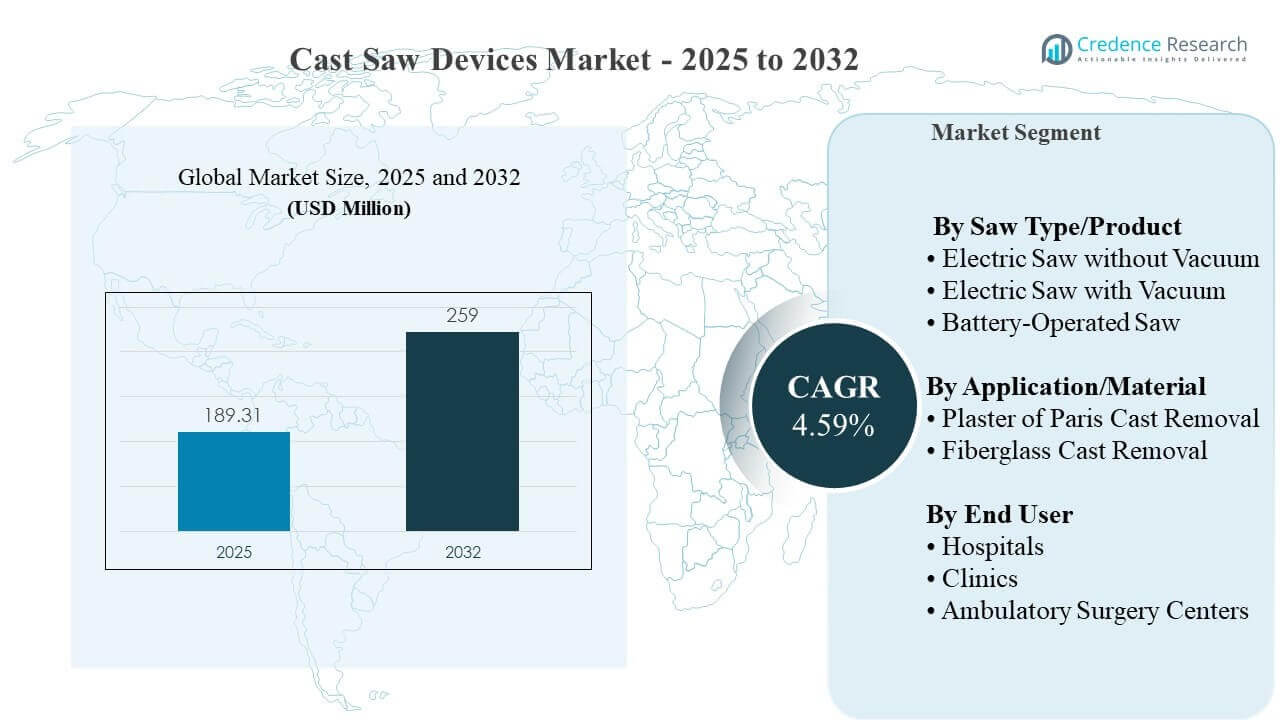
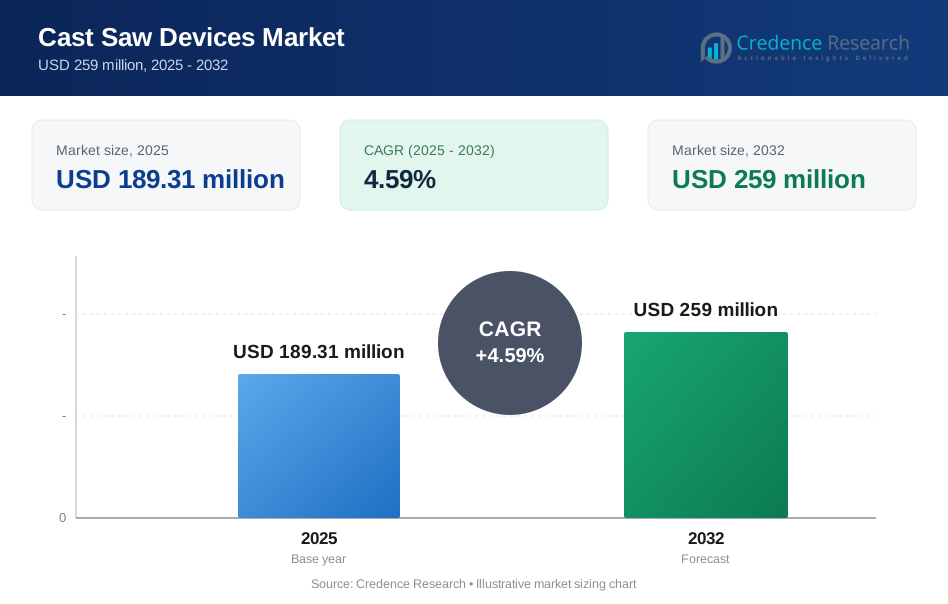
The global Cast Saw Devices Market size was estimated at USD 189.31 million in 2025 and is expected to reach USD 259 million by 2032, growing at a CAGR of 4.59% from 2025 to 2032. Demand is supported by sustained orthopedic immobilization volume and the need for efficient, safe cast removal workflows that reduce patient discomfort and clinician exposure to dust and vibration. Increasing standardization of fracture-care pathways across hospitals and outpatient orthopedic settings further supports steady replacement cycles for cast removal equipment.
| REPORT ATTRIBUTE | DETAILS |
|---|---|
| Historical Period | 2020-2024 |
| Base Year | 2025 |
| Forecast Period | 2026-2032 |
| Cast Saw Devices Market Size 2025 | USD 189.31 million |
| Cast Saw Devices Market, CAGR | 4.59% |
| Cast Saw Devices Market Size 2032 | USD 259 million |
Key Market Trends & Insights
- The market is projected to expand at a CAGR of 4.59% during 2025–2032.
- Plaster of Paris Cast Removal led the application/material mix with a 57.3% share in 2025, reflecting continued usage of POP casting in routine fracture care.
- Electric Saw with Vacuum was the leading product category at 47.2% in 2025, indicating growing preference for dust-managed cast removal in higher-throughput settings.
- Hospitals accounted for 44.1% in 2025, reinforcing their role as the primary site for trauma/fracture case management and cast removal volumes.
- North America held the largest regional share at 36.4% in 2025, supported by high procedure throughput and faster adoption of workflow-oriented device upgrades.
Segment Analysis
Cast saw device purchasing is increasingly shaped by safety, workflow efficiency, and clinician ergonomics. Providers prioritize consistent oscillation performance, controllable cutting depth, and blade stability to reduce the risk of skin injury and improve patient experience during removal. Dust management has become a practical decision factor, especially in fracture rooms and busy outpatient orthopedic clinics, because particulate control reduces cleanup burden and supports better room turnover.
Material mix also influences system selection. POP casts remain widely used in many routine settings, sustaining demand for general-purpose oscillating saw configurations and compatible blades. At the same time, fiberglass cast utilization in many developed settings supports demand for blades and configurations optimized for rigid cast materials, as providers look for faster, smoother removal with lower perceived heat and vibration at the cast interface.
By Saw Type/Product Insights
Electric Saw with Vacuum accounted for the largest share of 47.2% in 2025. Dust extraction aligns with infection-control expectations and reduces airborne cast particulate exposure for clinicians and patients during high-volume cast removal days. These systems also reduce post-procedure cleanup time, supporting faster room turnover in orthopedic clinics and emergency departments. Hospitals and larger clinics tend to value reliability and service support, making vacuum-integrated platforms attractive in procurement decisions.
By Application/Material Insights
Plaster of Paris Cast Removal accounted for the largest share of 57.3% in 2025. POP casting remains common in routine fracture immobilization due to familiarity, clinical versatility, and broad availability across care settings. This maintains steady demand for cast saw devices and blades configured for frequent, standardized removal procedures. Facilities also favor predictable removal performance that reduces patient anxiety and supports consistent clinical throughput.
By End User Insights
Hospitals accounted for the largest share of 44.1% in 2025. Hospitals manage a large share of acute trauma and fracture caseloads, making cast application and removal a routine capability across orthopedic and emergency departments. Purchasing is often centralized, which supports adoption of standardized platforms and accessories across departments. Training, maintenance responsiveness, and device uptime tend to weigh heavily in hospital buying decisions due to higher daily procedure volume.
Cast Saw Devices Market Drivers
Sustained fracture and orthopedic immobilization volume
Cast removal demand is anchored to ongoing fracture incidence and routine orthopedic immobilization pathways. Cast saw devices remain a standard requirement for fracture rooms, emergency departments, and outpatient orthopedic clinics where cast removal is performed at scale. Consistent case volumes create baseline replacement demand for saws, blades, and accessories. As providers increase standardization of fracture-care protocols, cast removal equipment is increasingly treated as a workflow-critical asset rather than a discretionary tool.
Workflow efficiency and room turnover requirements
High-throughput care settings prioritize cast removal processes that reduce procedure time and minimize cleanup. Devices designed for predictable oscillation, stable blade control, and simplified handling support faster patient throughput and lower clinician fatigue. Vacuum-enabled designs help contain debris, improving room readiness for the next patient. This operational focus encourages facilities to upgrade older systems to improve clinical efficiency and safety.
- For instance, the DeSoutter CleanCast CC7 operates at a high-speed cutting cycle of 17,000 CPM and a low-speed setting of 14,000 CPM, delivers 138 W of motor power, and incorporates tool-free blade loading all within a handpiece weighing just 1.5 lbs enabling clinicians to complete blade swaps and resume cutting without instrument downtime between patients.
Growing attention to dust exposure, ergonomics, and safety
Clinicians and administrators are paying closer attention to staff exposure to cast dust and to ergonomic strain associated with repetitive cast removal. Lower vibration, reduced noise, and improved grip design help address clinician comfort in busy orthopedic practices. Patient comfort during cast removal is also an important quality-of-care factor, shaping preferences for smoother removal performance and better control. These needs reinforce demand for premium platforms and compatible consumables.
- For instance, Switzerland-based Oscimed’s OSCIMED 2000 cast saw combines a 100 W brushless motor with 14,500 rev/min blade oscillation, a 62 dBA noise level, a 760 g handpiece, and an instant stop button, making it a stronger example for facilities prioritizing lower noise exposure, easier handling, and operator safety during repetitive cast removal.
Expansion of outpatient orthopedic care
Growth in outpatient orthopedic follow-up and treatment volumes increases the number of cast removals performed outside inpatient settings. Clinics and ambulatory environments typically favor portable and easy-to-maintain systems that support frequent use with limited setup time. As ambulatory pathways expand, demand increases for compact devices, quick-change accessories, and standardized training. This shifts some purchasing focus toward systems optimized for mobility and rapid daily workflows.
Cast Saw Devices Market Challenges
Cast saw device buyers face cost and procurement constraints, especially when upgrades involve not only the saw but also compatible blades, vacuum components, and maintenance programs. In budget-limited facilities, older corded systems may be retained longer, delaying replacement cycles. Variation in casting materials and clinician preferences can also complicate standardization across departments. Training requirements and adherence to safe removal technique remain essential to reduce injury risk, which can slow adoption of new platforms without structured onboarding.
- For instance, the Stryker 940 Cast Cutter alone requires selection across three distinct proprietary blade variants Stainless Steel, Plasma Ion Nitrided, and Titanium Nitrided blades (each priced at approximately $114.95 per blade) each optimized for different cast materials such as plaster or synthetic composites, meaning a facility stocking all three variants must manage separate procurement channels and compatibility protocols across cast types.
Operational reliability and service support can be challenging in settings where maintenance access is limited. Device downtime disrupts clinic throughput and can force rescheduling or reliance on backup tools. Consumable compatibility and ongoing blade supply also influence ownership experience, particularly in high-volume fracture rooms. These factors push buyers to prioritize vendors with robust service networks and consistent accessory availability.
Cast Saw Devices Market Trends and Opportunities
Vacuum-integrated cast removal is gaining importance as facilities seek better dust management and faster room turnover. This trend creates opportunities for suppliers to differentiate with stronger extraction performance, quieter operation, and simplified filter or collection workflows. Battery-operated systems also support mobility across fracture clinics, emergency departments, and satellite orthopedic sites, enabling quicker setup and fewer cable-related constraints. Accessories and material-specific blade designs remain a key avenue for performance differentiation.
- For instance, De Soutter Medical’s CleanCast CC7 combines a 200 W handpiece weighing 670 g with an 800 W extractor that delivers 1,900 mm H2O suction, HEPA capture of particles above 0.3 microns, and 10 L dust-bag capacity, while its cordless CSB-100 operates at 15,000 cpm and uses 10.8 V, 2,600 mAh batteries to support mobile cast-removal workflows.
There is growing opportunity in training, protocols, and bundled service offerings that reduce variability in cast removal practice and improve safety. Suppliers that combine devices with standardized clinician training, preventive maintenance, and consumable logistics can strengthen retention in hospital systems. Product design that emphasizes ergonomic handling and reduced vibration supports clinician satisfaction and can influence repurchase decisions. Over time, these trends support a shift toward higher-value platforms even in cost-conscious environments.
Regional Insights
North America
North America accounted for 36.4% of the market in 2025. High orthopedic procedure throughput and established fracture-care infrastructure sustain baseline device demand across hospitals and specialty clinics. Providers show strong adoption of workflow-oriented upgrades that support staff efficiency, including dust-managed cast removal. Replacement demand is supported by ongoing device standardization in larger health systems.
Europe
Europe represented 22.7% in 2025. Demand is supported by consistent orthopedic caseloads and structured care pathways across public and private healthcare providers. Procurement often favors reliable performance, safety features, and durable accessory ecosystems. Standardized training and equipment protocols in orthopedic departments support steady utilization of cast removal platforms.
Asia Pacific
Asia Pacific held 26.1% in 2025. Expansion of hospital networks and improving access to orthopedic care support rising utilization of cast management tools. Facilities increasingly emphasize modernization of outpatient and emergency workflows, supporting demand for portable and easy-to-operate devices. Broad variability in care settings sustains demand across both basic and more feature-rich platforms.
Latin America
Latin America accounted for 8.3% in 2025. Improving access to orthopedic and trauma care supports gradual uptake of cast removal equipment across hospitals and clinics. Purchasing decisions are often cost-sensitive, which sustains demand for reliable core configurations. Growth also benefits from expansion of orthopedic services in higher-volume urban centers.
Middle East & Africa
Middle East & Africa represented 6.5% in 2025. Demand is supported by capacity expansion in trauma and orthopedic services in select countries and larger hospital systems. Procurement may prioritize durable platforms with accessible service support and training. Gradual expansion of outpatient orthopedic services also supports steady equipment adoption.
Competitive Landscape
Competition is shaped by product reliability, ergonomic handling, blade compatibility, and safety performance in high-frequency cast removal workflows. Suppliers differentiate through dust management capability, perceived patient comfort, and features that reduce clinician fatigue such as lower vibration and improved grip design. Service responsiveness, consumable availability, and training support are important purchasing criteria, particularly for hospital systems that require standardized performance across departments.
Stryker Corporation’s approach typically aligns with hospital-focused procurement priorities, emphasizing standardized orthopedic workflow integration, dependable device performance, and support infrastructure suitable for high procedure throughput environments. This positioning is relevant where large health systems seek equipment consistency across orthopedic and emergency settings. Portfolio breadth and service capabilities can influence multi-site purchasing decisions. As facilities prioritize staff efficiency and safety practices, established suppliers often benefit from trust in uptime and accessory continuity.
The industry research and growth report includes detailed analyses of the competitive landscape of the market and information about key companies, including:
- Stryker Corporation
- De Soutter Medical
- Essity Aktiebolag
- OSCIMED SA
- Smith & Nephew plc
- HEBU Medical GmbH
- Prime Medical Inc.
- Shanghai Bojin Medical Instrument Co., Ltd.
- Hanshin Medical Co., Ltd.
- McArthur Medical Sales, Inc.
Qualitative and quantitative analysis of companies has been conducted to help clients understand the wider business environment as well as the strengths and weaknesses of key industry players. Data is qualitatively analyzed to categorize companies as pure play, category-focused, industry-focused, and diversified; it is quantitatively analyzed to categorize companies as dominant, leading, strong, tentative, and weak.
Recent Developments
- In December 2025, Essity’s orthopedic portfolio activity highlighted Delta-Cast® Serene™, introduced as a cast remover positioned around quieter operation, safety, and simplified usability to improve the removal experience for clinicians and patients.
Report Scope
| Report Attribute | Details |
| Market size value in 2025 | USD 189.31 million |
| Revenue forecast in 2032 | USD 259 million |
| Growth rate (CAGR) | 4.59% (2025–2032) |
| Base year | 2025 |
| Forecast period | 2026–2032 |
| Quantitative units | USD million |
| Segments covered | By Saw Type/Product Outlook: Electric Saw without Vacuum, Electric Saw with Vacuum, Battery-Operated Saw; By Application/Material Outlook: Plaster of Paris Cast Removal, Fiberglass Cast Removal; By End User Outlook: Hospitals, Clinics, Ambulatory Surgery Centers |
| Regional scope | North America, Europe, Asia Pacific, Latin America, Middle East & Africa |
| Key companies profiled | Stryker Corporation, De Soutter Medical, Essity Aktiebolag, OSCIMED SA, Smith & Nephew plc, HEBU Medical GmbH, Prime Medical Inc., Shanghai Bojin Medical Instrument Co., Ltd., Hanshin Medical Co., Ltd., McArthur Medical Sales, Inc. |
| No. of Pages | 327 |
Segmentation
By Saw Type/Product
- Electric Saw without Vacuum
- Electric Saw with Vacuum
- Battery-Operated Saw
By Application/Material
- Plaster of Paris Cast Removal
- Fiberglass Cast Removal
By End User
- Hospitals
- Clinics
- Ambulatory Surgery Centers
By Region
- North America
- U.S.
- Canada
- Mexico
- Europe
- Germany
- France
- U.K.
- Italy
- Spain
- Rest of Europe
- Asia Pacific
- China
- Japan
- India
- South Korea
- South-east Asia
- Rest of Asia Pacific
- Latin America
- Brazil
- Argentina
- Rest of Latin America
- Middle East & Africa
- GCC Countries
- South Africa
- Rest of the Middle East and Africa
Request a Free Sample
Fill in your details and we'll send you a free sample report.
- Sample data tables & charts
- Research methodology
Need a Custom Version of This Report?
Tailor the scope, geography, or segments to your exact requirements.
- Custom geography or segment scope
- Direct access to our analyst team
Frequently Asked Questions
What is the market size and forecast for the Cast Saw Devices Market?
What is the CAGR for the Cast Saw Devices Market?
What is the largest segment in the market?
What factors are driving market growth?
Who are the leading companies in the Cast Saw Devices Market?
Which region leads the market?
Table of Content
Chapter 1. Report Introduction
- 1.1 Report Description & Purpose
- 1.1.1 Report Title & Market Definition
- 1.1.2 Unique Selling Propositions (USP) & Key Differentiators
- 1.1.3 Value Proposition for Stakeholders
- 1.2 Research Objectives
- 1.2.1 Market Sizing Objectives (Volume & Revenue)
- 1.2.2 Segmentation Objectives
- 1.2.3 Competitive Intelligence Objectives
- 1.2.4 Forecast & Scenario Objectives
- 1.3 Report Scope
- 1.3.1 Cast Saw Devices Scope – Types & Subtypes Covered
- 1.3.2 Geographic Scope – Regions & Countries Covered
- 1.3.3 Historical Period, Base Year & Forecast Period (2025; forecast to 2032)
- 1.3.4 Inclusions & Exclusions
- 1.4 HS Code & Classification Framework
- 1.5 Currency, Units & Pricing Basis
- 1.6 Target Stakeholders
- 1.7 Limitations & Assumptions
Chapter 2. Executive Summary
- 2.1 Global Cast Saw Devices Market Snapshot
- 2.1.1 Market Size – Historical (2025) & Forecast (2025-2032) (2025: USD 189.31 million → 2032: USD 259 million)
- 2.1.2 Volume & Revenue – Global Totals
- 2.1.3 Key Market Highlights – Top Five Facts
- 2.2 Cast Saw Devices Market Segmentation Snapshot
- 2.2.1 Market Split by Region – 2025 vs. 2032
- 2.3 Competitive Snapshot
- 2.3.1 Top 10 Players by Revenue Share – 2025
- 2.3.2 Top 10 Players by Volume Share – 2025
- 2.3.3 Recent Strategic Developments (18-Month Summary)
- 2.4 Key Investment Highlights & Strategic Conclusions
Chapter 3. Cast Saw Devices Market Dynamics & Industry Analysis
- 3.1 Market Overview & Context
- 3.1.1 Cast Saw Devices Market Position in the Broader Automotive Value Chain
- 3.1.2 OEM vs. Replacement Market Dynamics
- 3.1.3 Market Maturity & Development Stage by Region
- 3.2 Cast Saw Devices Market Drivers
- 3.3 Cast Saw Devices Market Restraints & Challenges
- 3.4 Cast Saw Devices Market Opportunities
- 3.5 Porter's Five Forces Analysis
- 3.5.1 Threat of New Entrants
- 3.5.2 Bargaining Power of Suppliers
- 3.5.3 Bargaining Power of Buyers
- 3.5.4 Threat of Substitutes
- 3.5.5 Competitive Rivalry – Intensity Assessment
- 3.6 Cast Saw Devices Value Chain Analysis
- 3.6.1 Upstream – Raw Material/Input Suppliers
- 3.6.1.1 Raw Material/Input 1
- 3.6.1.2 Raw Material/Input 2
- 3.6.1.3 Raw Material/Input 3
- 3.6.2 Midstream – Production/Manufacturing/Service Delivery
- 3.6.2.1 Production/Process Overview
- 3.6.2.2 Key Facility Locations & Capacity by Manufacturer
- 3.6.3 Downstream – Distribution & End Consumer
- 3.6.3.1 Primary Channel – B2B/OEM
- 3.6.3.2 Secondary Channels – Dealer, Retail, Online, Direct
- 3.6.4 Value Chain Profitability Analysis
- 3.6.1 Upstream – Raw Material/Input Suppliers
- 3.7 PESTEL Analysis
- 3.7.1 Political Factors
- 3.7.2 Economic Factors
- 3.7.3 Social Factors
- 3.7.4 Technological Factors
- 3.7.5 Environmental Factors
- 3.7.6 Legal Factors
- 3.8 Cast Saw Devices Supply Chain Analysis
- 3.8.1 Raw Material/Input Supply Risk Assessment
- 3.8.2 Manufacturing Concentration Risk (Geographic Exposure)
- 3.8.3 Trade Disruption Impact Analysis
- 3.9 Regulatory & Policy Landscape
Note: The regulatory and policy landscape section covers regulations based on their applicability to the market, Cast Saw Devices category, geography, and scope of the study. Only regulatory frameworks with a material impact on operations, compliance, trade, sustainability, or market access are analyzed in detail.
Chapter 4. Key Investment Pockets & Opportunity Analysis
- 4.1 Cast Saw Devices Market Attractiveness Analysis
- 4.1.1 By Region – Investment Attractiveness Matrix (Volume × CAGR)
- 4.2 Absolute Revenue Growth Opportunity
- 4.2.1 By Region – Absolute USD Growth Through 2032
- 4.3 Incremental Volume Opportunity
- 4.3.1 By Region – Incremental Volume Through 2032
- 4.3.2 Segment – Incremental Volume
- 4.4 Emerging Submarket Opportunity Deep Dive (Subject to Applicability)
- 4.5 Emerging Market Opportunity Scorecards
- 4.5.1 United States
- 4.5.2 Europe
- 4.5.3 Asia
- 4.5.4 Middle East & Africa
Note: Emerging Market Opportunity Scorecards will be included based on relevance and strategic importance. Regions listed are indicative and may vary depending on data availability and market dynamics.
Chapter 5. Cast Saw Devices Import-Export Analysis & Trade Flows
- 5.1 Global Trade Overview
- 5.1.1 Global Export Value by Country (2025)
- 5.1.2 Global Export Volume by Country (2025)
- 5.1.3 Global Import Value by Country (2025)
- 5.1.4 Global Import Volume by Country (2025)
- 5.1.5 Net Trade Balance by Country (2025)
- 5.2 Export Analysis – Segment
- 5.2.1 Type 1 (HS Code)
- 5.2.2 Type 2 (HS Code)
- 5.2.3 Type 3 (HS Code)
- 5.2.4 Type 4 (HS Code)
- 5.2.5 Type 5 (HS Code)
- 5.3 Import Analysis – Segment
- 5.3.1 Type 1 (HS Code)
- 5.3.2 Type 2 (HS Code)
- 5.3.3 Type 3 (HS Code)
- 5.3.4 Type 4 (HS Code)
- 5.3.5 Type 5 (HS Code)
- 5.4 Average Unit Trade Prices
- 5.4.1 Average Export Price – Segment & Country
- 5.4.2 Average Import Price – Segment & Source Country
- 5.4.3 Price Trends (2025)
- 5.5 Key Trade Route Analysis
- 5.5.1 Trade Route 1
- 5.5.2 Trade Route 2
- 5.5.3 Trade Route 3
- 5.5.4 Trade Route 4
- 5.5.5 Trade Route 5
- 5.6 Trade Policy Impact Assessment
- 5.6.1 US Anti-Dumping & Section 301 Tariffs
- 5.6.2 EU Customs Union Impact
- 5.6.3 Major Free Trade Agreements
- 5.6.4 USMCA Rules of Origin
Note: Trade policy analysis will be included only where relevant to the Cast Saw Devices market.
Chapter 6. Competitive Landscape & Company Benchmarking
- 6.1 Cast Saw Devices Market Concentration & Structure
- 6.1.1 Herfindahl-Hirschman Index (HHI) – vs. 2025
- 6.1.2 Tier 1, Tier 2 & Tier 3 Market Structure
- 6.1.3 Global, Regional & Local Player Dynamics
- 6.2 Cast Saw Devices Market Share Analysis – 2025
- 6.2.1 Global Revenue Share by Company
- 6.2.2 Global Volume Share by Company
- 6.2.3 Regional Revenue Share
- 6.2.4 Market Share Evolution ( vs. 2025)
- 6.2.5 OEM Segment Share by Company
- 6.2.6 Replacement Segment Share by Company
- 6.3 Production/Delivery Capacity & Facility Analysis
- 6.3.1 Global Installed Capacity
- 6.3.2 Capacity Utilization Rates
- 6.3.3 Production/Output Volume
- 6.3.4 Facility Locations & Capacity Map
- 6.3.5 Planned Capacity Additions
- 6.4 Cast Saw Devices Competitive Benchmarking Matrix
- 6.4.1 Revenue, Volume, CAGR & Profitability Comparison
- 6.4.2 Channel Revenue Mix
- 6.4.3 Geographic Revenue Exposure
- 6.4.4 R&D Intensity
- 6.4.5 Sustainability Maturity
- 6.5 Strategic Developments in Cast Saw Devices (Last 24 Months)
- 6.5.1 Mergers, Acquisitions & Divestments
- 6.5.2 New Cast Saw Devices Launches
- 6.5.3 Facility Expansions
- 6.5.4 Strategic Alliances, Joint Ventures & Partnerships
- 6.5.5 Distribution Expansion & Market Entry
- 6.5.6 Sustainability & ESG Initiatives
- 6.6 Competitive Strategy Mapping
- 6.6.1 Leader, Challenger, Follower & Niche Classification
- 6.6.2 Pricing Strategy Comparison
- 6.6.3 Channel Strategy Matrix
Note: Strategic developments are included based on their materiality and the availability of reliable information.
Chapter 7. Global Cast Saw Devices Market – By Distribution Channel
- 7.1 Segment Overview
- 7.1.1 Volume & Revenue Split by Channel (2025 & 2032)
- 7.1.2 Channel Mix Evolution (2025-2032)
Chapter 8. Regional Market Analysis – Global Overview
- 8.1 Global Regional Overview
- 8.1.1 Regional Volume Share
- 8.1.2 Regional Revenue Share
- 8.1.3 Regional Volume by Region
- 8.1.4 Regional Revenue by Region
- 8.1.5 Regional Forecast Through 2032
- 8.2 Cross-Regional Segment Analysis
- 8.2.1 By Distribution Channel
- 8.2.2 By Brand/Price Tier
Chapter 9. North America Cast Saw Devices Market
- 9.1 United States
- 9.2 Canada
- 9.3 Mexico
Chapter 10. Europe Cast Saw Devices Market
- 10.1 Germany
- 10.2 France
- 10.3 Italy
- 10.4 United Kingdom
- 10.5 Spain
- 10.6 Poland
- 10.7 Russia
- 10.8 Netherlands
- 10.9 Belgium
- 10.10 Sweden
- 10.11 Denmark
- 10.12 Norway
- 10.13 Rest of Europe
Chapter 11. Asia Pacific Cast Saw Devices Market
- 11.1 China
- 11.2 India
- 11.3 Japan
- 11.4 South Korea
- 11.5 Thailand
- 11.6 Indonesia
- 11.7 Vietnam
- 11.8 Malaysia
- 11.9 Australia
- 11.10 Rest of Asia Pacific
Chapter 12. Latin America Cast Saw Devices Market
- 12.1 Brazil
- 12.2 Argentina
- 12.3 Colombia
- 12.4 Chile
- 12.5 Rest of Latin America
Chapter 13. Middle East Cast Saw Devices Market
- 13.1 Saudi Arabia
- 13.2 United Arab Emirates
- 13.3 Turkey
- 13.4 Israel
- 13.5 Iran
- 13.6 Rest of the Middle East
Chapter 14. Africa Cast Saw Devices Market
- 14.1 South Africa
- 14.2 Egypt
- 14.3 Nigeria
- 14.4 Morocco
- 14.5 Rest of Africa
Chapter 15. Cast Saw Devices Company Profiles
- 15.1 [Company 01]
- 15.1.1 Company Overview
- 15.1.2 Key Management Personnel
- 15.1.3 Products & Services Portfolio
- 15.1.4 Financial Performance
- 15.1.5 Key Market Focus & Geographic Presence
- 15.1.6 Recent Developments & Strategic Initiatives
Note: The company profile list is preliminary and may change based on research findings, market developments, data availability, and client requirements.
Chapter 16. Appendices
- Appendix A – List of Abbreviations & Acronyms
- Appendix B – Industry Classification Code Reference – Full Series
- Appendix C – Production & Capacity Data Tables
- Appendix D – End-Use & Demand Base Tables
- Appendix E – Consumption & Replacement Rate Assumptions
- Appendix F – ASP Reference Tables
- Appendix G – Manufacturing & Facility Database
- Appendix H – Import-Export Data Tables
- Appendix I – Regulatory Summary Tables
- Appendix J – Primary Research Participant List (Anonymized)
- Appendix K – Primary Research Questionnaire Framework
- Appendix L – Data Sources & Bibliography
- Appendix M – Market Size Divergence & Source Comparison
Chapter 17. Research Methodology
- 17.1 Research Framework & Philosophy
- 17.2 Secondary Research – Sources, Hierarchy & Data Extraction
- 17.3 Data Modeling – Bottom-Up & Top-Down Market Sizing
- 17.4 Primary Research – Stakeholder Framework, LOI & Sample Sizes
- 17.5 Forecast Methodology – Regression, Scenario & Sensitivity Analysis
- 17.6 Quality Control – Four-Layer Validation Framework
- 17.7 Limitations & Standard Assumptions
- 17.8 Disclaimer
