
Data Lake Market Overview:
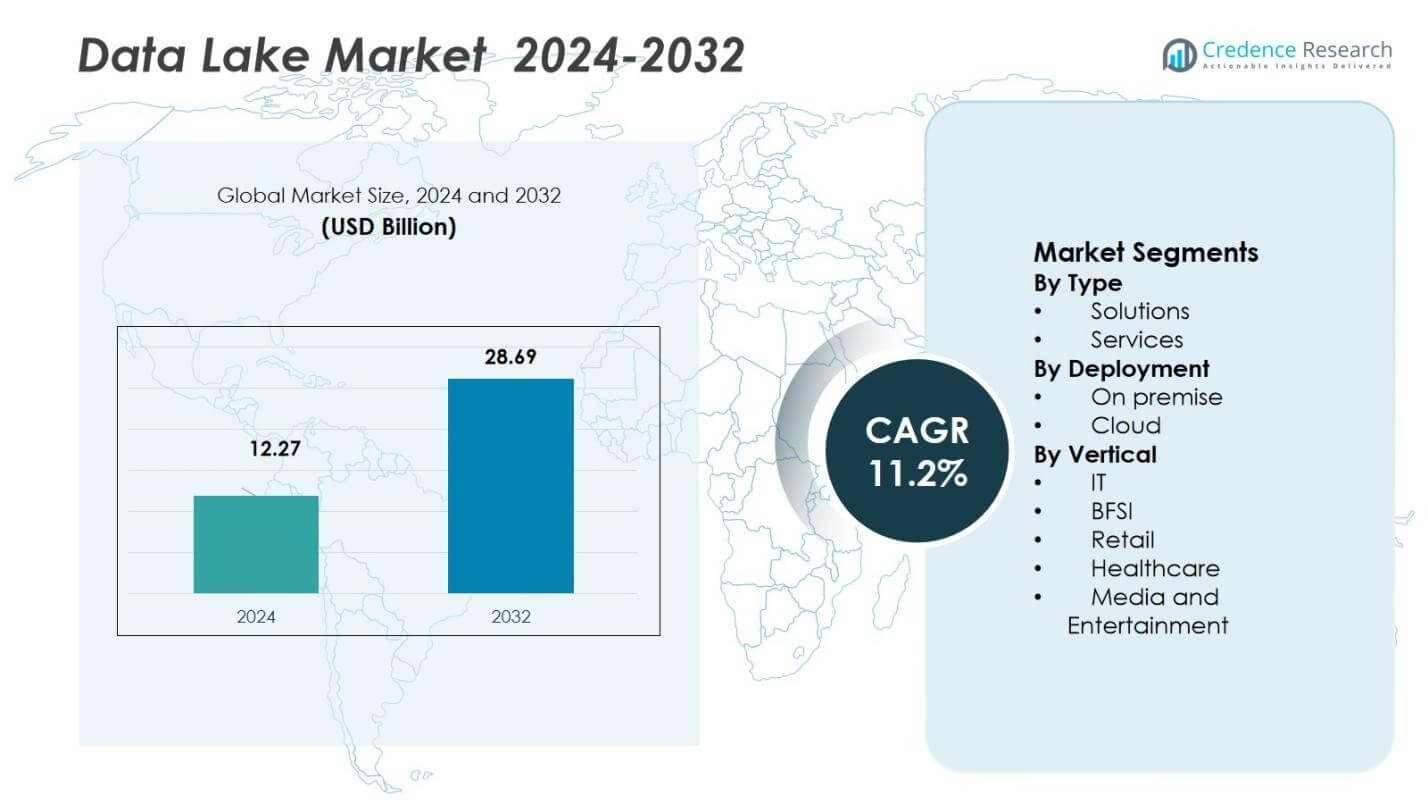
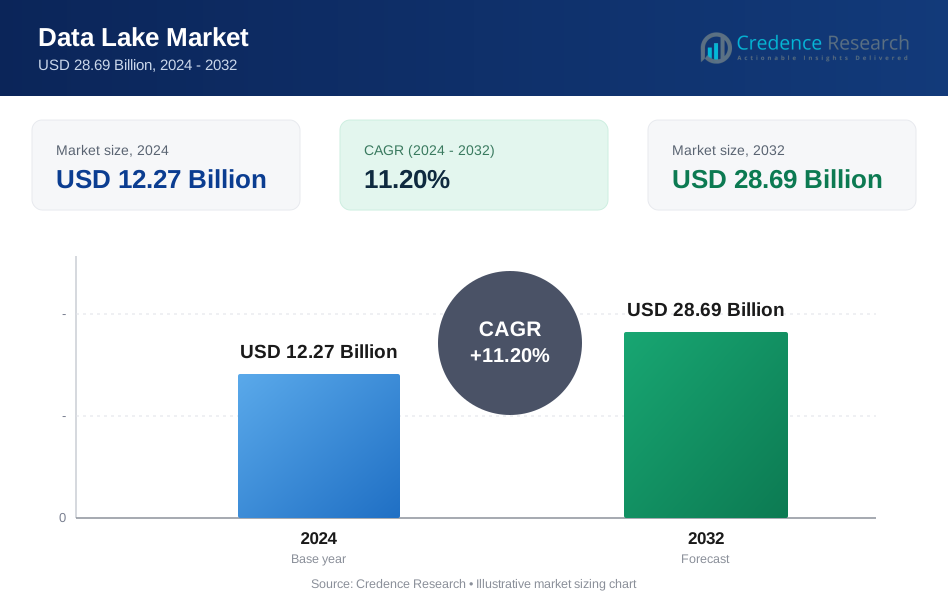
Data Lake Market size was valued at USD 12.27 Billion in 2024 and is anticipated to reach USD 28.69 Billion by 2032, at a CAGR of 11.2% during the forecast period.
| REPORT ATTRIBUTE | DETAILS |
|---|---|
| Historical Period | 2020-2023 |
| Base Year | 2024 |
| Forecast Period | 2025-2032 |
| Data Lake Market Size 2024 | USD 12.27 Billion |
| Data Lake Market, CAGR | 11.2% |
| Data Lake Market Size 2032 | USD 28.69 Billion |
The Data Lake Market is driven by strong participation from leading technology providers, including Amazon Web Services, Microsoft Corporation, Snowflake Inc., Oracle Corporation, Google LLC, Cloudera Inc., Teradata Corporation, SAS Institute Inc., Informatica Corporation, and Dremio Corporation. These companies compete by strengthening cloud-native architectures, enhancing data integration, and enabling AI-driven analytics across diverse enterprise environments. North America leads the global market with a 38.2% share in 2024, supported by advanced cloud adoption, robust digital infrastructure, and the presence of major vendors. Europe and Asia-Pacific follow as key growth regions, driven by accelerating digital transformation and expanding demand for scalable analytics platforms.
Data Lake Market Insights
- The Data Lake Market reached USD 12.27 Billion in 2024 and is projected to reach USD 28.69 Billion by 2032, growing at an 11.2% CAGR during the forecast period.
- Market growth is driven by rising enterprise data volume, rapid digital transformation, and increasing adoption of AI, machine learning, and big data analytics across large enterprises.
- Key trends include strong migration toward cloud-native architectures, growth of data lakehouse models, and rising demand for unified governance, real-time analytics, and industry-specific data frameworks.
- The competitive landscape is led by AWS, Microsoft, Snowflake, Oracle, Google, Cloudera, Teradata, SAS, Informatica, and Dremio, with solutions holding a 62.3% segment share and cloud deployment leading at 71.6%.
- Regionally, North America leads with 38.2% share, followed by Europe at 26.7% and Asia-Pacific at 23.9%, supported by investment in cloud infrastructure, AI adoption, and expanding digital ecosystems.
Data Lake Market Segmentation Analysis
By Type
Solutions dominated the Data Lake Market in 2024 with a 62.3% share, driven by growing enterprise reliance on advanced data integration, governance, and analytics platforms. Organizations increasingly adopt scalable solution suites to handle rising data volume from IoT systems, cloud applications, and real-time streaming sources. Their ability to unify structured and unstructured data, improve data accessibility, and support AI/ML-driven insights accelerates adoption across large enterprises. Meanwhile, services covering consulting, implementation, and managed services continue to expand as businesses seek expert support for data architecture modernization and cloud-native data lake deployment.
- For instance, AWS Lake Formation enabled Capital One to centralize and secure a significant volume of its data across its cloud environment, which has improved analytics and governance efficiency.
By Deployment
Cloud-based deployment held the largest share at 71.6% in 2024, fueled by rapid digital transformation initiatives, lower upfront investment, and the rising preference for flexible, pay-as-you-go data lake architectures. Enterprises increasingly leverage cloud platforms to scale storage capacity, enhance processing speed, and integrate AI-driven analytics seamlessly. Cloud-native ecosystems offered by providers such as AWS, Microsoft, and Snowflake also enable automation, real-time data ingestion, and enhanced security controls. On-premise deployment remains relevant for highly regulated industries requiring strict data sovereignty and full control over sensitive datasets.
- For instance, AWS reported that customers were storing more than 100 trillion objects in Amazon S3, demonstrating the hyperscale storage foundation supporting modern cloud data lakes.
By Vertical
The IT segment led the Data Lake Market with a 28.4% share in 2024, supported by extensive data generation across software development, cloud operations, cybersecurity, and IT service management processes. The segment benefits from the need for unified, high-performance data platforms capable of supporting large-scale analytics and automation. BFSI follows closely as financial institutions adopt data lakes to strengthen fraud detection, risk modeling, and customer personalization. Retail, healthcare, and media & entertainment increasingly deploy data lakes to manage consumer data, clinical records, digital content, and predictive analytics workloads essential for operational efficiency and real-time decision-making.
Data Lake Market Key Growth Drivers
Rising Enterprise Data Volume from Digital Transformation
A major growth driver for the Data Lake market is the exponential increase in enterprise data volume generated through digital transformation initiatives. Organizations across sectors are producing massive datasets from cloud applications, connected devices, social media interactions, transactional systems, and real-time operational feeds. Traditional databases and data warehouses are unable to store, scale, or process these growing volumes efficiently, accelerating the shift toward flexible data lakes. The ability of data lakes to ingest structured, semi-structured, and unstructured data at scale makes them essential for enterprises aiming to extract actionable insights. As companies adopt digital-first models, the demand for unified data storage systems supporting real-time analytics, AI integration, and predictive intelligence continues to surge. Additionally, the rise of IoT deployments, 5G connectivity, and digital customer engagement platforms further intensify data generation, positioning data lakes as a critical backbone for long-term analytics strategies.
- For instance, Netflix collects and analyzes more than 1 trillion events daily through its data pipeline, using cloud-scale data lakes to optimize content recommendations and streaming performance.
Growing Adoption of AI, Machine Learning, and Advanced Analytics
Rapid expansion of AI and machine learning applications is significantly driving the adoption of data lakes, as these technologies require diverse, large-scale datasets for model training and optimization. Traditional systems struggle to provide the volume and variety of data needed to deploy advanced analytics solutions efficiently. Data lakes enable enterprises to store historical and real-time data in native formats, allowing data scientists to experiment, engineer features, and train models without restrictive schema requirements. This capability supports innovations such as automated decision-making, fraud detection, personalized recommendations, and predictive maintenance. Organizations leveraging AI-driven insights depend on data lakes to maintain seamless data flows across multiple business units, ensuring consistency and scalability. Moreover, open-source and cloud-native analytics tools integrated within modern data lakes offer accelerated processing, enhancing operational intelligence. As AI/ML adoption broadens across industries, the role of data lakes in enabling high-performance analytics continues to strengthen.
· For instance, Airbnb processes over a million user events every second and feeds billions of daily events into its cloud data lake to train machine learning models for dynamic pricing and fraud detection.
Shift Toward Cloud-Native Architectures and Cost-Effective Storage
The shift toward cloud-native architectures is another critical driver accelerating Data Lake market expansion, primarily due to the cost-efficiency, scalability, and flexibility cloud platforms provide. Enterprises increasingly migrate from on-premise systems to cloud ecosystems to handle rising storage demands without large capital investments. Cloud-based data lakes offer highly elastic storage, automated provisioning, integrated security, and seamless connectivity with analytics and machine learning services. This reduces infrastructure complexity while improving performance for large-scale querying and processing. Leading cloud providers also offer optimized data management tools, enabling organizations to build end-to-end analytics pipelines with minimal operational overhead. Additionally, pay-as-you-go models allow companies to optimize storage costs, especially for archives and infrequently accessed data. As digital transformation accelerates globally, cloud-native data lakes continue to be a preferred foundation for real-time analytics, advanced reporting, and AI-driven business intelligence initiatives.
Data Lake Market Key Trends & Opportunities
Emergence of Unified Data Platforms with Integrated Governance
One of the most significant market trends is the emergence of unified data platforms that combine data lake storage with advanced governance, cataloging, and security capabilities. Traditional data lakes often faced challenges related to data quality and discoverability, leading to the concept of “data swamps.” Modern data lakehouse architectures address these limitations by integrating schema enforcement, metadata management, and version control. This shift presents a major opportunity for enterprises to utilize high-quality data for analytics, AI applications, and compliance workflows. The rising focus on data privacy regulations also drives the adoption of unified governance frameworks within data lakes. Vendors are increasingly offering centralized monitoring, lineage tracking, and automated access control systems. As businesses seek to harmonize data assets across multi-cloud and hybrid environments, unified platforms create opportunities to streamline analytics operations while ensuring regulatory adherence and operational efficiency.
- For instance, Databricks’ Unity Catalog supports centralized governance for more than 10,000 global customers, enabling unified data discovery, lineage, and access control across petabyte-scale lakehouse environments.
Expansion of Industry-Specific Data Lake Solutions
The Data Lake market is witnessing a strong trend toward industry-specific solutions tailored for verticals such as BFSI, healthcare, retail, and manufacturing. These sectors generate unique datasets financial transactions, patient records, supply chain logs, IoT sensor outputs, and multimedia content that require customized data architectures and analytics tools. Vendors are now developing pre-built industry models, compliance-ready storage frameworks, and domain-specific connectors to accelerate deployment. This trend creates substantial growth opportunities as enterprises prioritize solutions aligned with regulatory needs, customer behavior analytics, and operational optimization. For example, financial institutions leverage data lakes for fraud detection and risk modeling, while healthcare providers use them for clinical analytics and precision medicine. The rising demand for verticalized AI applications further strengthens the need for domain-focused data lake ecosystems. As organizations continue to modernize operations, tailored data lake offerings present strong commercial potential for vendors and service providers.
- For instance, Kaiser Permanente manages electronic health record data for more than 12.6 million members, feeding petabyte-scale data lakes to support population health analytics and AI-driven clinical decision support.
Data Lake Market Key Challenges
Data Security, Privacy, and Compliance Complexities
Data security and regulatory compliance remain major challenges restraining Data Lake market expansion. Since data lakes store massive volumes of sensitive information-including financial transactions, customer identities, medical records, and intellectual property-they become attractive targets for cyberattacks. Ensuring appropriate access controls, encryption, and monitoring across distributed architectures can be difficult, especially in hybrid and multi-cloud deployments. Compliance with stringent regulations such as GDPR, HIPAA, and PCI-DSS further complicates data handling requirements. Many organizations struggle to maintain consistent governance across varied data sources, leading to issues like unauthorized access, data leakage, and inaccurate lineage mapping. Additionally, integrating diverse datasets without compromising privacy introduces further risks. Without strong governance frameworks and continuous security updates, data lakes may expose enterprises to compliance violations and operational vulnerabilities, limiting adoption among highly regulated industries.
Complexity in Data Integration, Quality Management, and Skilled Workforce Availability
Another major challenge lies in the complexity associated with data integration, data quality management, and the shortage of skilled professionals capable of managing large-scale data lake ecosystems. Integrating structured and unstructured data from multiple systems requires deep technical expertise and sophisticated data engineering processes. Poorly managed ingestion pipelines often result in inconsistent, incomplete, or duplicate data, reducing analytical accuracy. Maintaining metadata, ensuring schema alignment, and implementing governance rules add further layers of operational difficulty. Moreover, the demand for data scientists, cloud architects, and machine learning engineers far exceeds supply, creating resource constraints for enterprises attempting large-scale data lake deployments. High implementation complexity and dependency on advanced skills often increase costs and extend deployment timelines. These challenges highlight the need for automated tools, low-code platforms, and skilled workforce development to support market growth.
Data Lake Market Regional Analysis
North America
North America dominated the Data Lake Market in 2024 with a 38.2% share, driven by strong cloud adoption, robust digital transformation programs, and the presence of major technology providers such as AWS, Microsoft, Google, and Snowflake. Enterprises across BFSI, IT, and healthcare increasingly deploy data lakes to support advanced analytics, AI/ML workloads, and regulatory reporting. The region benefits from mature data governance frameworks and high investment in big data technologies. Rising volumes of enterprise data, expanding IoT ecosystems, and growing demand for real-time insights continue to strengthen North America’s leadership in the global market.
Europe
Europe held a 26.7% share of the Data Lake Market in 2024, supported by expanding digital initiatives across manufacturing, retail, and financial services. The region places strong emphasis on data governance and regulatory compliance under GDPR, accelerating the adoption of secure and well-governed data lake platforms. Countries such as Germany, the UK, and France lead in cloud investment and AI-driven analytics, boosting demand for scalable data storage and processing frameworks. Growing industry modernization efforts, including Industry 4.0 and smart mobility projects, further strengthen Europe’s need for unified data management and real-time analytical capabilities.
Asia-Pacific
Asia-Pacific accounted for 23.9% of the Data Lake Market in 2024 and remains the fastest-growing region due to rapid cloud adoption, expanding digital ecosystems, and increasing enterprise investments in AI, big data, and IoT. China, India, Japan, and South Korea lead growth as companies modernize IT infrastructure and shift toward cloud-native architectures. The rise of e-commerce, fintech, smart manufacturing, and connected healthcare applications fuels significant data generation, accelerating the adoption of scalable data lake platforms. Government-led digital transformation and increasing demand for real-time business intelligence strengthen APAC’s long-term market expansion.
Latin America
Latin America captured a 6.4% share in 2024, driven by rising digital transformation initiatives across BFSI, telecommunications, retail, and government sectors. Countries such as Brazil, Mexico, and Chile are increasingly adopting cloud-based analytics, boosting demand for cost-effective and scalable data lake solutions. Enterprises focus on enhancing customer analytics, improving operational efficiency, and supporting real-time decision-making. Despite challenges such as uneven cloud infrastructure and limited advanced analytics expertise, the region is experiencing steady growth as organizations invest in big data modernization and expand their digital service ecosystems.
Middle East & Africa
The Middle East & Africa region accounted for 4.8% of the Data Lake Market in 2024, supported by growing adoption of cloud platforms, smart city initiatives, and digital transformation across telecom, BFSI, and public sector organizations. The UAE, Saudi Arabia, and South Africa lead regional deployment as enterprises integrate data lakes to improve automation, cybersecurity, and operational intelligence. Investments in AI, IoT, and large-scale digital government programs generate rising data volumes, driving the need for advanced storage and analytics frameworks. Ongoing infrastructure improvements and cloud ecosystem expansion continue to support market growth.
Data Lake Market Segmentations
By Type
- Solutions
- Services
By Deployment
- On premise
- Cloud
By Vertical
- IT
- BFSI
- Retail
- Healthcare
- Media and Entertainment
By Geography
- North America
- U.S.
- Canada
- Mexico
- Europe
- Germany
- France
- U.K.
- Italy
- Spain
- Rest of Europe
- Asia Pacific
- China
- Japan
- India
- South Korea
- South-east Asia
- Rest of Asia Pacific
- Latin America
- Brazil
- Argentina
- Rest of Latin America
- Middle East & Africa
- GCC Countries
- South Africa
- Rest of the Middle East and Africa
Data Lake Market Competitive Landscape
The competitive landscape of the Data Lake Market is characterized by the strong presence of global technology providers, cloud platform vendors, and data management specialists offering scalable, secure, and analytics-driven solutions. Leading companies such as Amazon Web Services, Microsoft Corporation, Snowflake Inc., Oracle Corporation, Google LLC, Cloudera Inc., Teradata Corporation, SAS Institute Inc., Informatica Corporation, and Dremio Corporation actively compete by enhancing data integration, governance, and AI-enabled analytics capabilities. These vendors focus on expanding cloud-native architectures, improving real-time data processing, and integrating advanced machine learning tools to strengthen platform efficiency. Strategic partnerships, product innovations, and multi-cloud support models are central to gaining competitive advantage. As enterprises increasingly adopt modern data architectures, vendors differentiate through performance optimization, low-cost storage models, and enhanced security frameworks. The market continues to evolve with rising investments in unified data platforms, interoperability enhancements, and industry-specific data lake solutions designed to meet evolving digital transformation needs.
Key Player Analysis
- Snowflake Inc.
- Teradata Corporation
- Informatica Corporation
- Dremio Corporation
- Oracle Corporation
- Zaloni, Inc.
- SAS Institute Inc.
- Microsoft Corporation
- Cloudera, Inc.
- Amazon Web Services, Inc.
Recent Developments
- In November 2025, SAP SE and Microsoft Corporation unveiled “SAP Business Data Cloud Connect for Microsoft Fabric”, enabling zero-copy sharing of SAP data into Microsoft’s AI-ready data lake (OneLake).
- In October 2025, Oracle launched its “Autonomous AI Lakehouse”, an open and interoperable data lake/lakehouse platform combining its Autonomous AI Database with the Apache Iceberg standard.
- In June 2024, Databricks announced the acquisition of Tabular, a data-management startup founded by the original creators of Apache Iceberg.
Report Coverage
The research report offers an in-depth analysis based on Type, Deployment, Vertical and Geography. It details leading market players, providing an overview of their business, product offerings, investments, revenue streams, and key applications. Additionally, the report includes insights into the competitive environment, SWOT analysis, current market trends, as well as the primary drivers and constraints. Furthermore, it discusses various factors that have driven market expansion in recent years. The report also explores market dynamics, regulatory scenarios, and technological advancements that are shaping the industry. It assesses the impact of external factors and global economic changes on market growth. Lastly, it provides strategic recommendations for new entrants and established companies to navigate the complexities of the market.
Future Outlook
- The Data Lake market will continue expanding as enterprises accelerate digital transformation and rely more on scalable data architectures.
- Adoption of AI, machine learning, and predictive analytics will significantly increase demand for advanced data lake ecosystems.
- Cloud-native data lakes will gain stronger preference as organizations prioritize flexibility, automation, and cost efficiency.
- Data lakehouse architectures will become mainstream, merging analytics performance with robust governance and data quality control.
- Industry-specific data lake solutions will rise, driven by unique data models needed in BFSI, healthcare, retail, and manufacturing.
- Real-time data ingestion and streaming analytics will grow rapidly to support instant decision-making across industries.
- Governance, security, and compliance features will strengthen as regulatory environments and data privacy standards evolve.
- Multi-cloud and hybrid deployments will expand as enterprises balance performance, risk, and cost optimization.
- Automation and low-code data engineering tools will reduce implementation complexity and boost adoption.
- Emerging markets in Asia-Pacific, Latin America, and the Middle East will drive the next phase of global expansion through increasing cloud investments.
Request a Free Sample
Fill in your details and we'll send you a free sample report.
- Sample data tables & charts
- Research methodology
Need a Custom Version of This Report?
Tailor the scope, geography, or segments to your exact requirements.
- Custom geography or segment scope
- Direct access to our analyst team
Frequently Asked Questions
What is the current market size for Data Lake Market, and what is its projected size in 2032?
At what Compound Annual Growth Rate is the Data Lake Market projected to grow between 2025 and 2032?
Which Data Lake Market segment held the largest share in 2024?
What are the primary factors fueling the growth of the Data Lake Market?
Who are the leading companies in the Data Lake Market?
Which region commanded the largest share of the Data Lake Market in 2024?
Table of Content
Chapter 1. Report Introduction
- 1.1 Report Description & Purpose
- 1.1.1 Report Title & Market Definition
- 1.1.2 Unique Selling Propositions (USP) & Key Differentiators
- 1.1.3 Value Proposition for Stakeholders
- 1.2 Research Objectives
- 1.2.1 Market Sizing Objectives (Volume & Revenue) (Volume Where Applicable)
- 1.2.2 Segmentation Objectives
- 1.2.3 Competitive Intelligence Objectives
- 1.2.4 Forecast & Scenario Objectives
- 1.3 Report Scope
- 1.3.1 Data Lake Scope – Segments & Subsegments Covered
- 1.3.2 Geographic Scope – Regions & Countries Covered
- 1.3.3 Historical Period, Base Year & Forecast Period (2024; forecast to 2032)
- 1.3.4 Inclusions & Exclusions
- 1.4 Industry Classification & Applicable Codes
- 1.5 Currency, Measurement Units & Valuation Basis
- 1.6 Target Stakeholders
- 1.7 Limitations & Assumptions
Chapter 2. Executive Summary
- 2.1 Global Data Lake Market Snapshot
- 2.1.1 Market Size – Historical (2024) & Forecast (2024-2032) (2024: USD 12.27 Billion → 2032: USD 28.69 Billion)
- 2.1.2 Volume & Revenue – Global Totals (Volume Where Applicable)
- 2.1.3 Key Market Highlights – Top Five Facts
- 2.2 Data Lake Market Segmentation Snapshot
- 2.2.1 Market Split by Region – 2024 vs. 2032
- 2.3 Competitive Snapshot
- 2.3.1 Top 10 Players by Revenue Share – 2024
- 2.3.2 Top 10 Players by Volume Share – 2024 (Volume Where Applicable)
- 2.3.3 Recent Strategic Developments (18-Month Summary)
- 2.4 Key Investment Highlights & Strategic Conclusions
Chapter 3. Data Lake Market Dynamics & Industry Analysis
- 3.1 Market Overview & Context
- 3.1.1 Data Lake Market Position in the Broader Industry Value Chain
- 3.1.2 Demand Structure & Purchasing Dynamics
- 3.1.3 Market Maturity & Development Stage by Region
- 3.2 Data Lake Market Drivers
- 3.3 Data Lake Market Restraints & Challenges
- 3.4 Data Lake Market Opportunities
- 3.5 Porter's Five Forces Analysis
- 3.5.1 Threat of New Entrants
- 3.5.2 Bargaining Power of Suppliers
- 3.5.3 Bargaining Power of Buyers
- 3.5.4 Threat of Substitutes
- 3.5.5 Competitive Rivalry – Intensity Assessment
- 3.6 Data Lake Value Chain Analysis
- 3.6.1 Upstream – Key Inputs, Resources & Suppliers
- 3.6.1.1 Key Input/Resource 1
- 3.6.1.2 Key Input/Resource 2
- 3.6.1.3 Key Input/Resource 3
- 3.6.2 Midstream – Core Operations & Value Creation
- 3.6.2.1 Operating Model & Process Overview
- 3.6.2.2 Key Operating Locations & Capabilities by Company
- 3.6.3 Downstream – Market Channels & End Users
- 3.6.3.1 Direct Sales & Customer Engagement Channels
- 3.6.3.2 Indirect Sales, Intermediaries & Partner Channels
- 3.6.4 Value Chain Profitability Analysis
- 3.6.1 Upstream – Key Inputs, Resources & Suppliers
- 3.7 PESTEL Analysis
- 3.7.1 Political Factors
- 3.7.2 Economic Factors
- 3.7.3 Social Factors
- 3.7.4 Technological Factors
- 3.7.5 Environmental Factors
- 3.7.6 Legal Factors
- 3.8 Data Lake Supply Chain Analysis
- 3.8.1 Critical Input & Resource Availability Risk Assessment
- 3.8.2 Supplier & Operational Concentration Risk (Geographic Exposure)
- 3.8.3 Supply & Service Disruption Impact Analysis
- 3.9 Regulatory & Policy Landscape
Note: The regulatory and policy landscape section covers regulations based on their applicability to the market, Data Lake category, geography, and scope of the study. Only regulatory frameworks with a material impact on operations, compliance, trade, sustainability, or market access are analyzed in detail.
Chapter 4. Key Investment Pockets & Opportunity Analysis
- 4.1 Data Lake Market Attractiveness Analysis
- 4.1.1 By Region – Investment Attractiveness Matrix (Market Size × CAGR)
- 4.2 Absolute Revenue Growth Opportunity
- 4.2.1 By Region – Absolute Revenue Growth Through 2032
- 4.3 Incremental Demand Opportunity
- 4.3.1 By Region – Incremental Demand Through 2032
- 4.3.2 Segment – Incremental Demand
- 4.4 Emerging Submarket Opportunity Deep Dive (Subject to Applicability)
- 4.5 Priority Market Opportunity Scorecards
- 4.5.1 United States
- 4.5.2 Europe
- 4.5.3 Asia
- 4.5.4 Middle East & Africa
Note: Priority market opportunity scorecards reflect the geographic scope and strategic relevance of the study. Listed markets are indicative and may be adapted to the industry.
Chapter 5. Data Lake Cross-Border Trade & Market Access Analysis
- 5.1 International Trade & Cross-Border Activity Overview
- 5.1.1 Global Export Value by Country (2024)
- 5.1.2 Global Export Volume by Country (2024) (Volume Where Applicable)
- 5.1.3 Global Import Value by Country (2024)
- 5.1.4 Global Import Volume by Country (2024) (Volume Where Applicable)
- 5.1.5 Net Trade Balance by Country (2024)
- 5.2 Export Analysis – Segment
- 5.2.1 Category 1 (Applicable Classification Code)
- 5.2.2 Category 2 (Applicable Classification Code)
- 5.2.3 Category 3 (Applicable Classification Code)
- 5.2.4 Category 4 (Applicable Classification Code)
- 5.2.5 Category 5 (Applicable Classification Code)
- 5.3 Import Analysis – Segment
- 5.3.1 Category 1 (Applicable Classification Code)
- 5.3.2 Category 2 (Applicable Classification Code)
- 5.3.3 Category 3 (Applicable Classification Code)
- 5.3.4 Category 4 (Applicable Classification Code)
- 5.3.5 Category 5 (Applicable Classification Code)
- 5.4 Cross-Border Pricing & Transaction Benchmarks
- 5.4.1 Export Pricing – Segment & Country
- 5.4.2 Import Pricing – Segment & Source Country
- 5.4.3 Price Trends (2024)
- 5.5 Key Cross-Border Trade & Delivery Routes
- 5.5.1 Cross-Border Trade/Delivery Route 1
- 5.5.2 Cross-Border Trade/Delivery Route 2
- 5.5.3 Cross-Border Trade/Delivery Route 3
- 5.5.4 Cross-Border Trade/Delivery Route 4
- 5.5.5 Cross-Border Trade/Delivery Route 5
- 5.6 Trade Policy & Market Access Impact Assessment
- 5.6.1 Tariff & Non-Tariff Barriers
- 5.6.2 Regional Trade & Economic Integration Frameworks
- 5.6.3 Bilateral & Multilateral Trade Agreements
- 5.6.4 Cross-Border Operating, Licensing & Localization Requirements
Note: This chapter applies where cross-border trade or delivery is relevant to Data Lake. Goods, services, and digital offerings are assessed using applicable classifications and transaction measures. Import-export volumes, trade balances, and route analyses are included only where meaningful to the market.
Chapter 6. Competitive Landscape & Company Benchmarking
- 6.1 Data Lake Market Concentration & Structure
- 6.1.1 Herfindahl-Hirschman Index (HHI) – vs. 2024
- 6.1.2 Leading, Mid-Sized & Emerging Player Structure
- 6.1.3 Global, Regional & Local Player Dynamics
- 6.2 Data Lake Market Share Analysis – 2024
- 6.2.1 Global Revenue Share by Company
- 6.2.2 Global Volume Share by Company (Volume Where Applicable)
- 6.2.3 Regional Revenue Share
- 6.2.4 Market Share Evolution ( vs. 2024)
- 6.2.5 Company Market Share by Key Segment
- 6.2.6 Company Market Share by Customer Group
- 6.3 Operating Scale, Capacity & Infrastructure Analysis
- 6.3.1 Global Operating Scale & Supply Capacity
- 6.3.2 Resource Utilization & Operating Efficiency
- 6.3.3 Output, Service Delivery & Activity Metrics
- 6.3.4 Operating Footprint & Infrastructure Map
- 6.3.5 Planned Operational & Capacity Expansion
- 6.4 Data Lake Competitive Benchmarking Matrix
- 6.4.1 Revenue, Growth, Profitability & Operating Metric Comparison
- 6.4.2 Channel Revenue Mix
- 6.4.3 Geographic Revenue Exposure
- 6.4.4 R&D Intensity
- 6.4.5 Sustainability Maturity
- 6.5 Strategic Developments in Data Lake (Last 24 Months)
- 6.5.1 Mergers, Acquisitions & Divestments
- 6.5.2 New Products, Services & Solutions in Data Lake
- 6.5.3 Operational & Infrastructure Expansions
- 6.5.4 Strategic Alliances, Joint Ventures & Partnerships
- 6.5.5 Distribution Expansion & Market Entry
- 6.5.6 Sustainability & ESG Initiatives
- 6.6 Competitive Strategy Mapping
- 6.6.1 Leader, Challenger, Follower & Niche Classification
- 6.6.2 Pricing Strategy Comparison
- 6.6.3 Channel Strategy Matrix
Note: Strategic developments are included based on their materiality and the availability of reliable information.
Chapter 7. Global Data Lake Market – By Sales & Delivery Channel
- 7.1 Segment Overview
- 7.1.1 Volume & Revenue Split by Channel (2024 & 2032) (Volume Where Applicable)
- 7.1.2 Channel Mix Evolution (2024-2032)
Chapter 8. Regional Market Analysis – Global Overview
- 8.1 Global Regional Overview
- 8.1.1 Regional Volume Share (Volume Where Applicable)
- 8.1.2 Regional Revenue Share
- 8.1.3 Regional Volume by Region (Volume Where Applicable)
- 8.1.4 Regional Revenue by Region
- 8.1.5 Regional Forecast Through 2032
- 8.2 Cross-Regional Segment Analysis
- 8.2.1 By Sales & Delivery Channel
- 8.2.2 By Competitive Positioning & Price Tier
Chapter 9. North America Data Lake Market
- 9.1 United States
- 9.2 Canada
- 9.3 Mexico
Chapter 10. Europe Data Lake Market
- 10.1 Germany
- 10.2 France
- 10.3 Italy
- 10.4 United Kingdom
- 10.5 Spain
- 10.6 Poland
- 10.7 Russia
- 10.8 Netherlands
- 10.9 Belgium
- 10.10 Sweden
- 10.11 Denmark
- 10.12 Norway
- 10.13 Rest of Europe
Chapter 11. Asia Pacific Data Lake Market
- 11.1 China
- 11.2 India
- 11.3 Japan
- 11.4 South Korea
- 11.5 Thailand
- 11.6 Indonesia
- 11.7 Vietnam
- 11.8 Malaysia
- 11.9 Australia
- 11.10 Rest of Asia Pacific
Chapter 12. Latin America Data Lake Market
- 12.1 Brazil
- 12.2 Argentina
- 12.3 Colombia
- 12.4 Chile
- 12.5 Rest of Latin America
Chapter 13. Middle East Data Lake Market
- 13.1 Saudi Arabia
- 13.2 United Arab Emirates
- 13.3 Turkey
- 13.4 Israel
- 13.5 Iran
- 13.6 Rest of the Middle East
Chapter 14. Africa Data Lake Market
- 14.1 South Africa
- 14.2 Egypt
- 14.3 Nigeria
- 14.4 Morocco
- 14.5 Rest of Africa
Chapter 15. Data Lake Company Profiles
- 15.1 [Company 01]
- 15.1.1 Company Overview
- 15.1.2 Key Management Personnel
- 15.1.3 Products & Services Portfolio
- 15.1.4 Financial Performance
- 15.1.5 Key Market Focus & Geographic Presence
- 15.1.6 Recent Developments & Strategic Initiatives
Note: The company profile list is preliminary and may change based on research findings, market developments, data availability, and client requirements.
Chapter 16. Appendices
- Appendix A – List of Abbreviations & Acronyms
- Appendix B – Industry Classification Code Reference – Full Series
- Appendix C – Supply, Output & Operating Capacity Data Tables
- Appendix D – End-Use & Demand Base Tables
- Appendix E – Demand, Adoption & Usage Assumptions
- Appendix F – Pricing & Revenue Metric Reference Tables
- Appendix G – Company Operations & Infrastructure Database
- Appendix H – Cross-Border Trade & Activity Data Tables (Where Applicable)
- Appendix I – Regulatory Summary Tables
- Appendix J – Primary Research Participant List (Anonymized)
- Appendix K – Primary Research Questionnaire Framework
- Appendix L – Data Sources & Bibliography
- Appendix M – Market Size Divergence & Source Comparison
Chapter 17. Research Methodology
- 17.1 Research Framework & Philosophy
- 17.2 Secondary Research – Sources, Hierarchy & Data Extraction
- 17.3 Data Modeling – Bottom-Up & Top-Down Market Sizing
- 17.4 Primary Research – Stakeholder Framework, LOI & Sample Sizes
- 17.5 Forecast Methodology – Regression, Scenario & Sensitivity Analysis
- 17.6 Quality Control – Four-Layer Validation Framework
- 17.7 Limitations & Standard Assumptions
- 17.8 Disclaimer
