
Market Overview
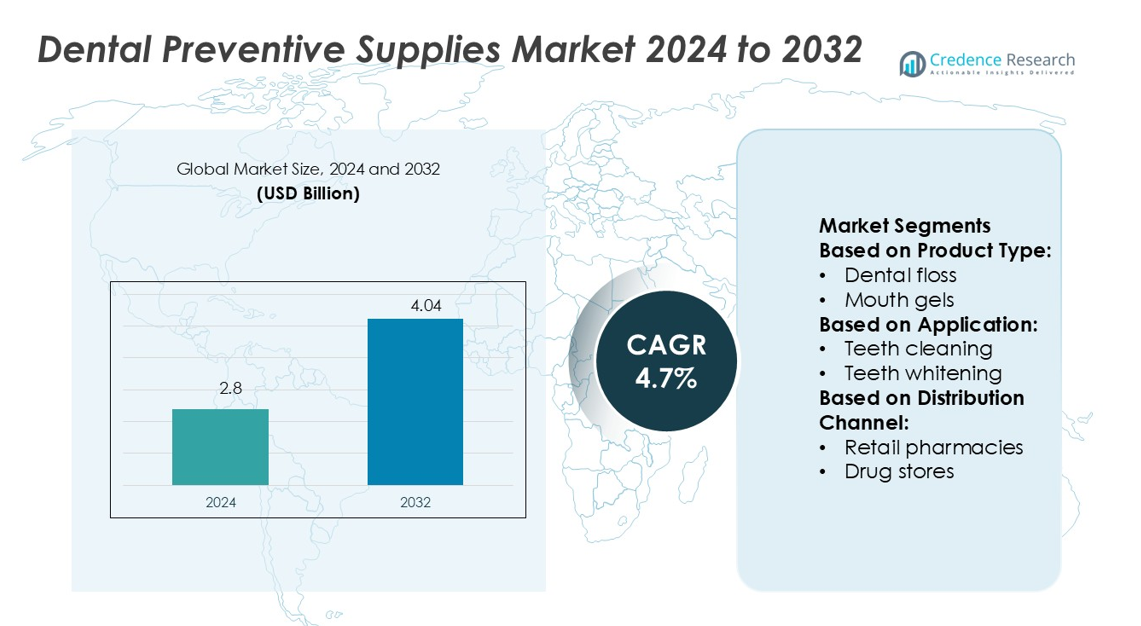
Dental Preventive Supplies Market size was valued USD 2.8 billion in 2024 and is anticipated to reach USD 4.04 billion by 2032, at a CAGR of 4.7% during the forecast period.
| REPORT ATTRIBUTE | DETAILS |
|---|---|
| Historical Period | 2020-2023 |
| Base Year | 2024 |
| Forecast Period | 2025-2032 |
| Dental Preventive Supplies Market Size 2024 | USD 2.8 billion |
| Dental Preventive Supplies Market, CAGR | 4.7% |
| Dental Preventive Supplies Market Size 2032 | USD 4.04 billion |
The Dental Preventive Supplies Market is shaped by major companies including Ivoclar Vivadent, Johnson & Johnson, Hu-Friedy Mfg. Co., LLC., Haleon, Colgate-Palmolive Company, 3M Company, Henry Schein, Inc., GC International AG, Church & Dwight Co., and Dentsply Sirona Inc. These players focus on developing advanced fluoride varnishes, whitening solutions, and sealants to strengthen their competitive positions. Strategic investments in R&D, sustainable formulations, and digital distribution are key strategies driving growth. North America leads the global market with a 34.5% share in 2025, supported by strong dental infrastructure, early adoption of preventive care, and a well-established retail pharmacy network.
Market Insights
- The Dental Preventive Supplies Market was valued at USD 2.8 billion in 2024 and is projected to reach USD 4.04 billion by 2032, growing at a CAGR of 4.7%.
- Strong demand for fluoride varnishes and whitening solutions is driving market growth, supported by rising preventive care awareness and expanding access to affordable dental products.
- E-commerce expansion, sustainable product development, and growing cosmetic dentistry trends are shaping market strategies and consumer behavior.
- The market is competitive, with major players focusing on innovation, strategic partnerships, and distribution expansion to strengthen their global presence.
- North America leads with a 34.5% share in 2025, followed by Europe at 28.3% and Asia Pacific at 24.7%, while dental fluorides and varnishes hold the largest segment share.
Market Segmentation Analysis:
By Product Type
Dental fluorides and varnish hold the largest share of the Dental Preventive Supplies Market, capturing 34.6% in 2025. This dominance is driven by rising awareness of fluoride’s role in preventing tooth decay and strengthening enamel. Fluoride treatments are widely adopted in preventive dental care programs and pediatric dentistry. Sealants and tooth whitening products are also seeing strong demand as patients focus more on oral aesthetics and long-term protection. Growing investments in dental hygiene campaigns and the launch of advanced fluoride-based formulations continue to boost this segment’s growth across developed and emerging markets.
- For instance, VOCO introduced its Profluorid Varnish system, which contains 22,600 ppm fluoride in a single-unit dose, enabling precise enamel protection and easier application in pediatric treatments.
By Application
Teeth cleaning remains the dominant application segment, accounting for 43.2% of the market share in 2025. Increased emphasis on oral hygiene and preventive care drives consistent demand for cleaning products such as fluoride varnishes, prophylactic pastes, and mouth gels. Dental professionals recommend routine cleanings to prevent plaque buildup and reduce caries risk. Teeth whitening and coating applications are also gaining popularity due to rising cosmetic dentistry trends. Expanding access to affordable preventive treatments in clinics and home-use kits further supports the segment’s strong position.
- For instance, Hu-Friedy launched its Harmony™ Ergonomic Scalers and Curettes, engineered with TrueFit™ Technology that analyzed 2,878,320 data points of pinch force and scaling pressure during development.
By Distribution Channel
Retail pharmacies dominate the distribution landscape, holding 39.7% of the market share in 2025. Consumers prefer pharmacies for trusted brands, easy availability, and professional recommendations. Drug stores follow closely, supported by strong penetration in urban and semi-urban regions. E-commerce is expanding rapidly, fueled by convenience, competitive pricing, and digital promotions. The growth of online dental care brands and subscription-based preventive kits is expected to further strengthen e-commerce’s role. However, retail pharmacies remain the primary channel for clinical-grade preventive dental supplies.
Key Growth Drivers
Rising Awareness of Preventive Oral Care
Growing awareness of preventive dental care is driving demand for dental fluorides, varnishes, and sealants. Governments and dental associations are promoting regular oral hygiene practices through campaigns and school programs. Patients are shifting focus from curative to preventive care, supporting steady product adoption. Dental professionals increasingly recommend fluoride varnishes and prophylactic pastes during routine checkups. This shift reduces long-term treatment costs and improves oral health outcomes. Strong educational efforts and expanding insurance coverage further accelerate product penetration across developed and emerging markets.
- For instance, Colgate’s in vitro viral inactivation trials, their stannous fluoride toothpaste reduced parainfluenza virus titers by 99.98% at 30 seconds and 99.99% at 120 seconds.
Expansion of Cosmetic and Aesthetic Dentistry
Rising interest in dental aesthetics is fueling demand for whitening and desensitizing products. Consumers are prioritizing brighter smiles, boosting the use of over-the-counter and clinic-based whitening solutions. Dental clinics offer advanced whitening procedures, creating strong demand for professional-grade preventive supplies. This growth is reinforced by new formulations that offer fast results with minimal sensitivity. Influencer marketing and digital campaigns amplify product visibility. The cosmetic trend aligns with preventive goals, driving strong growth for whitening and cleaning solutions in both retail and clinical settings.
- For instance, 3M’s Fast Release Varnish contains 22,600 ppm sodium fluoride and is delivered in 0.4 mL unit-dose trays (about 9 mg fluoride ion) for precise dosing.
Technological Advancements in Dental Materials
Continuous innovation in dental preventive materials enhances treatment effectiveness and patient comfort. Advanced fluoride varnishes and sealants now provide longer-lasting protection and easier application. New bioactive materials help strengthen enamel while reducing the risk of caries. Manufacturers are investing in research to improve product safety and efficacy. These developments align with clinical needs for quick application and better patient outcomes. The growing integration of advanced formulations across both pediatric and adult dental care strengthens market growth prospects globally.
Key Trends & Opportunities
Growth of E-commerce Dental Products
E-commerce is emerging as a major distribution channel for dental preventive supplies. Online platforms offer a wide product range, competitive pricing, and doorstep delivery. Consumers prefer trusted brands and subscription-based oral care kits. Dental professionals also use online procurement channels for clinical-grade products. The ease of comparison, bundled offers, and digital marketing strategies are boosting online sales. This trend creates opportunities for manufacturers to expand direct-to-consumer models and enhance brand visibility, especially in urban and semi-urban areas.
- For instance, Henry Schein, Inc. has continuously expanded its e-commerce ecosystem, with platforms offering over 300,000 branded and private-label SKUs covering preventive care, restorative materials, infection control, and hygiene consumables.
Rising Adoption of Pediatric Preventive Dentistry
Pediatric dentistry is gaining importance as early preventive measures reduce future dental complications. Fluoride varnishes, sealants, and gentle cleaning products are widely used for children. Governments and health organizations support preventive programs in schools and community centers. Parents are becoming more aware of the benefits of early oral care. Manufacturers are launching child-friendly formulations to improve acceptance and compliance. This focus on early prevention creates a sustained demand pipeline and supports market expansion in multiple regions.
- For instance, GC International AG markets MI Varnish®, a 5 % sodium fluoride varnish that also carries CPP-ACP (Recaldent®) to deliver bioavailable calcium, phosphate, and fluoride ions.
Key Challenges
High Cost of Advanced Preventive Products
The high cost of advanced preventive dental supplies limits adoption in low- and middle-income regions. Premium fluoride varnishes and whitening kits are often not covered by insurance, restricting patient access. Dental clinics face cost challenges in offering preventive treatments at scale. This pricing gap leads to unequal access between urban and rural populations. Manufacturers need cost-effective solutions to penetrate price-sensitive markets and support broader adoption.
Limited Access to Dental Care in Developing Regions
Access to preventive dental care remains limited in several developing countries. Shortages of dental professionals, low patient awareness, and underdeveloped distribution networks restrict market reach. Many patients seek treatment only when problems become severe, reducing preventive product uptake. Weak infrastructure and low insurance coverage further slow growth. Expanding training programs, improving supply chains, and supporting public health initiatives are critical to overcoming this barrier and achieving wider adoption.
Regional Analysis
North America
North America leads the Dental Preventive Supplies Market with a 34.5% share in 2025. High awareness of preventive oral care, strong insurance coverage, and regular dental checkups drive demand. The U.S. dominates due to advanced dental infrastructure and strong adoption of fluoride varnishes and whitening solutions. Pediatric preventive programs in schools further strengthen product penetration. E-commerce platforms and retail pharmacy networks enhance accessibility for consumers. Key manufacturers are investing in product innovation and targeted marketing strategies, supporting consistent growth. The region also benefits from early adoption of bioactive materials and advanced sealants.
Europe
Europe holds 28.3% of the Dental Preventive Supplies Market in 2025. The region benefits from strong regulatory support for oral care programs and growing adoption of fluoride-based products. Countries such as Germany, France, and the UK are major contributors due to established dental service networks and patient education campaigns. Whitening and desensitizing products are seeing increased uptake as cosmetic dentistry gains popularity. Universal healthcare systems and insurance coverage encourage preventive treatments. E-commerce and drug store channels are expanding access to quality products. Manufacturers also focus on sustainable and bio-friendly materials to meet regional environmental regulations.
Asia Pacific
Asia Pacific accounts for 24.7% of the Dental Preventive Supplies Market in 2025. Rising disposable income, expanding dental infrastructure, and growing awareness of oral hygiene are driving growth. Countries such as China, Japan, India, and South Korea show strong demand for fluorides, sealants, and whitening products. Governments are promoting preventive dentistry through school programs and awareness campaigns. The region has a fast-growing e-commerce sector, which improves product accessibility. Global manufacturers are expanding their presence to meet increasing urban and rural demand. Technological advancements and affordable pricing strategies are expected to further boost market penetration.
Latin America
Latin America holds 7.1% of the Dental Preventive Supplies Market in 2025. Brazil and Mexico lead regional demand with growing investments in dental clinics and preventive health programs. Rising middle-class income and increased awareness of dental hygiene support product adoption. Fluoride varnishes, desensitizers, and mouth gels are gaining popularity in urban centers. However, access in rural areas remains limited due to infrastructure gaps. Expanding pharmacy chains and e-commerce platforms are improving product reach. Manufacturers are focusing on affordable preventive solutions to strengthen their position in this price-sensitive market.
Middle East & Africa
The Middle East & Africa region captures 5.4% of the Dental Preventive Supplies Market in 2025. Market growth is supported by increasing healthcare investments and rising dental care awareness. Countries such as the UAE and South Africa are leading adoption with improved access to modern clinics. Fluoride varnishes and whitening kits are witnessing steady growth in urban centers. Limited access to dental services in rural areas remains a challenge. E-commerce and retail pharmacy expansions are improving product availability. Manufacturers are targeting partnerships with local distributors to tap into emerging demand across both segments.
Market Segmentations:
By Product Type:
- Dental floss
- Mouth gels
By Application:
- Teeth cleaning
- Teeth whitening
By Distribution Channel:
- Retail pharmacies
- Drug stores
By Geography
- North America
- U.S.
- Canada
- Mexico
- Europe
- Germany
- France
- U.K.
- Italy
- Spain
- Rest of Europe
- Asia Pacific
- China
- Japan
- India
- South Korea
- South-east Asia
- Rest of Asia Pacific
- Latin America
- Brazil
- Argentina
- Rest of Latin America
- Middle East & Africa
- GCC Countries
- South Africa
- Rest of the Middle East and Africa
Competitive Landscape
The Dental Preventive Supplies Market is shaped by key players including Ivoclar Vivadent, Johnson & Johnson, Hu-Friedy Mfg. Co., LLC., Haleon, Colgate-Palmolive Company, 3M Company, Henry Schein, Inc., GC International AG, Church & Dwight Co., and Dentsply Sirona Inc. The Dental Preventive Supplies Market is highly competitive, driven by rapid product innovation, strong brand positioning, and expanding global distribution. Companies are focusing on developing advanced fluoride varnishes, desensitizers, and bioactive sealants that offer long-lasting protection and improved patient experience. Strategic collaborations with dental service providers and e-commerce platforms are strengthening product accessibility and brand reach. Manufacturers are also emphasizing sustainable formulations and eco-friendly packaging to align with evolving regulatory standards. Continuous investment in R&D supports faster product launches and clinical validation. This competitive environment fosters technological advancement, enhances preventive care outcomes, and accelerates global market expansion.
Key Player Analysis
- Ivoclar Vivadent
- Johnson & Johnson
- Hu-Friedy Mfg. Co., LLC.
- Haleon
- Colgate-Palmolive Company
- 3M Company
- Henry Schein, Inc.
- GC International AG
- Church & Dwight Co.
- Dentsply Sirona Inc.
Recent Developments
- In June 2024, Ivoclar launched the Vivadent aerosol reduction gel to improve the experience of ultrasonic tooth cleaning and enhance prophylactic abilities at the dental practice. The gel is colorless and water-based and does not leave tooth stains or cling to clothing or surfaces.
- In January 2024, DentaSEAL Pro introduced its derivative, ‘clinical care innovation,’ which coincided with the launch of a next-generation sealant and a first-of-its-kind appliance topcoat.
- In January 2024, Dentsply Sirona entered into a four-year partnership with the International Association for Disability & Oral Health (iADH) to increase oral care access for people with disabilities.
- In January 2024, Align Technology, Inc. announced the launch of iTero Lumina intraoral scanner with a 3X wider field of capture in a 50% smaller and 45% lighter wand to deliver faster scanning speed, superior visualization, higher accuracy, and a more comfortable scanning experience
Report Coverage
The research report offers an in-depth analysis based on Product Type, Application, Distribution Channel and Geography. It details leading market players, providing an overview of their business, product offerings, investments, revenue streams, and key applications. Additionally, the report includes insights into the competitive environment, SWOT analysis, current market trends, as well as the primary drivers and constraints. Furthermore, it discusses various factors that have driven market expansion in recent years. The report also explores market dynamics, regulatory scenarios, and technological advancements that are shaping the industry. It assesses the impact of external factors and global economic changes on market growth. Lastly, it provides strategic recommendations for new entrants and established companies to navigate the complexities of the market.
Future Outlook
- Preventive dental care will gain stronger focus through public health initiatives and awareness programs.
- Demand for fluoride varnishes and sealants will increase in both developed and emerging markets.
- E-commerce platforms will play a bigger role in product distribution and consumer engagement.
- Technological innovations will improve product effectiveness, ease of application, and patient comfort.
- Cosmetic dentistry trends will continue to drive whitening and desensitizing product adoption.
- Sustainable and eco-friendly dental products will gain higher market preference.
- Pediatric preventive dentistry programs will expand, strengthening early oral care adoption.
- Strategic partnerships with dental clinics and retailers will enhance product reach.
- Emerging markets will contribute significantly to overall market growth.
- Digital marketing and subscription-based preventive kits will shape future consumer buying patterns.

Request a Free Sample
Fill in your details and we'll send you a free sample report.
- Sample data tables & charts
- Research methodology
Market Dynamics
Rising Awareness of Preventive Oral Care
Government campaigns, dental associations, and insurance coverage are increasing public understanding of the importance of preventive dental care, leading to higher adoption of fluoride varnishes, sealants, and other preventive supplies.
Expansion of Cosmetic and Aesthetic Dentistry
Growing consumer interest in dental aesthetics is boosting demand for whitening and desensitizing products, with both over-the-counter and professional-grade solutions seeing increased uptake in clinics and retail channels.
Technological Advancements in Dental Materials
Continuous innovation in fluoride varnishes, sealants, and bioactive materials is improving product efficacy, ease of application, and patient comfort, encouraging both dental professionals and consumers to adopt advanced preventive solutions.
Growth of E-commerce Dental Products
The rapid expansion of e-commerce platforms is making dental preventive supplies more accessible, offering consumers a wide range of products, competitive pricing, and convenient delivery, while enabling manufacturers to reach new markets directly.
Rising Adoption of Pediatric Preventive Dentistry
Early intervention through school programs and child-friendly formulations is increasing the use of preventive dental supplies among children, supporting long-term oral health and creating a sustained demand pipeline.
Need a Custom Version of This Report?
Tailor the scope, geography, or segments to your exact requirements.
- Custom geography or segment scope
- Direct access to our analyst team
Frequently Asked Questions
What is the current market size for Dental Preventive Supplies Market, and what is its projected size in 2032?
At what Compound Annual Growth Rate is the Dental Preventive Supplies Market projected to grow between 2025 and 2032?
Which Dental Preventive Supplies Market segment held the largest share in 2024?
What are the primary factors fueling the growth of the Dental Preventive Supplies Market?
How can consumers make informed choices when selecting dental preventive supplies?
Table of Content
Chapter 1 Market Segmentation
- 1.1 Segmentation Framework
- 1.1.1 Product and Service Classification
- 1.1.2 Application and End-Use Classification
- 1.1.3 Technology and Solution Classification
- 1.1.4 Customer and Distribution Channel Classification
- 1.1.5 Geographic Segmentation
- 1.1.6 Market Segment Definitions and Boundaries
- 1.2 By Application
- 1.2.1 Teeth cleaning
- 1.2.2 Teeth whitening
- 1.2.3 Teeth coating
- 1.3 By Product Type
- 1.3.1 Dental fluorides and varnish
- 1.3.2 Sealants
- 1.3.3 Tooth whitening products
- 1.3.4 Dental floss
- 1.3.5 Mouth gels
Chapter 2 Introduction
- 2.1 Report Objectives and Scope
- 2.2 Product Definition and Industry Terminology
- 2.3 Market Inclusions and Exclusions
- 2.4 Research Process
- 2.4.1 Primary Research and Expert Interviews
- 2.4.2 Secondary Research and Source Review
- 2.4.3 Top-Down and Bottom-Up Estimation
- 2.4.4 Data Triangulation and Verification
- 2.5 Market Size Measurement Basis
- 2.5.1 2024: USD 2.8 billion → 2032: USD 4.04 billion
- 2.6 Historical and Forecast Reference Periods
- 2.6.1 Base Year: 2024
- 2.6.2 Forecast Period: 2024-2032
- 2.7 Research Assumptions and Limitations
Chapter 3 Executive Summary
- 3.1 Market Snapshot and Key Findings
- 3.2 Base-Year Market Size, 2024
- 3.3 Forecast Market Size, 2032
- 3.4 Revenue and Volume Growth Outlook
- 3.5 Key Demand and Supply Indicators
- 3.6 Leading Market Segments
- 3.7 Fastest-Growing Market Opportunities
- 3.8 Regional Performance Highlights
- 3.9 Technology and Industry Transformation
- 3.10 Competitive Landscape Summary
- 3.11 Analyst View and Strategic Implications
Chapter 4 Global Dental Preventive Supply Market Trends and Developments
- 4.1 Historical Industry Development
- 4.2 Recent Market Trends and Developments
- 4.3 Demand and Customer Behavior Trends
- 4.4 Technology and Product Innovation
- 4.5 Artificial Intelligence, Automation and Digitalization
- 4.6 Local Manufacturing and Supply Chain Realignment
- 4.7 Industry Partnerships, Mergers and Acquisitions
- 4.8 Sustainability and Circular Economy Developments
- 4.9 Government and Private Sector Investment Trends
- 4.10 Emerging Business Models and Commercialization
- 4.11 Industry Developments and Announcements
Chapter 5 Global Dental Preventive Supply Market Production, Supply and Demand Analysis
- 5.1 Demand Trend and Consumption Analysis
- 5.2 Demand Forecast, 2024-2032
- 5.3 Production and Output Trend
- 5.4 Production and Output Forecast, 2024-2032
- 5.5 Installed Capacity and Capacity Utilization
- 5.6 Company-Wise Production Plants and Statistics
- 5.6.1 Installed Production Capacity
- 5.6.2 Actual Production
- 5.6.3 Planned Capacity and Expansion Targets
- 5.7 Supply Chain Structure and Procurement Trends
- 5.8 Supply-Demand Gap and Bottlenecks
- 5.9 Import Dependence and Sourcing Structure
- 5.10 Contract Manufacturing and Outsourcing
- 5.11 Regional Supply and Demand Concentration
Chapter 6 Global Dental Preventive Supply Market Pricing Analysis
- 6.1 Pricing Structure and Measurement
- 6.2 Historical Pricing Trends
- 6.3 Pricing Outlook, 2024-2032
- 6.4 Average Selling Price and Unit Economics
- 6.5 Pricing by Product and Market Segment
- 6.6 Geographic Pricing Differences
- 6.7 Key Input, Energy, Labor and Logistics Costs
- 6.8 Contract Pricing and Purchasing Models
- 6.9 Pricing Sensitivity and Competitive Positioning
- 6.10 Price, Margin and Profitability Implications
Chapter 7 Global Dental Preventive Supply Market Dynamics
- 7.1 Market Growth Drivers
- 7.1.1 Demand-Side Drivers
- 7.1.2 Technology and Innovation Drivers
- 7.1.3 Infrastructure and Investment Drivers
- 7.1.4 Regulatory and Policy Drivers
- 7.2 Market Restraints
- 7.2.1 Cost and Affordability Constraints
- 7.2.2 Technology and Adoption Barriers
- 7.2.3 Supply Chain and Operational Constraints
- 7.3 Market Challenges
- 7.3.1 Competitive Pressure and Margin Erosion
- 7.3.2 Skills, Infrastructure and Implementation Gaps
- 7.4 Emerging Market Opportunities
- 7.5 Market Dynamics Impact and Time-Horizon Assessment
Chapter 8 Global Dental Preventive Supply Value Chain Analysis
- 8.1 Industry Value Chain Overview
- 8.2 Upstream Suppliers and Critical Inputs
- 8.3 Technology and Component Providers
- 8.4 Manufacturing or Service Delivery
- 8.5 Distribution, Channel Partners and Integrators
- 8.6 Downstream Applications and End Users
- 8.7 Value Addition and Profit Pools
- 8.8 Vertical Integration and Outsourcing
- 8.9 Supplier Concentration and Risk
- 8.10 Supply Chain Localization and Resilience
Chapter 9 Global Dental Preventive Supply Market Regulations and Policies
- 9.1 Relevant Laws, Standards and Compliance Frameworks
- 9.2 Product, Service, Safety and Quality Requirements
- 9.3 Government Policies, Incentives and Subsidies
- 9.4 Imports, Exports and Trade Barriers
- 9.5 Public Procurement and Local Content Requirements
- 9.6 Environmental and Sustainability Compliance
- 9.7 Upcoming Policy Changes and Market Implications
Chapter 10 Global Dental Preventive Supply Market Hotspots and Opportunities
- 10.1 Market Opportunity Mapping and Growth Hotspots
- 10.2 High-Growth Applications and Customer Groups
- 10.3 Underserved Markets and White-Space Opportunities
- 10.4 Emerging Technology and Product Opportunities
- 10.5 New Capacity and Investment Hotspots
- 10.6 Market Entry and Expansion Opportunities
- 10.7 Distribution and Partnership Opportunities
- 10.8 Near-Term and Long-Term Commercial Potential
- 10.9 Opportunity Attractiveness and Execution Risks
Chapter 11 Global Dental Preventive Supply Market Outlook, 2024-2032
- 11.1 Market Size and Analysis
- 11.1.1 Revenue (Market Measurement: 2024: USD 2.8 billion → 2032: USD 4.04 billion)
- 11.1.2 Market Volume and Quantity Sold
- 11.1.3 Historical Market Size
- 11.1.4 Base-Year Market Size, 2024
- 11.2 Market Forecast, 2024-2032
- 11.2.1 Revenue Forecast to 2032
- 11.2.2 Volume Forecast to 2032
- 11.2.3 CAGR and Year-on-Year Growth
- 11.2.4 Incremental Revenue Opportunity
- 11.3 Forecast Assumptions and Scenario Analysis
- 11.3.1 Base-Case Forecast
- 11.3.2 Optimistic and Conservative Scenarios
- 11.3.3 Technology, Pricing and Policy Sensitivities
- 11.4 Market Attractiveness and Growth Outlook
Chapter 12 Global Dental Preventive Supply Market Segmentation and Outlook
- 12.1 Segmentation Summary and Market Shares, 2024
- 12.2 Largest and Fastest-Growing Segments
- 12.3 By Application - Market Size and Forecast, 2024-2032
- 12.3.1 Segment Definition and Scope
- 12.3.2 Historical Market Size
- 12.3.3 Revenue Forecast, 2024-2032
- 12.3.4 Volume Forecast, 2024-2032
- 12.3.5 Base-Year Market Share, 2024
- 12.3.6 Segment CAGR and Growth Drivers
- 12.3.7 Subsegment Market Size and Forecast
- 12.3.7.1 Teeth cleaning
- 12.3.7.2 Teeth whitening
- 12.3.7.3 Teeth coating
- 12.3.8 Subsegment Pricing and Adoption Trends
- 12.3.9 Leading Suppliers and Competition
- 12.3.10 Regional Demand and Opportunities
- 12.4 By Product Type - Market Size and Forecast, 2024-2032
- 12.4.1 Segment Definition and Scope
- 12.4.2 Historical Market Size
- 12.4.3 Revenue Forecast, 2024-2032
- 12.4.4 Volume Forecast, 2024-2032
- 12.4.5 Base-Year Market Share, 2024
- 12.4.6 Segment CAGR and Growth Drivers
- 12.4.7 Subsegment Market Size and Forecast
- 12.4.7.1 Dental fluorides and varnish
- 12.4.7.2 Sealants
- 12.4.7.3 Tooth whitening products
- 12.4.7.4 Dental floss
- 12.4.7.5 Mouth gels
- 12.4.8 Subsegment Pricing and Adoption Trends
- 12.4.9 Leading Suppliers and Competition
- 12.4.10 Regional Demand and Opportunities
- 12.5 Segment Growth Comparison
- 12.6 Segment Attractiveness and Priority Matrix
Chapter 13 Global Dental Preventive Supply End-Use and Application Market Outlook
- 13.1 End-Use Industry and Customer Demand Structure
- 13.2 Leading Applications and Customer Groups
- 13.3 End-Use Market Size, Share and Forecast
- 13.4 Major End-Use Industry Deep Dives
- 13.4.1 Customer Requirements and Use Cases
- 13.4.2 Demand and Replacement Cycles
- 13.4.3 Technical and Regulatory Considerations
- 13.4.4 Purchasing and Procurement Models
- 13.4.5 Leading Vendors and Distribution Channels
- 13.4.6 Forecast and Commercial Opportunities
- 13.5 Emerging Applications and Cross-Segment Demand
- 13.6 End-Use Industry Investment Priorities
Chapter 14 Global Dental Preventive Supply Geographic Market Outlook, 2024-2032
- 14.1 Regional Market Size and Share, 2024
- 14.2 Regional Market Forecast, 2024-2032
- 14.3 Regional Pricing, Production and Demand Differences
- 14.4 North America
- 14.4.1 United States
- 14.4.2 Canada
- 14.4.3 Mexico
- 14.5 Europe
- 14.5.1 Germany
- 14.5.2 France
- 14.5.3 Italy
- 14.5.4 United Kingdom
- 14.5.5 Spain
- 14.5.6 Poland
- 14.5.7 Russia
- 14.5.8 Netherlands
- 14.5.9 Belgium
- 14.5.10 Sweden
- 14.5.11 Denmark
- 14.5.12 Norway
- 14.5.13 Rest of Europe
- 14.6 Asia Pacific
- 14.6.1 China
- 14.6.2 India
- 14.6.3 Japan
- 14.6.4 South Korea
- 14.6.5 Thailand
- 14.6.6 Indonesia
- 14.6.7 Vietnam
- 14.6.8 Malaysia
- 14.6.9 Australia
- 14.6.10 Rest of Asia Pacific
- 14.7 Latin America
- 14.7.1 Brazil
- 14.7.2 Argentina
- 14.7.3 Colombia
- 14.7.4 Chile
- 14.7.5 Rest of Latin America
- 14.8 Middle East
- 14.8.1 Saudi Arabia
- 14.8.2 United Arab Emirates
- 14.8.3 Turkey
- 14.8.4 Israel
- 14.8.5 Iran
- 14.8.6 Rest of the Middle East
- 14.9 Africa
- 14.9.1 South Africa
- 14.9.2 Egypt
- 14.9.3 Nigeria
- 14.9.4 Morocco
- 14.9.5 Rest of Africa
- 14.10 Regional Investment, Policy and Supply Chain Differences
- 14.11 Regional Competitive Landscape
- 14.12 Geographic Growth Hotspots
Chapter 15 Global Dental Preventive Supply Technology, Innovation and Sustainability Outlook
- 15.1 Technology Landscape and Maturity
- 15.2 Product, Process and Service Innovation
- 15.3 AI, Automation and Digital Tools in the Industry
- 15.4 Technology Adoption and Performance Benchmarking
- 15.5 Innovation Pipeline and R&D Investment
- 15.6 Patent and Intellectual Property Trends
- 15.7 Energy Efficiency and Resource Management
- 15.8 Sustainability, Recycling and Circularity
- 15.9 Technology Roadmap, 2024-2032
- 15.10 Risks of Obsolescence and Technology Substitution
Chapter 16 Global Dental Preventive Supply Market Key Strategic Imperatives
- 16.1 Growth and Market Entry Priorities
- 16.2 High-Return Products and Segments
- 16.3 Pricing, Profitability and Cost Optimization
- 16.4 Technology Investment and Product Differentiation
- 16.5 Supply Chain Localization and Resilience
- 16.6 Distribution and Customer Acquisition
- 16.7 Partnership, Acquisition and Capacity Strategy
- 16.8 Regional Expansion Priorities
- 16.9 Short-, Medium- and Long-Term Actions
Chapter 17 Competition Outlook
- 17.1 Industry Competition Characteristics
- 17.2 Market Structure and Concentration
- 17.3 Market Share and Competitive Positioning, 2024
- 17.4 Company-Wise Revenue and Product Benchmarking
- 17.5 Production and Service Capacity Benchmarking
- 17.6 Technology, Pricing and Differentiation
- 17.7 Regional Footprint and Distribution Strength
- 17.8 Mergers, Acquisitions and Strategic Alliances
- 17.9 New Entrants and Competitive Threats
- 17.10 Porter's Five Forces and Industry Attractiveness
- 17.11 Competitive Outlook, 2024-2032
Chapter 18 Company Profiles
- 18.1 Company Coverage and Selection Criteria
- 18.2 Ivoclar Vivadent
- 18.2.1 Business Description
- 18.2.2 Company Ownership and Geographic Presence
- 18.2.3 Product and Service Portfolio
- 18.2.4 Manufacturing and Operating Footprint
- 18.2.5 Production Capacity and Expansion Plans
- 18.2.6 Financial Performance and Investment
- 18.2.7 Market Share and Competitive Position
- 18.2.8 Technology and Innovation Capabilities
- 18.2.9 Strategic Alliances or Partnerships
- 18.2.10 Recent Developments
- 18.2.11 Growth Strategy and Outlook
- 18.3 Johnson & Johnson
- 18.4 Hu-Friedy Mfg. Co., LLC.
- 18.5 Haleon
- 18.6 Colgate-Palmolive Company
- 18.7 3M Company
- 18.8 Henry Schein, Inc.
- 18.9 GC International AG
- 18.10 Church & Dwight Co.
- 18.11 Dentsply Sirona Inc.
- 18.12 Other Relevant Market Participants
Note: Every listed company is profiled on the structure shown under the first company. The company list is preliminary and may change based on research findings, market developments, data availability and client requirements.
Chapter 19 Disclaimer
- 19.1 Research and Forecast Disclaimer
- 19.2 Data Source and Estimation Limitations
Note: The depth of individual sections depends on data availability for this market. Volume, capacity, trade and other unit-based metrics are included where applicable.

