
Depth Filteration Market Overview:
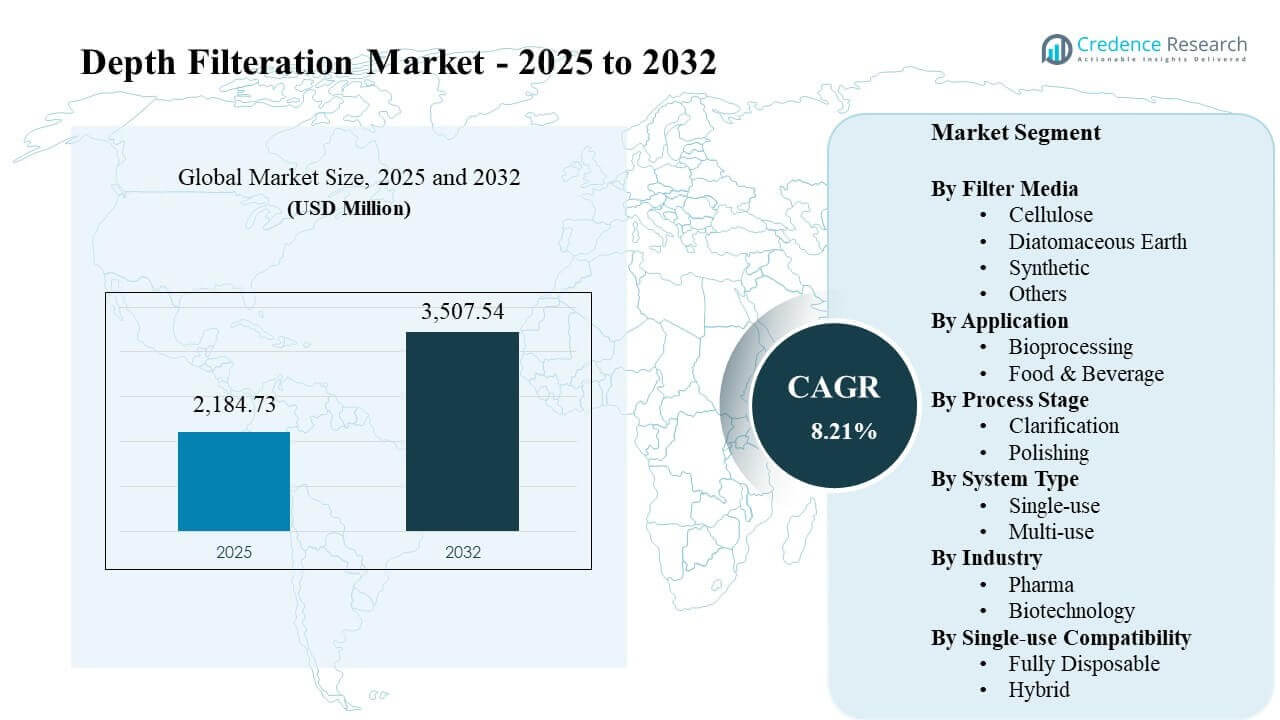
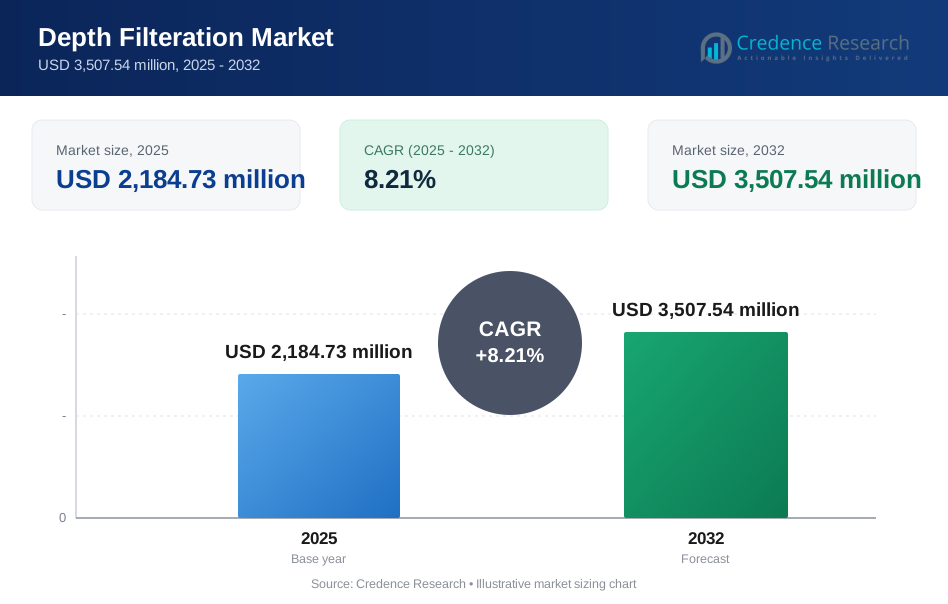
The global Depth Filteration Market size was estimated at USD 2,184.73 million in 2025 and is expected to reach USD 3,507.54 million by 2032, growing at a CAGR of 8.21% from 2025 to 2032. Growth is primarily driven by rising filtration intensity across bioprocessing as manufacturers scale biologics output and tighten upstream clarification requirements ahead of downstream purification. Expansion of single-use processing platforms and capacity additions across major biologics hubs also support steady replacement demand for depth media and assemblies.
| REPORT ATTRIBUTE | DETAILS |
|---|---|
| Historical Period | 2020-2024 |
| Base Year | 2025 |
| Forecast Period | 2026-2032 |
| Depth Filteration Market Size 2025 | USD 2,184.73 million |
| Depth Filteration Market, CAGR | 8.21% |
| Depth Filteration Market Size 2032 | USD 3,507.54 million |
Key Market Trends & Insights
- The Depth Filteration Market is projected to expand from USD 2,184.73 million in 2025 to USD 3,507.54 million by 2032, reflecting an 8.21% CAGR during 2025–2032.
- North America represented 33.2% of revenue in 2025, supported by high filtration intensity across regulated manufacturing footprints.
- Asia Pacific captured 28.3% of revenue in 2025 and is increasingly shaped by biologics capacity expansion and broader industrial processing demand.
- Cellulose accounted for the largest Filter Media share at 44.6% in 2025, reflecting broad qualification across clarification trains and strong cost-performance balance.
- Bioprocessing led Application demand with a 40.7% share in 2025, driven by upstream cell and debris removal needs ahead of downstream steps.
Segment Analysis
Depth filtration demand is closely tied to clarification and impurity-management requirements in bioprocessing and adjacent regulated manufacturing workflows. Increased batch throughput, higher cell densities, and tighter downstream protection needs are elevating the role of depth media as a core pre-treatment step. Procurement decisions often prioritize validated performance, supply assurance, and predictable lifecycle cost across high-consumption consumables. Standardization across facilities and CDMO networks also supports repeat purchasing of qualified media and formats.
Technology adoption is increasingly shaped by single-use processing models that reduce cleaning validation burden and accelerate changeovers between campaigns. Buyers continue to evaluate filtration trains as integrated systems, balancing depth stages with membranes, chromatography protection, and final filtration needs. Media engineering and format innovation are also supporting better handling, reduced changeout frequency, and improved robustness in variable feed streams. Sustainability requirements are beginning to influence materials selection and waste reduction initiatives across single-use-heavy operation.
By Filter Media Insights
Cellulose accounted for the largest share of 44.6% in 2025. Cellulose-based media remains widely qualified in clarification workflows, supporting consistent validation practices across regulated manufacturing. Broad availability and mature supply chains help reduce procurement risk for high-volume operations. The performance-cost balance fits applications where throughput, dirt-holding capacity, and predictable batch outcomes matter. Continued optimization of media structures and formats helps sustain cellulose adoption across mainstream use cases.
By Application Insights
Bioprocessing accounted for the largest share of 40.7% in 2025. Bioprocessing requires robust removal of cells, debris, and colloids upstream of downstream purification steps that are sensitive to fouling. Growth in biologics manufacturing increases filtration intensity per batch and supports recurring demand for depth consumables. Single-use assemblies align with contamination-control priorities and faster turnaround between campaigns. CDMO expansion also increases multi-client changeovers that favor reliable, validated depth filtration solutions.
By Process Stage Insights
Clarification and polishing demand is shaped by the feed stream profile, target product sensitivity, and overall design of filtration trains. Clarification typically anchors upstream removal of cells and high particulate loads to stabilize downstream unit operations. Polishing becomes more important when facilities require tighter particulate control to protect membranes and chromatography steps. Stage selection is often influenced by total cost of ownership, changeover cadence, and the facility’s approach to validation and batch documentation.
By System Type Insights
Single-use systems continue to gain attention because disposable assemblies reduce cleaning validation burden and can shorten campaign turnaround times. Disposable configurations also support contamination-risk mitigation in multiproduct sites and outsourced manufacturing models. Multi-use systems remain relevant in settings where reusable hardware economics are attractive for steady, high-volume operations. Supplier innovation increasingly focuses on modular platforms that scale capacity while maintaining predictable performance across changing process requirements.
By Industry Insights
Pharma and biotechnology demand is anchored in regulated manufacturing environments that prioritize consistent performance and validated process control. Biotechnology activity can elevate depth filtration needs due to high filtration intensity during development, scale-up, and production of biologics and advanced therapies. Pharmaceutical manufacturing sustains demand through sterile processing requirements and strong quality management systems. Industry purchasing behavior is also influenced by long qualification cycles, supplier reliability, and the ability to support process characterization and troubleshooting.
By Single-use Compatibility Insights
Fully disposable and hybrid models are adopted based on facility infrastructure, validation approaches, and operating preferences for changeover speed. Fully disposable configurations align with rapid campaign changeovers and multiproduct environments seeking stronger contamination control. Hybrid systems remain common where reusable housings are retained, paired with disposable media formats for operational flexibility. Sustainability requirements are beginning to influence compatibility decisions through material redesign, waste reduction efforts, and circularity-oriented initiatives.
Depth Filteration Market Drivers
Bioprocessing capacity additions and higher filtration intensity
Bioprocessing scale-up is increasing filtration intensity because higher cell densities and complex feeds require stronger upstream clarification performance. Depth filtration remains a key protection step for downstream purification and membrane filtration. Manufacturing networks are also expanding capacity, which increases recurring demand for qualified media and assemblies. Contract manufacturing growth supports additional changeovers and frequent consumable replacement across multi-client operations.
- For instance, Pall reported that its Stax mAx clarification platform reduced the number of capsules required per batch by 25% to 50% versus HP-series double-layer, single-stage depth filtration systems, and its process-scale Stax assembly delivered volumetric throughput within 2% at a differential pressure of 1.0 bar during scale-up testing.
Shift toward single-use processing and faster changeovers
Single-use adoption supports depth filtration demand by reducing cleaning validation burden and accelerating turnaround time between campaigns. Disposable assemblies can lower cross-contamination risk in multiproduct facilities and enable more flexible scheduling. Facilities focused on rapid product changeovers often prefer standardized, validated consumables. Single-use platform growth also expands demand for integrated filtration formats designed for modular, scalable processing.
- For instance, Merck states that its Millistak+ Pod depth filter system scales up to 20,000 L, while its process-scale holder accepts 5 to 10 Pod filters per rack and allows up to 3 racks to be stacked for flexible single-use deployment.
Tighter quality expectations and process consistency requirements
Regulated manufacturing environments continue to prioritize validated filtration performance and consistent batch outcomes. Depth filtration supports control of turbidity, particulates, and colloids that can impact downstream yield and equipment reliability. Quality systems also reinforce documentation and traceability requirements that favor established suppliers and proven media. Standardized filtration trains across sites improve training consistency and reduce operational variability.
Broader industrial and food processing demand for robust clarification
Depth filtration supports high-solids and variable-feed applications that require durable, cost-effective clarification. Industrial processing and food and beverage operations rely on stable filtration performance to protect equipment and maintain output consistency. Facilities seek long service life and reduced changeout frequency to lower operating costs. As processing volumes rise, depth filtration consumption grows alongside preventive maintenance and performance optimization efforts.
Market Challenges
Depth filtration programs face operational challenges tied to feed variability, which can affect throughput, filter life, and batch predictability. Facilities must balance performance targets with total filtration cost, particularly when changeouts interrupt production schedules. Qualification and validation cycles can be lengthy, increasing switching costs and limiting rapid adoption of alternative media formats. Supply assurance and lead-time stability also remain important, especially for high-consumption consumables.
Waste management and sustainability constraints are becoming more visible, particularly in single-use-heavy workflows. Disposal requirements, regional regulations, and internal ESG targets can influence purchasing decisions and create additional cost considerations. Facilities also face the challenge of optimizing filtration trains without overdesigning stages that add complexity and cost. Skilled process support and application engineering often becomes a deciding factor in supplier selection.
Depth Filteration Market Trends and Opportunities
Single-use platform expansion is creating opportunities for modular depth filtration assemblies that integrate more easily with upstream and downstream unit operations. Buyers increasingly prefer standardized configurations that simplify installation, documentation, and operator training. Improvements in media structure, format design, and handling can help reduce changeout frequency and improve process robustness. These advances support stronger adoption across CDMOs and multi-site manufacturing networks.
- For instance, Sartorius states that its Sartoclear Dynamics single-use clarification technology can process cell-culture harvests up to 2,000 liters in a single-use format, replace centrifugation plus subsequent depth filtration in one step, and run at 300 L/m²/h; in one 1,000-liter CHO case study, the system delivered final turbidity of 8 NTU, 92% recovery, and 93% DNA removal.
Sustainability-led innovation is emerging as an opportunity for differentiation, especially through materials optimization and waste reduction programs. Suppliers that support circularity initiatives and provide lifecycle guidance can strengthen procurement positioning. Industrial and food processing demand also offers growth upside where robust depth filtration improves operational stability under variable feed conditions. Regional capacity buildouts in Asia Pacific can further expand qualification activity and long-term consumable demand.
Regional Insights
North America
North America represented 33.2% of revenue in 2025, supported by mature biopharmaceutical manufacturing capacity and strong adoption of validated filtration trains. Demand is reinforced by high filtration intensity across upstream clarification and downstream protection steps. CDMO concentration and multiproduct operations support frequent changeovers that increase consumable turnover. Procurement priorities often emphasize supply assurance, documentation support, and predictable performance across qualified configurations.
Europe
Europe accounted for 25.9% of revenue in 2025, supported by regulated manufacturing ecosystems and strong adoption of consistent process control practices. Filtration demand is shaped by quality expectations, standardization across multi-site operations, and a steady pipeline of biologics production. Buyers often emphasize lifecycle cost and robustness under repeated campaigns. Supplier selection is influenced by technical support capabilities and validated performance across varied feed streams.
Asia Pacific
Asia Pacific captured 28.3% of revenue in 2025, reflecting expanding biologics capacity and broader industrial processing growth. Regional manufacturers continue to invest in scalable processing platforms that increase depth filtration usage across clarification steps. Qualification activity supports recurring demand as facilities ramp output and standardize filtration trains. Procurement decisions often balance cost-performance requirements with reliability, lead times, and consistent supply.
Latin America
Latin America held 7.5% of revenue in 2025, supported by food and beverage processing demand and selective growth in healthcare manufacturing capabilities. Industrial clarification needs contribute to recurring demand for depth media and cartridges. Market development is influenced by investment cycles, availability of technical support, and distributor reach. Buyers often prioritize practical operating economics, service life, and ease of integration into existing processing lines.
Middle East & Africa
Middle East & Africa represented 5.1% of revenue in 2025, with demand tied to industrial processing and selective healthcare manufacturing localization initiatives. Growth momentum is supported by capacity additions in key subregions and modernization of processing infrastructure. Procurement decisions often emphasize reliability and fit with installed equipment bases. Supplier partnerships and service coverage can influence adoption where local technical resources are limited.
Competitive Landscape
Competition in the Depth Filteration Market is shaped by performance validation, breadth of media and format portfolios, and the ability to support customers with application engineering. Suppliers differentiate through supply assurance for high-consumption consumables, integration support for single-use platforms, and predictable filtration outcomes across campaigns. Product positioning also emphasizes handling, service life, and consistent batch performance under variable feed conditions. Sustainability-linked initiatives are increasingly influencing buyer evaluation criteria for single-use-compatible offerings.
Merck is positioned around supporting filtration needs across life science manufacturing with a focus on validated consumables, process support, and supply reliability. Portfolio depth across filtration formats supports deployment across clarification and protection steps in common manufacturing trains. Manufacturing expansions and operational scale can strengthen fulfillment performance for customers with high-volume consumable requirements. Application-oriented support helps reduce implementation risk during qualification and ongoing process optimization.
The industry research and growth report includes detailed analyses of the competitive landscape of the market and information about key companies, including:
- Merck
- Sartorius
- Pall
- 3M
- Eaton
- Parker Hannifin
- Donaldson
- Alfa Laval
- GE Healthcare
- Amazon Filters
Qualitative and quantitative analysis of companies has been conducted to help clients understand the wider business environment as well as the strengths and weaknesses of key industry players. Data is qualitatively analyzed to categorize companies as pure play, category-focused, industry-focused, and diversified; it is quantitatively analyzed to categorize companies as dominant, leading, strong, tentative, and weak.
Recent Developments
- In February 2025, Thermo Fisher Scientific announced a definitive agreement to acquire Solventum’s Purification & Filtration business for approximately $4.1 billion. In its announcement, Thermo Fisher said the acquisition would broaden its bioprocessing capabilities and that the business would become part of its Life Sciences Solutions segment after closing.
- In March 2025, Merck KGaA introduced a new line of virus-retentive depth filters for sterile bioprocessing and high-integrity clarification applications. In the same market update, this launch was identified as one of the recent developments among depth filter manufacturers.
- In March 2025, Sartorius AG announced a collaboration with Pall Corporation to co-develop next-generation depth filtration media for biologics manufacturing workflows. In the reported update, the partnership was highlighted as a recent strategic development in the depth filters market.
- In December 2024, Amazon Filters launched the SupaPore TMB vent filter for pharmaceutical and biotechnology applications. In the product coverage, the company said SupaPore TMB was designed for hot operating conditions such as sterile air venting and large-scale fermentation, where filters are exposed to sustained high temperatures.
Report Scope
| Report Attribute | Details |
| Market size value in 2025 | USD 2,184.73 million |
| Revenue forecast in 2032 | USD 3,507.54 million |
| Growth rate (CAGR) | 8.21% (2025–2032) |
| Base year | 2025 |
| Forecast period | 2026–2032 |
| Quantitative units | USD million |
| Segments covered | Filter Media Outlook: Cellulose, Diatomaceous Earth, Synthetic, Others; Application Outlook: Bioprocessing, Food & Beverage; Process Stage Outlook: Clarification, Polishing; System Type Outlook: Single-use, Multi-use; Industry Outlook: Pharma, Biotechnology; Single-use Compatibility Outlook: Fully Disposable, Hybrid |
| Regional scope | North America, Europe, Asia Pacific, Latin America, Middle East & Africa |
| Key companies profiled | Merck; Sartorius; Pall; 3M; Eaton; Parker Hannifin; Donaldson; Alfa Laval; GE Healthcare; Amazon Filters |
| No.of Pages | 338 |
Segmentation
By Filter Media
- Cellulose
- Diatomaceous Earth
- Synthetic
- Others
By Application
- Bioprocessing
- Food & Beverage
By Process Stage
- Clarification
- Polishing
By System Type
- Single-use
- Multi-use
By Industry
- Pharma
- Biotechnology
By Single-use Compatibility
- Fully Disposable
- Hybrid
By Region
- North America
- U.S.
- Canada
- Mexico
- Europe
- Germany
- France
- U.K.
- Italy
- Spain
- Rest of Europe
- Asia Pacific
- China
- Japan
- India
- South Korea
- South-east Asia
- Rest of Asia Pacific
- Latin America
- Brazil
- Argentina
- Rest of Latin America
- Middle East & Africa
- GCC Countries
- South Africa
- Rest of the Middle East and Africa
Request a Free Sample
Fill in your details and we'll send you a free sample report.
- Sample data tables & charts
- Research methodology
Need a Custom Version of This Report?
Tailor the scope, geography, or segments to your exact requirements.
- Custom geography or segment scope
- Direct access to our analyst team
Frequently Asked Questions
What is the market size and forecast for the Depth Filteration Market?
What is the CAGR for the Depth Filteration Market during 2025–2032?
What is the largest segment in the Depth Filteration Market?
What factors are driving growth in the Depth Filteration Market?
Which companies are profiled in the Depth Filteration Market report?
Which region leads the Depth Filteration Market?
Table of Content
Chapter 1. Report Introduction
- 1.1 Report Description & Purpose
- 1.1.1 Report Title & Market Definition
- 1.1.2 Unique Selling Propositions (USP) & Key Differentiators
- 1.1.3 Value Proposition for Stakeholders
- 1.2 Research Objectives
- 1.2.1 Market Sizing Objectives (Volume & Revenue)
- 1.2.2 Segmentation Objectives
- 1.2.3 Competitive Intelligence Objectives
- 1.2.4 Forecast & Scenario Objectives
- 1.3 Report Scope
- 1.3.1 Depth Filteration Scope – Types & Subtypes Covered
- 1.3.2 Geographic Scope – Regions & Countries Covered
- 1.3.3 Historical Period, Base Year & Forecast Period (2025; forecast to 2032)
- 1.3.4 Inclusions & Exclusions
- 1.4 HS Code & Classification Framework
- 1.5 Currency, Units & Pricing Basis
- 1.6 Target Stakeholders
- 1.7 Limitations & Assumptions
Chapter 2. Executive Summary
- 2.1 Global Depth Filteration Market Snapshot
- 2.1.1 Market Size – Historical (2025) & Forecast (2025-2032) (2025: USD 2,184.73 million → 2032: USD 3,507.54 million)
- 2.1.2 Volume & Revenue – Global Totals
- 2.1.3 Key Market Highlights – Top Five Facts
- 2.2 Depth Filteration Market Segmentation Snapshot
- 2.2.1 Market Split by Region – 2025 vs. 2032
- 2.3 Competitive Snapshot
- 2.3.1 Top 10 Players by Revenue Share – 2025
- 2.3.2 Top 10 Players by Volume Share – 2025
- 2.3.3 Recent Strategic Developments (18-Month Summary)
- 2.4 Key Investment Highlights & Strategic Conclusions
Chapter 3. Depth Filteration Market Dynamics & Industry Analysis
- 3.1 Market Overview & Context
- 3.1.1 Depth Filteration Market Position in the Broader Automotive Value Chain
- 3.1.2 OEM vs. Replacement Market Dynamics
- 3.1.3 Market Maturity & Development Stage by Region
- 3.2 Depth Filteration Market Drivers
- 3.3 Depth Filteration Market Restraints & Challenges
- 3.4 Depth Filteration Market Opportunities
- 3.5 Porter's Five Forces Analysis
- 3.5.1 Threat of New Entrants
- 3.5.2 Bargaining Power of Suppliers
- 3.5.3 Bargaining Power of Buyers
- 3.5.4 Threat of Substitutes
- 3.5.5 Competitive Rivalry – Intensity Assessment
- 3.6 Depth Filteration Value Chain Analysis
- 3.6.1 Upstream – Raw Material/Input Suppliers
- 3.6.1.1 Raw Material/Input 1
- 3.6.1.2 Raw Material/Input 2
- 3.6.1.3 Raw Material/Input 3
- 3.6.2 Midstream – Production/Manufacturing/Service Delivery
- 3.6.2.1 Production/Process Overview
- 3.6.2.2 Key Facility Locations & Capacity by Manufacturer
- 3.6.3 Downstream – Distribution & End Consumer
- 3.6.3.1 Primary Channel – B2B/OEM
- 3.6.3.2 Secondary Channels – Dealer, Retail, Online, Direct
- 3.6.4 Value Chain Profitability Analysis
- 3.6.1 Upstream – Raw Material/Input Suppliers
- 3.7 PESTEL Analysis
- 3.7.1 Political Factors
- 3.7.2 Economic Factors
- 3.7.3 Social Factors
- 3.7.4 Technological Factors
- 3.7.5 Environmental Factors
- 3.7.6 Legal Factors
- 3.8 Depth Filteration Supply Chain Analysis
- 3.8.1 Raw Material/Input Supply Risk Assessment
- 3.8.2 Manufacturing Concentration Risk (Geographic Exposure)
- 3.8.3 Trade Disruption Impact Analysis
- 3.9 Regulatory & Policy Landscape
Note: The regulatory and policy landscape section covers regulations based on their applicability to the market, Depth Filteration category, geography, and scope of the study. Only regulatory frameworks with a material impact on operations, compliance, trade, sustainability, or market access are analyzed in detail.
Chapter 4. Key Investment Pockets & Opportunity Analysis
- 4.1 Depth Filteration Market Attractiveness Analysis
- 4.1.1 By Region – Investment Attractiveness Matrix (Volume × CAGR)
- 4.2 Absolute Revenue Growth Opportunity
- 4.2.1 By Region – Absolute USD Growth Through 2032
- 4.3 Incremental Volume Opportunity
- 4.3.1 By Region – Incremental Volume Through 2032
- 4.3.2 Segment – Incremental Volume
- 4.4 Emerging Submarket Opportunity Deep Dive (Subject to Applicability)
- 4.5 Emerging Market Opportunity Scorecards
- 4.5.1 United States
- 4.5.2 Europe
- 4.5.3 Asia
- 4.5.4 Middle East & Africa
Note: Emerging Market Opportunity Scorecards will be included based on relevance and strategic importance. Regions listed are indicative and may vary depending on data availability and market dynamics.
Chapter 5. Depth Filteration Import-Export Analysis & Trade Flows
- 5.1 Global Trade Overview
- 5.1.1 Global Export Value by Country (2025)
- 5.1.2 Global Export Volume by Country (2025)
- 5.1.3 Global Import Value by Country (2025)
- 5.1.4 Global Import Volume by Country (2025)
- 5.1.5 Net Trade Balance by Country (2025)
- 5.2 Export Analysis – Segment
- 5.2.1 Type 1 (HS Code)
- 5.2.2 Type 2 (HS Code)
- 5.2.3 Type 3 (HS Code)
- 5.2.4 Type 4 (HS Code)
- 5.2.5 Type 5 (HS Code)
- 5.3 Import Analysis – Segment
- 5.3.1 Type 1 (HS Code)
- 5.3.2 Type 2 (HS Code)
- 5.3.3 Type 3 (HS Code)
- 5.3.4 Type 4 (HS Code)
- 5.3.5 Type 5 (HS Code)
- 5.4 Average Unit Trade Prices
- 5.4.1 Average Export Price – Segment & Country
- 5.4.2 Average Import Price – Segment & Source Country
- 5.4.3 Price Trends (2025)
- 5.5 Key Trade Route Analysis
- 5.5.1 Trade Route 1
- 5.5.2 Trade Route 2
- 5.5.3 Trade Route 3
- 5.5.4 Trade Route 4
- 5.5.5 Trade Route 5
- 5.6 Trade Policy Impact Assessment
- 5.6.1 US Anti-Dumping & Section 301 Tariffs
- 5.6.2 EU Customs Union Impact
- 5.6.3 Major Free Trade Agreements
- 5.6.4 USMCA Rules of Origin
Note: Trade policy analysis will be included only where relevant to the Depth Filteration market.
Chapter 6. Competitive Landscape & Company Benchmarking
- 6.1 Depth Filteration Market Concentration & Structure
- 6.1.1 Herfindahl-Hirschman Index (HHI) – vs. 2025
- 6.1.2 Tier 1, Tier 2 & Tier 3 Market Structure
- 6.1.3 Global, Regional & Local Player Dynamics
- 6.2 Depth Filteration Market Share Analysis – 2025
- 6.2.1 Global Revenue Share by Company
- 6.2.2 Global Volume Share by Company
- 6.2.3 Regional Revenue Share
- 6.2.4 Market Share Evolution ( vs. 2025)
- 6.2.5 OEM Segment Share by Company
- 6.2.6 Replacement Segment Share by Company
- 6.3 Production/Delivery Capacity & Facility Analysis
- 6.3.1 Global Installed Capacity
- 6.3.2 Capacity Utilization Rates
- 6.3.3 Production/Output Volume
- 6.3.4 Facility Locations & Capacity Map
- 6.3.5 Planned Capacity Additions
- 6.4 Depth Filteration Competitive Benchmarking Matrix
- 6.4.1 Revenue, Volume, CAGR & Profitability Comparison
- 6.4.2 Channel Revenue Mix
- 6.4.3 Geographic Revenue Exposure
- 6.4.4 R&D Intensity
- 6.4.5 Sustainability Maturity
- 6.5 Strategic Developments in Depth Filteration (Last 24 Months)
- 6.5.1 Mergers, Acquisitions & Divestments
- 6.5.2 New Depth Filteration Launches
- 6.5.3 Facility Expansions
- 6.5.4 Strategic Alliances, Joint Ventures & Partnerships
- 6.5.5 Distribution Expansion & Market Entry
- 6.5.6 Sustainability & ESG Initiatives
- 6.6 Competitive Strategy Mapping
- 6.6.1 Leader, Challenger, Follower & Niche Classification
- 6.6.2 Pricing Strategy Comparison
- 6.6.3 Channel Strategy Matrix
Note: Strategic developments are included based on their materiality and the availability of reliable information.
Chapter 7. Global Depth Filteration Market – By Distribution Channel
- 7.1 Segment Overview
- 7.1.1 Volume & Revenue Split by Channel (2025 & 2032)
- 7.1.2 Channel Mix Evolution (2025-2032)
Chapter 8. Regional Market Analysis – Global Overview
- 8.1 Global Regional Overview
- 8.1.1 Regional Volume Share
- 8.1.2 Regional Revenue Share
- 8.1.3 Regional Volume by Region
- 8.1.4 Regional Revenue by Region
- 8.1.5 Regional Forecast Through 2032
- 8.2 Cross-Regional Segment Analysis
- 8.2.1 By Distribution Channel
- 8.2.2 By Brand/Price Tier
Chapter 9. North America Depth Filteration Market
- 9.1 United States
- 9.2 Canada
- 9.3 Mexico
Chapter 10. Europe Depth Filteration Market
- 10.1 Germany
- 10.2 France
- 10.3 Italy
- 10.4 United Kingdom
- 10.5 Spain
- 10.6 Poland
- 10.7 Russia
- 10.8 Netherlands
- 10.9 Belgium
- 10.10 Sweden
- 10.11 Denmark
- 10.12 Norway
- 10.13 Rest of Europe
Chapter 11. Asia Pacific Depth Filteration Market
- 11.1 China
- 11.2 India
- 11.3 Japan
- 11.4 South Korea
- 11.5 Thailand
- 11.6 Indonesia
- 11.7 Vietnam
- 11.8 Malaysia
- 11.9 Australia
- 11.10 Rest of Asia Pacific
Chapter 12. Latin America Depth Filteration Market
- 12.1 Brazil
- 12.2 Argentina
- 12.3 Colombia
- 12.4 Chile
- 12.5 Rest of Latin America
Chapter 13. Middle East Depth Filteration Market
- 13.1 Saudi Arabia
- 13.2 United Arab Emirates
- 13.3 Turkey
- 13.4 Israel
- 13.5 Iran
- 13.6 Rest of the Middle East
Chapter 14. Africa Depth Filteration Market
- 14.1 South Africa
- 14.2 Egypt
- 14.3 Nigeria
- 14.4 Morocco
- 14.5 Rest of Africa
Chapter 15. Depth Filteration Company Profiles
- 15.1 [Company 01]
- 15.1.1 Company Overview
- 15.1.2 Key Management Personnel
- 15.1.3 Products & Services Portfolio
- 15.1.4 Financial Performance
- 15.1.5 Key Market Focus & Geographic Presence
- 15.1.6 Recent Developments & Strategic Initiatives
Note: The company profile list is preliminary and may change based on research findings, market developments, data availability, and client requirements.
Chapter 16. Appendices
- Appendix A – List of Abbreviations & Acronyms
- Appendix B – Industry Classification Code Reference – Full Series
- Appendix C – Production & Capacity Data Tables
- Appendix D – End-Use & Demand Base Tables
- Appendix E – Consumption & Replacement Rate Assumptions
- Appendix F – ASP Reference Tables
- Appendix G – Manufacturing & Facility Database
- Appendix H – Import-Export Data Tables
- Appendix I – Regulatory Summary Tables
- Appendix J – Primary Research Participant List (Anonymized)
- Appendix K – Primary Research Questionnaire Framework
- Appendix L – Data Sources & Bibliography
- Appendix M – Market Size Divergence & Source Comparison
Chapter 17. Research Methodology
- 17.1 Research Framework & Philosophy
- 17.2 Secondary Research – Sources, Hierarchy & Data Extraction
- 17.3 Data Modeling – Bottom-Up & Top-Down Market Sizing
- 17.4 Primary Research – Stakeholder Framework, LOI & Sample Sizes
- 17.5 Forecast Methodology – Regression, Scenario & Sensitivity Analysis
- 17.6 Quality Control – Four-Layer Validation Framework
- 17.7 Limitations & Standard Assumptions
- 17.8 Disclaimer
