Desalting And Buffer Exchange Market Overview:
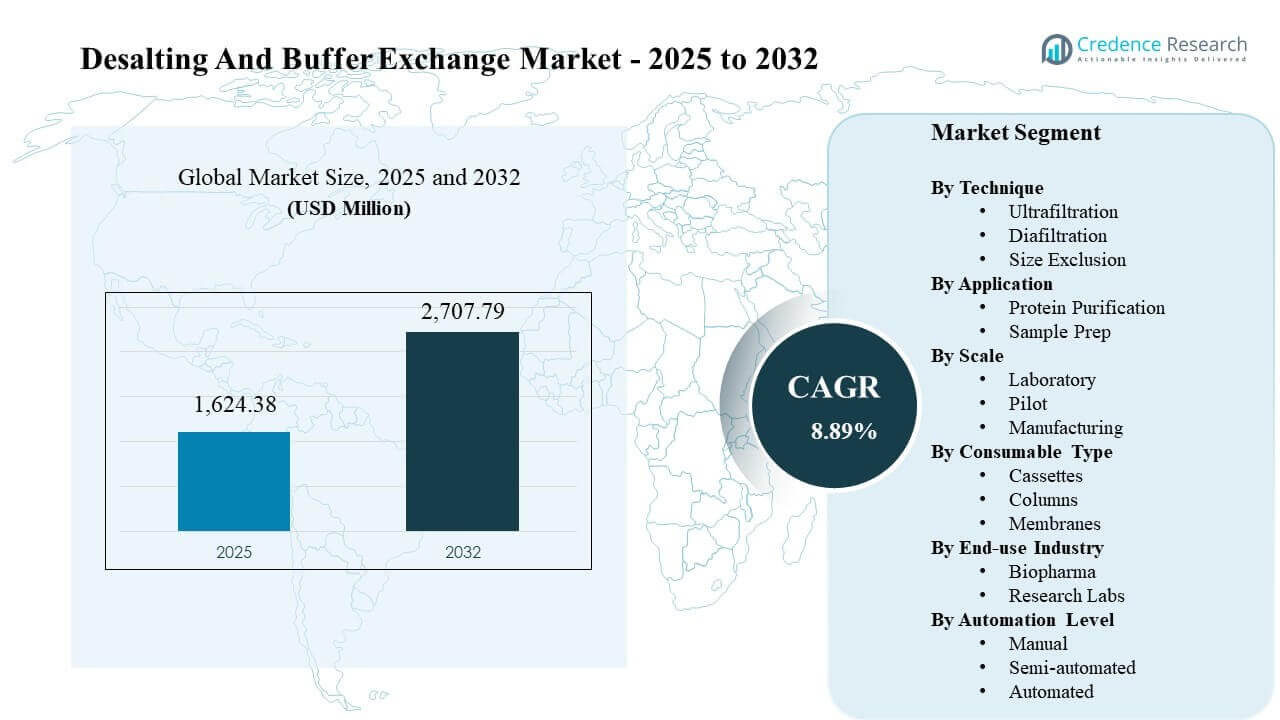
The global Desalting And Buffer Exchange Market size was estimated at USD 1,624.38 million in 2025 and is expected to reach USD 2,707.79 million by 2032, growing at a CAGR of 8.89% from 2025 to 2032. Expansion in biologics development and manufacturing is accelerating demand for reliable downstream processing steps that stabilize proteins, remove salts, and set final buffer conditions before analytics, formulation, and fill-finish activities. North America remains a key demand center, supported by strong bioprocess capacity, deep tool standardization, and high adoption of scalable purification workflows across research and manufacturing environments.
| REPORT ATTRIBUTE | DETAILS |
|---|---|
| Historical Period | 2020-2024 |
| Base Year | 2025 |
| Forecast Period | 2026-2032 |
| Desalting And Buffer Exchange Market Size 2025 | USD 1,624.38 million |
| Desalting And Buffer Exchange Market, CAGR | 8.89% |
| Desalting And Buffer Exchange Market Size 2032 | USD 2,707.79 million |
Key Market Trends & Insights
- The Desalting And Buffer Exchange Market is projected to expand from USD 1,624.38 million (2025) to USD 2,707.79 million (2032) at an 8.89% CAGR (2025–2032).
- North America accounted for 37.80% of 2025 revenue, reflecting concentration of bioprocess R&D and manufacturing capacity.
- Asia Pacific represented 27.40% of 2025 revenue, supported by expanding biologics pipelines and growing CDMO activity.
- Size Exclusion led the technique mix with a 44.30% share in 2025, reflecting broad adoption for fast, reproducible buffer conditioning in protein workflows.
- Protein Purification led applications with a 47.60% share in 2025, underpinned by routine desalting and buffer exchange needs across biologics and proteomics.
Segment Analysis
Desalting and buffer exchange workflows are selected based on target molecule sensitivity, throughput needs, and acceptable trade-offs between recovery, processing time, and operating cost. Laboratory users often prioritize speed and convenience for repeated assay preparation and method development, which supports strong demand for standardized formats and straightforward protocols. Pilot and manufacturing environments focus on scalability, robustness, and consistent performance across larger batch volumes where buffer composition directly affects product quality attributes.
Consumables purchasing is driven by repeat use, method validation, and platform standardization across teams and sites. Columns, membranes, and cassette formats are frequently aligned to existing purification systems to reduce operator variability and simplify training. Automation adoption is increasing where teams are measured on turnaround time, traceability, and reproducibility, especially in regulated settings and high-throughput research.
Process choice also depends on downstream requirements such as formulation readiness, analytics compatibility, and concentration targets. Buffer exchange steps can be tightly coupled with concentration and polishing activities, which increases the value of integrated solution bundles that combine hardware, consumables, and workflow support.
By Technique Insights
Size Exclusion accounted for the largest share of 44.30% in 2025. Size Exclusion supports rapid desalting and buffer exchange with predictable performance, which strengthens adoption in routine protein workflows. Standardized formats help reduce method variability and improve repeatability across users and sites. Broad compatibility with protein purification and analytical preparation requirements also supports frequent use in both research and production-linked applications.
By Application Insights
Protein Purification accounted for the largest share of 47.60% in 2025. Protein Purification relies on consistent buffer conditions to preserve structure, stability, and downstream assay performance. Growth in recombinant proteins and monoclonal antibody development increases routine use of desalting and buffer exchange operations. Wider adoption of standardized purification protocols reinforces repeat purchasing of compatible consumables and repeatable techniques across workflows.
By Scale Insights
Laboratory, pilot, and manufacturing adoption is shaped by throughput requirements, validation needs, and process scalability across development stages. Laboratory settings emphasize fast turnaround, convenience, and high repeatability for screening and analytical preparation. Pilot operations focus on bridging development and production through scalable methods that maintain recovery and performance. Manufacturing adoption emphasizes robust, validated workflows that reduce variability and support consistent product quality across batches.
By Consumable Type Insights
Columns accounted for the largest share of 45.10% in 2025. Columns are widely used for fast desalting and buffer exchange with straightforward protocols that support reproducibility. Prepacked formats reduce setup time and support consistent outcomes across users, which strengthens demand in both research and production-adjacent environments. Strong alignment with protein purification workflows supports recurring purchases tied to method standardization and repeated sample processing.
By End-use Industry Insights
Biopharma and research labs drive demand through different performance priorities and operating constraints. Biopharma environments prioritize validated performance, traceability, and scalability across development-to-manufacturing pathways. Research labs prioritize speed, flexibility, and ease of use for sample preparation and assay readiness. Broad growth in proteomics and biologics research increases demand for repeatable buffer conditioning steps that reduce downstream variability.
By Automation Level Insights
Manual, semi-automated, and automated workflows reflect differences in throughput targets, staffing models, and reproducibility requirements. Manual workflows remain common in small-scale settings where flexibility and low upfront cost are prioritized. Semi-automated approaches support improved consistency and higher throughput without full platform integration. Automated workflows expand in high-throughput and regulated environments where process standardization, auditability, and reduced operator variability are core procurement priorities.
Desalting And Buffer Exchange Market Drivers
Expansion of biologics pipelines and downstream processing needs
Biologics development increases the number of protein-based workflows that require tight control of buffer composition before analytical characterization and formulation. Desalting and buffer exchange steps help remove salts, adjust pH, and set excipient conditions that support stability and performance. Higher volumes of development programs expand routine sample preparation workloads. Greater emphasis on consistent quality attributes increases demand for repeatable, validated buffer conditioning steps across research and production-linked operations.
Scale-up requirements across development, pilot, and manufacturing
Scale-up activity increases demand for workflows that can transition from bench protocols to larger-volume operations without major method redesign. Ultrafiltration and diafiltration approaches support scalable processing where concentration and buffer exchange must occur together. Pilot environments reinforce adoption of robust consumables that maintain performance under changing volumes. Manufacturing operations favor methods that support predictable recovery, consistent output quality, and reproducible execution across shifts and sites.
- For instance, Sartorius’ Sartocon Slice ultrafiltration cassettes support scale-up from 0.1 m² to over 2.5 m² membrane area, enabling consistent flux rates above 100 L/m²/h in protein concentration and diafiltration processes.
Standardization and platform adoption across laboratories and sites
Organizations increasingly standardize purification and sample conditioning workflows to reduce training burden and improve reproducibility. Platform alignment increases repeat purchasing of compatible consumables and accelerates adoption of established techniques for routine steps. Standardization supports consistent outcomes across multisite research and production environments. Procurement models also favor vendors that can supply integrated solutions across consumables, hardware, and workflow support to minimize operational variation.
- For instance, Merck Millipore’s Amicon Ultra centrifugal filters are standardized across laboratories globally, offering molecular weight cut-offs from 3 kDa to 100 kDa with >90% protein recovery and processing times under 15 minutes for typical 15 mL samples.
Growing focus on reproducibility, traceability, and efficiency
Reproducibility expectations are rising across research and regulated environments, pushing organizations toward methods that reduce operator-driven variation. Traceability needs encourage standardized consumable formats and controlled workflows that support documentation. Efficiency targets increase interest in automation and semi-automation that shorten turnaround time and reduce rework. Workflow efficiency also improves when buffer exchange steps integrate smoothly with concentration, purification, and analytics preparation activities.
Desalting And Buffer Exchange Market Challenges
Pricing pressure can intensify when buyers compare similar functional outcomes across columns, membranes, and cassette formats, especially in high-volume environments that negotiate aggressively. Differentiation often relies on recovery, consistency, and ease of use, which can be difficult to quantify across diverse protein types. Supply continuity and qualification needs add friction when organizations attempt to switch suppliers. Procurement teams may require additional validation work, which can slow conversion to newer solutions.
- For instance, Cytiva’s MabSelect PrismA Protein A resin demonstrates dynamic binding capacities exceeding 70 g/L at 6-minute residence time, enabling high-throughput operations, yet switching to such resins often requires multi-batch validation studies and documented comparability protocols under GMP guidelines.
Method selection can be constrained by molecule sensitivity, aggregation risk, and recovery requirements that vary across protein classes and downstream goals. High-concentration processing can introduce viscosity and fouling challenges that increase cycle time and reduce throughput. Scale-up introduces operational complexity when laboratory protocols do not translate cleanly to pilot or manufacturing conditions. Training and workflow discipline remain critical, because inconsistent execution can affect downstream analytics and final product readiness.
Desalting And Buffer Exchange Market Trends and Opportunities
Automation and workflow integration continue to expand as laboratories and bioprocess groups prioritize consistent execution and faster turnaround. Integrated platforms that combine hardware, consumables, and guided protocols can improve reproducibility and reduce operator training burden. Opportunities increase for solutions that support both small-volume research workflows and larger-volume scale-up requirements. Vendors that provide application support and standardized method kits can strengthen adoption across teams and sites.
- For instance, Sartorius’ ambr® 250 high-throughput bioreactor system enables parallel processing of up to 24–48 bioreactors with automated control, reducing process development timelines by approximately 30–50% while maintaining reproducibility across runs.
Growth in Asia Pacific bioprocess capacity and rising adoption of biologics development services creates opportunities for expanded local supply, distribution reach, and service support. Consumables innovation that improves recovery, reduces processing time, and increases compatibility across protein types can support premium positioning. Expanded use in proteomics and analytical sample preparation also creates demand for fast, low-loss buffer conditioning solutions. Product formats optimized for high-throughput screening can capture incremental laboratory demand.
Regional Insights
North America
North America accounted for 37.80% of 2025 revenue, supported by strong bioprocessing infrastructure and high concentration of biologics R&D and manufacturing capacity. Standardized purification workflows drive repeat purchasing of columns, membranes, and cassettes across research and production-linked operations. Adoption is reinforced by quality and reproducibility expectations that favor validated consumables and consistent processes. Vendor competition focuses on integrated solution ecosystems, workflow support, and scalability across development stages.
Europe
Europe represented 24.10% of 2025 revenue, supported by established biopharma manufacturing, active biologics research, and structured quality management practices. Demand is strengthened by emphasis on repeatability and compliance within research and production settings. Procurement often prioritizes consistency, documented performance, and reliable supply. Growth opportunities improve for suppliers that align consumables with standardized purification platforms and provide strong technical support for method transfer and validation.
Asia Pacific
Asia Pacific represented 27.40% of 2025 revenue, reflecting expanding biologics pipelines, growth in CDMO capacity, and increasing investment in life sciences infrastructure. Scale-up activity supports demand for scalable techniques and consumables that maintain performance across larger volumes. Organizations also invest in workflow standardization to improve productivity and consistency. Suppliers that expand local availability, training, and application support can accelerate adoption across fast-growing research and manufacturing hubs.
Latin America
Latin America accounted for 6.20% of 2025 revenue, supported by growing research activity and gradual expansion of biologics capabilities in key markets. Demand remains concentrated in major academic and biopharma centers where sample preparation and purification workflows are expanding. Budget constraints can increase sensitivity to consumables pricing and qualification effort. Opportunities improve for suppliers that offer robust distribution coverage, dependable supply, and practical workflow guidance for laboratory and pilot applications.
Middle East & Africa
Middle East & Africa accounted for 4.50% of 2025 revenue, supported by selective investment in healthcare and life sciences infrastructure and expanding research capacity in leading hubs. Demand is often driven by laboratory workflows and targeted bioprocess initiatives rather than broad manufacturing scale. Availability of technical support and dependable supply can influence vendor selection. Opportunities increase for suppliers that strengthen channel partnerships, training, and service models aligned to emerging research and bioprocess needs.
Competitive Landscape
Competition in the Desalting And Buffer Exchange Market is shaped by breadth of purification portfolios, consumables compatibility, and the ability to support workflows from research to manufacturing. Vendors differentiate through product performance, recovery, reproducibility, and ease of method transfer across stages. Integrated ecosystems that pair consumables with hardware platforms can increase standardization and reduce switching. Application support and supply reliability remain important decision factors for research labs and regulated bioprocess environments.
Merck emphasizes broad filtration and purification portfolios that align with scalable workflows and standardized consumables usage across development and manufacturing pathways. Merck positioning benefits from end-to-end bioprocess capabilities that connect buffer exchange steps with adjacent purification and concentration needs. Technical support and validated workflows can strengthen adoption where reproducibility and documentation are prioritized. Portfolio breadth also supports cross-selling opportunities when organizations standardize across multiple downstream unit operations.
The industry research and growth report includes detailed analyses of the competitive landscape of the market and information about key companies, including:
- Merck
- Sartorius
- Cytiva
- Repligen
- Thermo Fisher Scientific
- Pall
- GE Healthcare
- 3M
- Danaher
- Avantor
Qualitative and quantitative analysis of companies has been conducted to help clients understand the wider business environment as well as the strengths and weaknesses of key industry players. Data is qualitatively analyzed to categorize companies as pure play, category-focused, industry-focused, and diversified; it is quantitatively analyzed to categorize companies as dominant, leading, strong, tentative, and weak.
Recent Developments
- In July 2024, Repligen Corporation announced an agreement to acquire Tantti, a chromatography innovator, in a move aimed at strengthening Repligen’s advanced purification technology offerings and specifically enhancing its chromatography-based solutions for desalting and buffer exchange in the rapidly expanding biologics sector.
- In February 2024, Sartorius AG expanded its single-use and filtration solutions portfolio, a strategic move intended to reinforce its downstream processing capabilities that are highly relevant to desalting and buffer exchange operations within biopharmaceutical manufacturing workflows.
- In July 2025, Cytiva introduced the ÄKTA readyflux TFF system 500, an automated single-use tangential flow filtration platform tailored for smaller-scale manufacturing, to meet growing demand for efficient buffer exchange and concentration in low-volume applications such as viral vectors, monoclonal antibodies, and mRNA-based therapeutics.
- In September 2025, Thermo Fisher Scientific completed the acquisition of Solventum’s Purification and Filtration business for approximately USD 4.0 billion in cash, integrating specialized bioprocessing filtration and membrane technologies into its life sciences segment to strengthen end-to-end bioproduction offerings, including critical desalting and buffer exchange steps.
Report Scope
| Report Attribute | Details |
| Market size value in 2025 | USD 1,624.38 million |
| Revenue forecast in 2032 | USD 2,707.79 million |
| Growth rate (CAGR) | 8.89% (2025–2032) |
| Base year | 2025 |
| Forecast period | 2026–2032 |
| Quantitative units | USD million |
| Segments covered | Technique; Application; Scale; Consumable Type; End-use Industry; Automation Level |
| Regional scope | North America, Europe, Asia Pacific, Latin America, Middle East & Africa |
| Key companies profiled | Merck; Sartorius; Cytiva; Repligen; Thermo Fisher Scientific; Pall; GE Healthcare; 3M; Danaher; Avantor |
| No.of Pages | 328 |
Segmentation
By Technique
- Ultrafiltration
- Diafiltration
- Size Exclusion
By Application
- Protein Purification
- Sample Prep
By Scale
- Laboratory
- Pilot
- Manufacturing
By Consumable Type
- Cassettes
- Columns
- Membranes
By End-use Industry
- Biopharma
- Research Labs
By Automation Level
- Manual
- Semi-automated
- Automated
By Region
- North America
- U.S.
- Canada
- Mexico
- Europe
- Germany
- France
- U.K.
- Italy
- Spain
- Rest of Europe
- Asia Pacific
- China
- Japan
- India
- South Korea
- South-east Asia
- Rest of Asia Pacific
- Latin America
- Brazil
- Argentina
- Rest of Latin America
- Middle East & Africa
- GCC Countries
- South Africa
- Rest of the Middle East and Africa

Request a Free Sample
Fill in your details and we'll send you a free sample report.
- Sample data tables & charts
- Research methodology
Need a Custom Version of This Report?
Tailor the scope, geography, or segments to your exact requirements.
- Custom geography or segment scope
- Direct access to our analyst team
Frequently Asked Questions
What is the market size and forecast for the Desalting And Buffer Exchange Market?
What is the CAGR for the Desalting And Buffer Exchange Market?
What is the largest segment in the Desalting And Buffer Exchange Market?
What factors are driving growth in the Desalting And Buffer Exchange Market?
Which companies are leading in the Desalting And Buffer Exchange Market?
Which region leads the Desalting And Buffer Exchange Market?
Table of Content
Chapter 1 Market Segmentation
- 1.1 Segmentation Framework
- 1.1.1 Product and Service Classification
- 1.1.2 Application and End-Use Classification
- 1.1.3 Technology and Solution Classification
- 1.1.4 Customer and Distribution Channel Classification
- 1.1.5 Geographic Segmentation
- 1.1.6 Market Segment Definitions and Boundaries
Chapter 2 Introduction
- 2.1 Report Objectives and Scope
- 2.2 Product Definition and Industry Terminology
- 2.3 Market Inclusions and Exclusions
- 2.4 Research Process
- 2.4.1 Primary Research and Expert Interviews
- 2.4.2 Secondary Research and Source Review
- 2.4.3 Top-Down and Bottom-Up Estimation
- 2.4.4 Data Triangulation and Verification
- 2.5 Market Size Measurement Basis
- 2.5.1 2025: USD 1,624.38 million → 2032: USD 2,707.79 million
- 2.6 Historical and Forecast Reference Periods
- 2.6.1 Base Year: 2025
- 2.6.2 Forecast Period: 2025-2032
- 2.7 Research Assumptions and Limitations
Chapter 3 Executive Summary
- 3.1 Market Snapshot and Key Findings
- 3.2 Base-Year Market Size, 2025
- 3.3 Forecast Market Size, 2032
- 3.4 Revenue and Volume Growth Outlook
- 3.5 Key Demand and Supply Indicators
- 3.6 Leading Market Segments
- 3.7 Fastest-Growing Market Opportunities
- 3.8 Regional Performance Highlights
- 3.9 Technology and Industry Transformation
- 3.10 Competitive Landscape Summary
- 3.11 Analyst View and Strategic Implications
Chapter 4 Global Desalting And Buffer Exchange Market Trends and Developments
- 4.1 Historical Industry Development
- 4.2 Recent Market Trends and Developments
- 4.3 Demand and Customer Behavior Trends
- 4.4 Technology and Product Innovation
- 4.5 Artificial Intelligence, Automation and Digitalization
- 4.6 Local Manufacturing and Supply Chain Realignment
- 4.7 Industry Partnerships, Mergers and Acquisitions
- 4.8 Sustainability and Circular Economy Developments
- 4.9 Government and Private Sector Investment Trends
- 4.10 Emerging Business Models and Commercialization
- 4.11 Industry Developments and Announcements
Chapter 5 Global Desalting And Buffer Exchange Market Production, Supply and Demand Analysis
- 5.1 Demand Trend and Consumption Analysis
- 5.2 Demand Forecast, 2025-2032
- 5.3 Production and Output Trend
- 5.4 Production and Output Forecast, 2025-2032
- 5.5 Installed Capacity and Capacity Utilization
- 5.6 Company-Wise Production Plants and Statistics
- 5.6.1 Installed Production Capacity
- 5.6.2 Actual Production
- 5.6.3 Planned Capacity and Expansion Targets
- 5.7 Supply Chain Structure and Procurement Trends
- 5.8 Supply-Demand Gap and Bottlenecks
- 5.9 Import Dependence and Sourcing Structure
- 5.10 Contract Manufacturing and Outsourcing
- 5.11 Regional Supply and Demand Concentration
Chapter 6 Global Desalting And Buffer Exchange Market Pricing Analysis
- 6.1 Pricing Structure and Measurement
- 6.2 Historical Pricing Trends
- 6.3 Pricing Outlook, 2025-2032
- 6.4 Average Selling Price and Unit Economics
- 6.5 Pricing by Product and Market Segment
- 6.6 Geographic Pricing Differences
- 6.7 Key Input, Energy, Labor and Logistics Costs
- 6.8 Contract Pricing and Purchasing Models
- 6.9 Pricing Sensitivity and Competitive Positioning
- 6.10 Price, Margin and Profitability Implications
Chapter 7 Global Desalting And Buffer Exchange Market Dynamics
- 7.1 Market Growth Drivers
- 7.1.1 Demand-Side Drivers
- 7.1.2 Technology and Innovation Drivers
- 7.1.3 Infrastructure and Investment Drivers
- 7.1.4 Regulatory and Policy Drivers
- 7.2 Market Restraints
- 7.2.1 Cost and Affordability Constraints
- 7.2.2 Technology and Adoption Barriers
- 7.2.3 Supply Chain and Operational Constraints
- 7.3 Market Challenges
- 7.3.1 Competitive Pressure and Margin Erosion
- 7.3.2 Skills, Infrastructure and Implementation Gaps
- 7.4 Emerging Market Opportunities
- 7.5 Market Dynamics Impact and Time-Horizon Assessment
Chapter 8 Global Desalting And Buffer Exchange Value Chain Analysis
- 8.1 Industry Value Chain Overview
- 8.2 Upstream Suppliers and Critical Inputs
- 8.3 Technology and Component Providers
- 8.4 Manufacturing or Service Delivery
- 8.5 Distribution, Channel Partners and Integrators
- 8.6 Downstream Applications and End Users
- 8.7 Value Addition and Profit Pools
- 8.8 Vertical Integration and Outsourcing
- 8.9 Supplier Concentration and Risk
- 8.10 Supply Chain Localization and Resilience
Chapter 9 Global Desalting And Buffer Exchange Market Regulations and Policies
- 9.1 Relevant Laws, Standards and Compliance Frameworks
- 9.2 Product, Service, Safety and Quality Requirements
- 9.3 Government Policies, Incentives and Subsidies
- 9.4 Imports, Exports and Trade Barriers
- 9.5 Public Procurement and Local Content Requirements
- 9.6 Environmental and Sustainability Compliance
- 9.7 Upcoming Policy Changes and Market Implications
Chapter 10 Global Desalting And Buffer Exchange Market Hotspots and Opportunities
- 10.1 Market Opportunity Mapping and Growth Hotspots
- 10.2 High-Growth Applications and Customer Groups
- 10.3 Underserved Markets and White-Space Opportunities
- 10.4 Emerging Technology and Product Opportunities
- 10.5 New Capacity and Investment Hotspots
- 10.6 Market Entry and Expansion Opportunities
- 10.7 Distribution and Partnership Opportunities
- 10.8 Near-Term and Long-Term Commercial Potential
- 10.9 Opportunity Attractiveness and Execution Risks
Chapter 11 Global Desalting And Buffer Exchange Market Outlook, 2025-2032
- 11.1 Market Size and Analysis
- 11.1.1 Revenue (Market Measurement: 2025: USD 1,624.38 million → 2032: USD 2,707.79 million)
- 11.1.2 Market Volume and Quantity Sold
- 11.1.3 Historical Market Size
- 11.1.4 Base-Year Market Size, 2025
- 11.2 Market Forecast, 2025-2032
- 11.2.1 Revenue Forecast to 2032
- 11.2.2 Volume Forecast to 2032
- 11.2.3 CAGR and Year-on-Year Growth
- 11.2.4 Incremental Revenue Opportunity
- 11.3 Forecast Assumptions and Scenario Analysis
- 11.3.1 Base-Case Forecast
- 11.3.2 Optimistic and Conservative Scenarios
- 11.3.3 Technology, Pricing and Policy Sensitivities
- 11.4 Market Attractiveness and Growth Outlook
Chapter 12 Global Desalting And Buffer Exchange Market Segmentation and Outlook
- 12.1 Segmentation Summary and Market Shares, 2025
- 12.2 Largest and Fastest-Growing Segments
- 12.3 Segment Growth Comparison
- 12.4 Segment Attractiveness and Priority Matrix
Chapter 13 Global Desalting And Buffer Exchange Geographic Market Outlook, 2025-2032
- 13.1 Regional Market Size and Share, 2025
- 13.2 Regional Market Forecast, 2025-2032
- 13.3 Regional Pricing, Production and Demand Differences
- 13.4 North America
- 13.4.1 United States
- 13.4.2 Canada
- 13.4.3 Mexico
- 13.5 Europe
- 13.5.1 Germany
- 13.5.2 France
- 13.5.3 Italy
- 13.5.4 United Kingdom
- 13.5.5 Spain
- 13.5.6 Poland
- 13.5.7 Russia
- 13.5.8 Netherlands
- 13.5.9 Belgium
- 13.5.10 Sweden
- 13.5.11 Denmark
- 13.5.12 Norway
- 13.5.13 Rest of Europe
- 13.6 Asia Pacific
- 13.6.1 China
- 13.6.2 India
- 13.6.3 Japan
- 13.6.4 South Korea
- 13.6.5 Thailand
- 13.6.6 Indonesia
- 13.6.7 Vietnam
- 13.6.8 Malaysia
- 13.6.9 Australia
- 13.6.10 Rest of Asia Pacific
- 13.7 Latin America
- 13.7.1 Brazil
- 13.7.2 Argentina
- 13.7.3 Colombia
- 13.7.4 Chile
- 13.7.5 Rest of Latin America
- 13.8 Middle East
- 13.8.1 Saudi Arabia
- 13.8.2 United Arab Emirates
- 13.8.3 Turkey
- 13.8.4 Israel
- 13.8.5 Iran
- 13.8.6 Rest of the Middle East
- 13.9 Africa
- 13.9.1 South Africa
- 13.9.2 Egypt
- 13.9.3 Nigeria
- 13.9.4 Morocco
- 13.9.5 Rest of Africa
- 13.10 Regional Investment, Policy and Supply Chain Differences
- 13.11 Regional Competitive Landscape
- 13.12 Geographic Growth Hotspots
Chapter 14 Global Desalting And Buffer Exchange Technology, Innovation and Sustainability Outlook
- 14.1 Technology Landscape and Maturity
- 14.2 Product, Process and Service Innovation
- 14.3 AI, Automation and Digital Tools in the Industry
- 14.4 Technology Adoption and Performance Benchmarking
- 14.5 Innovation Pipeline and R&D Investment
- 14.6 Patent and Intellectual Property Trends
- 14.7 Energy Efficiency and Resource Management
- 14.8 Sustainability, Recycling and Circularity
- 14.9 Technology Roadmap, 2025-2032
- 14.10 Risks of Obsolescence and Technology Substitution
Chapter 15 Global Desalting And Buffer Exchange Market Key Strategic Imperatives
- 15.1 Growth and Market Entry Priorities
- 15.2 High-Return Products and Segments
- 15.3 Pricing, Profitability and Cost Optimization
- 15.4 Technology Investment and Product Differentiation
- 15.5 Supply Chain Localization and Resilience
- 15.6 Distribution and Customer Acquisition
- 15.7 Partnership, Acquisition and Capacity Strategy
- 15.8 Regional Expansion Priorities
- 15.9 Short-, Medium- and Long-Term Actions
Chapter 16 Competition Outlook
- 16.1 Industry Competition Characteristics
- 16.2 Market Structure and Concentration
- 16.3 Market Share and Competitive Positioning, 2025
- 16.4 Company-Wise Revenue and Product Benchmarking
- 16.5 Production and Service Capacity Benchmarking
- 16.6 Technology, Pricing and Differentiation
- 16.7 Regional Footprint and Distribution Strength
- 16.8 Mergers, Acquisitions and Strategic Alliances
- 16.9 New Entrants and Competitive Threats
- 16.10 Porter's Five Forces and Industry Attractiveness
- 16.11 Competitive Outlook, 2025-2032
Chapter 17 Company Profiles
- 17.1 Company Coverage and Selection Criteria
- 17.2 Leading Market Participants – Standard Profile Structure
- 17.2.1 Business Description
- 17.2.2 Company Ownership and Geographic Presence
- 17.2.3 Product and Service Portfolio
- 17.2.4 Manufacturing and Operating Footprint
- 17.2.5 Production Capacity and Expansion Plans
- 17.2.6 Financial Performance and Investment
- 17.2.7 Market Share and Competitive Position
- 17.2.8 Technology and Innovation Capabilities
- 17.2.9 Strategic Alliances or Partnerships
- 17.2.10 Recent Developments
- 17.2.11 Growth Strategy and Outlook
- 17.3 Other Relevant Market Participants
Note: Every listed company is profiled on the structure shown under the first company. The company list is preliminary and may change based on research findings, market developments, data availability and client requirements.
Chapter 18 Disclaimer
- 18.1 Research and Forecast Disclaimer
- 18.2 Data Source and Estimation Limitations
Note: The depth of individual sections depends on data availability for this market. Volume, capacity, trade and other unit-based metrics are included where applicable.