
| REPORT ATTRIBUTE | DETAILS |
|---|---|
| Historical Period | 2019-2022 |
| Base Year | 2023 |
| Forecast Period | 2024-2032 |
| ECG Equipment Market Size 2023 | USD 5,948.50 Million |
| ECG Equipment Market, CAGR | 7.50% |
| ECG Equipment Market Size 2032 | USD 11,404.69 Million |
Market Insights
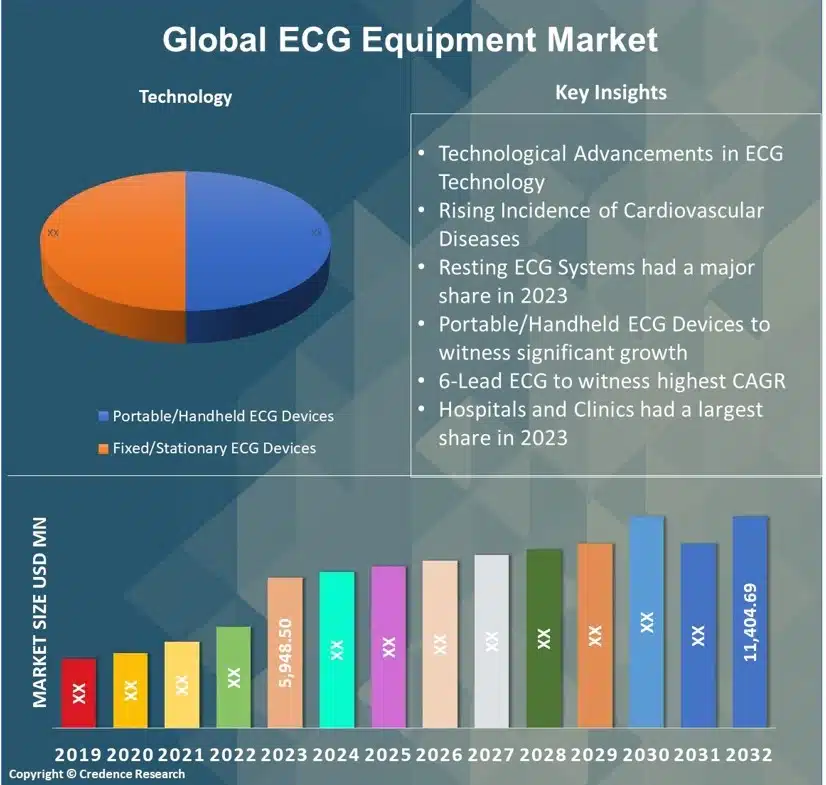
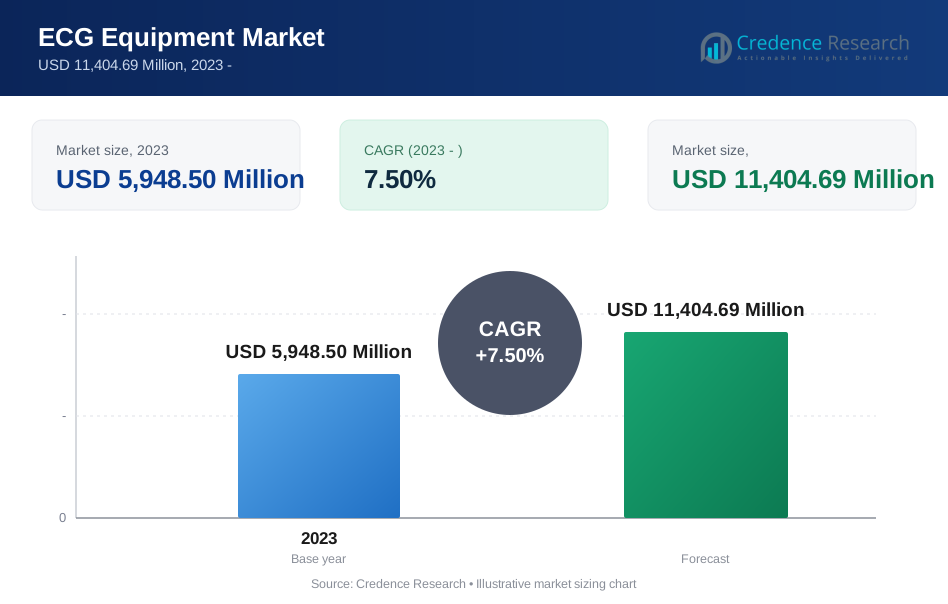
- The global demand for ECG Equipment was valued at USD 5,948.50 Million in 2023 and is expected to reach USD 11,404.69 Million in 2032, growing at a CAGR of 7.50% between 2024 and 2032.
- The Resting ECG Systems sector is the market leader by type of ECG equipment, accounting for more than 31% of total value in 2023, while the stress ECG systems segment is expected to grow rapidly throughout the forecast period.
- The Fixed/Stationary ECG Devices dominates the global need for ECG Equipment, accounting for more than 55% in 2023 and Portable/Handheld ECG Devices is predicted to expand at a high CAGR.
- The 6-Lead ECG is predicted to grow fastest over the projection period, while the 3-Lead ECG segment will have a market share of more than 25% in 2023.
- Over the projection period, the Ambulatory Surgical Centers category is expected to expand at the highest rate, while the Hospitals and Clinics category will dominate the market in 2023 with over 25% share.
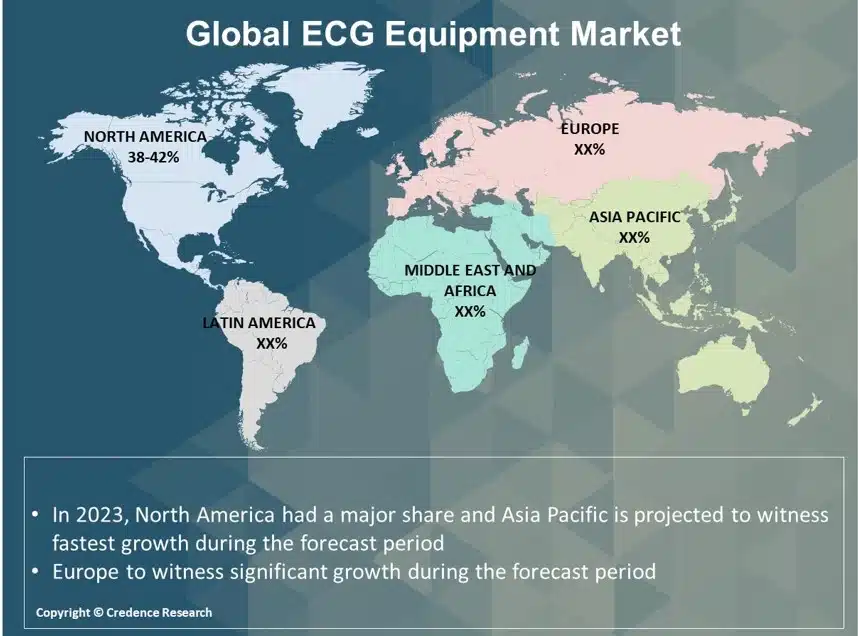
- North America is fueling the growth of the ECG Equipment industry with over one-third share in 2023, while Asia Pacific and Europe collectively account for just under 55% share in 2023. Europe held over 20% share in 2023.
- Due to the rising incidence of cardiovascular diseases and transferring capacities, the market for ECG Equipment is driven by Integration of artificial intelligence (AI) in ECG analysis.
- The market's primary possibilities include the significant growth potential in North America, integration of ECG equipment with mobile health applications enhances patient engagement and data accessibility.
Executive Summary
Market Definition
The Electrocardiography (ECG) equipment is a medical device designed for the recording and interpretation of the electrical activity of the heart over a specific period. This diagnostic tool measures the heart's electrical impulses through electrodes attached to the skin, producing a visual representation of the heart's rhythm and activity known as an electrocardiogram. ECG equipment is widely used in medical settings to assess cardiac health, diagnose heart conditions, and monitor the effectiveness of treatments. The resulting ECG traces provide valuable information about the heart's electrical conduction system, helping healthcare professionals identify abnormalities, such as arrhythmias or signs of ischemia, and guide appropriate medical interventions.
Market Overview
The global ECG Equipment market has witnessed steady growth in recent years and is expected to grow at a CAGR of 7.50% between 2024 and 2032. The market was valued at USD 5,948.50 million in 2023 and is expected to reach USD 11,404.69 million in 2032.
The growth of the Electrocardiography (ECG) equipment market is propelled by several key drivers such as technological advancements play a pivotal role in enhancing the capabilities and functionality of ECG equipment. Ongoing innovations, including improvements in signal processing, the integration of artificial intelligence (AI) for more precise diagnostics, and the development of portable and wearable ECG devices, contribute to increased adoption and demand. These advancements not only improve the diagnostic accuracy of ECG equipment but also enhance the convenience of monitoring heart health, especially in remote and home healthcare settings.
In addition, the rising incidence of cardiovascular diseases globally serves as a significant growth driver for the ECG equipment market. With an increasing prevalence of heart-related disorders, there is a growing demand for efficient and reliable diagnostic tools for early detection and continuous monitoring. The aging population, coupled with lifestyle changes and a rise in chronic health conditions, further amplifies the need for ECG equipment in healthcare settings. Additionally, the integration of ECG technology into preventive healthcare initiatives, along with the growing emphasis on telemedicine and digital health, creates opportunities for market expansion as ECG equipment becomes an integral component of comprehensive cardiac care and remote patient monitoring strategies.
Segmentation by Type of ECG Equipment
- Resting ECG Systems is the leading segment by interface type and held over 31% share in value in 2023, attributable to the improved diagnostic accuracy, patient safety, and overall healthcare outcomes.
- The Stress ECG Systems segment will likely exhibit a significant CAGR during the forecast period. This is attributed to the integration of ECG equipment with mobile health applications enhances patient engagement and data accessibility.
- Holter Monitors, and Event Monitors are another segment but contributes very little to the global ECG Equipment market compared to the Resting ECG Systems, and Stress ECG Systems segments.
Segmentation by Technology
- The Fixed/Stationary ECG Devices segment governs the demand for ECG Equipment in the world, holding a massive share of over 55% in 2023.
- Portable/Handheld ECG Devices is also expected to grow at a rapid CAGR due to the market expansion in various regions as healthcare infrastructure develops and ECG technology becomes more accessible globally.
Segmentation by Lead Type
- The 6-Lead ECG segment is expected to post the highest CAGR during the forecast period. This is primarily due to advancements in ECG technology contribute to improved diagnostic accuracy, patient safety, and overall healthcare outcomes.
- The 3-Lead ECG segment is leading the market share with over 25% share in 2023.
Segmentation by End-User
- The Ambulatory Surgical Centers segment is anticipated to register the highest CAGR during the projection period.
- With a market share of nearly 25% in 2023, the Hospitals and Clinics category is currently in the lead.
- The category of Ambulatory Surgical Centers includes medical facilities which provide outpatient surgical care.
Segmentation by Region
- North America is fueling the growth of the ECG Equipment industry with over one-third share in 2023 due to the region's supportive government policies and initiatives on the growth of the ECG equipment market.
- Asia Pacific and Europe collectively account for just under 55% share in 2023, with Europe holding over 20% share in the same year.
- The rest of the world, including Latin America, the Middle East, and Africa, supplies the remaining demand for ECG Equipment.
The market for ECG Equipment is driven by influence of strategic partnerships and collaborations between ECG equipment manufacturers, healthcare providers, and technology companies on market dynamics.
North America stands as the dominating region in the global Electrocardiography (ECG) equipment market. This dominance is attributed to advanced healthcare infrastructure, a high prevalence of cardiovascular diseases, and a strong focus on technological innovation. The region boasts well-established medical facilities that readily adopt and integrate the latest ECG technologies. Additionally, a robust regulatory framework and significant investments in healthcare contribute to the rapid adoption of ECG equipment. The presence of key market players and their continuous efforts in research and development further solidify North America's leadership position in the ECG equipment market.
The Asia Pacific emerges as the fastest-growing region in the ECG equipment market. This growth is fueled by a combination of factors, including the increasing incidence of cardiovascular diseases, rising healthcare awareness, and substantial investments in healthcare infrastructure. Developing economies within Asia Pacific are witnessing a surge in demand for advanced medical technologies, including ECG equipment, as they strive to enhance their healthcare capabilities. The region's large and aging population, coupled with lifestyle changes, contributes to the rising prevalence of heart-related disorders, driving the need for efficient diagnostic tools. Furthermore, supportive government initiatives, collaborations with global healthcare organizations, and the adoption of innovative technologies position the Asia Pacific region as a key contributor to the expanding ECG equipment market.
The primary factor driving the ECG Equipment market's growth rate is the the rising incidence of cardiovascular diseases globally serves as a significant growth driver for the ECG equipment market. With an increasing prevalence of heart-related disorders, there is a growing demand for efficient and reliable diagnostic tools for early detection and continuous monitoring. The aging population, coupled with lifestyle changes and a rise in chronic health conditions, further amplifies the need for ECG equipment in healthcare settings.
Key Highlights of the Report
The global ECG Equipment market is segmented by type of ECG equipment, technology, lead type, end-user, and region. Resting ECG Systems-based ECG Equipment are the most popular, while Fixed/Stationary ECG Devices are the primary segments. In addition, 3-Lead ECG and 6-Lead ECG are the most commonly used categories. However, hospitals and clinics end user dominate the market, with North America leading the market growth.
One of the main factors propelling the global market for ECG Equipment is technological advancements play a pivotal role in enhancing the capabilities and functionality of ECG equipment. Ongoing innovations, including improvements in signal processing, the integration of artificial intelligence (AI) for more precise diagnostics, and the development of portable and wearable ECG devices, contribute to increased adoption and demand.
Nonetheless, North America is anticipated to have the greatest share of the worldwide ECG Equipment market because of the supportive government policies and initiatives on the growth of the ECG equipment market. Furthermore, the market is anticipated to expand at the highest rate in the Asia-Pacific (APAC) region due to the increasing prevalence of heart-related disorders driving the demand for ECG equipment in diagnostic and monitoring applications.
What Are The Main Drivers Of The Global ECG Equipment Market?
Increased use of consumer electronics like smartphones, rising demand for ECG Equipment due to its benefits of high data and power transfer capacity, rising data transferability and security concerns, and increased production of automotive infotainment are the main factors propelling the ECG Equipment market forward. Additionally, due to the slow speeds and limited data streaming capabilities of wireless devices, the industry is also anticipated to benefit from the increased adoption of wired connecting devices.
What Are The Major Challenges Faced By The Global ECG Equipment Market?
The global ECG equipment market faces several major challenges such as high equipment costs, both in terms of acquisition and maintenance, pose a significant barrier, particularly for healthcare facilities in resource-limited settings. Concerns related to data security and privacy in the era of connected health technologies present challenges in the widespread adoption of ECG equipment.
What Are The Growth Opportunities In The Global ECG Equipment Market?
The global ECG equipment market presents several promising avenues such as expanding market presence in emerging economies, driven by increasing healthcare investments and rising demand for diagnostic services, offers a significant opportunity for growth. Continued investment in research and development for advanced ECG technologies, such as portable and wearable devices, provides avenues for product differentiation and market expansion. The integration of ECG equipment into remote patient monitoring solutions and telemedicine applications further broadens its potential applications.
Market Drivers
The global ECG Equipment market is driven by several factors. The following are the key drivers of the global ECG Equipment market:
Technological Advancements in ECG Equipment
The global ECG equipment market is the continuous progress in technological advancements. Ongoing innovations in ECG technology, including the integration of artificial intelligence, portable and wearable devices, and improvements in signal processing, significantly enhance the diagnostic capabilities of ECG equipment. These advancements not only improve the accuracy and efficiency of cardiac monitoring but also contribute to the broader adoption of ECG devices across various healthcare settings, driving market growth.
Market Restraints
The global ECG Equipment market faces some challenges that may hinder its growth. These include the following:
High Equipment Costs
A significant restraint faced by the global ECG equipment market is the high cost associated with acquiring and maintaining advanced devices. The initial investment required for purchasing state-of-the-art ECG equipment, along with ongoing expenses for maintenance and upgrades, can be a substantial financial burden for healthcare facilities, particularly in resource-limited settings. The cost factor hampers widespread adoption, limiting access to advanced diagnostic services and impacting the overall market penetration of ECG equipment.
Opportunities
The global ECG Equipment market offers significant growth opportunities. These include the following:
Expansion in Emerging Markets
The global ECG equipment market lies in expanding market presence in emerging economies. Increasing healthcare investments, rising disposable income, and growing awareness of the importance of cardiovascular health create a conducive environment for market expansion. As per the Centers for Disease Control and Prevention (CDC), cardiovascular diseases stand out as the prevalent health issues globally, marked by a significant mortality rate. In 2020 alone, the United States recorded 696,962 deaths attributed to cardiovascular diseases, highlighting their substantial impact on public health. The World Health Organization (WHO) underscores the global scale of this health concern, noting that cardiovascular diseases are the primary cause of death worldwide. The WHO reports an alarming annual toll of approximately 17.9 million deaths due to cardiovascular diseases, emphasizing the urgent need for effective preventive measures, diagnostic tools, and treatments to address this widespread health challenge. As these regions focus on enhancing their healthcare infrastructure, there is an increased demand for advanced diagnostic services, providing a significant growth opportunity for ECG equipment manufacturers. Capitalizing on the untapped potential in emerging markets can lead to increased sales, a broader market reach, and a positive impact on overall market growth.
Competitive Landscape
Key Players
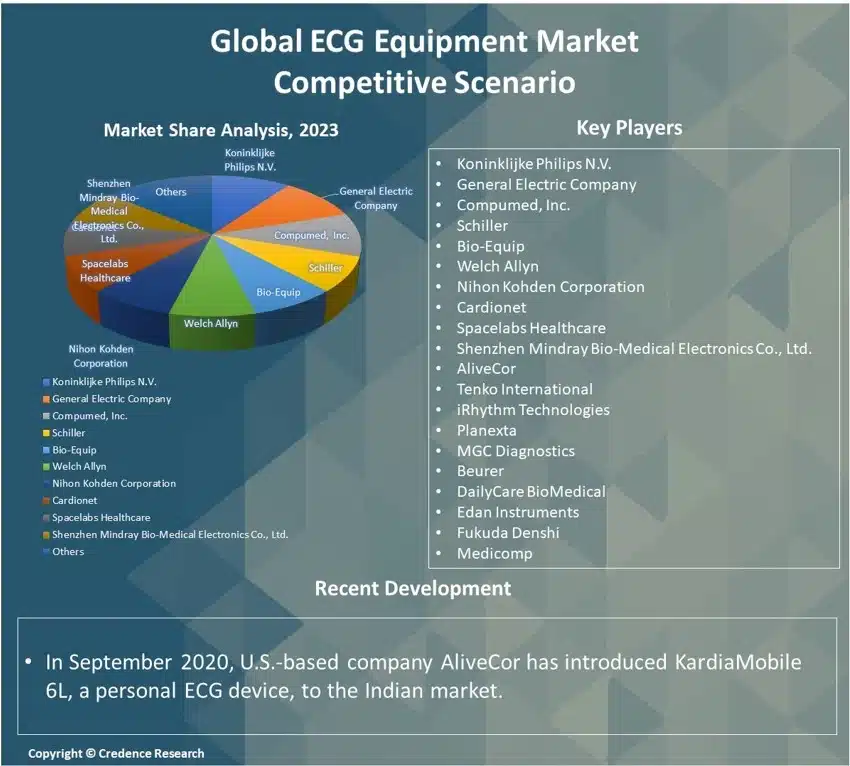
The global ECG Equipment market is highly competitive, with several key players. Some of the major players in the market and their market share are as follows:
- Koninklijke Philips N.V.
- General Electric Company
- Compumed, Inc.
- Schiller
- Bio-Equip
- Welch Allyn
- Nihon Kohden Corporation
- Cardionet
- Spacelabs Healthcare
- Shenzhen Mindray Bio-Medical Electronics Co., Ltd.
- AliveCor
- Tenko International
- iRhythm Technologies
- Planexta
- MGC Diagnostics
- Beurer
- DailyCare BioMedical
- Edan Instruments
- Fukuda Denshi
- Medicomp
- Others
These organizations prioritize product innovation, distribution channel expansion, and mergers and acquisitions to stay competitive.
The global ECG Equipment market's key players continually seek to stay ahead by offering new products and developments.
In November 2021, Philips has entered into an agreement to acquire Cardiologs, a French medical technology company specializing in heart diagnostics using artificial intelligence (AI) and cloud computing. Through this acquisition, Philips aims to enhance its cardiac monitoring and diagnostics portfolio by integrating Cardiologs' innovative software technology, which includes advanced electrocardiogram (ECG) analysis and reporting services. This strategic move underscores Philips' commitment to advancing healthcare solutions through cutting-edge technologies, further solidifying its position in the cardiac care sector.
In September 2020, U.S.-based company AliveCor has introduced KardiaMobile 6L, a personal ECG device, to the Indian market.
Summary of Key Findings
- The demand for ECG equipment is rising due to the technological advancements play a pivotal role in enhancing the capabilities and functionality of ECG equipment. Ongoing innovations, including improvements in signal processing, the integration of artificial intelligence (AI) for more precise diagnostics, and the development of portable and wearable ECG devices, contribute to increased adoption and demand, which is boosting the growth of the ECG Equipment market.
- Market segmented by type of ECG equipment, technology, lead type, end-user, and region.
- Resting ECG systems-based ECG Equipment are the most popular, with rising healthcare expenditure and the demand for advanced ECG equipment in healthcare facilities.
- Fixed/stationary ECG devices are most commonly used for devices.
- North America is leading market growth; the market is highly competitive with key players including Koninklijke Philips N.V., General Electric Company, Compumed, Inc., Schiller, Bio-Equip, Welch Allyn, Nihon Kohden Corporation, Cardionet, Spacelabs Healthcare, Shenzhen Mindray Bio-Medical Electronics Co., Ltd., AliveCor, Tenko International, iRhythm Technologies, Planexta, MGC Diagnostics, Beurer, DailyCare BioMedical, Edan Instruments, Fukuda Denshi, Medicomp, and Others.
Future Outlook
- Positive outlook for the global ECG Equipment market with significant growth potential in the North American region.
- One of the main factors promoting the market's expansion is the government and business sectors' current reliance on ECG Equipment.
- During the forecast period, high equipment costs, both in terms of acquisition and maintenance, pose a significant barrier, particularly for healthcare facilities in resource-limited settings is a significant factor projected to restrain the growth of the ECG Equipment market.
- Key firms must focus on product innovation, growing market reach, and maintaining competitive pricing to keep ahead of the competition.
How CXOs Can Benefit from the Credence Research ECG Equipment Market Report
The Credence Research ECG Equipment Market Report provides CXOs with a comprehensive overview of the market, including:
- Market size and growth forecast: The report provides detailed estimates of the global ECG Equipment market size, segmented by type of ECG equipment, technology, lead type, end-user, and region. It also includes forecasts for the market through 2032, based on key trends and drivers.
- Market segmentation: The report segments the ECG Equipment market by type of ECG equipment, technology, lead type, end-user, and region. This segmentation provides CXOs with a granular understanding of the market and the opportunities in each segment.
- Competitive landscape: The report profiles the key players in the ECG Equipment market and provides insights into their strategies, product offerings, and financial performance. This information can help CXOs to identify and assess their competition.
- Key trends and drivers: The report identifies and analyzes the key trends and drivers that are shaping the ECG Equipment This information can help CXOs to make informed decisions about their investments and strategies.
CXOs can use the insights from the Credence Research ECG Equipment Market Report to:
- Identify growth opportunities: The report can help CXOs to identify new growth opportunities in the ECG Equipment For example, the report identifies the growing demand for ECG Equipment from hospitals and clinics as a key opportunity.
- Make informed investment decisions: The report can help CXOs to make informed investment decisions about ECG Equipment. For example, the report provides insights into the key factors to consider when evaluating ECG Equipment providers and selecting ECG Equipment
- Develop competitive strategies: The report can help CXOs to develop competitive strategies for their ECG Equipment For example, the report identifies the key strategies that ECG Equipment providers are using to differentiate themselves from their competitors.
- Track market developments: The report can help CXOs to track market developments and stay ahead of the curve. For example, the report provides insights into the latest trends and innovations in the ECG Equipment
Overall, the Credence Research ECG Equipment Market Report is a valuable resource for CXOs who are looking to gain a deeper understanding of the market and identify opportunities for growth.
Segmentation
- By Type of ECG Equipment
- Resting ECG Systems
- Stress ECG Systems
- Holter Monitors
- Event Monitors
- By Technology
- Portable/Handheld ECG Devices
- Fixed/Stationary ECG Devices
- By Lead Type
- 3-Lead ECG
- 6-Lead ECG
- 12-Lead ECG
- Others
- By End-User
- Hospitals and Clinics
- Ambulatory Surgical Centers
- Diagnostic Centers
- Home Care Settings
- By Region
- North America
- The U.S.
- Canada
- Mexico
- Europe
- Germany
- France
- The U.K.
- Italy
- Spain
- Rest of Europe
- Asia Pacific
- China
- Japan
- India
- South Korea
- South-east Asia
- Rest of Asia Pacific
- Latin America
- Brazil
- Argentina
- Rest of Latin America
- Middle East & Africa
- GCC Countries
- South Africa
- Rest of Middle East and Africa
- North America
Request a Free Sample
Fill in your details and we'll send you a free sample report.
- Sample data tables & charts
- Research methodology
Need a Custom Version of This Report?
Tailor the scope, geography, or segments to your exact requirements.
- Custom geography or segment scope
- Direct access to our analyst team
Frequently Asked Questions
What is the current size of the global ECG Equipment market?
What is the expected growth rate of the ECG Equipment market between 2024 and 2032?
Which segment is leading the market share in terms of type of ECG equipment?
Which end users segment governs the demand for ECG Equipment in the world?
Who are the major players in the global ECG Equipment market?
Table of Content
Chapter 1. Report Introduction
- 1.1 Report Description & Purpose
- 1.1.1 Report Title & Market Definition
- 1.1.2 Unique Selling Propositions (USP) & Key Differentiators
- 1.1.3 Value Proposition for Stakeholders
- 1.2 Research Objectives
- 1.2.1 Market Sizing Objectives (Volume & Revenue)
- 1.2.2 Segmentation Objectives
- 1.2.3 Competitive Intelligence Objectives
- 1.2.4 Forecast & Scenario Objectives
- 1.3 Report Scope
- 1.3.1 ECG Equipment Scope – Types & Subtypes Covered
- 1.3.2 Geographic Scope – Regions & Countries Covered
- 1.3.3 Historical Period, Base Year & Forecast Period (2023; forecast to the forecast period)
- 1.3.4 Inclusions & Exclusions
- 1.4 HS Code & Classification Framework
- 1.5 Currency, Units & Pricing Basis
- 1.6 Target Stakeholders
- 1.7 Limitations & Assumptions
Chapter 2. Executive Summary
- 2.1 Global ECG Equipment Market Snapshot
- 2.1.1 Market Size – Historical (2023) & Forecast (the forecast period) (2023: USD 5,948.50 Million → forecast year: USD 11,404.69 Million)
- 2.1.2 Volume & Revenue – Global Totals
- 2.1.3 Key Market Highlights – Top Five Facts
- 2.2 ECG Equipment Market Segmentation Snapshot
- 2.2.1 Market Split by Region – 2023 vs.
- 2.3 Competitive Snapshot
- 2.3.1 Top 10 Players by Revenue Share – 2023
- 2.3.2 Top 10 Players by Volume Share – 2023
- 2.3.3 Recent Strategic Developments (18-Month Summary)
- 2.4 Key Investment Highlights & Strategic Conclusions
Chapter 3. ECG Equipment Market Dynamics & Industry Analysis
- 3.1 Market Overview & Context
- 3.1.1 ECG Equipment Market Position in the Broader Automotive Value Chain
- 3.1.2 OEM vs. Replacement Market Dynamics
- 3.1.3 Market Maturity & Development Stage by Region
- 3.2 ECG Equipment Market Drivers
- 3.3 ECG Equipment Market Restraints & Challenges
- 3.4 ECG Equipment Market Opportunities
- 3.5 Porter's Five Forces Analysis
- 3.5.1 Threat of New Entrants
- 3.5.2 Bargaining Power of Suppliers
- 3.5.3 Bargaining Power of Buyers
- 3.5.4 Threat of Substitutes
- 3.5.5 Competitive Rivalry – Intensity Assessment
- 3.6 ECG Equipment Value Chain Analysis
- 3.6.1 Upstream – Raw Material/Input Suppliers
- 3.6.1.1 Raw Material/Input 1
- 3.6.1.2 Raw Material/Input 2
- 3.6.1.3 Raw Material/Input 3
- 3.6.2 Midstream – Production/Manufacturing/Service Delivery
- 3.6.2.1 Production/Process Overview
- 3.6.2.2 Key Facility Locations & Capacity by Manufacturer
- 3.6.3 Downstream – Distribution & End Consumer
- 3.6.3.1 Primary Channel – B2B/OEM
- 3.6.3.2 Secondary Channels – Dealer, Retail, Online, Direct
- 3.6.4 Value Chain Profitability Analysis
- 3.6.1 Upstream – Raw Material/Input Suppliers
- 3.7 PESTEL Analysis
- 3.7.1 Political Factors
- 3.7.2 Economic Factors
- 3.7.3 Social Factors
- 3.7.4 Technological Factors
- 3.7.5 Environmental Factors
- 3.7.6 Legal Factors
- 3.8 ECG Equipment Supply Chain Analysis
- 3.8.1 Raw Material/Input Supply Risk Assessment
- 3.8.2 Manufacturing Concentration Risk (Geographic Exposure)
- 3.8.3 Trade Disruption Impact Analysis
- 3.9 Regulatory & Policy Landscape
Note: The regulatory and policy landscape section covers regulations based on their applicability to the market, ECG Equipment category, geography, and scope of the study. Only regulatory frameworks with a material impact on operations, compliance, trade, sustainability, or market access are analyzed in detail.
Chapter 4. Key Investment Pockets & Opportunity Analysis
- 4.1 ECG Equipment Market Attractiveness Analysis
- 4.1.1 By Region – Investment Attractiveness Matrix (Volume × CAGR)
- 4.2 Absolute Revenue Growth Opportunity
- 4.2.1 By Region – Absolute USD Growth Through the forecast period
- 4.3 Incremental Volume Opportunity
- 4.3.1 By Region – Incremental Volume Through the forecast period
- 4.3.2 Segment – Incremental Volume
- 4.4 Emerging Submarket Opportunity Deep Dive (Subject to Applicability)
- 4.5 Emerging Market Opportunity Scorecards
- 4.5.1 United States
- 4.5.2 Europe
- 4.5.3 Asia
- 4.5.4 Middle East & Africa
Note: Emerging Market Opportunity Scorecards will be included based on relevance and strategic importance. Regions listed are indicative and may vary depending on data availability and market dynamics.
Chapter 5. ECG Equipment Import-Export Analysis & Trade Flows
- 5.1 Global Trade Overview
- 5.1.1 Global Export Value by Country (2023)
- 5.1.2 Global Export Volume by Country (2023)
- 5.1.3 Global Import Value by Country (2023)
- 5.1.4 Global Import Volume by Country (2023)
- 5.1.5 Net Trade Balance by Country (2023)
- 5.2 Export Analysis – Segment
- 5.2.1 Type 1 (HS Code)
- 5.2.2 Type 2 (HS Code)
- 5.2.3 Type 3 (HS Code)
- 5.2.4 Type 4 (HS Code)
- 5.2.5 Type 5 (HS Code)
- 5.3 Import Analysis – Segment
- 5.3.1 Type 1 (HS Code)
- 5.3.2 Type 2 (HS Code)
- 5.3.3 Type 3 (HS Code)
- 5.3.4 Type 4 (HS Code)
- 5.3.5 Type 5 (HS Code)
- 5.4 Average Unit Trade Prices
- 5.4.1 Average Export Price – Segment & Country
- 5.4.2 Average Import Price – Segment & Source Country
- 5.4.3 Price Trends (2023)
- 5.5 Key Trade Route Analysis
- 5.5.1 Trade Route 1
- 5.5.2 Trade Route 2
- 5.5.3 Trade Route 3
- 5.5.4 Trade Route 4
- 5.5.5 Trade Route 5
- 5.6 Trade Policy Impact Assessment
- 5.6.1 US Anti-Dumping & Section 301 Tariffs
- 5.6.2 EU Customs Union Impact
- 5.6.3 Major Free Trade Agreements
- 5.6.4 USMCA Rules of Origin
Note: Trade policy analysis will be included only where relevant to the ECG Equipment market.
Chapter 6. Competitive Landscape & Company Benchmarking
- 6.1 ECG Equipment Market Concentration & Structure
- 6.1.1 Herfindahl-Hirschman Index (HHI) – vs. 2023
- 6.1.2 Tier 1, Tier 2 & Tier 3 Market Structure
- 6.1.3 Global, Regional & Local Player Dynamics
- 6.2 ECG Equipment Market Share Analysis – 2023
- 6.2.1 Global Revenue Share by Company
- 6.2.2 Global Volume Share by Company
- 6.2.3 Regional Revenue Share
- 6.2.4 Market Share Evolution ( vs. 2023)
- 6.2.5 OEM Segment Share by Company
- 6.2.6 Replacement Segment Share by Company
- 6.3 Production/Delivery Capacity & Facility Analysis
- 6.3.1 Global Installed Capacity
- 6.3.2 Capacity Utilization Rates
- 6.3.3 Production/Output Volume
- 6.3.4 Facility Locations & Capacity Map
- 6.3.5 Planned Capacity Additions
- 6.4 ECG Equipment Competitive Benchmarking Matrix
- 6.4.1 Revenue, Volume, CAGR & Profitability Comparison
- 6.4.2 Channel Revenue Mix
- 6.4.3 Geographic Revenue Exposure
- 6.4.4 R&D Intensity
- 6.4.5 Sustainability Maturity
- 6.5 Strategic Developments in ECG Equipment (Last 24 Months)
- 6.5.1 Mergers, Acquisitions & Divestments
- 6.5.2 New ECG Equipment Launches
- 6.5.3 Facility Expansions
- 6.5.4 Strategic Alliances, Joint Ventures & Partnerships
- 6.5.5 Distribution Expansion & Market Entry
- 6.5.6 Sustainability & ESG Initiatives
- 6.6 Competitive Strategy Mapping
- 6.6.1 Leader, Challenger, Follower & Niche Classification
- 6.6.2 Pricing Strategy Comparison
- 6.6.3 Channel Strategy Matrix
Note: Strategic developments are included based on their materiality and the availability of reliable information.
Chapter 7. Global ECG Equipment Market – By Distribution Channel
- 7.1 Segment Overview
- 7.1.1 Volume & Revenue Split by Channel (2023 & )
- 7.1.2 Channel Mix Evolution (the forecast period)
Chapter 8. Regional Market Analysis – Global Overview
- 8.1 Global Regional Overview
- 8.1.1 Regional Volume Share
- 8.1.2 Regional Revenue Share
- 8.1.3 Regional Volume by Region
- 8.1.4 Regional Revenue by Region
- 8.1.5 Regional Forecast Through the forecast period
- 8.2 Cross-Regional Segment Analysis
- 8.2.1 By Distribution Channel
- 8.2.2 By Brand/Price Tier
Chapter 9. North America ECG Equipment Market
- 9.1 United States
- 9.2 Canada
- 9.3 Mexico
Chapter 10. Europe ECG Equipment Market
- 10.1 Germany
- 10.2 France
- 10.3 Italy
- 10.4 United Kingdom
- 10.5 Spain
- 10.6 Poland
- 10.7 Russia
- 10.8 Netherlands
- 10.9 Belgium
- 10.10 Sweden
- 10.11 Denmark
- 10.12 Norway
- 10.13 Rest of Europe
Chapter 11. Asia Pacific ECG Equipment Market
- 11.1 China
- 11.2 India
- 11.3 Japan
- 11.4 South Korea
- 11.5 Thailand
- 11.6 Indonesia
- 11.7 Vietnam
- 11.8 Malaysia
- 11.9 Australia
- 11.10 Rest of Asia Pacific
Chapter 12. Latin America ECG Equipment Market
- 12.1 Brazil
- 12.2 Argentina
- 12.3 Colombia
- 12.4 Chile
- 12.5 Rest of Latin America
Chapter 13. Middle East ECG Equipment Market
- 13.1 Saudi Arabia
- 13.2 United Arab Emirates
- 13.3 Turkey
- 13.4 Israel
- 13.5 Iran
- 13.6 Rest of the Middle East
Chapter 14. Africa ECG Equipment Market
- 14.1 South Africa
- 14.2 Egypt
- 14.3 Nigeria
- 14.4 Morocco
- 14.5 Rest of Africa
Chapter 15. ECG Equipment Company Profiles
- 15.1 [Company 01]
- 15.1.1 Company Overview
- 15.1.2 Key Management Personnel
- 15.1.3 Products & Services Portfolio
- 15.1.4 Financial Performance
- 15.1.5 Key Market Focus & Geographic Presence
- 15.1.6 Recent Developments & Strategic Initiatives
Note: The company profile list is preliminary and may change based on research findings, market developments, data availability, and client requirements.
Chapter 16. Appendices
- Appendix A – List of Abbreviations & Acronyms
- Appendix B – Industry Classification Code Reference – Full Series
- Appendix C – Production & Capacity Data Tables
- Appendix D – End-Use & Demand Base Tables
- Appendix E – Consumption & Replacement Rate Assumptions
- Appendix F – ASP Reference Tables
- Appendix G – Manufacturing & Facility Database
- Appendix H – Import-Export Data Tables
- Appendix I – Regulatory Summary Tables
- Appendix J – Primary Research Participant List (Anonymized)
- Appendix K – Primary Research Questionnaire Framework
- Appendix L – Data Sources & Bibliography
- Appendix M – Market Size Divergence & Source Comparison
Chapter 17. Research Methodology
- 17.1 Research Framework & Philosophy
- 17.2 Secondary Research – Sources, Hierarchy & Data Extraction
- 17.3 Data Modeling – Bottom-Up & Top-Down Market Sizing
- 17.4 Primary Research – Stakeholder Framework, LOI & Sample Sizes
- 17.5 Forecast Methodology – Regression, Scenario & Sensitivity Analysis
- 17.6 Quality Control – Four-Layer Validation Framework
- 17.7 Limitations & Standard Assumptions
- 17.8 Disclaimer
