| REPORT ATTRIBUTE | DETAILS |
|---|---|
| Historical Period | 2020-2023 |
| Base Year | 2024 |
| Forecast Period | 2025-2032 |
| Electric Vehicle Battery Market Size 2024 | USD 54.4 billion |
| Electric Vehicle Battery Market, CAGR | 19.40% |
| Electric Vehicle Battery Market Size 2032 | USD 224.7 billion |
Market Overview:
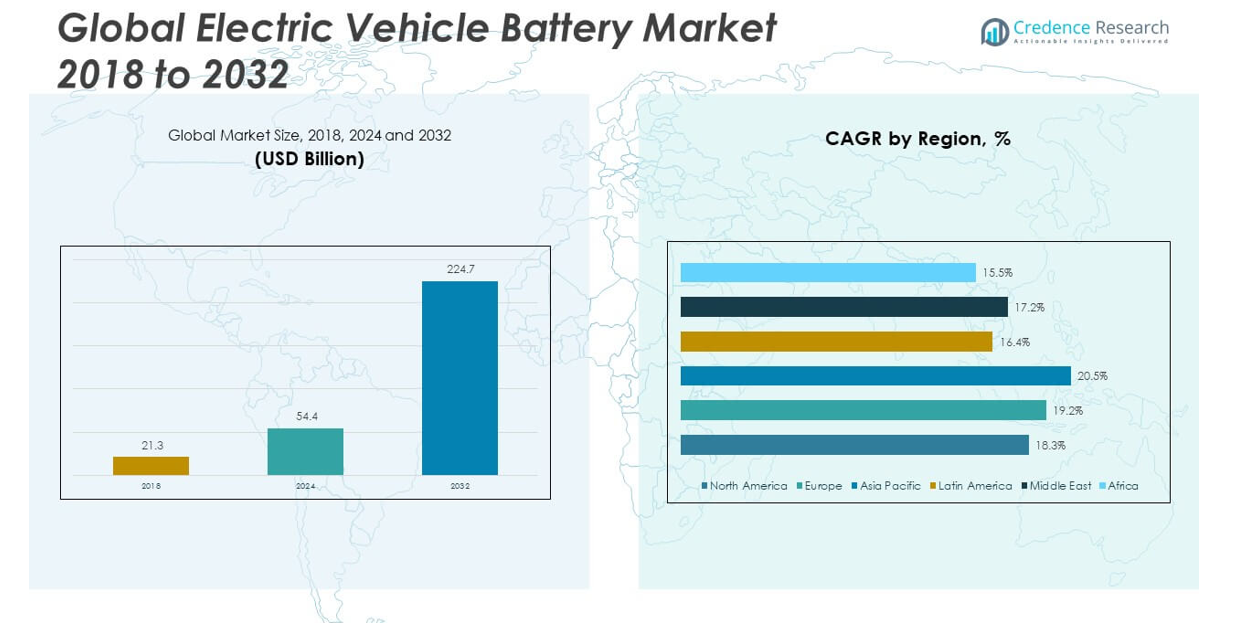
The Electric Vehicle Battery Market size was valued at USD 21.3 billion in 2018 to USD 54.4 billion in 2024 and is anticipated to reach USD 224.7 billion by 2032, at a CAGR of 19.40% during the forecast period.
Several key factors are propelling the growth of the EV battery market. Firstly, the global shift towards sustainable transportation is leading to a surge in demand for electric vehicles, thereby increasing the need for efficient and high-capacity batteries. Technological advancements in battery chemistries, such as lithium iron phosphate (LFP) and solid-state batteries, are enhancing energy density, reducing costs, and improving safety. Additionally, government incentives and regulations aimed at reducing carbon emissions are encouraging both manufacturers and consumers to invest in electric mobility solutions. The growing emphasis on battery recycling and reuse is also contributing to the market's expansion, as it addresses environmental concerns and reduces dependency on raw materials.
The Asia Pacific region plays a dominant role in the global EV battery market, particularly due to the strong manufacturing base and extensive supply chains in countries like China. China is a leader in EV battery production, benefiting from government incentives and investments in local manufacturing capabilities. Europe is also emerging as a key player, with countries focusing on enhancing local production capacity and reducing dependency on external suppliers. The European Union has introduced initiatives aimed at boosting battery production and technological advancements within the region. North America is witnessing significant growth, driven by substantial investments in electric vehicle and battery manufacturing, alongside supportive policies promoting clean energy solutions. However, regional differences in policies, infrastructure, and competition from established markets continue to shape the dynamics of the EV battery market.
Market Insights:
- The Electric Vehicle Battery Market was valued at USD 21.3 billion in 2018 and is projected to reach USD 224.7 billion by 2032, growing at a CAGR of 19.40% during the forecast period.
- The demand for electric vehicles is one of the key factors propelling market growth, as consumers shift towards sustainable transportation options to reduce carbon footprints.
- Technological advancements, such as lithium-ion and solid-state batteries, are improving energy density, reducing costs, and enhancing performance, further boosting EV adoption.
- Government incentives and environmental regulations encouraging the shift towards electric mobility are accelerating the adoption of electric vehicles, thus driving battery demand.
- Battery recycling and sustainability efforts are becoming increasingly important, as the industry focuses on reducing raw material dependency and minimizing environmental impact.
- Supply chain challenges, including raw material constraints, particularly for lithium, cobalt, and nickel, present a significant hurdle to meeting growing demand.
- The Asia Pacific region, particularly China, plays a dominant role in the market, followed by Europe and North America, where significant investments are fueling growth.
Market Drivers:
Growing Demand for Electric Vehicles
The increasing demand for electric vehicles (EVs) is one of the primary drivers of the Electric Vehicle Battery Market. Consumers are increasingly shifting towards electric mobility due to rising environmental concerns and the need to reduce carbon footprints. Governments around the world are incentivizing EV adoption with policies that promote sustainable transportation solutions, including tax rebates, grants, and favorable regulations. These government initiatives, combined with growing awareness about the environmental impact of traditional fuel vehicles, have accelerated the uptake of electric vehicles. As more consumers opt for EVs, the demand for efficient, high-capacity batteries to power these vehicles continues to grow, creating a strong pull in the market for electric vehicle batteries.
Technological Advancements in Battery Technologies
Technological advancements in battery technologies are significantly influencing the growth of the Electric Vehicle Battery Market. Innovations such as lithium-ion and solid-state batteries are improving energy density, reducing charging times, and enhancing overall battery performance. These advancements are key to addressing consumer concerns about battery life and vehicle range, two major factors influencing EV adoption. The development of alternative chemistries, such as lithium iron phosphate (LFP) batteries, also contributes to cost reduction and makes EVs more affordable. As these technologies continue to evolve, EV batteries are becoming more efficient, reliable, and economical, thus driving further growth in the market.
- For instance, CATL has developed third-generation lithium iron phosphate (LFP) batteries, achieving energy densities up to 180 Wh/kg and enabling fast charging within 30 minutes. In solid-state battery innovation,
Government Regulations and Environmental Initiatives
Government regulations and environmental policies play a crucial role in shaping the Electric Vehicle Battery Market. Many countries have set ambitious targets for reducing greenhouse gas emissions, which are leading to stricter emissions standards for conventional internal combustion engine vehicles. In response, governments are promoting the adoption of electric vehicles through subsidies, grants, and regulatory frameworks that make EVs more attractive to consumers. These policies, along with increasing concerns about climate change, are accelerating the shift towards electric mobility. The growing emphasis on sustainable energy and energy storage solutions is expected to continue pushing the demand for EV batteries and further expand the market.
- For example, the European Union’s Battery Regulation, effective from 2023, mandates a minimum of 50% lithium recovery from spent batteries by 2027, increasing to 80% by 2031, and requires digital battery passports for traceability.
Battery Recycling and Sustainability Efforts
The push for sustainability in the automotive sector is further propelling the growth of the Electric Vehicle Battery Market. As the production of EVs increases, so does the need for responsible management of used batteries. Battery recycling has become an essential focus within the industry, addressing both environmental concerns and supply chain challenges. Advances in recycling technologies are making it easier and more cost-effective to reuse valuable materials from spent batteries, reducing the reliance on raw materials such as lithium and cobalt. These efforts support a circular economy and contribute to the overall sustainability of the electric vehicle ecosystem, strengthening the market for EV batteries.
Market Trends:
Shift Towards Lithium Iron Phosphate (LFP) Batteries
A notable trend in the Electric Vehicle Battery Market is the increasing adoption of lithium iron phosphate (LFP) batteries. These batteries are gaining popularity due to their lower cost, enhanced safety features, and longer lifespan compared to traditional lithium-ion batteries. LFP batteries do not use cobalt or nickel, which are costly and pose ethical and environmental concerns. Their adoption is especially prevalent in lower-cost EVs, where manufacturers aim to reduce the overall vehicle price without compromising performance. As more automakers incorporate LFP batteries into their models, it is expected that the demand for these batteries will continue to rise, reshaping the dynamics of the EV battery market.
Emergence of Solid-State Batteries
Solid-state batteries are emerging as a major trend in the Electric Vehicle Battery Market. These batteries offer several advantages, including higher energy density, faster charging times, and enhanced safety features compared to traditional liquid-based batteries. Solid-state technology eliminates the risk of overheating and fire hazards associated with liquid electrolytes. The development of solid-state batteries is driven by the need for longer driving ranges and quicker charging solutions, which are critical for widespread EV adoption. As companies invest heavily in research and development to overcome current manufacturing challenges, solid-state batteries are expected to play a significant role in the future of electric mobility.
- For example, Toyota has announced a solid-state EV battery capable of 10-minute charging and a 1,000 km range, targeting commercialization by 2028.
Growth in Battery Recycling Technologies
Battery recycling is becoming an increasingly important trend within the Electric Vehicle Battery Market. As the number of electric vehicles on the road continues to grow, so does the need for effective recycling methods to manage used batteries. New recycling technologies are being developed to extract valuable materials from spent batteries, such as lithium, cobalt, and nickel, reducing the demand for new raw materials. This trend supports the push towards a circular economy in the EV sector, promoting sustainability and reducing environmental impact. The expansion of recycling infrastructure is expected to provide a more efficient and cost-effective solution for battery waste, further boosting the market for EV batteries.
- For instance, globally, China leads with the capacity to recycle over 500,000 metric tons of EV batteries annually, while the US and Europe each have about 200,000 metric tons of capacity, with the EU planning to double this by 2025.
Strategic Partnerships and Investments in EV Battery Manufacturing
An ongoing trend in the Electric Vehicle Battery Market is the increasing number of strategic partnerships and investments in EV battery manufacturing. Automotive companies are collaborating with battery manufacturers to secure a steady supply of high-quality batteries, which is essential to meet the growing demand for electric vehicles. These partnerships are also facilitating advancements in battery technologies and expanding production capacity. Governments and private investors are also contributing to the development of battery gigafactories, particularly in regions like Europe and North America. These collaborations are expected to increase production efficiencies and further reduce the cost of EV batteries, driving the continued growth of the market.
Market Challenges Analysis:
Supply Chain and Raw Material Constraints
One of the primary challenges facing the Electric Vehicle Battery Market is the limited availability of essential raw materials. Key materials such as lithium, cobalt, and nickel are crucial for battery production, and their supply is subject to geopolitical tensions, environmental concerns, and mining practices. The extraction of these minerals often comes with ethical challenges, including poor working conditions and environmental degradation in certain regions. These constraints can disrupt the supply chain and lead to price volatility. As demand for electric vehicles increases, the pressure on these materials intensifies, creating challenges for manufacturers who need to secure a stable and sustainable supply of raw materials to meet production goals.
Battery Lifecycle and Recycling Challenges
The lifecycle management of EV batteries presents another significant challenge for the Electric Vehicle Battery Market. While battery recycling technologies are advancing, they are not yet fully optimized, and the infrastructure for large-scale recycling remains underdeveloped in many regions. As a result, the growing number of used batteries raises concerns about waste management and environmental impact. In addition, many existing recycling processes are not efficient enough to recover the full range of valuable materials from spent batteries. Addressing these challenges will require significant investments in recycling technologies and facilities to ensure that EV batteries can be disposed of responsibly without contributing to pollution or depleting scarce resources.
Market Opportunities:
Expansion of Charging Infrastructure
One of the significant opportunities in the Electric Vehicle Battery Market lies in the expansion of EV charging infrastructure. As the adoption of electric vehicles grows, the demand for widespread and fast-charging networks will increase. Developing efficient charging solutions, such as ultra-fast chargers and wireless charging technology, can address current limitations and reduce range anxiety among consumers. Investments in infrastructure by governments and private sectors will further accelerate EV adoption, creating a positive feedback loop that benefits the EV battery market. This opportunity is especially significant in regions with limited charging infrastructure, where early investments can capture substantial market share.
Advancements in Battery Recycling and Second-Life Applications
Another promising opportunity within the Electric Vehicle Battery Market is the development of advanced battery recycling technologies and the utilization of second-life applications for used batteries. Recycling processes that can efficiently recover key materials like lithium, cobalt, and nickel offer both economic and environmental benefits. Additionally, used EV batteries can be repurposed for stationary energy storage, creating a secondary market for batteries that have reached the end of their useful life in vehicles. This trend not only supports sustainability goals but also reduces the pressure on raw material extraction, creating long-term opportunities for both battery manufacturers and energy storage companies.
Market Segmentation Analysis:
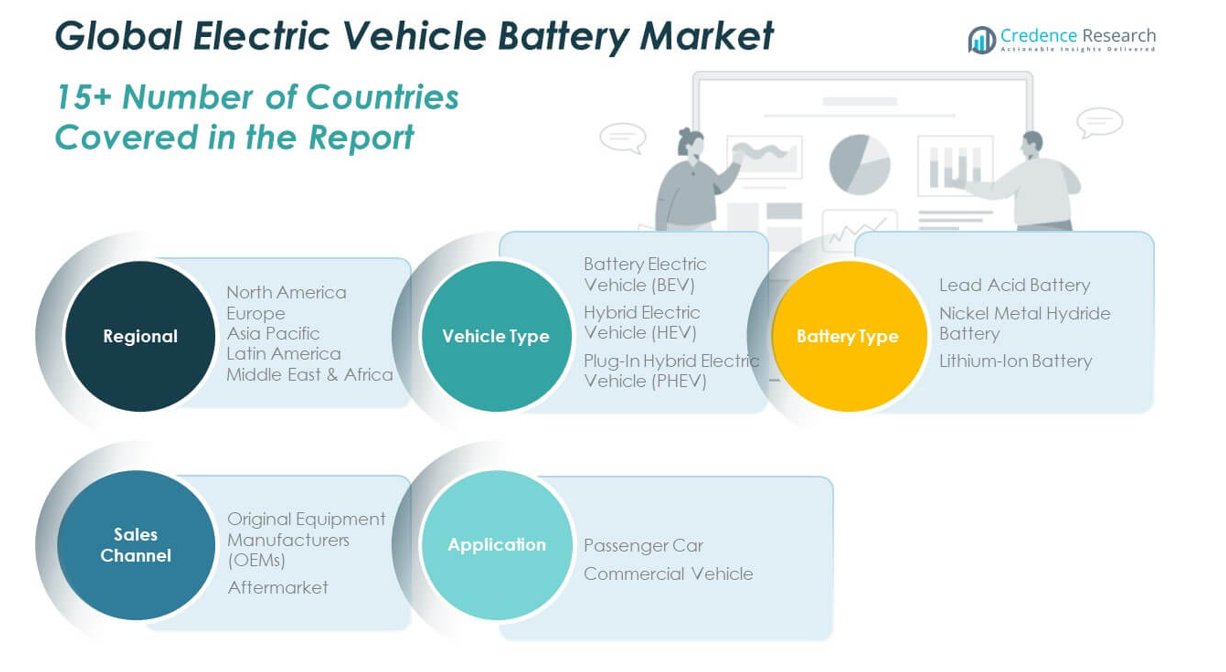
The Electric Vehicle Battery Market is segmented by vehicle type, battery type, sales channel, and application.
By vehicle type segment includes Battery Electric Vehicles (BEVs), Hybrid Electric Vehicles (HEVs), and Plug-In Hybrid Electric Vehicles (PHEVs). BEVs are expected to dominate due to the growing consumer preference for fully electric mobility solutions. HEVs and PHEVs continue to see steady growth as they offer a balance between electric power and traditional fuel-based powertrains.
- Tesla Model 3 and Nissan Leaf are leading examples, representing the growing consumer preference for fully electric vehicles due to their all-electric powertrains and zero tailpipe emissions.
By battery type, the market consists of Lead Acid, Nickel Metal Hydride (NiMH), and Lithium-Ion batteries. Lithium-Ion batteries hold the largest market share due to their higher energy density, longer lifespan, and cost-effectiveness, making them the preferred choice for EV manufacturers. Lead Acid batteries are still used in some lower-cost models, while NiMH batteries are found in older hybrid vehicles.
By sales channels, Original Equipment Manufacturers (OEMs) dominate the market, providing batteries directly for vehicle production. The aftermarket segment is expected to grow as the demand for replacement batteries increases with the growing number of EVs on the road.
- For example, companies like LG Chem, Panasonic, and Bosch provide replacement batteries and battery-related services for existing EVs, serving the growing aftermarket demand as the EV fleet ages.
By application segment is divided into Passenger Cars and Commercial Vehicles. Passenger cars hold the largest share due to the widespread adoption of EVs for personal use. However, the demand for commercial electric vehicles, including electric buses and delivery trucks, is increasing rapidly as businesses aim to reduce their carbon footprint and operating costs. This growth in both segments reflects the expanding scope of the Electric Vehicle Battery Market.
Segmentation:
By Vehicle Type
- Battery Electric Vehicle (BEV)
- Hybrid Electric Vehicle (HEV)
- Plug-In Hybrid Electric Vehicle (PHEV)
By Battery Type
- Lead Acid Battery
- Nickel Metal Hydride Battery
- Lithium-Ion Battery
By Sales Channel
- Original Equipment Manufacturers (OEMs)
- Aftermarket
By Application
- Passenger Car
- Commercial Vehicle
By Region
- North America
- U.S.
- Canada
- Mexico
- Europe
- Germany
- France
- U.K.
- Italy
- Spain
- Rest of Europe
- Asia Pacific
- China
- Japan
- India
- South Korea
- South-east Asia
- Rest of Asia Pacific
- Latin America
- Brazil
- Argentina
- Rest of Latin America
- Middle East & Africa
- GCC Countries
- South Africa
- Rest of the Middle East and Africa
Regional Analysis:
North America Electric Vehicle Battery Market
The North America Electric Vehicle Battery Market size was valued at USD 4.6 billion in 2018, increased to USD 10.0 billion in 2024, and is anticipated to reach USD 34.2 billion by 2032, at a CAGR of 18.3% during the forecast period. The market in North America is primarily driven by strong government support, including tax incentives, regulatory policies, and the increasing push toward clean energy adoption. The United States remains the largest market, with substantial investments from both established automakers and new entrants focused on electric mobility. Canada's growing electric vehicle infrastructure further complements market growth. As the demand for EVs continues to rise, the need for high-performance, cost-effective batteries will remain a significant focus for manufacturers in the region.
Europe Electric Vehicle Battery Market
The Europe Electric Vehicle Battery Market size was valued at USD 4.3 billion in 2018, increased to USD 12.9 billion in 2024, and is anticipated to reach USD 57.1 billion by 2032, at a CAGR of 19.2% during the forecast period. Europe has emerged as a key player in the global EV battery market, driven by stringent emissions regulations and a growing preference for electric mobility. The European Union’s aggressive climate targets and investments in EV battery manufacturing have strengthened the region’s position. Key markets include Germany, France, and the UK, where both local and international companies are ramping up production. Europe is also focusing on securing a sustainable battery supply chain with growing emphasis on recycling technologies.
Asia Pacific Electric Vehicle Battery Market
The Asia Pacific Electric Vehicle Battery Market size was valued at USD 9.3 billion in 2018, increased to USD 25.9 billion in 2024, and is anticipated to reach USD 114.8 billion by 2032, at a CAGR of 20.5% during the forecast period. Asia Pacific leads the global market, with China at the forefront of EV battery production, accounting for the majority of global battery manufacturing. The region benefits from established battery supply chains, low manufacturing costs, and substantial government incentives. Japan and South Korea also play vital roles, with their advanced technology and strong presence in the battery production sector. The increasing demand for electric vehicles and energy storage solutions continues to drive market expansion in this region.
Latin America Electric Vehicle Battery Market
The Latin America Electric Vehicle Battery Market size was valued at USD 1.2 billion in 2018, increased to USD 1.5 billion in 2024, and is anticipated to reach USD 7.6 billion by 2032, at a CAGR of 16.4% during the forecast period. The Latin American market is witnessing steady growth, primarily driven by emerging economies such as Brazil and Mexico. Government incentives for EV adoption and the potential for local manufacturing of batteries present key growth opportunities. Despite its relatively smaller size, the market is expected to grow as infrastructure development and awareness of environmental benefits increase. The rise of electric buses and public transport solutions in key cities also contributes to this trend.
Middle East Electric Vehicle Battery Market
The Middle East Electric Vehicle Battery Market size was valued at USD 1.3 billion in 2018, increased to USD 3.2 billion in 2024, and is anticipated to reach USD 8.3 billion by 2032, at a CAGR of 17.2% during the forecast period. The Middle East’s EV battery market is experiencing growth, driven by increasing oil prices, which encourage diversification into sustainable energy solutions. Countries like the UAE and Saudi Arabia are pushing for green initiatives and supporting the adoption of electric mobility through favorable policies. The region's focus on developing modern infrastructure and its investments in renewable energy offer substantial opportunities for growth in the EV battery sector.
Africa Electric Vehicle Battery Market
The Africa Electric Vehicle Battery Market size was valued at USD 0.7 billion in 2018, increased to USD 0.9 billion in 2024, and is anticipated to reach USD 2.7 billion by 2032, at a CAGR of 15.5% during the forecast period. The African market remains in the early stages of development but is poised for significant growth as more countries explore EV adoption. South Africa is leading the charge, with increasing investments in renewable energy and electric vehicle infrastructure. The region benefits from abundant raw materials such as cobalt and lithium, positioning Africa as a key player in the global supply chain. Government incentives and an evolving middle class could further drive the demand for EVs and batteries in the coming years.
Key Player Analysis:
- CATL
- BYD
- LG Energy Solution
- Panasonic
- SK Innovation / SK On
- Samsung SDI
- CALB
- Guoxuan High-tech
- Sunwoda
- EVE Energy
- Farasis Energy
- AESC
- Hitachi Vehicle Energy
- Primearth EV Energy (PEVE)
Competitive Analysis:
The Electric Vehicle Battery Market is highly competitive, with key players focusing on technological innovation and large-scale production to meet the growing demand for electric vehicles. Companies like LG Energy Solution, CATL, Panasonic, and Samsung SDI dominate the market, leveraging their advanced manufacturing capabilities and extensive research and development in battery technologies. These players are focusing on improving energy density, reducing costs, and enhancing the sustainability of batteries. Smaller companies are also emerging with specialized offerings, targeting niche segments within the market, such as solid-state or lithium iron phosphate (LFP) batteries. Strategic partnerships and joint ventures between automakers and battery manufacturers are becoming increasingly common, helping companies secure stable supply chains and expand production capacities. As competition intensifies, factors such as production efficiency, battery performance, and regulatory compliance will determine market leadership in the rapidly growing EV battery sector.
Recent Developments:
- In April 2025, CATL made headlines by unveiling three significant electric vehicle battery innovations at its inaugural Super Tech Day. The company introduced the Freevoy Dual-Power Battery, which features a pioneering cross-chemistry system design enabling a remarkable range of up to 1,500 kilometers on a single charge.
- In Feb 2025, LG Energy Solution announced it would debut its new 46-series cylindrical battery cells at InterBattery 2025 in Seoul. The 4680 model, measuring 80 mm in length, along with two longer variants, will be showcased for the first time to the public. These new cells are touted to deliver more than five times the energy output of the 21 mm diameter cells currently used in EVs, marking a significant leap in battery performance and customization for automakers.
- In July 2023, Toyota announced a major breakthrough in electric vehicle battery technology, revealing plans to launch a new solid-state battery capable of delivering an unprecedented range of up to 745 miles on a single charge.
Market Concentration & Characteristics:
The Electric Vehicle Battery Market is moderately concentrated, with a few dominant players holding significant market share, including LG Energy Solution, CATL, Panasonic, and Samsung SDI. These companies have established strong manufacturing capabilities and substantial research and development investments, enabling them to lead in terms of production volume and technological innovation. Despite the dominance of these major players, the market also features growing competition from regional players and new entrants focused on emerging battery technologies like solid-state and lithium iron phosphate (LFP) batteries. As the market evolves, companies are increasingly forming strategic partnerships and joint ventures to expand production capacities and secure supply chains. This dynamic environment is driving continuous improvements in battery performance, cost reduction, and sustainability, contributing to the overall growth and competitiveness of the Electric Vehicle Battery Market.
Report Coverage:
The research report offers an in-depth analysis based on vehicle type, battery type, sales channel, and application. It details leading market players, providing an overview of their business, product offerings, investments, revenue streams, and key applications. Additionally, the report includes insights into the competitive environment, SWOT analysis, current market trends, as well as the primary drivers and constraints. Furthermore, it discusses various factors that have driven market expansion in recent years. The report also explores market dynamics, regulatory scenarios, and technological advancements that are shaping the industry. It assesses the impact of external factors and global economic changes on market growth. Lastly, it provides strategic recommendations for new entrants and established companies to navigate the complexities of the market.
Future Outlook:
- The Electric Vehicle Battery Market will continue to expand rapidly due to growing demand for electric vehicles and government incentives.
- Technological advancements, including solid-state and high-capacity batteries, will improve performance and reduce costs.
- Battery recycling will become increasingly important to address supply chain sustainability and reduce raw material dependency.
- Key players will focus on improving energy density and reducing charging times to meet consumer expectations.
- Regional production of batteries will increase as countries aim for energy independence and reduce reliance on imports.
- Partnerships between automakers and battery manufacturers will grow to ensure stable supply chains.
- The development of ultra-fast charging infrastructure will enhance EV adoption, driving further demand for advanced batteries.
- Investment in battery manufacturing plants will rise, particularly in North America and Europe, due to regulatory support.
- Environmental regulations will continue to push for cleaner battery technologies and lower emissions.
- Emerging markets in Latin America, Africa, and the Middle East will present new growth opportunities for battery manufacturers.

Request a Free Sample
Fill in your details and we'll send you a free sample report.
- Sample data tables & charts
- Research methodology
Market Dynamics
Surge in Electric Vehicle Adoption
The global shift toward sustainable transportation, supported by government incentives and consumer environmental awareness, is driving rapid growth in electric vehicle sales, directly increasing demand for high-capacity EV batteries.
Technological Advancements in Battery Chemistry
Innovations such as lithium iron phosphate (LFP) and solid-state batteries are improving energy density, reducing costs, and enhancing safety, making EVs more attractive and accelerating battery market expansion.
Government Regulations and Incentives
Stringent emissions standards and supportive policies, such as tax rebates and grants for EV purchases, are encouraging both manufacturers and consumers to transition to electric mobility, boosting battery demand.
Expansion of Battery Recycling and Sustainability Initiatives
Growing emphasis on battery recycling and reuse is addressing environmental concerns and reducing dependency on raw materials, supporting a circular economy and further fueling market growth.
Strategic Investments and Partnerships in Battery Manufacturing
Automakers and battery producers are forming alliances and investing in gigafactories to secure supply chains and scale up production, enabling the industry to meet rising global demand efficiently.
Need a Custom Version of This Report?
Tailor the scope, geography, or segments to your exact requirements.
- Custom geography or segment scope
- Direct access to our analyst team
Frequently Asked Questions
What is the current size of the Electric Vehicle Battery Market?
What are the key segments within the Electric Vehicle Battery Market?
What are some challenges faced by the Electric Vehicle Battery Market?
Who are the major players in the Electric Vehicle Battery Market?
Table of Content
Chapter 1 Market Segmentation
- 1.1 Segmentation Framework
- 1.1.1 Product and Service Classification
- 1.1.2 Application and End-Use Classification
- 1.1.3 Technology and Solution Classification
- 1.1.4 Customer and Distribution Channel Classification
- 1.1.5 Geographic Segmentation
- 1.1.6 Market Segment Definitions and Boundaries
- 1.2 By Application
- 1.2.1 Passenger Car
- 1.2.2 Commercial Vehicle
- 1.3 By Battery Type
- 1.3.1 Lithium-Ion Battery
- 1.3.2 Lead Acid Battery
- 1.3.3 Nickel Metal Hydride Battery
- 1.4 By Vehicle Type
- 1.4.1 Battery Electric Vehicle (BEV)
- 1.4.2 Hybrid Electric Vehicle (HEV)
- 1.4.3 Plug-In Hybrid Electric Vehicle (PHEV)
- 1.5 By Sales Channel
- 1.5.1 Original Equipment Manufacturers (OEMs)
- 1.5.2 Aftermarket
Chapter 2 Introduction
- 2.1 Report Objectives and Scope
- 2.2 Product Definition and Industry Terminology
- 2.3 Market Inclusions and Exclusions
- 2.4 Research Process
- 2.4.1 Primary Research and Expert Interviews
- 2.4.2 Secondary Research and Source Review
- 2.4.3 Top-Down and Bottom-Up Estimation
- 2.4.4 Data Triangulation and Verification
- 2.5 Market Size Measurement Basis
- 2.5.1 2018: USD 21.3 billion → 2024: USD 54.4 billion
- 2.6 Historical and Forecast Reference Periods
- 2.6.1 Base Year: 2018
- 2.6.2 Forecast Period: 2018-2024
- 2.7 Research Assumptions and Limitations
Chapter 3 Executive Summary
- 3.1 Market Snapshot and Key Findings
- 3.2 Base-Year Market Size, 2018
- 3.3 Forecast Market Size, 2024
- 3.4 Revenue and Volume Growth Outlook
- 3.5 Key Demand and Supply Indicators
- 3.6 Leading Market Segments
- 3.7 Fastest-Growing Market Opportunities
- 3.8 Regional Performance Highlights
- 3.9 Technology and Industry Transformation
- 3.10 Competitive Landscape Summary
- 3.11 Analyst View and Strategic Implications
Chapter 4 Global Electric Vehicle Battery Market Trends and Developments
- 4.1 Historical Industry Development
- 4.2 Recent Market Trends and Developments
- 4.3 Demand and Customer Behavior Trends
- 4.4 Technology and Product Innovation
- 4.5 Artificial Intelligence, Automation and Digitalization
- 4.6 Local Manufacturing and Supply Chain Realignment
- 4.7 Industry Partnerships, Mergers and Acquisitions
- 4.8 Sustainability and Circular Economy Developments
- 4.9 Government and Private Sector Investment Trends
- 4.10 Emerging Business Models and Commercialization
- 4.11 Industry Developments and Announcements
Chapter 5 Global Electric Vehicle Battery Market Production, Supply and Demand Analysis
- 5.1 Demand Trend and Consumption Analysis
- 5.2 Demand Forecast, 2018-2024
- 5.3 Production and Output Trend
- 5.4 Production and Output Forecast, 2018-2024
- 5.5 Installed Capacity and Capacity Utilization
- 5.6 Company-Wise Production Plants and Statistics
- 5.6.1 Installed Production Capacity
- 5.6.2 Actual Production
- 5.6.3 Planned Capacity and Expansion Targets
- 5.7 Supply Chain Structure and Procurement Trends
- 5.8 Supply-Demand Gap and Bottlenecks
- 5.9 Import Dependence and Sourcing Structure
- 5.10 Contract Manufacturing and Outsourcing
- 5.11 Regional Supply and Demand Concentration
Chapter 6 Global Electric Vehicle Battery Market Pricing Analysis
- 6.1 Pricing Structure and Measurement
- 6.2 Historical Pricing Trends
- 6.3 Pricing Outlook, 2018-2024
- 6.4 Average Selling Price and Unit Economics
- 6.5 Pricing by Product and Market Segment
- 6.6 Geographic Pricing Differences
- 6.7 Key Input, Energy, Labor and Logistics Costs
- 6.8 Contract Pricing and Purchasing Models
- 6.9 Pricing Sensitivity and Competitive Positioning
- 6.10 Price, Margin and Profitability Implications
Chapter 7 Global Electric Vehicle Battery Market Dynamics
- 7.1 Market Growth Drivers
- 7.1.1 Demand-Side Drivers
- 7.1.2 Technology and Innovation Drivers
- 7.1.3 Infrastructure and Investment Drivers
- 7.1.4 Regulatory and Policy Drivers
- 7.2 Market Restraints
- 7.2.1 Cost and Affordability Constraints
- 7.2.2 Technology and Adoption Barriers
- 7.2.3 Supply Chain and Operational Constraints
- 7.3 Market Challenges
- 7.3.1 Competitive Pressure and Margin Erosion
- 7.3.2 Skills, Infrastructure and Implementation Gaps
- 7.4 Emerging Market Opportunities
- 7.5 Market Dynamics Impact and Time-Horizon Assessment
Chapter 8 Global Electric Vehicle Battery Value Chain Analysis
- 8.1 Industry Value Chain Overview
- 8.2 Upstream Suppliers and Critical Inputs
- 8.3 Technology and Component Providers
- 8.4 Manufacturing or Service Delivery
- 8.5 Distribution, Channel Partners and Integrators
- 8.6 Downstream Applications and End Users
- 8.7 Value Addition and Profit Pools
- 8.8 Vertical Integration and Outsourcing
- 8.9 Supplier Concentration and Risk
- 8.10 Supply Chain Localization and Resilience
Chapter 9 Global Electric Vehicle Battery Market Regulations and Policies
- 9.1 Relevant Laws, Standards and Compliance Frameworks
- 9.2 Product, Service, Safety and Quality Requirements
- 9.3 Government Policies, Incentives and Subsidies
- 9.4 Imports, Exports and Trade Barriers
- 9.5 Public Procurement and Local Content Requirements
- 9.6 Environmental and Sustainability Compliance
- 9.7 Upcoming Policy Changes and Market Implications
Chapter 10 Global Electric Vehicle Battery Market Hotspots and Opportunities
- 10.1 Market Opportunity Mapping and Growth Hotspots
- 10.2 High-Growth Applications and Customer Groups
- 10.3 Underserved Markets and White-Space Opportunities
- 10.4 Emerging Technology and Product Opportunities
- 10.5 New Capacity and Investment Hotspots
- 10.6 Market Entry and Expansion Opportunities
- 10.7 Distribution and Partnership Opportunities
- 10.8 Near-Term and Long-Term Commercial Potential
- 10.9 Opportunity Attractiveness and Execution Risks
Chapter 11 Global Electric Vehicle Battery Market Outlook, 2018-2024
- 11.1 Market Size and Analysis
- 11.1.1 Revenue (Market Measurement: 2018: USD 21.3 billion → 2024: USD 54.4 billion)
- 11.1.2 Market Volume and Quantity Sold
- 11.1.3 Historical Market Size
- 11.1.4 Base-Year Market Size, 2018
- 11.2 Market Forecast, 2018-2024
- 11.2.1 Revenue Forecast to 2024
- 11.2.2 Volume Forecast to 2024
- 11.2.3 CAGR and Year-on-Year Growth
- 11.2.4 Incremental Revenue Opportunity
- 11.3 Forecast Assumptions and Scenario Analysis
- 11.3.1 Base-Case Forecast
- 11.3.2 Optimistic and Conservative Scenarios
- 11.3.3 Technology, Pricing and Policy Sensitivities
- 11.4 Market Attractiveness and Growth Outlook
Chapter 12 Global Electric Vehicle Battery Market Segmentation and Outlook
- 12.1 Segmentation Summary and Market Shares, 2018
- 12.2 Largest and Fastest-Growing Segments
- 12.3 By Application - Market Size and Forecast, 2018-2024
- 12.3.1 Segment Definition and Scope
- 12.3.2 Historical Market Size
- 12.3.3 Revenue Forecast, 2018-2024
- 12.3.4 Volume Forecast, 2018-2024
- 12.3.5 Base-Year Market Share, 2018
- 12.3.6 Segment CAGR and Growth Drivers
- 12.3.7 Subsegment Market Size and Forecast
- 12.3.7.1 Passenger Car
- 12.3.7.2 Commercial Vehicle
- 12.3.8 Subsegment Pricing and Adoption Trends
- 12.3.9 Leading Suppliers and Competition
- 12.3.10 Regional Demand and Opportunities
- 12.4 By Battery Type - Market Size and Forecast, 2018-2024
- 12.4.1 Segment Definition and Scope
- 12.4.2 Historical Market Size
- 12.4.3 Revenue Forecast, 2018-2024
- 12.4.4 Volume Forecast, 2018-2024
- 12.4.5 Base-Year Market Share, 2018
- 12.4.6 Segment CAGR and Growth Drivers
- 12.4.7 Subsegment Market Size and Forecast
- 12.4.7.1 Lithium-Ion Battery
- 12.4.7.2 Lead Acid Battery
- 12.4.7.3 Nickel Metal Hydride Battery
- 12.4.8 Subsegment Pricing and Adoption Trends
- 12.4.9 Leading Suppliers and Competition
- 12.4.10 Regional Demand and Opportunities
- 12.5 By Vehicle Type - Market Size and Forecast, 2018-2024
- 12.5.1 Segment Definition and Scope
- 12.5.2 Historical Market Size
- 12.5.3 Revenue Forecast, 2018-2024
- 12.5.4 Volume Forecast, 2018-2024
- 12.5.5 Base-Year Market Share, 2018
- 12.5.6 Segment CAGR and Growth Drivers
- 12.5.7 Subsegment Market Size and Forecast
- 12.5.7.1 Battery Electric Vehicle (BEV)
- 12.5.7.2 Hybrid Electric Vehicle (HEV)
- 12.5.7.3 Plug-In Hybrid Electric Vehicle (PHEV)
- 12.5.8 Subsegment Pricing and Adoption Trends
- 12.5.9 Leading Suppliers and Competition
- 12.5.10 Regional Demand and Opportunities
- 12.6 By Sales Channel - Market Size and Forecast, 2018-2024
- 12.6.1 Segment Definition and Scope
- 12.6.2 Historical Market Size
- 12.6.3 Revenue Forecast, 2018-2024
- 12.6.4 Volume Forecast, 2018-2024
- 12.6.5 Base-Year Market Share, 2018
- 12.6.6 Segment CAGR and Growth Drivers
- 12.6.7 Subsegment Market Size and Forecast
- 12.6.7.1 Original Equipment Manufacturers (OEMs)
- 12.6.7.2 Aftermarket
- 12.6.8 Subsegment Pricing and Adoption Trends
- 12.6.9 Leading Suppliers and Competition
- 12.6.10 Regional Demand and Opportunities
- 12.7 Segment Growth Comparison
- 12.8 Segment Attractiveness and Priority Matrix
Chapter 13 Global Electric Vehicle Battery End-Use and Application Market Outlook
- 13.1 End-Use Industry and Customer Demand Structure
- 13.2 Leading Applications and Customer Groups
- 13.3 End-Use Market Size, Share and Forecast
- 13.4 Major End-Use Industry Deep Dives
- 13.4.1 Customer Requirements and Use Cases
- 13.4.2 Demand and Replacement Cycles
- 13.4.3 Technical and Regulatory Considerations
- 13.4.4 Purchasing and Procurement Models
- 13.4.5 Leading Vendors and Distribution Channels
- 13.4.6 Forecast and Commercial Opportunities
- 13.5 Emerging Applications and Cross-Segment Demand
- 13.6 End-Use Industry Investment Priorities
Chapter 14 Global Electric Vehicle Battery Geographic Market Outlook, 2018-2024
- 14.1 Regional Market Size and Share, 2018
- 14.2 Regional Market Forecast, 2018-2024
- 14.3 Regional Pricing, Production and Demand Differences
- 14.4 North America
- 14.4.1 United States
- 14.4.2 Canada
- 14.4.3 Mexico
- 14.5 Europe
- 14.5.1 Germany
- 14.5.2 France
- 14.5.3 Italy
- 14.5.4 United Kingdom
- 14.5.5 Spain
- 14.5.6 Poland
- 14.5.7 Russia
- 14.5.8 Netherlands
- 14.5.9 Belgium
- 14.5.10 Sweden
- 14.5.11 Denmark
- 14.5.12 Norway
- 14.5.13 Rest of Europe
- 14.6 Asia Pacific
- 14.6.1 China
- 14.6.2 India
- 14.6.3 Japan
- 14.6.4 South Korea
- 14.6.5 Thailand
- 14.6.6 Indonesia
- 14.6.7 Vietnam
- 14.6.8 Malaysia
- 14.6.9 Australia
- 14.6.10 Rest of Asia Pacific
- 14.7 Latin America
- 14.7.1 Brazil
- 14.7.2 Argentina
- 14.7.3 Colombia
- 14.7.4 Chile
- 14.7.5 Rest of Latin America
- 14.8 Middle East
- 14.8.1 Saudi Arabia
- 14.8.2 United Arab Emirates
- 14.8.3 Turkey
- 14.8.4 Israel
- 14.8.5 Iran
- 14.8.6 Rest of the Middle East
- 14.9 Africa
- 14.9.1 South Africa
- 14.9.2 Egypt
- 14.9.3 Nigeria
- 14.9.4 Morocco
- 14.9.5 Rest of Africa
- 14.10 Regional Investment, Policy and Supply Chain Differences
- 14.11 Regional Competitive Landscape
- 14.12 Geographic Growth Hotspots
Chapter 15 Global Electric Vehicle Battery Technology, Innovation and Sustainability Outlook
- 15.1 Technology Landscape and Maturity
- 15.2 Product, Process and Service Innovation
- 15.3 AI, Automation and Digital Tools in the Industry
- 15.4 Technology Adoption and Performance Benchmarking
- 15.5 Innovation Pipeline and R&D Investment
- 15.6 Patent and Intellectual Property Trends
- 15.7 Energy Efficiency and Resource Management
- 15.8 Sustainability, Recycling and Circularity
- 15.9 Technology Roadmap, 2018-2024
- 15.10 Risks of Obsolescence and Technology Substitution
Chapter 16 Global Electric Vehicle Battery Market Key Strategic Imperatives
- 16.1 Growth and Market Entry Priorities
- 16.2 High-Return Products and Segments
- 16.3 Pricing, Profitability and Cost Optimization
- 16.4 Technology Investment and Product Differentiation
- 16.5 Supply Chain Localization and Resilience
- 16.6 Distribution and Customer Acquisition
- 16.7 Partnership, Acquisition and Capacity Strategy
- 16.8 Regional Expansion Priorities
- 16.9 Short-, Medium- and Long-Term Actions
Chapter 17 Competition Outlook
- 17.1 Industry Competition Characteristics
- 17.2 Market Structure and Concentration
- 17.3 Market Share and Competitive Positioning, 2018
- 17.4 Company-Wise Revenue and Product Benchmarking
- 17.5 Production and Service Capacity Benchmarking
- 17.6 Technology, Pricing and Differentiation
- 17.7 Regional Footprint and Distribution Strength
- 17.8 Mergers, Acquisitions and Strategic Alliances
- 17.9 New Entrants and Competitive Threats
- 17.10 Porter's Five Forces and Industry Attractiveness
- 17.11 Competitive Outlook, 2018-2024
Chapter 18 Company Profiles
- 18.1 Company Coverage and Selection Criteria
- 18.2 CATL
- 18.2.1 Business Description
- 18.2.2 Company Ownership and Geographic Presence
- 18.2.3 Product and Service Portfolio
- 18.2.4 Manufacturing and Operating Footprint
- 18.2.5 Production Capacity and Expansion Plans
- 18.2.6 Financial Performance and Investment
- 18.2.7 Market Share and Competitive Position
- 18.2.8 Technology and Innovation Capabilities
- 18.2.9 Strategic Alliances or Partnerships
- 18.2.10 Recent Developments
- 18.2.11 Growth Strategy and Outlook
- 18.3 BYD
- 18.4 LG Energy Solution
- 18.5 Panasonic
- 18.6 SK On
- 18.7 Samsung SDI
- 18.8 CALB
- 18.9 Guoxuan High-tech
- 18.10 EVE Energy
- 18.11 AESC
- 18.12 Other Relevant Market Participants
Note: Every listed company is profiled on the structure shown under the first company. The company list is preliminary and may change based on research findings, market developments, data availability and client requirements.
Chapter 19 Disclaimer
- 19.1 Research and Forecast Disclaimer
- 19.2 Data Source and Estimation Limitations
Note: The depth of individual sections depends on data availability for this market. Volume, capacity, trade and other unit-based metrics are included where applicable.