
| REPORT ATTRIBUTE | DETAILS |
|---|---|
| Historical Period | 2019-2022 |
| Base Year | 2023 |
| Forecast Period | 2024-2032 |
| Facility Management Services Market Size 2024 | USD 52.6 Billion |
| Facility Management Services Market, CAGR | 12.4% |
| Facility Management Services Market Size 2032 | USD 112.5 Billion |
Market Overview
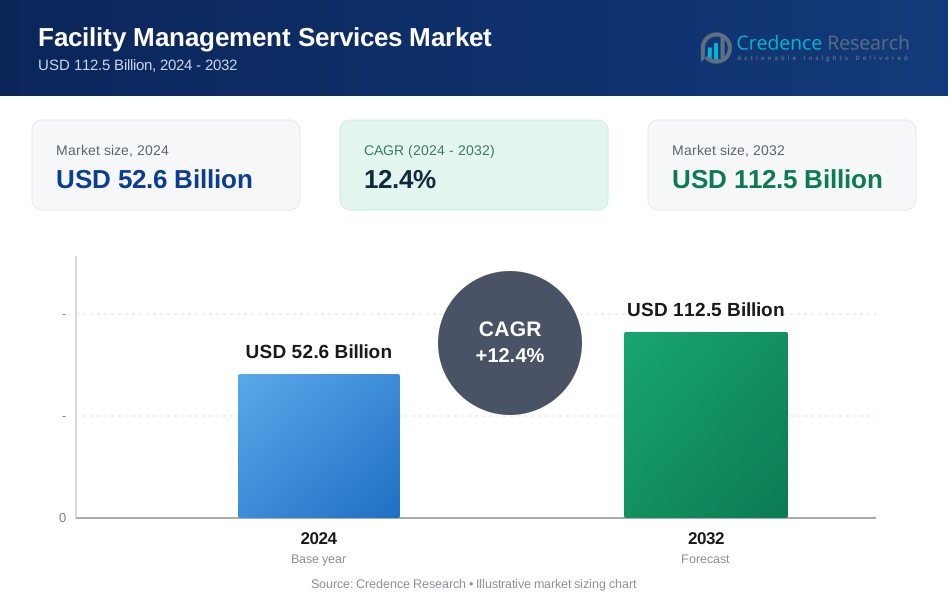
The Facility Management Services Market is projected to grow from USD 52.6 Billion in 2024 to USD 112.5 Billion by 2032, at a compound annual growth rate (CAGR) of 12.4% during the forecast period.
The Facility Management Services Market is driven by the growing demand for integrated services across commercial, residential, and industrial sectors to enhance operational efficiency and cost management. Rapid urbanization and infrastructure development are fueling the need for professional facility management, especially in emerging economies. Businesses are increasingly adopting advanced technologies such as IoT, AI, and cloud-based solutions to streamline processes like maintenance, energy management, and security, driving market growth. Sustainability trends, including green building certifications and energy efficiency mandates, are pushing service providers to offer eco-friendly solutions. Additionally, the rise in outsourcing non-core operations to specialized facility management firms allows organizations to focus on core business objectives, further boosting the market. The shift towards flexible workspaces and hybrid working model’s post-pandemic has also amplified the demand for adaptive facility management services tailored to evolving business needs. These factors collectively support the steady expansion of the market.
The facility management services market exhibits robust growth across key regions, with North America and Asia-Pacific leading the charge. North America, driven by advanced infrastructure and widespread adoption of integrated facility management (IFM) services, holds a significant market share, supported by high demand in the healthcare, retail, and corporate sectors. Asia-Pacific is the fastest-growing region, propelled by rapid urbanization, infrastructure development, and increasing outsourcing trends in countries like China, India, and Japan.
Market Drivers:
Growing Demand for Outsourced Services:
The rising preference for outsourcing facility management services is a key driver of market growth, as organizations concentrate on core activities and entrust non-core operations such as cleaning, maintenance, and security to specialized providers, a pattern seen strongly in healthcare, IT, and retail where efficiency and cost control matter. For instance, in India Delhi National Capital Region, a V V Giri National Labour Institute study estimates about 1.5 lakh private security personnel engaged by roughly 500 security firms, showing how widely organizations rely on contracted specialist providers for essential support functions. In healthcare, the operating scale itself reinforces this outsourcing pull since India has 23581 Government Hospitals and 22 Central Government Hospitals, creating large recurring requirements for housekeeping, maintenance, and security services across facilities.
Integration of Advanced Technologies:
The adoption of advanced technologies such as Internet of Things IoT, artificial intelligence AI, and cloud-based platforms is transforming facility management services by enabling predictive maintenance, real-time condition monitoring, and data-driven decisions that improve operational efficiency across large facilities. For instance, the Ministry of Housing and Urban Affairs Smart Cities Mission reports that Integrated Command and Control Centres are operational in all 100 Smart Cities and that these centres improve city operations such as transport, water supply, and solid waste management by integrating emerging technologies like AI, IoT, and data analytics. This same report notes that over 84,000 CCTV surveillance cameras have been installed across 100 Smart Cities to strengthen monitoring and response capabilities, reinforcing the shift toward technology-enabled, always-on oversight that facility teams increasingly expect from outsourced service providers. In specific mission cities such as Ahmedabad, Surat, and Chandigarh, the Smart Cities Mission highlights the use of ICCC-linked traffic management systems that rely on real-time data and centralized monitoring, illustrating how IoT and AI-led command-and-monitor models are becoming embedded in day-to-day operations and extending the demand for intelligent, sustainable facility management practices.
Emphasis on Sustainability and Energy Efficiency:
Growing awareness of environmental sustainability and stringent regulatory requirements are driving demand for energy-efficient and eco-friendly facility management services, as organizations seek solutions that comply with green building certifications and energy efficiency standards. As a global example from the European Union, the European Commission states that buildings are responsible for 40% of EU energy consumption and 36% of greenhouse gas emissions, which is strengthening the case for tighter building-performance compliance and operational efficiency in managed facilities. The European Environment Agency further reports that the buildings sector represented 33% of EU energy-related greenhouse gas emissions in 2023 and that total buildings-sector emissions fell 43% between 2005 and 2023, reinforcing why services such as energy optimization, waste management, and water conservation are gaining traction as companies work to reduce their footprint and align with sustainability goals.
Expansion of Commercial and Industrial Sectors:
Rapid urbanization and infrastructure development across emerging economies are fueling demand for facility management services as offices, shopping malls, and manufacturing facilities expand and require comprehensive solutions to keep operations seamless. As a global instance, the United Nations projects the urban share of the world’s population will rise from 55% in 2018 to 68% by 2050, adding 2.5 billion more people to urban areas, with India, China, and Nigeria together accounting for 35% of the projected increase in the world’s urban population between 2018 and 2050, which reinforces the scale of facilities that must be planned, operated, and maintained in fast-growing cities.
In India, the Government of India has stated that the National Infrastructure Pipeline was launched with projected infrastructure investment of around ₹111 lakh crore during FY20 to FY25 and that the pipeline includes 8,964 projects with total investment of more than ₹108 lakh crore under different stages of implementation, directly supporting sustained requirements for hard and soft facility management across new and upgraded assets. Moreover, the post-pandemic shift toward hybrid workspaces is strengthening the need for flexible and adaptive services, with OECD analysis showing the average share of remote job postings across studied countries rose from 2.5% in January 2020 to 7.9% in April 2021 and remained near peak at 7.5% in September 2021, indicating a lasting operational shift that changes cleaning, space utilization, and workplace support needs.
Market Trends:
Increased Adoption of Technology-Driven Solutions:
The facility management services market is experiencing a significant shift towards technology-driven solutions. Advanced tools such as IoT, artificial intelligence, and big data analytics are enabling predictive maintenance, real-time monitoring, and automated workflows. For instance, Cisco Systems has implemented smart building systems powered by IoT to manage energy consumption, security, and asset tracking more efficiently. Additionally, IBM is using AI-powered chatbots and virtual assistants to improve customer service and streamline communication, marking a transformation in service delivery.
Focus on Sustainable Facility Management:
Sustainability has emerged as a central trend in the facility management industry, driven by environmental concerns and regulatory requirements. Organizations are prioritizing energy-efficient solutions, waste management practices, and water conservation strategies to reduce their carbon footprint. For example, Google has aligned its services with green building certifications, promoting eco-friendly practices and leveraging renewable energy technologies. This trend reflects a growing commitment to achieving global sustainability goals.
Growth in Integrated Facility Management (IFM) Services:
The demand for integrated facility management (IFM) services is on the rise as organizations seek holistic solutions to streamline operations. IFM combines multiple services such as cleaning, maintenance, and security into a single contract, allowing businesses to enhance efficiency and reduce costs. Microsoft is a notable example, consolidating its operations across various locations through IFM services. The flexibility and scalability of IFM services are further driving their adoption.
Shift Towards Flexible and Hybrid Workspaces:
The post-pandemic era has accelerated the shift towards flexible and hybrid workspaces, creating new opportunities for facility management services. Businesses are focusing on workspace reconfigurations, enhanced hygiene measures, and remote facility management to accommodate evolving workplace needs. For example, Amazon has implemented flexible workspace solutions to cater to the dynamic requirements of modern work environments, fueling market growth. This trend underscores the increasing importance of adaptive and customized solutions.
Market Challenges Analysis:
Rising Operational Costs and Technological Challenges:
The facility management services market faces the challenge of rising operational costs, driven by the integration of advanced technologies like IoT, AI, and automation. While these technologies enhance service efficiency and deliver superior outcomes, they require substantial investment in infrastructure, training, and maintenance. Small and mid-sized service providers often find it difficult to compete due to the high cost of adopting and upgrading these systems. Additionally, the increasing complexity of managing diverse facilities across sectors with varying compliance requirements adds to the operational burden, making cost management and service customization significant challenges for the industry. This financial strain often limits innovation and hinders smaller providers from scaling their operations effectively.
Workforce Shortages and Retention Issues:
Labor shortages and high employee turnover present another critical challenge for the facility management market. The industry’s growing reliance on skilled personnel to operate advanced technologies is creating a talent gap, particularly in emerging markets. Furthermore, the demanding nature of facility management roles, coupled with lower pay in certain areas, affects employee retention and satisfaction. Service disruptions caused by workforce instability can lead to reduced client confidence and hinder long-term partnerships. Providers must invest in employee training, engagement, and competitive compensation to mitigate these issues, but these efforts further strain their operational budgets, creating a cyclical challenge that affects overall growth and stability. Additionally, navigating cultural differences and language barriers in multinational operations adds further complexity to workforce management.
Market Segmentation Analysis:
By Type
The facility management services market is segmented into in-house and outsourced services, each catering to different organizational needs. Outsourced facility management dominates the market due to its ability to deliver cost-efficient and specialized solutions, allowing businesses to focus on core operations while leaving non-core activities to experts. This segment has seen robust growth as companies increasingly adopt advanced technologies and expertise provided by third-party vendors. In-house facility management, although less prevalent, remains relevant in sectors where direct control over operations is critical, such as healthcare and educational institutions.
By Service
Based on service, the market is divided into hard services, soft services, and specialized offerings. Hard services, including HVAC maintenance, electrical repairs, and plumbing, account for a significant share due to their essential role in ensuring operational functionality and safety. Soft services, such as cleaning, landscaping, and security, are gaining traction as organizations prioritize enhanced workplace environments. Specialized services, including energy management and space optimization, are emerging as high-growth areas driven by sustainability goals and the evolving demands of hybrid workspaces. These segments collectively highlight the market’s ability to address diverse operational needs effectively.
Segments:
Based on Type:
- Outsourced Services
- In-house Services
Based on Service:
- Hard Service
-
- Electrical
- Civil
- Mechanical
- Specialized Hard Services
- Others Hard Services
- Soft Service
- Cleaning
- Laundry
- Landscaping
- Security
- Others Soft Services
- Management Service
-
- Catering
- Property
- Contract Management
- Energy & Utilities
- Maintenance Planning & Control
- Others Management Service
Based on Application:
- Government & Public Sector
- Industrial Sector
- Commercial Sector
- IT & Telecommunication Sector
- Banking, Financial Services, & Insurance (BFSI) Sector
- Education & Entertainment Sector
- Transportation & Logistics Sector
- Healthcare Sector
- Other Sectors
Based on the Geography:
- North America
- U.S.
- Canada
- Mexico
- Europe
- Germany
- France
- U.K.
- Italy
- Spain
- Rest of Europe
- Asia Pacific
- China
- Japan
- India
- South Korea
- South-east Asia
- Rest of Asia Pacific
- Latin America
- Brazil
- Argentina
- Rest of Latin America
- Middle East & Africa
- GCC Countries
- South Africa
- Rest of the Middle East and Africa
Regional Analysis:
North America
North America holds a leading position in the facility management services market, driven by advanced infrastructure, technological adoption, and a well-established outsourcing culture. The region accounts for 35% of the global market share, with the United States being the primary contributor due to its large-scale commercial establishments and widespread adoption of integrated facility management (IFM) services. The growing demand for technology-driven solutions such as IoT-based smart building management systems and predictive maintenance tools further supports the market's growth in North America. Companies in the region are investing heavily in automation and AI-powered analytics to optimize facility operations and reduce operational costs, ensuring sustained market dominance. Additionally, regulatory compliance regarding workplace safety and energy efficiency standards enhances the adoption of professional facility management services. Key industries such as healthcare, retail, and corporate offices are increasingly outsourcing facility management to improve efficiency and meet regulatory requirements. Canada complements the market dynamics with its increasing focus on sustainable building practices and green certifications, solidifying the region’s dominance. The push towards energy-efficient buildings and government-backed incentives for sustainability further bolster the demand for advanced facility management solutions in the region.
Asia-Pacific
Asia-Pacific is emerging as the fastest-growing region in the facility management services market, holding 25% of the global share and expected to expand significantly during the forecast period. The region’s rapid urbanization, infrastructure development, and industrialization in countries like China, India, and Japan drive demand for professional facility management. The outsourcing trend is gaining traction across the region, supported by cost-effective labor and increasing adoption of technology-based solutions. China, as the largest contributor, benefits from its booming commercial real estate sector, smart city initiatives, and government-driven infrastructure projects. India is witnessing accelerated growth due to the rise of IT parks, business hubs, and public infrastructure projects, supported by favorable government policies and foreign investments. Moreover, Japan is adopting advanced facility management practices driven by its focus on automation and technological innovation in smart buildings. Furthermore, the shift towards hybrid workspaces and the implementation of stricter safety and hygiene measures post-pandemic contribute to the growing demand for integrated and adaptive facility management services in the region. Increasing awareness of green buildings and the adoption of energy-efficient practices add to the region’s appeal as a growth hotspot in the global market.
Key Player Analysis:
- CBRE Group, Inc.
- Spotless Group Holdings Limited
- ISS World Services A/S
- Sodexo, Inc.
- Knight Facilities Management
- Tenon Group
- BVG India Ltd.
- EMCOR Group, Inc.
- Quess Corp Ltd.
- Arthur McKay & Co Ltd.
Competitive Analysis:
The facility management services market is highly competitive, with leading players such as CBRE Group, Inc., ISS World Services A/S, Sodexo, Inc., EMCOR Group, Inc., Spotless Group Holdings Limited, Tenon Group, Quess Corp Ltd., BVG India Ltd., Knight Facilities Management, and Arthur McKay & Co Ltd. dominating the landscape. These companies leverage advanced technologies like IoT, AI, and predictive analytics to deliver tailored solutions that enhance operational efficiency and sustainability. Their strategies include expanding service portfolios, forming strategic alliances, and adopting integrated facility management models to meet diverse client needs. Players also focus on sustainability initiatives, including energy-efficient solutions and green certifications, to align with evolving market demands. For instance, Quess Corp Ltd. has achieved several green building certifications for their facilities, and BVG India Ltd. has invested in renewable energy projects to power their operations. The increasing emphasis on hybrid workspaces and digital transformation further fuels the competition, as companies strive to deliver innovative, adaptive, and cost-effective solutions across global markets.
Recent Developments:
- In Feb 2025, ISS secured an integrated facilities services contract with Aroundtown across 47 German locations, covering services such as cleaning, building technology, security, landscaping, and winter services.
- In May 2025, Mitie secured a £12 million three-year integrated facilities management contract with the UK Intellectual Property Office (with an option to extend), covering engineering, cleaning, and waste management across two sites.
- In Feb 2025 (FM/biomed ops), Sodexo India announced an advanced Healthcare Technology Management facility in Kolkata and highlighted CMMS-driven decision support for equipment uptime and maintenance planning.
Market Concentration & Characteristics:
The facility management services market exhibits a moderately fragmented structure, characterized by the presence of numerous regional and global players. Leading companies such as CBRE Group, Inc., Sodexo, Inc., ISS World Services A/S, and EMCOR Group, Inc. hold significant market shares, driven by their robust service portfolios and advanced technological capabilities. The market's competitive nature is further defined by the strong emphasis on innovation, with companies integrating IoT, AI, and cloud-based solutions to enhance efficiency and provide tailored services. Regional players focus on cost-effective solutions and localized expertise to cater to specific markets, creating a balanced competitive landscape. The industry's dynamics are also influenced by increasing demand for sustainability-focused services and the growing preference for integrated facility management (IFM) solutions. These characteristics underline the market's adaptability and the critical role of innovation in shaping its growth trajectory.
Report Coverage:
The research report offers an in-depth analysis based on Type, Service, Application and Geography. It details leading market players, providing an overview of their business, product offerings, investments, revenue streams, and key applications. Additionally, the report includes insights into the competitive environment, SWOT analysis, current market trends, as well as the primary drivers and constraints. Furthermore, it discusses various factors that have driven market expansion in recent years. The report also explores market dynamics, regulatory scenarios, and technological advancements that are shaping the industry. It assesses the impact of external factors and global economic changes on market growth. Lastly, it provides strategic recommendations for new entrants and established companies to navigate the complexities of the market.
Future Outlook:
- The facility management services market is expected to grow steadily, driven by increasing demand for integrated solutions across industries.
- Technological advancements such as IoT, AI, and cloud-based platforms will continue to reshape service delivery and efficiency.
- Sustainability and energy efficiency will remain key focus areas, with organizations seeking eco-friendly facility management practices.
- The rise of hybrid workspaces will drive demand for flexible and adaptive facility management solutions.
- Outsourcing trends are likely to strengthen as businesses prioritize cost-efficiency and operational expertise.
- Emerging markets, particularly in Asia-Pacific, will witness rapid growth due to urbanization and infrastructure development.
- The healthcare and IT sectors will lead in adopting advanced facility management services to meet regulatory and operational needs.
- Workforce training and retention will become critical as service providers address talent shortages.
- Strategic partnerships and mergers will drive market consolidation and enhance service capabilities.
- Digital transformation and automation will play a pivotal role in maintaining competitiveness and meeting evolving client expectations.
Request a Free Sample
Fill in your details and we'll send you a free sample report.
- Sample data tables & charts
- Research methodology
Market Dynamics
Growing Demand for Outsourced Services
Organizations are increasingly outsourcing facility management to specialized providers to focus on core business activities and achieve cost efficiencies, especially in sectors like healthcare, IT, and retail where operational scale and complexity drive the need for expert support.
Integration of Advanced Technologies
The adoption of IoT, AI, and cloud-based platforms is transforming facility management by enabling predictive maintenance, real-time monitoring, and data-driven decision-making, which enhances operational efficiency and service quality across large and complex facilities.
Emphasis on Sustainability and Energy Efficiency
Rising environmental awareness and stricter regulations are pushing organizations to adopt energy-efficient and eco-friendly facility management solutions, including green building certifications and waste reduction practices, to meet sustainability goals and regulatory compliance.
Expansion of Commercial and Industrial Sectors
Rapid urbanization and infrastructure development, particularly in emerging economies, are increasing the number and complexity of facilities requiring professional management, driving demand for comprehensive facility management services.
Shift Towards Flexible and Hybrid Workspaces
The post-pandemic move to hybrid and flexible work environments is creating new requirements for adaptive facility management, including workspace reconfiguration, enhanced hygiene, and remote management capabilities, fueling market growth.
Need a Custom Version of This Report?
Tailor the scope, geography, or segments to your exact requirements.
- Custom geography or segment scope
- Direct access to our analyst team
Frequently Asked Questions
What is the current size of the Facility Management Services Market?
What factors are driving the growth of the Facility Management Services Market?
What are the key segments within the Facility Management Services Market?
What are some challenges faced by the Facility Management Services Market?
Who are the major players in the Facility Management Services Market?
Table of Content
Chapter 1 Market Segmentation
- 1.1 Segmentation Framework
- 1.1.1 Product and Service Classification
- 1.1.2 Application and End-Use Classification
- 1.1.3 Technology and Solution Classification
- 1.1.4 Customer and Distribution Channel Classification
- 1.1.5 Geographic Segmentation
- 1.1.6 Market Segment Definitions and Boundaries
- 1.2 By Type
- 1.2.1 Outsourced Services
- 1.2.2 In-house Services
- 1.3 By Service
- 1.3.1 Hard Services (Electrical, Civil, Mechanical, Specialized Hard Services, Others)
- 1.3.2 Soft Services (Cleaning, Laundry, Landscaping, Security, Others)
- 1.3.3 Management Services (Catering, Property, Contract Management, Energy & Utilities, Maintenance Planning & Control, Others)
- 1.4 By Application
- 1.4.1 Government & Public Sector
- 1.4.2 Industrial Sector
- 1.4.3 Commercial Sector
- 1.4.4 IT & Telecommunication Sector
- 1.4.5 Banking, Financial Services & Insurance (BFSI) Sector
- 1.4.6 Education & Entertainment Sector
- 1.4.7 Transportation & Logistics Sector
- 1.4.8 Healthcare Sector
- 1.4.9 Other Sectors
Chapter 2 Introduction
- 2.1 Report Objectives and Scope
- 2.2 Product Definition and Industry Terminology
- 2.3 Market Inclusions and Exclusions
- 2.4 Research Process
- 2.4.1 Primary Research and Expert Interviews
- 2.4.2 Secondary Research and Source Review
- 2.4.3 Top-Down and Bottom-Up Estimation
- 2.4.4 Data Triangulation and Verification
- 2.5 Market Size Measurement Basis
- 2.5.1 2024: USD 52.6 Billion → 2032: USD 112.5 Billion
- 2.6 Historical and Forecast Reference Periods
- 2.6.1 Base Year: 2024
- 2.6.2 Forecast Period: 2024-2032
- 2.7 Research Assumptions and Limitations
Chapter 3 Executive Summary
- 3.1 Market Snapshot and Key Findings
- 3.2 Base-Year Market Size, 2024
- 3.3 Forecast Market Size, 2032
- 3.4 Revenue and Volume Growth Outlook
- 3.5 Key Demand and Supply Indicators
- 3.6 Leading Market Segments
- 3.7 Fastest-Growing Market Opportunities
- 3.8 Regional Performance Highlights
- 3.9 Technology and Industry Transformation
- 3.10 Competitive Landscape Summary
- 3.11 Analyst View and Strategic Implications
Chapter 4 Global Facility Management Services Market Trends and Developments
- 4.1 Historical Industry Development
- 4.2 Recent Market Trends and Developments
- 4.3 Demand and Customer Behavior Trends
- 4.4 Technology and Product Innovation
- 4.5 Artificial Intelligence, Automation and Digitalization
- 4.6 Local Manufacturing and Supply Chain Realignment
- 4.7 Industry Partnerships, Mergers and Acquisitions
- 4.8 Sustainability and Circular Economy Developments
- 4.9 Government and Private Sector Investment Trends
- 4.10 Emerging Business Models and Commercialization
- 4.11 Industry Developments and Announcements
Chapter 5 Global Facility Management Services Market Supply and Demand Analysis
- 5.1 Demand Trend and Consumption Analysis
- 5.2 Demand Forecast, 2024-2032
- 5.3 Supply Chain Structure and Procurement Trends
- 5.4 Supply-Demand Gap and Bottlenecks
- 5.5 Import Dependence and Sourcing Structure
- 5.6 Regional Supply and Demand Concentration
Chapter 6 Global Facility Management Services Market Pricing Analysis
- 6.1 Pricing Structure and Measurement
- 6.2 Historical Pricing Trends
- 6.3 Pricing Outlook, 2024-2032
- 6.4 Pricing by Product and Market Segment
- 6.5 Geographic Pricing Differences
- 6.6 Key Input, Energy, Labor and Logistics Costs
- 6.7 Contract Pricing and Purchasing Models
- 6.8 Pricing Sensitivity and Competitive Positioning
- 6.9 Price, Margin and Profitability Implications
Chapter 7 Global Facility Management Services Market Dynamics
- 7.1 Market Growth Drivers
- 7.1.1 Demand-Side Drivers
- 7.1.2 Technology and Innovation Drivers
- 7.1.3 Infrastructure and Investment Drivers
- 7.1.4 Regulatory and Policy Drivers
- 7.2 Market Restraints
- 7.2.1 Cost and Affordability Constraints
- 7.2.2 Technology and Adoption Barriers
- 7.2.3 Supply Chain and Operational Constraints
- 7.3 Market Challenges
- 7.3.1 Competitive Pressure and Margin Erosion
- 7.3.2 Skills, Infrastructure and Implementation Gaps
- 7.4 Emerging Market Opportunities
- 7.5 Market Dynamics Impact and Time-Horizon Assessment
Chapter 8 Global Facility Management Services Value Chain Analysis
- 8.1 Industry Value Chain Overview
- 8.2 Upstream Suppliers and Critical Inputs
- 8.3 Technology and Component Providers
- 8.4 Manufacturing or Service Delivery
- 8.5 Distribution, Channel Partners and Integrators
- 8.6 Downstream Applications and End Users
- 8.7 Value Addition and Profit Pools
- 8.8 Vertical Integration and Outsourcing
- 8.9 Supplier Concentration and Risk
- 8.10 Supply Chain Localization and Resilience
Chapter 9 Global Facility Management Services Market Regulations and Policies
- 9.1 Relevant Laws, Standards and Compliance Frameworks
- 9.2 Product, Service, Safety and Quality Requirements
- 9.3 Government Policies, Incentives and Subsidies
- 9.4 Imports, Exports and Trade Barriers
- 9.5 Public Procurement and Local Content Requirements
- 9.6 Data Protection, AI and Cybersecurity Compliance
- 9.7 Upcoming Policy Changes and Market Implications
Chapter 10 Global Facility Management Services Market Hotspots and Opportunities
- 10.1 Market Opportunity Mapping and Growth Hotspots
- 10.2 High-Growth Applications and Customer Groups
- 10.3 Underserved Markets and White-Space Opportunities
- 10.4 Emerging Technology and Product Opportunities
- 10.5 New Capacity and Investment Hotspots
- 10.6 Market Entry and Expansion Opportunities
- 10.7 Distribution and Partnership Opportunities
- 10.8 Near-Term and Long-Term Commercial Potential
- 10.9 Opportunity Attractiveness and Execution Risks
Chapter 11 Global Facility Management Services Market Outlook, 2024-2032
- 11.1 Market Size and Analysis
- 11.1.1 Revenue (Market Measurement: 2024: USD 52.6 Billion → 2032: USD 112.5 Billion)
- 11.1.2 Historical Market Size
- 11.1.3 Base-Year Market Size, 2024
- 11.2 Market Forecast, 2024-2032
- 11.2.1 Revenue Forecast to 2032
- 11.2.2 CAGR and Year-on-Year Growth
- 11.2.3 Incremental Revenue Opportunity
- 11.3 Forecast Assumptions and Scenario Analysis
- 11.3.1 Base-Case Forecast
- 11.3.2 Optimistic and Conservative Scenarios
- 11.3.3 Technology, Pricing and Policy Sensitivities
- 11.4 Market Attractiveness and Growth Outlook
Chapter 12 Global Facility Management Services Market Segmentation and Outlook
- 12.1 Segmentation Summary and Market Shares, 2024
- 12.2 Largest and Fastest-Growing Segments
- 12.3 By Type - Market Size and Forecast, 2024-2032
- 12.3.1 Segment Definition and Scope
- 12.3.2 Historical Market Size
- 12.3.3 Revenue Forecast, 2024-2032
- 12.3.4 Base-Year Market Share, 2024
- 12.3.5 Segment CAGR and Growth Drivers
- 12.3.6 Subsegment Market Size and Forecast
- 12.3.6.1 Outsourced Services
- 12.3.6.2 In-house Services
- 12.3.7 Subsegment Pricing and Adoption Trends
- 12.3.8 Leading Suppliers and Competition
- 12.3.9 Regional Demand and Opportunities
- 12.4 By Service - Market Size and Forecast, 2024-2032
- 12.4.1 Segment Definition and Scope
- 12.4.2 Historical Market Size
- 12.4.3 Revenue Forecast, 2024-2032
- 12.4.4 Base-Year Market Share, 2024
- 12.4.5 Segment CAGR and Growth Drivers
- 12.4.6 Subsegment Market Size and Forecast
- 12.4.6.1 Hard Services (Electrical, Civil, Mechanical, Specialized Hard Services, Others)
- 12.4.6.2 Soft Services (Cleaning, Laundry, Landscaping, Security, Others)
- 12.4.6.3 Management Services (Catering, Property, Contract Management, Energy & Utilities, Maintenance Planning & Control, Others)
- 12.4.7 Subsegment Pricing and Adoption Trends
- 12.4.8 Leading Suppliers and Competition
- 12.4.9 Regional Demand and Opportunities
- 12.5 By Application - Market Size and Forecast, 2024-2032
- 12.5.1 Segment Definition and Scope
- 12.5.2 Historical Market Size
- 12.5.3 Revenue Forecast, 2024-2032
- 12.5.4 Base-Year Market Share, 2024
- 12.5.5 Segment CAGR and Growth Drivers
- 12.5.6 Subsegment Market Size and Forecast
- 12.5.6.1 Government & Public Sector
- 12.5.6.2 Industrial Sector
- 12.5.6.3 Commercial Sector
- 12.5.6.4 IT & Telecommunication Sector
- 12.5.6.5 Banking, Financial Services & Insurance (BFSI) Sector
- 12.5.6.6 Education & Entertainment Sector
- 12.5.6.7 Transportation & Logistics Sector
- 12.5.6.8 Healthcare Sector
- 12.5.6.9 Other Sectors
- 12.5.7 Subsegment Pricing and Adoption Trends
- 12.5.8 Leading Suppliers and Competition
- 12.5.9 Regional Demand and Opportunities
- 12.6 Segment Growth Comparison
- 12.7 Segment Attractiveness and Priority Matrix
Chapter 13 Global Facility Management Services End-Use and Application Market Outlook
- 13.1 End-Use Industry and Customer Demand Structure
- 13.2 Leading Applications and Customer Groups
- 13.3 End-Use Market Size, Share and Forecast
- 13.4 Major End-Use Industry Deep Dives
- 13.4.1 Customer Requirements and Use Cases
- 13.4.2 Demand and Replacement Cycles
- 13.4.3 Technical and Regulatory Considerations
- 13.4.4 Purchasing and Procurement Models
- 13.4.5 Leading Vendors and Distribution Channels
- 13.4.6 Forecast and Commercial Opportunities
- 13.5 Emerging Applications and Cross-Segment Demand
- 13.6 End-Use Industry Investment Priorities
Chapter 14 Global Facility Management Services Geographic Market Outlook, 2024-2032
- 14.1 Regional Market Size and Share, 2024
- 14.2 Regional Market Forecast, 2024-2032
- 14.3 Regional Pricing, Production and Demand Differences
- 14.4 North America
- 14.4.1 United States
- 14.4.2 Canada
- 14.4.3 Mexico
- 14.5 Europe
- 14.5.1 Germany
- 14.5.2 France
- 14.5.3 Italy
- 14.5.4 United Kingdom
- 14.5.5 Spain
- 14.5.6 Poland
- 14.5.7 Russia
- 14.5.8 Netherlands
- 14.5.9 Belgium
- 14.5.10 Sweden
- 14.5.11 Denmark
- 14.5.12 Norway
- 14.5.13 Rest of Europe
- 14.6 Asia Pacific
- 14.6.1 China
- 14.6.2 India
- 14.6.3 Japan
- 14.6.4 South Korea
- 14.6.5 Thailand
- 14.6.6 Indonesia
- 14.6.7 Vietnam
- 14.6.8 Malaysia
- 14.6.9 Australia
- 14.6.10 Rest of Asia Pacific
- 14.7 Latin America
- 14.7.1 Brazil
- 14.7.2 Argentina
- 14.7.3 Colombia
- 14.7.4 Chile
- 14.7.5 Rest of Latin America
- 14.8 Middle East
- 14.8.1 Saudi Arabia
- 14.8.2 United Arab Emirates
- 14.8.3 Turkey
- 14.8.4 Israel
- 14.8.5 Iran
- 14.8.6 Rest of the Middle East
- 14.9 Africa
- 14.9.1 South Africa
- 14.9.2 Egypt
- 14.9.3 Nigeria
- 14.9.4 Morocco
- 14.9.5 Rest of Africa
- 14.10 Regional Investment, Policy and Supply Chain Differences
- 14.11 Regional Competitive Landscape
- 14.12 Geographic Growth Hotspots
Chapter 15 Global Facility Management Services Technology, Innovation and Sustainability Outlook
- 15.1 Technology Landscape and Maturity
- 15.2 Product, Process and Service Innovation
- 15.3 AI, Automation and Digital Tools in the Industry
- 15.4 Technology Adoption and Performance Benchmarking
- 15.5 Innovation Pipeline and R&D Investment
- 15.6 Energy Efficiency and Resource Management
- 15.7 Sustainability, Recycling and Circularity
- 15.8 Technology Roadmap, 2024-2032
- 15.9 Risks of Obsolescence and Technology Substitution
Chapter 16 Global Facility Management Services Market Key Strategic Imperatives
- 16.1 Growth and Market Entry Priorities
- 16.2 High-Return Products and Segments
- 16.3 Pricing, Profitability and Cost Optimization
- 16.4 Technology Investment and Product Differentiation
- 16.5 Supply Chain Localization and Resilience
- 16.6 Distribution and Customer Acquisition
- 16.7 Partnership, Acquisition and Capacity Strategy
- 16.8 Regional Expansion Priorities
- 16.9 Short-, Medium- and Long-Term Actions
Chapter 17 Competition Outlook
- 17.1 Industry Competition Characteristics
- 17.2 Market Structure and Concentration
- 17.3 Market Share and Competitive Positioning, 2024
- 17.4 Company-Wise Revenue and Product Benchmarking
- 17.5 Production and Service Capacity Benchmarking
- 17.6 Technology, Pricing and Differentiation
- 17.7 Regional Footprint and Distribution Strength
- 17.8 Mergers, Acquisitions and Strategic Alliances
- 17.9 New Entrants and Competitive Threats
- 17.10 Porter's Five Forces and Industry Attractiveness
- 17.11 Competitive Outlook, 2024-2032
Chapter 18 Company Profiles
- 18.1 Company Coverage and Selection Criteria
- 18.2 CBRE Group, Inc.
- 18.2.1 Business Description
- 18.2.2 Company Ownership and Geographic Presence
- 18.2.3 Product and Service Portfolio
- 18.2.4 Manufacturing and Operating Footprint
- 18.2.5 Financial Performance and Investment
- 18.2.6 Market Share and Competitive Position
- 18.2.7 Technology and Innovation Capabilities
- 18.2.8 Strategic Alliances or Partnerships
- 18.2.9 Recent Developments
- 18.2.10 Growth Strategy and Outlook
- 18.3 ISS World Services A/S
- 18.4 Sodexo, Inc.
- 18.5 EMCOR Group, Inc.
- 18.6 Spotless Group Holdings Limited
- 18.7 Tenon Group
- 18.8 Quess Corp Ltd.
- 18.9 BVG India Ltd.
- 18.10 Knight Facilities Management
- 18.11 Arthur McKay & Co Ltd.
- 18.12 Other Relevant Market Participants
Note: Every listed company is profiled on the structure shown under the first company. The company list is preliminary and may change based on research findings, market developments, data availability and client requirements.
Chapter 19 Disclaimer
- 19.1 Research and Forecast Disclaimer
- 19.2 Data Source and Estimation Limitations
Note: The depth of individual sections depends on data availability for this market. Volume, capacity, trade and other unit-based metrics are included where applicable.

