Market Insights
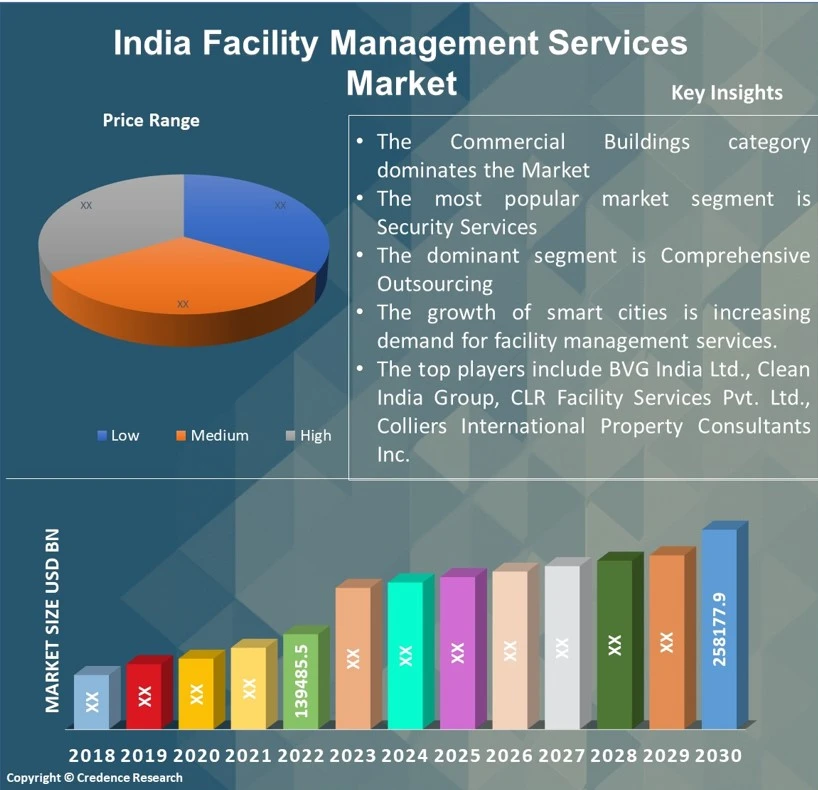
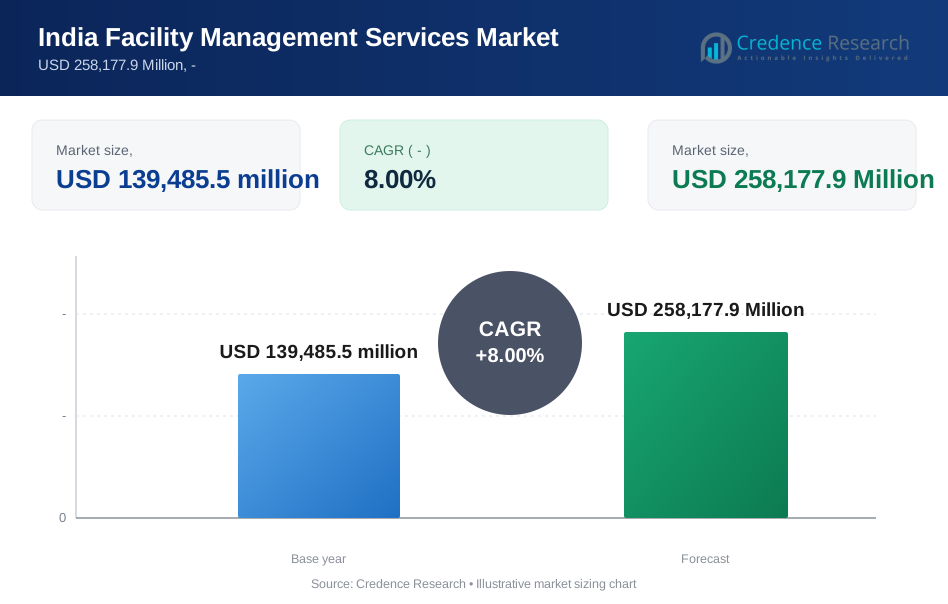
- The demand for India Facility Management Services was valued at USD 139485.5 million in 2022 and is expected to reach USD 258177.9 Million in 2030, growing at a CAGR of 8.00% between 2023 and 2030.
- The most popular market segment is comprehensive services.
- Commercial buildings dominate the india facility management services market, with healthcare facilities being the fastest-growing segment.
- Security services is the most popular market segment, while Housekeeping and Janitorial Services is another important market area.
- Comprehensive outsourcing is the dominating market sector.
- IoT in facility management is the fastest growing segment.
- Green building initiatives are the most popular category, and environmental compliance is also important.
- Single vendor contracts is the most popular category.
Executive Summary
Market Definition
The Facility Management Services Market refers to the industry that provides a wide range of services to various organizations and institutions in India to manage and maintain their physical assets and infrastructure. Building maintenance, cleaning, security, trash management, landscaping, and other tasks are all part of facility management services. These services are critical for the seamless and optimal operation of facilities such as offices, hospitals, educational institutions, retail spaces, and residential complexes. The growing need for efficient and cost-effective facility management, as well as businesses' increased emphasis on outsourcing non-core operations, are driving the market for facility management services in India.
Market Overview
It is anticipated that between 2023 and 2030, the India Facility Management Services Market will expand at a compound annual growth rate (CAGR) of 8.00%. From USD 139485.5 million in 2022, the market is projected to be worth USD 258177.9 million by 2030.
The Facility Management Services Market in India is expanding rapidly and provides a wide range of services for managing and maintaining various facilities. Organizations are turning to facility management services to ensure efficient and cost-effective administration of their physical assets, as the emphasis on outsourcing non-core operations grows. The market includes, among other things, building maintenance, cleaning, security, trash management, and landscaping. The necessity for optimal functioning and flawless operation of facilities in various sectors, such as offices, hospitals, educational institutions, retail spaces, and residential complexes, drives demand for these services. Facility management service providers are adjusting to their clients' shifting needs and offering creative solutions as the sector evolves.
Segmentation By Integrated Facility Management (IFM)
- The Comprehensive Services segment has the highest market demand. Comprehensive services relate to the supply of a wide range of facility management solutions, such as maintenance, cleaning, security, and energy management, all packaged together as a comprehensive package.
Segmentation By Vertical-Specific Facility Management
- The Commercial Buildings category dominates the India Facility Management Services Market. To maintain seamless operations and a pleasant atmosphere for inhabitants and visitors, commercial facilities such as office spaces, retail centres, and hotels require complete facility management services.
- On the other hand, Healthcare Facilities is the market's fastest-growing segment. Healthcare facilities are paying more in facility management services to maintain cleanliness, safety, and regulatory compliance as the focus shifts to healthcare infrastructure and patient happiness.
Segmentation by Services Offered
- The most popular market segment is Security Services. Security services are in high demand since they are required to keep various properties and facilities safe and secure.
- Another key market category is Housekeeping and Janitorial Services. These services are critical for maintaining cleanliness and guaranteeing adequate property upkeep.
Segmentation by Outsourcing Models
- The dominant segment is Comprehensive Outsourcing. This sector entails outsourcing all facility management services to a single service provider. It provides the benefit of a comprehensive and integrated approach to facility management, providing seamless operations and effective service delivery.
Segmentation by Technology Integration
- The most rapidly developing segment is IoT in Facility Management. By providing real-time monitoring, automation, and predictive maintenance, IoT (Internet of Things) technology is transforming facility management. This market is rapidly expanding because to its capacity to improve operational efficiency and decision-making processes.
Segmentation by Compliance and Sustainability
- The most popular category is Green Building Initiatives. This section focuses on applying environmentally friendly practices and solutions in facility management. With rising environmental awareness, there is a growing need for services that assist firms in meeting their sustainability objectives.
- Another critical aspect is environmental compliance, which ensures that facilities follow environmental regulations and standards.
Segmentation by Vendor Management
- The most popular category is Single Vendor Contracts. Hiring a single vendor or service provider to handle numerous facilities management services falls under this category. It simplifies operations and reduces complexity by providing a single point of contact for all facilities management needs.
- On the other hand, Multi-Vendor Contracts entail hiring many suppliers to provide various services. While both segments have benefits, single vendor contracts are more typically used because of the ease of coordination and efficiency they provide.
Key Highlights of the Report
The India Facility Management Services Market is segmented By Integrated Facility Management (IFM), Vertical-Specific Facility Management, Services Offered, Technology Integration, Compliance and Sustainability, Vendor Management and region. In 2022, Comprehensive Outsourcing and Commercial Buildings are the two most important segments. Also, the most popular market sector is Security Services, and the Comprehensive Services segment has the biggest market demand.
The primary drivers of the market include rising need for efficient and cost-effective facility management solutions, a growing emphasis on outsourcing non-core tasks, and rapid urbanization and infrastructure development. Furthermore, market barriers include a lack of awareness, difficulties in guaranteeing quality and consistency, price sensitivity, and budget constraints.
What Elements Are Driving the Market for India Facility Management Services ?
Several factors contribute to the growth and demand for the India Facility Management Services Market. The demand for efficient and cost-effective facilities management solutions is growing. Organizations are realizing the value of outsourcing non-essential services to specialized service providers, which allows them to focus on their core business activities. In addition, India's growing urbanization and infrastructural development are fueling the demand for facility management services. As cities grow and new structures are built, there is an increasing need for expert management of these facilities to ensure their proper operation and maintenance. Furthermore, the growing emphasis on sustainability and energy efficiency has increased demand for facility management services that include environmentally friendly techniques into their operations.
What Are The Main Obstacles That The India Facility Management Services Market Faces?
While the Facility Management Services Market in India is expanding, there are some challenges that must be overcome. One of the most significant issues is a lack of understanding about the benefits of professional facility management services. Many organizations, particularly small and medium-sized businesses, may be unaware of the value that these services can provide. Furthermore, ensuring quality and consistency across service providers might be a constraint. With so many providers on the market, it can be difficult to maintain consistent service quality and standards.
What Market Development Prospects Are There For India Facility Management Services?
The India Facility Management Services Market offers numerous intriguing growth and innovation prospects. Adoption of modern technologies such as the Internet of Things (IoT) and Artificial Intelligence (AI) is expanding the scope of smart facility management systems. Real-time monitoring, predictive maintenance, and automation are enabled by these technologies, resulting in more efficient and effective facility management techniques. There is also room for growth in developing industries such as healthcare and hospitality. As these businesses expand, the demand for specialist facility management services customized to their specific needs is projected to rise.
Market Drivers
The India Facility Management Services Market is driven by several factors. The following are the key drivers of the India Facility Management Services Market:
Rising Levels Of Building Management Outsourcing
End users can focus on core business activities by outsourcing facility-related services such as HVAC, catering, security, and various other support services. Companies today are more likely to benefit from their core processes by selling unproductive or linked processors and passing them on to third parties capable of taking responsibility. The market's expansion of outsourcing services is further emphasized by abundant growth prospects in end-user industries such as healthcare, infrastructure, and retail. Corporate support tasks such as facility management are outsourced. Ensures that the provider is accountable for the facility's services and any risks linked with them. Internal operations also involve service personnel training, which adds to the total cost of ownership. However, hiring an outsourced supplier can significantly reduce training and operational costs, allowing you to maximize earnings. Organizations understand the necessity to hire professional service providers to secure and protect their investments as they make investments in various areas of their business.
When executing maintenance and other business support services, businesses incur significant costs. Maintenance and work order management technology systems have established a strong presence in mature facilities management contracts. Financial management tools, benchmarking, energy management, space planning, and tenant management are thus examples of supporting services that are included in integrated facilities management. During the forecast period, all of these factors are projected to fuel the growth of the India Facility Management Services Market.
Market Restraints
The India Facility Management Services Marketfaces some challenges that may hinder its growth. These include the following:
Employee Turnover And A Lack Of Training
Facilities management services necessitate the use of trained, semi-skilled, and unskilled staff. However, qualified and semi-skilled workers are in low supply to perform facility management services. Some facility management services, such as plumbing, energy management, water management, and catering, can be handled, but the market is limited because to a dearth of experienced individuals to perform services that need technical expertise.
New surveillance and security equipment, for example, are being created for security agencies. However, operating such devices requires competence. Although the widespread availability of unskilled labour boosts suppliers' bargaining power, labour force retention remains a major concern for suppliers and is projected to limit market expansion during the forecast period.
Opportunities
The India Facility Management Services Marketoffers significant growth opportunities. These include the following:
Increasing Government Initiatives And Infrastructure Spending
The government and municipal governments have undertaken the "National Infrastructure Program" and "National Program on Strategies for Sustainable Smart Cities," among other infrastructure-related operations. These initiatives are expected to open up lucrative new markets for facility management services. More commercial projects, metro train projects, social infrastructure, and green buildings will come from increased investment.
This factor is projected to open up new potential for the India facility management services industry. The demand for facility management services for long-term building maintenance is increasing as development activities rise. As a result, it is expected that government investments in the building infrastructure industry will provide profitable opportunities for the industry.
Competitive Landscape
Key Players
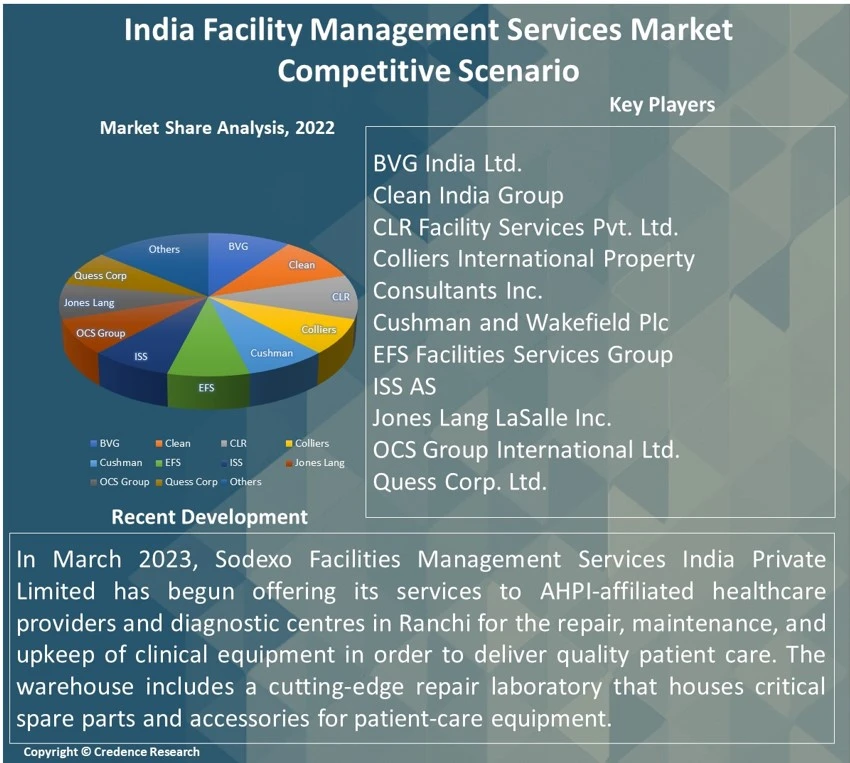
The India Facility Management Services Market is highly competitive, with several key players. Some of the major players in the market and their market share are as follows:
- BVG India Ltd.
- Clean India Group
- CLR Facility Services Pvt. Ltd.
- Colliers International Property Consultants Inc.
- Cushman and Wakefield Plc
- EFS Facilities Services Group
- ISS AS
- Jones Lang LaSalle Inc.
- OCS Group International Ltd.
- Quess Corp. Ltd.
- ServiceMax Facility Management Pvt. Ltd.
- SILA Group
- SMS Integrated Facility Services Pvt. Ltd.
- Sodexo SA
- Tenon Facility Management Pvt. Ltd.
- Updater Services Ltd.
- Vatika Group
- Handiman Services Ltd.
These organizations prioritize product innovation, Disease Area expansion, and mergers and acquisitions to stay competitive.
The India Facility Management Services Market's key players continually seek to stay ahead by offering new Speciess and developments.
In August 2021, JLL announced the purchase of Skyline Al, an AI platform that performs in-depth analyses of commercial real estate sites.
In June 2022, The University of Southern Denmark (SDU), consulting firm K-Jacobsen, Signal Architects, and ISS, and technology businesses Ubiqisense and Enabled Robotics collaborated on the FacilityCobot interdisciplinary innovation initiative. The purpose of the project is to develop a revolutionary mobile robot that combines a smart building sensing system with a human-robot interface and frees cleaning personnel from hard or repetitive tasks. With the integration of the aforementioned technologies, the robot will be able to work successfully with cleaning workers, particularly in areas with a lot of open space, such as offices and canteens.
In June 2023, JLL introduced Carbon Pathfinder, a software tool it created to help businesses identify carbon emissions from their facilities and solutions to minimize those emissions.
Summary of Key Findings
- Employee turnover and a lack of training can severely limit market expansion.
- Market segmented By Integrated Facility Management (IFM), Vertical-Specific Facility Management, Services Offered, Technology Integration, Compliance and Sustainability, Vendor Management and region
- Security Services is the most popular market segment
- The Comprehensive Services segment has the largest market demand.
- The market is highly competitive with key players including BVG India Ltd., Clean India Group, CLR Facility Services Pvt. Ltd., Colliers International Property Consultants Inc., Cushman and Wakefield Plc, EFS Facilities Services Group, ISS AS
Future Outlook
- Rising demand for facilities management services that are outsourced
- Increasing emphasis on environmentally friendly and sustainable facility management techniques
- Use of new technologies in facility management, such as IoT and AI
- There is a growing demand for integrated facilities management systems.
- Market expansion in sectors such as healthcare, hospitality, and retail
- A focus on cost-cutting and operational efficiency
- The growth of smart cities is increasing demand for facility management services.
Segmentation
- By Integrated Facility Management (IFM):
- Comprehensive Services
- Single Service Contracts
- By Vertical-Specific Facility Management:
- Commercial Buildings
- Residential Complexes
- Healthcare Facilities
- Educational Institutions
- By Services Offered:
- Housekeeping and Janitorial Services
- Security Services
- Technical Maintenance
- Pest Control
- Waste Management
- Landscaping and Horticulture
- Helpdesk and Support Services
- By Outsourcing Models:
- Comprehensive Outsourcing
- Selective Outsourcing
- By Technology Integration:
- Facility Management Software
- IoT in Facility Management
- By Compliance and Sustainability:
- Environmental Compliance
- Green Building Initiatives
- By Vendor Management:
- Single Vendor Contracts
- Multi-Vendor Contracts
Request a Free Sample
Fill in your details and we'll send you a free sample report.
- Sample data tables & charts
- Research methodology
Market Dynamics
Growth in Outsourcing of Non-Core Operations
Indian organizations are increasingly outsourcing facility management to specialized providers, allowing them to focus on core business activities and benefit from professional expertise, which drives demand for comprehensive facility management solutions.
Rapid Urbanization and Infrastructure Development
The expansion of urban areas and the construction of new commercial, healthcare, and residential facilities in India are fueling the need for professional facility management services to ensure efficient operation and maintenance.
Adoption of Advanced Technologies (IoT and AI)
The integration of IoT and AI in facility management enables real-time monitoring, automation, and predictive maintenance, significantly improving operational efficiency and attracting clients seeking innovative solutions.
Emphasis on Sustainability and Green Building Initiatives
Growing environmental awareness and regulatory requirements are pushing organizations to adopt green building practices and sustainable facility management, increasing demand for services that support environmental compliance and energy efficiency.
Need a Custom Version of This Report?
Tailor the scope, geography, or segments to your exact requirements.
- Custom geography or segment scope
- Direct access to our analyst team
Frequently Asked Questions
What is the current Species of the India Facility Management Services Market?
What is the predicted growth rate of the India Facility Management Services Market between 2023 and 2032
Which segment has the most market share Outsourcing Models?
Which Integrated Facility Management (IFM) segment governs the market demand for India Facility Management Services ?
Which Vertical-Specific Facility Management segment is predicted to grow at the fastest growth segment over the forecast period?
Who are the major players in the India Facility Management Services Market?
Table of Content
Chapter 1 Market Segmentation
- 1.1 Segmentation Framework
- 1.1.1 Product and Service Classification
- 1.1.2 Application and End-Use Classification
- 1.1.3 Technology and Solution Classification
- 1.1.4 Customer and Distribution Channel Classification
- 1.1.5 Geographic Segmentation
- 1.1.6 Market Segment Definitions and Boundaries
- 1.2 By Services Offered
- 1.2.1 Housekeeping and Janitorial Services
- 1.2.2 Security Services
- 1.2.3 Technical Maintenance
- 1.2.4 Pest Control
- 1.2.5 Waste Management
- 1.2.6 Landscaping and Horticulture
- 1.2.7 Helpdesk and Support Services
- 1.3 By Outsourcing Models
- 1.3.1 Comprehensive Outsourcing
- 1.3.2 Selective Outsourcing
- 1.4 By Integrated Facility Management (IFM)
- 1.4.1 Comprehensive Services
- 1.4.2 Single Service Contracts
- 1.5 By Vertical-Specific Facility Management
- 1.5.1 Commercial Buildings
- 1.5.2 Residential Complexes
- 1.5.3 Healthcare Facilities
- 1.5.4 Educational Institutions
Chapter 2 Introduction
- 2.1 Report Objectives and Scope
- 2.2 Product Definition and Industry Terminology
- 2.3 Market Inclusions and Exclusions
- 2.4 Research Process
- 2.4.1 Primary Research and Expert Interviews
- 2.4.2 Secondary Research and Source Review
- 2.4.3 Top-Down and Bottom-Up Estimation
- 2.4.4 Data Triangulation and Verification
- 2.5 Market Size Measurement Basis
- 2.5.1 2022: USD 139,485.5 million → 2032: USD 258,177.9 Million
- 2.6 Historical and Forecast Reference Periods
- 2.6.1 Base Year: 2022
- 2.6.2 Forecast Period: 2022-2032
- 2.7 Research Assumptions and Limitations
Chapter 3 Executive Summary
- 3.1 Market Snapshot and Key Findings
- 3.2 Base-Year Market Size, 2022
- 3.3 Forecast Market Size, 2032
- 3.4 Revenue and Volume Growth Outlook
- 3.5 Key Demand and Supply Indicators
- 3.6 Leading Market Segments
- 3.7 Fastest-Growing Market Opportunities
- 3.8 Regional Performance Highlights
- 3.9 Technology and Industry Transformation
- 3.10 Competitive Landscape Summary
- 3.11 Analyst View and Strategic Implications
Chapter 4 India Facility Management Services Market Trends and Developments
- 4.1 Historical Industry Development
- 4.2 Recent Market Trends and Developments
- 4.3 Demand and Customer Behavior Trends
- 4.4 Technology and Product Innovation
- 4.5 Artificial Intelligence, Automation and Digitalization
- 4.6 Local Manufacturing and Supply Chain Realignment
- 4.7 Industry Partnerships, Mergers and Acquisitions
- 4.8 Sustainability and Circular Economy Developments
- 4.9 Government and Private Sector Investment Trends
- 4.10 Emerging Business Models and Commercialization
- 4.11 Industry Developments and Announcements
Chapter 5 India Facility Management Services Market Supply and Demand Analysis
- 5.1 Demand Trend and Consumption Analysis
- 5.2 Demand Forecast, 2022-2032
- 5.3 Supply Chain Structure and Procurement Trends
- 5.4 Supply-Demand Gap and Bottlenecks
- 5.5 Import Dependence and Sourcing Structure
- 5.6 Regional Supply and Demand Concentration
Chapter 6 India Facility Management Services Market Pricing Analysis
- 6.1 Pricing Structure and Measurement
- 6.2 Historical Pricing Trends
- 6.3 Pricing Outlook, 2022-2032
- 6.4 Pricing by Product and Market Segment
- 6.5 Geographic Pricing Differences
- 6.6 Key Input, Energy, Labor and Logistics Costs
- 6.7 Contract Pricing and Purchasing Models
- 6.8 Pricing Sensitivity and Competitive Positioning
- 6.9 Price, Margin and Profitability Implications
Chapter 7 India Facility Management Services Market Dynamics
- 7.1 Market Growth Drivers
- 7.1.1 Demand-Side Drivers
- 7.1.2 Technology and Innovation Drivers
- 7.1.3 Infrastructure and Investment Drivers
- 7.1.4 Regulatory and Policy Drivers
- 7.2 Market Restraints
- 7.2.1 Cost and Affordability Constraints
- 7.2.2 Technology and Adoption Barriers
- 7.2.3 Supply Chain and Operational Constraints
- 7.3 Market Challenges
- 7.3.1 Competitive Pressure and Margin Erosion
- 7.3.2 Skills, Infrastructure and Implementation Gaps
- 7.4 Emerging Market Opportunities
- 7.5 Market Dynamics Impact and Time-Horizon Assessment
Chapter 8 India Facility Management Services Value Chain Analysis
- 8.1 Industry Value Chain Overview
- 8.2 Upstream Suppliers and Critical Inputs
- 8.3 Technology and Component Providers
- 8.4 Manufacturing or Service Delivery
- 8.5 Distribution, Channel Partners and Integrators
- 8.6 Downstream Applications and End Users
- 8.7 Value Addition and Profit Pools
- 8.8 Vertical Integration and Outsourcing
- 8.9 Supplier Concentration and Risk
- 8.10 Supply Chain Localization and Resilience
Chapter 9 India Facility Management Services Market Regulations and Policies
- 9.1 Relevant Laws, Standards and Compliance Frameworks
- 9.2 Product, Service, Safety and Quality Requirements
- 9.3 Government Policies, Incentives and Subsidies
- 9.4 Imports, Exports and Trade Barriers
- 9.5 Public Procurement and Local Content Requirements
- 9.6 Data Protection, AI and Cybersecurity Compliance
- 9.7 Upcoming Policy Changes and Market Implications
Chapter 10 India Facility Management Services Market Hotspots and Opportunities
- 10.1 Market Opportunity Mapping and Growth Hotspots
- 10.2 High-Growth Applications and Customer Groups
- 10.3 Underserved Markets and White-Space Opportunities
- 10.4 Emerging Technology and Product Opportunities
- 10.5 New Capacity and Investment Hotspots
- 10.6 Market Entry and Expansion Opportunities
- 10.7 Distribution and Partnership Opportunities
- 10.8 Near-Term and Long-Term Commercial Potential
- 10.9 Opportunity Attractiveness and Execution Risks
Chapter 11 India Facility Management Services Market Outlook, 2022-2032
- 11.1 Market Size and Analysis
- 11.1.1 Revenue (Market Measurement: 2022: USD 139,485.5 million → 2032: USD 258,177.9 Million)
- 11.1.2 Historical Market Size
- 11.1.3 Base-Year Market Size, 2022
- 11.2 Market Forecast, 2022-2032
- 11.2.1 Revenue Forecast to 2032
- 11.2.2 CAGR and Year-on-Year Growth
- 11.2.3 Incremental Revenue Opportunity
- 11.3 Forecast Assumptions and Scenario Analysis
- 11.3.1 Base-Case Forecast
- 11.3.2 Optimistic and Conservative Scenarios
- 11.3.3 Technology, Pricing and Policy Sensitivities
- 11.4 Market Attractiveness and Growth Outlook
Chapter 12 India Facility Management Services Market Segmentation and Outlook
- 12.1 Segmentation Summary and Market Shares, 2022
- 12.2 Largest and Fastest-Growing Segments
- 12.3 By Services Offered - Market Size and Forecast, 2022-2032
- 12.3.1 Segment Definition and Scope
- 12.3.2 Historical Market Size
- 12.3.3 Revenue Forecast, 2022-2032
- 12.3.4 Base-Year Market Share, 2022
- 12.3.5 Segment CAGR and Growth Drivers
- 12.3.6 Subsegment Market Size and Forecast
- 12.3.6.1 Housekeeping and Janitorial Services
- 12.3.6.2 Security Services
- 12.3.6.3 Technical Maintenance
- 12.3.6.4 Pest Control
- 12.3.6.5 Waste Management
- 12.3.6.6 Landscaping and Horticulture
- 12.3.6.7 Helpdesk and Support Services
- 12.3.7 Subsegment Pricing and Adoption Trends
- 12.3.8 Leading Suppliers and Competition
- 12.3.9 Regional Demand and Opportunities
- 12.4 By Outsourcing Models - Market Size and Forecast, 2022-2032
- 12.4.1 Segment Definition and Scope
- 12.4.2 Historical Market Size
- 12.4.3 Revenue Forecast, 2022-2032
- 12.4.4 Base-Year Market Share, 2022
- 12.4.5 Segment CAGR and Growth Drivers
- 12.4.6 Subsegment Market Size and Forecast
- 12.4.6.1 Comprehensive Outsourcing
- 12.4.6.2 Selective Outsourcing
- 12.4.7 Subsegment Pricing and Adoption Trends
- 12.4.8 Leading Suppliers and Competition
- 12.4.9 Regional Demand and Opportunities
- 12.5 By Integrated Facility Management (IFM) - Market Size and Forecast, 2022-2032
- 12.5.1 Segment Definition and Scope
- 12.5.2 Historical Market Size
- 12.5.3 Revenue Forecast, 2022-2032
- 12.5.4 Base-Year Market Share, 2022
- 12.5.5 Segment CAGR and Growth Drivers
- 12.5.6 Subsegment Market Size and Forecast
- 12.5.6.1 Comprehensive Services
- 12.5.6.2 Single Service Contracts
- 12.5.7 Subsegment Pricing and Adoption Trends
- 12.5.8 Leading Suppliers and Competition
- 12.5.9 Regional Demand and Opportunities
- 12.6 By Vertical-Specific Facility Management - Market Size and Forecast, 2022-2032
- 12.6.1 Segment Definition and Scope
- 12.6.2 Historical Market Size
- 12.6.3 Revenue Forecast, 2022-2032
- 12.6.4 Base-Year Market Share, 2022
- 12.6.5 Segment CAGR and Growth Drivers
- 12.6.6 Subsegment Market Size and Forecast
- 12.6.6.1 Commercial Buildings
- 12.6.6.2 Residential Complexes
- 12.6.6.3 Healthcare Facilities
- 12.6.6.4 Educational Institutions
- 12.6.7 Subsegment Pricing and Adoption Trends
- 12.6.8 Leading Suppliers and Competition
- 12.6.9 Regional Demand and Opportunities
- 12.7 Segment Growth Comparison
- 12.8 Segment Attractiveness and Priority Matrix
Chapter 13 India Facility Management Services End-Use and Application Market Outlook
- 13.1 End-Use Industry and Customer Demand Structure
- 13.2 Leading Applications and Customer Groups
- 13.3 End-Use Market Size, Share and Forecast
- 13.4 Major End-Use Industry Deep Dives
- 13.4.1 Customer Requirements and Use Cases
- 13.4.2 Demand and Replacement Cycles
- 13.4.3 Technical and Regulatory Considerations
- 13.4.4 Purchasing and Procurement Models
- 13.4.5 Leading Vendors and Distribution Channels
- 13.4.6 Forecast and Commercial Opportunities
- 13.5 Emerging Applications and Cross-Segment Demand
- 13.6 End-Use Industry Investment Priorities
Chapter 14 India Facility Management Services Geographic Market Outlook, 2022-2032
- 14.1 Domestic Market Distribution and Demand Clusters
- 14.2 State- or Province-Wise Market Size and Forecast, 2022-2032
- 14.3 City and Metropolitan Market Outlook
- 14.4 Industrial, Manufacturing and Commercial Clusters
- 14.5 Geographic Concentration of Key End Users
- 14.6 Local Pricing and Purchasing Differences
- 14.7 Domestic Production Facilities and Capacity Map
- 14.8 Local Infrastructure and Project Pipeline
- 14.9 State-Level Policy and Incentive Differences
- 14.10 Subnational Investment Hotspots and Opportunities
- 14.11 Distribution and Logistics Networks
- 14.12 Domestic Competitive Footprint
Chapter 15 India Facility Management Services Technology, Innovation and Sustainability Outlook
- 15.1 Technology Landscape and Maturity
- 15.2 Product, Process and Service Innovation
- 15.3 AI, Automation and Digital Tools in the Industry
- 15.4 Technology Adoption and Performance Benchmarking
- 15.5 Innovation Pipeline and R&D Investment
- 15.6 Energy Efficiency and Resource Management
- 15.7 Sustainability, Recycling and Circularity
- 15.8 Technology Roadmap, 2022-2032
- 15.9 Risks of Obsolescence and Technology Substitution
Chapter 16 India Facility Management Services Market Key Strategic Imperatives
- 16.1 Growth and Market Entry Priorities
- 16.2 High-Return Products and Segments
- 16.3 Pricing, Profitability and Cost Optimization
- 16.4 Technology Investment and Product Differentiation
- 16.5 Supply Chain Localization and Resilience
- 16.6 Distribution and Customer Acquisition
- 16.7 Partnership, Acquisition and Capacity Strategy
- 16.8 Regional Expansion Priorities
- 16.9 Short-, Medium- and Long-Term Actions
Chapter 17 Competition Outlook
- 17.1 Industry Competition Characteristics
- 17.2 Market Structure and Concentration
- 17.3 Market Share and Competitive Positioning, 2022
- 17.4 Company-Wise Revenue and Product Benchmarking
- 17.5 Production and Service Capacity Benchmarking
- 17.6 Technology, Pricing and Differentiation
- 17.7 Regional Footprint and Distribution Strength
- 17.8 Mergers, Acquisitions and Strategic Alliances
- 17.9 New Entrants and Competitive Threats
- 17.10 Porter's Five Forces and Industry Attractiveness
- 17.11 Competitive Outlook, 2022-2032
Chapter 18 Company Profiles
- 18.1 Company Coverage and Selection Criteria
- 18.2 BVG India Ltd.
- 18.2.1 Business Description
- 18.2.2 Company Ownership and Geographic Presence
- 18.2.3 Product and Service Portfolio
- 18.2.4 Manufacturing and Operating Footprint
- 18.2.5 Financial Performance and Investment
- 18.2.6 Market Share and Competitive Position
- 18.2.7 Technology and Innovation Capabilities
- 18.2.8 Strategic Alliances or Partnerships
- 18.2.9 Recent Developments
- 18.2.10 Growth Strategy and Outlook
- 18.3 Quess Corp. Ltd.
- 18.4 Sodexo SA
- 18.5 ISS AS
- 18.6 Jones Lang LaSalle Inc. (JLL)
- 18.7 Colliers International Property Consultants Inc.
- 18.8 Cushman and Wakefield Plc
- 18.9 Updater Services Ltd.
- 18.10 Tenon Facility Management Pvt. Ltd.
- 18.11 EFS Facilities Services Group
- 18.12 Other Relevant Market Participants
Note: Every listed company is profiled on the structure shown under the first company. The company list is preliminary and may change based on research findings, market developments, data availability and client requirements.
Chapter 19 Disclaimer
- 19.1 Research and Forecast Disclaimer
- 19.2 Data Source and Estimation Limitations
Note: The depth of individual sections depends on data availability for this market. Volume, capacity, trade and other unit-based metrics are included where applicable.