
Market Overview
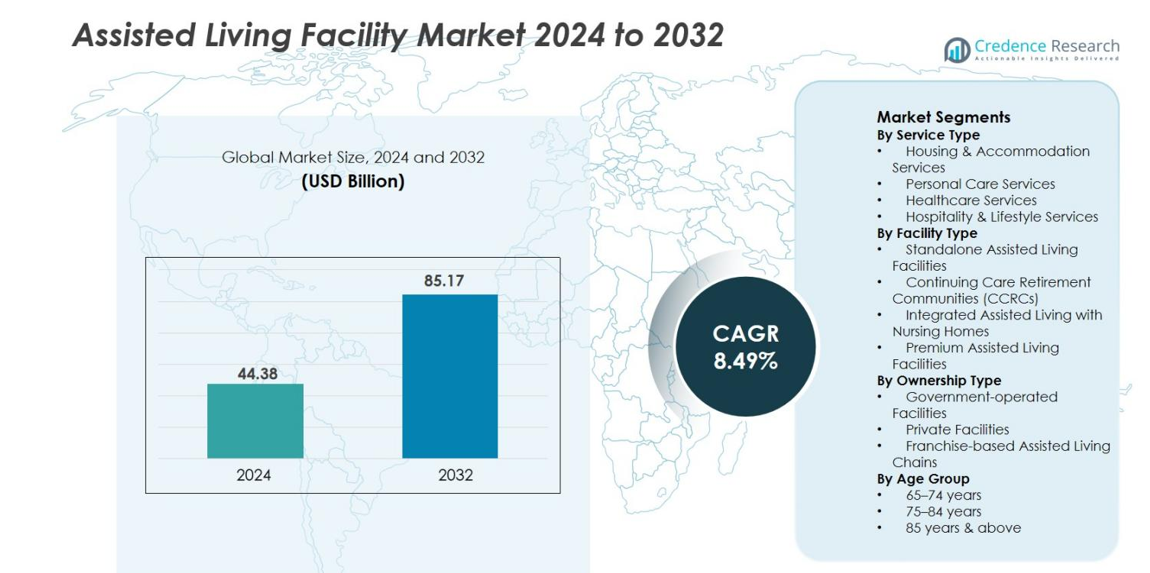
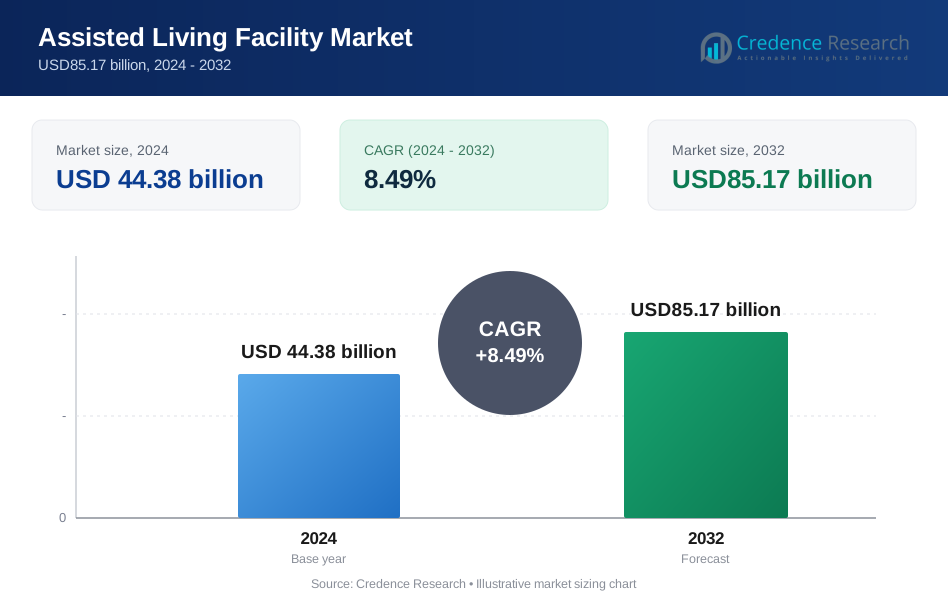
The Assisted Living Facility Market size was valued at USD 44.38 billion in 2024 and is anticipated to reach USD 85.17 billion by 2032, at a CAGR of 8.49% during the forecast period.
| REPORT ATTRIBUTE | DETAILS |
|---|---|
| Historical Period | 2020-2023 |
| Base Year | 2024 |
| Forecast Period | 2025-2032 |
| Assisted Living Facility Market Size 2024 | USD 44.38 billion |
| Assisted Living Facility Market, CAGR | 8.49% |
| Assisted Living Facility MarketSize 2032 | USD 85.17 billion |
The Assisted Living Facility Market is primarily driven by key players such as Brookdale Senior Living Inc., Atria Management Company, Sunrise Senior Living, Life Care Services (LCS), and Sonida Senior Living. These companies are major contributors to the market's growth through expansive networks, high-quality care services, and innovative senior living models. North America leads the market with a share of 36.24% in 2024, driven by a large aging population and advanced healthcare infrastructure. Europe holds a significant share of 20%, supported by increasing life expectancy and growing demand for senior care. Asia-Pacific is the fastest-growing region, capturing 15% of the market, with strong growth driven by urbanization and rising incomes in countries like China and India. The shift toward personalized care, technology integration, and premium offerings is expected to further shape the market dynamics in these regions.
Market Insights
- The Assisted Living Facility Market was valued at USD 44.38 billion in 2024 and is projected to grow at a CAGR of 8.49 % to reach USD 85.17 billion by 2032.
- The Housing & Accommodation Services segment held around 40 % of the market in 2024, while Standalone Assisted Living Facilities accounted for about 45 %.
- North America dominates the market with a 36.24 % share in 2024, Europe holds 20 %, Asia Pacific about 15 %, Latin America 7 %, and the Middle East & Africa around 5 %.
- Major drivers include ageing populations demanding long‑term support, rising healthcare costs pushing seniors toward assisted living solutions, and the adoption of smart‑home and telehealth technologies within facilities.
- Key restraints include stringent and varying regulatory compliance across regions that increase operational costs, and ongoing staffing shortages which limit facility expansion and care quality.
Market Segmentation Analysis
By Service Type
The Housing & Accommodation Services segment holds the largest share in the Assisted Living Facility Market, accounting for 40% of the market in 2024. This segment is driven by increasing demand for independent living arrangements with basic support services for seniors. Personal Care Services follow closely with a significant share, as aging populations seek assistance with daily activities. Healthcare Services, Hospitality & Lifestyle Services, and Specialized Services also play essential roles, but their contributions are relatively smaller compared to Housing & Accommodation, reflecting the shift towards more residential-focused care.
- For instance, Brookdale Senior Living operates over 650 communities across 41 U.S. states, offering various housing units, including assisted living, equipped with 24/7 emergency response systems and dedicated staff trained to support senior independence.
By Facility Type
Standalone Assisted Living Facilities dominate the market, holding 45% of the market share in 2024. These facilities provide dedicated residential services for seniors and are increasingly favored for their specialized care models. Continuing Care Retirement Communities (CCRCs) are also growing rapidly, driven by their integrated care model, while Integrated Assisted Living with Nursing Homes caters to more advanced needs. Premium Assisted Living Facilities cater to the affluent elderly population, while Affordable Assisted Living Facilities remain crucial in meeting the demand in lower-income segments.
- For instance, Life Care Services (LCS) manages over 140 Continuing Care Retirement Communities, accommodating more than 40,000 residents across independent living, assisted living, and skilled nursing units.
By Ownership Type
Private Facilities represent the largest portion of the Assisted Living Facility Market, with a share of 60% in 2024. These facilities are often seen as offering higher levels of care and more personalized services, driving their growth. Government-operated Facilities are crucial in providing affordable care for the broader population but occupy a smaller market share. Franchise-based Assisted Living Chains are also gaining popularity, especially for offering a standardized level of service across multiple locations, appealing to both operators and residents seeking consistent care.
Key Growth Drivers
Aging Population and Increased Demand for Senior Care
The rapidly growing aging population worldwide is one of the primary growth drivers for the Assisted Living Facility Market. As the global senior population continues to increase, particularly in developed nations, there is a rising need for long-term care options. The demand for assisted living facilities is further amplified by the preference for aging in place, where seniors seek supportive environments that allow them to maintain independence while receiving essential services. This demographic shift is expected to significantly fuel market expansion.
- For instance, Life Care Services (LCS) provides senior living accommodations to more than 40,000 residents across its managed communities, many of whom are above the age of 75.
Rising Healthcare Costs and Preference for Affordable Care Options
The rising costs of healthcare, combined with a growing awareness of long-term care expenses, are pushing more seniors toward assisted living facilities as an affordable alternative to nursing homes and hospitals. These facilities offer an attractive option with personalized care, lower costs, and the ability to provide various levels of support without the high financial burden of institutionalized healthcare. As a result, a larger segment of the population is opting for assisted living as a cost-effective solution to healthcare and personal care needs.
- For instance, Brookdale Senior Living structures its assisted living pricing between $2,160 and $14,300 monthly depending on location and care level, with individualized service plans where residents pay only for the support they actually need enabling cost optimization compared to institutional care models that charge fixed facility-wide rates.
Technological Advancements in Care Services
Technological innovations in healthcare and senior care services are transforming the Assisted Living Facility Market. From remote monitoring tools and telemedicine to advanced in-facility medical technologies, these innovations enable better management of residents' health and improve their quality of life. Smart home technologies, in particular, are being integrated into facilities, allowing seniors to live more independently with enhanced safety and convenience. The growing adoption of technology in assisted living environments is increasing the appeal and efficiency of these facilities, driving further market growth.
Key Trends & Opportunities
Integration of Wellness Programs and Lifestyle Services
A growing trend in the Assisted Living Facility Market is the integration of wellness and lifestyle services into senior care offerings. These services go beyond basic medical and personal care, focusing on holistic well-being. Many facilities are incorporating fitness programs, recreational activities, and mental health support into their services, enhancing residents' physical and emotional health. This trend is attractive to younger seniors who seek an active lifestyle, presenting an opportunity for facilities to expand their service offerings and cater to a broader demographic.
- For instance, Brookdale Senior Living operates its signature “B-Fit” program across more than 600 communities, offering structured exercise sessions designed for senior mobility.
Rise in Premium and Luxury Assisted Living Facilities
There is a rising demand for premium and luxury assisted living facilities as affluent seniors seek high-end, comfortable living environments with personalized services. These facilities offer upscale accommodations, gourmet dining, and specialized care services tailored to the individual needs of residents. This trend is not only driven by increased disposable income among older populations but also by the desire for enhanced quality of life in later years. The growing luxury segment presents a lucrative opportunity for service providers to capture a higher-paying market niche.
- For instance, Belmont Village Senior Living operates more than 30 premium communities, several of which feature luxury high-rise designs with 150–200 private units, on-site chefs, and licensed nurses available 24 hours a day.
Key Challenges
Regulatory and Compliance Challenges
One of the primary challenges in the Assisted Living Facility Market is navigating complex and evolving regulatory requirements. Governments impose stringent rules and standards for senior care facilities to ensure resident safety and well-being. Compliance with these regulations can be both time-consuming and costly for facility operators. Additionally, the regulatory landscape can vary by region, further complicating the expansion of facilities across different markets. These challenges may result in increased operational costs and slowdowns in market growth for some players.
Staffing Shortages and Workforce Management
The Assisted Living Facility Market is facing significant staffing shortages, with a high demand for qualified caregivers and healthcare professionals. The shortage of skilled labor, exacerbated by the COVID-19 pandemic and its lingering effects, has placed a strain on facility operations. Recruiting and retaining trained staff is a critical issue, as insufficient staffing can impact care quality and lead to higher turnover rates. The ongoing challenges in workforce management may hinder the growth and efficiency of assisted living facilities, limiting their ability to meet increasing demand.
Regional Analysis
North America
North America holds a market share of 36.24% in the assisted living facility market in 2024. The region benefits from a large and rapidly aging senior population, well-developed healthcare infrastructure, and supportive regulatory frameworks that enable private pay and government-funded senior care solutions. Providers leverage advanced care models and technology integration to improve service delivery. Strong consumer preference for independent and semi-independent living with support services continues to drive facility expansions. Competitive intensity remains high as operators pursue differentiation through wellness programs, memory-care offerings, and branded chain-managed communities.
Europe
In Europe, the assisted living facility market accounts for 20% of the global share. Demographic trends—such as increasing life expectancy and a growing population aged 65+ underpin rising demand for senior care services. Regulatory reforms and public-private partnerships in countries like Germany, the UK, and the Nordics are enhancing service standards and capacity. Operators are shifting toward holistic care models that combine accommodation with wellness and medical services. Investment in premium and specialized assisted living communities is increasing, offering opportunities despite slower growth compared to emerging regions.
Asia Pacific
The Asia Pacific region captures 15% of the global assisted living facility market share and is the fastest-growing region. Urbanization, rising disposable incomes, and a large and still-growing elderly demographic in countries such as Japan, China, and India are key growth drivers. Government initiatives and foreign investment are accelerating facility development, including hybrid models integrating senior housing with health services. The market presents significant opportunities for facility operators and care-service providers willing to adapt offerings to local cultural norms and multi-generational living preferences.
Middle East & Africa
The Middle East & Africa region currently holds 5% of the global assisted living facility market share. This region is witnessing growth due to the rising elderly population and increasing government support for senior care. Countries like the UAE and Saudi Arabia are investing heavily in healthcare infrastructure, including the development of assisted living communities that blend luxury accommodations with specialized healthcare services. While the market is still in its early stages compared to other regions, it offers significant potential for growth as regional governments seek to enhance eldercare options.
Latin America
Latin America holds a 7% share of the assisted living facility market, with countries like Brazil and Mexico seeing an increase in demand for senior living solutions. The market is supported by a growing elderly population and improved economic conditions, leading to higher demand for senior care services. In addition, urbanization and an expanding middle class are creating favorable conditions for the development of both affordable and premium assisted living communities. However, limited awareness and infrastructure challenges present barriers to growth, which could hinder the rapid expansion of the market in some countries.
Market Segmentations:
By Service Type
- Housing & Accommodation Services
- Personal Care Services
- Healthcare Services
- Hospitality & Lifestyle Services
By Facility Type
- Standalone Assisted Living Facilities
- Continuing Care Retirement Communities (CCRCs)
- Integrated Assisted Living with Nursing Homes
- Premium Assisted Living Facilities
By Ownership Type
- Government-operated Facilities
- Private Facilities
- Franchise-based Assisted Living Chains
By Age Group
- 65–74 years
- 75–84 years
- 85 years & above
By Geography
- North America
- U.S.
- Canada
- Mexico
- Europe
- Germany
- France
- U.K.
- Italy
- Spain
- Rest of Europe
- Asia Pacific
- China
- Japan
- India
- South Korea
- South-east Asia
- Rest of Asia Pacific
- Latin America
- Brazil
- Argentina
- Rest of Latin America
- Middle East & Africa
- GCC Countries
- South Africa
- Rest of the Middle East and Africa
Competitive Landscape
The competitive landscape of the assisted living facility market is characterised by a blend of large‑scale operators and regional specialists, with key players such as Brookdale Senior Living Inc., Atria Management Company, Sunrise Senior Living, Life Care Services (LCS) and Sonida Senior Living driving a significant share of global operations. These firms leverage expansive geographic networks, brand recognition, and economies of scale to compete effectively in a moderately fragmented market where the top five players account for around 32 % of total share. Consolidation through acquisitions and strategic partnerships underpins many providers’ growth strategies, while differentiation via service quality, technological integration (e.g., telehealth, remote monitoring), and premium‑amenity offerings becomes increasingly vital. Regional players also pose competition by targeting local demographic nuances and adapting culturally‑relevant service models. As the market evolves, competitive advantage will hinge on operational efficiency, care‑service innovation, regulatory compliance robustness, and the ability to scale while maintaining resident satisfaction.
Key Player Analysis
- Cassia
- Sonida Senior Living
- Presbyterian Homes and Services
- Evangelical Lutheran Good Samaritan Society
- Discovery Senior Living
- Atria Management Company
- Max Group
- Redwood Capital Investments LLC
- Brookdale Senior Living Inc.
- Life Care Services (LCS)
Recent Developments
- In September 2025, LTC Properties Inc. announced a US $40 million off-market acquisition of two assisted living and memory care communities in Kentucky (158 units total) from Charter Senior Living.
- In September 2025, Epoch Elder Care launched its “Monet House” assisted living and dementia care facility in Balewadi, Pune (10-floor, 33,000 sq ft, 56 rooms for ~70 residents) in India.
- In July 2025, CareAcademy and Wisconsin Assisted Living Association (WALA) announced a strategic partnership to advance assisted-living workforce development in Wisconsin.
Report Coverage
The research report offers an in-depth analysis based on Service Type, Facility Type, Ownership Type, Age Group and Geography. It details leading market players, providing an overview of their business, product offerings, investments, revenue streams, and key applications. Additionally, the report includes insights into the competitive environment, SWOT analysis, current market trends, as well as the primary drivers and constraints. Furthermore, it discusses various factors that have driven market expansion in recent years. The report also explores market dynamics, regulatory scenarios, and technological advancements that are shaping the industry. It assesses the impact of external factors and global economic changes on market growth. Lastly, it provides strategic recommendations for new entrants and established companies to navigate the complexities of the market.
Future Outlook
- The market will experience sustained growth driven by the increasing global senior population and extended life expectancy.
- Providers will expand services tailored to higher‑acuity residents as chronic disease prevalence and cognitive impairment become more widespread.
- Facility operators will integrate advanced technology — including remote monitoring, tele‑health, and smart‑home systems — to improve resident care and operational efficiency.
- Premium and lifestyle‑oriented assisted living offerings will gain traction as affluent seniors seek upscale living combined with supportive care.
- Development of affordable assisted living models will accelerate to meet demand in emerging markets and lower‑income segments.
- Regionally, Asia‑Pacific and Latin America will grow more rapidly than mature markets, spurred by urbanisation, rising incomes, and government initiatives.
- Ownership structures will diversify, with private equity, public‑private partnerships and franchise‑based chains increasing their footprint in senior care.
- Operators will pursue consolidation, mergers and acquisitions to scale operations, leverage brand recognition and achieve cost efficiencies.
- Workforce shortages and rising labour costs will prompt greater use of automation, training programmes and new service staffing models.
- Regulatory reform and reimbursement innovation will influence market dynamics, with enhanced government support and alternative payment models shaping facility viability.
Request a Free Sample
Fill in your details and we'll send you a free sample report.
- Sample data tables & charts
- Research methodology
Need a Custom Version of This Report?
Tailor the scope, geography, or segments to your exact requirements.
- Custom geography or segment scope
- Direct access to our analyst team
Frequently Asked Questions
Q. What is the current market size for the Assisted Living Facility Market, and what is its projected size in 2032?
At what Compound Annual Growth Rate is the Assisted Living Facility Market projected to grow between 2025 and 2032?
Who are the major players in the global assisted living facility market?
What are the major market drivers of the assisted living facility industry?
What key trends influence the global assisted living facility market?
What are the major market opportunities of the assisted living facility industry?
Who are the leading companies in the Assisted Living Facility Market?
Table of Content
Chapter 1. Report Introduction
- 1.1 Report Description & Purpose
- 1.1.1 Report Title & Market Definition
- 1.1.2 Unique Selling Propositions (USP) & Key Differentiators
- 1.1.3 Value Proposition for Stakeholders
- 1.2 Research Objectives
- 1.2.1 Market Sizing Objectives (Volume & Revenue)
- 1.2.2 Segmentation Objectives
- 1.2.3 Competitive Intelligence Objectives
- 1.2.4 Forecast & Scenario Objectives
- 1.3 Report Scope
- 1.3.1 Assisted Living Facility Scope – Types & Subtypes Covered
- 1.3.2 Geographic Scope – Regions & Countries Covered
- 1.3.3 Historical Period, Base Year & Forecast Period (2024; forecast to 2032)
- 1.3.4 Inclusions & Exclusions
- 1.4 HS Code & Classification Framework
- 1.5 Currency, Units & Pricing Basis
- 1.6 Target Stakeholders
- 1.7 Limitations & Assumptions
Chapter 2. Executive Summary
- 2.1 Global Assisted Living Facility Market Snapshot
- 2.1.1 Market Size – Historical (2024) & Forecast (2024-2032) (2024: USD 44.38 billion → 2032: USD85.17 billion)
- 2.1.2 Volume & Revenue – Global Totals
- 2.1.3 Key Market Highlights – Top Five Facts
- 2.2 Assisted Living Facility Market Segmentation Snapshot
- 2.2.1 Market Split by Region – 2024 vs. 2032
- 2.3 Competitive Snapshot
- 2.3.1 Top 10 Players by Revenue Share – 2024
- 2.3.2 Top 10 Players by Volume Share – 2024
- 2.3.3 Recent Strategic Developments (18-Month Summary)
- 2.4 Key Investment Highlights & Strategic Conclusions
Chapter 3. Assisted Living Facility Market Dynamics & Industry Analysis
- 3.1 Market Overview & Context
- 3.1.1 Assisted Living Facility Market Position in the Broader Automotive Value Chain
- 3.1.2 OEM vs. Replacement Market Dynamics
- 3.1.3 Market Maturity & Development Stage by Region
- 3.2 Assisted Living Facility Market Drivers
- 3.3 Assisted Living Facility Market Restraints & Challenges
- 3.4 Assisted Living Facility Market Opportunities
- 3.5 Porter's Five Forces Analysis
- 3.5.1 Threat of New Entrants
- 3.5.2 Bargaining Power of Suppliers
- 3.5.3 Bargaining Power of Buyers
- 3.5.4 Threat of Substitutes
- 3.5.5 Competitive Rivalry – Intensity Assessment
- 3.6 Assisted Living Facility Value Chain Analysis
- 3.6.1 Upstream – Raw Material/Input Suppliers
- 3.6.1.1 Raw Material/Input 1
- 3.6.1.2 Raw Material/Input 2
- 3.6.1.3 Raw Material/Input 3
- 3.6.2 Midstream – Production/Manufacturing/Service Delivery
- 3.6.2.1 Production/Process Overview
- 3.6.2.2 Key Facility Locations & Capacity by Manufacturer
- 3.6.3 Downstream – Distribution & End Consumer
- 3.6.3.1 Primary Channel – B2B/OEM
- 3.6.3.2 Secondary Channels – Dealer, Retail, Online, Direct
- 3.6.4 Value Chain Profitability Analysis
- 3.6.1 Upstream – Raw Material/Input Suppliers
- 3.7 PESTEL Analysis
- 3.7.1 Political Factors
- 3.7.2 Economic Factors
- 3.7.3 Social Factors
- 3.7.4 Technological Factors
- 3.7.5 Environmental Factors
- 3.7.6 Legal Factors
- 3.8 Assisted Living Facility Supply Chain Analysis
- 3.8.1 Raw Material/Input Supply Risk Assessment
- 3.8.2 Manufacturing Concentration Risk (Geographic Exposure)
- 3.8.3 Trade Disruption Impact Analysis
- 3.9 Regulatory & Policy Landscape
Note: The regulatory and policy landscape section covers regulations based on their applicability to the market, Assisted Living Facility category, geography, and scope of the study. Only regulatory frameworks with a material impact on operations, compliance, trade, sustainability, or market access are analyzed in detail.
Chapter 4. Key Investment Pockets & Opportunity Analysis
- 4.1 Assisted Living Facility Market Attractiveness Analysis
- 4.1.1 By Region – Investment Attractiveness Matrix (Volume × CAGR)
- 4.2 Absolute Revenue Growth Opportunity
- 4.2.1 By Region – Absolute USD Growth Through 2032
- 4.3 Incremental Volume Opportunity
- 4.3.1 By Region – Incremental Volume Through 2032
- 4.3.2 Segment – Incremental Volume
- 4.4 Emerging Submarket Opportunity Deep Dive (Subject to Applicability)
- 4.5 Emerging Market Opportunity Scorecards
- 4.5.1 United States
- 4.5.2 Europe
- 4.5.3 Asia
- 4.5.4 Middle East & Africa
Note: Emerging Market Opportunity Scorecards will be included based on relevance and strategic importance. Regions listed are indicative and may vary depending on data availability and market dynamics.
Chapter 5. Assisted Living Facility Import-Export Analysis & Trade Flows
- 5.1 Global Trade Overview
- 5.1.1 Global Export Value by Country (2024)
- 5.1.2 Global Export Volume by Country (2024)
- 5.1.3 Global Import Value by Country (2024)
- 5.1.4 Global Import Volume by Country (2024)
- 5.1.5 Net Trade Balance by Country (2024)
- 5.2 Export Analysis – Segment
- 5.2.1 Type 1 (HS Code)
- 5.2.2 Type 2 (HS Code)
- 5.2.3 Type 3 (HS Code)
- 5.2.4 Type 4 (HS Code)
- 5.2.5 Type 5 (HS Code)
- 5.3 Import Analysis – Segment
- 5.3.1 Type 1 (HS Code)
- 5.3.2 Type 2 (HS Code)
- 5.3.3 Type 3 (HS Code)
- 5.3.4 Type 4 (HS Code)
- 5.3.5 Type 5 (HS Code)
- 5.4 Average Unit Trade Prices
- 5.4.1 Average Export Price – Segment & Country
- 5.4.2 Average Import Price – Segment & Source Country
- 5.4.3 Price Trends (2024)
- 5.5 Key Trade Route Analysis
- 5.5.1 Trade Route 1
- 5.5.2 Trade Route 2
- 5.5.3 Trade Route 3
- 5.5.4 Trade Route 4
- 5.5.5 Trade Route 5
- 5.6 Trade Policy Impact Assessment
- 5.6.1 US Anti-Dumping & Section 301 Tariffs
- 5.6.2 EU Customs Union Impact
- 5.6.3 Major Free Trade Agreements
- 5.6.4 USMCA Rules of Origin
Note: Trade policy analysis will be included only where relevant to the Assisted Living Facility market.
Chapter 6. Competitive Landscape & Company Benchmarking
- 6.1 Assisted Living Facility Market Concentration & Structure
- 6.1.1 Herfindahl-Hirschman Index (HHI) – vs. 2024
- 6.1.2 Tier 1, Tier 2 & Tier 3 Market Structure
- 6.1.3 Global, Regional & Local Player Dynamics
- 6.2 Assisted Living Facility Market Share Analysis – 2024
- 6.2.1 Global Revenue Share by Company
- 6.2.2 Global Volume Share by Company
- 6.2.3 Regional Revenue Share
- 6.2.4 Market Share Evolution ( vs. 2024)
- 6.2.5 OEM Segment Share by Company
- 6.2.6 Replacement Segment Share by Company
- 6.3 Production/Delivery Capacity & Facility Analysis
- 6.3.1 Global Installed Capacity
- 6.3.2 Capacity Utilization Rates
- 6.3.3 Production/Output Volume
- 6.3.4 Facility Locations & Capacity Map
- 6.3.5 Planned Capacity Additions
- 6.4 Assisted Living Facility Competitive Benchmarking Matrix
- 6.4.1 Revenue, Volume, CAGR & Profitability Comparison
- 6.4.2 Channel Revenue Mix
- 6.4.3 Geographic Revenue Exposure
- 6.4.4 R&D Intensity
- 6.4.5 Sustainability Maturity
- 6.5 Strategic Developments in Assisted Living Facility (Last 24 Months)
- 6.5.1 Mergers, Acquisitions & Divestments
- 6.5.2 New Assisted Living Facility Launches
- 6.5.3 Facility Expansions
- 6.5.4 Strategic Alliances, Joint Ventures & Partnerships
- 6.5.5 Distribution Expansion & Market Entry
- 6.5.6 Sustainability & ESG Initiatives
- 6.6 Competitive Strategy Mapping
- 6.6.1 Leader, Challenger, Follower & Niche Classification
- 6.6.2 Pricing Strategy Comparison
- 6.6.3 Channel Strategy Matrix
Note: Strategic developments are included based on their materiality and the availability of reliable information.
Chapter 7. Global Assisted Living Facility Market – By Distribution Channel
- 7.1 Segment Overview
- 7.1.1 Volume & Revenue Split by Channel (2024 & 2032)
- 7.1.2 Channel Mix Evolution (2024-2032)
Chapter 8. Regional Market Analysis – Global Overview
- 8.1 Global Regional Overview
- 8.1.1 Regional Volume Share
- 8.1.2 Regional Revenue Share
- 8.1.3 Regional Volume by Region
- 8.1.4 Regional Revenue by Region
- 8.1.5 Regional Forecast Through 2032
- 8.2 Cross-Regional Segment Analysis
- 8.2.1 By Distribution Channel
- 8.2.2 By Brand/Price Tier
Chapter 9. North America Assisted Living Facility Market
- 9.1 United States
- 9.2 Canada
- 9.3 Mexico
Chapter 10. Europe Assisted Living Facility Market
- 10.1 Germany
- 10.2 France
- 10.3 Italy
- 10.4 United Kingdom
- 10.5 Spain
- 10.6 Poland
- 10.7 Russia
- 10.8 Netherlands
- 10.9 Belgium
- 10.10 Sweden
- 10.11 Denmark
- 10.12 Norway
- 10.13 Rest of Europe
Chapter 11. Asia Pacific Assisted Living Facility Market
- 11.1 China
- 11.2 India
- 11.3 Japan
- 11.4 South Korea
- 11.5 Thailand
- 11.6 Indonesia
- 11.7 Vietnam
- 11.8 Malaysia
- 11.9 Australia
- 11.10 Rest of Asia Pacific
Chapter 12. Latin America Assisted Living Facility Market
- 12.1 Brazil
- 12.2 Argentina
- 12.3 Colombia
- 12.4 Chile
- 12.5 Rest of Latin America
Chapter 13. Middle East Assisted Living Facility Market
- 13.1 Saudi Arabia
- 13.2 United Arab Emirates
- 13.3 Turkey
- 13.4 Israel
- 13.5 Iran
- 13.6 Rest of the Middle East
Chapter 14. Africa Assisted Living Facility Market
- 14.1 South Africa
- 14.2 Egypt
- 14.3 Nigeria
- 14.4 Morocco
- 14.5 Rest of Africa
Chapter 15. Assisted Living Facility Company Profiles
- 15.1 [Company 01]
- 15.1.1 Company Overview
- 15.1.2 Key Management Personnel
- 15.1.3 Products & Services Portfolio
- 15.1.4 Financial Performance
- 15.1.5 Key Market Focus & Geographic Presence
- 15.1.6 Recent Developments & Strategic Initiatives
Note: The company profile list is preliminary and may change based on research findings, market developments, data availability, and client requirements.
Chapter 16. Appendices
- Appendix A – List of Abbreviations & Acronyms
- Appendix B – Industry Classification Code Reference – Full Series
- Appendix C – Production & Capacity Data Tables
- Appendix D – End-Use & Demand Base Tables
- Appendix E – Consumption & Replacement Rate Assumptions
- Appendix F – ASP Reference Tables
- Appendix G – Manufacturing & Facility Database
- Appendix H – Import-Export Data Tables
- Appendix I – Regulatory Summary Tables
- Appendix J – Primary Research Participant List (Anonymized)
- Appendix K – Primary Research Questionnaire Framework
- Appendix L – Data Sources & Bibliography
- Appendix M – Market Size Divergence & Source Comparison
Chapter 17. Research Methodology
- 17.1 Research Framework & Philosophy
- 17.2 Secondary Research – Sources, Hierarchy & Data Extraction
- 17.3 Data Modeling – Bottom-Up & Top-Down Market Sizing
- 17.4 Primary Research – Stakeholder Framework, LOI & Sample Sizes
- 17.5 Forecast Methodology – Regression, Scenario & Sensitivity Analysis
- 17.6 Quality Control – Four-Layer Validation Framework
- 17.7 Limitations & Standard Assumptions
- 17.8 Disclaimer
