Biodegradable Agrochemicals Market Overview:
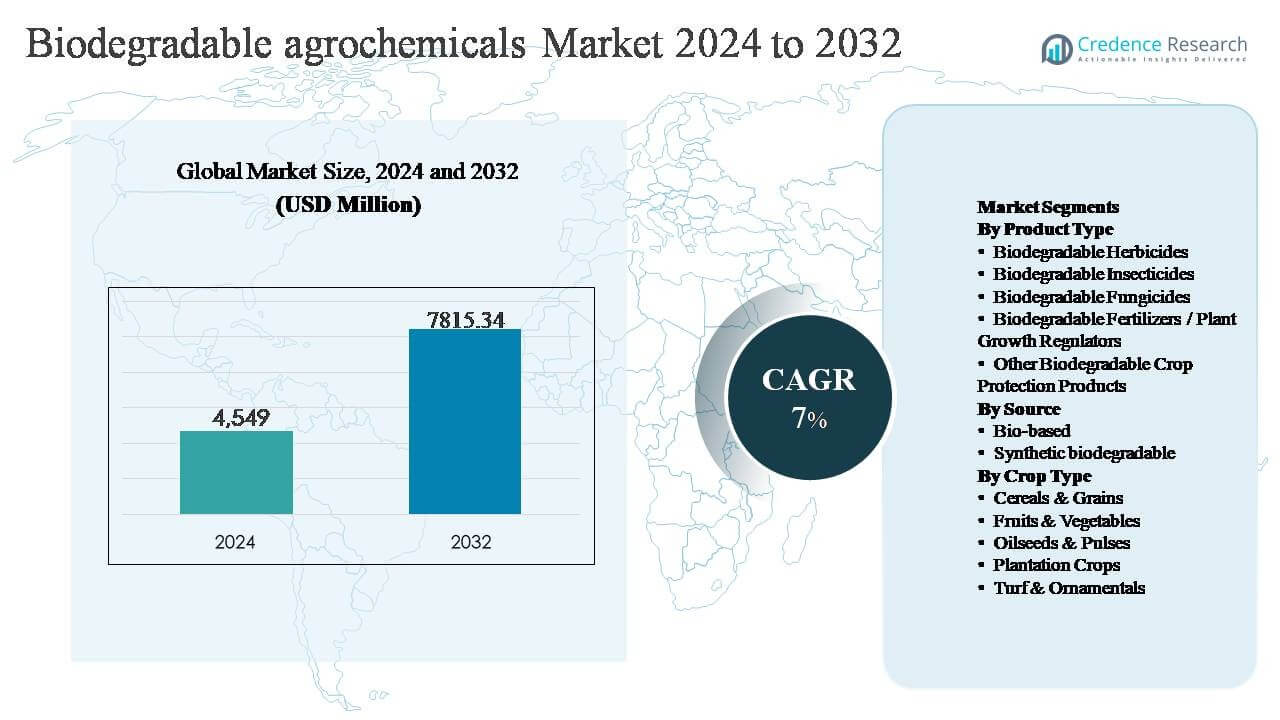
The global biodegradable agrochemicals market was valued at USD 4,549 million in 2024 and is projected to reach USD 7,815.34 million by 2032, expanding at a compound annual growth rate (CAGR) of 7% during the forecast period.
| REPORT ATTRIBUTE | DETAILS |
|---|---|
| Historical Period | 2020-2023 |
| Base Year | 2024 |
| Forecast Period | 2025-2032 |
| Biodegradable Agrochemicals Market Size 2024 | USD 4,549 million |
| Biodegradable Agrochemicals Market , CAGR | 7% |
| Biodegradable Agrochemicals Market Size 2032 | USD 7,815.34 million |
Biodegradable Agrochemicals Market Insights
- Market growth is primarily driven by tightening environmental regulations, restrictions on synthetic pesticide residues, and increasing adoption of integrated pest management and organic farming practices, accelerating demand for biodegradable insecticides and fungicides, which together account for over 55% of product-type demand.
- Key market trends include rapid expansion of microbial- and plant-based formulations, technological improvements in controlled-release biodegradable carriers, and growing usage in high-value fruits and vegetables, while bio-based products dominate the source segment with nearly 63% market share.
- The competitive landscape features global agrochemical leaders and biological specialists competing through innovation, partnerships, and portfolio expansion, with strong emphasis on regulatory approvals, farmer education, and crop-specific solutions.
- Regionally, North America leads with ~32% market share, followed by Europe at ~28% driven by strict sustainability policies, while Asia-Pacific holds ~26%, supported by large cultivation areas and increasing adoption of eco-friendly agro-inputs.
Biodegradable Agrochemicals Market Segmentation Analysis:
By Product Type:
By product type, biodegradable insecticides represent the dominant sub-segment, accounting for an estimated 34-36% market share, driven by rising pest resistance to synthetic chemicals and stricter residue limits in food crops. Strong adoption of microbial-based formulations, including Bacillus and spinosad-derived actives, supports their leadership. Biodegradable fungicides follow, supported by increasing fungal disease incidence in horticulture. Biodegradable herbicides are gaining steady traction in weed management for organic farming systems. Meanwhile, biodegradable fertilizers and plant growth regulators are expanding due to soil health benefits, while other biodegradable crop protection products serve niche applications.
- For instance, Corteva Agriscience’s (formerly Dow AgroSciences) spinosad manufacturing is based on Saccharopolyspora spinosa fermentation, with commercial technical material produced at a minimum purity of 850 g/kg (85%) active ingredient, with high-grade versions reaching 90-95%.
By Source:
By source, bio-based agrochemicals dominate the market with approximately 62-65% share, supported by regulatory incentives, consumer preference for naturally derived inputs, and alignment with organic certification standards. Products derived from plant extracts, microbes, and natural minerals are widely adopted due to lower ecotoxicity and faster environmental degradation. Synthetic biodegradable agrochemicals form the secondary segment, driven by improved performance consistency, longer shelf life, and scalable manufacturing. This segment benefits from advances in biodegradable polymer chemistry that enable controlled release and enhanced field efficacy while maintaining compliance with environmental regulations.
- For instance, BASF has developed poly-ester–based biodegradable encapsulation matrices with molecular weights above 20,000 g/mol, enabling gradual active ingredient release over several weeks under field conditions.
By Crop Type:
By crop type, cereals and grains constitute the leading sub-segment, holding around 38-40% market share, driven by large cultivation areas, high pest and weed pressure, and government-supported sustainable farming programs. Fruits and vegetables follow closely, supported by export-driven demand for residue-free produce. Oilseeds and pulses benefit from biodegradable inputs that improve nitrogen fixation and soil microbiome health. Plantation crops show growing adoption due to long-term soil conservation needs, while turf and ornamentals represent a smaller but premium segment driven by landscaping, golf courses, and urban green space sustainability initiatives.
Key Growth Drivers
Stringent Environmental Regulations and Policy Support
Regulatory pressure to reduce the environmental footprint of conventional agrochemicals is a primary growth driver for biodegradable agrochemicals. Governments across North America, Europe, and parts of Asia-Pacific are tightening restrictions on synthetic pesticide residues, groundwater contamination, and soil toxicity. Policies promoting integrated pest management (IPM), organic farming, and low-residue crop protection are accelerating adoption of biodegradable alternatives. Subsidies, faster registration pathways for bio-based products, and bans on high-risk synthetic actives are shifting farmer preferences toward environmentally benign solutions. These regulatory measures not only encourage replacement demand but also stimulate innovation, supporting wider commercialization of biodegradable formulations across staple and high-value crops.
- For instance, the European Union’s approval process under Regulation (EC) No 1107/2009 requires active substances to demonstrate groundwater concentrations below 0.1 micrograms per liter in standard leaching models, a threshold that many microbial and plant-derived actives can meet due to rapid biodegradation kinetics.
Rising Adoption of Sustainable and Organic Farming Practices
The global transition toward sustainable agriculture is significantly boosting demand for biodegradable agrochemicals. Farmers increasingly prioritize soil health, biodiversity conservation, and long-term yield stability, all of which align with biodegradable input usage. Growth in certified organic acreage and residue-free export-oriented farming has amplified the need for crop protection products that degrade rapidly without harming beneficial organisms. Biodegradable insecticides and fungicides are particularly favored in horticulture and specialty crops, where quality and compliance standards are stringent. This shift is reinforced by growing consumer demand for sustainably produced food, encouraging upstream adoption of eco-friendly agrochemical solutions.
- For instance, Koppert Biological Systems’ Spinosad formulations for horticulture are produced via fermentation of Saccharopolyspora spinosa and are characterized by soil aerobic degradation half-lives measured in single-digit days, enabling compliance with residue-free harvest requirements in high-value fruits and vegetables.
Advancements in Bio-formulation and Delivery Technologies
Technological progress in formulation science is enhancing the performance and reliability of biodegradable agrochemicals, driving broader adoption. Innovations such as microbial consortia, encapsulation technologies, and controlled-release biodegradable polymers are improving field efficacy, persistence, and ease of application. These advancements address historical concerns around lower effectiveness and shorter activity duration compared to conventional products. Improved shelf life, compatibility with existing spraying systems, and enhanced resistance management capabilities are making biodegradable agrochemicals viable for large-scale commercial farming, supporting their penetration across cereals, oilseeds, and plantation crops.
Key Trends & Opportunities
Expansion of Microbial- and Plant-Based Active Ingredients
A key trend shaping the biodegradable agrochemicals market is the rapid expansion of microbial- and plant-based active ingredients. Products derived from bacteria, fungi, and botanical extracts are gaining traction due to their targeted action and minimal non-target impact. These actives align well with resistance management strategies and are increasingly integrated into mainstream crop protection programs. Ongoing research into strain optimization and fermentation scalability presents strong opportunities for product differentiation and cost reduction, supporting adoption beyond niche organic farming into conventional agriculture.
- For instance, FMC Corporation’s collaboration with AgroSpheres has advanced micro-encapsulation platforms capable of forming biodegradable polymer shells with diameters below 5 micrometers, improving stability and on-leaf persistence of microbial actives under UV exposure.
Growth Opportunities in High-Value Crops and Horticulture
High-value crops such as fruits, vegetables, and ornamentals represent a significant growth opportunity for biodegradable agrochemicals. These crops face intense pest and disease pressure while operating under strict residue limits imposed by retailers and export markets. Biodegradable fungicides and insecticides are increasingly preferred due to their short pre-harvest intervals and compatibility with frequent application cycles. As global trade in fresh produce expands, demand for compliant and sustainable crop protection inputs is expected to accelerate, creating long-term growth opportunities for biodegradable solutions.
- For instance, Bayer's Serenade® Opti, based on Bacillus subtilis strain QST 713, is labeled for harvest intervals as short as 0 days on multiple fruit and vegetable crops, enabling repeated applications during peak disease pressure without residue accumulation.
Key Challenges
Performance Consistency and Farmer Confidence
Despite technological progress, performance consistency remains a key challenge for biodegradable agrochemicals. Variability in efficacy due to climatic conditions, soil microbiology, and application timing can limit farmer confidence, particularly in large-scale commercial farming. Compared to synthetic alternatives, some biodegradable products still exhibit narrower activity spectra and shorter residual effects. Overcoming these limitations requires continued investment in formulation refinement, field validation, and farmer education to ensure predictable outcomes and sustained adoption.
Higher Costs and Scalability Constraints
Cost competitiveness poses another significant challenge for the biodegradable agrochemicals market. Bio-based raw materials, fermentation processes, and specialized formulation technologies often result in higher production costs than conventional synthetic products. Limited economies of scale and complex supply chains further constrain pricing flexibility, especially in price-sensitive developing markets. Addressing these challenges will depend on manufacturing scale-up, process optimization, and supportive policy frameworks that help bridge the cost gap and enable broader market penetration.
Regional Analysis
North America
North America accounts for approximately 31-33% of the global biodegradable agrochemicals market, driven by strong regulatory enforcement, high adoption of sustainable farming practices, and advanced agri-input distribution networks. The United States leads regional demand, supported by extensive use of biodegradable insecticides and fungicides in fruits, vegetables, and specialty crops. Federal and state-level programs promoting integrated pest management and reduced chemical residues further support adoption. Canada contributes through growing organic acreage and soil health initiatives. High farmer awareness, robust R&D activity, and early commercialization of bio-based formulations continue to reinforce North America’s market leadership.
Europe
Europe holds an estimated 27-29% market share, supported by stringent environmental regulations and aggressive sustainability targets under the European Green Deal. Countries such as Germany, France, Italy, and Spain drive demand due to widespread adoption of biodegradable fungicides and herbicides in cereals, vineyards, and horticulture. Strict residue limits and bans on high-risk synthetic agrochemicals accelerate the shift toward biodegradable alternatives. Strong institutional support for organic farming and biological crop protection products further enhances market penetration. Europe’s focus on biodiversity preservation and soil regeneration positions the region as a key innovation hub for bio-based agrochemicals.
Asia-Pacific
Asia-Pacific represents the fastest-growing region, accounting for approximately 25-27% of the global market, driven by expanding agricultural production and rising awareness of sustainable inputs. China and India dominate regional demand due to large cultivated areas and increasing regulatory scrutiny of chemical pesticide usage. Adoption is particularly strong in fruits, vegetables, and plantation crops, where export-oriented farming requires residue compliance. Government-led initiatives promoting bio-inputs and soil health improvement support growth. Rapid commercialization of cost-effective biodegradable formulations and increasing farmer education are expected to further expand Asia-Pacific’s market share over the forecast period.
Latin America
Latin America accounts for around 8-9% of the global biodegradable agrochemicals market, supported by strong agricultural exports and growing emphasis on sustainable crop protection. Brazil and Argentina lead regional demand, particularly in oilseeds, cereals, and plantation crops. Export-driven compliance with European and North American residue standards is encouraging adoption of biodegradable insecticides and fungicides. Increasing focus on soil conservation and resistance management in large-scale farming systems further supports growth. While price sensitivity remains a constraint, expanding awareness and gradual regulatory alignment are expected to drive steady adoption across the region.
Middle East & Africa
The Middle East & Africa region holds an estimated 5-6% market share, with growth driven by increasing investment in sustainable agriculture and food security initiatives. Adoption is concentrated in high-value crops, horticulture, and plantation farming, particularly in South Africa, Israel, and parts of the Gulf region. Biodegradable agrochemicals are gaining traction due to water conservation needs and soil degradation concerns. Limited awareness and cost constraints restrict wider adoption; however, government-backed sustainability programs and expanding commercial farming are gradually improving market penetration across selected countries.
Biodegradable Agrochemicals Market Segmentations:
By Product Type
- Biodegradable Herbicides
- Biodegradable Insecticides
- Biodegradable Fungicides
- Biodegradable Fertilizers / Plant Growth Regulators
- Other Biodegradable Crop Protection Products
By Source
- Bio-based
- Synthetic biodegradable
By Crop Type
- Cereals & Grains
- Fruits & Vegetables
- Oilseeds & Pulses
- Plantation Crops
- Turf & Ornamentals
By Geography
- North America
- U.S.
- Canada
- Mexico
- Europe
- Germany
- France
- U.K.
- Italy
- Spain
- Rest of Europe
- Asia Pacific
- China
- Japan
- India
- South Korea
- South-east Asia
- Rest of Asia Pacific
- Latin America
- Brazil
- Argentina
- Rest of Latin America
- Middle East & Africa
- GCC Countries
- South Africa
- Rest of the Middle East and Africa
Competitive Landscape
The competitive landscape of the biodegradable agrochemicals market is moderately consolidated, characterized by the presence of multinational agrochemical companies alongside specialized biological input manufacturers. Leading players compete through broad portfolios spanning biodegradable insecticides, fungicides, herbicides, and bio-based plant growth regulators, supported by strong regulatory expertise and established distribution networks. Competition increasingly centers on innovation in microbial formulations, botanical actives, and biodegradable carrier technologies that enhance efficacy and shelf stability. Strategic partnerships, licensing agreements, and targeted acquisitions are common, enabling companies to expand biological pipelines and accelerate market entry. Major players also invest heavily in field trials and farmer education programs to strengthen adoption and brand credibility. Regional players differentiate through crop-specific solutions and localized formulations tailored to climatic conditions. Overall, continuous product innovation, regulatory compliance capabilities, and global reach remain the key determinants of competitive positioning in the biodegradable agrochemicals market.
Key Player Analysis
- BASF SE
- UPL Limited
- Bayer AG
- Koppert Biological Systems
- Corteva Agriscience
- Novozymes
- Syngenta AG
- Valent BioSciences
- Certis USA
- Marrone Bio Innovations
Recent Developments
- In March 2025, BASF expanded the application scope of its biological fungicide Serifel®, based on Bacillus amyloliquefaciens strain MBI 600, by validating its compatibility across tank mixes exceeding 20 conventional and biological crop protection products, improving operational flexibility in integrated pest management programs. The strain is produced via industrial fermentation delivering viable counts above 1 × 10⁹ CFU per gram, ensuring consistent field performance in horticultural crops.
- In February 2025, Bayer strengthened its biodegradable fungicide portfolio by expanding registrations for Serenade® ASO, formulated with Bacillus subtilis strain QST 713, for additional fruit and vegetable crops. The product delivers more than 1 × 10⁹ CFU per milliliter and produces multiple antimicrobial lipopeptides, including iturin and surfactin, enabling suppression of Botrytis, Alternaria, and Powdery mildew through multi-site activity while maintaining pollinator safety.
Report Coverage
The research report offers an in-depth analysis based on Product type, Source, Crop type and Geography. It details leading market players, providing an overview of their business, product offerings, investments, revenue streams, and key applications. Additionally, the report includes insights into the competitive environment, SWOT analysis, current market trends, as well as the primary drivers and constraints. Furthermore, it discusses various factors that have driven market expansion in recent years. The report also explores market dynamics, regulatory scenarios, and technological advancements that are shaping the industry. It assesses the impact of external factors and global economic changes on market growth. Lastly, it provides strategic recommendations for new entrants and established companies to navigate the complexities of the market.

Request a Free Sample
Fill in your details and we'll send you a free sample report.
- Sample data tables & charts
- Research methodology
Need a Custom Version of This Report?
Tailor the scope, geography, or segments to your exact requirements.
- Custom geography or segment scope
- Direct access to our analyst team
Frequently Asked Questions
What is the current market size for biodegradable agrochemicals, and what is its projected size in 2032?
At what Compound Annual Growth Rate is the biodegradable agrochemicals market projected to grow between 2024 and 2032?
Which biodegradable agrochemicals segment held the largest share in 2024?
What are the primary factors fueling the growth of biodegradable agrochemicals?
Who are the leading companies in the biodegradable agrochemicals market?
Which region commanded the largest share of the biodegradable agrochemicals market in 2024?
Table of Content
Chapter 1 Market Segmentation
- 1.1 Segmentation Framework
- 1.1.1 Product and Service Classification
- 1.1.2 Application and End-Use Classification
- 1.1.3 Technology and Solution Classification
- 1.1.4 Customer and Distribution Channel Classification
- 1.1.5 Geographic Segmentation
- 1.1.6 Market Segment Definitions and Boundaries
Chapter 2 Introduction
- 2.1 Report Objectives and Scope
- 2.2 Product Definition and Industry Terminology
- 2.3 Market Inclusions and Exclusions
- 2.4 Research Process
- 2.4.1 Primary Research and Expert Interviews
- 2.4.2 Secondary Research and Source Review
- 2.4.3 Top-Down and Bottom-Up Estimation
- 2.4.4 Data Triangulation and Verification
- 2.5 Market Size Measurement Basis
- 2.5.1 2024: USD 4,549 million → 2032: USD 7,815.34 million
- 2.6 Historical and Forecast Reference Periods
- 2.6.1 Base Year: 2024
- 2.6.2 Forecast Period: 2024-2032
- 2.7 Research Assumptions and Limitations
Chapter 3 Executive Summary
- 3.1 Market Snapshot and Key Findings
- 3.2 Base-Year Market Size, 2024
- 3.3 Forecast Market Size, 2032
- 3.4 Revenue and Volume Growth Outlook
- 3.5 Key Demand and Supply Indicators
- 3.6 Leading Market Segments
- 3.7 Fastest-Growing Market Opportunities
- 3.8 Regional Performance Highlights
- 3.9 Technology and Industry Transformation
- 3.10 Competitive Landscape Summary
- 3.11 Analyst View and Strategic Implications
Chapter 4 Global Biodegradable Agrochemicals Market Trends and Developments
- 4.1 Historical Industry Development
- 4.2 Recent Market Trends and Developments
- 4.3 Demand and Customer Behavior Trends
- 4.4 Technology and Product Innovation
- 4.5 Artificial Intelligence, Automation and Digitalization
- 4.6 Local Manufacturing and Supply Chain Realignment
- 4.7 Industry Partnerships, Mergers and Acquisitions
- 4.8 Sustainability and Circular Economy Developments
- 4.9 Government and Private Sector Investment Trends
- 4.10 Emerging Business Models and Commercialization
- 4.11 Industry Developments and Announcements
Chapter 5 Global Biodegradable Agrochemicals Market Production, Supply and Demand Analysis
- 5.1 Demand Trend and Consumption Analysis
- 5.2 Demand Forecast, 2024-2032
- 5.3 Production and Output Trend
- 5.4 Production and Output Forecast, 2024-2032
- 5.5 Installed Capacity and Capacity Utilization
- 5.6 Company-Wise Production Plants and Statistics
- 5.6.1 Installed Production Capacity
- 5.6.2 Actual Production
- 5.6.3 Planned Capacity and Expansion Targets
- 5.7 Supply Chain Structure and Procurement Trends
- 5.8 Supply-Demand Gap and Bottlenecks
- 5.9 Import Dependence and Sourcing Structure
- 5.10 Contract Manufacturing and Outsourcing
- 5.11 Regional Supply and Demand Concentration
Chapter 6 Global Biodegradable Agrochemicals Market Pricing Analysis
- 6.1 Pricing Structure and Measurement
- 6.2 Historical Pricing Trends
- 6.3 Pricing Outlook, 2024-2032
- 6.4 Average Selling Price and Unit Economics
- 6.5 Pricing by Product and Market Segment
- 6.6 Geographic Pricing Differences
- 6.7 Key Input, Energy, Labor and Logistics Costs
- 6.8 Contract Pricing and Purchasing Models
- 6.9 Pricing Sensitivity and Competitive Positioning
- 6.10 Price, Margin and Profitability Implications
Chapter 7 Global Biodegradable Agrochemicals Market Dynamics
- 7.1 Market Growth Drivers
- 7.1.1 Demand-Side Drivers
- 7.1.2 Technology and Innovation Drivers
- 7.1.3 Infrastructure and Investment Drivers
- 7.1.4 Regulatory and Policy Drivers
- 7.2 Market Restraints
- 7.2.1 Cost and Affordability Constraints
- 7.2.2 Technology and Adoption Barriers
- 7.2.3 Supply Chain and Operational Constraints
- 7.3 Market Challenges
- 7.3.1 Competitive Pressure and Margin Erosion
- 7.3.2 Skills, Infrastructure and Implementation Gaps
- 7.4 Emerging Market Opportunities
- 7.5 Market Dynamics Impact and Time-Horizon Assessment
Chapter 8 Global Biodegradable Agrochemicals Value Chain Analysis
- 8.1 Industry Value Chain Overview
- 8.2 Upstream Suppliers and Critical Inputs
- 8.3 Technology and Component Providers
- 8.4 Manufacturing or Service Delivery
- 8.5 Distribution, Channel Partners and Integrators
- 8.6 Downstream Applications and End Users
- 8.7 Value Addition and Profit Pools
- 8.8 Vertical Integration and Outsourcing
- 8.9 Supplier Concentration and Risk
- 8.10 Supply Chain Localization and Resilience
Chapter 9 Global Biodegradable Agrochemicals Market Regulations and Policies
- 9.1 Relevant Laws, Standards and Compliance Frameworks
- 9.2 Product, Service, Safety and Quality Requirements
- 9.3 Government Policies, Incentives and Subsidies
- 9.4 Imports, Exports and Trade Barriers
- 9.5 Public Procurement and Local Content Requirements
- 9.6 Environmental and Sustainability Compliance
- 9.7 Upcoming Policy Changes and Market Implications
Chapter 10 Global Biodegradable Agrochemicals Market Hotspots and Opportunities
- 10.1 Market Opportunity Mapping and Growth Hotspots
- 10.2 High-Growth Applications and Customer Groups
- 10.3 Underserved Markets and White-Space Opportunities
- 10.4 Emerging Technology and Product Opportunities
- 10.5 New Capacity and Investment Hotspots
- 10.6 Market Entry and Expansion Opportunities
- 10.7 Distribution and Partnership Opportunities
- 10.8 Near-Term and Long-Term Commercial Potential
- 10.9 Opportunity Attractiveness and Execution Risks
Chapter 11 Global Biodegradable Agrochemicals Market Outlook, 2024-2032
- 11.1 Market Size and Analysis
- 11.1.1 Revenue (Market Measurement: 2024: USD 4,549 million → 2032: USD 7,815.34 million)
- 11.1.2 Market Volume and Quantity Sold
- 11.1.3 Historical Market Size
- 11.1.4 Base-Year Market Size, 2024
- 11.2 Market Forecast, 2024-2032
- 11.2.1 Revenue Forecast to 2032
- 11.2.2 Volume Forecast to 2032
- 11.2.3 CAGR and Year-on-Year Growth
- 11.2.4 Incremental Revenue Opportunity
- 11.3 Forecast Assumptions and Scenario Analysis
- 11.3.1 Base-Case Forecast
- 11.3.2 Optimistic and Conservative Scenarios
- 11.3.3 Technology, Pricing and Policy Sensitivities
- 11.4 Market Attractiveness and Growth Outlook
Chapter 12 Global Biodegradable Agrochemicals Market Segmentation and Outlook
- 12.1 Segmentation Summary and Market Shares, 2024
- 12.2 Largest and Fastest-Growing Segments
- 12.3 Segment Growth Comparison
- 12.4 Segment Attractiveness and Priority Matrix
Chapter 13 Global Biodegradable Agrochemicals Geographic Market Outlook, 2024-2032
- 13.1 Regional Market Size and Share, 2024
- 13.2 Regional Market Forecast, 2024-2032
- 13.3 Regional Pricing, Production and Demand Differences
- 13.4 North America
- 13.4.1 United States
- 13.4.2 Canada
- 13.4.3 Mexico
- 13.5 Europe
- 13.5.1 Germany
- 13.5.2 France
- 13.5.3 Italy
- 13.5.4 United Kingdom
- 13.5.5 Spain
- 13.5.6 Poland
- 13.5.7 Russia
- 13.5.8 Netherlands
- 13.5.9 Belgium
- 13.5.10 Sweden
- 13.5.11 Denmark
- 13.5.12 Norway
- 13.5.13 Rest of Europe
- 13.6 Asia Pacific
- 13.6.1 China
- 13.6.2 India
- 13.6.3 Japan
- 13.6.4 South Korea
- 13.6.5 Thailand
- 13.6.6 Indonesia
- 13.6.7 Vietnam
- 13.6.8 Malaysia
- 13.6.9 Australia
- 13.6.10 Rest of Asia Pacific
- 13.7 Latin America
- 13.7.1 Brazil
- 13.7.2 Argentina
- 13.7.3 Colombia
- 13.7.4 Chile
- 13.7.5 Rest of Latin America
- 13.8 Middle East
- 13.8.1 Saudi Arabia
- 13.8.2 United Arab Emirates
- 13.8.3 Turkey
- 13.8.4 Israel
- 13.8.5 Iran
- 13.8.6 Rest of the Middle East
- 13.9 Africa
- 13.9.1 South Africa
- 13.9.2 Egypt
- 13.9.3 Nigeria
- 13.9.4 Morocco
- 13.9.5 Rest of Africa
- 13.10 Regional Investment, Policy and Supply Chain Differences
- 13.11 Regional Competitive Landscape
- 13.12 Geographic Growth Hotspots
Chapter 14 Global Biodegradable Agrochemicals Technology, Innovation and Sustainability Outlook
- 14.1 Technology Landscape and Maturity
- 14.2 Product, Process and Service Innovation
- 14.3 AI, Automation and Digital Tools in the Industry
- 14.4 Technology Adoption and Performance Benchmarking
- 14.5 Innovation Pipeline and R&D Investment
- 14.6 Patent and Intellectual Property Trends
- 14.7 Energy Efficiency and Resource Management
- 14.8 Sustainability, Recycling and Circularity
- 14.9 Technology Roadmap, 2024-2032
- 14.10 Risks of Obsolescence and Technology Substitution
Chapter 15 Global Biodegradable Agrochemicals Market Key Strategic Imperatives
- 15.1 Growth and Market Entry Priorities
- 15.2 High-Return Products and Segments
- 15.3 Pricing, Profitability and Cost Optimization
- 15.4 Technology Investment and Product Differentiation
- 15.5 Supply Chain Localization and Resilience
- 15.6 Distribution and Customer Acquisition
- 15.7 Partnership, Acquisition and Capacity Strategy
- 15.8 Regional Expansion Priorities
- 15.9 Short-, Medium- and Long-Term Actions
Chapter 16 Competition Outlook
- 16.1 Industry Competition Characteristics
- 16.2 Market Structure and Concentration
- 16.3 Market Share and Competitive Positioning, 2024
- 16.4 Company-Wise Revenue and Product Benchmarking
- 16.5 Production and Service Capacity Benchmarking
- 16.6 Technology, Pricing and Differentiation
- 16.7 Regional Footprint and Distribution Strength
- 16.8 Mergers, Acquisitions and Strategic Alliances
- 16.9 New Entrants and Competitive Threats
- 16.10 Porter's Five Forces and Industry Attractiveness
- 16.11 Competitive Outlook, 2024-2032
Chapter 17 Company Profiles
- 17.1 Company Coverage and Selection Criteria
- 17.2 Leading Market Participants – Standard Profile Structure
- 17.2.1 Business Description
- 17.2.2 Company Ownership and Geographic Presence
- 17.2.3 Product and Service Portfolio
- 17.2.4 Manufacturing and Operating Footprint
- 17.2.5 Production Capacity and Expansion Plans
- 17.2.6 Financial Performance and Investment
- 17.2.7 Market Share and Competitive Position
- 17.2.8 Technology and Innovation Capabilities
- 17.2.9 Strategic Alliances or Partnerships
- 17.2.10 Recent Developments
- 17.2.11 Growth Strategy and Outlook
- 17.3 Other Relevant Market Participants
Note: Every listed company is profiled on the structure shown under the first company. The company list is preliminary and may change based on research findings, market developments, data availability and client requirements.
Chapter 18 Disclaimer
- 18.1 Research and Forecast Disclaimer
- 18.2 Data Source and Estimation Limitations
Note: The depth of individual sections depends on data availability for this market. Volume, capacity, trade and other unit-based metrics are included where applicable.