
Fishmeal Market Overview:
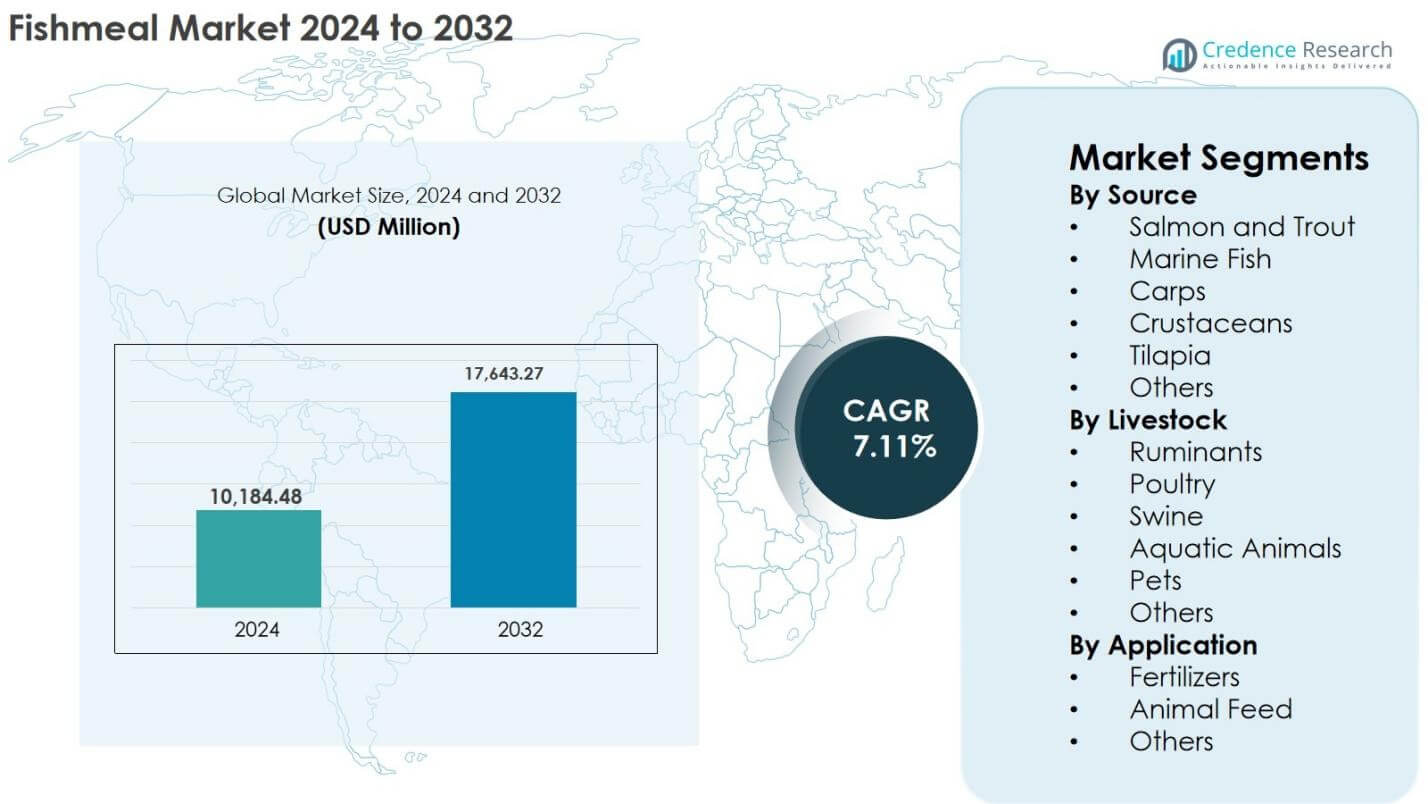
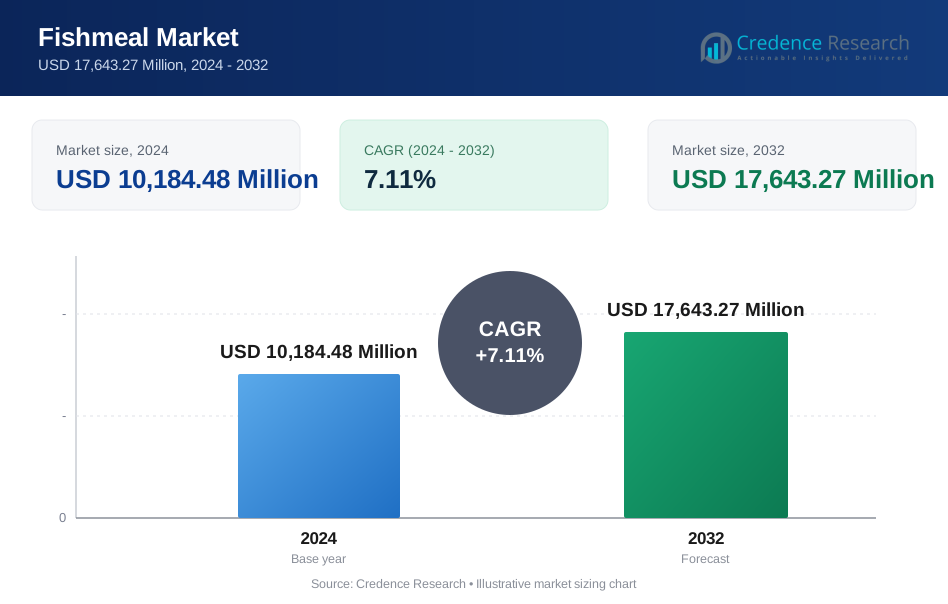
Fishmeal market size was valued USD 10,184.48 Million in 2024 and is anticipated to reach USD 17,643.27 Million by 2032, at a CAGR of 7.11% during the forecast period.
| REPORT ATTRIBUTE | DETAILS |
|---|---|
| Historical Period | 2020-2024 |
| Base Year | 2025 |
| Forecast Period | 2026-2032 |
| Fishmeal Market Size 2024 | USD 10,184.48 million |
| Fishmeal Market, CAGR | 7.11% |
| Fishmeal Market Size 2032 | USD 17,643.27 million |
Fishmeal Market Insights
- The market is driven by rising aquaculture output and growing use of high-protein feed ingredients in shrimp, salmon, tilapia, and carp farming, along with expanding poultry and livestock feed consumption across emerging economies.
- Key market trends include increasing adoption of byproduct-based fishmeal production, sustainability-focused sourcing practices, and technological advancements that enhance protein quality, digestibility, and nutrient retention in feed applications.
- The market consists of leading producers such as Pelagia, Copeinca, Austral Group S.A.A, Pesquera Exalmar S.A.A, Omega Protein Corporation, and Triplenine Group A/S, with players focusing on capacity optimization, supply-chain integration, and export-oriented processing.
- Asia-Pacific leads the market with 46% share in 2024, followed by Europe with 22% and North America with 18%, while Aquatic Animals represent the dominant livestock segment with 62% share due to strong aquaculture feed demand.
Fishmeal Market Segmentation Analysis:
By Source
The Fishmeal market by source is dominated by Marine Fish, which accounts for over 48% market share in 2024, driven by the abundant availability of small pelagic species such as anchovy, mackerel, and sardine, along with their high protein content that supports aquafeed nutrition and growth efficiency. Salmon and Trout hold a notable share due to rising demand in premium aquaculture segments, while Carps and Tilapia contribute steadily across Asian production hubs. Crustaceans and Others are emerging sources, supported by increased utilization of fish-processing byproducts and sustainability-focused circular economy practices.
- For instance, the International Fishmeal and Fish Oil Organisation (IFFO) reports that Peru and Chile’s anchovy fisheries alone typically contribute around one‑third of the world’s fishmeal production, underscoring the central role of small pelagics in the supply base.
By Livestock
Based on livestock, Aquatic Animals emerged as the leading sub-segment with a dominant 62% market share in 2024, driven by rapid expansion in commercial aquaculture, growth in shrimp and salmon farming, and increasing use of high-protein feed formulations to improve feed conversion ratios and yield performance. Poultry represents the next major consumer group, supported by rising broiler production and protein-rich feed supplementation, while Ruminants and Swine show moderate uptake in specialty blends. Pets and Others are gradually expanding due to premium pet nutrition trends and functional protein inclusion in diets.
- For instance, the FAO reports that aquaculture now supplies over half of the fish consumed globally, with intensive shrimp and salmon systems relying on formulated feeds that commonly include fishmeal to support growth and health.
By Application
In terms of application, Animal Feed remains the dominant sub-segment with 86% market share in 2024, as fishmeal continues to serve as a critical protein ingredient in aquafeed, poultry feed, and specialty livestock diets due to its high digestibility, omega-3 profile, and balanced amino acid composition. Fertilizers represent a smaller but steadily growing segment, supported by increasing use of organic and bio-based soil nutrition solutions. The Others category, including nutraceutical and industrial applications, is expanding gradually as manufacturers develop value-added fishmeal derivatives for specialized nutritional and agricultural uses.
Key Growth Drivers
Rising Aquaculture Production and Protein-Rich Feed Demand
The Fishmeal market is experiencing strong growth due to the rapid expansion of global aquaculture production and the increasing reliance on high-protein feed ingredients to enhance output efficiency and animal health. Fishmeal offers superior digestibility, balanced amino acid composition, and essential omega-3 fatty acids, making it a preferred component in shrimp, salmon, tilapia, and marine fish farming. Governments and producers are prioritizing improved feed conversion ratios, faster growth performance, and enhanced disease resistance, which strengthens demand for premium nutritional inputs. Intensive aquaculture systems in Asia-Pacific and Latin America, along with the growth of commercial hatcheries and high-value species farming, continue to increase the use of specialized feed blends containing fishmeal. These factors collectively reinforce market expansion and position fishmeal as a critical input in sustaining seafood production, addressing protein security, and supporting the global shift toward efficient and commercially managed aquaculture ecosystems.
- For instance, Mowi and other major salmon producers have documented improved growth rates and fillet quality when using feeds that incorporate marine proteins alongside plant-based ingredients.
Expansion of Poultry and Livestock Industries
Growth in the global poultry and livestock sectors represents another key driver of the Fishmeal market, supported by rising meat consumption, industrial-scale farming, and greater emphasis on nutrition-enhanced feed formulations. Fishmeal is widely used as a functional protein supplement in poultry and swine feeds, improving growth performance, nutrient absorption, gut health, and overall productivity. Rapid broiler production growth in Asia, North America, and Latin America continues to stimulate demand for protein-dense feed concentrates. Feed manufacturers are increasingly adopting fortified formulations to improve weight gain efficiency and yield quality, particularly in premium meat segments. The market also benefits from rising adoption of performance-oriented feed strategies and sustainability-linked nutrition programs across commercial farms. Together, these developments are broadening fishmeal consumption beyond aquaculture, reinforcing its role across diversified livestock categories and strengthening long-term demand across the global feed manufacturing value chain.
- For instance, technical manuals from feed producers and breeding companies recommend strategic use of high-quality animal proteins, including fishmeal, in starter and breeder feeds to maximize weight gain efficiency and flock performance.
Increased Utilization of Byproducts and Sustainable Processing Practices
The Fishmeal market is gaining momentum from the increasing utilization of fish-processing byproducts and the industry’s transition toward sustainability-focused production practices. Rather than relying solely on wild-caught pelagic fish, manufacturers are converting processing trimmings, offcuts, and seafood-waste residues into high-value fishmeal, supporting circular-economy adoption and resource optimization. This shift enhances supply stability, reduces pressure on marine ecosystems, and improves production efficiency. Technological advancements in drying, rendering, and nutrient-retention processes are improving protein quality and consistency, enabling the production of premium-grade feed ingredients. Supportive regulatory frameworks, traceability standards, and sustainability certifications further strengthen market credibility. Collaboration between fishing fleets, seafood processors, and feed companies is also improving integrated production networks and mitigating raw-material volatility. As responsible sourcing becomes a strategic procurement priority across the aquaculture and feed sectors, the adoption of eco-efficient fishmeal production is expected to accelerate and support long-term market development.
Key Trends & Opportunities
Shift Toward Functional and Specialized Feed Formulations
A major trend shaping the Fishmeal market is the growing shift toward functional, performance-enhancing, and species-specific feed formulations across aquaculture and livestock sectors. Feed producers are integrating fishmeal into precision-nutrition diets designed to improve growth efficiency, immune strength, feed stability, and survival rates, particularly in high-value species such as shrimp, salmon, seabass, and marine finfish. Rising adoption of nutritionally optimized starter feeds for hatcheries and juvenile stages is further stimulating demand. Advances in feed technology, pellet durability, enzymatic supplementation, and nutrient stabilization support improved feed performance outcomes. Manufacturers are also developing hybrid formulations that combine fishmeal with alternative proteins while retaining performance advantages, enabling economic and nutritional balance. The increasing focus on productivity optimization, disease mitigation, and export-grade output quality positions fishmeal as a key ingredient in next-generation feed systems and creates significant opportunities for value-driven innovation across global feed markets.
- For instance, Skretting and BioMar have developed species-specific feeds for salmon, shrimp, and seabass that use calibrated fishmeal inclusion to optimize feed conversion ratios, health status, and fillet or carcass quality.
Emergence of Value-Added Applications Beyond Animal Nutrition
Another key opportunity in the Fishmeal market is the expanding use of fishmeal and its derivatives beyond traditional aquaculture and livestock feed applications. Fishmeal-based nutrients are gaining wider acceptance in organic and sustainable agriculture as bio-fertilizers and soil-enrichment inputs, driven by the global shift toward eco-friendly farming practices. At the same time, bioactive compounds extracted from fishmeal residues are being explored for nutraceuticals, dietary supplements, and functional nutrition applications. Ongoing research in protein isolation, hydrolysis technology, and bio-processing is enabling the development of high-value derivatives suitable for pharmaceutical, cosmetic, and biochemical industries. These diversification trends help reduce dependence on feed demand cycles and create alternative revenue channels for producers. As end-user industries increasingly recognize the functional versatility, nutrient density, and biological value of fishmeal components, the market is expected to benefit from innovation-led expansion and broader cross-sector adoption.
- For instance, fish emulsion and hydrolysate products derived from fish processing byproducts are widely marketed in North America and Europe as organic-certified fertilizers to improve soil health and plant vigor.
Key Challenges
Volatility in Raw Material Supply and Dependence on Wild-Catch Resources
A major challenge for the Fishmeal market is its high dependence on wild-caught marine fish, which leads to frequent volatility in raw-material supply and pricing. Seasonal fluctuations in fish populations, climate-related disruptions such as El Niño, and regulatory fishing quotas often constrain production volumes and create uncertainty in the supply chain. Sustainability-driven fishing controls and environmental protection measures in key producing regions further restrict marine catch availability. These factors increase procurement risks for feed producers and aquaculture operators who rely on consistent fishmeal inputs. In addition, geopolitical disruptions, trade restrictions, and transportation constraints can intensify supply imbalances and cost pressures. Although the growing use of processing byproducts has helped stabilize sourcing to some extent, structural dependence on marine resources remains a persistent challenge, affecting long-term price stability, production planning, and supply-security resilience across the industry.
Competition from Alternative Protein Sources and Cost Pressures
The Fishmeal market also faces increasing competition from emerging alternative protein sources such as soybean meal, insect-based protein, algae protein, single-cell proteins, and microbial-fermented feed ingredients. Feed manufacturers are actively testing substitution strategies to reduce cost volatility associated with fishmeal and to address sustainability-related procurement concerns. Continuous improvements in plant-based and microbial protein technologies are enhancing digestibility and nutritional efficiency, increasing their viability as partial replacements in certain feed formulations. High production costs and price sensitivity in developing markets further intensify substitution pressure. At the same time, regulatory and environmental expectations are pushing producers to reduce dependence on marine-derived inputs. While fishmeal remains indispensable in high-performance and specialty feed segments, rising adoption of alternative proteins is reshaping demand patterns and compelling manufacturers to innovate, upgrade quality standards, and strengthen value differentiation to maintain competitive positioning in the global feed industry.
Regional Analysis
North America
North America holds a notable share of the Fishmeal market, accounting for around 18% of global revenue in 2024, driven by strong demand from aquaculture, poultry, and pet nutrition industries in the U.S. and Canada. The region benefits from advanced feed manufacturing infrastructure, high adoption of performance-enhancing protein supplements, and increasing focus on sustainable sourcing practices. Growth in salmon and trout farming, particularly in coastal areas, further strengthens consumption. Rising emphasis on premium livestock nutrition, along with investments in feed innovation and value-added fishmeal derivatives, continues to support steady market expansion across North American supply chains.
Europe
Europe represents a significant Fishmeal market, contributing 22% market share in 2024, supported by strong aquaculture operations in Norway, Iceland, Denmark, and the U.K., along with mature livestock feed industries. The region places high importance on traceability, eco-certified production, and circular-economy utilization of fish-processing byproducts. Demand is largely driven by salmon farming and high-value marine species, where feed efficiency and nutritional quality remain priorities. Technological advancements in rendering and protein-optimization, combined with strict environmental regulations, shape sourcing and trade flows, while growing adoption of sustainable feed inputs supports long-term market penetration across Europe.
Asia-Pacific
Asia-Pacific dominates the Fishmeal market with the largest share of around 46% in 2024, owing to rapid aquaculture expansion in China, Vietnam, India, Thailand, and Indonesia. The region is both a major consumer and producer, supported by large-scale shrimp, tilapia, carp, and marine fish farming ecosystems. Rising seafood exports, increasing urban protein consumption, and adoption of intensive farming systems significantly boost demand for high-protein feed ingredients. Local production using pelagic fish and processing byproducts complements import volumes from Latin America. Government initiatives to enhance aquaculture productivity and feed efficiency further reinforce Asia-Pacific’s leadership in global fishmeal consumption.
Latin America
Latin America accounts for about 10% market share in 2024, driven primarily by strong production hubs in Peru and Chile, which rank among the world’s leading suppliers of fishmeal derived from anchovy and other pelagic species. The region benefits from abundant marine resources, export-oriented processing industries, and established trade linkages with Asia and Europe. Growing aquaculture development in Ecuador and Brazil also supports domestic demand. However, climatic variability and fishing-quota regulations influence annual output volumes. Continued investments in sustainable harvesting, resource monitoring, and processing-efficiency upgrades are strengthening Latin America’s strategic position in global fishmeal supply chains.
Middle East & Africa
The Middle East & Africa region holds a moderate share of 4% in 2024, but it is witnessing gradual growth driven by expanding aquaculture operations in Egypt, Saudi Arabia, Turkey, and parts of Sub-Saharan Africa. Increasing investment in fish farming, poultry feed, and animal protein production is stimulating demand for imported fishmeal, as domestic production capacity remains limited. Several governments are promoting aquaculture to improve food security, creating new opportunities for feed suppliers. Although dependence on imports and price fluctuations present challenges, rising adoption of protein-rich feed ingredients is expected to support steady market expansion across the region.
Fishmeal Market Segmentations:
By Source
- Salmon and Trout
- Marine Fish
- Carps
- Crustaceans
- Tilapia
- Others
By Livestock
- Ruminants
- Poultry
- Swine
- Aquatic Animals
- Pets
- Others
By Application
- Fertilizers
- Animal Feed
- Others
By Geography
- North America
- U.S.
- Canada
- Mexico
- Europe
- Germany
- France
- U.K.
- Italy
- Spain
- Rest of Europe
- Asia Pacific
- China
- Japan
- India
- South Korea
- South-east Asia
- Rest of Asia Pacific
- Latin America
- Brazil
- Argentina
- Rest of Latin America
- Middle East & Africa
- GCC Countries
- South Africa
- Rest of the Middle East and Africa
Competitive Landscape
The Fishmeal market features a moderately consolidated landscape, with leading producers focusing on capacity optimization, sustainable sourcing, and supply-chain integration to strengthen their market position. Key players include Pelagia, Copeinca, Austral Group S.A.A, Pesquera Exalmar S.A.A, Pesquera Diamante S.A, Triplenine Group A/S, Omega Protein Corporation, FF Skagen, Oceana Group Limited, and The Scoular Company. These companies operate extensive processing facilities and maintain long-term supply relationships with aquafeed and livestock-feed manufacturers across Asia-Pacific, Europe, and Latin America. Strategic priorities include expanding byproduct-based production, improving traceability standards, and enhancing product quality consistency to meet sustainability and regulatory expectations. Several participants are also investing in technology upgrades, marine resource management, and export-market diversification to mitigate raw-material volatility and trade risks. Partnerships with feed companies and vertically integrated fishing operations further support operational efficiency and value addition, while emerging regional producers continue to expand their presence in niche supply segments.
Key Player Analysis
- Pelagia
- Copeinca
- Pesquera Exalmar S.A.A
- Triplenine Group A/S
- Austral Group S.A.A
- Omega Protein Corporation
- FF Skagen
- Oceana Group Limited
- Pesquera Diamante SA
- The Scoular Company
Recent Developments
- In November 2025, Peruvian authorities increased the anchovy fishing quota for the second season, potentially boosting raw material supply for fishmeal producers and influencing market dynamics.
- In September 2024, Ginkgo Bioworks, a company developing a leading platform for cell programming and biosecurity, announced a new collaboration with NOVUS International a pioneer in intelligent nutrition to create next-generation feed additives tailored to the evolving requirements of the animal agriculture sector.
- In March 2024, Poseidon Ocean Systems, headquartered in Campbell River, British Columbia, secured approximately USD 20.75 million in Series B funding, led by Ecosystem Integrity Fund, a venture capital firm focused on sustainability, to support initiatives aimed at improving fish welfare and reducing environmental impact.
Report Coverage
The research report offers an in-depth analysis based on Source, Livestock, Application, and Geography. It details leading market players, providing an overview of their business, product offerings, investments, revenue streams, and key applications. Additionally, the report includes insights into the competitive environment, SWOT analysis, current market trends, as well as the primary drivers and constraints. Furthermore, it discusses various factors that have driven market expansion in recent years. The report also explores market dynamics, regulatory scenarios, and technological advancements that are shaping the industry. It assesses the impact of external factors and global economic changes on market growth. Lastly, it provides strategic recommendations for new entrants and established companies to navigate the complexities of the market.
Future Outlook
- The market will continue to expand as aquaculture production scales up and demand for high-protein feed ingredients increases across major farming regions.
- Feed manufacturers will adopt more performance-oriented nutrition strategies that strengthen the role of fishmeal in premium aquafeed and specialty livestock diets.
- Utilization of fish-processing byproducts will rise, supporting circular-economy practices and reducing dependence on wild-catch marine resources.
- Sustainability certifications, traceability systems, and responsible sourcing standards will increasingly influence procurement and trade dynamics.
- Technological advancements in processing and protein optimization will enhance product quality, consistency, and nutritional efficiency.
- Competition from alternative protein sources will intensify, encouraging innovation and value differentiation among fishmeal producers.
- Regional production hubs in Latin America and Asia-Pacific will strengthen their strategic role in export supply networks.
- Demand from poultry, pet nutrition, and specialty feed applications will expand alongside aquaculture growth.
- Climate variability and fishing-quota regulations will continue to shape supply stability and price trends.
- Industry collaboration among fishing companies, processors, and feed manufacturers will increase to improve integration, risk management, and long-term market resilience.
Request a Free Sample
Fill in your details and we'll send you a free sample report.
- Sample data tables & charts
- Research methodology
Need a Custom Version of This Report?
Tailor the scope, geography, or segments to your exact requirements.
- Custom geography or segment scope
- Direct access to our analyst team
Frequently Asked Questions
What is the current market size for Fishmeal Market, and what is its projected size in 2032?
At what Compound Annual Growth Rate is the Fishmeal Market projected to grow between 2024 and 2032?
Which Fishmeal Market segment held the largest share in 2024?
What are the primary factors fueling the growth of the Fishmeal Market?
Who are the leading companies in the Fishmeal Market?
Which region commanded the largest share of the Fishmeal Market in 2024?
Table of Content
Chapter 1. Report Introduction
- 1.1 Report Description & Purpose
- 1.1.1 Report Title & Market Definition
- 1.1.2 Unique Selling Propositions (USP) & Key Differentiators
- 1.1.3 Value Proposition for Stakeholders
- 1.2 Research Objectives
- 1.2.1 Market Sizing Objectives (Volume & Revenue)
- 1.2.2 Segmentation Objectives
- 1.2.3 Competitive Intelligence Objectives
- 1.2.4 Forecast & Scenario Objectives
- 1.3 Report Scope
- 1.3.1 Fishmeal Scope – Types & Subtypes Covered
- 1.3.2 Geographic Scope – Regions & Countries Covered
- 1.3.3 Historical Period, Base Year & Forecast Period (2024; forecast to 2032)
- 1.3.4 Inclusions & Exclusions
- 1.4 HS Code & Classification Framework
- 1.5 Currency, Units & Pricing Basis
- 1.6 Target Stakeholders
- 1.7 Limitations & Assumptions
Chapter 2. Executive Summary
- 2.1 Global Fishmeal Market Snapshot
- 2.1.1 Market Size – Historical (2024) & Forecast (2024-2032) (2024: USD 10,184.48 Million → 2032: USD 17,643.27 Million)
- 2.1.2 Volume & Revenue – Global Totals
- 2.1.3 Key Market Highlights – Top Five Facts
- 2.2 Fishmeal Market Segmentation Snapshot
- 2.2.1 Market Split by Region – 2024 vs. 2032
- 2.3 Competitive Snapshot
- 2.3.1 Top 10 Players by Revenue Share – 2024
- 2.3.2 Top 10 Players by Volume Share – 2024
- 2.3.3 Recent Strategic Developments (18-Month Summary)
- 2.4 Key Investment Highlights & Strategic Conclusions
Chapter 3. Fishmeal Market Dynamics & Industry Analysis
- 3.1 Market Overview & Context
- 3.1.1 Fishmeal Market Position in the Broader Automotive Value Chain
- 3.1.2 OEM vs. Replacement Market Dynamics
- 3.1.3 Market Maturity & Development Stage by Region
- 3.2 Fishmeal Market Drivers
- 3.3 Fishmeal Market Restraints & Challenges
- 3.4 Fishmeal Market Opportunities
- 3.5 Porter's Five Forces Analysis
- 3.5.1 Threat of New Entrants
- 3.5.2 Bargaining Power of Suppliers
- 3.5.3 Bargaining Power of Buyers
- 3.5.4 Threat of Substitutes
- 3.5.5 Competitive Rivalry – Intensity Assessment
- 3.6 Fishmeal Value Chain Analysis
- 3.6.1 Upstream – Raw Material/Input Suppliers
- 3.6.1.1 Raw Material/Input 1
- 3.6.1.2 Raw Material/Input 2
- 3.6.1.3 Raw Material/Input 3
- 3.6.2 Midstream – Production/Manufacturing/Service Delivery
- 3.6.2.1 Production/Process Overview
- 3.6.2.2 Key Facility Locations & Capacity by Manufacturer
- 3.6.3 Downstream – Distribution & End Consumer
- 3.6.3.1 Primary Channel – B2B/OEM
- 3.6.3.2 Secondary Channels – Dealer, Retail, Online, Direct
- 3.6.4 Value Chain Profitability Analysis
- 3.6.1 Upstream – Raw Material/Input Suppliers
- 3.7 PESTEL Analysis
- 3.7.1 Political Factors
- 3.7.2 Economic Factors
- 3.7.3 Social Factors
- 3.7.4 Technological Factors
- 3.7.5 Environmental Factors
- 3.7.6 Legal Factors
- 3.8 Fishmeal Supply Chain Analysis
- 3.8.1 Raw Material/Input Supply Risk Assessment
- 3.8.2 Manufacturing Concentration Risk (Geographic Exposure)
- 3.8.3 Trade Disruption Impact Analysis
- 3.9 Regulatory & Policy Landscape
Note: The regulatory and policy landscape section covers regulations based on their applicability to the market, Fishmeal category, geography, and scope of the study. Only regulatory frameworks with a material impact on operations, compliance, trade, sustainability, or market access are analyzed in detail.
Chapter 4. Key Investment Pockets & Opportunity Analysis
- 4.1 Fishmeal Market Attractiveness Analysis
- 4.1.1 By Region – Investment Attractiveness Matrix (Volume × CAGR)
- 4.2 Absolute Revenue Growth Opportunity
- 4.2.1 By Region – Absolute USD Growth Through 2032
- 4.3 Incremental Volume Opportunity
- 4.3.1 By Region – Incremental Volume Through 2032
- 4.3.2 Segment – Incremental Volume
- 4.4 Emerging Submarket Opportunity Deep Dive (Subject to Applicability)
- 4.5 Emerging Market Opportunity Scorecards
- 4.5.1 United States
- 4.5.2 Europe
- 4.5.3 Asia
- 4.5.4 Middle East & Africa
Note: Emerging Market Opportunity Scorecards will be included based on relevance and strategic importance. Regions listed are indicative and may vary depending on data availability and market dynamics.
Chapter 5. Fishmeal Import-Export Analysis & Trade Flows
- 5.1 Global Trade Overview
- 5.1.1 Global Export Value by Country (2024)
- 5.1.2 Global Export Volume by Country (2024)
- 5.1.3 Global Import Value by Country (2024)
- 5.1.4 Global Import Volume by Country (2024)
- 5.1.5 Net Trade Balance by Country (2024)
- 5.2 Export Analysis – Segment
- 5.2.1 Type 1 (HS Code)
- 5.2.2 Type 2 (HS Code)
- 5.2.3 Type 3 (HS Code)
- 5.2.4 Type 4 (HS Code)
- 5.2.5 Type 5 (HS Code)
- 5.3 Import Analysis – Segment
- 5.3.1 Type 1 (HS Code)
- 5.3.2 Type 2 (HS Code)
- 5.3.3 Type 3 (HS Code)
- 5.3.4 Type 4 (HS Code)
- 5.3.5 Type 5 (HS Code)
- 5.4 Average Unit Trade Prices
- 5.4.1 Average Export Price – Segment & Country
- 5.4.2 Average Import Price – Segment & Source Country
- 5.4.3 Price Trends (2024)
- 5.5 Key Trade Route Analysis
- 5.5.1 Trade Route 1
- 5.5.2 Trade Route 2
- 5.5.3 Trade Route 3
- 5.5.4 Trade Route 4
- 5.5.5 Trade Route 5
- 5.6 Trade Policy Impact Assessment
- 5.6.1 US Anti-Dumping & Section 301 Tariffs
- 5.6.2 EU Customs Union Impact
- 5.6.3 Major Free Trade Agreements
- 5.6.4 USMCA Rules of Origin
Note: Trade policy analysis will be included only where relevant to the Fishmeal market.
Chapter 6. Competitive Landscape & Company Benchmarking
- 6.1 Fishmeal Market Concentration & Structure
- 6.1.1 Herfindahl-Hirschman Index (HHI) – vs. 2024
- 6.1.2 Tier 1, Tier 2 & Tier 3 Market Structure
- 6.1.3 Global, Regional & Local Player Dynamics
- 6.2 Fishmeal Market Share Analysis – 2024
- 6.2.1 Global Revenue Share by Company
- 6.2.2 Global Volume Share by Company
- 6.2.3 Regional Revenue Share
- 6.2.4 Market Share Evolution ( vs. 2024)
- 6.2.5 OEM Segment Share by Company
- 6.2.6 Replacement Segment Share by Company
- 6.3 Production/Delivery Capacity & Facility Analysis
- 6.3.1 Global Installed Capacity
- 6.3.2 Capacity Utilization Rates
- 6.3.3 Production/Output Volume
- 6.3.4 Facility Locations & Capacity Map
- 6.3.5 Planned Capacity Additions
- 6.4 Fishmeal Competitive Benchmarking Matrix
- 6.4.1 Revenue, Volume, CAGR & Profitability Comparison
- 6.4.2 Channel Revenue Mix
- 6.4.3 Geographic Revenue Exposure
- 6.4.4 R&D Intensity
- 6.4.5 Sustainability Maturity
- 6.5 Strategic Developments in Fishmeal (Last 24 Months)
- 6.5.1 Mergers, Acquisitions & Divestments
- 6.5.2 New Fishmeal Launches
- 6.5.3 Facility Expansions
- 6.5.4 Strategic Alliances, Joint Ventures & Partnerships
- 6.5.5 Distribution Expansion & Market Entry
- 6.5.6 Sustainability & ESG Initiatives
- 6.6 Competitive Strategy Mapping
- 6.6.1 Leader, Challenger, Follower & Niche Classification
- 6.6.2 Pricing Strategy Comparison
- 6.6.3 Channel Strategy Matrix
Note: Strategic developments are included based on their materiality and the availability of reliable information.
Chapter 7. Global Fishmeal Market – By Distribution Channel
- 7.1 Segment Overview
- 7.1.1 Volume & Revenue Split by Channel (2024 & 2032)
- 7.1.2 Channel Mix Evolution (2024-2032)
Chapter 8. Regional Market Analysis – Global Overview
- 8.1 Global Regional Overview
- 8.1.1 Regional Volume Share
- 8.1.2 Regional Revenue Share
- 8.1.3 Regional Volume by Region
- 8.1.4 Regional Revenue by Region
- 8.1.5 Regional Forecast Through 2032
- 8.2 Cross-Regional Segment Analysis
- 8.2.1 By Distribution Channel
- 8.2.2 By Brand/Price Tier
Chapter 9. North America Fishmeal Market
- 9.1 United States
- 9.2 Canada
- 9.3 Mexico
Chapter 10. Europe Fishmeal Market
- 10.1 Germany
- 10.2 France
- 10.3 Italy
- 10.4 United Kingdom
- 10.5 Spain
- 10.6 Poland
- 10.7 Russia
- 10.8 Netherlands
- 10.9 Belgium
- 10.10 Sweden
- 10.11 Denmark
- 10.12 Norway
- 10.13 Rest of Europe
Chapter 11. Asia Pacific Fishmeal Market
- 11.1 China
- 11.2 India
- 11.3 Japan
- 11.4 South Korea
- 11.5 Thailand
- 11.6 Indonesia
- 11.7 Vietnam
- 11.8 Malaysia
- 11.9 Australia
- 11.10 Rest of Asia Pacific
Chapter 12. Latin America Fishmeal Market
- 12.1 Brazil
- 12.2 Argentina
- 12.3 Colombia
- 12.4 Chile
- 12.5 Rest of Latin America
Chapter 13. Middle East Fishmeal Market
- 13.1 Saudi Arabia
- 13.2 United Arab Emirates
- 13.3 Turkey
- 13.4 Israel
- 13.5 Iran
- 13.6 Rest of the Middle East
Chapter 14. Africa Fishmeal Market
- 14.1 South Africa
- 14.2 Egypt
- 14.3 Nigeria
- 14.4 Morocco
- 14.5 Rest of Africa
Chapter 15. Fishmeal Company Profiles
- 15.1 [Company 01]
- 15.1.1 Company Overview
- 15.1.2 Key Management Personnel
- 15.1.3 Products & Services Portfolio
- 15.1.4 Financial Performance
- 15.1.5 Key Market Focus & Geographic Presence
- 15.1.6 Recent Developments & Strategic Initiatives
Note: The company profile list is preliminary and may change based on research findings, market developments, data availability, and client requirements.
Chapter 16. Appendices
- Appendix A – List of Abbreviations & Acronyms
- Appendix B – Industry Classification Code Reference – Full Series
- Appendix C – Production & Capacity Data Tables
- Appendix D – End-Use & Demand Base Tables
- Appendix E – Consumption & Replacement Rate Assumptions
- Appendix F – ASP Reference Tables
- Appendix G – Manufacturing & Facility Database
- Appendix H – Import-Export Data Tables
- Appendix I – Regulatory Summary Tables
- Appendix J – Primary Research Participant List (Anonymized)
- Appendix K – Primary Research Questionnaire Framework
- Appendix L – Data Sources & Bibliography
- Appendix M – Market Size Divergence & Source Comparison
Chapter 17. Research Methodology
- 17.1 Research Framework & Philosophy
- 17.2 Secondary Research – Sources, Hierarchy & Data Extraction
- 17.3 Data Modeling – Bottom-Up & Top-Down Market Sizing
- 17.4 Primary Research – Stakeholder Framework, LOI & Sample Sizes
- 17.5 Forecast Methodology – Regression, Scenario & Sensitivity Analysis
- 17.6 Quality Control – Four-Layer Validation Framework
- 17.7 Limitations & Standard Assumptions
- 17.8 Disclaimer
