
Dicamba Herbicide Market Overview:
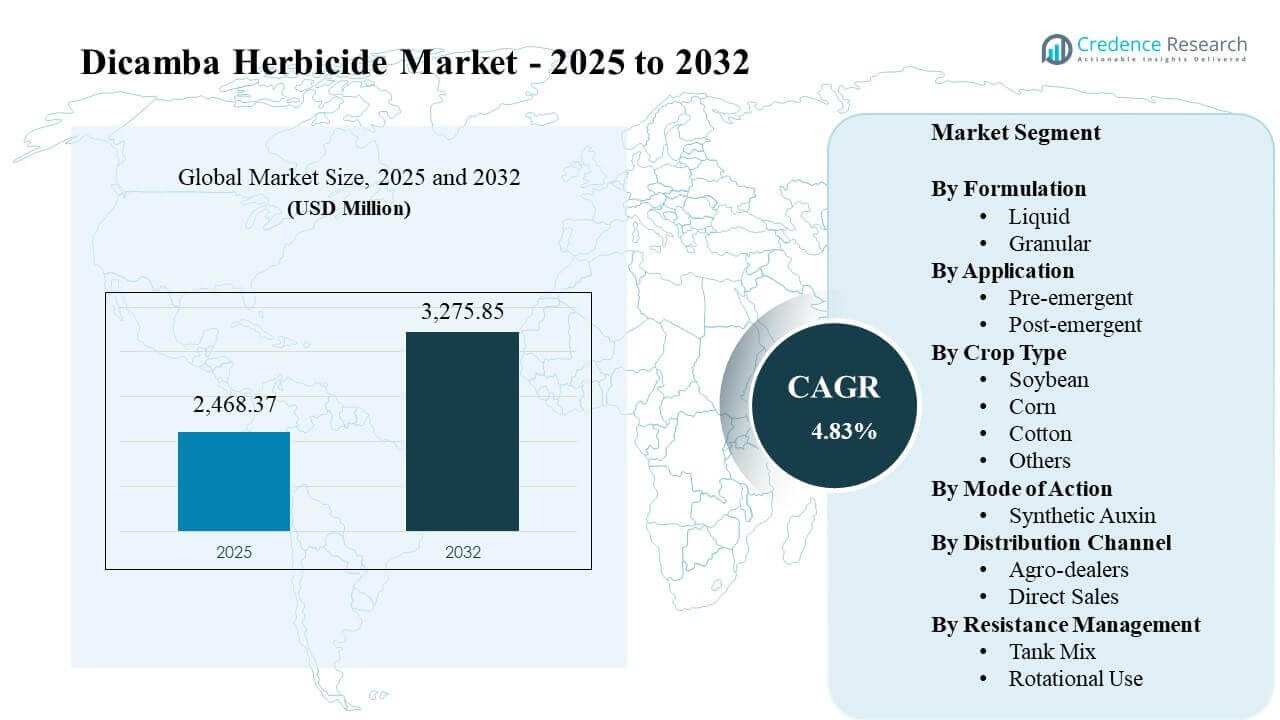
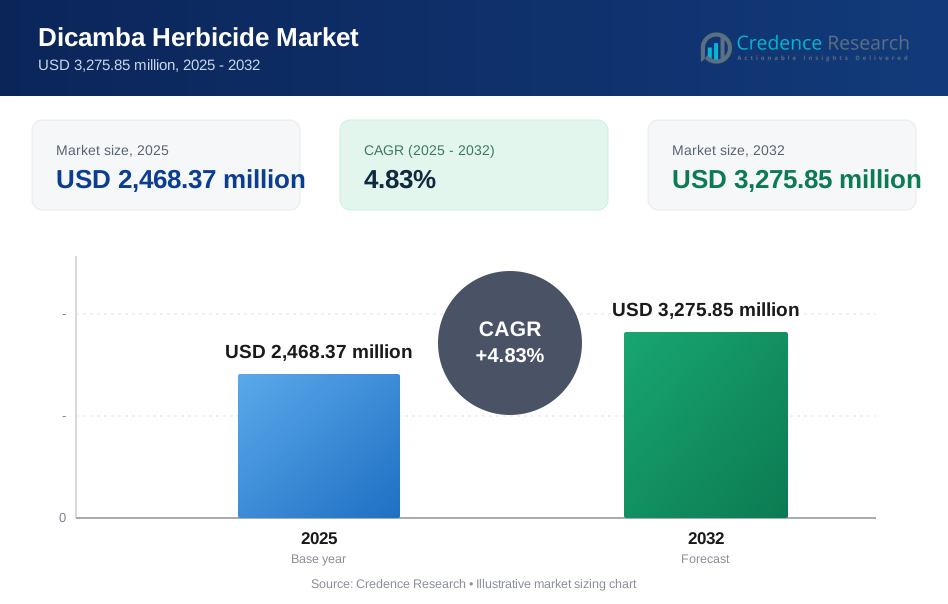
The global Dicamba Herbicide Market size was estimated at USD 2,468.37 million in 2025 and is expected to reach USD 3,275.85 million by 2032, growing at a CAGR of 4.83% from 2025 to 2032. Demand is supported by persistent broadleaf weed pressure in large-scale row-crop systems, where dicamba remains a valued tool in integrated programs that aim to protect yield and slow resistance development. Adoption is also influenced by how effectively suppliers and channels support stewardship, application timing, and product-handling requirements that reduce off-target risk and improve field consistency.
| REPORT ATTRIBUTE | DETAILS |
|---|---|
| Historical Period | 2020-2024 |
| Base Year | 2025 |
| Forecast Period | 2026-2032 |
| Dicamba Herbicide Market Size 2025 | USD 2,468.37 million |
| Dicamba Herbicide Market, CAGR | 4.83% |
| Dicamba Herbicide Market Size 2032 | USD 3,275.85 million |
Key Market Trends & Insights
- The Dicamba Herbicide Market is projected to expand from USD 2,468.37 million in 2025 to USD 3,275.85 million by 2032 at a CAGR of 4.83% (2025–2032).
- Post-emergent application leads the market with a 2025 share of 69.1%, reflecting strong in-season demand for broadleaf weed control.
- Liquid formulations account for 61.6% of 2025 revenue, supported by handling convenience and compatibility with standard spray systems.
- North America holds 46.2% of 2025 revenue, driven by high-intensity row-crop production and structured crop protection programs.
- Latin America represents 18.7% of 2025 revenue, supported by large soybean and corn cultivation footprints and high herbicide program intensity.
Segment Analysis
The Dicamba Herbicide Market shows strong concentration in application timing and formulation preferences, shaped by field logistics, equipment compatibility, and stewardship expectations. Liquid products retain the dominant position because they simplify mixing and dosing processes at the farm level and integrate easily into established spray workflows. Purchasing decisions also prioritize predictable performance across variable weed pressure, along with clear guidance for label-compliant use in sensitive environments.
Application timing remains the most influential program decision because it affects both weed-control outcomes and operational risk. Post-emergent demand stays high because growers often need effective in-season control to address weed escapes and variable emergence. Pre-emergent usage is gaining strategic importance as programs shift toward earlier control to reduce later-season pressure and reinforce resistance management, particularly when combined with complementary modes of action.
By Formulation Insights
Liquid accounted for the largest share of 61.6% in 2025. Liquid products lead because they align with standard spraying infrastructure and reduce handling friction during peak windows. They also support more consistent dose control in large-acreage operations where speed and repeatability matter. Suppliers continue to compete on formulation performance attributes that improve field reliability and support stewardship practices. Granular products remain relevant where storage, transport, and targeted use cases favor dry formats.
By Application Insights
Post-emergent accounted for the largest share of 69.1% in 2025. Post-emergent use leads because it provides in-season flexibility to address active weed growth and protect yield during critical crop stages. It also fits rescue applications when early programs underperform or weather delays earlier passes. Stewardship requirements continue to shape product selection, nozzle choices, and timing decisions, which increases the value of dealer guidance and training. Pre-emergent programs gain traction where growers prioritize early-season suppression and reduced off-target exposure risk.
By Crop Type Insights
Soybean and cotton tend to anchor dicamba demand because broadleaf weed pressure is often most acute in these row-crop systems and growers prioritize effective control to protect yield and harvest quality. Corn contributes steady demand where dicamba is positioned as part of broader broadleaf programs and as a rotational fit within integrated weed management. Crop-specific agronomy, local weed species, and tolerance system adoption influence the intensity of use by crop. “Others” includes crops where usage is more situational and driven by regional weed pressure and label availability.
By Mode of Action Insights
Synthetic auxin positioning supports continued relevance because growers and agronomists increasingly emphasize mode-of-action diversity to slow resistance development. Dicamba’s role is strongest when integrated with complementary chemistries and cultural practices to reduce selection pressure. Product selection is also shaped by tolerance of neighboring crops and the need to manage volatility and drift risks through compliant application methods. Stewardship-driven use reinforces the need for consistent product performance and practical guidance at the point of sale.
By Distribution Channel Insights
Agro-dealers remain influential because they provide seasonal availability, local agronomy support, and practical guidance on compliant application practices. Dealer-led programs also help growers coordinate product choice with nozzle selection, weather constraints, and tank-mix partners. Direct sales channels are more prominent in large-acreage accounts seeking bundled crop protection programs, predictable supply, and technical stewardship support. Channel competitiveness increasingly depends on service quality, training, and product portfolio breadth.
By Resistance Management Insights
Tank mix strategies remain common because growers aim to broaden control spectrum and reduce reliance on a single chemistry during peak pressure periods. Rotational use is increasingly emphasized in integrated weed management to reduce long-term selection pressure and maintain efficacy across seasons. Decisions depend on local resistance patterns, the cost of complementary chemistries, and the practicality of multi-pass programs. Supplier guidance and retailer stewardship programs help standardize resistance management practices across farm operations.
Market Drivers
Broadleaf weed pressure in large row-crop systems
Broadleaf weeds threaten yield and crop quality across large row-crop acreage, sustaining demand for dependable broadleaf herbicides year after year today. Dicamba stays central in programs that require strong control during critical growth stages and rapid response to late-season escapes. In-season pressure supports repeat purchasing and reinforces post-emergent use where weeds emerge unevenly. Growers prioritize products that perform consistently despite shifting weather, field variability, and staggered weed flushes across acres.
- For instance, Bayer’s XtendiMax® with VaporGrip® Technology demonstrated up to 90% reduction in volatility compared to older dicamba formulations in controlled field trials, while maintaining effective control of over 90 broadleaf weed species across soybean and cotton systems.
Resistance management priorities in herbicide programs
Resistance concerns push growers to diversify herbicide programs and rotate or combine modes of action across seasons. Dicamba benefits because it can serve as a rotation partner or a component in broader weed-control plans, especially where glyphosate resistance persists. Used with tank-mix partners and sound agronomy, dicamba helps maintain control spectrum and reduce selection pressure. This driver is strongest in high-pressure regions with intensive cropping and frequent applications each season.
High preference for liquid handling and spray compatibility
Liquid formulations lead because they fit spray systems and reduce friction in measuring, mixing, and dosing during short application windows. Operational simplicity matters at scale when labor and equipment schedules are tight and weather narrows field time. Liquid products also support uniform workflows across multiple fields and geographies, improving repeatability for operators. These advantages encourage repeat purchasing and motivate channels to stock liquids heavily, sustaining demand concentration in liquid formats.
Structured retail advisory and stewardship support
Stewardship requirements elevate the value of agronomic guidance, training, and distributor-led compliance support. Agro-dealers and large distributors translate label rules into practical on-farm steps, helping growers manage timing, equipment setup, and weather constraints. Clear direction on spray practices lowers operational risk and improves confidence in consistent results. Service quality can shape brand preference and reinforce loyalty, especially as regulatory expectations evolve and compliance becomes more demanding season to season overall.
- For instance, Syngenta’s Spray Assist digital tool integrates real-time weather data and label requirements, helping operators maintain wind speeds between 3–10 mph and buffer compliance, which reduced off-target movement incidents by over 40% in monitored pilot regions.
Dicamba Herbicide Market Challenges
Regulatory scrutiny and stewardship requirements create uncertainty for planning and product availability, especially where off-target risk is a central concern. Compliance-driven limits can narrow application windows and increase operational complexity for growers and custom applicators. Strict adherence to label conditions raises the need for training, documentation, and retailer support, adding overhead. These constraints can lift total program costs, reduce flexibility during volatile weather, and influence shifts to alternative herbicide strategies.
Operational risk tied to drift, volatility, and neighboring-crop sensitivity continues to shape adoption and product choice. Growers may adjust timing, nozzles, spray volumes, and tank-mix partners to reduce exposure risk, which can add friction to planning. In higher-sensitivity areas, more conservative use patterns may emerge, increasing reliance on substitute chemistries or mechanical practices. The challenge increases demand for improved formulations and practical guidance that support predictable, compliant application outcomes safely.
- For instance, Corteva Agriscience’s Enlist Duo, combining 2,4-D choline with glyphosate, achieved a 96% reduction in physical drift potential compared to traditional 2,4-D formulations based on wind tunnel testing, while also requiring specific nozzle types and boom height restrictions (≤24 inches above canopy), illustrating how even drift-reduction technologies still impose precise operational controls.
Dicamba Herbicide Market Trends and Opportunities
Program design is shifting toward earlier-season control and more integrated weed management, creating opportunities for offerings that support pre-emergent positioning and structured rotation plans. Suppliers that provide clear use guidance, compatible tank-mix recommendations, and practical training can strengthen channel preference. As growers standardize operational workflows, products that simplify application and reduce compliance friction can gain share. This trend also supports value-added services tied to agronomy and stewardship.
- For instance, Syngenta’s Acuron® herbicide demonstrates residual control of key grass and broadleaf weeds for up to 6–8 weeks under field conditions, enabling early-season weed suppression and reducing the need for multiple post-emergence applications, while its pre-mix formulation simplifies tank-mix complexity and improves application consistency.
Channel strategies increasingly emphasize bundled solutions and field support, especially for large-acreage accounts seeking predictable supply and consistent outcomes. Direct sales growth opportunities improve when suppliers offer integrated portfolios that align with crop calendars and resistance management. Digital agronomy tools and advisory services can increase customer stickiness by improving planning and documenting compliant use. In emerging markets, expansion opportunities improve where distributor coverage and technical training scale alongside commercial farming intensity.
Regional Insights
North America
North America accounted for 46.2% of 2025 revenue, supported by large-scale row-crop production and high-intensity herbicide programs. Demand is shaped by the need for consistent broadleaf control and structured retail support that helps growers manage stewardship requirements. Product selection emphasizes operational fit, application timing discipline, and performance reliability under variable field conditions. Channel strength and training programs play a central role in sustaining adoption and repeat purchasing.
Europe
Europe represented 17.4% of 2025 revenue, with demand shaped by established crop protection usage and strong distributor networks. Adoption intensity is moderated by regulatory expectations and careful stewardship practices that influence product access and timing. Buyers tend to value predictable field performance and clear compliance guidance that reduces operational risk. Portfolio breadth and advisory support can influence brand preference across major agricultural regions.
Asia Pacific
Asia Pacific accounted for 13.6% of 2025 revenue, supported by agricultural intensification and expanding commercial farming in key markets. Dicamba demand is influenced by diverse crop patterns and uneven penetration across countries, which elevates the role of distribution coverage and training. Growth potential is strongest where herbicide programs professionalize and advisory support improves application consistency. Suppliers that align products with local agronomy and channel capabilities can strengthen uptake.
Latin America
Latin America held 18.7% of 2025 revenue, supported by large soybean and corn cultivation footprints and high weed-control intensity. Demand is reinforced by competitive export-driven farming models that prioritize yield protection and consistent field outcomes. Distributor relationships and seasonal availability are critical because growers operate on tight application windows across large acreages. Resistance management focus supports continued investment in diversified herbicide programs.
Middle East & Africa
Middle East & Africa accounted for 4.1% of 2025 revenue, reflecting smaller concentration in row-crop systems where dicamba demand is most intensive. Adoption varies by country due to differences in crop mix, distributor reach, and stewardship enforcement. Where commercial agriculture is expanding, demand can strengthen through improved channel coverage and technical training. Suppliers that build reliable distribution and application support can improve market access over time.
Competitive Landscape
Competition in the Dicamba Herbicide Market is driven by formulation performance, product stewardship support, channel reach, and the ability to serve integrated weed management programs. Leading players emphasize portfolio breadth, field-level advisory services, and distributor partnerships that improve season readiness and application compliance. Differentiation often depends on how well suppliers support predictable outcomes in constrained application windows and how effectively they help customers manage operational risk. Strategic positioning also reflects geographic exposure to large row-crop markets and the ability to scale service-enabled go-to-market models.
Bayer maintains a strong position through broad crop protection portfolios and deep relationships across agricultural distribution channels. Product strategy typically emphasizes program fit across key crops, supported by technical guidance that aligns with stewardship expectations and operational constraints. Bayer’s competitiveness is strengthened by the ability to bundle complementary inputs and advisory services that support consistent field performance. The company’s scale also supports regional supply planning and coordinated channel execution in major agricultural markets.
The industry research and growth report includes detailed analyses of the competitive landscape of the market and information about key companies, including:
Qualitative and quantitative analysis of companies has been conducted to help clients understand the wider business environment as well as the strengths and weaknesses of key industry players. Data is qualitatively analyzed to categorize companies as pure play, category-focused, industry-focused, and diversified; it is quantitatively analyzed to categorize companies as dominant, leading, strong, tentative, and weak.
Recent Developments
- In March 2026, ADAMA US announced the launch of Dicamba 4L DGA, a dicamba-based broadleaf herbicide formulated with DGA technology to provide dependable weed control in key row crops while reducing volatility potential and the risk of off-target movement.
- In February 2026, Bayer reported that a new U.S. EPA federal registration for low-volatility dicamba herbicides will enable the company to launch its Stryax dicamba herbicide for the 2026 growing season, targeting dicamba-tolerant soybean and cotton systems once state approvals and applicator training programs are in place.
- In March 2025, Nufarm Ltd. registered its WeedMaster XHL herbicide, which combines dual-salt 2,4-D with DGA dicamba to offer reduced volatility compared with traditional DMA dicamba while providing control of more than 90 weed and brush species across over 25 approved crops, including cereals, corn, soybeans, pastures, and rangeland
Report Scope
| Report Attribute | Details |
| Market size value in 2025 | USD 2,468.37 million |
| Revenue forecast in 2032 | USD 3,275.85 million |
| Growth rate (CAGR) | 4.83% (2025–2032) |
| Base year | 2025 |
| Forecast period | 2026-2032 |
| Quantitative units | USD million |
| Segments covered | By Formulation; By Application; By Crop Type; By Mode of Action; By Distribution Channel; By Resistance Management |
| Regional scope | North America, Europe, Asia Pacific, Latin America, Middle East & Africa |
| Key companies profiled | Bayer; BASF; Syngenta; Corteva; FMC; Nufarm; UPL; ADAMA; Albaugh; Arysta |
| No.of Pages | 326 |
Segmentation
By Formulation
- Liquid
- Granular
By Application
- Pre-emergent
- Post-emergent
By Crop Type
- Soybean
- Corn
- Cotton
- Others
By Mode of Action
- Synthetic Auxin
By Distribution Channel
- Agro-dealers
- Direct Sales
By Resistance Management
- Tank Mix
- Rotational Use
By Region
- North America
- U.S.
- Canada
- Mexico
- Europe
- Germany
- France
- U.K.
- Italy
- Spain
- Rest of Europe
- Asia Pacific
- China
- Japan
- India
- South Korea
- South-east Asia
- Rest of Asia Pacific
- Latin America
- Brazil
- Argentina
- Rest of Latin America
- Middle East & Africa
- GCC Countries
- South Africa
- Rest of the Middle East and Africa
Request a Free Sample
Fill in your details and we'll send you a free sample report.
- Sample data tables & charts
- Research methodology
Need a Custom Version of This Report?
Tailor the scope, geography, or segments to your exact requirements.
- Custom geography or segment scope
- Direct access to our analyst team
Frequently Asked Questions
What is the current size and forecast size of the Dicamba Herbicide Market?
What is the CAGR for the Dicamba Herbicide Market?
What is the largest segment in the Dicamba Herbicide Market?
What factors are driving growth in the Dicamba Herbicide Market?
Who are the leading companies in the Dicamba Herbicide Market?
Which region leads the Dicamba Herbicide Market?
Table of Content
Chapter 1. Report Introduction
- 1.1 Report Description & Purpose
- 1.1.1 Report Title & Market Definition
- 1.1.2 Unique Selling Propositions (USP) & Key Differentiators
- 1.1.3 Value Proposition for Stakeholders
- 1.2 Research Objectives
- 1.2.1 Market Sizing Objectives (Volume & Revenue)
- 1.2.2 Segmentation Objectives
- 1.2.3 Competitive Intelligence Objectives
- 1.2.4 Forecast & Scenario Objectives
- 1.3 Report Scope
- 1.3.1 Dicamba Herbicide Scope – Types & Subtypes Covered
- 1.3.2 Geographic Scope – Regions & Countries Covered
- 1.3.3 Historical Period, Base Year & Forecast Period (2025; forecast to 2032)
- 1.3.4 Inclusions & Exclusions
- 1.4 HS Code & Classification Framework
- 1.5 Currency, Units & Pricing Basis
- 1.6 Target Stakeholders
- 1.7 Limitations & Assumptions
Chapter 2. Executive Summary
- 2.1 Global Dicamba Herbicide Market Snapshot
- 2.1.1 Market Size – Historical (2025) & Forecast (2025-2032) (2025: USD 2,468.37 million → 2032: USD 3,275.85 million)
- 2.1.2 Volume & Revenue – Global Totals
- 2.1.3 Key Market Highlights – Top Five Facts
- 2.2 Dicamba Herbicide Market Segmentation Snapshot
- 2.2.1 Market Split by Region – 2025 vs. 2032
- 2.3 Competitive Snapshot
- 2.3.1 Top 10 Players by Revenue Share – 2025
- 2.3.2 Top 10 Players by Volume Share – 2025
- 2.3.3 Recent Strategic Developments (18-Month Summary)
- 2.4 Key Investment Highlights & Strategic Conclusions
Chapter 3. Dicamba Herbicide Market Dynamics & Industry Analysis
- 3.1 Market Overview & Context
- 3.1.1 Dicamba Herbicide Market Position in the Broader Automotive Value Chain
- 3.1.2 OEM vs. Replacement Market Dynamics
- 3.1.3 Market Maturity & Development Stage by Region
- 3.2 Dicamba Herbicide Market Drivers
- 3.3 Dicamba Herbicide Market Restraints & Challenges
- 3.4 Dicamba Herbicide Market Opportunities
- 3.5 Porter's Five Forces Analysis
- 3.5.1 Threat of New Entrants
- 3.5.2 Bargaining Power of Suppliers
- 3.5.3 Bargaining Power of Buyers
- 3.5.4 Threat of Substitutes
- 3.5.5 Competitive Rivalry – Intensity Assessment
- 3.6 Dicamba Herbicide Value Chain Analysis
- 3.6.1 Upstream – Raw Material/Input Suppliers
- 3.6.1.1 Raw Material/Input 1
- 3.6.1.2 Raw Material/Input 2
- 3.6.1.3 Raw Material/Input 3
- 3.6.2 Midstream – Production/Manufacturing/Service Delivery
- 3.6.2.1 Production/Process Overview
- 3.6.2.2 Key Facility Locations & Capacity by Manufacturer
- 3.6.3 Downstream – Distribution & End Consumer
- 3.6.3.1 Primary Channel – B2B/OEM
- 3.6.3.2 Secondary Channels – Dealer, Retail, Online, Direct
- 3.6.4 Value Chain Profitability Analysis
- 3.6.1 Upstream – Raw Material/Input Suppliers
- 3.7 PESTEL Analysis
- 3.7.1 Political Factors
- 3.7.2 Economic Factors
- 3.7.3 Social Factors
- 3.7.4 Technological Factors
- 3.7.5 Environmental Factors
- 3.7.6 Legal Factors
- 3.8 Dicamba Herbicide Supply Chain Analysis
- 3.8.1 Raw Material/Input Supply Risk Assessment
- 3.8.2 Manufacturing Concentration Risk (Geographic Exposure)
- 3.8.3 Trade Disruption Impact Analysis
- 3.9 Regulatory & Policy Landscape
Note: The regulatory and policy landscape section covers regulations based on their applicability to the market, Dicamba Herbicide category, geography, and scope of the study. Only regulatory frameworks with a material impact on operations, compliance, trade, sustainability, or market access are analyzed in detail.
Chapter 4. Key Investment Pockets & Opportunity Analysis
- 4.1 Dicamba Herbicide Market Attractiveness Analysis
- 4.1.1 By Region – Investment Attractiveness Matrix (Volume × CAGR)
- 4.2 Absolute Revenue Growth Opportunity
- 4.2.1 By Region – Absolute USD Growth Through 2032
- 4.3 Incremental Volume Opportunity
- 4.3.1 By Region – Incremental Volume Through 2032
- 4.3.2 Segment – Incremental Volume
- 4.4 Emerging Submarket Opportunity Deep Dive (Subject to Applicability)
- 4.5 Emerging Market Opportunity Scorecards
- 4.5.1 United States
- 4.5.2 Europe
- 4.5.3 Asia
- 4.5.4 Middle East & Africa
Note: Emerging Market Opportunity Scorecards will be included based on relevance and strategic importance. Regions listed are indicative and may vary depending on data availability and market dynamics.
Chapter 5. Dicamba Herbicide Import-Export Analysis & Trade Flows
- 5.1 Global Trade Overview
- 5.1.1 Global Export Value by Country (2025)
- 5.1.2 Global Export Volume by Country (2025)
- 5.1.3 Global Import Value by Country (2025)
- 5.1.4 Global Import Volume by Country (2025)
- 5.1.5 Net Trade Balance by Country (2025)
- 5.2 Export Analysis – Segment
- 5.2.1 Type 1 (HS Code)
- 5.2.2 Type 2 (HS Code)
- 5.2.3 Type 3 (HS Code)
- 5.2.4 Type 4 (HS Code)
- 5.2.5 Type 5 (HS Code)
- 5.3 Import Analysis – Segment
- 5.3.1 Type 1 (HS Code)
- 5.3.2 Type 2 (HS Code)
- 5.3.3 Type 3 (HS Code)
- 5.3.4 Type 4 (HS Code)
- 5.3.5 Type 5 (HS Code)
- 5.4 Average Unit Trade Prices
- 5.4.1 Average Export Price – Segment & Country
- 5.4.2 Average Import Price – Segment & Source Country
- 5.4.3 Price Trends (2025)
- 5.5 Key Trade Route Analysis
- 5.5.1 Trade Route 1
- 5.5.2 Trade Route 2
- 5.5.3 Trade Route 3
- 5.5.4 Trade Route 4
- 5.5.5 Trade Route 5
- 5.6 Trade Policy Impact Assessment
- 5.6.1 US Anti-Dumping & Section 301 Tariffs
- 5.6.2 EU Customs Union Impact
- 5.6.3 Major Free Trade Agreements
- 5.6.4 USMCA Rules of Origin
Note: Trade policy analysis will be included only where relevant to the Dicamba Herbicide market.
Chapter 6. Competitive Landscape & Company Benchmarking
- 6.1 Dicamba Herbicide Market Concentration & Structure
- 6.1.1 Herfindahl-Hirschman Index (HHI) – vs. 2025
- 6.1.2 Tier 1, Tier 2 & Tier 3 Market Structure
- 6.1.3 Global, Regional & Local Player Dynamics
- 6.2 Dicamba Herbicide Market Share Analysis – 2025
- 6.2.1 Global Revenue Share by Company
- 6.2.2 Global Volume Share by Company
- 6.2.3 Regional Revenue Share
- 6.2.4 Market Share Evolution ( vs. 2025)
- 6.2.5 OEM Segment Share by Company
- 6.2.6 Replacement Segment Share by Company
- 6.3 Production/Delivery Capacity & Facility Analysis
- 6.3.1 Global Installed Capacity
- 6.3.2 Capacity Utilization Rates
- 6.3.3 Production/Output Volume
- 6.3.4 Facility Locations & Capacity Map
- 6.3.5 Planned Capacity Additions
- 6.4 Dicamba Herbicide Competitive Benchmarking Matrix
- 6.4.1 Revenue, Volume, CAGR & Profitability Comparison
- 6.4.2 Channel Revenue Mix
- 6.4.3 Geographic Revenue Exposure
- 6.4.4 R&D Intensity
- 6.4.5 Sustainability Maturity
- 6.5 Strategic Developments in Dicamba Herbicide (Last 24 Months)
- 6.5.1 Mergers, Acquisitions & Divestments
- 6.5.2 New Dicamba Herbicide Launches
- 6.5.3 Facility Expansions
- 6.5.4 Strategic Alliances, Joint Ventures & Partnerships
- 6.5.5 Distribution Expansion & Market Entry
- 6.5.6 Sustainability & ESG Initiatives
- 6.6 Competitive Strategy Mapping
- 6.6.1 Leader, Challenger, Follower & Niche Classification
- 6.6.2 Pricing Strategy Comparison
- 6.6.3 Channel Strategy Matrix
Note: Strategic developments are included based on their materiality and the availability of reliable information.
Chapter 7. Global Dicamba Herbicide Market – By Distribution Channel
- 7.1 Segment Overview
- 7.1.1 Volume & Revenue Split by Channel (2025 & 2032)
- 7.1.2 Channel Mix Evolution (2025-2032)
Chapter 8. Regional Market Analysis – Global Overview
- 8.1 Global Regional Overview
- 8.1.1 Regional Volume Share
- 8.1.2 Regional Revenue Share
- 8.1.3 Regional Volume by Region
- 8.1.4 Regional Revenue by Region
- 8.1.5 Regional Forecast Through 2032
- 8.2 Cross-Regional Segment Analysis
- 8.2.1 By Distribution Channel
- 8.2.2 By Brand/Price Tier
Chapter 9. North America Dicamba Herbicide Market
- 9.1 United States
- 9.2 Canada
- 9.3 Mexico
Chapter 10. Europe Dicamba Herbicide Market
- 10.1 Germany
- 10.2 France
- 10.3 Italy
- 10.4 United Kingdom
- 10.5 Spain
- 10.6 Poland
- 10.7 Russia
- 10.8 Netherlands
- 10.9 Belgium
- 10.10 Sweden
- 10.11 Denmark
- 10.12 Norway
- 10.13 Rest of Europe
Chapter 11. Asia Pacific Dicamba Herbicide Market
- 11.1 China
- 11.2 India
- 11.3 Japan
- 11.4 South Korea
- 11.5 Thailand
- 11.6 Indonesia
- 11.7 Vietnam
- 11.8 Malaysia
- 11.9 Australia
- 11.10 Rest of Asia Pacific
Chapter 12. Latin America Dicamba Herbicide Market
- 12.1 Brazil
- 12.2 Argentina
- 12.3 Colombia
- 12.4 Chile
- 12.5 Rest of Latin America
Chapter 13. Middle East Dicamba Herbicide Market
- 13.1 Saudi Arabia
- 13.2 United Arab Emirates
- 13.3 Turkey
- 13.4 Israel
- 13.5 Iran
- 13.6 Rest of the Middle East
Chapter 14. Africa Dicamba Herbicide Market
- 14.1 South Africa
- 14.2 Egypt
- 14.3 Nigeria
- 14.4 Morocco
- 14.5 Rest of Africa
Chapter 15. Dicamba Herbicide Company Profiles
- 15.1 [Company 01]
- 15.1.1 Company Overview
- 15.1.2 Key Management Personnel
- 15.1.3 Products & Services Portfolio
- 15.1.4 Financial Performance
- 15.1.5 Key Market Focus & Geographic Presence
- 15.1.6 Recent Developments & Strategic Initiatives
Note: The company profile list is preliminary and may change based on research findings, market developments, data availability, and client requirements.
Chapter 16. Appendices
- Appendix A – List of Abbreviations & Acronyms
- Appendix B – Industry Classification Code Reference – Full Series
- Appendix C – Production & Capacity Data Tables
- Appendix D – End-Use & Demand Base Tables
- Appendix E – Consumption & Replacement Rate Assumptions
- Appendix F – ASP Reference Tables
- Appendix G – Manufacturing & Facility Database
- Appendix H – Import-Export Data Tables
- Appendix I – Regulatory Summary Tables
- Appendix J – Primary Research Participant List (Anonymized)
- Appendix K – Primary Research Questionnaire Framework
- Appendix L – Data Sources & Bibliography
- Appendix M – Market Size Divergence & Source Comparison
Chapter 17. Research Methodology
- 17.1 Research Framework & Philosophy
- 17.2 Secondary Research – Sources, Hierarchy & Data Extraction
- 17.3 Data Modeling – Bottom-Up & Top-Down Market Sizing
- 17.4 Primary Research – Stakeholder Framework, LOI & Sample Sizes
- 17.5 Forecast Methodology – Regression, Scenario & Sensitivity Analysis
- 17.6 Quality Control – Four-Layer Validation Framework
- 17.7 Limitations & Standard Assumptions
- 17.8 Disclaimer
