Europe Pre-Insulated Pipe Market Overview:
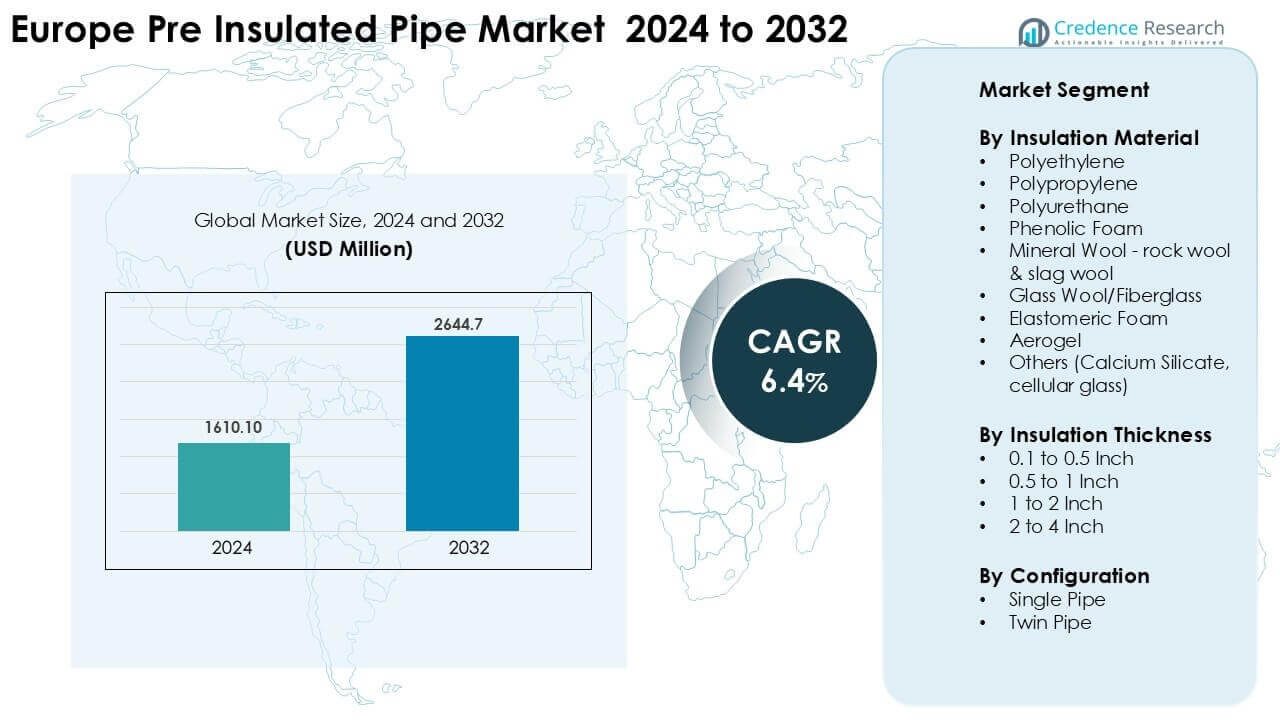
Europe Pre Insulated Pipe Market was valued at USD 1610.10 million in 2024 and is anticipated to reach USD 2644.7 million by 2032, growing at a CAGR of 6.4 % during the forecast period.
| REPORT ATTRIBUTE | DETAILS |
|---|---|
| Historical Period | 2020-2024 |
| Base Year | 2025 |
| Forecast Period | 2026-2032 |
| Europe Pre-Insulated Pipe Market Size 2024 | USD 1610.10 million |
| Europe Pre-Insulated Pipe Market, CAGR | 6.4% |
| Europe Pre-Insulated Pipe Market Size 2032 | USD 2644.7 million |
Europe Pre-Insulated Pipe Market Insights
- Strong expansion of district-heating and cooling systems acts as the main growth driver, with rising upgrades of aging pipelines and wider adoption of renewable-supported heat networks.
- Low-temperature district-heating, digital leak monitoring, and geothermal integration shape the market trend, supporting advanced insulated piping with improved thermal performance.
- The market features active competition among Georg Fischer, Isoplus, Flexalen, Aquatherm, Uponor, Brugg Group, Brugg Pipesystems, CPV Ltd., Durotan, and Insulcon, all focusing on innovation and energy-efficient designs.
- Russia leads the regional landscape with 34% share, followed by Germany at 21%, while the district-heating segment remains dominant due to high network density and ongoing modernization across key European cities.
Europe Pre-Insulated Pipe Market Segmentation Analysis:
By Insulation Material
The insulation material segment in the Europe pre insulated pipe market is dominated by polyurethane, holding around 45% market share. Polyurethane leads due to strong thermal efficiency, low heat loss, and long service life. District heating and cooling networks widely adopt polyurethane-insulated pipes for energy savings. European decarbonization targets further support demand for efficient insulation materials. Polyethylene and polypropylene follow due to flexibility and moisture resistance in small networks. Mineral wool and glass wool maintain niche use in high-temperature systems. Advanced materials like aerogel gain limited traction due to high costs.
- For instance, Logstor’s pre-insulated pipes use rigid polyurethane (PUR) foam that strictly complies with EN 253 standards.
By Insulation Thickness
The insulation thickness segment is led by 1 to 2 inch pipes, accounting for nearly 38% market share. This range balances thermal performance and installation cost. Urban district heating networks prefer this thickness for moderate climate conditions across Europe. Regulatory requirements on heat loss reduction support consistent demand. Thickness of 2 to 4 inch follows, driven by long-distance transmission lines. Thinner ranges, such as 0.1 to 0.5 inch, serve compact building systems. Energy efficiency standards across EU countries continue to influence optimal insulation thickness selection.
- For instance, in many European district heating installations, pre‑insulated pipes with insulation thickness of 1 to 2 inches are specified for networks connecting heat plants to urban substations, often using polyurethane core insulation with overall jacket diameters suited for pipe flow of 50 °C to 120 °C services.
By Configuration
The configuration segment is dominated by twin pipe systems, holding about 54% market share in Europe. Twin pipes lead due to combined supply and return lines within a single casing. This design reduces heat loss, trench width, and installation time. District heating operators favor twin configurations for dense urban areas. Single pipe systems remain relevant in industrial and customized layouts. Expansion of smart city heating projects supports twin pipe adoption. Operational efficiency and lower lifecycle costs remain key drivers for configuration preference across European networks.
Key Growth Drivers
Rising District Heating and Cooling Expansion Across Europe
Europe is witnessing strong growth in district heating and cooling networks as cities transition toward low-carbon energy systems. Governments promote centralized thermal grids to reduce building-level emissions and improve energy efficiency. Nordic and Eastern European countries lead this shift, supported by policies targeting cleaner heat sources such as biomass, geothermal, waste heat recovery, and renewable-powered heat pumps. Pre-insulated pipes play a central role because they minimize thermal losses and support long-distance heat transmission with high reliability. Construction of new residential blocks and modernization of old pipelines in countries like Germany, Poland, Denmark, and the Netherlands boost demand. The replacement of legacy steel networks with advanced bonded pipe systems further drives market expansion. Higher energy prices across the region also accelerate adoption, as utilities seek solutions that lower operating costs and improve long-term system performance.
Strict EU Regulations Promoting Energy Efficiency and Decarbonization
The European Union enforces strong energy-efficiency directives that support the use of pre-insulated pipes in both existing and new heat networks. Policies such as the Energy Efficiency Directive (EED), Renewable Energy Directive (RED III), and Fit for 55 package encourage utilities to adopt low-loss, thermally efficient infrastructure. These regulations push public and private operators to modernize old pipelines and shift to next-generation insulation materials that meet defined thermal-conductivity thresholds. The focus on reducing CO₂ emissions across buildings and industrial facilities strengthens investment in pre-insulated distribution lines. Funding from EU recovery instruments and national climate plans further improves project economics. Cities integrating sustainable heating systems such as low-temperature district networks depend on advanced insulated piping to maintain system efficiency. This regulatory momentum acts as a long-term growth catalyst across residential, commercial, and industrial sectors.
- For instance, In France’s capital, the Paris district heating system comprises more than 500 kilometres of underground pipes supplying heat to roughly one quarter of the city’s buildings; such scale reflects regulatory backing for upgrading legacy systems with improved insulated pipe technologies.
Growing Replacement and Modernization of Aging Infrastructure
Much of Europe’s district-heating infrastructure is over twenty to forty years old, creating significant heat loss, maintenance burdens, and operational inefficiencies. Utilities and municipalities are undertaking large-scale replacement programs to upgrade outdated networks with modern, corrosion-resistant, and better-insulated pipe systems. Pre-insulated pipes featuring polyurethane foam insulation and high-density polyethylene (HDPE) casings provide long service life, lower lifetime operating costs, and reduced leak risks. The push to integrate digital monitoring and leak-detection systems also supports replacement activity. Countries such as the UK, France, Austria, and Sweden are allocating funds to rehabilitate pipelines and extend district-heating coverage to new urban zones. Aging industrial steam networks in chemical, food processing, and manufacturing plants further add to retrofit demand. This modernization cycle supports stable and sustained adoption over the next decade.
Key Trends & Opportunities
Shift Toward Low-Temperature District Heating Networks
Europe is moving from traditional high-temperature district-heating systems to low-temperature and ultra-low-temperature grids to reduce thermal losses and improve energy efficiency. This shift creates strong opportunities for advanced pre-insulated pipes designed for optimized thermal conductivity and flexible installation. Low-temperature networks also enable wider integration of renewables and waste-heat sources, including heat pumps, data-center waste heat, industrial surplus heat, and geothermal energy. As cities target climate-neutrality goals for 2030–2050, such networks require long-distance, high-performance insulated pipelines. Manufacturers are increasingly developing pipes with improved foam bonding, thinner insulation layers, and enhanced barrier properties. This trend is most visible in Denmark, Sweden, Finland, Germany, and the Netherlands, where several new low-temperature pilot zones and community heating systems are being deployed. The opportunity lies in supplying lightweight, efficient, and long-life piping solutions to support this transition.
Growing Use of Smart Monitoring and Digital Pipe Networks
Digitalization is emerging as a major trend, offering strong opportunities for manufacturers providing embedded sensors and remote-monitoring features. Utilities are adopting intelligent pre-insulated pipes that support leak detection, moisture monitoring, and real-time temperature profiling. These systems help operators minimize energy loss, detect faults early, and reduce maintenance expenditure. As heat networks expand across dense urban areas, digital infrastructure becomes essential to reduce operational risks. EU funding frameworks encourage deployment of smart thermal grids integrated with IoT-based diagnostics. Companies are developing pipe systems pre-equipped with conductive wires or fiber-optic cables for better monitoring accuracy. This trend supports premium product demand and allows manufacturers to differentiate through technologically advanced solutions. Increasing digital-readiness in district-heating upgrades across Germany, the UK, Norway, and Central Europe further accelerates market penetration.
- For instance, in Unterhaching, Germany, Geothermie Unterhaching GmbH has integrated a fiber‑optic network alongside its municipal district heating system, enabling continuous fiber‑optic monitoring and remote consumption data collection across all connected households as the system expands toward providing heating access for every residence by 2028.
Rising Adoption in Industrial and Commercial Heat-Distribution Projects
Industrial facilities in chemicals, food processing, paper, and pharmaceuticals are upgrading thermal-distribution systems to improve energy use and meet carbon-reduction standards. Pre-insulated pipes are ideal for steam, chilled water, and process fluids due to low heat loss and long operating life. Commercial complexes, hospitals, universities, and business districts across Europe are expanding centralized heating and cooling networks that rely heavily on insulated pipelines. Opportunities arise from the construction of large mixed-use developments and industrial parks that require reliable thermal distribution. Companies offering customizable pipe diameters, multilayer insulation, and corrosion-resistant materials benefit from this trend. Growing investments in data centers, where waste heat recovery is integrated into district-heating systems, also support adoption of advanced pipe systems.
Key Challenges
High Installation and Project Costs
Pre-insulated pipe systems involve higher upfront costs due to specialized materials, insulation foam, multilayer casings, and professional installation requirements. Large-diameter or complex routing requirements further increase project budgets. Utilities and municipalities sometimes postpone modernization due to capital constraints, especially in small and medium-sized cities. Civil-work costs including trenching, drilling, and reinstatement can exceed the pipe’s material cost itself. Rising prices for polyurethane, HDPE, and steel add pressure on procurement budgets. Although long-term savings are significant, initial investment remains a barrier for wider adoption in regions with limited funding. Cost challenges also impact industrial users, who require customized pipe layouts and additional protective casings. This slows market penetration despite strong regulatory support.
Technical Complexity and Skilled-Labor Shortage
Installation of pre-insulated pipes requires specialized expertise in welding, jointing, foam injection, and leak-detection integration. Europe faces a shortage of skilled installers and certified technicians, increasing project delays and installation costs. Incorrect installation can compromise insulation quality, cause moisture ingress, and reduce pipe longevity. As networks expand and shift toward advanced digital and low-temperature systems, demand for precision installation rises. Limited workforce availability restricts the speed of modernization programs in countries with aging infrastructure. Training programs exist, but scaling them across Europe takes time. Manufacturers must rely on certified partners, which creates operational bottlenecks for large-scale projects.
Regional Analysis
Italy and Spain
Italy and Spain together hold around 14% share of the Europe pre-insulated pipe market in 2024. Both countries are expanding district-heating and cooling networks to improve energy efficiency in dense urban areas. Italy invests heavily in geothermal-supported thermal systems, while Spain focuses on district-cooling integration in commercial zones. Growth is supported by modernization of industrial heat-distribution networks, particularly in food processing, chemicals, and manufacturing. Rising adoption of energy-efficient building standards and EU-supported decarbonization programs accelerate the shift toward insulated piping. These markets continue transitioning from conventional heating toward structured thermal networks.
Germany
Germany accounts for approximately 21% of the regional market, making it one of the largest national contributors. Strong regulatory commitments under the German Heat Act and national decarbonization policies support rapid network modernization. Extensive district-heating upgrades in major cities, combined with large-scale integration of biomass, geothermal, and industrial waste heat, strengthen demand. Germany also has a significant retrofit pipeline due to aging installations. Industrial applications across chemicals, pharmaceuticals, and food processing further boost the need for high-performance insulated pipes. Public funding for climate-friendly heat infrastructure ensures sustained market growth over the forecast period.
United Kingdom
The United Kingdom holds close to 10% share of the Europe market. Growth is driven by rising investment in low-carbon district-heating schemes under national clean-energy mandates. Major urban centers such as London, Manchester, and Birmingham are expanding heat networks to reduce building emissions. The UK also invests in waste-heat recovery from data centers and industrial clusters, increasing the use of pre-insulated pipes for long-distance thermal distribution. Adoption rises in universities, hospitals, and mixed-use commercial developments. Government funding programs under the Green Heat Network Fund (GHNF) support a steady rollout of advanced pipe systems across new and existing projects.
Turkey
Turkey represents around 9% of the Europe pre-insulated pipe market in 2024. Strong district-heating expansion in colder regions, particularly Central Anatolia and Eastern Turkey, drives ongoing demand. Population growth and rapid urban development lead municipalities to adopt modern insulated pipeline systems for efficient heat transportation. Industrial expansion in petrochemicals, textiles, and manufacturing further supports demand for thermally efficient distribution lines. Turkey also invests in geothermal-based heating networks, making it one of Europe’s fastest-growing geothermal users. These initiatives, combined with infrastructure modernization and increasing insulation requirements, strengthen long-term adoption of pre-insulated pipes.
France
France accounts for nearly 12% share of the regional market. The country expands district-heating capacity through renewable-based networks powered by biomass, waste-to-energy plants, and geothermal fields. France’s strong commitment to building-level energy efficiency drives modernization of older heat-distribution grids, especially in Paris, Lyon, and Lille. Industrial applications in chemicals, paper, and pharmaceuticals also increase demand for insulated piping. Government programs supporting carbon-neutral heating systems and urban climate-action plans maintain steady investment. France’s balanced mix of new installations and retrofit projects supports a stable, long-term growth outlook for advanced pre-insulated pipelines.
Russia
Russia holds about 34% of the broader Europe region’s pre-insulated pipe market due to its extensive district-heating networks. Extremely cold climatic conditions require robust, thermally efficient distribution systems across residential, industrial, and municipal grids. Large-scale modernization of old steel pipelines is underway, as Russia seeks to reduce heat losses and improve energy efficiency. The country upgrades urban heating systems in Moscow, St. Petersburg, Kazan, and regional cities, driving significant pipe replacement demand. Industrial facilities in oil refining, petrochemicals, and heavy manufacturing also rely heavily on insulated pipelines. High heating reliance keeps Russia a dominant market contributor.
Europe Pre-Insulated Pipe Market Segmentations:
By Insulation Material
- Polyethylene
- Polypropylene
- Polyurethane
- Phenolic Foam
- Mineral Wool - rock wool & slag wool
- Glass Wool/Fiberglass
- Elastomeric Foam
- Aerogel
- Others (Calcium Silicate, cellular glass)
By Insulation Thickness
- 0.1 to 0.5 Inch
- 0.5 to 1 Inch
- 1 to 2 Inch
- 2 to 4 Inch
By Configuration
- Single Pipe
- Twin Pipe
By Geography
- Italy and Spain
- Germany
- United Kingdom
- Turkey
- France
- Russia
Competitive Landscape
The Europe pre-insulated pipe market features a competitive landscape led by established manufacturers focusing on energy-efficient thermal infrastructure and modernization projects. Key companies such as Georg Fischer, Isoplus, Flexalen, Aquatherm, Uponor, Brugg Group, Brugg Pipesystems, CPV Ltd., Durotan, and Insulcon strengthen their positions through advanced insulation technologies, corrosion-resistant materials, and integrated leak-detection systems. These players invest in research to enhance foam bonding, improve HDPE casing durability, and support low-temperature district-heating applications. Strategic partnerships with utilities, municipalities, and EPC contractors remain central to market expansion. Companies also scale production capacity to meet rising demand from district-heating networks, industrial facilities, and commercial developments. Growing emphasis on digital monitoring, sustainable materials, and lifecycle-cost optimization drives product innovation. The competitive environment continues to evolve as suppliers align with EU energy-efficiency directives and green-heat initiatives.
Key Player Analysis
- Georg Fischer
- Flexalen
- Isoplus
- CPV Ltd.
- Brugg Group
- Insulcon
- Aquatherm
- Uponor
- Durotan
- Brugg Pipesystems
Recent Developments
- In May 2025, Georg Fischer AG showcased its strategic progress in Flow Solutions, including pre-insulated pipes, as part of a combined offering with its Uponor infrastructure business. The company is emphasizing synergies and expanded product integration in European infrastructure market.
- In 2024, The ISOPLUS Group expanded its European footprint by acquiring a French district heating company (SOLICE), strengthening its position in customized pre-insulated piping solutions for district energy networks.
Report Coverage
The research report offers an in-depth analysis based on Insulation Material, Insulation Thickness, Configuration and Geography. It details leading market players, providing an overview of their business, product offerings, investments, revenue streams, and key applications. Additionally, the report includes insights into the competitive environment, SWOT analysis, current market trends, as well as the primary drivers and constraints. Furthermore, it discusses various factors that have driven market expansion in recent years. The report also explores market dynamics, regulatory scenarios, and technological advancements that are shaping the industry. It assesses the impact of external factors and global economic changes on market growth. Lastly, it provides strategic recommendations for new entrants and established companies to navigate the complexities of the market.
Future Outlook
- Demand will rise as European cities expand district-heating and cooling networks to meet decarbonization goals.
- Adoption of low-temperature heat grids will accelerate the need for advanced insulated piping.
- Replacement of aging steel pipelines will remain a major growth driver across urban districts.
- Manufacturers will integrate more digital monitoring and leak-detection systems into next-generation pipe designs.
- Industrial facilities will increase upgrades to improve energy efficiency and reduce heat-loss costs.
- EU climate policies will continue pushing utilities toward thermally efficient pipeline technologies.
- Geothermal, biomass, and waste-heat recovery projects will create new installation opportunities.
- Demand for corrosion-resistant materials and high-density casings will strengthen product innovation.
- Public–private partnerships will support large-scale heating modernization programs across Europe.
- Competition will intensify as suppliers expand regional production and align products with stricter energy-efficiency standards.

Request a Free Sample
Fill in your details and we'll send you a free sample report.
- Sample data tables & charts
- Research methodology
Need a Custom Version of This Report?
Tailor the scope, geography, or segments to your exact requirements.
- Custom geography or segment scope
- Direct access to our analyst team
Frequently Asked Questions
What is the current market size for Europe Pre Insulated Pipe Market, and what is its projected size in 2032?
At what Compound Annual Growth Rate is Europe Pre Insulated Pipe Market projected to grow between 2024 and 2032?
Which Europe Pre Insulated Pipe Market segment held the largest share in 2024?
What are the primary factors fueling the growth of Europe Pre Insulated Pipe Market?
Who are the leading companies in Europe Pre Insulated Pipe Market?
Which region commanded the largest share of Europe Pre Insulated Pipe Market?
Table of Content
Chapter 1 Market Segmentation
- 1.1 Segmentation Framework
- 1.1.1 Product and Service Classification
- 1.1.2 Application and End-Use Classification
- 1.1.3 Technology and Solution Classification
- 1.1.4 Customer and Distribution Channel Classification
- 1.1.5 Geographic Segmentation
- 1.1.6 Market Segment Definitions and Boundaries
Chapter 2 Introduction
- 2.1 Report Objectives and Scope
- 2.2 Product Definition and Industry Terminology
- 2.3 Market Inclusions and Exclusions
- 2.4 Research Process
- 2.4.1 Primary Research and Expert Interviews
- 2.4.2 Secondary Research and Source Review
- 2.4.3 Top-Down and Bottom-Up Estimation
- 2.4.4 Data Triangulation and Verification
- 2.5 Market Size Measurement Basis
- 2.5.1 2024: USD 1610.10 million → 2032: USD 2644.7 million
- 2.6 Historical and Forecast Reference Periods
- 2.6.1 Base Year: 2024
- 2.6.2 Forecast Period: 2024-2032
- 2.7 Research Assumptions and Limitations
Chapter 3 Executive Summary
- 3.1 Market Snapshot and Key Findings
- 3.2 Base-Year Market Size, 2024
- 3.3 Forecast Market Size, 2032
- 3.4 Revenue and Volume Growth Outlook
- 3.5 Key Demand and Supply Indicators
- 3.6 Leading Market Segments
- 3.7 Fastest-Growing Market Opportunities
- 3.8 Regional Performance Highlights
- 3.9 Technology and Industry Transformation
- 3.10 Competitive Landscape Summary
- 3.11 Analyst View and Strategic Implications
Chapter 4 Europe Pre-Insulated Pipe Market Trends and Developments
- 4.1 Historical Industry Development
- 4.2 Recent Market Trends and Developments
- 4.3 Demand and Customer Behavior Trends
- 4.4 Technology and Product Innovation
- 4.5 Artificial Intelligence, Automation and Digitalization
- 4.6 Local Manufacturing and Supply Chain Realignment
- 4.7 Industry Partnerships, Mergers and Acquisitions
- 4.8 Sustainability and Circular Economy Developments
- 4.9 Government and Private Sector Investment Trends
- 4.10 Emerging Business Models and Commercialization
- 4.11 Industry Developments and Announcements
Chapter 5 Europe Pre-Insulated Pipe Market Production, Supply and Demand Analysis
- 5.1 Demand Trend and Consumption Analysis
- 5.2 Demand Forecast, 2024-2032
- 5.3 Production and Output Trend
- 5.4 Production and Output Forecast, 2024-2032
- 5.5 Installed Capacity and Capacity Utilization
- 5.6 Company-Wise Production Plants and Statistics
- 5.6.1 Installed Production Capacity
- 5.6.2 Actual Production
- 5.6.3 Planned Capacity and Expansion Targets
- 5.7 Supply Chain Structure and Procurement Trends
- 5.8 Supply-Demand Gap and Bottlenecks
- 5.9 Import Dependence and Sourcing Structure
- 5.10 Contract Manufacturing and Outsourcing
- 5.11 Regional Supply and Demand Concentration
Chapter 6 Europe Pre-Insulated Pipe Market Pricing Analysis
- 6.1 Pricing Structure and Measurement
- 6.2 Historical Pricing Trends
- 6.3 Pricing Outlook, 2024-2032
- 6.4 Average Selling Price and Unit Economics
- 6.5 Pricing by Product and Market Segment
- 6.6 Geographic Pricing Differences
- 6.7 Key Input, Energy, Labor and Logistics Costs
- 6.8 Contract Pricing and Purchasing Models
- 6.9 Pricing Sensitivity and Competitive Positioning
- 6.10 Price, Margin and Profitability Implications
Chapter 7 Europe Pre-Insulated Pipe Market Dynamics
- 7.1 Market Growth Drivers
- 7.1.1 Demand-Side Drivers
- 7.1.2 Technology and Innovation Drivers
- 7.1.3 Infrastructure and Investment Drivers
- 7.1.4 Regulatory and Policy Drivers
- 7.2 Market Restraints
- 7.2.1 Cost and Affordability Constraints
- 7.2.2 Technology and Adoption Barriers
- 7.2.3 Supply Chain and Operational Constraints
- 7.3 Market Challenges
- 7.3.1 Competitive Pressure and Margin Erosion
- 7.3.2 Skills, Infrastructure and Implementation Gaps
- 7.4 Emerging Market Opportunities
- 7.5 Market Dynamics Impact and Time-Horizon Assessment
Chapter 8 Europe Pre-Insulated Pipe Value Chain Analysis
- 8.1 Industry Value Chain Overview
- 8.2 Upstream Suppliers and Critical Inputs
- 8.3 Technology and Component Providers
- 8.4 Manufacturing or Service Delivery
- 8.5 Distribution, Channel Partners and Integrators
- 8.6 Downstream Applications and End Users
- 8.7 Value Addition and Profit Pools
- 8.8 Vertical Integration and Outsourcing
- 8.9 Supplier Concentration and Risk
- 8.10 Supply Chain Localization and Resilience
Chapter 9 Europe Pre-Insulated Pipe Market Regulations and Policies
- 9.1 Relevant Laws, Standards and Compliance Frameworks
- 9.2 Product, Service, Safety and Quality Requirements
- 9.3 Government Policies, Incentives and Subsidies
- 9.4 Imports, Exports and Trade Barriers
- 9.5 Public Procurement and Local Content Requirements
- 9.6 Environmental and Sustainability Compliance
- 9.7 Upcoming Policy Changes and Market Implications
Chapter 10 Europe Pre-Insulated Pipe Market Hotspots and Opportunities
- 10.1 Market Opportunity Mapping and Growth Hotspots
- 10.2 High-Growth Applications and Customer Groups
- 10.3 Underserved Markets and White-Space Opportunities
- 10.4 Emerging Technology and Product Opportunities
- 10.5 New Capacity and Investment Hotspots
- 10.6 Market Entry and Expansion Opportunities
- 10.7 Distribution and Partnership Opportunities
- 10.8 Near-Term and Long-Term Commercial Potential
- 10.9 Opportunity Attractiveness and Execution Risks
Chapter 11 Europe Pre-Insulated Pipe Market Outlook, 2024-2032
- 11.1 Market Size and Analysis
- 11.1.1 Revenue (Market Measurement: 2024: USD 1610.10 million → 2032: USD 2644.7 million)
- 11.1.2 Market Volume and Quantity Sold
- 11.1.3 Historical Market Size
- 11.1.4 Base-Year Market Size, 2024
- 11.2 Market Forecast, 2024-2032
- 11.2.1 Revenue Forecast to 2032
- 11.2.2 Volume Forecast to 2032
- 11.2.3 CAGR and Year-on-Year Growth
- 11.2.4 Incremental Revenue Opportunity
- 11.3 Forecast Assumptions and Scenario Analysis
- 11.3.1 Base-Case Forecast
- 11.3.2 Optimistic and Conservative Scenarios
- 11.3.3 Technology, Pricing and Policy Sensitivities
- 11.4 Market Attractiveness and Growth Outlook
Chapter 12 Europe Pre-Insulated Pipe Market Segmentation and Outlook
- 12.1 Segmentation Summary and Market Shares, 2024
- 12.2 Largest and Fastest-Growing Segments
- 12.3 Segment Growth Comparison
- 12.4 Segment Attractiveness and Priority Matrix
Chapter 13 Europe Pre-Insulated Pipe Geographic Market Outlook, 2024-2032
- 13.1 Regional Market Size and Country-Level Shares, 2024
- 13.2 Country Market Size Comparison, 2024
- 13.3 Country Market Forecasts, 2024-2032
- 13.4 Subregional Industrial and Demand Clusters
- 13.5 Intra-Regional Pricing and Cost Differences
- 13.6 Cross-Border Trade and Supply Networks
- 13.7 Regional Supply and Demand Balances
- 13.8 Country Opportunity Comparison and Prioritization
Note: Every listed country is covered on the structure shown under the first country.
Chapter 14 Europe Pre-Insulated Pipe Technology, Innovation and Sustainability Outlook
- 14.1 Technology Landscape and Maturity
- 14.2 Product, Process and Service Innovation
- 14.3 AI, Automation and Digital Tools in the Industry
- 14.4 Technology Adoption and Performance Benchmarking
- 14.5 Innovation Pipeline and R&D Investment
- 14.6 Patent and Intellectual Property Trends
- 14.7 Energy Efficiency and Resource Management
- 14.8 Sustainability, Recycling and Circularity
- 14.9 Technology Roadmap, 2024-2032
- 14.10 Risks of Obsolescence and Technology Substitution
Chapter 15 Europe Pre-Insulated Pipe Market Key Strategic Imperatives
- 15.1 Growth and Market Entry Priorities
- 15.2 High-Return Products and Segments
- 15.3 Pricing, Profitability and Cost Optimization
- 15.4 Technology Investment and Product Differentiation
- 15.5 Supply Chain Localization and Resilience
- 15.6 Distribution and Customer Acquisition
- 15.7 Partnership, Acquisition and Capacity Strategy
- 15.8 Regional Expansion Priorities
- 15.9 Short-, Medium- and Long-Term Actions
Chapter 16 Competition Outlook
- 16.1 Industry Competition Characteristics
- 16.2 Market Structure and Concentration
- 16.3 Market Share and Competitive Positioning, 2024
- 16.4 Company-Wise Revenue and Product Benchmarking
- 16.5 Production and Service Capacity Benchmarking
- 16.6 Technology, Pricing and Differentiation
- 16.7 Regional Footprint and Distribution Strength
- 16.8 Mergers, Acquisitions and Strategic Alliances
- 16.9 New Entrants and Competitive Threats
- 16.10 Porter's Five Forces and Industry Attractiveness
- 16.11 Competitive Outlook, 2024-2032
Chapter 17 Company Profiles
- 17.1 Company Coverage and Selection Criteria
- 17.2 Leading Market Participants – Standard Profile Structure
- 17.2.1 Business Description
- 17.2.2 Company Ownership and Geographic Presence
- 17.2.3 Product and Service Portfolio
- 17.2.4 Manufacturing and Operating Footprint
- 17.2.5 Production Capacity and Expansion Plans
- 17.2.6 Financial Performance and Investment
- 17.2.7 Market Share and Competitive Position
- 17.2.8 Technology and Innovation Capabilities
- 17.2.9 Strategic Alliances or Partnerships
- 17.2.10 Recent Developments
- 17.2.11 Growth Strategy and Outlook
- 17.3 Other Relevant Market Participants
Note: Every listed company is profiled on the structure shown under the first company. The company list is preliminary and may change based on research findings, market developments, data availability and client requirements.
Chapter 18 Disclaimer
- 18.1 Research and Forecast Disclaimer
- 18.2 Data Source and Estimation Limitations
Note: The depth of individual sections depends on data availability for this market. Volume, capacity, trade and other unit-based metrics are included where applicable.