Loader Market Overview:
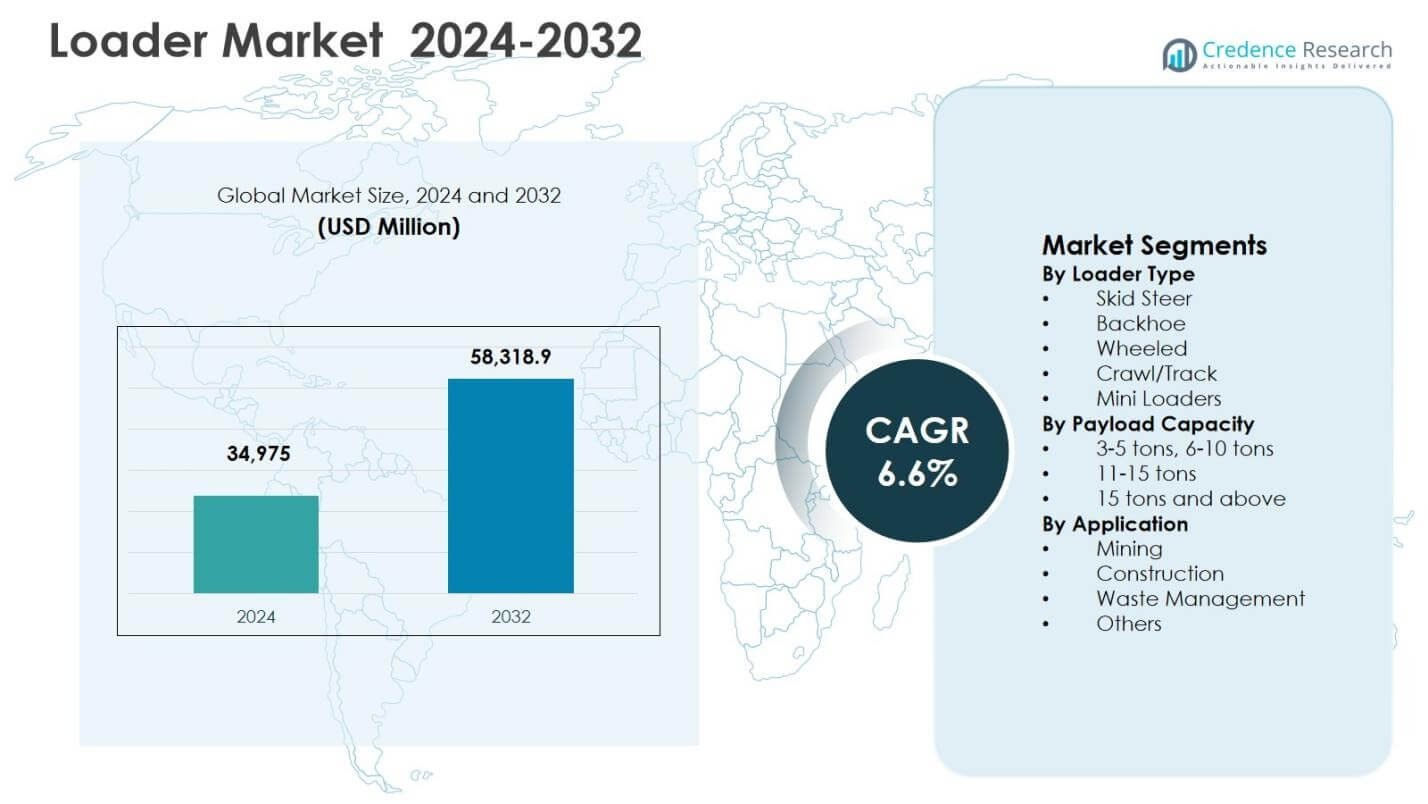
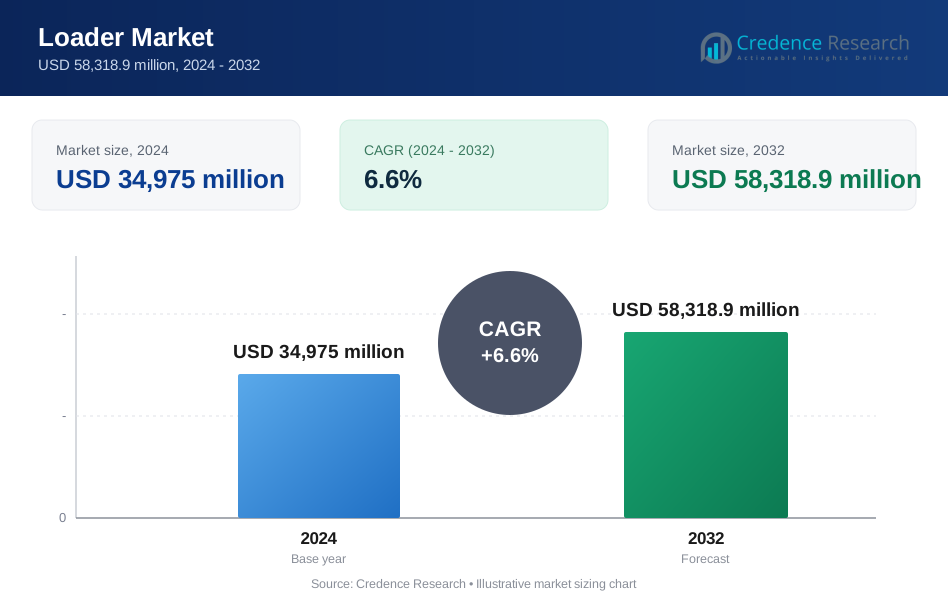
The Loader Market size was valued at USD 34,975 million in 2024 and is anticipated to reach USD 58,318.9 million by 2032, growing at a CAGR of 6.6% during the forecast period.
| REPORT ATTRIBUTE | DETAILS |
|---|---|
| Historical Period | 2020-2023 |
| Base Year | 2024 |
| Forecast Period | 2025-2032 |
| Loader Market Size 2024 | USD 34,975 million |
| Loader Market, CAGR | 6.6% |
| Loader Market Size 2032 | USD 58,318.9 million |
Loader Market Insights
- Market growth is driven by rising infrastructure investments, expanding construction activities, and increasing mechanization across construction, mining, and industrial material-handling operations.
- Key market trends include the integration of telematics, automation, and smart fleet management, along with growing adoption of electric and low-emission loaders to meet sustainability and regulatory requirements.
- The market structure is shaped by global manufacturers focusing on product innovation, payload efficiency, rental models, and aftersales services, with wheeled loaders holding 6% segment share in 2024, followed by the 6–10 tons payload segment with 34.2% share.
- Regionally, Asia Pacific led the Loader Market with 9% share in 2024, followed by North America at 24.6% and Europe at 21.8%, supported by infrastructure development, mining activity, and fleet replacement demand.
Loader Market Segmentation Analysis:
By Loader Type:
In the Loader Market, wheeled loaders emerged as the dominant loader type, accounting for 38.6% market share in 2024, driven by their high load-handling capacity, operational efficiency, and extensive use across large-scale construction and mining projects. Their ability to operate efficiently on paved and uneven surfaces supports demand from infrastructure and urban development activities. Skid steer loaders held 21.4% share, supported by compact design and maneuverability in confined job sites, while backhoe loaders captured 18.9% share due to versatility. Crawl/track loaders and mini loaders jointly accounted for the remaining share, supported by niche applications and urban maintenance needs.
- For instance, Caterpillar's 990 wheel loader in a coal mining operation completes truck loads in just three passes with its custom coal bucket, enhancing productivity through rapid high-capacity loading.
By Payload Capacity:
The 6–10 tons payload capacity segment dominated the Loader Market with a 34.2% share in 2024, supported by balanced performance between lifting capability, fuel efficiency, and equipment cost. This capacity range is widely preferred across construction, mining, and material-handling operations requiring medium-duty loaders with high utilization rates. The 3–5 tons segment followed with 26.8% share, driven by demand from small contractors and municipal applications. Loaders with 11–15 tons capacity accounted for 22.5% share, supported by infrastructure and quarry operations, while loaders with payloads of 15 tons and above held the remaining share, driven by large-scale mining projects.
- For instance, JCB's 433-5 wheeled loader offers a 3.3-ton payload capacity with a 3.1 m³ bucket and 11-ton operating weight, ideal for construction tasks with 210 L fuel tank for extended use.
By Application:
Construction remained the leading application in the Loader Market, accounting for 41.9% market share in 2024, driven by rapid infrastructure development, urban expansion, and rising investments in road, residential, and commercial projects. Loaders are essential for material handling, earthmoving, and site preparation activities, ensuring sustained demand from contractors. Mining followed with 27.6% share, supported by increased mineral extraction and capacity expansions. Waste management applications captured 16.3% share, driven by municipal solid waste handling and recycling operations, while other applications collectively accounted for the remaining share, supported by agriculture and industrial material handling.
Key Growth Drivers
Expanding Infrastructure and Construction Investments
Rising investments in infrastructure development continue to be a primary growth driver for the Loader Market. Governments and private developers are accelerating spending on roads, highways, airports, railways, and urban housing projects, increasing demand for material-handling and earthmoving equipment. Loaders play a critical role in excavation, site preparation, and bulk material movement, making them indispensable across project lifecycles. Large-scale urbanization in emerging economies and renovation activities in mature markets further support sustained equipment utilization. The growing focus on smart cities and industrial corridors is also driving replacement demand for advanced loaders with higher productivity and lower operating costs.
- For instance, Volvo CE tested a remotely controlled L180H wheel loader 1,300 feet underground at Kankberg mine, successfully loading ore into trucks and navigating tunnels via 5G from a surface office. The project demonstrated real-time control for production tasks in harsh environments.
Growth in Mining and Resource Extraction Activities
The expansion of global mining activities significantly supports the Loader Market. Increasing demand for minerals, metals, and aggregates from construction, energy, and manufacturing sectors has resulted in higher mining output and capacity expansions. Loaders are extensively used for ore handling, overburden removal, and material transportation in both surface and underground mining operations. Rising investments in quarrying and mineral processing facilities further strengthen demand. Additionally, the need for robust, high-capacity loaders capable of operating in harsh environments is driving adoption of technologically advanced equipment with improved durability, safety features, and operational efficiency.
- For instance, Komatsu's 4LD underground loader enabled New Horus at Poderosa Mine to boost monthly tonnage by 35%, from 2,560 to 3,456 tons, while cutting maintenance costs 25% to $2.40 per hour.
Mechanization and Equipment Modernization
Growing mechanization across construction, agriculture, and industrial sectors is accelerating loader adoption worldwide. Contractors and operators are increasingly replacing manual labor and outdated machinery with modern loaders to improve productivity, reduce project timelines, and address skilled labor shortages. Fleet modernization initiatives emphasize fuel efficiency, lower emissions, and advanced control systems, driving replacement demand. Enhanced financing options, leasing models, and rental services also make loader procurement more accessible to small and mid-sized operators. This shift toward mechanized operations continues to strengthen long-term growth prospects for the Loader Market.
Key Trends & Opportunities
Integration of Advanced Technologies and Automation
The Loader Market is witnessing increased integration of advanced technologies, creating significant growth opportunities. Manufacturers are incorporating telematics, GPS tracking, automated control systems, and real-time performance monitoring to enhance operational efficiency and fleet management. Automation features improve precision, reduce operator fatigue, and lower maintenance costs, making loaders more attractive to large contractors and mining operators. The growing adoption of data-driven decision-making supports predictive maintenance and optimized equipment utilization. These advancements are also enabling manufacturers to differentiate products, strengthen aftermarket services, and build long-term customer relationships through digital platforms.
- For instance, Caterpillar's VisionLink telematics integrates GPS tracking and performance monitoring across wheel loaders, enabling fleet managers to access real-time location, diagnostics, and health data for proactive decisions.
Rising Demand for Electric and Low-Emission Loaders
The shift toward sustainability is emerging as a key opportunity in the Loader Market. Stricter emission regulations and growing environmental awareness are driving demand for electric, hybrid, and low-emission loaders. These models offer reduced carbon footprints, lower noise levels, and improved energy efficiency, making them suitable for urban construction and indoor applications. Government incentives and green construction initiatives further support adoption. Manufacturers investing in battery technology, alternative powertrains, and energy-efficient designs are well-positioned to capitalize on this trend, particularly in developed markets with strong regulatory frameworks.
- For instance, Volvo's L120 Electric wheel loader, a 20-tonne model, uses a 282 kWh Lithium Iron Phosphate battery for zero exhaust emissions and near-silent operation with a 6-tonne payload.
Key Challenges
High Initial Investment and Operating Costs
High acquisition and operating costs remain a major challenge for the Loader Market. Advanced loaders equipped with modern technologies and higher payload capacities require significant upfront investment, which can limit adoption among small contractors and price-sensitive buyers. In addition, fuel expenses, maintenance requirements, and replacement parts contribute to total cost of ownership. Fluctuations in fuel prices further impact operating budgets. Although financing and rental options partially address this issue, cost considerations continue to influence purchasing decisions and can slow market penetration in developing regions.
Supply Chain Disruptions and Component Availability
Supply chain constraints pose an ongoing challenge for the Loader Market. Dependence on global suppliers for critical components such as engines, hydraulic systems, electronics, and semiconductors exposes manufacturers to production delays and cost volatility. Disruptions caused by geopolitical tensions, logistics bottlenecks, and raw material price fluctuations affect equipment availability and delivery timelines. These challenges increase lead times and can impact project schedules for end users. Managing supplier diversification, inventory levels, and cost pressures remains a critical focus area for manufacturers to maintain stable production and market competitiveness.
Regional Analysis
North America
North America accounted for 24.6% market share in 2024 in the Loader Market, supported by strong construction activity, infrastructure rehabilitation programs, and steady mining operations. The region benefits from high equipment replacement rates and early adoption of technologically advanced loaders with telematics and automation features. Demand remains strong across residential construction, commercial development, and road maintenance projects. The presence of large contractors, well-developed rental networks, and access to financing solutions further support market stability. Growth is also driven by investments in renewable energy projects and aggregate handling, sustaining consistent loader utilization across applications.
Europe
Europe held 21.8% market share in 2024, driven by infrastructure modernization, urban redevelopment, and strict emission regulations encouraging fleet upgrades. Construction activity across transportation networks, energy-efficient buildings, and industrial facilities supports loader demand. The region shows strong adoption of compact and electric loaders, particularly in urban and indoor applications. Mining and quarrying activities in selected countries also contribute to steady equipment demand. Government-backed infrastructure funding, combined with sustainability-focused construction practices, continues to drive replacement demand and supports gradual market expansion across Western and Eastern European economies.
Asia Pacific
Asia Pacific dominated the Loader Market with a 38.9% market share in 2024, supported by rapid urbanization, large-scale infrastructure projects, and expanding mining activities. High demand from countries investing heavily in highways, railways, ports, and housing projects drives extensive loader utilization. Growing mechanization in construction and rising equipment penetration among contractors further strengthen regional demand. Mining and quarrying operations also contribute significantly to volume sales. The availability of cost-competitive manufacturing, improving financing access, and increasing adoption of mid-capacity loaders position Asia Pacific as the primary growth engine of the global market.
Latin America
Latin America captured 7.6% market share in 2024, driven by mining expansion, infrastructure development, and public investment in transportation and utilities. Loaders are widely used in mineral extraction, quarrying, and road construction projects across resource-rich economies. The region benefits from rising demand for efficient material-handling equipment to support large-scale infrastructure initiatives. Although economic volatility affects capital spending, equipment rental services and refurbished machinery sales help sustain demand. Gradual improvements in construction activity and mining output continue to support stable growth in the regional loader market.
Middle East & Africa
The Middle East & Africa accounted for 7.1% market share in 2024, supported by infrastructure expansion, urban development, and mining activities. Large construction projects related to transportation networks, commercial complexes, and industrial zones drive loader demand across the Middle East. In Africa, mining and quarrying remain key application areas, particularly for mineral and aggregate extraction. Government-led development programs and investments in logistics and energy infrastructure support equipment deployment. Demand for durable, high-capacity loaders suited for harsh operating environments continues to shape purchasing decisions across the region.
Loader Market Segmentations:
By Loader Type
- Skid Steer
- Backhoe
- Wheeled
- Crawl/Track
- Mini Loaders
By Payload Capacity
- 3-5 tons, 6-10 tons
- 11-15 tons
- 15 tons and above
By Application
- Mining
- Construction
- Waste Management
- Others
By Geography
- North America
- U.S.
- Canada
- Mexico
- Europe
- Germany
- France
- U.K.
- Italy
- Spain
- Rest of Europe
- Asia Pacific
- China
- Japan
- India
- South Korea
- South-east Asia
- Rest of Asia Pacific
- Latin America
- Brazil
- Argentina
- Rest of Latin America
- Middle East & Africa
- GCC Countries
- South Africa
- Rest of the Middle East and Africa
Competitive Landscape
Competitive landscape in the Loader Market is shaped by the presence of major global manufacturers including Caterpillar Inc., Komatsu Ltd., Volvo Construction Equipment AB, John Deere (Deere & Company), JCB (J.C. Bamford Excavators Ltd), Hitachi Construction Machinery Co., Ltd., Liebherr Group, CNH Industrial N.V., Doosan Bobcat Inc., and Hyundai Heavy Industries Co., Ltd.. The market remains moderately consolidated, with leading players focusing on product innovation, fleet modernization, and geographic expansion to strengthen market positions. Companies invest heavily in advanced technologies such as telematics, automation, and fuel-efficient powertrains to enhance productivity and reduce operating costs. Strategic initiatives including capacity expansions, localized manufacturing, and strengthened dealer networks support regional penetration. Additionally, growing emphasis on electric and low-emission loaders is reshaping product portfolios, while aftersales services, financing solutions, and rental partnerships are increasingly used as differentiation strategies to retain customers and drive long-term revenue growth.
Key Player Analysis
- Liebherr Group
- Hyundai Heavy Industries Co., Ltd.
- John Deere (Deere & Company)
- Komatsu Ltd.
- CNH Industrial N.V.
- Doosan Bobcat Inc.
- JCB (J.C. Bamford Excavators Ltd)
- Volvo Construction Equipment AB
- Hitachi Construction Machinery Co., Ltd.
- Caterpillar Inc.
Recent Developments
- In December 2025, Volvo Construction Equipment delivered Indonesia’s first L120 electric wheel loader, marking the initial commercial deployment of this electric model in the country.
- In December 2025, Action Construction Equipment (ACE) partnered with Kotak Mahindra Bank to improve financing frameworks for backhoe loader and construction equipment customers in India.
- In January 2025, JCB India launched its CEV Stage 5 ready machines, including Backhoe Loaders, Skid Steer Loaders, and Wheeled Loaders, at the Bharat Construction Equipment Expo 2025.
- In July 2025, Caterpillar launched the new Cat® 980 GC Wheel Loader, featuring low fuel consumption through an on-demand fan and load-sensing hydraulics.
Report Coverage
The research report offers an in-depth analysis based on Loader Type, Payload Capacity, Application and Geography. It details leading market players, providing an overview of their business, product offerings, investments, revenue streams, and key applications. Additionally, the report includes insights into the competitive environment, SWOT analysis, current market trends, as well as the primary drivers and constraints. Furthermore, it discusses various factors that have driven market expansion in recent years. The report also explores market dynamics, regulatory scenarios, and technological advancements that are shaping the industry. It assesses the impact of external factors and global economic changes on market growth. Lastly, it provides strategic recommendations for new entrants and established companies to navigate the complexities of the market.
Future Outlook
- Loader Market demand will continue to rise due to sustained investments in infrastructure, urban development, and transportation projects across major economies.
- Increasing mechanization in construction, mining, and industrial material handling will support steady equipment adoption.
- Technological advancements such as telematics, automation, and smart fleet management will improve operational efficiency and equipment utilization.
- Electric and low-emission loaders will gain traction as emission regulations tighten and sustainability initiatives expand.
- Growth of equipment rental and leasing models will improve accessibility for small and mid-sized contractors.
- Mining and quarrying activities will remain a stable source of demand, particularly for high-capacity loaders.
- Manufacturers will focus on product customization to address diverse application requirements and operating conditions.
- Expansion of dealer networks and aftersales services will strengthen customer retention and lifecycle revenues.
- Emerging economies will contribute significantly to volume growth due to rapid urbanization and infrastructure expansion.
- Digitalization of construction workflows will increase demand for connected loaders integrated with data-driven project management systems.
Request a Free Sample
Fill in your details and we'll send you a free sample report.
- Sample data tables & charts
- Research methodology
Need a Custom Version of This Report?
Tailor the scope, geography, or segments to your exact requirements.
- Custom geography or segment scope
- Direct access to our analyst team
Frequently Asked Questions
What is the current market size for the Loader Market, and what is its projected size in 2032?
At what Compound Annual Growth Rate is the Loader Market projected to grow between 2024 and 2032?
Which Loader Market segment held the largest share in 2024?
What are the primary factors fueling the growth of the Loader Market?
Who are the leading companies in the Loader Market?
Which region commanded the largest share of the Loader Market in 2024?
Table of Content
Chapter 1 Market Segmentation
- 1.1 Segmentation Framework
- 1.1.1 Product and Service Classification
- 1.1.2 Application and End-Use Classification
- 1.1.3 Technology and Solution Classification
- 1.1.4 Customer and Distribution Channel Classification
- 1.1.5 Geographic Segmentation
- 1.1.6 Market Segment Definitions and Boundaries
Chapter 2 Introduction
- 2.1 Report Objectives and Scope
- 2.2 Product Definition and Industry Terminology
- 2.3 Market Inclusions and Exclusions
- 2.4 Research Process
- 2.4.1 Primary Research and Expert Interviews
- 2.4.2 Secondary Research and Source Review
- 2.4.3 Top-Down and Bottom-Up Estimation
- 2.4.4 Data Triangulation and Verification
- 2.5 Market Size Measurement Basis
- 2.5.1 2024: USD 34,975 million → 2032: USD 58,318.9 million
- 2.6 Historical and Forecast Reference Periods
- 2.6.1 Base Year: 2024
- 2.6.2 Forecast Period: 2024-2032
- 2.7 Research Assumptions and Limitations
Chapter 3 Executive Summary
- 3.1 Market Snapshot and Key Findings
- 3.2 Base-Year Market Size, 2024
- 3.3 Forecast Market Size, 2032
- 3.4 Revenue and Volume Growth Outlook
- 3.5 Key Demand and Supply Indicators
- 3.6 Leading Market Segments
- 3.7 Fastest-Growing Market Opportunities
- 3.8 Regional Performance Highlights
- 3.9 Technology and Industry Transformation
- 3.10 Competitive Landscape Summary
- 3.11 Analyst View and Strategic Implications
Chapter 4 Global Loader Market Trends and Developments
- 4.1 Historical Industry Development
- 4.2 Recent Market Trends and Developments
- 4.3 Demand and Customer Behavior Trends
- 4.4 Technology and Product Innovation
- 4.5 Artificial Intelligence, Automation and Digitalization
- 4.6 Local Manufacturing and Supply Chain Realignment
- 4.7 Industry Partnerships, Mergers and Acquisitions
- 4.8 Sustainability and Circular Economy Developments
- 4.9 Government and Private Sector Investment Trends
- 4.10 Emerging Business Models and Commercialization
- 4.11 Industry Developments and Announcements
Chapter 5 Global Loader Market Production, Supply and Demand Analysis
- 5.1 Demand Trend and Consumption Analysis
- 5.2 Demand Forecast, 2024-2032
- 5.3 Production and Output Trend
- 5.4 Production and Output Forecast, 2024-2032
- 5.5 Installed Capacity and Capacity Utilization
- 5.6 Company-Wise Production Plants and Statistics
- 5.6.1 Installed Production Capacity
- 5.6.2 Actual Production
- 5.6.3 Planned Capacity and Expansion Targets
- 5.7 Supply Chain Structure and Procurement Trends
- 5.8 Supply-Demand Gap and Bottlenecks
- 5.9 Import Dependence and Sourcing Structure
- 5.10 Contract Manufacturing and Outsourcing
- 5.11 Regional Supply and Demand Concentration
Chapter 6 Global Loader Market Pricing Analysis
- 6.1 Pricing Structure and Measurement
- 6.2 Historical Pricing Trends
- 6.3 Pricing Outlook, 2024-2032
- 6.4 Average Selling Price and Unit Economics
- 6.5 Pricing by Product and Market Segment
- 6.6 Geographic Pricing Differences
- 6.7 Key Input, Energy, Labor and Logistics Costs
- 6.8 Contract Pricing and Purchasing Models
- 6.9 Pricing Sensitivity and Competitive Positioning
- 6.10 Price, Margin and Profitability Implications
Chapter 7 Global Loader Market Dynamics
- 7.1 Market Growth Drivers
- 7.1.1 Demand-Side Drivers
- 7.1.2 Technology and Innovation Drivers
- 7.1.3 Infrastructure and Investment Drivers
- 7.1.4 Regulatory and Policy Drivers
- 7.2 Market Restraints
- 7.2.1 Cost and Affordability Constraints
- 7.2.2 Technology and Adoption Barriers
- 7.2.3 Supply Chain and Operational Constraints
- 7.3 Market Challenges
- 7.3.1 Competitive Pressure and Margin Erosion
- 7.3.2 Skills, Infrastructure and Implementation Gaps
- 7.4 Emerging Market Opportunities
- 7.5 Market Dynamics Impact and Time-Horizon Assessment
Chapter 8 Global Loader Value Chain Analysis
- 8.1 Industry Value Chain Overview
- 8.2 Upstream Suppliers and Critical Inputs
- 8.3 Technology and Component Providers
- 8.4 Manufacturing or Service Delivery
- 8.5 Distribution, Channel Partners and Integrators
- 8.6 Downstream Applications and End Users
- 8.7 Value Addition and Profit Pools
- 8.8 Vertical Integration and Outsourcing
- 8.9 Supplier Concentration and Risk
- 8.10 Supply Chain Localization and Resilience
Chapter 9 Global Loader Market Regulations and Policies
- 9.1 Relevant Laws, Standards and Compliance Frameworks
- 9.2 Product, Service, Safety and Quality Requirements
- 9.3 Government Policies, Incentives and Subsidies
- 9.4 Imports, Exports and Trade Barriers
- 9.5 Public Procurement and Local Content Requirements
- 9.6 Environmental and Sustainability Compliance
- 9.7 Upcoming Policy Changes and Market Implications
Chapter 10 Global Loader Market Hotspots and Opportunities
- 10.1 Market Opportunity Mapping and Growth Hotspots
- 10.2 High-Growth Applications and Customer Groups
- 10.3 Underserved Markets and White-Space Opportunities
- 10.4 Emerging Technology and Product Opportunities
- 10.5 New Capacity and Investment Hotspots
- 10.6 Market Entry and Expansion Opportunities
- 10.7 Distribution and Partnership Opportunities
- 10.8 Near-Term and Long-Term Commercial Potential
- 10.9 Opportunity Attractiveness and Execution Risks
Chapter 11 Global Loader Market Outlook, 2024-2032
- 11.1 Market Size and Analysis
- 11.1.1 Revenue (Market Measurement: 2024: USD 34,975 million → 2032: USD 58,318.9 million)
- 11.1.2 Market Volume and Quantity Sold
- 11.1.3 Historical Market Size
- 11.1.4 Base-Year Market Size, 2024
- 11.2 Market Forecast, 2024-2032
- 11.2.1 Revenue Forecast to 2032
- 11.2.2 Volume Forecast to 2032
- 11.2.3 CAGR and Year-on-Year Growth
- 11.2.4 Incremental Revenue Opportunity
- 11.3 Forecast Assumptions and Scenario Analysis
- 11.3.1 Base-Case Forecast
- 11.3.2 Optimistic and Conservative Scenarios
- 11.3.3 Technology, Pricing and Policy Sensitivities
- 11.4 Market Attractiveness and Growth Outlook
Chapter 12 Global Loader Market Segmentation and Outlook
- 12.1 Segmentation Summary and Market Shares, 2024
- 12.2 Largest and Fastest-Growing Segments
- 12.3 Segment Growth Comparison
- 12.4 Segment Attractiveness and Priority Matrix
Chapter 13 Global Loader Geographic Market Outlook, 2024-2032
- 13.1 Regional Market Size and Share, 2024
- 13.2 Regional Market Forecast, 2024-2032
- 13.3 Regional Pricing, Production and Demand Differences
- 13.4 North America
- 13.4.1 United States
- 13.4.2 Canada
- 13.4.3 Mexico
- 13.5 Europe
- 13.5.1 Germany
- 13.5.2 France
- 13.5.3 Italy
- 13.5.4 United Kingdom
- 13.5.5 Spain
- 13.5.6 Poland
- 13.5.7 Russia
- 13.5.8 Netherlands
- 13.5.9 Belgium
- 13.5.10 Sweden
- 13.5.11 Denmark
- 13.5.12 Norway
- 13.5.13 Rest of Europe
- 13.6 Asia Pacific
- 13.6.1 China
- 13.6.2 India
- 13.6.3 Japan
- 13.6.4 South Korea
- 13.6.5 Thailand
- 13.6.6 Indonesia
- 13.6.7 Vietnam
- 13.6.8 Malaysia
- 13.6.9 Australia
- 13.6.10 Rest of Asia Pacific
- 13.7 Latin America
- 13.7.1 Brazil
- 13.7.2 Argentina
- 13.7.3 Colombia
- 13.7.4 Chile
- 13.7.5 Rest of Latin America
- 13.8 Middle East
- 13.8.1 Saudi Arabia
- 13.8.2 United Arab Emirates
- 13.8.3 Turkey
- 13.8.4 Israel
- 13.8.5 Iran
- 13.8.6 Rest of the Middle East
- 13.9 Africa
- 13.9.1 South Africa
- 13.9.2 Egypt
- 13.9.3 Nigeria
- 13.9.4 Morocco
- 13.9.5 Rest of Africa
- 13.10 Regional Investment, Policy and Supply Chain Differences
- 13.11 Regional Competitive Landscape
- 13.12 Geographic Growth Hotspots
Chapter 14 Global Loader Technology, Innovation and Sustainability Outlook
- 14.1 Technology Landscape and Maturity
- 14.2 Product, Process and Service Innovation
- 14.3 AI, Automation and Digital Tools in the Industry
- 14.4 Technology Adoption and Performance Benchmarking
- 14.5 Innovation Pipeline and R&D Investment
- 14.6 Patent and Intellectual Property Trends
- 14.7 Energy Efficiency and Resource Management
- 14.8 Sustainability, Recycling and Circularity
- 14.9 Technology Roadmap, 2024-2032
- 14.10 Risks of Obsolescence and Technology Substitution
Chapter 15 Global Loader Market Key Strategic Imperatives
- 15.1 Growth and Market Entry Priorities
- 15.2 High-Return Products and Segments
- 15.3 Pricing, Profitability and Cost Optimization
- 15.4 Technology Investment and Product Differentiation
- 15.5 Supply Chain Localization and Resilience
- 15.6 Distribution and Customer Acquisition
- 15.7 Partnership, Acquisition and Capacity Strategy
- 15.8 Regional Expansion Priorities
- 15.9 Short-, Medium- and Long-Term Actions
Chapter 16 Competition Outlook
- 16.1 Industry Competition Characteristics
- 16.2 Market Structure and Concentration
- 16.3 Market Share and Competitive Positioning, 2024
- 16.4 Company-Wise Revenue and Product Benchmarking
- 16.5 Production and Service Capacity Benchmarking
- 16.6 Technology, Pricing and Differentiation
- 16.7 Regional Footprint and Distribution Strength
- 16.8 Mergers, Acquisitions and Strategic Alliances
- 16.9 New Entrants and Competitive Threats
- 16.10 Porter's Five Forces and Industry Attractiveness
- 16.11 Competitive Outlook, 2024-2032
Chapter 17 Company Profiles
- 17.1 Company Coverage and Selection Criteria
- 17.2 Leading Market Participants – Standard Profile Structure
- 17.2.1 Business Description
- 17.2.2 Company Ownership and Geographic Presence
- 17.2.3 Product and Service Portfolio
- 17.2.4 Manufacturing and Operating Footprint
- 17.2.5 Production Capacity and Expansion Plans
- 17.2.6 Financial Performance and Investment
- 17.2.7 Market Share and Competitive Position
- 17.2.8 Technology and Innovation Capabilities
- 17.2.9 Strategic Alliances or Partnerships
- 17.2.10 Recent Developments
- 17.2.11 Growth Strategy and Outlook
- 17.3 Other Relevant Market Participants
Note: Every listed company is profiled on the structure shown under the first company. The company list is preliminary and may change based on research findings, market developments, data availability and client requirements.
Chapter 18 Disclaimer
- 18.1 Research and Forecast Disclaimer
- 18.2 Data Source and Estimation Limitations
Note: The depth of individual sections depends on data availability for this market. Volume, capacity, trade and other unit-based metrics are included where applicable.