
| REPORT ATTRIBUTE | DETAILS |
|---|---|
| Historical Period | 2019-2022 |
| Base Year | 2023 |
| Forecast Period | 2024-2032 |
| Indonesia Interior Fit Out Market Size 2023 | USD 367.18 million |
| Indonesia Interior Fit Out Market, CAGR | 6.10% |
| Indonesia Interior Fit Out Market Size 2032 | USD 627.00 million |
Market Overview
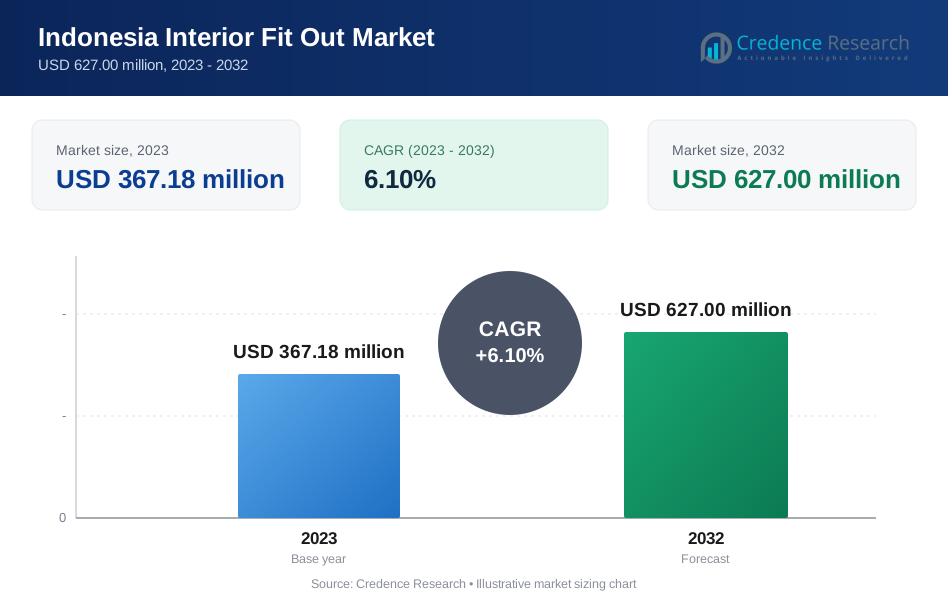
The Indonesia Interior Fit Out Market is projected to grow from USD 367.18 million in 2023 to an estimated USD 627.00 million by 2032, with a compound annual growth rate (CAGR) of 6.10% from 2024 to 2032. This growth is attributed to the increasing demand for high-quality, functional, and aesthetically pleasing interior spaces driven by a booming construction sector, urbanization, and rising disposable incomes in Indonesia.
Market drivers include the rapid urbanization and expansion of commercial spaces, such as offices, retail outlets, and hospitality venues, which require advanced fit-out solutions. Trends such as the integration of technology into interior designs and sustainable, eco-friendly materials are further shaping the market. The preference for custom-made and modular solutions, as well as the rise in renovation projects, are fueling market growth. Additionally, the growing demand for office spaces that promote employee well-being and productivity is playing a key role in the market’s evolution.
Geographically, Indonesia dominates the Southeast Asian region in terms of market share, owing to its large population and thriving economic sectors. Major urban centers like Jakarta, Surabaya, and Bali are key drivers of the interior fit-out market, with a concentration of both residential and commercial projects. Key players in the market include major fit-out companies such as PT. Trimuda Griya, PT. Cipta Guna Graha, and international players like JLL and Turner & Townsend, all contributing to the dynamic competitive landscape.
Market Insights
- The Indonesia Interior Fit Out Market is projected to grow from USD 367.18 million in 2023 to USD 627.00 million by 2032, with a CAGR of 6.10% from 2024 to 2032.
- Rapid urbanization, expansion of commercial spaces, and increasing demand for modern, functional, and sustainable interiors are major factors fueling market growth.
- The rising demand for smart and tech-enabled interior solutions, such as automated lighting and climate control, is shaping the market’s evolution.
- Consumers and businesses are prioritizing eco-friendly materials and energy-efficient designs, driving growth in the sustainable interior fit-out sector.
- Java, especially Jakarta, is the dominant region, followed by Bali, with strong demand for residential, commercial, and hospitality fit-outs.
- Supply chain disruptions, material price volatility, and a shortage of skilled labor pose challenges to the market’s growth and project timelines.
- The market is highly competitive, with both global players like Gensler and local firms offering diverse fit-out services catering to various sectors.
Market Drivers
Rapid Urbanization and Growing Construction Sector
Indonesia’s urban population is steadily increasing, now at approximately 58.57% as of 2023, with many moving to urban areas for better employment and living standards. This shift has led to a significant rise in demand for residential and commercial spaces. The construction sector is booming, evidenced by large-scale developments like the Jakarta-Bandung high-speed rail line, which modernizes transportation and stimulates further urban growth. The Indonesian government has committed around USD 500 billion to enhance urban infrastructure over the next five years, creating numerous opportunities for interior fit-out services as newly constructed buildings require tailored solutions. As the demand for high-quality, functional interior spaces rises alongside construction activity, interior fit-out companies are well-positioned to cater to these needs, focusing on modern design and comfort in their offerings.
Rising Disposable Income and Consumer Demand for Premium Interiors
With Indonesia’s growing economy, disposable incomes are increasing, particularly among the middle and upper-middle-class segments. This demographic is increasingly inclined to invest in premium and customized interiors for both living and working environments. In 2023, urban households allocated nearly 30% of their monthly income to modern retail purchases, reflecting a trend toward enhancing their spaces. Businesses are prioritizing employee well-being by investing in superior fit-out solutions that promote productivity and comfort. Additionally, the expanding hospitality industry has fueled demand for luxurious interior fit-outs in hotels and resorts. As consumers seek aesthetically pleasing and functional environments, interior fit-out services have become essential in meeting expectations and industry standards, driving market growth further.
Technological Advancements and Smart Solutions in Interior Fit Outs
The increasing integration of technology in interior design significantly drives the Indonesia Interior Fit Out Market. Advanced technologies such as smart lighting systems, automated climate control, and IoT devices are gaining traction, especially in office spaces and hospitality sectors. Events like the Philips Smart LED Interior Design & Architect Gathering showcase innovations that enhance functionality and energy efficiency while improving user experience. As demand for modern tech-enabled interiors grows exponentially, companies are seeking fit-out solutions that incorporate these advancements to meet connectivity needs in today’s fast-paced world. Moreover, augmented reality (AR) and virtual reality (VR) are transforming how designs are conceptualized and presented, making it easier for clients to visualize their ideal spaces. As these technologies become more accessible, their adoption is expected to continue driving market growth.
Sustainability and Green Building Practices
Sustainability has emerged as a key focus within the interior fit-out industry due to rising consumer awareness of environmental impacts. There is an increasing demand for eco-friendly solutions that prioritize sustainable materials and energy-efficient designs. For instance, low-emission paints, sustainable flooring materials, and energy-efficient lighting are becoming standard choices among consumers and businesses alike. The Indonesian government has introduced policies encouraging sustainable construction practices, further boosting the demand for green interior fit-outs. Companies specializing in sustainable design are experiencing increased interest as they offer solutions that align with both aesthetic needs and environmental goals. This trend not only enhances business reputations but also aligns with international sustainability standards increasingly demanded by global companies operating in Indonesia. As the market shifts toward more sustainable practices, interior fit-out firms are expected to innovate continuously to deliver environmentally conscious designs that meet evolving consumer expectations.
Market Trends
Shift Towards Sustainable and Green Design Practices
Sustainability has become a central focus within the interior fit-out industry in Indonesia, with a growing emphasis on reducing environmental impact through the use of eco-friendly materials and energy-efficient solutions. Increasingly, both consumers and businesses are prioritizing sustainable interior design as they seek to minimize their carbon footprints and comply with environmentally conscious regulations. The trend towards green design includes the use of materials such as reclaimed wood, bamboo, low-VOC (volatile organic compounds) paints, and recycled products in interior fit-outs. For instance, designers are now opting for reclaimed wood and bamboo, which not only reduce environmental impact but also enhance indoor air quality. Additionally, many projects are integrating energy-efficient solutions such as LED lighting and smart HVAC systems to minimize energy consumption. This trend aligns with the growing consumer demand for spaces that reflect environmental responsibility and contribute to healthier living conditions, as evidenced by the rising number of projects pursuing green building certifications like LEED in Indonesia. Moreover, the incorporation of biophilic design elements, such as indoor plants and natural light, is becoming a standard practice in both residential and commercial interiors.
Integration of Smart and Tech-Enabled Solutions
Technological advancements are reshaping the interior fit-out market in Indonesia, with a significant rise in demand for smart and tech-enabled interiors. The integration of cutting-edge technology, such as Internet of Things (IoT) devices, automated systems, and smart appliances, is becoming a key aspect of interior design, particularly in commercial spaces and luxury residential projects. Businesses are increasingly adopting smart office solutions that improve productivity, security, and employee well-being.For instance, smart lighting systems that adjust based on occupancy and natural light levels are being widely implemented to enhance energy efficiency. Additionally, automated climate control systems allow users to maintain optimal comfort levels while reducing energy consumption. In residential settings, home automation systems enable users to control lighting, temperature, security, and entertainment from a single platform. As urban centers like Jakarta see rapid technological growth, demand for smart interior fit-outs that enhance efficiency continues to rise. Furthermore, the growing importance of digital connectivity in office spaces supports the need for integrated tech solutions that cater to hybrid work models.
Focus on Health and Wellness in Interior Design
Health and wellness have emerged as critical considerations in interior design, especially for workplaces and residential properties. The modern consumer is increasingly concerned with the impact of their environment on their physical and mental well-being. This trend has led to the incorporation of design elements that promote health, comfort, and productivity within interior fit-outs.For instance, businesses are adopting designs that prioritize employee well-being by focusing on elements such as natural lighting and air quality. Features like ergonomic furniture and biophilic design—integrating nature into interiors—are becoming prevalent in office fit-outs to create healthier work environments. In residential interiors, there is a focus on creating spaces that foster relaxation using non-toxic finishes and designs that promote airflow. The COVID-19 pandemic has accelerated this trend as people have become more aware of their environments' importance in maintaining overall health. Consequently, interior fit-out companies are increasingly focusing on health-conscious designs that cater to both commercial and residential spaces.
Rise of Flexible and Modular Interior Solutions
Flexibility and adaptability are key trends in the Indonesia Interior Fit Out Market in response to changing consumer preferences and the rise of hybrid work models. The demand for flexible interiors is growing as businesses seek spaces that can easily be reconfigured to accommodate evolving needs. In the commercial sector, companies are opting for modular designs that allow for flexible layouts.For instance, movable partitions and modular furniture enable easy adjustments to workspaces as requirements change. This flexibility not only enhances collaboration but also supports various work styles within offices. As companies embrace hybrid work models, multifunctional office spaces that can serve multiple purposes—such as meetings or socialization—are becoming increasingly important. In residential sectors, modular design is gaining popularity due to space optimization needs in urban areas where space is limited. Modular interiors allow homeowners to create personalized living spaces that meet unique needs efficiently. The growing emphasis on flexibility reflects broader shifts in how spaces are utilized in Indonesia's interior fit-out market.
Market Challenges
Supply Chain and Material Sourcing Issues
One of the primary challenges facing the Indonesia Interior Fit Out Market is the volatility and disruption in supply chains, particularly related to the sourcing of high-quality materials. A recent report indicated that approximately 80% of manufacturers in Southeast Asia have experienced supply chain disruptions affecting their production schedules, which is particularly evident in Indonesia where delays in material delivery have become commonplace. The global supply chain issues, exacerbated by the COVID-19 pandemic and geopolitical tensions, have led to delays and cost increases in the procurement of essential materials such as steel, timber, glass, and specialized finishes. Local manufacturers often face challenges in obtaining these materials in a timely manner, impacting overall project timelines. Additionally, there is a reliance on imported goods for certain premium materials, leading to dependency on foreign markets. Fluctuating prices for raw materials, especially in the wake of global inflationary pressures, complicate cost management and competitive pricing. These disruptions not only increase project costs but also lead to potential delays that can affect client satisfaction and long-term business relationships. To mitigate these risks, businesses must invest in robust supply chain management strategies and explore local sourcing options wherever possible.
Skilled Labor Shortage and Training Deficits
Another significant challenge in the Indonesia Interior Fit Out Market is the shortage of skilled labor. The demand for qualified professionals such as interior designers, project managers, and skilled technicians is growing; however, there is a notable gap between market requirements and the available workforce. Projections suggest that Indonesia could face a shortfall of around 10 million skilled workers by 2025. While there is an increasing number of new graduates from design and architecture programs, many lack the practical experience required to execute complex interior fit-out projects effectively. Additionally, the rapid pace of technological advancement in the industry—such as the integration of smart solutions and sustainable design practices—demands ongoing training for workers. Many local interior fit-out companies struggle to find workers equipped with necessary technical skills and certifications, making it harder to meet high client standards. To address this challenge, companies must invest in workforce development initiatives, partnerships with educational institutions, and in-house training programs to upskill their labor force and ensure quality and efficiency in their projects.
Market Opportunities
Expansion of Commercial and Residential Projects
The ongoing urbanization and robust construction sector in Indonesia provide a significant opportunity for the interior fit-out market. Major cities like Jakarta and Surabaya are witnessing a surge in the development of office buildings, retail outlets, hospitality venues, and residential complexes. This growth is driven by the influx of people into urban areas, increasing the demand for both commercial and residential spaces. For instance, the Jakarta-Bandung High-Speed Rail project is enhancing connectivity between these urban centers, prompting further development of modern living and working environments. Additionally, as of 2024, over 339 buildings in Jakarta have complied with green building codes, indicating a commitment to sustainable practices amid rapid urban growth. The rise of the middle class and increasing disposable income are also fueling demand for premium interior designs. Homeowners are investing in high-quality interiors for enhanced comfort, while businesses focus on creating functional and aesthetically appealing office spaces to promote productivity. This ongoing expansion creates a steady pipeline of projects that interior fit-out companies can capitalize on to secure high-value contracts.
Adoption of Sustainable and Green Design Practices
There is a burgeoning market for interior fit-out companies in Indonesia that specialize in sustainable and eco-friendly solutions. As environmental awareness rises, both consumers and businesses prioritize energy-efficient designs. The Indonesian government's commitment to green building initiatives has led to increased demand for eco-friendly materials and energy-efficient systems. For example, the National Roadmap for Green Building Implementation launched in October 2024 aims to decarbonize the building sector, which significantly contributes to greenhouse gas emissions. This initiative has already resulted in over 180 certified green projects covering approximately 6.1 million square meters. Furthermore, the EDGE certification program is gaining traction, focusing on reducing energy and water consumption in buildings. Companies that offer innovative sustainable fit-out solutions—such as reclaimed materials and non-toxic finishes—are well-positioned to benefit from this trend. The growing emphasis on sustainability not only aligns with consumer preferences but also presents substantial opportunities for companies committed to eco-conscious practices in their projects.
Market Segmentation Analysis
By Type
The Indonesia Interior Fit Out Market is segmented into three key types: Construction & Installation, Design & Consulting, and Others. The Construction & Installation segment focuses on the physical implementation of interior fit-out solutions, including structural work, installations, and furnishings integration, and accounts for a significant portion of the market as demand for high-quality spaces rises. The Design & Consulting segment has seen an increase in demand, particularly in commercial and luxury residential projects, with interior designers and consultants helping create functional, aesthetically pleasing, and efficient spaces. Lastly, the Others segment includes additional services such as project management, custom furniture manufacturing, and post-installation services, catering to businesses seeking more integrated solutions, and continues to grow as the market diversifies.
By Budget
The Indonesia Interior Fit Out Market is segmented by budget and end user. The low-budget segment focuses on cost-effective solutions for small businesses and residential projects, prioritizing functionality over luxury with affordable materials. The mid-range segment balances quality and cost, catering to Indonesia’s growing middle class seeking modern, durable fit-outs without the highest price tags, featuring good-quality finishes. The high-end luxury segment targets affluent consumers and premium businesses, offering custom designs, superior materials, and advanced technology for upscale offices, hotels, and residences. In terms of end-users, corporate offices are driving demand for fit-outs that enhance productivity and well-being, with flexible workspaces and collaborative zones. The hospitality and leisure sector remains a significant driver, requiring luxurious and high-functioning interiors for hotels, resorts, and leisure facilities. The healthcare sector demands specialized fit-outs that meet strict safety and hygiene standards, while residential projects, particularly in urban areas, seek modern, stylish designs driven by rising middle-class affluence. Lastly, the educational sector is increasingly investing in modern interiors for schools and universities to foster conducive learning environments.
Segments
Based on Type
- Construction & Installation
- Design & Consulting
- Others
Based on Budget
- Low Budget
- Mid-Range
- High End Luxury
Based on End user
- Corporate Offices
- Hospitality & Leisure
- Healthcare
- Residential
- Educational
Based on Design
- Modern and Contemporary
- Traditional and Classic
- Industrial and Urban
Based on Region
- Java
- Bali
- Sumatra and Sulawesi
- Other Regions
Regional Analysis
Java (70%)
Java, particularly Jakarta, remains the dominant region in the Indonesian Interior Fit Out Market, contributing roughly 70% of the overall market share. Jakarta is the economic and business hub of the country, housing a large concentration of corporate offices, retail centers, hotels, and residential complexes. The demand for interior fit-outs in this region is driven by the high number of commercial and residential developments, supported by rapid urbanization, an expanding middle class, and a growing number of multinational companies establishing their offices. The demand for modern and flexible office spaces, luxury residential properties, and upscale hospitality venues further boosts the interior fit-out market. Additionally, Jakarta’s high focus on green building initiatives and sustainable interior design practices has spurred growth in the market for eco-friendly fit-out solutions.
Bali (10%)
Bali holds approximately 10% of the market share and is a prominent player in the hospitality and leisure sector. The region's thriving tourism industry, coupled with its reputation as a luxury destination, drives the demand for high-end and unique interior fit-outs for hotels, resorts, and private villas. As tourism continues to grow, Bali sees a significant influx of international investors and tourists, which further fuels the need for premium interior solutions. The luxury residential and hospitality projects in Bali require innovative, aesthetically pleasing, and functional designs that reflect the island's cultural richness while offering modern amenities.
Key players
- Gensler
- Perkins+Will
- HOK Group Inc
- ISG Plc
- Turner Construction Company
- MACE
- Gilbane Building Company
- Structure Tone
- Stantec
- Tetris
- Sahabat Sengon Sejahtera
- Atelier Makra (PT. Makna Rupa Ananta)
Competitive Analysis
The Indonesia Interior Fit Out Market is highly competitive, with both global and local players vying for market share. Major international firms such as Gensler, Perkins+Will, HOK Group Inc, and ISG Plc bring advanced design expertise and global project experience to the market. These companies typically target high-end, large-scale commercial, and hospitality projects, offering cutting-edge design, technology integration, and sustainable solutions. On the other hand, local companies like PT. Sahabat Sengon Sejahtera and Atelier Makra have a deep understanding of the Indonesian market and its cultural nuances, which allows them to offer customized and cost-effective solutions. The competition is intense, with global players leveraging their brand reputation and extensive portfolios, while local players focus on niche markets and flexibility. As demand for both luxury and affordable fit-outs increases, companies will need to balance quality, price, and innovation to remain competitive in this dynamic market.
Recent Developments
- In January 2024, Gensler announced its involvement in several high-profile projects across Asia, including a major office fit-out for a tech giant in Jakarta. The project focuses on creating a flexible workspace that accommodates hybrid working models, reflecting the increasing demand for adaptable office environments in Indonesia.
- In December 2023, Perkins+Will launched a new sustainability initiative aimed at integrating green building practices into their fit-out projects in Indonesia. This includes using locally sourced materials and energy-efficient designs to enhance environmental performance in commercial spaces.
- In August 2023, MACE expanded its operations in Indonesia by partnering with local firms to deliver high-quality interior fit-outs for commercial spaces. Their recent project includes the renovation of a major retail outlet in Jakarta, focusing on enhancing customer experience through modern design.
- In July 2023, Gilbane completed an interior fit-out for a technology firm’s new office space in Jakarta. The project was notable for its rapid turnaround time and incorporation of smart building technologies to improve operational efficiency.
- In June 2023, Structure Tone launched its Detail & Build division in Asia, focusing on agile delivery of interior fit-outs. Their first major contract involved a high-profile office renovation in Jakarta aimed at modernizing workspace layouts to support flexible working arrangements.
- In May 2023, Stantec announced its involvement in multiple healthcare facility fit-outs across Indonesia, aiming to enhance patient care environments through thoughtful design and efficient use of space.
Market Concentration and Characteristics
The Indonesia Interior Fit Out Market exhibits a moderate level of market concentration, with a mix of both global and local players dominating the landscape. Major international firms such as Gensler, Perkins+Will, and Turner Construction Company have a strong presence, particularly in high-end commercial, hospitality, and large-scale residential projects, due to their global expertise and extensive resources. However, local companies like PT. Sahabat Sengon Sejahtera and Atelier Makra are able to compete effectively by offering more customized and cost-efficient solutions, catering to specific regional needs and preferences. The market is characterized by a diverse range of services, including design consulting, construction, installation, and post-installation services. The demand for high-quality, sustainable, and tech-enabled interior fit-outs is growing, particularly in urban centers like Jakarta and Bali. The market’s competitive landscape is marked by a blend of large, established players and agile, regionally focused firms, fostering both innovation and flexibility in response to consumer preferences and evolving trends.
Report Coverage
The research report offers an in-depth analysis based on Type, Budget, End user, Design and Region. It details leading market players, providing an overview of their business, product offerings, investments, revenue streams, and key applications. Additionally, the report includes insights into the competitive environment, SWOT analysis, current market trends, as well as the primary drivers and constraints. Furthermore, it discusses various factors that have driven market expansion in recent years. The report also explores market dynamics, regulatory scenarios, and technological advancements that are shaping the industry. It assesses the impact of external factors and global economic changes on market growth. Lastly, it provides strategic recommendations for new entrants and established companies to navigate the complexities of the market.
Future Outlook
- The increasing number of businesses establishing offices in urban centers will continue to drive demand for commercial interior fit-outs, particularly in Jakarta and Surabaya.
- As tourism in Indonesia rebounds, there will be a growing need for high-end interior fit-outs in hotels, resorts, and leisure facilities to cater to both domestic and international visitors.
- Sustainability will remain a key focus, with businesses and consumers opting for eco-friendly materials and energy-efficient designs to meet both environmental standards and personal preferences.
- Demand for smart, connected office spaces and homes will increase, with more businesses incorporating IoT systems, automated lighting, and climate control in their interior designs.
- The ongoing urbanization in Indonesia will fuel the demand for residential interior fit-outs, with a focus on optimizing space and providing modern, comfortable living environments.
- The trend toward flexible, modular office and residential spaces will continue, as businesses and consumers seek adaptable solutions to accommodate changing needs and preferences.
- The expanding middle class in Indonesia will contribute to increased demand for mid-range and luxury interior fit-outs, especially in the residential and retail sectors.
- With the focus on improving education infrastructure, there will be a rise in demand for interior fit-outs in schools, universities, and training centers, creating opportunities in the education sector.
- The use of augmented reality (AR) and virtual reality (VR) in the design process will become more widespread, enhancing client experiences and improving project outcomes.
- While Java remains the dominant market, regions like Bali, Sumatra, and Sulawesi will see steady growth in interior fit-outs, driven by increasing development in tourism, retail, and residential projects.
Request a Free Sample
Fill in your details and we'll send you a free sample report.
- Sample data tables & charts
- Research methodology
Need a Custom Version of This Report?
Tailor the scope, geography, or segments to your exact requirements.
- Custom geography or segment scope
- Direct access to our analyst team
Frequently Asked Questions
What is the market size of the Indonesia Interior Fit Out Market in 2023 and 2032?
What are the key drivers of growth in the Indonesia Interior Fit Out Market?
Which regions in Indonesia contribute most to the Interior Fit Out Market?
What types of businesses are driving the demand for interior fit-outs in Indonesia?
Table of Content
Chapter 1. Report Introduction
- 1.1 Report Description & Purpose
- 1.1.1 Report Title & Market Definition
- 1.1.2 Unique Selling Propositions (USP) & Key Differentiators
- 1.1.3 Value Proposition for Stakeholders
- 1.2 Research Objectives
- 1.2.1 Market Sizing Objectives (Volume & Revenue)
- 1.2.2 Segmentation Objectives
- 1.2.3 Competitive Intelligence Objectives
- 1.2.4 Forecast & Scenario Objectives
- 1.3 Report Scope
- 1.3.1 Indonesia Interior Fit Out Scope – Types & Subtypes Covered
- 1.3.2 Geographic Scope – Regions & Countries Covered
- 1.3.3 Historical Period, Base Year & Forecast Period (2023; forecast to 2032)
- 1.3.4 Inclusions & Exclusions
- 1.4 HS Code & Classification Framework
- 1.5 Currency, Units & Pricing Basis
- 1.6 Target Stakeholders
- 1.7 Limitations & Assumptions
Chapter 2. Executive Summary
- 2.1 Global Indonesia Interior Fit Out Market Snapshot
- 2.1.1 Market Size – Historical (2023) & Forecast (2023-2032) (2023: USD 367.18 million → 2032: USD 627.00 million)
- 2.1.2 Volume & Revenue – Global Totals
- 2.1.3 Key Market Highlights – Top Five Facts
- 2.2 Indonesia Interior Fit Out Market Segmentation Snapshot
- 2.2.1 Market Split by Region – 2023 vs. 2032
- 2.3 Competitive Snapshot
- 2.3.1 Top 10 Players by Revenue Share – 2023
- 2.3.2 Top 10 Players by Volume Share – 2023
- 2.3.3 Recent Strategic Developments (18-Month Summary)
- 2.4 Key Investment Highlights & Strategic Conclusions
Chapter 3. Indonesia Interior Fit Out Market Dynamics & Industry Analysis
- 3.1 Market Overview & Context
- 3.1.1 Indonesia Interior Fit Out Market Position in the Broader Automotive Value Chain
- 3.1.2 OEM vs. Replacement Market Dynamics
- 3.1.3 Market Maturity & Development Stage by Region
- 3.2 Indonesia Interior Fit Out Market Drivers
- 3.3 Indonesia Interior Fit Out Market Restraints & Challenges
- 3.4 Indonesia Interior Fit Out Market Opportunities
- 3.5 Porter's Five Forces Analysis
- 3.5.1 Threat of New Entrants
- 3.5.2 Bargaining Power of Suppliers
- 3.5.3 Bargaining Power of Buyers
- 3.5.4 Threat of Substitutes
- 3.5.5 Competitive Rivalry – Intensity Assessment
- 3.6 Indonesia Interior Fit Out Value Chain Analysis
- 3.6.1 Upstream – Raw Material/Input Suppliers
- 3.6.1.1 Raw Material/Input 1
- 3.6.1.2 Raw Material/Input 2
- 3.6.1.3 Raw Material/Input 3
- 3.6.2 Midstream – Production/Manufacturing/Service Delivery
- 3.6.2.1 Production/Process Overview
- 3.6.2.2 Key Facility Locations & Capacity by Manufacturer
- 3.6.3 Downstream – Distribution & End Consumer
- 3.6.3.1 Primary Channel – B2B/OEM
- 3.6.3.2 Secondary Channels – Dealer, Retail, Online, Direct
- 3.6.4 Value Chain Profitability Analysis
- 3.6.1 Upstream – Raw Material/Input Suppliers
- 3.7 PESTEL Analysis
- 3.7.1 Political Factors
- 3.7.2 Economic Factors
- 3.7.3 Social Factors
- 3.7.4 Technological Factors
- 3.7.5 Environmental Factors
- 3.7.6 Legal Factors
- 3.8 Indonesia Interior Fit Out Supply Chain Analysis
- 3.8.1 Raw Material/Input Supply Risk Assessment
- 3.8.2 Manufacturing Concentration Risk (Geographic Exposure)
- 3.8.3 Trade Disruption Impact Analysis
- 3.9 Regulatory & Policy Landscape
Note: The regulatory and policy landscape section covers regulations based on their applicability to the market, Indonesia Interior Fit Out category, geography, and scope of the study. Only regulatory frameworks with a material impact on operations, compliance, trade, sustainability, or market access are analyzed in detail.
Chapter 4. Key Investment Pockets & Opportunity Analysis
- 4.1 Indonesia Interior Fit Out Market Attractiveness Analysis
- 4.1.1 By Region – Investment Attractiveness Matrix (Volume × CAGR)
- 4.2 Absolute Revenue Growth Opportunity
- 4.2.1 By Region – Absolute USD Growth Through 2032
- 4.3 Incremental Volume Opportunity
- 4.3.1 By Region – Incremental Volume Through 2032
- 4.3.2 Segment – Incremental Volume
- 4.4 Emerging Submarket Opportunity Deep Dive (Subject to Applicability)
- 4.5 Emerging Market Opportunity Scorecards
- 4.5.1 United States
- 4.5.2 Europe
- 4.5.3 Asia
- 4.5.4 Middle East & Africa
Note: Emerging Market Opportunity Scorecards will be included based on relevance and strategic importance. Regions listed are indicative and may vary depending on data availability and market dynamics.
Chapter 5. Indonesia Interior Fit Out Import-Export Analysis & Trade Flows
- 5.1 Global Trade Overview
- 5.1.1 Global Export Value by Country (2023)
- 5.1.2 Global Export Volume by Country (2023)
- 5.1.3 Global Import Value by Country (2023)
- 5.1.4 Global Import Volume by Country (2023)
- 5.1.5 Net Trade Balance by Country (2023)
- 5.2 Export Analysis – Segment
- 5.2.1 Type 1 (HS Code)
- 5.2.2 Type 2 (HS Code)
- 5.2.3 Type 3 (HS Code)
- 5.2.4 Type 4 (HS Code)
- 5.2.5 Type 5 (HS Code)
- 5.3 Import Analysis – Segment
- 5.3.1 Type 1 (HS Code)
- 5.3.2 Type 2 (HS Code)
- 5.3.3 Type 3 (HS Code)
- 5.3.4 Type 4 (HS Code)
- 5.3.5 Type 5 (HS Code)
- 5.4 Average Unit Trade Prices
- 5.4.1 Average Export Price – Segment & Country
- 5.4.2 Average Import Price – Segment & Source Country
- 5.4.3 Price Trends (2023)
- 5.5 Key Trade Route Analysis
- 5.5.1 Trade Route 1
- 5.5.2 Trade Route 2
- 5.5.3 Trade Route 3
- 5.5.4 Trade Route 4
- 5.5.5 Trade Route 5
- 5.6 Trade Policy Impact Assessment
- 5.6.1 US Anti-Dumping & Section 301 Tariffs
- 5.6.2 EU Customs Union Impact
- 5.6.3 Major Free Trade Agreements
- 5.6.4 USMCA Rules of Origin
Note: Trade policy analysis will be included only where relevant to the Indonesia Interior Fit Out market.
Chapter 6. Competitive Landscape & Company Benchmarking
- 6.1 Indonesia Interior Fit Out Market Concentration & Structure
- 6.1.1 Herfindahl-Hirschman Index (HHI) – vs. 2023
- 6.1.2 Tier 1, Tier 2 & Tier 3 Market Structure
- 6.1.3 Global, Regional & Local Player Dynamics
- 6.2 Indonesia Interior Fit Out Market Share Analysis – 2023
- 6.2.1 Global Revenue Share by Company
- 6.2.2 Global Volume Share by Company
- 6.2.3 Regional Revenue Share
- 6.2.4 Market Share Evolution ( vs. 2023)
- 6.2.5 OEM Segment Share by Company
- 6.2.6 Replacement Segment Share by Company
- 6.3 Production/Delivery Capacity & Facility Analysis
- 6.3.1 Global Installed Capacity
- 6.3.2 Capacity Utilization Rates
- 6.3.3 Production/Output Volume
- 6.3.4 Facility Locations & Capacity Map
- 6.3.5 Planned Capacity Additions
- 6.4 Indonesia Interior Fit Out Competitive Benchmarking Matrix
- 6.4.1 Revenue, Volume, CAGR & Profitability Comparison
- 6.4.2 Channel Revenue Mix
- 6.4.3 Geographic Revenue Exposure
- 6.4.4 R&D Intensity
- 6.4.5 Sustainability Maturity
- 6.5 Strategic Developments in Indonesia Interior Fit Out (Last 24 Months)
- 6.5.1 Mergers, Acquisitions & Divestments
- 6.5.2 New Indonesia Interior Fit Out Launches
- 6.5.3 Facility Expansions
- 6.5.4 Strategic Alliances, Joint Ventures & Partnerships
- 6.5.5 Distribution Expansion & Market Entry
- 6.5.6 Sustainability & ESG Initiatives
- 6.6 Competitive Strategy Mapping
- 6.6.1 Leader, Challenger, Follower & Niche Classification
- 6.6.2 Pricing Strategy Comparison
- 6.6.3 Channel Strategy Matrix
Note: Strategic developments are included based on their materiality and the availability of reliable information.
Chapter 7. Global Indonesia Interior Fit Out Market – By Distribution Channel
- 7.1 Segment Overview
- 7.1.1 Volume & Revenue Split by Channel (2023 & 2032)
- 7.1.2 Channel Mix Evolution (2023-2032)
Chapter 8. Regional Market Analysis – Global Overview
- 8.1 Global Regional Overview
- 8.1.1 Regional Volume Share
- 8.1.2 Regional Revenue Share
- 8.1.3 Regional Volume by Region
- 8.1.4 Regional Revenue by Region
- 8.1.5 Regional Forecast Through 2032
- 8.2 Cross-Regional Segment Analysis
- 8.2.1 By Distribution Channel
- 8.2.2 By Brand/Price Tier
Chapter 9. North America Indonesia Interior Fit Out Market
- 9.1 United States
- 9.2 Canada
- 9.3 Mexico
Chapter 10. Europe Indonesia Interior Fit Out Market
- 10.1 Germany
- 10.2 France
- 10.3 Italy
- 10.4 United Kingdom
- 10.5 Spain
- 10.6 Poland
- 10.7 Russia
- 10.8 Netherlands
- 10.9 Belgium
- 10.10 Sweden
- 10.11 Denmark
- 10.12 Norway
- 10.13 Rest of Europe
Chapter 11. Asia Pacific Indonesia Interior Fit Out Market
- 11.1 China
- 11.2 India
- 11.3 Japan
- 11.4 South Korea
- 11.5 Thailand
- 11.6 Indonesia
- 11.7 Vietnam
- 11.8 Malaysia
- 11.9 Australia
- 11.10 Rest of Asia Pacific
Chapter 12. Latin America Indonesia Interior Fit Out Market
- 12.1 Brazil
- 12.2 Argentina
- 12.3 Colombia
- 12.4 Chile
- 12.5 Rest of Latin America
Chapter 13. Middle East Indonesia Interior Fit Out Market
- 13.1 Saudi Arabia
- 13.2 United Arab Emirates
- 13.3 Turkey
- 13.4 Israel
- 13.5 Iran
- 13.6 Rest of the Middle East
Chapter 14. Africa Indonesia Interior Fit Out Market
- 14.1 South Africa
- 14.2 Egypt
- 14.3 Nigeria
- 14.4 Morocco
- 14.5 Rest of Africa
Chapter 15. Indonesia Interior Fit Out Company Profiles
- 15.1 [Company 01]
- 15.1.1 Company Overview
- 15.1.2 Key Management Personnel
- 15.1.3 Products & Services Portfolio
- 15.1.4 Financial Performance
- 15.1.5 Key Market Focus & Geographic Presence
- 15.1.6 Recent Developments & Strategic Initiatives
Note: The company profile list is preliminary and may change based on research findings, market developments, data availability, and client requirements.
Chapter 16. Appendices
- Appendix A – List of Abbreviations & Acronyms
- Appendix B – Industry Classification Code Reference – Full Series
- Appendix C – Production & Capacity Data Tables
- Appendix D – End-Use & Demand Base Tables
- Appendix E – Consumption & Replacement Rate Assumptions
- Appendix F – ASP Reference Tables
- Appendix G – Manufacturing & Facility Database
- Appendix H – Import-Export Data Tables
- Appendix I – Regulatory Summary Tables
- Appendix J – Primary Research Participant List (Anonymized)
- Appendix K – Primary Research Questionnaire Framework
- Appendix L – Data Sources & Bibliography
- Appendix M – Market Size Divergence & Source Comparison
Chapter 17. Research Methodology
- 17.1 Research Framework & Philosophy
- 17.2 Secondary Research – Sources, Hierarchy & Data Extraction
- 17.3 Data Modeling – Bottom-Up & Top-Down Market Sizing
- 17.4 Primary Research – Stakeholder Framework, LOI & Sample Sizes
- 17.5 Forecast Methodology – Regression, Scenario & Sensitivity Analysis
- 17.6 Quality Control – Four-Layer Validation Framework
- 17.7 Limitations & Standard Assumptions
- 17.8 Disclaimer
