
Laptop Accessories Market Overview:
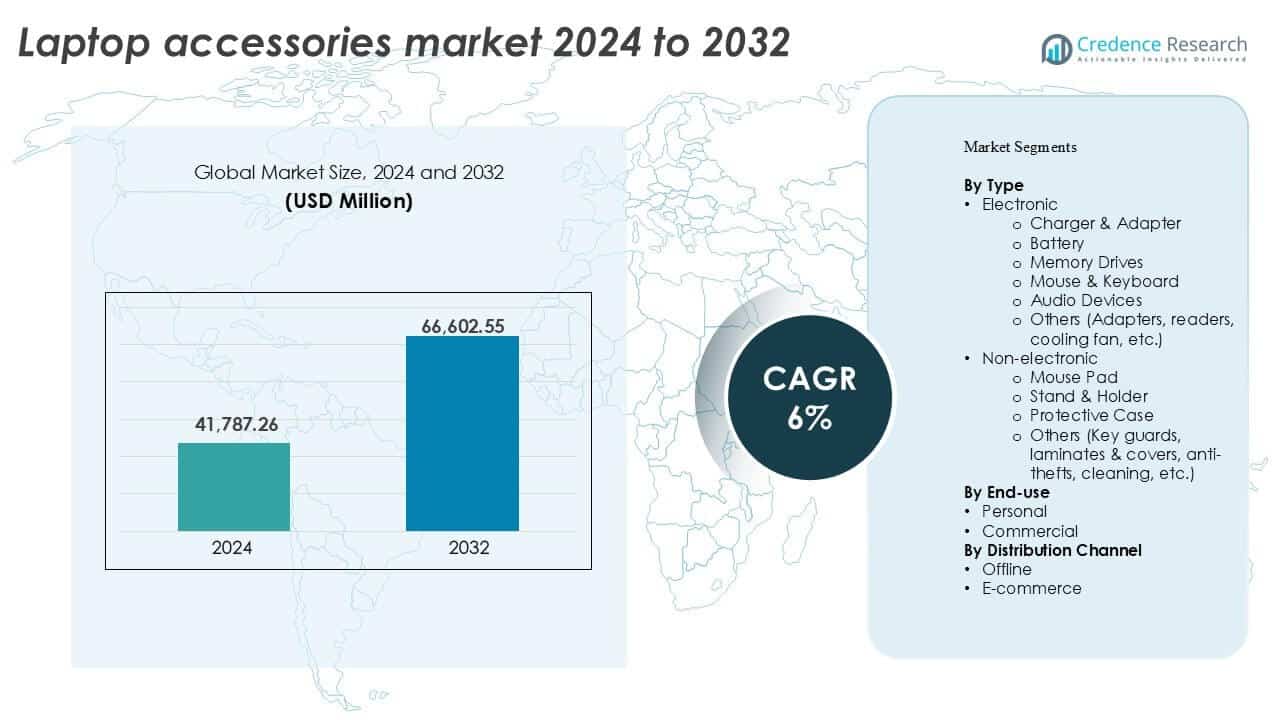
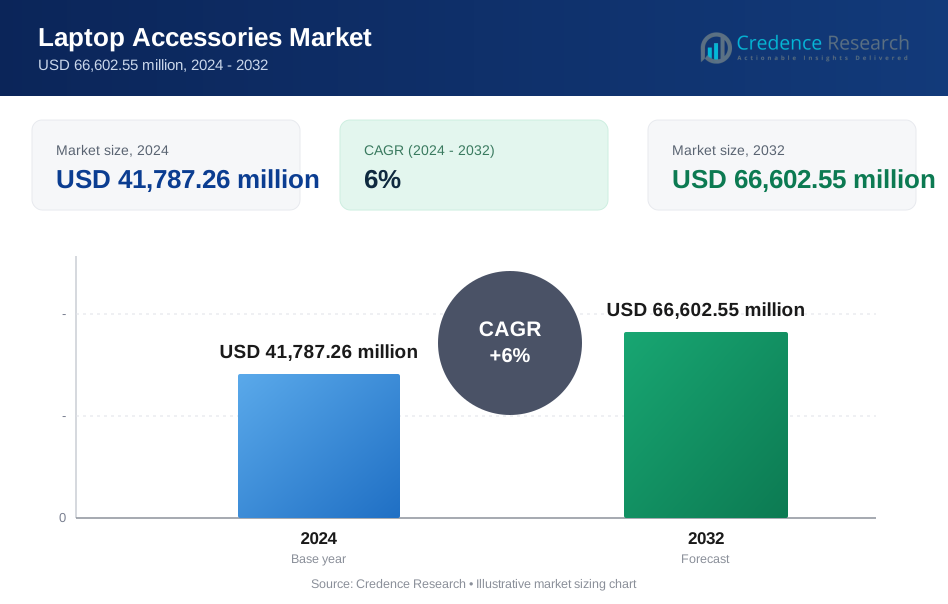
The global laptop accessories market size was valued at USD 41,787.26 million in 2024 and is anticipated to reach USD 66,602.55 million by 2032, growing at a CAGR of 6% during the forecast period.
| REPORT ATTRIBUTE | DETAILS |
|---|---|
| Historical Period | 2020-2023 |
| Base Year | 2024 |
| Forecast Period | 2025-2032 |
| Laptop Accessories Market Size 2024 | USD 41,787.26 million |
| Laptop Accessories Market, CAGR | 6% |
| Laptop Accessories Market Size 2032 | USD 66,602.55 million |
Top players in the global laptop accessories market include HP Inc., Logitech, Microsoft, Dell Inc., ASUSTeK Computer Inc., Western Digital Corp., Seagate Technology LLC, Kingston Technology, GIGA-BYTE Technology Co., Ltd., and Hama. These companies lead through wide product ranges, strong global distribution, and continuous innovation in ergonomics, wireless connectivity, and device compatibility. Logitech dominates in input devices, while HP and Dell focus on bundled accessories with laptops. Seagate, Western Digital, and Kingston lead in external storage. Asia Pacific holds the largest regional share at over 35% in 2024, driven by rising laptop adoption, cost-effective manufacturing, and growing e-commerce penetration.
Laptop Accessories Market Insights
- The global laptop accessories market was valued at USD 41,787.26 million in 2024 and is projected to reach USD 66,602.55 million by 2032, growing at a CAGR of 6%.
- Rising global laptop usage across personal, educational, and business applications continues to drive strong demand for accessories such as chargers, external drives, and ergonomic input devices.
- Key trends include the growth of wireless and multi-functional accessories, increased customization among gamers, and a rising focus on eco-friendly product design and packaging.
- The market remains fragmented with leading players like Logitech, HP, Microsoft, and Dell competing on product innovation, bundled offerings, and digital channel expansion.
- Asia Pacific leads with over 35% share, followed by North America at 30% and Europe at 25%; by segment, electronic accessories dominate with more than 65% share, led by chargers, keyboards, and memory drives.
Laptop Accessories Market Segmentation Analysis:
By Type
The electronic segment leads the laptop accessories market, holding over 65% of the total share in 2024. Within this, chargers and adapters dominate due to universal compatibility, frequent replacements, and travel demand. Rising laptop usage across mobile workforces and students continues to drive sales. Mouse and keyboard combos also see strong uptake, particularly among office users and gamers. Memory drives gain traction for backup needs and data portability. The non-electronic segment, while smaller, shows steady growth. Mouse pads and protective cases remain top sellers, supported by demand for customization, ergonomics, and device safety during travel or storage.
- For instance, Logitech’s MX Keys keyboard pairs with the MX Master 3 mouse and can last up to 70 days on a full charge.
By End-Use
The personal segment dominates the market with nearly 70% share in 2024, driven by rising laptop ownership among students, remote workers, and gamers. Frequent accessory upgrades for personalization, convenience, and enhanced functionality boost demand. The increasing trend of work-from-home setups sustains sales of comfort-focused products like laptop stands, wireless input devices, and external audio. In contrast, the commercial segment sees growing adoption from IT firms, educational institutions, and government offices. Bulk procurement of essential accessories such as adapters, mice, and cooling pads helps streamline operations and improve user productivity in professional environments.
- For instance, Bluetooth headsets from brands like Jabra can offer up to 35 hours of talk time per charge.
By Distribution Channel
The offline segment holds a slightly larger share in 2024, driven by consumer preference for physical testing, instant purchase, and after-sales support. Retail chains, multi-brand outlets, and tech stores offer bundled deals and installation services, particularly for high-value or brand-specific accessories. However, the e-commerce channel is growing rapidly and is expected to surpass offline sales by 2027. Convenience, broader selection, and online-exclusive discounts attract tech-savvy buyers. Platforms like Amazon and Flipkart lead sales for popular items such as chargers, headphones, and laptop sleeves. The rise of direct-to-consumer brand websites further accelerates digital distribution.
Laptop Accessories Market Key Growth Drivers
Expanding Laptop Ownership Across Consumer and Business Segments
Rising laptop penetration globally remains a key driver for the laptop accessories market. Increased adoption among students, professionals, and digital nomads directly supports demand for essential and optional accessories. Hybrid work models and remote learning continue to reshape digital habits, increasing the need for external keyboards, stands, webcams, and adapters. Business users require high-performance and ergonomic accessories to maintain productivity, while students and gamers demand personalization and enhanced device performance. As global laptop shipments remain strong, especially in emerging markets, accessory purchases are expected to follow a parallel growth trajectory. Accessories often require faster replacement cycles than laptops, further boosting recurring sales volumes across both B2C and B2B channels.
- For instance, USB‑C hubs with multiple ports (USB‑A, HDMI, Ethernet) commonly support data transfer speeds around 5 Gb/s for versatile connectivity.
E-Commerce and Omni-Channel Retail Growth Fueling Accessibility
Rapid expansion of e-commerce platforms plays a central role in market growth by improving access to a wide range of laptop accessories. Consumers benefit from product variety, price comparisons, and doorstep delivery, especially for low-involvement purchases like cables, cases, and USB hubs. Online channels enable global distribution for niche and premium brands, while allowing quick product discovery for trending innovations like portable docking stations or ergonomic accessories. The increasing use of mobile apps and voice-assisted shopping further simplifies purchase journeys. At the same time, traditional retailers have adopted omni-channel strategies, combining physical stores with online support to enhance consumer experience. This shift supports growth across tier-2 and tier-3 cities, where offline assortment remains limited but digital reach is growing.
- For instance, portable docking stations with 4K HDMI output at 60 Hz allow seamless display extension for mobile work setups.
Growing Demand for Customization and Ergonomic Enhancements
Consumers are increasingly focused on comfort, personalization, and performance when purchasing laptop accessories. Prolonged usage for work, education, and entertainment has driven interest in ergonomic solutions such as height-adjustable stands, wrist supports, and vertical mice. Health-conscious users seek posture-improving accessories to reduce strain and long-term physical discomfort. Simultaneously, a growing trend toward personalization supports demand for printed cases, RGB keyboards, and customized skins. Gaming and content creation communities are especially active in customizing their setups, often investing in premium headphones, external displays, and cooling pads. These lifestyle-driven preferences are prompting manufacturers to design functionally diverse accessories that combine aesthetics with performance, expanding upgrade cycles beyond basic utility.
Laptop Accessories Market Key Trends & Opportunities
Rising Popularity of Multipurpose and Smart Accessories
The laptop accessories market is witnessing a shift toward multi-functional and intelligent products. Consumers now prefer accessories that combine features—such as docking stations with charging, data transfer, and display extension capabilities. Smart accessories with Bluetooth connectivity, voice control, or sensor-based inputs are becoming common, especially among tech-savvy users and professionals. The growing number of USB-C-only laptops has further increased demand for multiport hubs and wireless peripherals. Compact, travel-friendly designs are trending in business segments. In addition, the integration of AI-driven features in audio devices and keyboards is opening new opportunities for innovation. This convergence of form and function helps brands create premium product lines that attract higher margins and longer engagement.
- For instance, USB‑C hubs with support for up to three external displays and power delivery of 100 W address varied connectivity needs.
Sustainable and Eco-Friendly Product Development Gaining Traction
Sustainability is emerging as a major trend across the electronics accessories industry. Consumers and businesses are increasingly aware of environmental concerns and seek eco-conscious alternatives. Laptop accessories made from recycled plastics, plant-based polymers, or biodegradable materials are gaining attention. Companies are also shifting to minimal and recyclable packaging to meet green standards. Brands that align with ESG goals gain favor among enterprise buyers, especially in Europe and North America. Certifications such as RoHS, EPEAT, and TCO Certified add credibility to sustainability claims. This trend creates opportunities for innovation in product materials, packaging, and supply chain transparency. As green procurement policies strengthen, eco-designed accessories are expected to gain market share across public and private sectors.
Laptop Accessories Market Key Challenges
Low Product Differentiation and Intense Price Competition
The laptop accessories market faces a high degree of commoditization, especially in entry-level categories like mouse pads, chargers, and sleeves. Numerous local and international players offer similar products with minimal functional difference, leading to price-based competition. This limits brand loyalty and squeezes margins, particularly for small and mid-sized vendors. OEM knockoffs and counterfeit accessories further intensify market clutter, especially in unregulated online marketplaces. To maintain competitiveness, brands are forced to invest heavily in design, packaging, or marketing, which reduces profitability. Over time, product differentiation through innovation or value-added features becomes essential to survive in saturated segments and justify premium pricing.
Compatibility and Technological Obsolescence Risks
Rapid changes in laptop hardware interfaces present a major challenge for accessory manufacturers. The shift from USB-A to USB-C, removal of audio jacks, or port minimization in ultrabooks forces constant redesign and shorter product lifecycles. Consumers may face compatibility issues with older accessories, leading to dissatisfaction or reduced usage. Vendors must continuously update product portfolios to align with device trends from major OEMs like Apple, Dell, and Lenovo. This accelerates R&D and inventory turnover costs. Additionally, non-standardized ports and varying power delivery protocols increase complexity in developing universal chargers or hubs. Brands that fail to adapt to these evolving technical requirements risk losing market relevance.
Laptop Accessories Market Regional Analysis
North America
North America held over 30% share of the global laptop accessories market in 2024, driven by strong digital infrastructure and widespread laptop usage. The U.S. remains the dominant market due to high consumer spending, enterprise IT investments, and a large remote workforce. Demand for ergonomic and smart accessories is strong, especially among hybrid workers and gamers. E-commerce growth supports easy access to branded and premium accessories. Rising trends like green packaging and sustainable materials further support product innovation. Canada and Mexico also contribute steadily, with growing education and business adoption fueling laptop accessory consumption.
Europe
Europe accounted for nearly 25% of the global market in 2024, led by high penetration of laptops across home, office, and institutional settings. Western Europe, particularly Germany, the U.K., and France, drives demand for both basic and advanced accessories. Commercial users favor productivity-focused accessories like docking stations, wireless keyboards, and display adapters. Regulatory focus on sustainable materials boosts sales of eco-friendly and certified accessories. Eastern Europe shows rising potential as digital adoption accelerates across education and public sectors. Strong retail infrastructure, combined with rapid e-commerce growth, continues to expand access to a wide variety of product lines.
Asia Pacific
Asia Pacific captured over 35% of the global laptop accessories market share in 2024, making it the largest regional segment. Rapid laptop adoption across China, India, Japan, and Southeast Asia drives robust demand for chargers, protective gear, and memory devices. Affordable product availability and local manufacturing capabilities fuel market expansion. India and China are key growth engines due to large student populations and booming digital workforces. Gaming culture in South Korea and Japan supports strong uptake of performance accessories. Online platforms dominate sales, while mobile-first consumers increasingly favor compact and wireless products. OEM bundling further enhances accessory penetration.
Latin America
Latin America contributed around 5% of the global market in 2024, with Brazil and Mexico leading regional growth. Expanding internet access, growing middle-class income, and rising student enrollment drive laptop and accessory adoption. Most demand centers around basic, cost-effective accessories such as chargers, mouse pads, and cases. E-commerce is gaining momentum but still faces logistics challenges in rural areas. Brands offering localized product lines and value-for-money bundles benefit the most. Education-focused digital initiatives and rising work-from-home trends are expected to create steady growth across urban centers, particularly in Brazil, Argentina, and Colombia.
Middle East & Africa (MEA)
MEA held nearly 3-4% of the global laptop accessories market in 2024. Growth is supported by digital transformation efforts in Gulf countries and rising laptop usage across education, business, and government sectors. The UAE and Saudi Arabia lead regional demand, with strong preference for branded and ergonomic accessories among professionals. Africa’s market remains largely price-sensitive, with demand concentrated in basic items like chargers and protective cases. Infrastructure gaps and limited retail access pose challenges, but mobile-first online platforms are enabling broader market reach. Public sector digitalization and IT education initiatives are expected to support future market expansion.
Laptop Accessories Market Segmentations:
By Type
- Electronic
- Charger & Adapter
- Battery
- Memory Drives
- Mouse & Keyboard
- Audio Devices
- Others (Adapters, readers, cooling fan, etc.)
- Non-electronic
- Mouse Pad
- Stand & Holder
- Protective Case
- Others (Key guards, laminates & covers, anti-thefts, cleaning, etc.)
By End-use
- Personal
- Commercial
By Distribution Channel
- Offline
- E-commerce
By Geography
- North America
- U.S.
- Canada
- Mexico
- Europe
- Germany
- France
- U.K.
- Italy
- Spain
- Rest of Europe
- Asia Pacific
- China
- Japan
- India
- South Korea
- South-east Asia
- Rest of Asia Pacific
- Latin America
- Brazil
- Argentina
- Rest of Latin America
- Middle East & Africa
- GCC Countries
- South Africa
- Rest of the Middle East and Africa
Laptop Accessories Market Competitive Landscape
The laptop accessories market is highly competitive, featuring a mix of global brands and regional players offering a broad range of products. Key companies such as HP Inc., Logitech, Microsoft, Dell Inc., and ASUSTeK Computer Inc. lead with strong brand presence, diverse portfolios, and wide distribution networks. These firms compete on innovation, product durability, and ergonomic design. Storage-focused players like Western Digital, Seagate Technology, and Kingston Technology dominate the memory drives segment with reliable, high-capacity solutions. GIGA-BYTE and Hama cater to niche markets, including gaming and personal customization. Leading brands leverage e-commerce platforms, direct-to-consumer models, and strategic partnerships to expand market reach. Continuous investments in wireless connectivity, compact designs, and green materials help maintain competitive advantage. Additionally, rapid product refresh cycles, bundling strategies, and cross-category offerings strengthen brand loyalty and consumer retention in a price-sensitive yet innovation-driven environment.
Laptop Accessories Market Key Player Analysis
- HP Inc.
- Logitech
- Microsoft
- GIGA-BYTE Technology Co., Ltd.
- Kingston Technology
- Seagate Technology LLC
- ASUSTeK Computer Inc.
- Dell Inc.
- Western Digital Corp.
- Hama
Recent Developments
- In September 2022, Western Digital Corp. partnered with Epic Games and Nintendo to deliver the first officially licensed Fortnite SanDisk microSDXC card for Nintendo Switch.
- In August 2022, ASUSTeK Computer Inc. launched the MD100 ASUS Marshmallow Mouse, adding the Portable Silent Wireless Mouse to the list of the ever-evolving segment of ASUS accessories. The MD100 ASUS Marshmallow mouse will be available online on Flipkart and ASUS E-shop, as well as at offline stores.
- In July 2022, Kingston Technology Company, Inc., a world leader in memory products and technology solutions, announced its partnership with the legendary e-sports organization, Ninjas in Pyjamas. The two-year deal makes Kingston FURY the official memory partner of Ninjas in Pyjamas.
Report Coverage
The research report offers an in-depth analysis based on Type, End-Use, Distribution Channel and Geography. It details leading market players, providing an overview of their business, product offerings, investments, revenue streams, and key applications. Additionally, the report includes insights into the competitive environment, SWOT analysis, current market trends, as well as the primary drivers and constraints. Furthermore, it discusses various factors that have driven market expansion in recent years. The report also explores market dynamics, regulatory scenarios, and technological advancements that are shaping the industry. It assesses the impact of external factors and global economic changes on market growth. Lastly, it provides strategic recommendations for new entrants and established companies to navigate the complexities of the market.
Future Outlook
- Demand for ergonomic accessories will rise with growing remote and hybrid work adoption.
- Wireless and Bluetooth-enabled devices will dominate future product launches.
- Gaming-focused accessories will see steady growth driven by esports and streaming trends.
- E-commerce platforms will become the primary sales channel for most brands.
- Sustainable materials and eco-friendly packaging will influence consumer preferences.
- AI integration in audio and input devices will enhance user experience and functionality.
- Personalization features such as RGB lighting and customizable skins will gain popularity.
- Compact and multi-functional accessories will appeal to mobile professionals and students.
- Asia Pacific will remain the fastest-growing regional market due to rising digital adoption.
- OEMs and accessory brands will expand collaborations to offer bundled product solutions.
Request a Free Sample
Fill in your details and we'll send you a free sample report.
- Sample data tables & charts
- Research methodology
Need a Custom Version of This Report?
Tailor the scope, geography, or segments to your exact requirements.
- Custom geography or segment scope
- Direct access to our analyst team
Frequently Asked Questions
What is the current market size for the Laptop accessories market, and what is its projected size in 2032?
At what Compound Annual Growth Rate is the Laptop accessories market projected to grow between 2024 and 2032?
Which Laptop accessories market segment held the largest share in 2024?
What are the primary factors fueling the growth of the Laptop accessories market?
Who are the leading companies in the Laptop accessories market?
Which region commanded the largest share of the Laptop accessories market in 2024?
Table of Content
Chapter 1. Report Introduction
- 1.1 Report Description & Purpose
- 1.1.1 Report Title & Market Definition
- 1.1.2 Unique Selling Propositions (USP) & Key Differentiators
- 1.1.3 Value Proposition for Stakeholders
- 1.2 Research Objectives
- 1.2.1 Market Sizing Objectives (Volume & Revenue)
- 1.2.2 Segmentation Objectives
- 1.2.3 Competitive Intelligence Objectives
- 1.2.4 Forecast & Scenario Objectives
- 1.3 Report Scope
- 1.3.1 Laptop Accessories Scope – Types & Subtypes Covered
- 1.3.2 Geographic Scope – Regions & Countries Covered
- 1.3.3 Historical Period, Base Year & Forecast Period (2024; forecast to 2032)
- 1.3.4 Inclusions & Exclusions
- 1.4 HS Code & Classification Framework
- 1.5 Currency, Units & Pricing Basis
- 1.6 Target Stakeholders
- 1.7 Limitations & Assumptions
Chapter 2. Executive Summary
- 2.1 Global Laptop Accessories Market Snapshot
- 2.1.1 Market Size – Historical (2024) & Forecast (2024-2032) (2024: USD 41,787.26 million → 2032: USD 66,602.55 million)
- 2.1.2 Volume & Revenue – Global Totals
- 2.1.3 Key Market Highlights – Top Five Facts
- 2.2 Laptop Accessories Market Segmentation Snapshot
- 2.2.1 Market Split by Region – 2024 vs. 2032
- 2.3 Competitive Snapshot
- 2.3.1 Top 10 Players by Revenue Share – 2024
- 2.3.2 Top 10 Players by Volume Share – 2024
- 2.3.3 Recent Strategic Developments (18-Month Summary)
- 2.4 Key Investment Highlights & Strategic Conclusions
Chapter 3. Laptop Accessories Market Dynamics & Industry Analysis
- 3.1 Market Overview & Context
- 3.1.1 Laptop Accessories Market Position in the Broader Automotive Value Chain
- 3.1.2 OEM vs. Replacement Market Dynamics
- 3.1.3 Market Maturity & Development Stage by Region
- 3.2 Laptop Accessories Market Drivers
- 3.3 Laptop Accessories Market Restraints & Challenges
- 3.4 Laptop Accessories Market Opportunities
- 3.5 Porter's Five Forces Analysis
- 3.5.1 Threat of New Entrants
- 3.5.2 Bargaining Power of Suppliers
- 3.5.3 Bargaining Power of Buyers
- 3.5.4 Threat of Substitutes
- 3.5.5 Competitive Rivalry – Intensity Assessment
- 3.6 Laptop Accessories Value Chain Analysis
- 3.6.1 Upstream – Raw Material/Input Suppliers
- 3.6.1.1 Raw Material/Input 1
- 3.6.1.2 Raw Material/Input 2
- 3.6.1.3 Raw Material/Input 3
- 3.6.2 Midstream – Production/Manufacturing/Service Delivery
- 3.6.2.1 Production/Process Overview
- 3.6.2.2 Key Facility Locations & Capacity by Manufacturer
- 3.6.3 Downstream – Distribution & End Consumer
- 3.6.3.1 Primary Channel – B2B/OEM
- 3.6.3.2 Secondary Channels – Dealer, Retail, Online, Direct
- 3.6.4 Value Chain Profitability Analysis
- 3.6.1 Upstream – Raw Material/Input Suppliers
- 3.7 PESTEL Analysis
- 3.7.1 Political Factors
- 3.7.2 Economic Factors
- 3.7.3 Social Factors
- 3.7.4 Technological Factors
- 3.7.5 Environmental Factors
- 3.7.6 Legal Factors
- 3.8 Laptop Accessories Supply Chain Analysis
- 3.8.1 Raw Material/Input Supply Risk Assessment
- 3.8.2 Manufacturing Concentration Risk (Geographic Exposure)
- 3.8.3 Trade Disruption Impact Analysis
- 3.9 Regulatory & Policy Landscape
Note: The regulatory and policy landscape section covers regulations based on their applicability to the market, Laptop Accessories category, geography, and scope of the study. Only regulatory frameworks with a material impact on operations, compliance, trade, sustainability, or market access are analyzed in detail.
Chapter 4. Key Investment Pockets & Opportunity Analysis
- 4.1 Laptop Accessories Market Attractiveness Analysis
- 4.1.1 By Region – Investment Attractiveness Matrix (Volume × CAGR)
- 4.2 Absolute Revenue Growth Opportunity
- 4.2.1 By Region – Absolute USD Growth Through 2032
- 4.3 Incremental Volume Opportunity
- 4.3.1 By Region – Incremental Volume Through 2032
- 4.3.2 Segment – Incremental Volume
- 4.4 Emerging Submarket Opportunity Deep Dive (Subject to Applicability)
- 4.5 Emerging Market Opportunity Scorecards
- 4.5.1 United States
- 4.5.2 Europe
- 4.5.3 Asia
- 4.5.4 Middle East & Africa
Note: Emerging Market Opportunity Scorecards will be included based on relevance and strategic importance. Regions listed are indicative and may vary depending on data availability and market dynamics.
Chapter 5. Laptop Accessories Import-Export Analysis & Trade Flows
- 5.1 Global Trade Overview
- 5.1.1 Global Export Value by Country (2024)
- 5.1.2 Global Export Volume by Country (2024)
- 5.1.3 Global Import Value by Country (2024)
- 5.1.4 Global Import Volume by Country (2024)
- 5.1.5 Net Trade Balance by Country (2024)
- 5.2 Export Analysis – Segment
- 5.2.1 Type 1 (HS Code)
- 5.2.2 Type 2 (HS Code)
- 5.2.3 Type 3 (HS Code)
- 5.2.4 Type 4 (HS Code)
- 5.2.5 Type 5 (HS Code)
- 5.3 Import Analysis – Segment
- 5.3.1 Type 1 (HS Code)
- 5.3.2 Type 2 (HS Code)
- 5.3.3 Type 3 (HS Code)
- 5.3.4 Type 4 (HS Code)
- 5.3.5 Type 5 (HS Code)
- 5.4 Average Unit Trade Prices
- 5.4.1 Average Export Price – Segment & Country
- 5.4.2 Average Import Price – Segment & Source Country
- 5.4.3 Price Trends (2024)
- 5.5 Key Trade Route Analysis
- 5.5.1 Trade Route 1
- 5.5.2 Trade Route 2
- 5.5.3 Trade Route 3
- 5.5.4 Trade Route 4
- 5.5.5 Trade Route 5
- 5.6 Trade Policy Impact Assessment
- 5.6.1 US Anti-Dumping & Section 301 Tariffs
- 5.6.2 EU Customs Union Impact
- 5.6.3 Major Free Trade Agreements
- 5.6.4 USMCA Rules of Origin
Note: Trade policy analysis will be included only where relevant to the Laptop Accessories market.
Chapter 6. Competitive Landscape & Company Benchmarking
- 6.1 Laptop Accessories Market Concentration & Structure
- 6.1.1 Herfindahl-Hirschman Index (HHI) – vs. 2024
- 6.1.2 Tier 1, Tier 2 & Tier 3 Market Structure
- 6.1.3 Global, Regional & Local Player Dynamics
- 6.2 Laptop Accessories Market Share Analysis – 2024
- 6.2.1 Global Revenue Share by Company
- 6.2.2 Global Volume Share by Company
- 6.2.3 Regional Revenue Share
- 6.2.4 Market Share Evolution ( vs. 2024)
- 6.2.5 OEM Segment Share by Company
- 6.2.6 Replacement Segment Share by Company
- 6.3 Production/Delivery Capacity & Facility Analysis
- 6.3.1 Global Installed Capacity
- 6.3.2 Capacity Utilization Rates
- 6.3.3 Production/Output Volume
- 6.3.4 Facility Locations & Capacity Map
- 6.3.5 Planned Capacity Additions
- 6.4 Laptop Accessories Competitive Benchmarking Matrix
- 6.4.1 Revenue, Volume, CAGR & Profitability Comparison
- 6.4.2 Channel Revenue Mix
- 6.4.3 Geographic Revenue Exposure
- 6.4.4 R&D Intensity
- 6.4.5 Sustainability Maturity
- 6.5 Strategic Developments in Laptop Accessories (Last 24 Months)
- 6.5.1 Mergers, Acquisitions & Divestments
- 6.5.2 New Laptop Accessories Launches
- 6.5.3 Facility Expansions
- 6.5.4 Strategic Alliances, Joint Ventures & Partnerships
- 6.5.5 Distribution Expansion & Market Entry
- 6.5.6 Sustainability & ESG Initiatives
- 6.6 Competitive Strategy Mapping
- 6.6.1 Leader, Challenger, Follower & Niche Classification
- 6.6.2 Pricing Strategy Comparison
- 6.6.3 Channel Strategy Matrix
Note: Strategic developments are included based on their materiality and the availability of reliable information.
Chapter 7. Global Laptop Accessories Market – By Distribution Channel
- 7.1 Segment Overview
- 7.1.1 Volume & Revenue Split by Channel (2024 & 2032)
- 7.1.2 Channel Mix Evolution (2024-2032)
Chapter 8. Regional Market Analysis – Global Overview
- 8.1 Global Regional Overview
- 8.1.1 Regional Volume Share
- 8.1.2 Regional Revenue Share
- 8.1.3 Regional Volume by Region
- 8.1.4 Regional Revenue by Region
- 8.1.5 Regional Forecast Through 2032
- 8.2 Cross-Regional Segment Analysis
- 8.2.1 By Distribution Channel
- 8.2.2 By Brand/Price Tier
Chapter 9. North America Laptop Accessories Market
- 9.1 United States
- 9.2 Canada
- 9.3 Mexico
Chapter 10. Europe Laptop Accessories Market
- 10.1 Germany
- 10.2 France
- 10.3 Italy
- 10.4 United Kingdom
- 10.5 Spain
- 10.6 Poland
- 10.7 Russia
- 10.8 Netherlands
- 10.9 Belgium
- 10.10 Sweden
- 10.11 Denmark
- 10.12 Norway
- 10.13 Rest of Europe
Chapter 11. Asia Pacific Laptop Accessories Market
- 11.1 China
- 11.2 India
- 11.3 Japan
- 11.4 South Korea
- 11.5 Thailand
- 11.6 Indonesia
- 11.7 Vietnam
- 11.8 Malaysia
- 11.9 Australia
- 11.10 Rest of Asia Pacific
Chapter 12. Latin America Laptop Accessories Market
- 12.1 Brazil
- 12.2 Argentina
- 12.3 Colombia
- 12.4 Chile
- 12.5 Rest of Latin America
Chapter 13. Middle East Laptop Accessories Market
- 13.1 Saudi Arabia
- 13.2 United Arab Emirates
- 13.3 Turkey
- 13.4 Israel
- 13.5 Iran
- 13.6 Rest of the Middle East
Chapter 14. Africa Laptop Accessories Market
- 14.1 South Africa
- 14.2 Egypt
- 14.3 Nigeria
- 14.4 Morocco
- 14.5 Rest of Africa
Chapter 15. Laptop Accessories Company Profiles
- 15.1 [Company 01]
- 15.1.1 Company Overview
- 15.1.2 Key Management Personnel
- 15.1.3 Products & Services Portfolio
- 15.1.4 Financial Performance
- 15.1.5 Key Market Focus & Geographic Presence
- 15.1.6 Recent Developments & Strategic Initiatives
Note: The company profile list is preliminary and may change based on research findings, market developments, data availability, and client requirements.
Chapter 16. Appendices
- Appendix A – List of Abbreviations & Acronyms
- Appendix B – Industry Classification Code Reference – Full Series
- Appendix C – Production & Capacity Data Tables
- Appendix D – End-Use & Demand Base Tables
- Appendix E – Consumption & Replacement Rate Assumptions
- Appendix F – ASP Reference Tables
- Appendix G – Manufacturing & Facility Database
- Appendix H – Import-Export Data Tables
- Appendix I – Regulatory Summary Tables
- Appendix J – Primary Research Participant List (Anonymized)
- Appendix K – Primary Research Questionnaire Framework
- Appendix L – Data Sources & Bibliography
- Appendix M – Market Size Divergence & Source Comparison
Chapter 17. Research Methodology
- 17.1 Research Framework & Philosophy
- 17.2 Secondary Research – Sources, Hierarchy & Data Extraction
- 17.3 Data Modeling – Bottom-Up & Top-Down Market Sizing
- 17.4 Primary Research – Stakeholder Framework, LOI & Sample Sizes
- 17.5 Forecast Methodology – Regression, Scenario & Sensitivity Analysis
- 17.6 Quality Control – Four-Layer Validation Framework
- 17.7 Limitations & Standard Assumptions
- 17.8 Disclaimer
