
| REPORT ATTRIBUTE | DETAILS |
|---|---|
| Historical Period | 2019-2022 |
| Base Year | 2023 |
| Forecast Period | 2024-2032 |
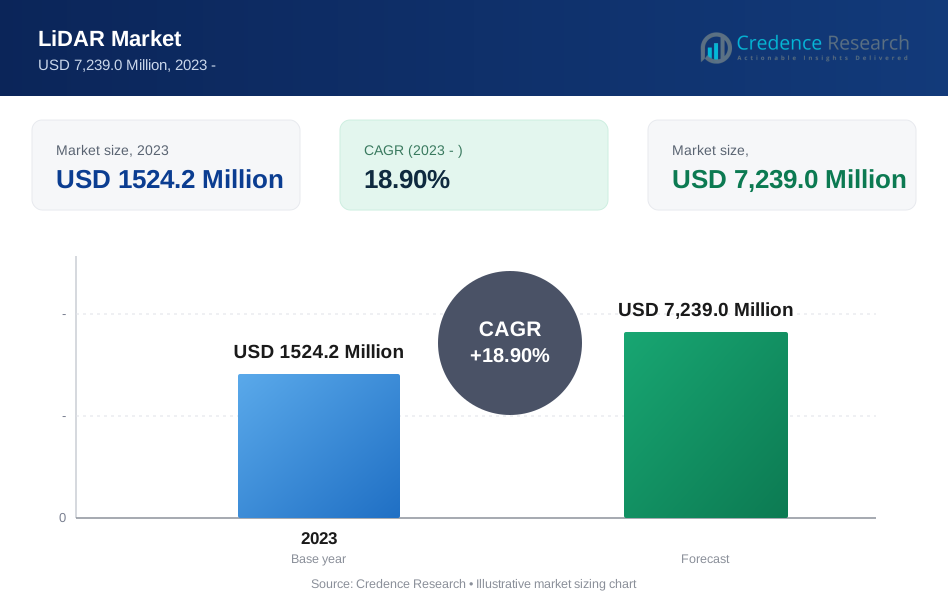
| LiDAR Market Size 2023 | USD 1524.2 Million |
| LiDAR Market , CAGR | 18.90% |
| LiDAR Market Size 2032 | USD 7239.0 Million |
Market Insights
- The LiDAR Market reached a valuation of USD 1524.2 Million in 2023 and is anticipated to rise to USD 7239.0 Million by 2032, indicating a strong CAGR of 18.90% from 2024 to 2032.
- Airborne LiDAR emerged as the leading segment by type, constituting approximately 35-38% of the total market share in 2023. This segment's growth is mainly attributed to its large scale applications such as forestry, agriculture, land development, and topographic mapping, which are crucial for creating detailed maps and 3D models.
- UAV (Unmanned Aerial Vehicle) LiDAR is projected to witness the highest CAGR during the forecast period. This is due to the high growth rate of UAV LiDAR attributed to increased affordability, flexibility, and technological advancements.
- Mobile LiDAR holds significant market share in 2023 and is growing significantly during the forecast period. The demand for 3D mapping is increasing in various industries such as construction, infrastructure, and environmental monitoring, and mobile LiDAR systems are ideally suited for this purpose.
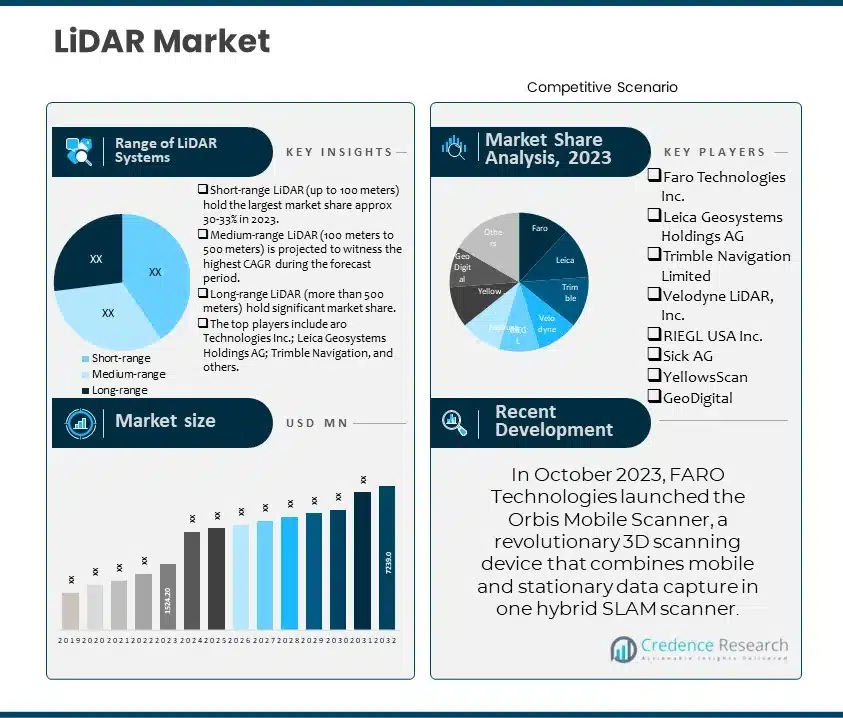
- Short-range LiDAR (up to 100 meters) holds the largest market share by range of LiDAR systems in 2023, accounting for approximately 30-33% of the total market. Short-range LiDAR plays a key role in autonomous vehicles, robotics, and consumer electronics, providing high-resolution data for obstacle detection, navigation, and object communication at close range.
- Laser scanners hold the largest market share by LiDAR component in 2023, constituting approximately 40% of the total market. Their important applications and various technologies contribute to their dominance, with solid-state laser scanners meeting the needs of various applications effectively.
- Topographic Mapping and Surveying dominate the market by application, holding approximately 35-40% of the market share in 2023. The increasing demand for land surveying and development projects contributes to the market growth in this segment.
- Government and Public Sector hold the largest market share by end-user industry in 2023, accounting for approximately 25-27% of the total market. LiDAR's applications in civil engineering, such as topographic mapping and surveying, and construction monitoring, contribute to this market dominance.
- North America holds the largest share of the LiDAR Market, accounting for around 35-38% of the market in 2023. Several major players in the LiDAR industry in this region, coupled with increasing adoption of LiDAR technology in various applications, drive the growth presence in the LiDAR market in North America.
- Technological advancements in LiDAR technology and infrastructure development are driving the growth of the LiDAR market globally, with significant contributions from regions such as Asia-Pacific, where increasing demand from various sectors such as automotive, manufacturing, and agriculture is observed.
Executive Summary
Market Definition
LiDAR (Light Detection and Ranging) is a remote sensing technology that uses laser light to measure distances and create high resolution images of objects and environment. It works by emitting laser pulses and measuring the time it takes before returning from a target, and enables accurate measurements of distance, shape and size. Lidar has many applications in various industries such as surveying, forestry, archaeology, civil engineering, mining, agriculture and transportation. In the automotive industry, LiDAR is used in Advanced Driver Assistance Systems (ADAS) and autonomous vehicles to provide detailed information about the environment, enabling safe navigation and determination. Global LiDAR market is expected to grow exponentially in the next few years.
Market Overview
- The LiDAR Market achieved a valuation of USD 1524.2 Million in 2023 and is poised to escalate to USD 7239.0 Million by 2032, showcasing a robust CAGR of 18.90% from 2024 to 2032.
- Airborne LiDAR emerged as the dominant segment by type, constituting approximately 35-38% of the total market share in 2023. This segment's growth is primarily attributed to its widespread applications in forestry, agriculture, land development, and topographic mapping, which are crucial for creating detailed maps and 3D models.
- UAV (Unmanned Aerial Vehicle) LiDAR is anticipated to witness significant growth during the forecast period, driven by increased affordability, flexibility, and technological advancements. This segment holds promising opportunities for market expansion.
- Mobile LiDAR holds the largest market share by type in 2023, accounting for a significant portion of the total market. The increasing demand for 3D mapping in various industries such as construction, infrastructure, and environmental monitoring drives the growth of mobile LiDAR systems.
- Short-range LiDAR (up to 100 meters) dominates the market by range of LiDAR systems, holding approximately 30-33% of the market share in 2023. This segment plays a vital role in applications such as autonomous vehicles, robotics, and consumer electronics, contributing to its significant market presence.
- Laser scanners hold the largest market share by LiDAR component in 2023, constituting approximately 40% of the total market. Their wide range of applications and various technologies contribute to their dominance in the market.
- Topographic Mapping and Surveying dominate the market by application, holding approximately 35-40% of the market share in 2023. The increasing demand for accurate land surveying and development projects drives the growth of LiDAR technology in this segment.
- Government and Public Sector hold the largest market share by end-user industry in 2023, accounting for approximately 25-27% of the total market. LiDAR's applications in civil engineering, construction monitoring, and infrastructure development contribute to its significant market presence in this sector.
- North America holds the largest share of the LiDAR Market, accounting for around 35-38% of the market in 2023. The region presents significant growth opportunities due to increasing demand from various sectors and continuous technological advancements fostering market expansion.
Segmentation by Type of LiDAR Technology
- Airborne LiDAR currently hold the largest market share approx 35-38% in 2023. This is because of its large scale applications like forestry, agriculture, land development, and topographic mapping and crucial for creating detailed maps and 3D models.
- UAV (Unmanned Aerial Vehicle) LiDAR is projected to witness the highest CAGR during the forecast period. This is due to high growth rate of UAV LiDAR can be attributed to increased affordability, flexibility, and technological advancements. contribute to the growth of this segment.
- Mobile LiDAR hold significant market share in 2023 and growing significantly during the forecast period. The demand for 3D mapping is increasing in various industries such as construction, infrastructure and environmental monitoring. Mobile lidar systems are ideally suited for this purpose because they are capable of capturing long-range 3D point clouds with large areas quickly and accurately.
Segmentation by Range of LiDAR Systems
- Short-range LiDAR (up to 100 meters) hold the largest market share approx 30-33% in 2023. Short-range LiDAR plays a key role in autonomous vehicles, robotics and consumer electronics, providing high-resolution data for obstacle detection, navigation and object communication at close range and its integration in drones, smart homes and smartphones is widespread and market power again.
- Medium-range LiDAR (100 meters to 500 meters) is projected to witness the highest CAGR during the forecast period. It provides efficient warehouse navigation and efficient inventory management, and enhances road safety with lane departure warning and automatic emergency braking Its ability to provide detailed data in a centralized format makes it attractive for businesses.
Segmentation by LiDAR Component
- Laser scanners hold the largest market share approx 40% in 2023. Their important applications and various technologies contribute to their dominance Solid-state laser scanners meet the needs of various applications and effective costs and performance further drive the market.
- Inertial Measurement Units (IMUs) is projected to witness the highest CAGR during the forecast period. With the technological advancements in MEMS technology reducing the size, cost and accuracy of IMUs, making them more attractive for LiDAR systems.
Segmentation by Application
- Topographic Mapping and Surveying hold the largest market share approx 35-40% in 2023. Incresing demand of land surveying and development projects contributed to the market growth.
- Transportation and Infrastructure is projected to witness the highest CAGR during the forecast period due to road and bridge mapping and infrastructure inspection and maintenance.
Segmentation by End-User Industry
- Government and Public Sector hold the largest market share approx 25-27% in 2023 owing to LiDAR's applications in civil engineering such as topographic mapping and surveying, and construction monitoring.
- Robotics and Automation is projected to witness the highest CAGR during the forecast period. Autonomous mobile robots (AMRs) for navigation and object manipulation contributed to the market growth.
Segmentation by Region
- North America held largest share around 35-38% of the market in 2023. There are several major players in the LiDAR industry in this region, such as Velodyne LiDAR, Inc., Pharo Technologies, Inc., Trimble Inc. and others. The presence of these companies, coupled with the increasing adoption of LiDAR technology in various applications drives the growth presence in the LiDAR market in North America.
- Europe and Asia Pacific collectively account for just under 55% share in 2023, with Asia Pacific holding over 20% share in the same year.
- The rest of the world, including Latin America, the Middle East, and Africa, supplies the remaining demand for LiDAR.
Technological advancements and infrastructure development and surveying, is driving the growth of the LiDAR market.
The North America region holds the largest share in the light detection ranging (LiDAR) market. This dominance can be attributed to several factors such as increasing demand for high-resolution data in various applications, favorable government regulations, and huge investments in research and development. For instance, in January 2023, Innoviz Technologies Ltd launched Innoviz360 software. Innoviz360 is a high-performance LiDAR sensor that offers improved performance and substantial cost reduction. It features up to 1280 scanning lines per frame, configurable frame rate, 0.05°x 0.05° resolution, and 300-meter range. Its design builds upon InnovizTwo's hardware advances, including a single laser, detector, and ASIC, and benefits from economies of scale. Besides, leading automotive companies in the US, which are actively adopting LiDAR technology in their vehicles, continue to drive the market. However, Canada also plays an important role in the North American LiDAR market due to the adoption of LiDAR technology greater use in forestry, for mining purposes and transportation industries. There has been an increase in the use of LiDAR technology in agriculture in Mexico, resulting in higher crop yields and better land management practices.
The Asia-Pacific region is experiencing a phenomenal growth in the Lidar market, driven by increasing demand from various sectors such as automotive, manufacturing, agriculture etc. China, Japan and South Korea are the major contributors to regional market growth due to their rapidly developing industries, urbanization and industrialization. The increasing use of autonomous vehicles, drones and robotics in countries gives great potential for LiDAR technology. For instance, in May 2022, Flyability introduced the Elios 3, a collision-tolerant indoor LiDAR drone for Industry 4.0. The drone features FlyAware SLAM engine for real-time 3D modeling and comes with Inspector 4.0 software for efficient inspections. Designed for reliability and stability, the Elios 3 addresses the needs of companies scaling up drone usage for industrial inspections.
Additionally, governments’ initiatives for smart urban infrastructure and environmental monitoring are driving the demand for LiDAR solutions. For instance, at the 12th Smart City World Expo Congress, Japan showcased the latest technologies and innovative approaches to urban planning, affirming its commitment to sustainable, efficient and livable cities the emphasis of the. Japan’s focus on advanced transportation infrastructure such as autonomous vehicles and intelligent traffic management is likely to increase the need for precision mapping and analytical technologies such as LiDAR. This creates new business opportunities for lidar manufacturers and service providers. India and Australia are emerging as promising markets, with increased interest in lidar technology in agriculture and mining.
Key Highlights of the Report
The LiDAR Market is segmented based on various factors including type of LiDAR technology, range of LiDAR systems, LiDAR components, applications, end-user industries, and regions. The growing demand for LiDAR technology, driven by factors such as technological advancements and infrastructure development, is fueling the adoption of LiDAR systems across various industries.
Airborne LiDAR emerges as the dominant segment, offering crucial applications in forestry, agriculture, land development, and topographic mapping, contributing significantly to the creation of detailed maps and 3D models. Mobile LiDAR holds significant market share and is witnessing substantial growth, driven by increasing demand for 3D mapping in industries such as construction, infrastructure, and environmental monitoring.
Short-range LiDAR holds the largest market share in terms of range of LiDAR systems, playing a key role in autonomous vehicles, robotics, and consumer electronics, providing high-resolution data for obstacle detection and navigation. The Food and Beverage Industry accounts for the largest end-user segment, as consumers seek LiDAR technology for various applications such as precision mapping and analytical technologies.
North America leads the LiDAR Market, with significant growth driven by factors such as increasing demand for high-resolution data, favorable government regulations, and investments in research and development. Europe and Asia Pacific collectively contribute a substantial share, with Asia Pacific experiencing phenomenal growth due to increasing demand from sectors such as automotive, manufacturing, and agriculture.
Key market players include Velodyne LiDAR, Inc., Pharo Technologies, Inc., Trimble Inc., and others. Technological advancements, such as improved LiDAR sensors and software, are driving market growth and innovation in the LiDAR Market.
What Are The Main Drivers Of The Global LiDAR Market?
The main drivers of the global lidar market are increasing adoption in automotive and transportation industries, growing demand for 3D imaging and mapping in construction and mining, crop tracking and agricultural production growing precision in agriculture coupled with government policies and investments in smart city projects.
What Are The Major Challenges Faced By The Global LiDAR Market?
The global LiDAR market is mainly restraint by the high cost and lack of infrastructure, lack of standardization and performance, privacy and security concerns. Moreover, the market faces intense competition from new technologies such as photogrammetry and in stereo vision, which can hinder its development.
What Are The Growth Opportunities In The Global LiDAR Market?
Growth opportunities exist in the global lidar market across various sectors, including autonomous vehicles and advanced driver assistance systems (ADAS), where lidar technology is increasingly being adopted for obstacle detection and transportation Construction and mining, 3D modeling and mapping and agriculture, crop monitoring and precision farming. Other potential growth areas include forestry, robotics and unmanned aerial vehicles (UAVs).
Market Drivers
The global LiDAR market is driven by several factors. The following are the key drivers of the global LiDAR market:
Increasing Demand Of Airborne LiDAR
Increasing demand of Airborne LiDAR drives the global LiDAR market. These technologies are widely used in applications such as surveying, forestry, monitoring infrastructure, where accurate and reliable data collection and analysis are critical LiDAR capability to provide 3D modeling it has high resolution and detailed geographical and material properties for it has made it an important tool in these areas , and drives market growth. For instance, in March 2024, Leica Geosystems has introduced the Leica TerrainMapper-3 airborne Lidar sensor, offering improved versatility and adaptability for various applications. The system features adjustable field of view up to 60 degrees and three scan patterns, allowing users to customize settings based on their specific needs. This new technology enables more efficient data collection and processing, supporting a wide range of applications such as land surveying, forestry, and infrastructure inspection.
Market Restraints
The global LiDAR market faces some challenges that may hinder its growth. These include the following:
Lack Of Standardization
The global LiDAR market is primarily constrained by lack of standardization. Despite its many advantages, the global lidar market faces a major challenge: lack of standardization. Recently, the International Organization for Standardization (ISO) released a new standard, ISO 19157, which aims to establish a unified framework for the acquisition, use and dissemination of LiDAR data but uniform standards lack of diversity and diversity in sectors continues to create confusion and inefficiency in the market. Without standardization, data consistency and connectivity issues will persist, making it harder for companies to collaborate and share data effectively. Addressing this issue is critical to the growth and long-term success of the LiDAR industry.
Opportunities
The global LiDAR market offers significant growth opportunities. These include the following:
Adoption Of Various Strategies Among Market Players
The major companies serving the global LiDAR Market are Faro Technologies Inc.; Leica Geosystems Holdings AG; Trimble Navigation Limited; Velodyne LiDAR, Inc, among others. The market players are considerably contributing to the market growth by the adoption of various strategies including mergers & acquisitions, collaborations, funding, and new product launches, to stay competitive in the market also makes opportunity for the market growth. For instance, in October 2023, FARO Technologies launched the Orbis Mobile Scanner, a revolutionary 3D scanning device that combines mobile and stationary data capture in one hybrid SLAM scanner. With local or cloud-based data processing and collaboration, the Orbis offers the latest advancements in FARO's industry-leading LiDAR technology, enabling faster and more accurate 3D reality capture.
Competitive Landscape
Key Players
The global LiDAR market is highly competitive, with several key players. Some of the major players in the market and their market share are as follows:
- Faro Technologies Inc.
- Leica Geosystems Holdings AG
- Trimble Navigation Limited
- Velodyne LiDAR, Inc.
- RIEGL USA Inc.
- Sick AG
- YellowsScan
- GeoDigital
- Others
These organizations prioritize product innovation, distribution channel expansion, and mergers and acquisitions to stay competitive.
The global LiDAR market's key players continually seek to stay ahead by offering new products and developments.
In February 2024, Trimble MX90 Mobile Mapping System launched with cutting-edge GNSS & inertial tech, capturing high-detail laser scans & imagery for robust data analysis. Features include 360-degree panoramic cameras, high-density colorized point clouds, accurate trajectories, and advanced data processing. Ideal for surveying, engineering, construction, and asset management.
In October 2023, FARO Technologies launched the Orbis Mobile Scanner, a revolutionary 3D scanning device that combines mobile and stationary data capture in one hybrid SLAM scanner. With local or cloud-based data processing and collaboration, the Orbis offers the latest advancements in FARO's industry-leading LiDAR technology, enabling faster and more accurate 3D reality capture.
Summary of Key Findings
- The LiDAR Market is witnessing notable growth driven by increasing demand for LiDAR technology across various industries, particularly in sectors such as automotive, manufacturing, and agriculture.
- Market segmentation is based on factors such as type of LiDAR technology, range of LiDAR systems, LiDAR components, applications, end-user industries, and regions, reflecting the diverse applications and market dynamics within the LiDAR industry.
- Airborne LiDAR emerges as the dominant segment, providing crucial applications in forestry, agriculture, land development, and topographic mapping.
- Key user segments include government and public sectors, aerospace and defense, transportation and logistics, and agriculture, highlighting the widespread adoption of LiDAR technology across different sectors.
- North America leads the LiDAR Market, followed by Europe and Asia Pacific, with significant growth opportunities identified in Asia Pacific due to increasing urbanization and technological advancements.
Future Outlook
- The LiDAR Market presents promising growth prospects, particularly in Asia Pacific, driven by factors such as urbanization, changing industry demands, and technological advancements.
- Anticipated challenges in the forecast period include addressing competition from alternative technologies and ensuring standardized performance and data consistency.
- To maintain competitiveness, industry players should focus on continuous technological innovation, sustainable business practices, and strategic collaborations to meet evolving market demands and capitalize on emerging opportunities in the dynamic LiDAR Market.
How CXOs Can Benefit from the Credence Research LiDAR Networks Market Report
The Credence Research LiDAR Networks Market Report provides CXOs with a comprehensive overview of the market, including:
- Market size and growth forecast: The report provides detailed estimates of the global LiDAR networks market size, segmented by type of LiDAR technology, range of LiDAR systems, LiDAR components, applications, end-user industries, and regions. It also includes forecasts for the market through 2032, based on key trends and drivers.
- Market segmentation: The report segments the LiDAR networks market by type of LiDAR technology, range of LiDAR systems, LiDAR components, applications, end-user industries, and regions. The increasing demand for advanced solutions is driven. This segmentation provides CXOs with a granular understanding of the market and the opportunities in each segment.
- Competitive landscape: The report profiles the key players in the LiDAR networks market and provides insights into their strategies, product offerings, and financial performance. This information can help CXOs to identify and assess their competition.
- Key trends and drivers: The report identifies and analyzes the key trends and drivers that are shaping the LiDAR networks market. This information can help CXOs to make informed decisions about their investments and strategies.
CXOs can use the insights from the Credence Research LiDAR Networks Market Report to:
- Identify growth opportunities: The report can help CXOs to identify new growth opportunities in the LiDAR networks market. For example, the report identifies the growing demand for LiDAR networks from cloud computing providers and telecom companies as a key opportunity.
- Make informed investment decisions: The report can help CXOs to make informed investment decisions about LiDAR networks. For example, the report provides insights into the key factors to consider when evaluating LiDAR providers and selecting LiDAR solutions.
- Develop competitive strategies: The report can help CXOs to develop competitive strategies for their LiDAR networks businesses. For example, the report identifies the key strategies that LiDAR providers are using to differentiate themselves from their competitors.
- Track market developments: The report can help CXOs to track market developments and stay ahead of the curve. For example, the report provides insights into the latest trends and innovations in the LiDAR networks market.
Overall, the Credence Research LiDAR Networks Market Report is a valuable resource for CXOs who are looking to gain a deeper understanding of the market and identify opportunities for growth.
Segmentation
- Type of LiDAR Technology:
- Airborne LiDAR
- Terrestrial LiDAR
- Mobile LiDAR
- Satellite LiDAR
- UAV (Unmanned Aerial Vehicle) LiDAR
- Handheld LiDAR
- Range of LiDAR Systems:
- Short-range LiDAR (up to 100 meters)
- Medium-range LiDAR (100 meters to 500 meters)
- Long-range LiDAR (more than 500 meters)
- LiDAR Component:
- Laser Scanners
- GPS/GNSS Receivers
- Inertial Measurement Units (IMUs)
- Photodetectors
- Laser Diodes
- Others
- Application:
- Topographic Mapping and Surveying
- Urban Planning and Development
- Transportation and Infrastructure
- Agriculture and Forestry
- Mining and Exploration
- Environmental Monitoring
- Defense and Aerospace
- Archaeology and Cultural Heritage
- Oil and Gas Exploration
- Flood Mapping and Management
- Others
- End-User Industry:
- Government and Public Sector
- Aerospace and Defense
- Mining and Quarrying
- Agriculture
- Transportation and Logistics
- Automotive
- Construction
- Energy and Utilities
- Forestry
- Archaeology and Cultural Heritage Preservation
- Others
- By Region
- North America
- The U.S.
- Canada
- Mexico
- Europe
- Germany
- France
- The U.K.
- Italy
- Spain
- Rest of Europe
- Asia Pacific
- China
- Japan
- India
- South Korea
- South-east Asia
- Rest of Asia Pacific
- Latin America
- Brazil
- Argentina
- Rest of Latin America
- Middle East & Africa
- GCC Countries
- South Africa
- Rest of Middle East and Africa
- North America
Request a Free Sample
Fill in your details and we'll send you a free sample report.
- Sample data tables & charts
- Research methodology
Need a Custom Version of This Report?
Tailor the scope, geography, or segments to your exact requirements.
- Custom geography or segment scope
- Direct access to our analyst team
Frequently Asked Questions
What is the current size of the global LiDAR market?
What is the expected growth rate of the LiDAR market between 2024 and 2032?
Which segment is leading the market share in terms of Type of LiDAR Technology?
Which LiDAR Component segments governs the demand for LiDAR in the world?
Who are the major players in the global LiDAR market?
Table of Content
Chapter 1. Report Introduction
- 1.1 Report Description & Purpose
- 1.1.1 Report Title & Market Definition
- 1.1.2 Unique Selling Propositions (USP) & Key Differentiators
- 1.1.3 Value Proposition for Stakeholders
- 1.2 Research Objectives
- 1.2.1 Market Sizing Objectives (Volume & Revenue)
- 1.2.2 Segmentation Objectives
- 1.2.3 Competitive Intelligence Objectives
- 1.2.4 Forecast & Scenario Objectives
- 1.3 Report Scope
- 1.3.1 LiDAR Scope – Types & Subtypes Covered
- 1.3.2 Geographic Scope – Regions & Countries Covered
- 1.3.3 Historical Period, Base Year & Forecast Period (2023; forecast to the forecast period)
- 1.3.4 Inclusions & Exclusions
- 1.4 HS Code & Classification Framework
- 1.5 Currency, Units & Pricing Basis
- 1.6 Target Stakeholders
- 1.7 Limitations & Assumptions
Chapter 2. Executive Summary
- 2.1 Global LiDAR Market Snapshot
- 2.1.1 Market Size – Historical (2023) & Forecast (the forecast period) (2023: USD 1524.2 Million → forecast year: USD 7,239.0 Million)
- 2.1.2 Volume & Revenue – Global Totals
- 2.1.3 Key Market Highlights – Top Five Facts
- 2.2 LiDAR Market Segmentation Snapshot
- 2.2.1 Market Split by Region – 2023 vs.
- 2.3 Competitive Snapshot
- 2.3.1 Top 10 Players by Revenue Share – 2023
- 2.3.2 Top 10 Players by Volume Share – 2023
- 2.3.3 Recent Strategic Developments (18-Month Summary)
- 2.4 Key Investment Highlights & Strategic Conclusions
Chapter 3. LiDAR Market Dynamics & Industry Analysis
- 3.1 Market Overview & Context
- 3.1.1 LiDAR Market Position in the Broader Automotive Value Chain
- 3.1.2 OEM vs. Replacement Market Dynamics
- 3.1.3 Market Maturity & Development Stage by Region
- 3.2 LiDAR Market Drivers
- 3.3 LiDAR Market Restraints & Challenges
- 3.4 LiDAR Market Opportunities
- 3.5 Porter's Five Forces Analysis
- 3.5.1 Threat of New Entrants
- 3.5.2 Bargaining Power of Suppliers
- 3.5.3 Bargaining Power of Buyers
- 3.5.4 Threat of Substitutes
- 3.5.5 Competitive Rivalry – Intensity Assessment
- 3.6 LiDAR Value Chain Analysis
- 3.6.1 Upstream – Raw Material/Input Suppliers
- 3.6.1.1 Raw Material/Input 1
- 3.6.1.2 Raw Material/Input 2
- 3.6.1.3 Raw Material/Input 3
- 3.6.2 Midstream – Production/Manufacturing/Service Delivery
- 3.6.2.1 Production/Process Overview
- 3.6.2.2 Key Facility Locations & Capacity by Manufacturer
- 3.6.3 Downstream – Distribution & End Consumer
- 3.6.3.1 Primary Channel – B2B/OEM
- 3.6.3.2 Secondary Channels – Dealer, Retail, Online, Direct
- 3.6.4 Value Chain Profitability Analysis
- 3.6.1 Upstream – Raw Material/Input Suppliers
- 3.7 PESTEL Analysis
- 3.7.1 Political Factors
- 3.7.2 Economic Factors
- 3.7.3 Social Factors
- 3.7.4 Technological Factors
- 3.7.5 Environmental Factors
- 3.7.6 Legal Factors
- 3.8 LiDAR Supply Chain Analysis
- 3.8.1 Raw Material/Input Supply Risk Assessment
- 3.8.2 Manufacturing Concentration Risk (Geographic Exposure)
- 3.8.3 Trade Disruption Impact Analysis
- 3.9 Regulatory & Policy Landscape
Note: The regulatory and policy landscape section covers regulations based on their applicability to the market, LiDAR category, geography, and scope of the study. Only regulatory frameworks with a material impact on operations, compliance, trade, sustainability, or market access are analyzed in detail.
Chapter 4. Key Investment Pockets & Opportunity Analysis
- 4.1 LiDAR Market Attractiveness Analysis
- 4.1.1 By Region – Investment Attractiveness Matrix (Volume × CAGR)
- 4.2 Absolute Revenue Growth Opportunity
- 4.2.1 By Region – Absolute USD Growth Through the forecast period
- 4.3 Incremental Volume Opportunity
- 4.3.1 By Region – Incremental Volume Through the forecast period
- 4.3.2 Segment – Incremental Volume
- 4.4 Emerging Submarket Opportunity Deep Dive (Subject to Applicability)
- 4.5 Emerging Market Opportunity Scorecards
- 4.5.1 United States
- 4.5.2 Europe
- 4.5.3 Asia
- 4.5.4 Middle East & Africa
Note: Emerging Market Opportunity Scorecards will be included based on relevance and strategic importance. Regions listed are indicative and may vary depending on data availability and market dynamics.
Chapter 5. LiDAR Import-Export Analysis & Trade Flows
- 5.1 Global Trade Overview
- 5.1.1 Global Export Value by Country (2023)
- 5.1.2 Global Export Volume by Country (2023)
- 5.1.3 Global Import Value by Country (2023)
- 5.1.4 Global Import Volume by Country (2023)
- 5.1.5 Net Trade Balance by Country (2023)
- 5.2 Export Analysis – Segment
- 5.2.1 Type 1 (HS Code)
- 5.2.2 Type 2 (HS Code)
- 5.2.3 Type 3 (HS Code)
- 5.2.4 Type 4 (HS Code)
- 5.2.5 Type 5 (HS Code)
- 5.3 Import Analysis – Segment
- 5.3.1 Type 1 (HS Code)
- 5.3.2 Type 2 (HS Code)
- 5.3.3 Type 3 (HS Code)
- 5.3.4 Type 4 (HS Code)
- 5.3.5 Type 5 (HS Code)
- 5.4 Average Unit Trade Prices
- 5.4.1 Average Export Price – Segment & Country
- 5.4.2 Average Import Price – Segment & Source Country
- 5.4.3 Price Trends (2023)
- 5.5 Key Trade Route Analysis
- 5.5.1 Trade Route 1
- 5.5.2 Trade Route 2
- 5.5.3 Trade Route 3
- 5.5.4 Trade Route 4
- 5.5.5 Trade Route 5
- 5.6 Trade Policy Impact Assessment
- 5.6.1 US Anti-Dumping & Section 301 Tariffs
- 5.6.2 EU Customs Union Impact
- 5.6.3 Major Free Trade Agreements
- 5.6.4 USMCA Rules of Origin
Note: Trade policy analysis will be included only where relevant to the LiDAR market.
Chapter 6. Competitive Landscape & Company Benchmarking
- 6.1 LiDAR Market Concentration & Structure
- 6.1.1 Herfindahl-Hirschman Index (HHI) – vs. 2023
- 6.1.2 Tier 1, Tier 2 & Tier 3 Market Structure
- 6.1.3 Global, Regional & Local Player Dynamics
- 6.2 LiDAR Market Share Analysis – 2023
- 6.2.1 Global Revenue Share by Company
- 6.2.2 Global Volume Share by Company
- 6.2.3 Regional Revenue Share
- 6.2.4 Market Share Evolution ( vs. 2023)
- 6.2.5 OEM Segment Share by Company
- 6.2.6 Replacement Segment Share by Company
- 6.3 Production/Delivery Capacity & Facility Analysis
- 6.3.1 Global Installed Capacity
- 6.3.2 Capacity Utilization Rates
- 6.3.3 Production/Output Volume
- 6.3.4 Facility Locations & Capacity Map
- 6.3.5 Planned Capacity Additions
- 6.4 LiDAR Competitive Benchmarking Matrix
- 6.4.1 Revenue, Volume, CAGR & Profitability Comparison
- 6.4.2 Channel Revenue Mix
- 6.4.3 Geographic Revenue Exposure
- 6.4.4 R&D Intensity
- 6.4.5 Sustainability Maturity
- 6.5 Strategic Developments in LiDAR (Last 24 Months)
- 6.5.1 Mergers, Acquisitions & Divestments
- 6.5.2 New LiDAR Launches
- 6.5.3 Facility Expansions
- 6.5.4 Strategic Alliances, Joint Ventures & Partnerships
- 6.5.5 Distribution Expansion & Market Entry
- 6.5.6 Sustainability & ESG Initiatives
- 6.6 Competitive Strategy Mapping
- 6.6.1 Leader, Challenger, Follower & Niche Classification
- 6.6.2 Pricing Strategy Comparison
- 6.6.3 Channel Strategy Matrix
Note: Strategic developments are included based on their materiality and the availability of reliable information.
Chapter 7. Global LiDAR Market – By Distribution Channel
- 7.1 Segment Overview
- 7.1.1 Volume & Revenue Split by Channel (2023 & )
- 7.1.2 Channel Mix Evolution (the forecast period)
Chapter 8. Regional Market Analysis – Global Overview
- 8.1 Global Regional Overview
- 8.1.1 Regional Volume Share
- 8.1.2 Regional Revenue Share
- 8.1.3 Regional Volume by Region
- 8.1.4 Regional Revenue by Region
- 8.1.5 Regional Forecast Through the forecast period
- 8.2 Cross-Regional Segment Analysis
- 8.2.1 By Distribution Channel
- 8.2.2 By Brand/Price Tier
Chapter 9. North America LiDAR Market
- 9.1 United States
- 9.2 Canada
- 9.3 Mexico
Chapter 10. Europe LiDAR Market
- 10.1 Germany
- 10.2 France
- 10.3 Italy
- 10.4 United Kingdom
- 10.5 Spain
- 10.6 Poland
- 10.7 Russia
- 10.8 Netherlands
- 10.9 Belgium
- 10.10 Sweden
- 10.11 Denmark
- 10.12 Norway
- 10.13 Rest of Europe
Chapter 11. Asia Pacific LiDAR Market
- 11.1 China
- 11.2 India
- 11.3 Japan
- 11.4 South Korea
- 11.5 Thailand
- 11.6 Indonesia
- 11.7 Vietnam
- 11.8 Malaysia
- 11.9 Australia
- 11.10 Rest of Asia Pacific
Chapter 12. Latin America LiDAR Market
- 12.1 Brazil
- 12.2 Argentina
- 12.3 Colombia
- 12.4 Chile
- 12.5 Rest of Latin America
Chapter 13. Middle East LiDAR Market
- 13.1 Saudi Arabia
- 13.2 United Arab Emirates
- 13.3 Turkey
- 13.4 Israel
- 13.5 Iran
- 13.6 Rest of the Middle East
Chapter 14. Africa LiDAR Market
- 14.1 South Africa
- 14.2 Egypt
- 14.3 Nigeria
- 14.4 Morocco
- 14.5 Rest of Africa
Chapter 15. LiDAR Company Profiles
- 15.1 [Company 01]
- 15.1.1 Company Overview
- 15.1.2 Key Management Personnel
- 15.1.3 Products & Services Portfolio
- 15.1.4 Financial Performance
- 15.1.5 Key Market Focus & Geographic Presence
- 15.1.6 Recent Developments & Strategic Initiatives
Note: The company profile list is preliminary and may change based on research findings, market developments, data availability, and client requirements.
Chapter 16. Appendices
- Appendix A – List of Abbreviations & Acronyms
- Appendix B – Industry Classification Code Reference – Full Series
- Appendix C – Production & Capacity Data Tables
- Appendix D – End-Use & Demand Base Tables
- Appendix E – Consumption & Replacement Rate Assumptions
- Appendix F – ASP Reference Tables
- Appendix G – Manufacturing & Facility Database
- Appendix H – Import-Export Data Tables
- Appendix I – Regulatory Summary Tables
- Appendix J – Primary Research Participant List (Anonymized)
- Appendix K – Primary Research Questionnaire Framework
- Appendix L – Data Sources & Bibliography
- Appendix M – Market Size Divergence & Source Comparison
Chapter 17. Research Methodology
- 17.1 Research Framework & Philosophy
- 17.2 Secondary Research – Sources, Hierarchy & Data Extraction
- 17.3 Data Modeling – Bottom-Up & Top-Down Market Sizing
- 17.4 Primary Research – Stakeholder Framework, LOI & Sample Sizes
- 17.5 Forecast Methodology – Regression, Scenario & Sensitivity Analysis
- 17.6 Quality Control – Four-Layer Validation Framework
- 17.7 Limitations & Standard Assumptions
- 17.8 Disclaimer
