
| REPORT ATTRIBUTE | DETAILS |
|---|---|
| Historical Period | 2020-2023 |
| Base Year | 2024 |
| Forecast Period | 2025-2032 |
| Mexico Industrial Solvents Market Size 2024 | USD 874.07 million |
| Mexico Industrial Solvents Market, CAGR | 5.81% |
| Mexico Industrial Solvents Market Size 2032 | USD 1,373.49 million |
Market Overview
Mexico Industrial Solvents market size was valued at USD 874.07 million in 2024 and is anticipated to reach USD 1,373.49 million by 2032, at a CAGR of 5.81% during the forecast period (2024-2032).
The Mexico industrial solvents market is driven by the rapid growth of key end-use industries such as automotive, construction, pharmaceuticals, and chemicals, which require solvents for manufacturing, cleaning, and formulation processes. Increasing urbanization and infrastructure development are fueling demand for paints, coatings, and adhesives, all of which heavily rely on solvents. Moreover, the expanding pharmaceutical sector, coupled with favorable government initiatives to attract foreign investment in manufacturing, is boosting solvent consumption. Sustainability trends are also shaping the market, with rising interest in bio-based and low-VOC (volatile organic compound) solvents driven by stricter environmental regulations and growing awareness of occupational health and safety. Technological advancements in solvent recovery and recycling processes are further supporting market growth by enhancing efficiency and reducing environmental impact. Overall, a combination of industrial expansion, regulatory developments, and evolving consumer preferences is influencing the market’s upward trajectory and shaping product innovation.
The geographical landscape of the Mexico industrial solvents market is shaped by major industrial hubs such as Mexico City, Monterrey, Guadalajara, and Tijuana, each contributing significantly to solvent demand through diverse manufacturing and processing activities. These regions benefit from strong infrastructure, access to skilled labor, and proximity to international trade routes, supporting robust industrial growth and solvent consumption across sectors like automotive, construction, electronics, and pharmaceuticals. Key players driving competition and innovation in the market include global giants such as Dow Inc., ExxonMobil Corporation, Eastman Chemical Company, and Huntsman Corporation, along with regionally established firms like Ashland Mexico Holdings Inc. and Celanese Corporation. These companies are investing in sustainable product lines, expanding production capabilities, and forming strategic partnerships to strengthen their presence in the Mexican market. Their focus on eco-friendly formulations and technological advancements positions them to meet the evolving demands of both local industries and export-oriented operations.
Market Insights
- The Mexico industrial solvents market was valued at USD 874.07 million in 2024 and is expected to reach USD 1,373.49 million by 2032, growing at a CAGR of 5.81% from 2024 to 2032.
- The global industrial solvents market was valued at USD 34,660.50 million in 2024 and is expected to reach USD 60,647.79 million by 2032, growing at a CAGR of 7.24% during the forecast period (2024-2032).
- Rising demand for eco-friendly solvents and bio-based solutions is driving growth in various industries, including automotive, pharmaceuticals, and construction.
- The automotive and construction sectors are key drivers, fueling the use of solvents for coatings, adhesives, and cleaning applications.
- Regulatory pressures around VOC emissions are pushing the industry toward more sustainable and green chemistry alternatives.
- Trends toward increasing automation and digitalization in manufacturing processes are boosting solvent demand in precision cleaning and coatings.
- Competitive landscape is dominated by global companies such as Dow Inc., ExxonMobil, and Eastman Chemical, with a focus on innovation and sustainability.
- Geographically, regions like Mexico City and Monterrey hold significant shares, benefiting from industrial growth and favorable trade conditions.
Report Scope
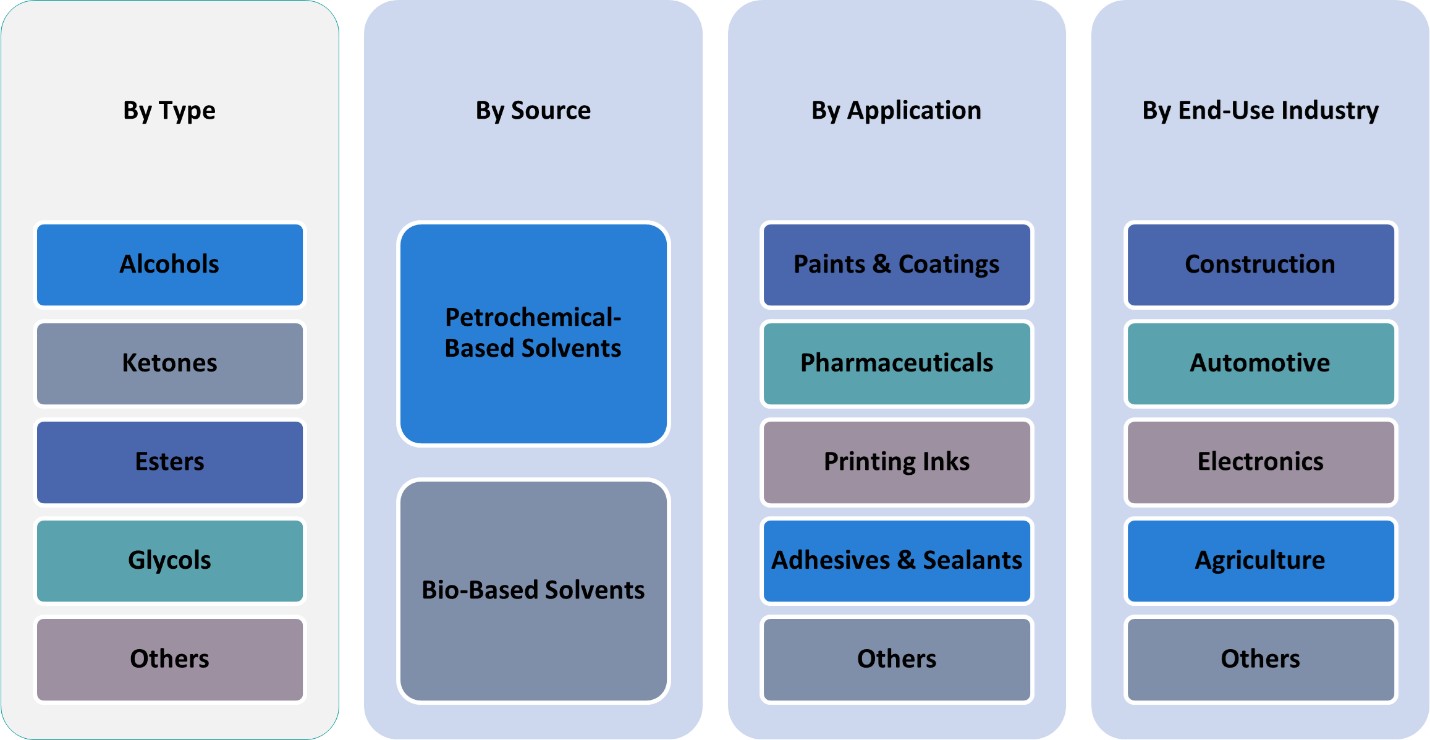
This report segments the Mexico Industrial Solvents market as follows:
Market Drivers
Expansion of Key End-Use Industries
One of the primary drivers of the Mexico industrial solvents market is the consistent growth of key end-use sectors such as automotive, construction, pharmaceuticals, and manufacturing. For instance, Mexico’s automotive sector has seen increased reliance on solvent-based coatings and cleaning solutions due to rising production volumes and export activities. These industries rely heavily on solvents for a variety of applications, including degreasing, cleaning, and chemical processing. In particular, the automotive industry uses solvents extensively in surface coatings and parts cleaning, while the construction sector drives demand for paints, adhesives, and sealants that depend on solvent-based formulations. As these industries continue to grow due to domestic consumption and export opportunities, the demand for industrial solvents is expected to rise proportionally.
Rising Urbanization and Infrastructure Development
Mexico’s ongoing urbanization and infrastructure development initiatives are also fueling the demand for industrial solvents. Government-backed infrastructure projects-ranging from residential construction to commercial buildings and transportation networks-have significantly increased the use of coatings, sealants, and other chemical products that incorporate solvents. Additionally, growth in the real estate and housing sector has created a robust downstream market for construction-related chemicals. As urban centers expand and infrastructure spending increases, the associated rise in solvent consumption further strengthens the market outlook.
Supportive Government Policies and FDI Inflows
The Mexican government's focus on industrialization, economic diversification, and foreign direct investment (FDI) has been instrumental in driving solvent demand. Through free trade agreements and economic development zones, Mexico has positioned itself as a manufacturing hub in North America. For instance, Mexico’s pharmaceutical sector has seen increased FDI inflows, with government-backed initiatives supporting local production and export growth. This favorable business environment has encouraged global chemical manufacturers to establish operations in the country, increasing domestic production and consumption of industrial solvents. Government incentives for pharmaceutical and electronics manufacturing-both solvent-intensive industries-are also contributing to market growth. These policy initiatives not only boost local consumption but also enhance export competitiveness for solvent-based products.
Shift Toward Green and Sustainable Solvents
Environmental sustainability is becoming a major influence in the industrial solvents market. Stricter environmental regulations surrounding VOC (volatile organic compound) emissions, worker safety, and hazardous waste disposal are encouraging manufacturers to adopt eco-friendly alternatives. The growing preference for bio-based and low-VOC solvents is leading to increased R&D and innovation in solvent formulations. Companies are investing in green chemistry solutions that meet both performance and regulatory standards, aligning with global sustainability goals. This shift not only addresses environmental concerns but also opens new opportunities for product differentiation and long-term growth in the solvent market.
Market Trends
Shift Toward Sustainable and Bio-Based Solvents
The Mexico industrial solvents market is witnessing a significant trend toward sustainability, driven by increasing environmental awareness and stricter government regulations. Regulatory bodies are enforcing tighter controls on the emission of volatile organic compounds (VOCs), which are commonly found in conventional solvents. As a result, there is a growing shift toward the use of low-VOC, water-based, and bio-based solvents derived from renewable resources such as corn, sugarcane, and soy. These green alternatives are gaining traction across end-use industries including paints, coatings, and pharmaceuticals due to their lower toxicity and reduced environmental footprint. In addition, multinational companies operating in Mexico are aligning with global sustainability goals, thereby increasing investment in research and development (R&D) to produce eco-friendly solvent solutions. This trend is expected to accelerate as consumers and industrial users prioritize environmentally responsible products and processes.
Increasing Demand from Paints, Coatings, and Adhesives
One of the most prominent trends in the Mexico industrial solvents market is the growing demand from the paints, coatings, and adhesives segment. As Mexico continues to experience expansion in its construction, automotive, and real estate sectors, the need for high-performance coatings has surged. For instance, Mexico’s paints and coatings market has reported a surge in demand due to urban expansion and large-scale infrastructure projects. Solvents play a vital role in improving the application properties and finish quality of these products. With the rise of infrastructure development projects, both public and private, solvent-based products are seeing heightened use. Simultaneously, end-users are showing a preference for specialty solvents that offer faster drying times, greater durability, and compliance with safety and environmental standards. As innovation continues in coating technologies, the use of advanced solvent systems tailored for specific applications is becoming more prevalent.
Technological Advancements and Process Optimization
Technology and innovation are shaping the evolution of industrial solvent applications in Mexico. New advancements in chemical engineering and process automation are enabling manufacturers to develop solvents with enhanced performance characteristics such as improved solvency, thermal stability, and compatibility with multiple substrates. For instance, Mexico’s solvent market has seen increased investment in research and development, focusing on specialized solvent formulations for high-performance applications. Digital tools and data analytics are also being utilized to optimize production processes, improve batch consistency, and reduce waste. Moreover, the growing adoption of closed-loop solvent recovery systems is helping industries improve operational efficiency and minimize environmental impact. These technologies are particularly valuable in sectors like pharmaceuticals, where stringent purity requirements demand precision and traceability in solvent use. The integration of such advancements is setting a new benchmark for quality, safety, and sustainability in solvent manufacturing.
Strategic Alliances and Market Diversification
The Mexican industrial solvents market is becoming increasingly dynamic, with companies forming strategic partnerships, mergers, and acquisitions to strengthen their market positions. Local and global players are collaborating to diversify their product portfolios, access new technologies, and enter untapped market segments. These alliances are especially common in response to the rising demand for specialized solvents in sectors such as electronics, healthcare, and agrochemicals. In parallel, firms are investing in regional distribution networks and localized production facilities to enhance supply chain efficiency and meet the growing needs of domestic and export markets. This diversification not only improves competitiveness but also positions the industry to respond agilely to changing market conditions and customer preferences.
Market Challenges Analysis
Regulatory Pressure and Environmental Compliance
One of the primary challenges facing the Mexico industrial solvents market is the increasing stringency of environmental regulations, particularly around the use and disposal of volatile organic compounds (VOCs). Regulatory bodies such as the Secretaría de Medio Ambiente y Recursos Naturales (SEMARNAT) and other environmental authorities are enforcing stricter emission controls to address air pollution and occupational health risks. For instance, Mexico’s General Law of Ecological Balance and Environmental Protection outlines stringent guidelines for VOC emissions, requiring industries to adopt cleaner technologies and sustainable practices. These regulations compel manufacturers to invest in reformulating products or transitioning to low-VOC and eco-friendly solvent alternatives, which can involve high R&D and production costs. Additionally, compliance with international standards such as REACH and EPA norms becomes a barrier for Mexican producers aiming to expand globally. For small and mid-sized enterprises, the financial and technical burden of aligning with evolving regulatory frameworks poses a significant challenge, potentially restricting innovation and delaying time-to-market for new products.
Raw Material Volatility and Supply Chain Constraints
Another key challenge impacting the industrial solvents market in Mexico is the volatility in raw material prices and disruptions in global supply chains. Solvent production is heavily dependent on petrochemical feedstocks such as methanol, ethanol, acetone, and toluene, whose prices are subject to fluctuations in crude oil markets and geopolitical instability. This price volatility impacts manufacturing margins and creates uncertainty in procurement planning. In addition, the COVID-19 pandemic and subsequent global logistics issues revealed vulnerabilities in the supply chain, particularly for imported chemicals and intermediates. Mexico’s reliance on international suppliers for several raw materials exposes local manufacturers to delivery delays and increased costs. While some efforts have been made to localize production and build strategic reserves, these initiatives remain limited and require long-term investment. Until supply chains become more resilient and raw material sourcing is stabilized, the market will continue to face pressure from input cost unpredictability and supply availability.
Market Opportunities
The Mexico industrial solvents market presents substantial growth opportunities, primarily driven by the country’s expanding manufacturing base and increasing integration into global supply chains. As Mexico continues to position itself as a key player in the North American manufacturing corridor, demand for industrial solvents across sectors such as automotive, electronics, and pharmaceuticals is projected to rise steadily. The implementation of the United States-Mexico-Canada Agreement (USMCA) has further enhanced trade relations and attracted significant foreign direct investment, particularly in high-tech and value-added industries that require a wide range of solvent applications. This shift offers manufacturers the chance to diversify their solvent portfolios to cater to specialized needs, including high-purity and performance-grade solvents. Furthermore, ongoing infrastructure development and urbanization are expected to support increased consumption of solvent-based products used in coatings, adhesives, and construction chemicals.
In addition, the growing trend toward sustainable and environmentally friendly chemical solutions opens new market avenues for bio-based and low-VOC solvent innovations. As regulatory frameworks continue to evolve and environmental consciousness rises, there is a clear opportunity for companies to invest in green chemistry and differentiate themselves through responsible manufacturing practices. The demand for non-toxic, biodegradable solvents is increasing across industries such as food processing, cosmetics, and pharmaceuticals, where consumer safety and compliance are paramount. Moreover, advancements in solvent recovery and recycling technologies are creating possibilities for cost reduction and waste minimization, offering a dual advantage of operational efficiency and environmental compliance. Companies that prioritize sustainable product development and invest in research and development tailored to regional needs are well-positioned to capture emerging demand and strengthen their foothold in the growing Mexican market.
Segments:
Based on Type:
- Alcohols
- Ketones
- Esters
- Glycols
- Others
Based on Application:
- Paints & Coatings
- Pharmaceuticals
- Printing Inks
- Adhesives & Sealants
- Others
Based on End- Use:
- Construction
- Automotive
- Electronics
- Agriculture
- Others
Based on Source:
- Petrochemical-Based Solvents
- Bio-Based Solvents
Based on the Geography:
- Mexico City
- Monterrey
- Guadalajara
- Tijuana
Regional Analysis
Mexico City
Mexico City accounts for the largest share of the industrial solvents market in the country, contributing approximately 34% of the total market value. As the nation’s capital and a major industrial and commercial hub, Mexico City hosts a diverse range of manufacturing activities, including pharmaceuticals, chemicals, automotive parts, and construction materials. The region benefits from strong infrastructure, well-established distribution networks, and proximity to major research institutions and government bodies. These advantages foster high demand for industrial solvents in formulations, coatings, and production processes. Furthermore, Mexico City’s ongoing urban development and public infrastructure investments continue to drive solvent usage in the construction and paints sectors. Its robust regulatory oversight also encourages companies to invest in low-VOC and eco-friendly solvent solutions, creating a strong market for sustainable alternatives.
Monterrey
Monterrey holds a significant 26% market share and stands out as a leading industrial center in northern Mexico. Known for its strong presence in steel, glass, automotive, and chemical manufacturing, Monterrey generates substantial demand for solvents used in surface treatment, degreasing, and industrial cleaning. The city’s proximity to the United States and its role as a logistics hub make it attractive to both domestic and multinational manufacturers seeking efficient supply chain access. Monterrey’s solvent market is also supported by high levels of industrial automation and adoption of advanced technologies in manufacturing processes, leading to increased consumption of specialty solvents that meet specific performance and safety requirements.
Guadalajara
Guadalajara contributes around 22% of the market share and is a fast-growing center for electronics, pharmaceuticals, and packaging industries-all of which require high-quality solvent solutions. Often referred to as the "Silicon Valley of Mexico," Guadalajara has seen a surge in foreign investment in electronics assembly and medical device manufacturing. These sectors demand solvents for precision cleaning, coating, and component processing. The local government’s support for innovation and sustainable practices further drives the demand for green solvents in this region. Additionally, Guadalajara’s expanding urban infrastructure and growing real estate sector are increasing the use of solvent-based construction products, adding to the region’s market momentum.
Tijuana
Tijuana represents an emerging market in the solvent sector, with a current market share of approximately 18%. Located on the U.S. border, Tijuana benefits from cross-border trade and a strong maquiladora (export-oriented manufacturing) industry. The city is a key hub for electronics, automotive parts, and medical equipment manufacturing-all of which are solvent-intensive sectors. As Tijuana continues to attract foreign investment and expand its industrial base, the demand for cleaning agents, adhesives, and specialty solvents is expected to grow. Although currently the smallest among the four key regions, Tijuana’s strategic location and growing industrial infrastructure position it as a promising area for future solvent market expansion.
Key Player Analysis
- Dow Inc.
- ExxonMobil Corporation
- Eastman Chemical Company
- Ashland Mexico Holdings Inc.
- Huntsman Corporation
- LyondellBasell Industries
- Celanese Corporation
- PPG Industries, Inc.
- Chevron Phillips Chemical Company
- DuPont de Nemours, Inc.
Competitive Analysis
The Mexico industrial solvents market is highly competitive, with leading players focusing on innovation, sustainability, and strategic partnerships to maintain their market positions. Dow Inc., ExxonMobil Corporation, Eastman Chemical Company, Ashland Mexico Holdings Inc., Huntsman Corporation, LyondellBasell Industries, Celanese Corporation, PPG Industries, Inc., Chevron Phillips Chemical Company, and DuPont de Nemours, Inc. are the dominant companies shaping the industry landscape. Companies are increasingly investing in the development of eco-friendly and bio-based solvents, responding to the growing demand for sustainable solutions across various industries, including automotive, construction, and pharmaceuticals. There is a notable shift towards the adoption of low-VOC and green chemistry products to comply with stricter environmental regulations. In addition, key players are enhancing their production capabilities by incorporating advanced manufacturing technologies and expanding their solvent portfolios to meet the evolving demands of the market. As automation and digitalization continue to shape industrial processes, companies are leveraging these trends to boost solvent consumption, especially in sectors requiring high-precision applications like coatings and cleaning. Furthermore, companies are pursuing strategic mergers and acquisitions, along with expanding their distribution networks to strengthen their reach within the region. Regional expansion is crucial, particularly in Mexico's key industrial hubs such as Mexico City and Monterrey, where demand for industrial solvents is driven by robust manufacturing and construction activities. These strategies enable players to remain competitive and capture emerging growth opportunities in the Mexican market.
Recent Developments
- In April 2025, Eastman announced off-list price increases for several EOD (Ethylene Oxide Derivatives) solvents, including Eastman™ DB Solvent, effective April 7, 2025, reflecting ongoing cost and market pressures.
- In March 2025, BASF reported generating approximately €11 billion in 2024 sales from products launched in the past five years, driven by R&D focused on sustainability, biodegradable materials, and digital transformation. The company filed 1,159 new patents in 2024, with 45% targeting sustainability. R&D investment in 2024 was €2.1 billion, with a similar budget planned for 2025.
- In March and April 2025, Shell is restructuring its global chemicals business to boost profitability and reduce capital spending by 2030. This includes exploring strategic partnerships in the U.S., potentially closing some European assets, and selling existing assets like the Singapore refinery and chemical complex. The company aims to streamline operations, focus on core businesses, and improve returns for shareholders.
- In March 2025, BASF is expanding its production capacity for aminic antioxidants at its Puebla, Mexico site, targeting the growing demand for long-life lubricants. The project is set for completion in 2026.
- In March 2025, ExxonMobil announced a $100 million upgrade to its Baton Rouge, Louisiana plant to produce ultra-high-purity (99.999%) isopropyl alcohol (IPA) for the semiconductor industry by 2027.
- In March 2024, Dow announced plans to invest in new ethylene derivatives capacity-including carbonate solvents-on the U.S. Gulf Coast. This investment, supported by the U.S. Department of Energy, aims to supply carbonate solvents for lithium-ion batteries, supporting the domestic EV and energy storage market. The facility will capture over 90% of CO₂ from ethylene oxide production, aligning with sustainability goals.
Market Concentration & Characteristics
The Mexico industrial solvents market exhibits a moderate level of market concentration, with a mix of global and regional players dominating the landscape. A few large multinational corporations hold significant market shares, benefiting from their advanced technological capabilities, established brand presence, and extensive distribution networks. These companies typically lead in the development of high-performance, eco-friendly, and bio-based solvents, which are increasingly in demand due to rising environmental concerns and regulatory pressures. Despite the dominance of key players, the market also offers opportunities for regional manufacturers and smaller players to capitalize on niche markets, particularly in sectors like pharmaceuticals and electronics. The market is characterized by a high level of innovation, with firms focusing on developing sustainable and compliant solutions to meet stringent environmental standards. Additionally, strong competition is driving companies to invest in R&D, product diversification, and improved production efficiencies to meet evolving customer needs and regional demands.
Report Coverage
The research report offers an in-depth analysis based on Type, Application, End-Use, Source and Geography. It details leading market players, providing an overview of their business, product offerings, investments, revenue streams, and key applications. Additionally, the report includes insights into the competitive environment, SWOT analysis, current market trends, as well as the primary drivers and constraints. Furthermore, it discusses various factors that have driven market expansion in recent years. The report also explores market dynamics, regulatory scenarios, and technological advancements that are shaping the industry. It assesses the impact of external factors and global economic changes on market growth. Lastly, it provides strategic recommendations for new entrants and established companies to navigate the complexities of the market.
Future Outlook
- The Mexico industrial solvents market is projected to experience steady growth, driven by increasing demand across various end-use industries.
- Environmental regulations are prompting a shift towards eco-friendly and bio-based solvents, aligning with global sustainability trends.
- Technological advancements in solvent formulations are enhancing performance while reducing environmental impact.
- The pharmaceutical and personal care sectors are increasingly adopting bio-based solvents due to their non-toxic and biodegradable properties.
- The growing focus on green chemistry is encouraging manufacturers to develop solvents that minimize waste and hazardous emissions.
- Strategic collaborations and partnerships are being pursued to expand product portfolios and enhance technological capabilities.
- Digitalization and automation in solvent production processes are improving efficiency and product quality.
- The expansion of the paints and coatings industry is driving the demand for high-performance and low-VOC solvents.
- Rising industrialization and urbanization are contributing to increased solvent consumption in construction and manufacturing sectors.
- The adoption of chemical leasing models is promoting the efficient use of solvents and reducing environmental impact.

Request a Free Sample
Fill in your details and we'll send you a free sample report.
- Sample data tables & charts
- Research methodology
Need a Custom Version of This Report?
Tailor the scope, geography, or segments to your exact requirements.
- Custom geography or segment scope
- Direct access to our analyst team
Frequently Asked Questions
What is the current size of the Mexico Industrial Solvents?
What factors are driving the growth of the Mexico Industrial Solvents?
What are some challenges faced by the Mexico Industrial Solvents?
Who are the major players in the Mexico Industrial Solvents?
Table of Content
Chapter 1. Report Introduction
- 1.1 Report Description & Purpose
- 1.1.1 Report Title & Market Definition
- 1.1.2 Unique Selling Propositions (USP) & Key Differentiators
- 1.1.3 Value Proposition for Stakeholders
- 1.2 Research Objectives
- 1.2.1 Market Sizing Objectives (Volume & Revenue) (Volume Where Applicable)
- 1.2.2 Segmentation Objectives
- 1.2.3 Competitive Intelligence Objectives
- 1.2.4 Forecast & Scenario Objectives
- 1.3 Report Scope
- 1.3.1 Mexico Industrial Solvents Scope – Segments & Subsegments Covered
- 1.3.2 Geographic Scope – Selected Country & Subnational Markets Covered
- 1.3.3 Historical Period, Base Year & Forecast Period (2024; forecast to 2032)
- 1.3.4 Inclusions & Exclusions
- 1.4 Industry Classification & Applicable Codes
- 1.5 Currency, Measurement Units & Valuation Basis
- 1.6 Target Stakeholders
- 1.7 Limitations & Assumptions
Chapter 2. Executive Summary
- 2.1 Mexico Industrial Solvents Snapshot
- 2.1.1 Market Size – Historical (2024) & Forecast (2024-2032) (2024: USD 874.07 million → 2032: USD 1,373.49 million)
- 2.1.2 Volume & Revenue – National Totals (Volume Where Applicable)
- 2.1.3 Key Market Highlights – Top Five Facts
- 2.2 Mexico Industrial Solvents Segmentation Snapshot
- 2.2.1 Market Split by Subnational Area – 2024 vs. 2032
- 2.3 Competitive Snapshot
- 2.3.1 Top 10 Players by Revenue Share – 2024
- 2.3.2 Top 10 Players by Volume Share – 2024 (Volume Where Applicable)
- 2.3.3 Recent Strategic Developments (18-Month Summary)
- 2.4 Key Investment Highlights & Strategic Conclusions
Chapter 3. Mexico Industrial Solvents Dynamics & Industry Analysis
- 3.1 Market Overview & Context
- 3.1.1 Mexico Industrial Solvents Position in the Broader Industry Value Chain
- 3.1.2 Demand Structure & Purchasing Dynamics
- 3.1.3 Market Maturity & Development Stage Across Domestic Markets
- 3.2 Mexico Industrial Solvents Drivers
- 3.3 Mexico Industrial Solvents Restraints & Challenges
- 3.4 Mexico Industrial Solvents Opportunities
- 3.5 Porter's Five Forces Analysis
- 3.5.1 Threat of New Entrants
- 3.5.2 Bargaining Power of Suppliers
- 3.5.3 Bargaining Power of Buyers
- 3.5.4 Threat of Substitutes
- 3.5.5 Competitive Rivalry – Intensity Assessment
- 3.6 Mexico Industrial Solvents Value Chain Analysis
- 3.6.1 Upstream – Key Inputs, Resources & Suppliers
- 3.6.1.1 Key Input/Resource 1
- 3.6.1.2 Key Input/Resource 2
- 3.6.1.3 Key Input/Resource 3
- 3.6.2 Midstream – Core Operations & Value Creation
- 3.6.2.1 Operating Model & Process Overview
- 3.6.2.2 Key Operating Locations & Capabilities by Company
- 3.6.3 Downstream – Market Channels & End Users
- 3.6.3.1 Direct Sales & Customer Engagement Channels
- 3.6.3.2 Indirect Sales, Intermediaries & Partner Channels
- 3.6.4 Value Chain Profitability Analysis
- 3.6.1 Upstream – Key Inputs, Resources & Suppliers
- 3.7 PESTEL Analysis
- 3.7.1 Political Factors
- 3.7.2 Economic Factors
- 3.7.3 Social Factors
- 3.7.4 Technological Factors
- 3.7.5 Environmental Factors
- 3.7.6 Legal Factors
- 3.8 Mexico Industrial Solvents Supply Chain Analysis
- 3.8.1 Critical Input & Resource Availability Risk Assessment
- 3.8.2 Supplier & Operational Concentration Risk (Geographic Exposure)
- 3.8.3 Supply & Service Disruption Impact Analysis
- 3.9 National & Subnational Regulatory Landscape
Note: The regulatory and policy landscape section covers regulations based on their applicability to the market, Mexico Industrial Solvents category, geography, and scope of the study. Only regulatory frameworks with a material impact on operations, compliance, trade, sustainability, or market access are analyzed in detail.
Chapter 4. Key Investment Pockets & Opportunity Analysis
- 4.1 Mexico Industrial Solvents Attractiveness Analysis
- 4.1.1 By Subnational Area – Investment Attractiveness Matrix (Market Size × CAGR)
- 4.2 Absolute Revenue Growth Opportunity
- 4.2.1 By Subnational Area – Absolute Revenue Growth Through 2032
- 4.3 Incremental Demand Opportunity
- 4.3.1 By Subnational Area – Incremental Demand Through 2032
- 4.3.2 Segment – Incremental Demand
- 4.4 Emerging Submarket Opportunity Deep Dive (Subject to Applicability)
- 4.5 Priority Domestic Market Opportunity Scorecards
- 4.5.1 Priority Domestic Market 1
- 4.5.2 Priority Domestic Market 2
- 4.5.3 Priority Domestic Market 3
- 4.5.4 Priority Domestic Market 4
Note: Domestic market scorecards cover relevant states, provinces, territories, cities, or economic zones within the selected country. Numbered entries are populated with market names suited to the national administrative structure and research scope. Geographic share tables use one consistent, nonoverlapping set of areas.
Chapter 5. Mexico Industrial Solvents Cross-Border Trade & Market Access Analysis
- 5.1 National Trade & International Partner Overview
- 5.1.1 Export Value by Destination Country (2024)
- 5.1.2 Export Volume by Destination Country (2024) (Where Applicable)
- 5.1.3 Import Value by Source Country (2024)
- 5.1.4 Import Volume by Source Country (2024) (Where Applicable)
- 5.1.5 National & Partner-Country Trade Balances (2024)
- 5.2 Export Analysis – Segment
- 5.2.1 Category 1 (Applicable Classification Code)
- 5.2.2 Category 2 (Applicable Classification Code)
- 5.2.3 Category 3 (Applicable Classification Code)
- 5.2.4 Category 4 (Applicable Classification Code)
- 5.2.5 Category 5 (Applicable Classification Code)
- 5.3 Import Analysis – Segment
- 5.3.1 Category 1 (Applicable Classification Code)
- 5.3.2 Category 2 (Applicable Classification Code)
- 5.3.3 Category 3 (Applicable Classification Code)
- 5.3.4 Category 4 (Applicable Classification Code)
- 5.3.5 Category 5 (Applicable Classification Code)
- 5.4 Cross-Border Pricing & Transaction Benchmarks
- 5.4.1 Export Pricing – Segment & Destination Country
- 5.4.2 Import Pricing – Segment & Source Country
- 5.4.3 Price Trends (2024)
- 5.5 Key Cross-Border Trade & Delivery Routes
- 5.5.1 Cross-Border Trade/Delivery Route 1
- 5.5.2 Cross-Border Trade/Delivery Route 2
- 5.5.3 Cross-Border Trade/Delivery Route 3
- 5.5.4 Cross-Border Trade/Delivery Route 4
- 5.5.5 Cross-Border Trade/Delivery Route 5
- 5.6 Trade Policy & Market Access Impact Assessment
- 5.6.1 Tariff & Non-Tariff Barriers
- 5.6.2 National Participation in Regional Trade & Economic Frameworks
- 5.6.3 Bilateral & Multilateral Trade Agreements
- 5.6.4 Cross-Border Operating, Licensing & Localization Requirements
Note: This chapter covers international trade relevant to Mexico Industrial Solvents in the selected country. Exports are analyzed by destination and imports by source. Domestic interregional flows are excluded from international trade totals. Goods, services, and digital offerings use applicable classifications; volume and route analyses apply only where meaningful.
Chapter 6. Competitive Landscape & Company Benchmarking
- 6.1 Mexico Industrial Solvents Concentration & Structure
- 6.1.1 Herfindahl-Hirschman Index (HHI) – vs. 2024
- 6.1.2 Leading, Mid-Sized & Emerging Player Structure
- 6.1.3 Multinational, National & Local Player Dynamics
- 6.2 Mexico Industrial Solvents Share Analysis – 2024
- 6.2.1 National Revenue Share by Company
- 6.2.2 National Volume Share by Company (Volume Where Applicable)
- 6.2.3 Company Revenue Share by Subnational Area
- 6.2.4 Market Share Evolution ( vs. 2024)
- 6.2.5 Company Market Share by Key Segment
- 6.2.6 Company Market Share by Customer Group
- 6.3 Operating Scale, Capacity & Infrastructure Analysis
- 6.3.1 National Operating Scale & Supply Capacity
- 6.3.2 Resource Utilization & Operating Efficiency
- 6.3.3 Output, Service Delivery & Activity Metrics
- 6.3.4 Operating Footprint & Infrastructure Map
- 6.3.5 Planned Operational & Capacity Expansion
- 6.4 Mexico Industrial Solvents Competitive Benchmarking Matrix
- 6.4.1 Revenue, Growth, Profitability & Operating Metric Comparison
- 6.4.2 Channel Revenue Mix
- 6.4.3 Revenue Exposure Across Domestic Markets
- 6.4.4 R&D Intensity
- 6.4.5 Sustainability Maturity
- 6.5 Strategic Developments in Mexico Industrial Solvents (Last 24 Months)
- 6.5.1 Mergers, Acquisitions & Divestments
- 6.5.2 New Products, Services & Solutions in Mexico Industrial Solvents
- 6.5.3 Operational & Infrastructure Expansions
- 6.5.4 Strategic Alliances, Joint Ventures & Partnerships
- 6.5.5 Distribution Expansion & Market Entry
- 6.5.6 Sustainability & ESG Initiatives
- 6.6 Competitive Strategy Mapping
- 6.6.1 Leader, Challenger, Follower & Niche Classification
- 6.6.2 Pricing Strategy Comparison
- 6.6.3 Channel Strategy Matrix
Note: Strategic developments are included based on their materiality and the availability of reliable information.
Chapter 7. Mexico Industrial Solvents – By Sales & Delivery Channel
- 7.1 Segment Overview
- 7.1.1 Volume & Revenue Split by Channel (2024 & 2032) (Volume Where Applicable)
- 7.1.2 Channel Mix Evolution (2024-2032)
Chapter 8. Subnational Market Analysis – Country Overview
- 8.1 Domestic Geographic Market Overview
- 8.1.1 Subnational Volume Share (Where Applicable)
- 8.1.2 Subnational Revenue Share
- 8.1.3 Market Volume by Subnational Area (Where Applicable)
- 8.1.4 Market Revenue by Subnational Area
- 8.1.5 Subnational Forecasts Through 2032
- 8.2 Cross-Area Segment Analysis Within the Country
- 8.2.1 By Sales & Delivery Channel
- 8.2.2 By Competitive Positioning & Price Tier
Chapter 9. Mexico Industrial Solvents – Priority Domestic Market 1
Chapter 10. Mexico Industrial Solvents – Priority Domestic Market 2
Chapter 11. Mexico Industrial Solvents – Priority Domestic Market 3
Chapter 12. Mexico Industrial Solvents – Priority Domestic Market 4
Chapter 13. Mexico Industrial Solvents Company Profiles
- 13.1 [Company 01]
- 13.1.1 Company Overview
- 13.1.2 Key Management Personnel
- 13.1.3 Products & Services Portfolio
- 13.1.4 Financial Performance
- 13.1.5 Domestic Market Focus & Local Operating Presence
- 13.1.6 Recent Developments & Strategic Initiatives
Note: The company profile list is preliminary and may change based on research findings, market developments, data availability, and client requirements.
Chapter 14. Appendices
- Appendix A – List of Abbreviations & Acronyms
- Appendix B – Industry Classification Code Reference – Full Series
- Appendix C – Supply, Output & Operating Capacity Data Tables
- Appendix D – End-Use & Demand Base Tables
- Appendix E – Demand, Adoption & Usage Assumptions
- Appendix F – Pricing & Revenue Metric Reference Tables
- Appendix G – Company Operations & Infrastructure Database
- Appendix H – Cross-Border Trade & Activity Data Tables (Where Applicable)
- Appendix I – Regulatory Summary Tables
- Appendix J – Primary Research Participant List (Anonymized)
- Appendix K – Primary Research Questionnaire Framework
- Appendix L – Data Sources & Bibliography
- Appendix M – Market Size Divergence & Source Comparison
Chapter 15. Research Methodology
- 15.1 Research Framework & Philosophy
- 15.2 Secondary Research – Sources, Hierarchy & Data Extraction
- 15.3 Data Modeling – National Market Sizing & Subnational Allocation
- 15.4 Primary Research – Stakeholder Framework, LOI & Sample Sizes
- 15.5 Forecast Methodology – Regression, Scenario & Sensitivity Analysis
- 15.6 Quality Control – Four-Layer Validation Framework
- 15.7 Limitations & Standard Assumptions
- 15.8 Disclaimer
