
Market Overview:
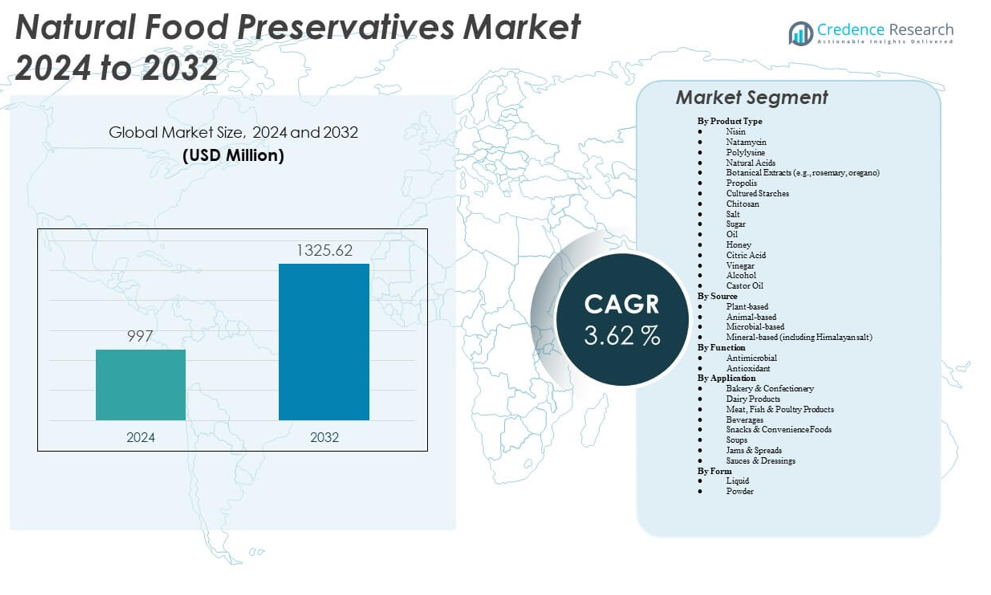
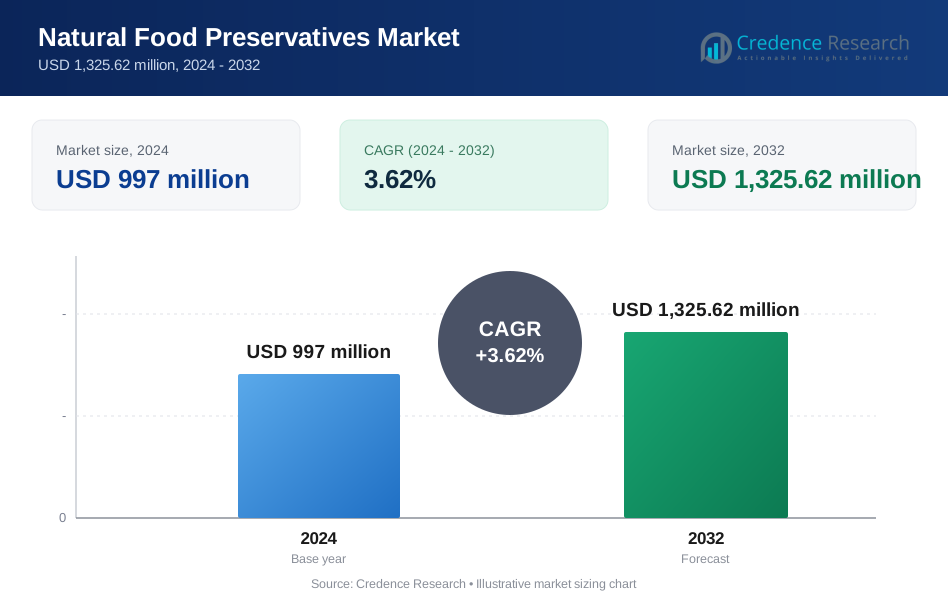
The Natural Food Preservatives Market is projected to grow from USD 997 million in 2024 to an estimated USD 1,325.62 million by 2032, with a compound annual growth rate (CAGR) of 3.62% from 2024 to 2032.
| REPORT ATTRIBUTE | DETAILS |
|---|---|
| Historical Period | 2020-2023 |
| Base Year | 2024 |
| Forecast Period | 2025-2032 |
| Natural Food Preservatives Market Size 2024 | USD 997 million |
| Natural Food Preservatives Market, CAGR | 3.62% |
| Natural Food Preservatives Market Size 2032 | USD 1,325.62 million |
The market growth is largely driven by the increasing consumer preference for clean-label products and natural food ingredients. As more consumers become health-conscious, the demand for food without synthetic additives rises, boosting the adoption of natural preservatives. Stringent regulations on synthetic preservatives also encourage food manufacturers to explore safer, natural alternatives. This trend is especially evident in processed foods, where natural preservatives help maintain product quality while addressing health concerns.
Regionally, North America leads the market due to high consumer awareness and regulatory frameworks that prioritize clean-label and organic products. Europe follows closely, driven by its stringent food safety regulations and demand for sustainable, organic food options. Asia Pacific is an emerging market, showing rapid growth in natural preservatives adoption, fueled by rising urbanization, expanding food industries, and changing consumer preferences towards healthier and natural food options.
Market Insights:
- The Natural Food Preservatives Market is projected to grow from USD 997 million in 2024 to USD 1,325.62 million by 2032, with a CAGR of 3.62% from 2024 to 2032.
- Rising consumer demand for clean-label and natural food products is driving the market’s growth.
- Strict regulations on synthetic preservatives are encouraging the adoption of natural alternatives.
- Health-conscious consumer behavior, seeking safer and chemical-free food options, contributes to market expansion.
- High production costs and limited shelf life of natural preservatives may restrain growth.
- North America leads the market, with Europe closely following due to regulatory support and demand for organic foods.
- Asia Pacific is emerging as a key growth region, with expanding food industries and increasing consumer preference for natural food products.
Market Drivers:
Health Conscious Consumers Driving Demand for Natural Ingredients
The shift towards healthier eating habits is a major driver of the Natural Food Preservatives Market. Consumers are increasingly aware of the harmful effects of synthetic preservatives and additives. They are seeking cleaner, more natural alternatives in the food they consume. This heightened awareness promotes the use of preservatives derived from plants and other natural sources, catering to the demand for clean-label products. The push for health-focused, preservative-free foods is reshaping the food preservation landscape. With more individuals prioritizing organic and non-GMO foods, the market for natural preservatives is expanding rapidly. Brands are investing in products that align with these health-conscious trends. This consumer preference continues to grow as people become more knowledgeable about the ingredients in their food.
- For instance, Kemin Industries’ FORTIUM™ R and EN-FORT™ products, both based on rosemary extract, are natural antioxidants validated to extend shelf life and maintain food freshness. Kemin’s rosemary extract complies with E392 food specs and is available in certified organic forms, demonstrating adoption by processed snack and bakery producers for clean label compliance.
Regulatory Support Boosting Natural Preservative Adoption
Strict regulations on synthetic preservatives in many countries are further pushing the demand for natural food preservatives. Governments around the world are tightening food safety regulations, especially concerning additives and chemicals. This has encouraged food producers to explore alternatives that are both safe and compliant with new guidelines. Natural preservatives offer a solution to regulatory constraints while maintaining product quality. Many companies are opting for plant-based preservatives to ensure compliance with these evolving standards. This shift not only addresses regulatory requirements but also enhances the credibility of food brands. With regulatory bodies continuing to enforce stricter rules on food additives, natural preservatives are gaining more prominence. As this trend continues, the market for natural food preservatives will likely expand further.
- For instance, Corbion’s Verdad® line including Verdad Opti Powder N70 and Verdad Avanta offers natural, cultured sugar- and celery-based preservatives, which are actively adopted by meat, poultry, and plant-based food manufacturers to comply with strict labeling and sodium reduction mandates in the US and Europe.
Rising Demand for Processed and Packaged Foods
The increasing demand for packaged and convenience foods significantly contributes to the growth of the Natural Food Preservatives Market. As consumers lead busier lives, the demand for ready-to-eat and shelf-stable products continues to rise. Natural preservatives play an essential role in ensuring the shelf life and safety of these products without compromising on quality. Food manufacturers are adopting these preservatives to meet the rising consumer demand for healthier, ready-made food options. With growing urbanization and shifting lifestyle trends, this demand is expected to rise globally. Processed foods are particularly popular in emerging markets where convenience plays a key role. As manufacturers prioritize both convenience and health, the market for natural preservatives is projected to grow.
Advances in Natural Preservation Technologies
Technological advancements in food preservation are contributing to the expansion of the Natural Food Preservatives Market. Companies are continuously innovating to develop more effective and sustainable natural preservatives. Research into novel preservation methods, such as fermentation and essential oils, is gaining momentum. These innovations help address challenges associated with the preservation of perishable food products while maintaining their nutritional value. The development of advanced extraction methods is allowing for better quality and efficiency in preserving food. With these innovations, natural preservatives are becoming more viable, cost-effective, and accessible for a wide range of food products. These advancements help food manufacturers to cater to the growing demand for clean, natural food products. Technological progress will continue to be a key factor in driving market growth.
Market Trends:
Increasing Popularity of Organic Foods
The demand for organic foods is another significant trend in the Natural Food Preservatives Market. Consumers are increasingly turning to organic produce and packaged foods, driven by a growing awareness of environmental and health concerns. Organic food manufacturers are turning to natural preservatives to maintain the integrity of their products without compromising their organic status. This trend is fueling the growth of the natural preservatives market as organic food brands seek alternatives to synthetic additives. The rising demand for organic foods is expected to remain strong in the coming years, offering new opportunities for natural preservative providers. With consumer preferences shifting towards organic, preservative-free, and sustainably produced food, natural preservatives are becoming a key element in meeting these demands. Brands are prioritizing natural, non-GMO ingredients, increasing the need for reliable and effective natural preservation solutions. The surge in organic food consumption is set to continue driving market growth.
- For instance, Amy’s Kitchen confirmed that all its frozen meals and soups, including its organic black bean soup, are preserved with organic citric acid instead of synthetic preservatives. This aligns with the company’s commitment to maintaining 100% certified organic status across its portfolio, reflecting strong growth in the organic food sector.
Evolving Consumer Preferences for Clean Labels
Clean labeling has become a major trend in the Natural Food Preservatives Market. Consumers are seeking transparency in the ingredients used in their food, and the demand for clean labels has risen sharply. A clean label emphasizes simple, recognizable ingredients without artificial additives or preservatives. As consumers become more knowledgeable about food production and ingredient sourcing, they are looking for products that align with these preferences. The rise of clean label products directly correlates with the growing adoption of natural preservatives in food. This demand for transparency is driving food manufacturers to seek preservative alternatives that are naturally derived. The trend reflects broader shifts in consumer behavior, where authenticity, sustainability, and health are prioritized. Clean labeling is reshaping how food brands approach preservation, and the natural preservatives market is well-positioned to benefit from this trend.
Expansion of Plant-Based Food Products
The growth of plant-based food products is accelerating the demand for natural food preservatives. As plant-based alternatives to meat, dairy, and other animal products gain popularity, there is an increasing need for natural preservatives to ensure these products maintain their shelf life and safety. Plant-based foods often have unique preservation challenges due to their high moisture content and lack of traditional preservatives. Natural preservatives such as vinegar, rosemary extract, and citrus extracts are finding increased use in these products. As the plant-based food market continues to expand, so does the need for effective natural preservation methods. Manufacturers are increasingly using these preservatives to cater to the growing demand for plant-based foods. The natural preservatives market stands to benefit significantly from this trend, with plant-based food innovation opening up new opportunities.
- For instance, Beyond Meat’s Beyond Sausage and Beyond Burger products use natural preservatives such as apple extract and lemon juice concentrate instead of synthetic options, as stated in the company’s 2024 ingredient policy. This approach helps preserve plant-based freshness while catering to consumer demand for clean, transparent ingredient lists in the growing meat alternatives market.
Technological Advancements in Preservation Methods
Technological innovation continues to play a significant role in the development of natural preservatives. Food manufacturers are investing in new preservation technologies that are not only effective but also meet the rising consumer demand for natural ingredients. Advances in methods such as high-pressure processing, cold plasma, and irradiation are helping to extend the shelf life of food products without the need for synthetic chemicals. These technologies provide effective preservation solutions while maintaining the nutritional integrity and natural flavor of the food. Such technological advancements are transforming the Natural Food Preservatives Market by expanding the range and efficiency of natural preservatives. As these new methods gain traction, more food products are incorporating natural preservatives to align with consumer preferences for healthy, clean-label foods. The growing integration of technology will continue to drive innovations in food preservation.
Market Challenges Analysis:
Cost-Effectiveness and Scalability Issues
One of the primary challenges faced by the Natural Food Preservatives Market is the cost and scalability of production. Natural preservatives, particularly those derived from organic sources, tend to be more expensive compared to synthetic alternatives. The cost of raw materials, extraction processes, and manufacturing techniques associated with natural preservatives often results in higher overall production costs. This challenge can limit the adoption of natural preservatives, particularly in cost-sensitive market segments such as mass-produced packaged foods. Smaller food producers and manufacturers may face difficulty in affording these alternatives, which can slow down the growth of the market. While natural preservatives offer health benefits, their higher cost remains a barrier to widespread adoption, especially in developing markets where affordability is a key consideration. Despite this, manufacturers are exploring more cost-effective production methods, but the issue persists as a significant challenge.
Limited Shelf Life of Natural Preservatives
Another challenge is the limited shelf life of natural preservatives compared to their synthetic counterparts. Natural preservatives, though effective, may not offer the same extended shelf life as chemical-based preservatives. This limits their application in certain food products that require long-term stability, such as snacks, ready-to-eat meals, and beverages. Food manufacturers may need to develop new formulations or use a combination of natural preservatives to overcome this limitation. However, finding the right balance between natural preservation and product longevity remains a hurdle. As demand for shelf-stable natural food products rises, manufacturers face the challenge of maintaining both quality and safety. The need to balance natural ingredients with the practicality of extended shelf life remains a challenge for the Natural Food Preservatives Market.
Market Opportunities:
Rising Demand for Sustainable and Eco-Friendly Solutions
The growing consumer preference for sustainability presents a significant opportunity for the Natural Food Preservatives Market. As environmental concerns increase, both consumers and food manufacturers are turning towards eco-friendly packaging and ingredients. Natural preservatives, derived from plants and other sustainable sources, fit perfectly into the trend toward greener, more sustainable food production. The market for organic and eco-conscious products is expanding, and consumers are willing to pay a premium for foods that align with their values. Companies that focus on providing natural preservatives sourced from renewable resources can capitalize on this opportunity. As sustainability becomes more important, the demand for natural preservatives will likely rise. The push for sustainable solutions opens new avenues for innovation and market expansion. Manufacturers who can meet these demands will find substantial growth opportunities in the market.
Expansion of Emerging Markets and Health Trends
The Natural Food Preservatives Market has significant growth potential in emerging markets, where there is an increasing focus on health and wellness. As disposable income rises in regions like Asia-Pacific and Latin America, there is a growing demand for higher-quality, preservative-free food products. Additionally, health-conscious consumers in these regions are becoming more aware of the risks associated with artificial preservatives, leading to an uptick in demand for natural alternatives. This trend presents an opportunity for manufacturers to introduce natural preservatives to these rapidly growing markets. The rise of middle-class populations and the expansion of modern retail channels in emerging regions will help drive market growth. Manufacturers have the chance to tap into these untapped regions by promoting the benefits of natural food preservatives as part of the health and wellness movement.
Market Segmentation Analysis:
By Product Type
The Natural Food Preservatives Market includes a wide range of product types, each offering unique preservation benefits. Nisin and natamycin are among the most widely used natural preservatives, particularly in dairy and meat products. Polylysine and natural acids are also gaining traction, offering antimicrobial properties to enhance shelf life. Botanical extracts such as rosemary and oregano have strong antioxidant and antimicrobial effects, which make them ideal for preserving various food products. Other products like honey, vinegar, and alcohol are valued for their natural preservation abilities, with honey offering both antimicrobial and moisture-retaining benefits. Each product type serves a specific role in extending food shelf life and maintaining quality, leading to growing adoption across multiple food categories.
- For instance, Danisco (a subsidiary of IFF, formerly DuPont) commercializes Nisaplin™, a nisin-based natural preservative, which is widely used for extending the shelf life of dairy and meat products such as ricotta cheese and cured meats.
By Source
Natural food preservatives are derived from various sources, including plant-based, animal-based, microbial-based, and mineral-based sources. Plant-based preservatives, such as essential oils from herbs, are increasingly popular due to their natural origins and broad functionality. Microbial-based preservatives, such as nisin, provide effective antimicrobial protection, while animal-based preservatives are often used in niche applications. Mineral-based preservatives like Himalayan salt are used for their ability to enhance shelf life, especially in meat and fish products. Each source offers different advantages, with plant-based and microbial-based preservatives leading the market due to their widespread use and regulatory acceptance.
By Function
The main functions of preservatives in the Natural Food Preservatives Market are antimicrobial and antioxidant properties. Antimicrobial preservatives, such as nisin and chitosan, prevent the growth of harmful bacteria and molds, extending the shelf life of perishable foods like dairy and meats. Antioxidant preservatives, including rosemary extract and citric acid, are used to prevent oxidation, maintaining the color, flavor, and nutritional quality of products. Both functions are essential in food preservation, with manufacturers increasingly seeking natural options that deliver these benefits while catering to consumer demand for clean-label ingredients.
By Application
The Natural Food Preservatives Market finds applications in various sectors, including bakery & confectionery, dairy products, meat, fish & poultry, beverages, and snacks. In bakery products, preservatives like vinegar and citric acid help maintain freshness and prevent mold growth. Dairy products often use natural preservatives like nisin and propolis for extended shelf life. The meat and poultry industry benefits from microbial preservatives to prevent spoilage. Beverages, snacks, and sauces also require natural preservatives to maintain quality and safety during distribution. With growing consumer demand for cleaner labels, the adoption of natural preservatives across these applications continues to rise.
By Form Natural food preservatives are available in two primary forms: liquid and powder. Liquid preservatives, such as vinegar, alcohol, and essential oils, are commonly used in beverages, sauces, and dressings due to their ease of incorporation. Powdered preservatives, such as citric acid, salt, and cultured starches, are more suitable for dry foods like snacks and bakery products. Both forms offer specific benefits depending on the type of food product and desired preservation effect. The flexibility of these forms allows manufacturers to choose the most suitable solution based on product characteristics, further driving the adoption of natural preservatives.
- For instance, Jungbunzlauer is a widely recognized producer of powdered citric acid, a natural preservative routinely integrated into beverage, bakery, and snack formulations for its flavor retention and antioxidant benefits. Application guides confirm its adoption in over 200 commercial product formulations, focusing on color and flavor stability evaluated through shelf-life protocols.
Segmentation:
By Product Type
- Nisin
- Natamycin
- Polylysine
- Natural Acids
- Botanical Extracts (e.g., rosemary, oregano)
- Propolis
- Cultured Starches
- Chitosan
- Salt
- Sugar
- Oil
- Honey
- Citric Acid
- Vinegar
- Alcohol
- Castor Oil
By Source
- Plant-based
- Animal-based
- Microbial-based
- Mineral-based (including Himalayan salt)
By Function
- Antimicrobial
- Antioxidant
By Application
- Bakery & Confectionery
- Dairy Products
- Meat, Fish & Poultry Products
- Beverages
- Snacks & Convenience Foods
- Soups
- Jams & Spreads
- Sauces & Dressings
By Form
- Liquid
- Powder
By Region
- North America
- U.S.
- Canada
- Mexico
- Europe
- Germany
- France
- U.K.
- Italy
- Spain
- Rest of Europe
- Asia Pacific
- China
- Japan
- India
- South Korea
- South-east Asia
- Rest of Asia Pacific
- Latin America
- Brazil
- Argentina
- Rest of Latin America
- Middle East & Africa
- GCC Countries
- South Africa
- Rest of the Middle East and Africa
Regional Analysis:
North America: Market Leadership and Clean‑Label Demand
North America commands approximately 34% of the global market share in natural food preservatives. It leads due to high consumer awareness of clean‑label and additive‑free food trends. The United States and Canada house major food processing operations that adopt natural preservation solutions to meet lifestyle and health demands. It benefits from advanced distribution systems and stringent regulatory frameworks that favour natural ingredients. Manufacturers in this region invest heavily in research and development for plant‑based and microbial‑based preservatives. Rising urbanisation and busy lifestyles further boost demand for long shelf‑life products. Market players in North America continue to innovate formulations that meet both safety and natural‑label criteria.
Europe: Mature Market with Regulatory Strength
Europe holds about 28% of the global natural food preservatives market. It ranks second due to its strong regulatory environment and established organic food segments. Countries such as Germany, France, and the UK drive adoption through strict limits on synthetic additives. Food manufacturers in Europe often shift toward botanical extracts and naturally‑derived acids to maintain competitive positioning. It focuses on sustainability and transparency, which supports natural preservative uptake. Retailers and consumers in Europe expect clean‐label and minimal‑processing claims, reinforcing demand. The region also benefits from strong research networks and ingredient innovation.
Asia Pacific, Latin America & Middle East & Africa: Emerging Growth Frontiers
The combined markets of Asia Pacific, Latin America, and the Middle East & Africa account for roughly 38% of global share. Asia Pacific leads among them, driven by rapid expansion of processed foods, rising incomes, and shifting dietary habits. India, China and Southeast Asia show strong growth in natural preservative adoption within bakery, dairy and meat sectors. Latin America and Middle East & Africa present emerging opportunities with expanding retail and urban populations. It still faces challenges such as cost sensitivity and fragmented supply chains but holds high potential for natural preservation technologies. Market players increasingly target these regions with scalable solutions and partnerships to capture future growth.
Key Player Analysis:
- Cargill, Incorporated
- Archer Daniels Midland Company (ADM)
- Kemin Industries, Inc.
- Corbion N.V.
- Naturex S.A. (a Givaudan brand)
- Tate & Lyle PLC
- Kerry Group Plc
- Koninklijke DSM N.V. / Royal DSM
- Ajinomoto Co., Inc.
Competitive Analysis:
The industry features a mix of large global ingredient suppliers and niche natural‑preservative specialists. Major firms like Cargill Incorporated, ADM (Archer Daniels Midland Company) and Kemin Industries, Inc. compete on scale, global reach and product diversity. Smaller firms focus on innovative extracts and clean‑label claims, which pressures larger players to adjust portfolio strategies. It drives consolidation and strategic partnerships, including acquisitions for technology access or regional entry. Product launches highlight plant‑based and microbial‑derived preservatives tailored to regulatory and consumer trends. Cost‑efficient production and supply‑chain optimization remain key competitive levers. The competitive environment remains dynamic as formulation, certification and branding gain importance.
Recent Developments:
- In August 2025, Corbion N.V. entered into a strategic partnership with BRAIN Biotech AG to accelerate the development of next-generation biobased antimicrobial compounds for the food and beverage sector. This collaboration aims to deliver impactful innovation in natural preservation technologies, merging Corbion's scale-up capabilities with BRAIN Biotech’s enzyme and microbial expertise.
Report Coverage:
The research report offers an in-depth analysis based on Product Type, Source, Function, Application and Form. It details leading market players, providing an overview of their business, product offerings, investments, revenue streams, and key applications. Additionally, the report includes insights into the competitive environment, SWOT analysis, current market trends, as well as the primary drivers and constraints. Furthermore, it discusses various factors that have driven market expansion in recent years. The report also explores market dynamics, regulatory scenarios, and technological advancements that are shaping the industry. It assesses the impact of external factors and global economic changes on market growth. Lastly, it provides strategic recommendations for new entrants and established companies to navigate the complexities of the market.
Future Outlook:
- The demand for plant-based preservatives will continue to rise as more consumers seek clean-label, natural food options.
- Technological advancements in natural preservation methods will drive more efficient and scalable solutions.
- The growing trend of health-conscious consumers will significantly expand the adoption of natural food preservatives.
- Regulatory support for the reduction of synthetic additives will create a more favorable environment for natural alternatives.
- The rise of sustainable and eco-friendly food packaging will increase the need for natural preservatives that complement green initiatives.
- As demand for processed foods grows globally, the need for shelf-stable, preservative-free food products will increase.
- The Asia Pacific region will emerge as a key growth market due to expanding food industries and changing consumer preferences.
- New innovations in preservatives derived from essential oils and fermentation processes will unlock new product opportunities.
- The increasing popularity of organic and non-GMO foods will fuel the market for natural preservatives in these sectors.
- With rising consumer demand, small and medium-sized enterprises will enter the market, increasing competition and innovation.
Request a Free Sample
Fill in your details and we'll send you a free sample report.
- Sample data tables & charts
- Research methodology
Need a Custom Version of This Report?
Tailor the scope, geography, or segments to your exact requirements.
- Custom geography or segment scope
- Direct access to our analyst team
Frequently Asked Questions
What is the current market size for the Natural Food Preservatives Market, and what is its projected size in 2032?
At what Compound Annual Growth Rate is the Natural Food Preservatives Market projected to grow between 2024 and 2032?
Which Natural Food Preservatives Market segment held the largest share in 2024?
What are the primary factors fueling the growth of the Natural Food Preservatives Market?
Table of Content
Chapter 1. Report Introduction
- 1.1 Report Description & Purpose
- 1.1.1 Report Title & Market Definition
- 1.1.2 Unique Selling Propositions (USP) & Key Differentiators
- 1.1.3 Value Proposition for Stakeholders
- 1.2 Research Objectives
- 1.2.1 Market Sizing Objectives (Volume & Revenue)
- 1.2.2 Segmentation Objectives
- 1.2.3 Competitive Intelligence Objectives
- 1.2.4 Forecast & Scenario Objectives
- 1.3 Report Scope
- 1.3.1 Natural Food Preservatives Scope – Types & Subtypes Covered
- 1.3.2 Geographic Scope – Regions & Countries Covered
- 1.3.3 Historical Period, Base Year & Forecast Period (2024; forecast to 2032)
- 1.3.4 Inclusions & Exclusions
- 1.4 HS Code & Classification Framework
- 1.5 Currency, Units & Pricing Basis
- 1.6 Target Stakeholders
- 1.7 Limitations & Assumptions
Chapter 2. Executive Summary
- 2.1 Global Natural Food Preservatives Market Snapshot
- 2.1.1 Market Size – Historical (2024) & Forecast (2024-2032) (2024: USD 997 million → 2032: USD 1,325.62 million)
- 2.1.2 Volume & Revenue – Global Totals
- 2.1.3 Key Market Highlights – Top Five Facts
- 2.2 Natural Food Preservatives Market Segmentation Snapshot
- 2.2.1 Market Split by Region – 2024 vs. 2032
- 2.3 Competitive Snapshot
- 2.3.1 Top 10 Players by Revenue Share – 2024
- 2.3.2 Top 10 Players by Volume Share – 2024
- 2.3.3 Recent Strategic Developments (18-Month Summary)
- 2.4 Key Investment Highlights & Strategic Conclusions
Chapter 3. Natural Food Preservatives Market Dynamics & Industry Analysis
- 3.1 Market Overview & Context
- 3.1.1 Natural Food Preservatives Market Position in the Broader Automotive Value Chain
- 3.1.2 OEM vs. Replacement Market Dynamics
- 3.1.3 Market Maturity & Development Stage by Region
- 3.2 Natural Food Preservatives Market Drivers
- 3.3 Natural Food Preservatives Market Restraints & Challenges
- 3.4 Natural Food Preservatives Market Opportunities
- 3.5 Porter's Five Forces Analysis
- 3.5.1 Threat of New Entrants
- 3.5.2 Bargaining Power of Suppliers
- 3.5.3 Bargaining Power of Buyers
- 3.5.4 Threat of Substitutes
- 3.5.5 Competitive Rivalry – Intensity Assessment
- 3.6 Natural Food Preservatives Value Chain Analysis
- 3.6.1 Upstream – Raw Material/Input Suppliers
- 3.6.1.1 Raw Material/Input 1
- 3.6.1.2 Raw Material/Input 2
- 3.6.1.3 Raw Material/Input 3
- 3.6.2 Midstream – Production/Manufacturing/Service Delivery
- 3.6.2.1 Production/Process Overview
- 3.6.2.2 Key Facility Locations & Capacity by Manufacturer
- 3.6.3 Downstream – Distribution & End Consumer
- 3.6.3.1 Primary Channel – B2B/OEM
- 3.6.3.2 Secondary Channels – Dealer, Retail, Online, Direct
- 3.6.4 Value Chain Profitability Analysis
- 3.6.1 Upstream – Raw Material/Input Suppliers
- 3.7 PESTEL Analysis
- 3.7.1 Political Factors
- 3.7.2 Economic Factors
- 3.7.3 Social Factors
- 3.7.4 Technological Factors
- 3.7.5 Environmental Factors
- 3.7.6 Legal Factors
- 3.8 Natural Food Preservatives Supply Chain Analysis
- 3.8.1 Raw Material/Input Supply Risk Assessment
- 3.8.2 Manufacturing Concentration Risk (Geographic Exposure)
- 3.8.3 Trade Disruption Impact Analysis
- 3.9 Regulatory & Policy Landscape
Note: The regulatory and policy landscape section covers regulations based on their applicability to the market, Natural Food Preservatives category, geography, and scope of the study. Only regulatory frameworks with a material impact on operations, compliance, trade, sustainability, or market access are analyzed in detail.
Chapter 4. Key Investment Pockets & Opportunity Analysis
- 4.1 Natural Food Preservatives Market Attractiveness Analysis
- 4.1.1 By Region – Investment Attractiveness Matrix (Volume × CAGR)
- 4.2 Absolute Revenue Growth Opportunity
- 4.2.1 By Region – Absolute USD Growth Through 2032
- 4.3 Incremental Volume Opportunity
- 4.3.1 By Region – Incremental Volume Through 2032
- 4.3.2 Segment – Incremental Volume
- 4.4 Emerging Submarket Opportunity Deep Dive (Subject to Applicability)
- 4.5 Emerging Market Opportunity Scorecards
- 4.5.1 United States
- 4.5.2 Europe
- 4.5.3 Asia
- 4.5.4 Middle East & Africa
Note: Emerging Market Opportunity Scorecards will be included based on relevance and strategic importance. Regions listed are indicative and may vary depending on data availability and market dynamics.
Chapter 5. Natural Food Preservatives Import-Export Analysis & Trade Flows
- 5.1 Global Trade Overview
- 5.1.1 Global Export Value by Country (2024)
- 5.1.2 Global Export Volume by Country (2024)
- 5.1.3 Global Import Value by Country (2024)
- 5.1.4 Global Import Volume by Country (2024)
- 5.1.5 Net Trade Balance by Country (2024)
- 5.2 Export Analysis – Segment
- 5.2.1 Type 1 (HS Code)
- 5.2.2 Type 2 (HS Code)
- 5.2.3 Type 3 (HS Code)
- 5.2.4 Type 4 (HS Code)
- 5.2.5 Type 5 (HS Code)
- 5.3 Import Analysis – Segment
- 5.3.1 Type 1 (HS Code)
- 5.3.2 Type 2 (HS Code)
- 5.3.3 Type 3 (HS Code)
- 5.3.4 Type 4 (HS Code)
- 5.3.5 Type 5 (HS Code)
- 5.4 Average Unit Trade Prices
- 5.4.1 Average Export Price – Segment & Country
- 5.4.2 Average Import Price – Segment & Source Country
- 5.4.3 Price Trends (2024)
- 5.5 Key Trade Route Analysis
- 5.5.1 Trade Route 1
- 5.5.2 Trade Route 2
- 5.5.3 Trade Route 3
- 5.5.4 Trade Route 4
- 5.5.5 Trade Route 5
- 5.6 Trade Policy Impact Assessment
- 5.6.1 US Anti-Dumping & Section 301 Tariffs
- 5.6.2 EU Customs Union Impact
- 5.6.3 Major Free Trade Agreements
- 5.6.4 USMCA Rules of Origin
Note: Trade policy analysis will be included only where relevant to the Natural Food Preservatives market.
Chapter 6. Competitive Landscape & Company Benchmarking
- 6.1 Natural Food Preservatives Market Concentration & Structure
- 6.1.1 Herfindahl-Hirschman Index (HHI) – vs. 2024
- 6.1.2 Tier 1, Tier 2 & Tier 3 Market Structure
- 6.1.3 Global, Regional & Local Player Dynamics
- 6.2 Natural Food Preservatives Market Share Analysis – 2024
- 6.2.1 Global Revenue Share by Company
- 6.2.2 Global Volume Share by Company
- 6.2.3 Regional Revenue Share
- 6.2.4 Market Share Evolution ( vs. 2024)
- 6.2.5 OEM Segment Share by Company
- 6.2.6 Replacement Segment Share by Company
- 6.3 Production/Delivery Capacity & Facility Analysis
- 6.3.1 Global Installed Capacity
- 6.3.2 Capacity Utilization Rates
- 6.3.3 Production/Output Volume
- 6.3.4 Facility Locations & Capacity Map
- 6.3.5 Planned Capacity Additions
- 6.4 Natural Food Preservatives Competitive Benchmarking Matrix
- 6.4.1 Revenue, Volume, CAGR & Profitability Comparison
- 6.4.2 Channel Revenue Mix
- 6.4.3 Geographic Revenue Exposure
- 6.4.4 R&D Intensity
- 6.4.5 Sustainability Maturity
- 6.5 Strategic Developments in Natural Food Preservatives (Last 24 Months)
- 6.5.1 Mergers, Acquisitions & Divestments
- 6.5.2 New Natural Food Preservatives Launches
- 6.5.3 Facility Expansions
- 6.5.4 Strategic Alliances, Joint Ventures & Partnerships
- 6.5.5 Distribution Expansion & Market Entry
- 6.5.6 Sustainability & ESG Initiatives
- 6.6 Competitive Strategy Mapping
- 6.6.1 Leader, Challenger, Follower & Niche Classification
- 6.6.2 Pricing Strategy Comparison
- 6.6.3 Channel Strategy Matrix
Note: Strategic developments are included based on their materiality and the availability of reliable information.
Chapter 7. Global Natural Food Preservatives Market – By Distribution Channel
- 7.1 Segment Overview
- 7.1.1 Volume & Revenue Split by Channel (2024 & 2032)
- 7.1.2 Channel Mix Evolution (2024-2032)
Chapter 8. Regional Market Analysis – Global Overview
- 8.1 Global Regional Overview
- 8.1.1 Regional Volume Share
- 8.1.2 Regional Revenue Share
- 8.1.3 Regional Volume by Region
- 8.1.4 Regional Revenue by Region
- 8.1.5 Regional Forecast Through 2032
- 8.2 Cross-Regional Segment Analysis
- 8.2.1 By Distribution Channel
- 8.2.2 By Brand/Price Tier
Chapter 9. North America Natural Food Preservatives Market
- 9.1 United States
- 9.2 Canada
- 9.3 Mexico
Chapter 10. Europe Natural Food Preservatives Market
- 10.1 Germany
- 10.2 France
- 10.3 Italy
- 10.4 United Kingdom
- 10.5 Spain
- 10.6 Poland
- 10.7 Russia
- 10.8 Netherlands
- 10.9 Belgium
- 10.10 Sweden
- 10.11 Denmark
- 10.12 Norway
- 10.13 Rest of Europe
Chapter 11. Asia Pacific Natural Food Preservatives Market
- 11.1 China
- 11.2 India
- 11.3 Japan
- 11.4 South Korea
- 11.5 Thailand
- 11.6 Indonesia
- 11.7 Vietnam
- 11.8 Malaysia
- 11.9 Australia
- 11.10 Rest of Asia Pacific
Chapter 12. Latin America Natural Food Preservatives Market
- 12.1 Brazil
- 12.2 Argentina
- 12.3 Colombia
- 12.4 Chile
- 12.5 Rest of Latin America
Chapter 13. Middle East Natural Food Preservatives Market
- 13.1 Saudi Arabia
- 13.2 United Arab Emirates
- 13.3 Turkey
- 13.4 Israel
- 13.5 Iran
- 13.6 Rest of the Middle East
Chapter 14. Africa Natural Food Preservatives Market
- 14.1 South Africa
- 14.2 Egypt
- 14.3 Nigeria
- 14.4 Morocco
- 14.5 Rest of Africa
Chapter 15. Natural Food Preservatives Company Profiles
- 15.1 [Company 01]
- 15.1.1 Company Overview
- 15.1.2 Key Management Personnel
- 15.1.3 Products & Services Portfolio
- 15.1.4 Financial Performance
- 15.1.5 Key Market Focus & Geographic Presence
- 15.1.6 Recent Developments & Strategic Initiatives
Note: The company profile list is preliminary and may change based on research findings, market developments, data availability, and client requirements.
Chapter 16. Appendices
- Appendix A – List of Abbreviations & Acronyms
- Appendix B – Industry Classification Code Reference – Full Series
- Appendix C – Production & Capacity Data Tables
- Appendix D – End-Use & Demand Base Tables
- Appendix E – Consumption & Replacement Rate Assumptions
- Appendix F – ASP Reference Tables
- Appendix G – Manufacturing & Facility Database
- Appendix H – Import-Export Data Tables
- Appendix I – Regulatory Summary Tables
- Appendix J – Primary Research Participant List (Anonymized)
- Appendix K – Primary Research Questionnaire Framework
- Appendix L – Data Sources & Bibliography
- Appendix M – Market Size Divergence & Source Comparison
Chapter 17. Research Methodology
- 17.1 Research Framework & Philosophy
- 17.2 Secondary Research – Sources, Hierarchy & Data Extraction
- 17.3 Data Modeling – Bottom-Up & Top-Down Market Sizing
- 17.4 Primary Research – Stakeholder Framework, LOI & Sample Sizes
- 17.5 Forecast Methodology – Regression, Scenario & Sensitivity Analysis
- 17.6 Quality Control – Four-Layer Validation Framework
- 17.7 Limitations & Standard Assumptions
- 17.8 Disclaimer
