
| REPORT ATTRIBUTE | DETAILS |
|---|---|
| Historical Period | 2019-2022 |
| Base Year | 2023 |
| Forecast Period | 2024-2032 |
| Network Attached Storage (NAS) Market Size 2024 | USD 42,876.95 Million |
| Network Attached Storage (NAS) Market, CAGR | 18.3% |
| Network Attached Storage (NAS) Market Size 2032 | USD 164475.74 Million |
Market Overview:
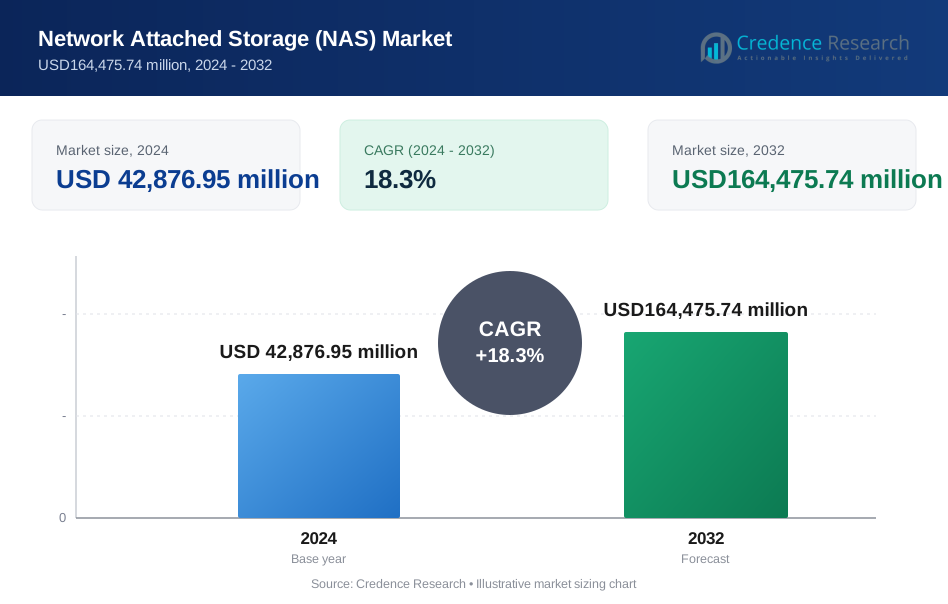
The Network Attached Storage (NAS) Market is projected to grow from USD 42,876.95 million in 2024 to an estimated USD 164475.74 Millions by 2032, with a compound annual growth rate (CAGR) of 18.3% from 2024 to 2032.
Key drivers of the NAS market include the exponential growth of data generation, the increasing need for secure and efficient storage solutions, and the growing trend of remote work. As organizations generate large volumes of data daily, there is a growing need for reliable, easily accessible, and scalable storage solutions. NAS systems allow businesses to centralize and manage data storage efficiently, ensuring data security and availability. Furthermore, the growing adoption of virtualization and cloud-based services is pushing organizations to seek advanced storage solutions like NAS that can seamlessly integrate with cloud platforms. These factors are expected to further accelerate the demand for NAS systems across various sectors.
Regionally, North America holds a dominant share of the NAS market due to the presence of major players and early adoption of advanced storage solutions in enterprises. The Asia Pacific region is expected to witness the highest growth rate due to rapid industrialization, increasing data consumption, and expanding small and medium enterprises (SMEs) adopting NAS solutions. Europe also contributes significantly to the market, driven by demand from the healthcare, automotive, and retail sectors for efficient and scalable data storage solutions.
Market Drivers:
Rising Data Generation and Demand for Efficient Storage Solutions:
The exponential growth in data generation across industries is a primary driver of the Network Attached Storage (NAS) market. With the increasing reliance on digital technologies, businesses are producing vast amounts of data daily. As data continues to grow in both volume and complexity, organizations are seeking efficient storage solutions that ensure accessibility, security, and scalability. For instance, NAS provides a centralized storage system that simplifies data management while reducing the risk of data loss, making it an attractive option for enterprises like Google, which manage enormous datasets effectively. NAS provides a centralized storage system that simplifies data management while reducing the risk of data loss, making it an attractive option for enterprises looking to store and manage large datasets effectively.
Cost-Effectiveness and Scalability:
Another key factor fueling the NAS market is its cost-effectiveness and scalability. Compared to traditional storage systems, NAS offers an affordable solution with the added benefit of scalability. Organizations can expand their storage capacity incrementally as data storage requirements increase, avoiding the need for large initial investments. For instance, the average cost of NAS systems can be up to 50% lower than traditional storage solutions. This flexibility makes NAS an ideal choice for businesses of all sizes, particularly small and medium-sized enterprises (SMEs) that require efficient storage solutions without substantial capital expenditure.
Integration with Cloud and Virtualization Technologies:
The growing adoption of cloud computing and virtualization technologies is also driving the demand for NAS systems. As more businesses migrate to the cloud and embrace virtualized environments, NAS systems have become integral in supporting these infrastructures. For instance, NAS solutions offer seamless integration with cloud platforms, providing enhanced data access and sharing capabilities. NAS solutions offer seamless integration with cloud platforms, providing enhanced data access and sharing capabilities. This interoperability between on-premise storage and cloud services allows businesses to optimize their storage management, improving operational efficiency and supporting hybrid storage models.
Remote Work and Data Security Needs:
The rise of remote work and the increased focus on data security are further propelling the NAS market. With employees working remotely, organizations need reliable, secure, and easily accessible storage solutions. For instance, NAS systems enable businesses like Tata Consultancy Services (TCS) to centralize data storage, making it accessible from any location, while providing robust data protection features. NAS systems enable businesses to centralize data storage, making it accessible from any location, while providing robust data protection features. The growing emphasis on cybersecurity has led organizations to adopt NAS solutions to safeguard sensitive data from unauthorized access, ensuring business continuity and compliance with data privacy regulations.
Market Trends:
Shift Toward Hybrid Cloud Storage:
One of the prominent trends in the Network Attached Storage (NAS) market is the shift toward hybrid cloud storage solutions. As businesses increasingly adopt cloud technologies, many are integrating their on-premises NAS systems with cloud platforms to create a hybrid storage environment. For instance, companies like IBM have successfully implemented hybrid cloud solutions, storing critical or sensitive data locally while leveraging the cloud for scalability and backup. This hybrid approach allows companies to store critical or sensitive data locally, while leveraging the cloud for scalability and backup. The ability to seamlessly switch between local and cloud storage provides businesses with enhanced flexibility, improved data redundancy, and greater control over their data storage strategies.
Edge Computing Integration:
Another emerging trend is the integration of NAS systems with edge computing technologies. Edge computing, which brings computational power closer to data sources, is gaining traction due to its ability to reduce latency and improve performance for time-sensitive applications. For instance, industries such as manufacturing, healthcare, and IoT are integrating NAS with edge computing to store and process data locally at the edge, ensuring faster access and real-time analysis. By integrating NAS with edge computing, businesses can store and process data locally at the edge, ensuring faster access and real-time analysis. This trend is particularly relevant for industries such as manufacturing, healthcare, and IoT, where real-time data processing is critical.
Increased Adoption of All-Flash NAS Solutions:
There is a growing shift toward all-flash NAS solutions, which offer faster data access speeds and lower latency compared to traditional hard disk drive (HDD) NAS systems. For instance, organizations with demanding applications such as Netflix for video editing, large-scale data analytics, and artificial intelligence are adopting all-flash NAS solutions for their high-performance storage needs. All-flash NAS solutions provide high-performance storage, making them ideal for organizations with demanding applications such as video editing, large-scale data analytics, and artificial intelligence. The enhanced performance and reliability of flash storage are driving businesses to adopt these advanced NAS systems, especially as data processing demands increase.
Focus on Data Security and Compliance:
As cybersecurity threats continue to rise, organizations are placing a greater emphasis on the security and compliance features of NAS solutions. For instance, modern NAS systems are being equipped with advanced encryption, multi-factor authentication, and automated backup capabilities to safeguard sensitive data. Modern NAS systems are being equipped with advanced encryption, multi-factor authentication, and automated backup capabilities to safeguard sensitive data. Additionally, these systems are being designed to help businesses comply with data protection regulations, such as GDPR and HIPAA, further promoting the adoption of NAS solutions across industries.
Market Challenges Analysis:
Data Security and Privacy Concerns:
One of the key challenges facing the Network Attached Storage (NAS) market is ensuring robust data security and privacy. As businesses increasingly store sensitive data on NAS systems, the risk of cyberattacks, data breaches, and unauthorized access grows. Despite advancements in encryption and security measures, the potential for security vulnerabilities remains a concern. Organizations must implement strong security protocols, including multi-factor authentication and regular system updates, to protect sensitive data. The evolving nature of cyber threats makes it critical for businesses to constantly upgrade and adapt their NAS security infrastructure.
Integration with Existing IT Infrastructure:
Another significant challenge in the NAS market is the seamless integration of NAS solutions with existing IT infrastructure. Many organizations have legacy systems in place, and integrating NAS with these older technologies can be complex and resource-intensive. Additionally, businesses may face compatibility issues when trying to connect NAS solutions with diverse hardware, software, and network environments. This integration challenge can increase costs and implementation timelines, causing hesitation among businesses looking to adopt NAS solutions. Companies need to ensure smooth interoperability to fully realize the benefits of NAS systems.
Scalability and Performance Issues:
While NAS systems are often praised for their scalability, managing large-scale deployments can still present challenges. As data volumes continue to grow, businesses may face performance bottlenecks, especially with traditional hard disk drive (HDD)-based NAS solutions. Ensuring that NAS systems can handle growing storage demands without compromising performance is a key challenge. Additionally, balancing cost with performance requirements remains a difficult task, as high-performance NAS systems, such as all-flash models, come with a significantly higher price tag.
High Initial Investment Costs:
Although NAS solutions offer long-term cost savings, the initial capital investment required for advanced systems can be a barrier for smaller organizations. The costs associated with purchasing, configuring, and maintaining NAS infrastructure can be significant, particularly for small and medium-sized enterprises (SMEs). While the scalability of NAS helps to mitigate costs over time, businesses must carefully evaluate the total cost of ownership before committing to NAS adoption.
Market Segmentation Analysis:
By Enterprise Type
The NAS market is segmented based on enterprise type, with key categories being large enterprises and small and medium-sized enterprises (SMEs). Large enterprises are the dominant segment, driven by the need for scalable, centralized, and secure storage solutions to handle vast amounts of data. These organizations often require high-performance NAS systems to support their complex IT infrastructures and data-intensive applications. SMEs, on the other hand, are increasingly adopting NAS systems due to their cost-effectiveness and scalability. As SMEs continue to digitalize and generate larger volumes of data, they seek affordable, efficient storage solutions, making them a growing segment in the NAS market.
By Storage Solution
The NAS market is also segmented by storage solution, primarily comprising file-level storage and block-level storage. File-level storage is more commonly used in NAS solutions due to its simplicity and ability to provide easy access to data over a network. This type of storage is highly suitable for organizations seeking centralized storage with minimal complexity. Block-level storage, while typically more complex and costlier, offers higher performance and is used for applications that require low-latency data access. The choice between these two storage solutions largely depends on an organization’s performance requirements and budget constraints.
Segmentations:
By Enterprise Type
- Large Enterprises
- Corporations
- Multinational Companies
- Government Organizations
- Small and Medium-sized Enterprises (SMEs)
-
- Startups
- Family-owned Businesses
- Regional Businesses
By Storage Solution
- File-level Storage
-
- Network File System (NFS)
- Server Message Block (SMB)
- Block-level Storage
-
- iSCSI (Internet Small Computer Systems Interface)
- Fibre Channel
By Region
- North America
-
- United States
- Canada
- Europe
-
- Germany
- United Kingdom
- France
- Asia Pacific
-
- China
- India
- Japan
- Latin America
-
- Brazil
- Mexico
- Middle East & Africa
-
- United Arab Emirates
- South Africa
Regional Analysis:
North America
North America holds the largest share of the NAS market, accounting for approximately 35% of the global market. The region's dominance is attributed to the presence of major NAS solution providers and the early adoption of advanced IT infrastructure across enterprises. The growing demand for efficient data storage solutions, especially in industries such as healthcare, retail, and IT services, fuels the adoption of NAS systems. Furthermore, the increasing trend of digital transformation, cloud integration, and remote work further contributes to market growth in this region. The United States is a key contributor to this market, followed by Canada, where businesses are embracing NAS for secure, scalable, and cost-effective storage.
Europe
Europe holds a significant portion of the NAS market, accounting for approximately 27%. The region's strong focus on data privacy and compliance regulations, such as GDPR, has accelerated the need for secure and reliable storage solutions. Countries like Germany, the United Kingdom, and France are major adopters of NAS systems across various sectors, including manufacturing, finance, and healthcare. As businesses across Europe generate increasingly large amounts of data, the demand for robust and secure NAS solutions continues to rise, driving regional market growth.
Asia Pacific
The Asia Pacific region currently holds around 25% of the global NAS market share and is expected to witness the highest growth rate from 2024 to 2032. The region's rapid industrialization, the expansion of small and medium-sized enterprises (SMEs), and the proliferation of cloud computing are significant drivers of NAS adoption. Key markets within this region include China, India, and Japan, where businesses are increasingly adopting NAS solutions for their ability to scale with growing data demands. The rise of data-driven industries such as e-commerce, finance, and technology is propelling the demand for storage systems that can support large data volumes. As a result, the market share of Asia Pacific is expected to increase significantly in the coming years.
Latin America
Latin America currently holds about 8% of the global NAS market share and is experiencing steady growth, with Brazil and Mexico being the major contributors. As businesses in the region undergo digital transformation and the need for data management increases, the demand for NAS systems is expected to rise. However, the market in Latin America is still relatively nascent compared to other regions, but it is gradually catching up due to increasing awareness and the adoption of cloud and virtualization technologies. This growth trajectory indicates a positive outlook for the NAS market in the region.
Middle East & Africa (MEA)
The MEA region represents a smaller portion of the global NAS market, contributing approximately 5% to the total market share. However, as the region experiences growth in sectors such as oil and gas, healthcare, and retail, the demand for efficient and scalable storage solutions is on the rise. Countries like the United Arab Emirates and South Africa are seeing an increased adoption of NAS solutions, driven by the need for enhanced data management and security. As these industries expand, NAS adoption is expected to increase, contributing to the region’s gradual market growth.
Key Player Analysis:
- Seagate Technology Holdings plc (Ireland)
- Synology Inc. (Taiwan)
- Buffalo Americas, Inc. (U.S.)
- NetApp, Inc. (U.S.)
- Dell Technologies Inc. (U.S.)
- IBM Corporation (U.S.)
- QNAP Systems, Inc. (Taiwan)
- NetGear, Inc. (U.S.)
- Hitachi Vantara LLC (Hitachi Ltd.) (Japan)
- Western Digital Corporation (U.S.)
Competitive Analysis:
The Network Attached Storage (NAS) market is highly competitive, with numerous global and regional players offering a range of storage solutions to meet the diverse needs of businesses. Key players in the market include companies such as Synology, QNAP Systems, Net gear, Western Digital, and Seagate Technology, among others. These companies compete based on factors such as storage capacity, scalability, performance, and security features. Innovation plays a crucial role, with industry leaders focusing on the development of all-flash NAS systems, integration with cloud platforms, and enhanced data protection measures to address growing data security concerns. For instance, Western Digital has developed NAS systems that seamlessly integrate with popular cloud platforms like AWS and Microsoft Azure, enhancing data access and sharing capabilities. Additionally, some players are expanding their product portfolios to include hybrid storage solutions and edge computing capabilities to cater to the increasing demand for low-latency, real-time data processing. As the market continues to evolve, companies are also focusing on strategic partnerships, acquisitions, and regional expansion to strengthen their market positions.
Recent Developments:
- In January 2024, Ugreen collaborated with Intel to launch UGREEN NASync network attached storage devices. This product lineup comes with automated decision-making ability and storage efficiency.
- In September 2023, QNAP launched a network expansion card, QXG-10G2T 10 GbE, dedicated to users that need simultaneous data access with lower latency. These end-users can be professional videographers, photographers, or part of a collaborative team. This new launch is a dual-port, advanced, 5-speed 10 GbE (RJ45) network expansion card, which acts as a cost-effective and energy-efficient solution for several networking needs. The card enhances the workflow efficiency of both NAS and PC users by offering them a seamless experience.
- In August 2023, Buffalo introduced a product transition to While Supplies Last for its TeraStation 6000 and 5010 Series NAS product families. The company also aims to transform the new TeraStation 5020 Series product family. All transformed products will be sold through the company’s authorized sales channels.
- In June 2023, Synology introduced a new addition to the entry-level J Series, the 2-bay DiskStation DS223j. This launch is focused on catering to the needs of home office and small teams. The DS223j is a NAS that uses the company’s intuitive DiskStation Manager and features several options and applications for everyday data storage and management, including video surveillance, file syncing and sharing, and backup.
Market Concentration & Characteristics:
The Network Attached Storage (NAS) market is highly competitive, with numerous global and regional players offering a range of storage solutions to meet the diverse needs of businesses. Key players in the market include companies such as Synology, QNAP Systems, Netgear, Western Digital, and Seagate Technology, among others. These companies compete based on factors such as storage capacity, scalability, performance, and security features. Innovation plays a crucial role, with industry leaders focusing on the development of all-flash NAS systems, integration with cloud platforms, and enhanced data protection measures to address growing data security concerns. Additionally, some players are expanding their product portfolios to include hybrid storage solutions and edge computing capabilities to cater to the increasing demand for low-latency, real-time data processing. As the market continues to evolve, companies are also focusing on strategic partnerships, acquisitions, and regional expansion to strengthen their market positions.
Report Coverage:
The research report offers an in-depth analysis based on Enterprise Type, Storage Solution. It details leading market players, providing an overview of their business, product offerings, investments, revenue streams, and key applications. Additionally, the report includes insights into the competitive environment, SWOT analysis, current market trends, as well as the primary drivers and constraints. Furthermore, it discusses various factors that have driven market expansion in recent years. The report also explores market dynamics, regulatory scenarios, and technological advancements that are shaping the industry. It assesses the impact of external factors and global economic changes on market growth. Lastly, it provides strategic recommendations for new entrants and established companies to navigate the complexities of the market.
Future Outlook:
- The demand for scalable and cost-effective storage solutions will continue to drive growth in the NAS market.
- Integration with cloud services and hybrid cloud storage models will become increasingly important for businesses looking to optimize their data management.
- The adoption of all-flash NAS systems will rise as businesses seek faster data access speeds and lower latency for performance-intensive applications.
- Edge computing will play a significant role in the future of NAS, with more enterprises seeking solutions that offer local data processing capabilities.
- Small and medium-sized enterprises (SMEs) will increasingly embrace NAS systems due to their affordability and scalability, expanding the market's customer base.
- Enhanced data security and compliance features will become critical as businesses face rising cybersecurity threats and more stringent data privacy regulations.
- The demand for NAS solutions will grow in industries like healthcare, finance, and manufacturing, where large amounts of data need to be stored and accessed quickly.
- Artificial intelligence and machine learning applications will drive the need for high-performance NAS solutions capable of supporting data-driven technologies.
- The expansion of the Internet of Things (IoT) will contribute to greater data storage needs, fueling NAS adoption across various sectors.
- Regional markets, particularly in Asia Pacific and Latin America, will see accelerated growth as digital transformation initiatives increase in these areas.
Request a Free Sample
Fill in your details and we'll send you a free sample report.
- Sample data tables & charts
- Research methodology
Need a Custom Version of This Report?
Tailor the scope, geography, or segments to your exact requirements.
- Custom geography or segment scope
- Direct access to our analyst team
Frequently Asked Questions
What is the current size of the Network Attached Storage (NAS) Market?
What factors are driving the growth of the Network Attached Storage (NAS) Market?
What are the key segments within the Network Attached Storage (NAS) Market?
What are some challenges faced by the Network Attached Storage (NAS) Market?
Who are the major players in the Network Attached Storage (NAS) Market?
Which segment is leading the market share?
Table of Content
Chapter 1. Report Introduction
- 1.1 Report Description & Purpose
- 1.1.1 Report Title & Market Definition
- 1.1.2 Unique Selling Propositions (USP) & Key Differentiators
- 1.1.3 Value Proposition for Stakeholders
- 1.2 Research Objectives
- 1.2.1 Market Sizing Objectives (Volume & Revenue)
- 1.2.2 Segmentation Objectives
- 1.2.3 Competitive Intelligence Objectives
- 1.2.4 Forecast & Scenario Objectives
- 1.3 Report Scope
- 1.3.1 Network Attached Storage (NAS) Scope – Types & Subtypes Covered
- 1.3.2 Geographic Scope – Regions & Countries Covered
- 1.3.3 Historical Period, Base Year & Forecast Period (2024; forecast to 2032)
- 1.3.4 Inclusions & Exclusions
- 1.4 HS Code & Classification Framework
- 1.5 Currency, Units & Pricing Basis
- 1.6 Target Stakeholders
- 1.7 Limitations & Assumptions
Chapter 2. Executive Summary
- 2.1 Global Network Attached Storage (NAS) Market Snapshot
- 2.1.1 Market Size – Historical (2024) & Forecast (2024-2032) (2024: USD 42,876.95 million → 2032: USD164,475.74 million)
- 2.1.2 Volume & Revenue – Global Totals
- 2.1.3 Key Market Highlights – Top Five Facts
- 2.2 Network Attached Storage (NAS) Market Segmentation Snapshot
- 2.2.1 Market Split by Region – 2024 vs. 2032
- 2.3 Competitive Snapshot
- 2.3.1 Top 10 Players by Revenue Share – 2024
- 2.3.2 Top 10 Players by Volume Share – 2024
- 2.3.3 Recent Strategic Developments (18-Month Summary)
- 2.4 Key Investment Highlights & Strategic Conclusions
Chapter 3. Network Attached Storage (NAS) Market Dynamics & Industry Analysis
- 3.1 Market Overview & Context
- 3.1.1 Network Attached Storage (NAS) Market Position in the Broader Automotive Value Chain
- 3.1.2 OEM vs. Replacement Market Dynamics
- 3.1.3 Market Maturity & Development Stage by Region
- 3.2 Network Attached Storage (NAS) Market Drivers
- 3.3 Network Attached Storage (NAS) Market Restraints & Challenges
- 3.4 Network Attached Storage (NAS) Market Opportunities
- 3.5 Porter's Five Forces Analysis
- 3.5.1 Threat of New Entrants
- 3.5.2 Bargaining Power of Suppliers
- 3.5.3 Bargaining Power of Buyers
- 3.5.4 Threat of Substitutes
- 3.5.5 Competitive Rivalry – Intensity Assessment
- 3.6 Network Attached Storage (NAS) Value Chain Analysis
- 3.6.1 Upstream – Raw Material/Input Suppliers
- 3.6.1.1 Raw Material/Input 1
- 3.6.1.2 Raw Material/Input 2
- 3.6.1.3 Raw Material/Input 3
- 3.6.2 Midstream – Production/Manufacturing/Service Delivery
- 3.6.2.1 Production/Process Overview
- 3.6.2.2 Key Facility Locations & Capacity by Manufacturer
- 3.6.3 Downstream – Distribution & End Consumer
- 3.6.3.1 Primary Channel – B2B/OEM
- 3.6.3.2 Secondary Channels – Dealer, Retail, Online, Direct
- 3.6.4 Value Chain Profitability Analysis
- 3.6.1 Upstream – Raw Material/Input Suppliers
- 3.7 PESTEL Analysis
- 3.7.1 Political Factors
- 3.7.2 Economic Factors
- 3.7.3 Social Factors
- 3.7.4 Technological Factors
- 3.7.5 Environmental Factors
- 3.7.6 Legal Factors
- 3.8 Network Attached Storage (NAS) Supply Chain Analysis
- 3.8.1 Raw Material/Input Supply Risk Assessment
- 3.8.2 Manufacturing Concentration Risk (Geographic Exposure)
- 3.8.3 Trade Disruption Impact Analysis
- 3.9 Regulatory & Policy Landscape
Note: The regulatory and policy landscape section covers regulations based on their applicability to the market, Network Attached Storage (NAS) category, geography, and scope of the study. Only regulatory frameworks with a material impact on operations, compliance, trade, sustainability, or market access are analyzed in detail.
Chapter 4. Key Investment Pockets & Opportunity Analysis
- 4.1 Network Attached Storage (NAS) Market Attractiveness Analysis
- 4.1.1 By Region – Investment Attractiveness Matrix (Volume × CAGR)
- 4.2 Absolute Revenue Growth Opportunity
- 4.2.1 By Region – Absolute USD Growth Through 2032
- 4.3 Incremental Volume Opportunity
- 4.3.1 By Region – Incremental Volume Through 2032
- 4.3.2 Segment – Incremental Volume
- 4.4 Emerging Submarket Opportunity Deep Dive (Subject to Applicability)
- 4.5 Emerging Market Opportunity Scorecards
- 4.5.1 United States
- 4.5.2 Europe
- 4.5.3 Asia
- 4.5.4 Middle East & Africa
Note: Emerging Market Opportunity Scorecards will be included based on relevance and strategic importance. Regions listed are indicative and may vary depending on data availability and market dynamics.
Chapter 5. Network Attached Storage (NAS) Import-Export Analysis & Trade Flows
- 5.1 Global Trade Overview
- 5.1.1 Global Export Value by Country (2024)
- 5.1.2 Global Export Volume by Country (2024)
- 5.1.3 Global Import Value by Country (2024)
- 5.1.4 Global Import Volume by Country (2024)
- 5.1.5 Net Trade Balance by Country (2024)
- 5.2 Export Analysis – Segment
- 5.2.1 Type 1 (HS Code)
- 5.2.2 Type 2 (HS Code)
- 5.2.3 Type 3 (HS Code)
- 5.2.4 Type 4 (HS Code)
- 5.2.5 Type 5 (HS Code)
- 5.3 Import Analysis – Segment
- 5.3.1 Type 1 (HS Code)
- 5.3.2 Type 2 (HS Code)
- 5.3.3 Type 3 (HS Code)
- 5.3.4 Type 4 (HS Code)
- 5.3.5 Type 5 (HS Code)
- 5.4 Average Unit Trade Prices
- 5.4.1 Average Export Price – Segment & Country
- 5.4.2 Average Import Price – Segment & Source Country
- 5.4.3 Price Trends (2024)
- 5.5 Key Trade Route Analysis
- 5.5.1 Trade Route 1
- 5.5.2 Trade Route 2
- 5.5.3 Trade Route 3
- 5.5.4 Trade Route 4
- 5.5.5 Trade Route 5
- 5.6 Trade Policy Impact Assessment
- 5.6.1 US Anti-Dumping & Section 301 Tariffs
- 5.6.2 EU Customs Union Impact
- 5.6.3 Major Free Trade Agreements
- 5.6.4 USMCA Rules of Origin
Note: Trade policy analysis will be included only where relevant to the Network Attached Storage (NAS) market.
Chapter 6. Competitive Landscape & Company Benchmarking
- 6.1 Network Attached Storage (NAS) Market Concentration & Structure
- 6.1.1 Herfindahl-Hirschman Index (HHI) – vs. 2024
- 6.1.2 Tier 1, Tier 2 & Tier 3 Market Structure
- 6.1.3 Global, Regional & Local Player Dynamics
- 6.2 Network Attached Storage (NAS) Market Share Analysis – 2024
- 6.2.1 Global Revenue Share by Company
- 6.2.2 Global Volume Share by Company
- 6.2.3 Regional Revenue Share
- 6.2.4 Market Share Evolution ( vs. 2024)
- 6.2.5 OEM Segment Share by Company
- 6.2.6 Replacement Segment Share by Company
- 6.3 Production/Delivery Capacity & Facility Analysis
- 6.3.1 Global Installed Capacity
- 6.3.2 Capacity Utilization Rates
- 6.3.3 Production/Output Volume
- 6.3.4 Facility Locations & Capacity Map
- 6.3.5 Planned Capacity Additions
- 6.4 Network Attached Storage (NAS) Competitive Benchmarking Matrix
- 6.4.1 Revenue, Volume, CAGR & Profitability Comparison
- 6.4.2 Channel Revenue Mix
- 6.4.3 Geographic Revenue Exposure
- 6.4.4 R&D Intensity
- 6.4.5 Sustainability Maturity
- 6.5 Strategic Developments in Network Attached Storage (NAS) (Last 24 Months)
- 6.5.1 Mergers, Acquisitions & Divestments
- 6.5.2 New Network Attached Storage (NAS) Launches
- 6.5.3 Facility Expansions
- 6.5.4 Strategic Alliances, Joint Ventures & Partnerships
- 6.5.5 Distribution Expansion & Market Entry
- 6.5.6 Sustainability & ESG Initiatives
- 6.6 Competitive Strategy Mapping
- 6.6.1 Leader, Challenger, Follower & Niche Classification
- 6.6.2 Pricing Strategy Comparison
- 6.6.3 Channel Strategy Matrix
Note: Strategic developments are included based on their materiality and the availability of reliable information.
Chapter 7. Global Network Attached Storage (NAS) Market – By Distribution Channel
- 7.1 Segment Overview
- 7.1.1 Volume & Revenue Split by Channel (2024 & 2032)
- 7.1.2 Channel Mix Evolution (2024-2032)
Chapter 8. Regional Market Analysis – Global Overview
- 8.1 Global Regional Overview
- 8.1.1 Regional Volume Share
- 8.1.2 Regional Revenue Share
- 8.1.3 Regional Volume by Region
- 8.1.4 Regional Revenue by Region
- 8.1.5 Regional Forecast Through 2032
- 8.2 Cross-Regional Segment Analysis
- 8.2.1 By Distribution Channel
- 8.2.2 By Brand/Price Tier
Chapter 9. North America Network Attached Storage (NAS) Market
- 9.1 United States
- 9.2 Canada
- 9.3 Mexico
Chapter 10. Europe Network Attached Storage (NAS) Market
- 10.1 Germany
- 10.2 France
- 10.3 Italy
- 10.4 United Kingdom
- 10.5 Spain
- 10.6 Poland
- 10.7 Russia
- 10.8 Netherlands
- 10.9 Belgium
- 10.10 Sweden
- 10.11 Denmark
- 10.12 Norway
- 10.13 Rest of Europe
Chapter 11. Asia Pacific Network Attached Storage (NAS) Market
- 11.1 China
- 11.2 India
- 11.3 Japan
- 11.4 South Korea
- 11.5 Thailand
- 11.6 Indonesia
- 11.7 Vietnam
- 11.8 Malaysia
- 11.9 Australia
- 11.10 Rest of Asia Pacific
Chapter 12. Latin America Network Attached Storage (NAS) Market
- 12.1 Brazil
- 12.2 Argentina
- 12.3 Colombia
- 12.4 Chile
- 12.5 Rest of Latin America
Chapter 13. Middle East Network Attached Storage (NAS) Market
- 13.1 Saudi Arabia
- 13.2 United Arab Emirates
- 13.3 Turkey
- 13.4 Israel
- 13.5 Iran
- 13.6 Rest of the Middle East
Chapter 14. Africa Network Attached Storage (NAS) Market
- 14.1 South Africa
- 14.2 Egypt
- 14.3 Nigeria
- 14.4 Morocco
- 14.5 Rest of Africa
Chapter 15. Network Attached Storage (NAS) Company Profiles
- 15.1 [Company 01]
- 15.1.1 Company Overview
- 15.1.2 Key Management Personnel
- 15.1.3 Products & Services Portfolio
- 15.1.4 Financial Performance
- 15.1.5 Key Market Focus & Geographic Presence
- 15.1.6 Recent Developments & Strategic Initiatives
Note: The company profile list is preliminary and may change based on research findings, market developments, data availability, and client requirements.
Chapter 16. Appendices
- Appendix A – List of Abbreviations & Acronyms
- Appendix B – Industry Classification Code Reference – Full Series
- Appendix C – Production & Capacity Data Tables
- Appendix D – End-Use & Demand Base Tables
- Appendix E – Consumption & Replacement Rate Assumptions
- Appendix F – ASP Reference Tables
- Appendix G – Manufacturing & Facility Database
- Appendix H – Import-Export Data Tables
- Appendix I – Regulatory Summary Tables
- Appendix J – Primary Research Participant List (Anonymized)
- Appendix K – Primary Research Questionnaire Framework
- Appendix L – Data Sources & Bibliography
- Appendix M – Market Size Divergence & Source Comparison
Chapter 17. Research Methodology
- 17.1 Research Framework & Philosophy
- 17.2 Secondary Research – Sources, Hierarchy & Data Extraction
- 17.3 Data Modeling – Bottom-Up & Top-Down Market Sizing
- 17.4 Primary Research – Stakeholder Framework, LOI & Sample Sizes
- 17.5 Forecast Methodology – Regression, Scenario & Sensitivity Analysis
- 17.6 Quality Control – Four-Layer Validation Framework
- 17.7 Limitations & Standard Assumptions
- 17.8 Disclaimer
