
Novel Antibody Therapies Market Overview:
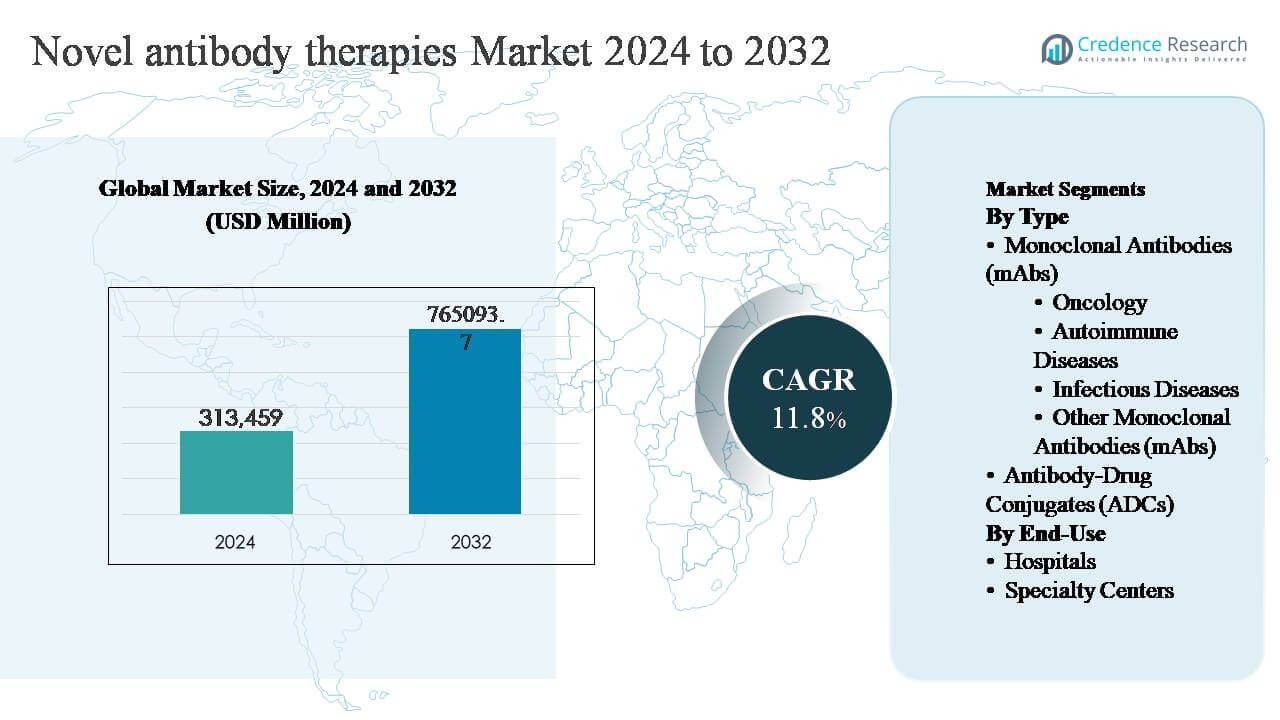
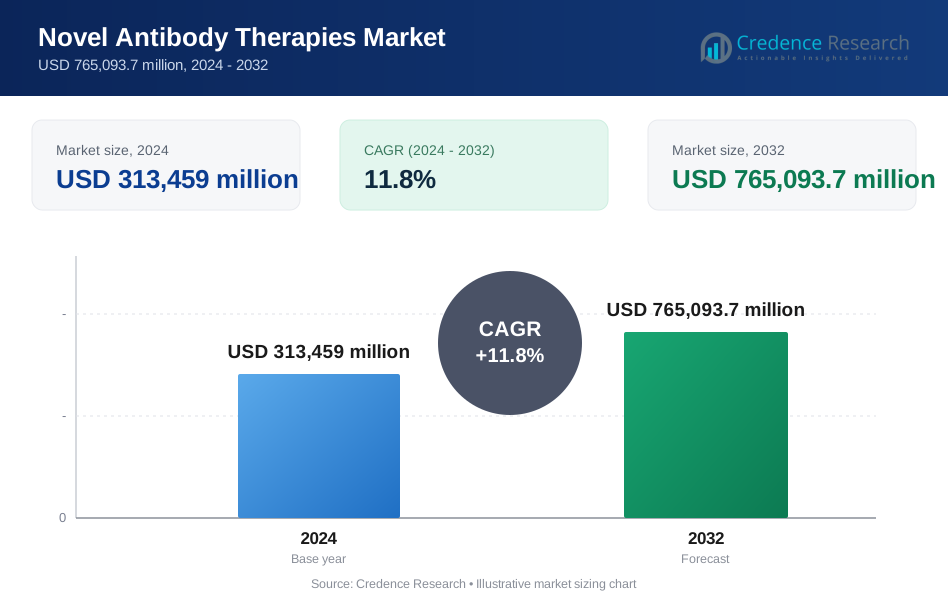
The global novel antibody therapies market represents one of the most transformative segments of modern biopharmaceutical innovation. In 2024, the market was valued at USD 313,459 million and is projected to reach USD 765,093.7 million by 2032, expanding at a robust compound annual growth rate (CAGR) of 11.8% over the forecast period.
| REPORT ATTRIBUTE | DETAILS |
|---|---|
| Historical Period | 2020-2023 |
| Base Year | 2024 |
| Forecast Period | 2025-2032 |
| Novel Antibody Therapies Market Size 2024 | USD 313,459 million |
| Novel Antibody Therapies Market , CAGR | 11.8% |
| Novel Antibody Therapies Market Size 2032 | USD 765,093.7 million |
Novel Antibody Therapies Market Insights
- Market growth is driven by rising adoption of targeted biologics in oncology and autoimmune diseases, where monoclonal antibodies dominate with over 70% segment share, supported by long treatment durations, high clinical efficacy, and expanding use in combination regimens.
- Key market trends include rapid advancement of antibody-drug conjugates and multispecific antibodies, while competitive intensity remains high among global leaders leveraging pipeline depth, lifecycle extensions, and strategic collaborations to defend share against biosimilar pressure.
- Market restraints include high development and manufacturing costs, complex biologics supply chains, and reimbursement pressure, which limit access in cost-sensitive healthcare systems and emerging markets.
- Regionally, North America leads with 44% share, followed by Europe at 29%, Asia-Pacific at 21%, and Rest of the World at 6%, with Asia-Pacific showing the fastest growth due to expanding biologics infrastructure.
Novel Antibody Therapies Market Segmentation Analysis:
By Type:
The novel antibody therapies market by type is dominated by monoclonal antibodies (mAbs), which account for the majority of total market revenue due to their broad clinical applicability and long-standing regulatory acceptance. Within mAbs, oncology represents the dominant sub-segment, holding the largest market share, driven by extensive use of immune checkpoint inhibitors, tumor-targeting antibodies, and combination regimens in solid tumors and hematologic malignancies. Autoimmune diseases form the second-largest mAbs application, supported by chronic treatment demand. Infectious disease and other mAbs contribute steadily, while antibody-drug conjugates (ADCs) represent the fastest-evolving segment, driven by precision cytotoxic delivery and expanding oncology pipelines.
- For instance, Roche’s oncology mAb portfolio includes atezolizumab, which has been evaluated across more than 40 Phase I–III clinical trials covering lung, breast, and urologic cancers, with cumulative patient enrollment exceeding 23,000 subjects, underscoring the scale of mAb adoption in oncology.
By End-Use:
By end-use, hospitals constitute the dominant sub-segment, capturing the largest share of the novel antibody therapies market due to their central role in administering complex biologics, oncology infusions, and inpatient immunotherapy protocols. High patient volumes, advanced infusion infrastructure, and multidisciplinary oncology care models reinforce hospital dominance. Specialty centers including oncology clinics and immunology-focused treatment centers represent a rapidly expanding segment, driven by decentralization of care, outpatient biologics administration, and rising adoption of targeted antibody therapies. Growth in specialty centers is further supported by improved cold-chain logistics, specialized clinician expertise, and patient preference for focused, lower-acuity treatment settings.
- For instance, The US Oncology Network–affiliated community oncology practices collectively support more than 700 sites of care across the United States. These locations enable advanced infusion services for more than 1.6 million patients annually while maintaining electronic regimen standardization across more than 3,300 affiliated providers.
Key Growth Drivers
Expanding Clinical Adoption Across Oncology and Chronic Diseases
The rapid expansion of clinical adoption across oncology, autoimmune, and inflammatory diseases is a primary growth driver for novel antibody therapies. In oncology, antibodies are increasingly used as backbone therapies due to their high target specificity, favorable safety profiles, and compatibility with combination regimens involving chemotherapy, radiotherapy, and cell-based therapies. In autoimmune and inflammatory diseases, long-term disease management requirements favor biologics over small molecules, supporting sustained demand. The growing prevalence of cancer and immune-mediated disorders globally, combined with earlier diagnosis and longer treatment durations, further accelerates uptake. Physicians increasingly prefer antibody-based therapies for their predictable pharmacokinetics and well-established clinical outcomes, reinforcing their central role in modern treatment protocols.
- For instance, Bristol Myers Squibb’s nivolumab has been studied across more than 90 Phase I–III oncology trials, with cumulative enrollment exceeding 35,000 patients, supporting its use as a core component in combination regimens for melanoma, lung cancer, renal cell carcinoma, and hematologic malignancies.
Advancements in Antibody Engineering and Platform Technologies
Continuous innovation in antibody engineering significantly drives market growth by improving efficacy, durability, and safety. Advances such as Fc-region optimization, half-life extension technologies, bispecific antibody formats, and site-specific conjugation methods have expanded the functional capabilities of antibodies. These innovations enable enhanced immune engagement, improved tumor penetration, and reduced off-target toxicity. Platform-based development approaches also shorten development timelines and improve pipeline productivity, encouraging sustained R&D investment. Improved manufacturability and scalability of next-generation antibodies further support commercialization, allowing developers to move complex molecules from clinical development to large-scale production with greater efficiency and consistency.
- For instance, AstraZeneca’s half-life–extended antibody platform incorporates Fc mutations that increase neonatal Fc receptor (FcRn) binding affinity, enabling antibodies such as tixagevimab and cilgavimab to achieve serum half-lives exceeding 80 days in humans, reducing dosing frequency while maintaining sustained neutralizing activity.
Strong Pipeline Expansion and Regulatory Momentum
The robust expansion of clinical pipelines and supportive regulatory pathways is another major growth driver. Novel antibody therapies continue to dominate late-stage development portfolios across large pharmaceutical companies and biotechnology firms. Accelerated approval pathways, orphan drug designations, and breakthrough therapy status have reduced time-to-market for innovative antibodies addressing unmet medical needs. Regulatory familiarity with antibody platforms lowers approval risk compared to novel drug modalities, encouraging sustained investment. Additionally, lifecycle management strategies including label expansions, new indications, and combination approvals extend commercial longevity and revenue potential for approved antibody products.
Key Trends & Opportunities
Rapid Growth of Antibody-Drug Conjugates and Multispecific Antibodies
Antibody-drug conjugates (ADCs) and multispecific antibodies represent a major trend and opportunity within the novel antibody therapies market. These formats combine precise targeting with enhanced functional activity, enabling selective delivery of cytotoxic agents or immune modulation. Their growing use in oncology reflects strong clinical efficacy in resistant and late-stage cancers. Advances in linker chemistry, payload diversity, and conjugation stability continue to expand therapeutic windows. Multispecific antibodies further offer opportunities in immune redirection and combination targeting within a single molecule, reducing treatment complexity and improving patient outcomes.
- For instance, Daiichi Sankyo’s DXd ADC technology employs a topoisomerase I inhibitor payload with a drug-to-antibody ratio of approximately 8, coupled via a cleavable tetrapeptide linker that remains stable in systemic circulation yet efficiently releases payload in tumor cells following lysosomal processing.
Expansion into Earlier Lines of Therapy and New Indications
A key opportunity lies in the expanding use of antibody therapies in earlier treatment lines and non-oncology indications. Antibodies are increasingly evaluated as first-line or maintenance therapies rather than last-resort options. This shift significantly increases treatment duration and addressable patient populations. Additionally, growing exploration of antibody applications in neurology, infectious diseases, and rare disorders opens new revenue streams. Improved blood-brain barrier penetration strategies and antiviral antibody platforms further broaden the clinical scope of antibody-based interventions.
- For instance, Vir Biotechnology’s monoclonal antibody sotrovimab was engineered using Fc modifications to extend serum half-life and maintained in vitro neutralization activity at nanomolar concentrations against multiple viral variants, enabling single-dose intravenous administration for acute viral infection management.
Key Challenges
High Development, Manufacturing, and Treatment Costs
Despite strong demand, high development and manufacturing costs remain a significant challenge. Antibody therapies require complex biologics manufacturing infrastructure, stringent quality controls, and cold-chain logistics, contributing to elevated production expenses. These costs translate into high treatment prices, limiting patient access in cost-sensitive healthcare systems. Payer scrutiny, reimbursement pressures, and pricing negotiations increasingly influence market uptake, particularly in emerging economies. Cost containment without compromising quality remains a critical hurdle for manufacturers.
Competitive Intensity and Biosimilar Pressure
The growing entry of biosimilars and increased competition within established antibody classes pose another key challenge. As patents expire for blockbuster monoclonal antibodies, biosimilar alternatives intensify price competition and erode branded market share. This pressure forces originator companies to invest heavily in next-generation antibodies and lifecycle extensions to sustain differentiation. Additionally, crowded pipelines increase the risk of clinical failure and commercialization challenges, making strategic positioning and clinical differentiation essential for long-term success.
Regional Analysis
North America
North America dominates the novel antibody therapies market, accounting for approximately 42-45% of global market share. The region’s leadership is driven by strong biopharmaceutical R&D infrastructure, high biologics adoption rates, and early access to innovative antibody platforms. The United States represents the largest contributor due to high oncology prevalence, rapid uptake of next-generation monoclonal antibodies and ADCs, and favorable reimbursement for specialty biologics. Robust regulatory pathways, extensive clinical trial activity, and sustained investment by leading pharmaceutical companies further support market maturity. Canada contributes steadily through expanding biologics manufacturing and rising use of antibody therapies in chronic disease management.
Europe
Europe holds an estimated 28-30% share of the global novel antibody therapies market, supported by well-established healthcare systems and strong regulatory harmonization. Countries such as Germany, France, the United Kingdom, and Italy lead regional demand due to widespread adoption of monoclonal antibodies in oncology and autoimmune disorders. The region benefits from public healthcare coverage that supports access to high-cost biologics, alongside growing bioscience research capabilities. Increased approvals of innovative antibodies and expanding use of ADCs in cancer treatment strengthen market growth. However, pricing controls and biosimilar penetration influence competitive dynamics across major European markets.
Asia-Pacific
Asia-Pacific represents the fastest-growing regional market, accounting for approximately 20-22% of global market share. Growth is driven by rising cancer incidence, expanding healthcare access, and increasing investment in biologics manufacturing across China, Japan, South Korea, and India. Governments in the region actively support domestic antibody development through funding initiatives and regulatory reforms. Japan remains a mature biologics market, while China shows rapid expansion due to strong local pipelines and accelerated approvals. Increasing clinical trial activity and growing adoption of advanced antibody therapies in tertiary hospitals further reinforce regional growth momentum.
Rest of the World (RoW)
The Rest of the World region, including Latin America, the Middle East, and Africa, accounts for approximately 5-8% of the global novel antibody therapies market. Market growth is supported by gradual improvements in healthcare infrastructure, rising awareness of biologic treatments, and expanding access to oncology care. Brazil, Mexico, and select Middle Eastern countries lead regional adoption, particularly in hospital-based antibody administration. However, limited reimbursement coverage, high therapy costs, and constrained cold-chain logistics restrict broader penetration. Despite these challenges, increasing government healthcare spending and international partnerships are expected to improve long-term market accessibility.
Novel Antibody Therapies Market Segmentations:
By Type
- Monoclonal Antibodies (mAbs)
- Oncology
- Autoimmune Diseases
- Infectious Diseases
- Other Monoclonal Antibodies (mAbs)
- Antibody-Drug Conjugates (ADCs)
By End-Use
- Hospitals
- Specialty Centers
By Geography
- North America
- U.S.
- Canada
- Mexico
- Europe
- Germany
- France
- U.K.
- Italy
- Spain
- Rest of Europe
- Asia Pacific
- China
- Japan
- India
- South Korea
- South-east Asia
- Rest of Asia Pacific
- Latin America
- Brazil
- Argentina
- Rest of Latin America
- Middle East & Africa
- GCC Countries
- South Africa
- Rest of the Middle East and Africa
Competitive Landscape
The competitive landscape of the novel antibody therapies market is characterized by intense innovation, strong pipeline depth, and strategic positioning by global pharmaceutical and biotechnology leaders. Large multinational companies dominate the market through extensive portfolios of monoclonal antibodies, antibody-drug conjugates, and next-generation engineered formats, supported by vertically integrated R&D and biologics manufacturing capabilities. Competition increasingly centers on clinical differentiation, target novelty, and expansion into earlier lines of therapy rather than first-to-market advantage alone. Strategic collaborations, licensing agreements, and acquisitions are widely used to access emerging antibody platforms, accelerate development timelines, and mitigate R&D risk. At the same time, mid-size biotechnology firms play a critical role in advancing first-in-class antibodies, often becoming acquisition targets following late-stage success. The landscape is further shaped by biosimilar entry for mature antibodies, prompting originator companies to invest in lifecycle extensions, combination therapies, and next-generation constructs to sustain long-term competitiveness.
Key Player Analysis
- AstraZeneca
- AbbVie, Inc.
- Amgen Inc.
- Bristol-Myers Squibb Company
- F. Hoffmann-La Roche Ltd.
- Johnson & Johnson Services, Inc.
- Merck & Co., Inc.
- Novartis AG
- Regeneron Pharmaceuticals Inc.
- Seagen
Recent Developments
- In May 2025, AbbVie received FDA approval in the United States for telisotuzumab vedotin (Emrelis), a c-Met-directed antibody-drug conjugate for non-small cell lung cancer, marking a significant regulatory milestone for its ADC pipeline.
- In March 2025, AstraZeneca announced its planned acquisition of EsoBiotec, a biotech specializing in rapid in-body immune cell modification technologies, aiming to bolster its capabilities in cell therapies relevant to cancer and autoimmune disease programs complementary to antibody therapeutic strategies.
Report Coverage
The research report offers an in-depth analysis based on Type, End-Use and Geography. It details leading market players, providing an overview of their business, product offerings, investments, revenue streams, and key applications. Additionally, the report includes insights into the competitive environment, SWOT analysis, current market trends, as well as the primary drivers and constraints. Furthermore, it discusses various factors that have driven market expansion in recent years. The report also explores market dynamics, regulatory scenarios, and technological advancements that are shaping the industry. It assesses the impact of external factors and global economic changes on market growth. Lastly, it provides strategic recommendations for new entrants and established companies to navigate the complexities of the market.
Request a Free Sample
Fill in your details and we'll send you a free sample report.
- Sample data tables & charts
- Research methodology
Need a Custom Version of This Report?
Tailor the scope, geography, or segments to your exact requirements.
- Custom geography or segment scope
- Direct access to our analyst team
Frequently Asked Questions
What is the current market size for Novel antibody therapies, and what is its projected size in 2032?
At what Compound Annual Growth Rate is the Novel antibody therapies market projected to grow between 2024 and 2032?
Which Novel antibody therapies segment held the largest share in 2024?
What are the primary factors fueling the growth of the Novel antibody therapies market?
Who are the leading companies in the Novel antibody therapies market?
Which region commanded the largest share of the Novel antibody therapies market in 2024?
Table of Content
Chapter 1. Report Introduction
- 1.1 Report Description & Purpose
- 1.1.1 Report Title & Market Definition
- 1.1.2 Unique Selling Propositions (USP) & Key Differentiators
- 1.1.3 Value Proposition for Stakeholders
- 1.2 Research Objectives
- 1.2.1 Market Sizing Objectives (Volume & Revenue)
- 1.2.2 Segmentation Objectives
- 1.2.3 Competitive Intelligence Objectives
- 1.2.4 Forecast & Scenario Objectives
- 1.3 Report Scope
- 1.3.1 Novel Antibody Therapies Scope – Types & Subtypes Covered
- 1.3.2 Geographic Scope – Regions & Countries Covered
- 1.3.3 Historical Period, Base Year & Forecast Period (2024; forecast to 2032)
- 1.3.4 Inclusions & Exclusions
- 1.4 HS Code & Classification Framework
- 1.5 Currency, Units & Pricing Basis
- 1.6 Target Stakeholders
- 1.7 Limitations & Assumptions
Chapter 2. Executive Summary
- 2.1 Global Novel Antibody Therapies Market Snapshot
- 2.1.1 Market Size – Historical (2024) & Forecast (2024-2032) (2024: USD 313,459 million → 2032: USD 765,093.7 million)
- 2.1.2 Volume & Revenue – Global Totals
- 2.1.3 Key Market Highlights – Top Five Facts
- 2.2 Novel Antibody Therapies Market Segmentation Snapshot
- 2.2.1 Market Split by Region – 2024 vs. 2032
- 2.3 Competitive Snapshot
- 2.3.1 Top 10 Players by Revenue Share – 2024
- 2.3.2 Top 10 Players by Volume Share – 2024
- 2.3.3 Recent Strategic Developments (18-Month Summary)
- 2.4 Key Investment Highlights & Strategic Conclusions
Chapter 3. Novel Antibody Therapies Market Dynamics & Industry Analysis
- 3.1 Market Overview & Context
- 3.1.1 Novel Antibody Therapies Market Position in the Broader Automotive Value Chain
- 3.1.2 OEM vs. Replacement Market Dynamics
- 3.1.3 Market Maturity & Development Stage by Region
- 3.2 Novel Antibody Therapies Market Drivers
- 3.3 Novel Antibody Therapies Market Restraints & Challenges
- 3.4 Novel Antibody Therapies Market Opportunities
- 3.5 Porter's Five Forces Analysis
- 3.5.1 Threat of New Entrants
- 3.5.2 Bargaining Power of Suppliers
- 3.5.3 Bargaining Power of Buyers
- 3.5.4 Threat of Substitutes
- 3.5.5 Competitive Rivalry – Intensity Assessment
- 3.6 Novel Antibody Therapies Value Chain Analysis
- 3.6.1 Upstream – Raw Material/Input Suppliers
- 3.6.1.1 Raw Material/Input 1
- 3.6.1.2 Raw Material/Input 2
- 3.6.1.3 Raw Material/Input 3
- 3.6.2 Midstream – Production/Manufacturing/Service Delivery
- 3.6.2.1 Production/Process Overview
- 3.6.2.2 Key Facility Locations & Capacity by Manufacturer
- 3.6.3 Downstream – Distribution & End Consumer
- 3.6.3.1 Primary Channel – B2B/OEM
- 3.6.3.2 Secondary Channels – Dealer, Retail, Online, Direct
- 3.6.4 Value Chain Profitability Analysis
- 3.6.1 Upstream – Raw Material/Input Suppliers
- 3.7 PESTEL Analysis
- 3.7.1 Political Factors
- 3.7.2 Economic Factors
- 3.7.3 Social Factors
- 3.7.4 Technological Factors
- 3.7.5 Environmental Factors
- 3.7.6 Legal Factors
- 3.8 Novel Antibody Therapies Supply Chain Analysis
- 3.8.1 Raw Material/Input Supply Risk Assessment
- 3.8.2 Manufacturing Concentration Risk (Geographic Exposure)
- 3.8.3 Trade Disruption Impact Analysis
- 3.9 Regulatory & Policy Landscape
Note: The regulatory and policy landscape section covers regulations based on their applicability to the market, Novel Antibody Therapies category, geography, and scope of the study. Only regulatory frameworks with a material impact on operations, compliance, trade, sustainability, or market access are analyzed in detail.
Chapter 4. Key Investment Pockets & Opportunity Analysis
- 4.1 Novel Antibody Therapies Market Attractiveness Analysis
- 4.1.1 By Region – Investment Attractiveness Matrix (Volume × CAGR)
- 4.2 Absolute Revenue Growth Opportunity
- 4.2.1 By Region – Absolute USD Growth Through 2032
- 4.3 Incremental Volume Opportunity
- 4.3.1 By Region – Incremental Volume Through 2032
- 4.3.2 Segment – Incremental Volume
- 4.4 Emerging Submarket Opportunity Deep Dive (Subject to Applicability)
- 4.5 Emerging Market Opportunity Scorecards
- 4.5.1 United States
- 4.5.2 Europe
- 4.5.3 Asia
- 4.5.4 Middle East & Africa
Note: Emerging Market Opportunity Scorecards will be included based on relevance and strategic importance. Regions listed are indicative and may vary depending on data availability and market dynamics.
Chapter 5. Novel Antibody Therapies Import-Export Analysis & Trade Flows
- 5.1 Global Trade Overview
- 5.1.1 Global Export Value by Country (2024)
- 5.1.2 Global Export Volume by Country (2024)
- 5.1.3 Global Import Value by Country (2024)
- 5.1.4 Global Import Volume by Country (2024)
- 5.1.5 Net Trade Balance by Country (2024)
- 5.2 Export Analysis – Segment
- 5.2.1 Type 1 (HS Code)
- 5.2.2 Type 2 (HS Code)
- 5.2.3 Type 3 (HS Code)
- 5.2.4 Type 4 (HS Code)
- 5.2.5 Type 5 (HS Code)
- 5.3 Import Analysis – Segment
- 5.3.1 Type 1 (HS Code)
- 5.3.2 Type 2 (HS Code)
- 5.3.3 Type 3 (HS Code)
- 5.3.4 Type 4 (HS Code)
- 5.3.5 Type 5 (HS Code)
- 5.4 Average Unit Trade Prices
- 5.4.1 Average Export Price – Segment & Country
- 5.4.2 Average Import Price – Segment & Source Country
- 5.4.3 Price Trends (2024)
- 5.5 Key Trade Route Analysis
- 5.5.1 Trade Route 1
- 5.5.2 Trade Route 2
- 5.5.3 Trade Route 3
- 5.5.4 Trade Route 4
- 5.5.5 Trade Route 5
- 5.6 Trade Policy Impact Assessment
- 5.6.1 US Anti-Dumping & Section 301 Tariffs
- 5.6.2 EU Customs Union Impact
- 5.6.3 Major Free Trade Agreements
- 5.6.4 USMCA Rules of Origin
Note: Trade policy analysis will be included only where relevant to the Novel Antibody Therapies market.
Chapter 6. Competitive Landscape & Company Benchmarking
- 6.1 Novel Antibody Therapies Market Concentration & Structure
- 6.1.1 Herfindahl-Hirschman Index (HHI) – vs. 2024
- 6.1.2 Tier 1, Tier 2 & Tier 3 Market Structure
- 6.1.3 Global, Regional & Local Player Dynamics
- 6.2 Novel Antibody Therapies Market Share Analysis – 2024
- 6.2.1 Global Revenue Share by Company
- 6.2.2 Global Volume Share by Company
- 6.2.3 Regional Revenue Share
- 6.2.4 Market Share Evolution ( vs. 2024)
- 6.2.5 OEM Segment Share by Company
- 6.2.6 Replacement Segment Share by Company
- 6.3 Production/Delivery Capacity & Facility Analysis
- 6.3.1 Global Installed Capacity
- 6.3.2 Capacity Utilization Rates
- 6.3.3 Production/Output Volume
- 6.3.4 Facility Locations & Capacity Map
- 6.3.5 Planned Capacity Additions
- 6.4 Novel Antibody Therapies Competitive Benchmarking Matrix
- 6.4.1 Revenue, Volume, CAGR & Profitability Comparison
- 6.4.2 Channel Revenue Mix
- 6.4.3 Geographic Revenue Exposure
- 6.4.4 R&D Intensity
- 6.4.5 Sustainability Maturity
- 6.5 Strategic Developments in Novel Antibody Therapies (Last 24 Months)
- 6.5.1 Mergers, Acquisitions & Divestments
- 6.5.2 New Novel Antibody Therapies Launches
- 6.5.3 Facility Expansions
- 6.5.4 Strategic Alliances, Joint Ventures & Partnerships
- 6.5.5 Distribution Expansion & Market Entry
- 6.5.6 Sustainability & ESG Initiatives
- 6.6 Competitive Strategy Mapping
- 6.6.1 Leader, Challenger, Follower & Niche Classification
- 6.6.2 Pricing Strategy Comparison
- 6.6.3 Channel Strategy Matrix
Note: Strategic developments are included based on their materiality and the availability of reliable information.
Chapter 7. Global Novel Antibody Therapies Market – By Distribution Channel
- 7.1 Segment Overview
- 7.1.1 Volume & Revenue Split by Channel (2024 & 2032)
- 7.1.2 Channel Mix Evolution (2024-2032)
Chapter 8. Regional Market Analysis – Global Overview
- 8.1 Global Regional Overview
- 8.1.1 Regional Volume Share
- 8.1.2 Regional Revenue Share
- 8.1.3 Regional Volume by Region
- 8.1.4 Regional Revenue by Region
- 8.1.5 Regional Forecast Through 2032
- 8.2 Cross-Regional Segment Analysis
- 8.2.1 By Distribution Channel
- 8.2.2 By Brand/Price Tier
Chapter 9. North America Novel Antibody Therapies Market
- 9.1 United States
- 9.2 Canada
- 9.3 Mexico
Chapter 10. Europe Novel Antibody Therapies Market
- 10.1 Germany
- 10.2 France
- 10.3 Italy
- 10.4 United Kingdom
- 10.5 Spain
- 10.6 Poland
- 10.7 Russia
- 10.8 Netherlands
- 10.9 Belgium
- 10.10 Sweden
- 10.11 Denmark
- 10.12 Norway
- 10.13 Rest of Europe
Chapter 11. Asia Pacific Novel Antibody Therapies Market
- 11.1 China
- 11.2 India
- 11.3 Japan
- 11.4 South Korea
- 11.5 Thailand
- 11.6 Indonesia
- 11.7 Vietnam
- 11.8 Malaysia
- 11.9 Australia
- 11.10 Rest of Asia Pacific
Chapter 12. Latin America Novel Antibody Therapies Market
- 12.1 Brazil
- 12.2 Argentina
- 12.3 Colombia
- 12.4 Chile
- 12.5 Rest of Latin America
Chapter 13. Middle East Novel Antibody Therapies Market
- 13.1 Saudi Arabia
- 13.2 United Arab Emirates
- 13.3 Turkey
- 13.4 Israel
- 13.5 Iran
- 13.6 Rest of the Middle East
Chapter 14. Africa Novel Antibody Therapies Market
- 14.1 South Africa
- 14.2 Egypt
- 14.3 Nigeria
- 14.4 Morocco
- 14.5 Rest of Africa
Chapter 15. Novel Antibody Therapies Company Profiles
- 15.1 [Company 01]
- 15.1.1 Company Overview
- 15.1.2 Key Management Personnel
- 15.1.3 Products & Services Portfolio
- 15.1.4 Financial Performance
- 15.1.5 Key Market Focus & Geographic Presence
- 15.1.6 Recent Developments & Strategic Initiatives
Note: The company profile list is preliminary and may change based on research findings, market developments, data availability, and client requirements.
Chapter 16. Appendices
- Appendix A – List of Abbreviations & Acronyms
- Appendix B – Industry Classification Code Reference – Full Series
- Appendix C – Production & Capacity Data Tables
- Appendix D – End-Use & Demand Base Tables
- Appendix E – Consumption & Replacement Rate Assumptions
- Appendix F – ASP Reference Tables
- Appendix G – Manufacturing & Facility Database
- Appendix H – Import-Export Data Tables
- Appendix I – Regulatory Summary Tables
- Appendix J – Primary Research Participant List (Anonymized)
- Appendix K – Primary Research Questionnaire Framework
- Appendix L – Data Sources & Bibliography
- Appendix M – Market Size Divergence & Source Comparison
Chapter 17. Research Methodology
- 17.1 Research Framework & Philosophy
- 17.2 Secondary Research – Sources, Hierarchy & Data Extraction
- 17.3 Data Modeling – Bottom-Up & Top-Down Market Sizing
- 17.4 Primary Research – Stakeholder Framework, LOI & Sample Sizes
- 17.5 Forecast Methodology – Regression, Scenario & Sensitivity Analysis
- 17.6 Quality Control – Four-Layer Validation Framework
- 17.7 Limitations & Standard Assumptions
- 17.8 Disclaimer
