Market Overview
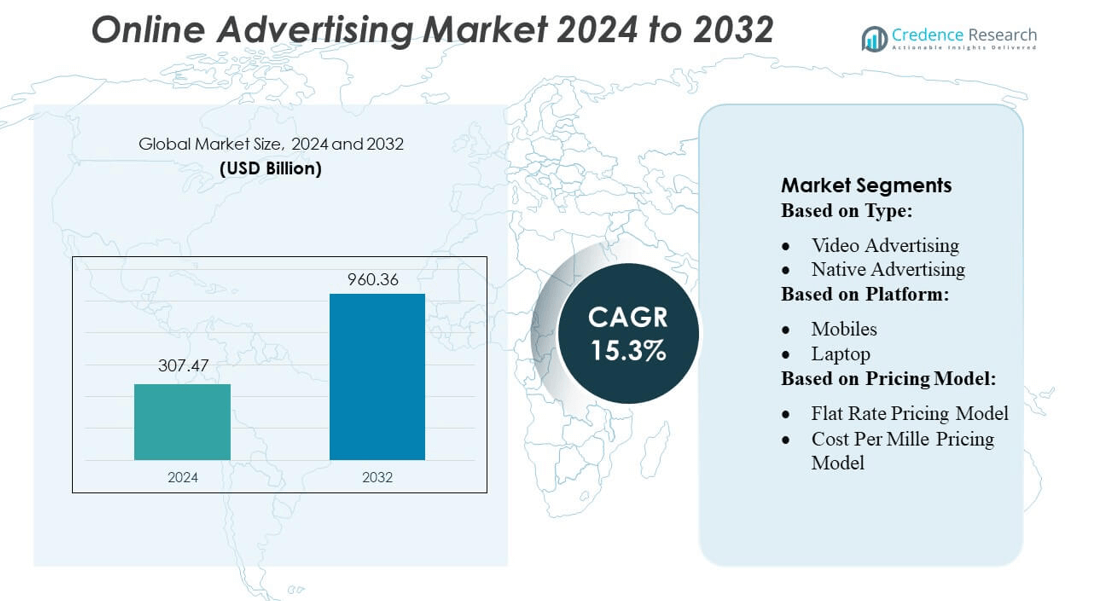
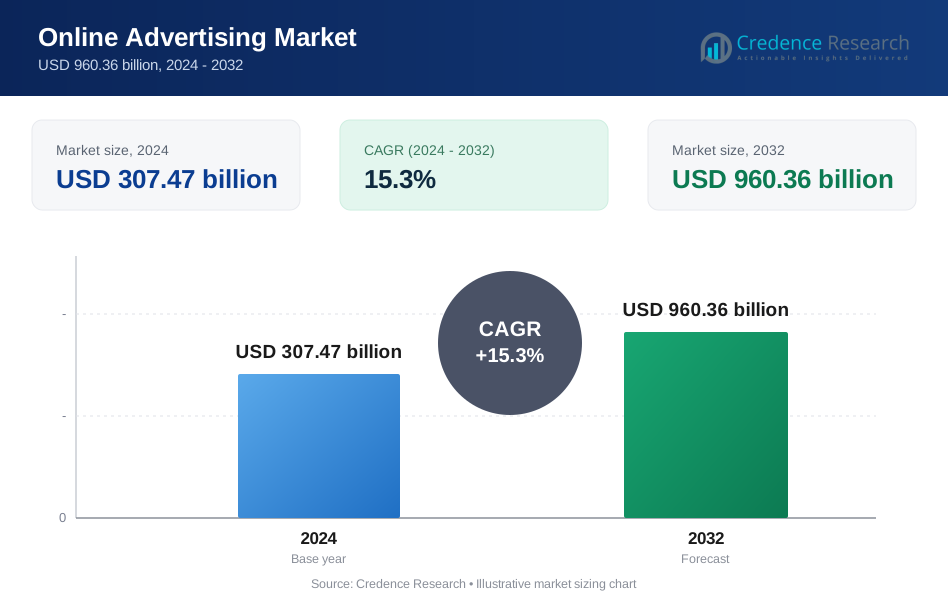
Online Advertising Market size was valued USD 307.47 billion in 2024 and is anticipated to reach USD 960.36 billion by 2032, at a CAGR of 15.3% during the forecast period.
| REPORT ATTRIBUTE | DETAILS |
|---|---|
| Historical Period | 2020-2023 |
| Base Year | 2024 |
| Forecast Period | 2025-2032 |
| Online Advertising Market Size 2024 | USD 307.47 billion |
| Online Advertising Market, CAGR | 15.3% |
| Online Advertising Market Size 2032 | USD 960.36 billion |
The Online Advertising Market’s competitive landscape is shaped by intense rivalry, technological innovation, and strategic differentiation. Leading firms vigorously invest in AI-driven programmatic platforms, real-time bidding, and first-party data capabilities to boost targeting precision and campaign efficiency. Major players leverage massive consumer reach on social, video, and retail platforms, while also emphasizing privacy-safe solutions and cross-channel attribution models. As firms scale globally, regional strategies matter: North America leads the market with about 34% share, driven by high internet penetration, mature ad tech infrastructure, and strong digital ad spend across search, display, and video formats.
Market Insights
- The Online Advertising Market was valued at USD 307.47 billion in 2024 and is projected to reach USD 960.36 billion by 2032 at a 3% CAGR, supported by rising digital spending, expanding online audiences, and increasing adoption of AI-enabled advertising solutions.
- Strong market drivers include rapid mobile and video consumption, accelerated e-commerce growth, and wider use of programmatic platforms that enhance precision targeting and campaign scalability.
- Key trends focus on privacy-centric advertising, growth of retail media networks, and rising demand for immersive formats such as AR and interactive ads, reshaping advertiser engagement strategies.
- Competitive intensity increases as global platforms invest in AI, first-party data, real-time bidding, and analytics, while firms emphasize transparency, brand safety, and cross-channel measurement to differentiate.
- Regionally, North America leads with about 34% share, while by type, video advertising holds the dominant segment share, driven by stronger engagement and higher ROI across mobile and social platforms.
Market Segmentation Analysis:
By Type
Video advertising dominates the online advertising market, accounting for the largest share-often estimated at over one-third of total digital ad spending-driven by rising user engagement on streaming platforms, short-form video apps, and connected TV environments. Brands prefer video formats due to higher click-through rates, improved storytelling capability, and better ROI compared to static formats. Growth is further fueled by advancements in programmatic video delivery, AI-based content personalization, and improved mobile network speeds, which enhance loading performance and expand reach across demographics.
- For instance, Snap reported that AR Lenses in its camera were used 8 billion times per day, and over 400,000 developers have created more than 4 million Lenses using its Lens Studio platform.
By Platform
Mobile platforms hold the dominant market position, capturing well above half of total online ad spending as consumers increasingly rely on smartphones for browsing, shopping, and media consumption. The segment’s growth is supported by expanding 4G/5G penetration, high in-app engagement rates, and superior ad-targeting precision through device-level data. Marketers prefer mobile ads for their location-based targeting, dynamic personalization, and strong conversion metrics. Additionally, app-based ecosystems allow seamless integration of video, native, and interactive formats, further accelerating mobile’s lead over desktops, laptops, and tablets.
- For instance, Microsoft has enhanced its Azure App Service platform to provide native support for Progressive Web Apps (PWAs) and seamless integration with serverless technologies like Azure Functions. The service is deployed across more than 70 Azure regions worldwide, enabling developers to build and deploy highly responsive and scalable web apps.
By Pricing Model
The Cost Per Click (CPC) pricing model leads the segment, representing the largest share due to its performance-driven structure and direct link to measurable user actions. Advertisers favor CPC because it optimizes budget utilization, reduces wastage, and supports real-time campaign adjustments based on click-through behavior. This model gains traction across search engines, e-commerce platforms, and social media networks where intent-driven traffic is strong. Its dominance is reinforced by advancements in analytics, automated bidding, and AI-enhanced audience segmentation that increase accuracy in predicting high-value user interactions.
Key Growth Drivers
Expansion of Programmatic Advertising
Programmatic advertising drives substantial growth as brands increasingly adopt automated, data-driven platforms to optimize campaign performance. Real-time bidding capabilities enable precise audience targeting, higher inventory efficiency, and improved ROI. As advertisers shift budgets toward algorithmic ad buying, demand grows for AI-driven personalization, dynamic creative optimization, and cross-device audience mapping. The integration of machine learning enhances predictive insights, enabling faster decision-making and reducing acquisition costs. This automation trend accelerates adoption across sectors such as retail, BFSI, entertainment, and e-commerce, strengthening programmatic’s position as a major growth catalyst.
- For instance, Multi-Task Multi-Domain (MTMD) lightweight model that replaced nine production ranking systems, reducing cost-per-click by 2% in live traffic while maintaining latency.
Rapid Growth of Mobile and Video Consumption
The surge in mobile internet usage and short-form video content consumption significantly propels online advertising growth. High smartphone penetration, faster 4G/5G networks, and increasing time spent on video-centric platforms strengthen the appeal of mobile-first campaigns. Advertisers benefit from immersive video formats that deliver stronger engagement and higher click-through rates than static content. The popularity of connected TV, OTT platforms, and social video apps further fuels demand for targeted video ads. As consumer behavior shifts toward on-the-go visual content, brands intensify investments in mobile and video advertising channels.
- For instance, Waystar’s Claim Manager maintains a 98.5% first-pass clean claim rate, powered by more than 2.5 million built-in claim edits updated in real time. This level of automation reduces resubmission delays and supports faster reimbursement across 5,000 payer connections.
Rising Adoption of AI and Data Analytics
AI and advanced analytics are major growth drivers, empowering advertisers with granular insights and predictive capabilities to enhance campaign effectiveness. Machine learning algorithms improve audience segmentation, automate bidding strategies, and optimize creative elements based on real-time performance signals. The growing use of customer data platforms and attribution tools helps brands understand user journeys and allocate budgets more efficiently. Additionally, AI-powered personalization boosts conversion rates by delivering contextually relevant ads. As digital ecosystems generate larger datasets, analytics-driven decision-making becomes indispensable for maximizing ad spend efficiency.
Key Trends & Opportunities
Growth of Privacy-Focused Advertising Solutions
Privacy-centric advertising is emerging as a key trend as regulators enforce stricter data protection rules and browsers phase out third-party cookies. This shift creates new opportunities for contextual advertising, first-party data strategies, and privacy-preserving identity solutions. Brands are investing in consent-driven data collection, clean rooms, and encrypted targeting frameworks to maintain relevance while ensuring compliance. The industry’s transition toward transparent, user-centric models opens avenues for innovative targeting methodologies that balance personalization with privacy, reshaping how advertisers track, attribute, and optimize customer interactions.
- For instance, Amazon Ads also highlighted a mobile campaign on MX Player, where a smartphone brand achieved 61 million + impressions and a 94% video completion rate, while driving 70% higher attention than online video benchmarks.
Expansion of Retail Media Networks
Retail Media Networks (RMNs) present a fast-growing opportunity as major e-commerce platforms monetize their first-party shopper data. Brands increasingly leverage RMNs to reach high-intent consumers through sponsored listings, display ads, and personalized product recommendations. These networks offer precise attribution, closed-loop reporting, and strong conversion rates, making them attractive for performance marketers. As retailers scale omnichannel ecosystems-spanning apps, marketplaces, and in-store digital screens-the advertising inventory expands. This trend enables advertisers to access premium retail audiences while helping retailers establish a high-margin revenue stream.
- For instance, NextGen Ambient Assist, introduced nearly two years ago, now handles 1.5 million patient encounters annually. It saves providers up to two hours per day in documentation by transcribing encounters in real time and generating summaries via AI.
Rise of Immersive and Interactive Ad Formats
Immersive formats such as AR/VR ads, 3D product visualizations, and gamified experiences are gaining traction, creating new engagement opportunities for brands. Advancements in augmented reality, AI-driven creative tools, and in-app interactive environments support deeper consumer interaction. Sectors like fashion, automotive, and beauty increasingly use AR try-ons and virtual showrooms to enhance customer experience. As metaverse environments and spatial computing platforms evolve, advertisers explore new digital spaces to deliver measurable and interactive campaigns. This shift opens avenues for richer storytelling and higher engagement levels.
Key Challenges
Increasing Ad Fraud and Brand Safety Concerns
Ad fraud-including bot traffic, click fraud, and impression manipulation-remains a major challenge that erodes advertiser trust and inflates campaign costs. Brands struggle to maintain transparency as fraudulent actors exploit programmatic systems and cross-channel networks. Additionally, brand safety risks increase as ads occasionally appear next to inappropriate or harmful content, damaging reputation. Despite advancements in verification tools and fraud detection algorithms, ensuring clean inventory and safe placements requires continuous monitoring, higher security investments, and collaboration across publishers, agencies, and technology providers.
Fragmented Ecosystem and Measurement Complexity
The online advertising landscape is highly fragmented across platforms, devices, and ad formats, complicating unified measurement and attribution. Brands face difficulty in tracking user journeys consistently due to walled gardens, privacy restrictions, and varied data standards. Cross-device identification challenges further limit accurate ROI assessment. As platforms prioritize first-party data, advertisers often navigate inconsistent metrics and limited interoperability. This complexity increases operational overhead and hinders budget optimization. Developing unified measurement frameworks and interoperable identity solutions becomes essential for achieving accurate, cross-channel performance insights.
Regional Analysis
North America
North America holds the largest share of the online advertising market, accounting for around 40% of global revenue. The region benefits from strong digital adoption, high internet penetration, and significant spending by major advertisers across retail, technology, and financial services. Companies such as Google, Meta, and Amazon dominate digital ad ecosystems, strengthening market maturity. Programmatic buying, video advertising, and performance-based campaigns are widely adopted due to advanced analytics and data-driven targeting. Although growth is steady rather than rapid, North America maintains leadership due to its developed infrastructure and strong advertiser demand.
Asia–Pacific
Asia–Pacific accounts for approximately 30–35% of the global online advertising market and represents the fastest-growing region. Rapid smartphone penetration, expanding 4G/5G networks, and rising digital spending in China, India, and Southeast Asia fuel strong growth. Consumers in this region are highly mobile-first, driving demand for video, in-app, and social media advertising. E-commerce platforms significantly increase digital ad investments through retail media networks. With a young digital population and fast-evolving mobile ecosystems, Asia–Pacific is expected to continue gaining market share and remain a major driver of global online advertising growth.
Europe
Europe holds about 15–20% of the online advertising market, supported by high digital literacy and strong adoption of data-driven advertising. Markets such as the UK, Germany, and France lead investment in programmatic and performance-based campaigns. However, stricter data privacy regulations encourage growth in contextual and privacy-compliant advertising strategies. Despite slower expansion compared to Asia–Pacific, Europe maintains steady growth due to consistent digital transformation among enterprises and high-quality ad inventory. The region’s focus on transparency, brand safety, and standardized measurement ensures stable advertiser confidence and sustained demand.
Latin America
Latin America captures roughly 6–8% of global online advertising spending, supported by rising internet access and expanding mobile usage across Brazil, Mexico, and Argentina. Social media platforms play a significant role in advertising budgets due to high user engagement. The growth of regional e-commerce platforms is increasing demand for digital ads, particularly mobile and video formats. Although economic volatility and uneven digital infrastructure slow overall expansion, investment in mobile-first campaigns and digital transformation among local businesses contributes to steady market development and improved regional competitiveness.
Middle East & Africa (MEA)
The Middle East & Africa region holds around 5–7% of the global online advertising market, with growth driven by increasing smartphone adoption and expanding internet connectivity. GCC countries, particularly the UAE and Saudi Arabia, lead digital ad spending due to strong economic conditions and rapid digitalization. Social media and mobile video advertising are major growth areas, supported by a young, highly engaged population. Despite challenges such as inconsistent digital infrastructure in some countries, improving connectivity and rising interest in programmatic advertising support gradual market expansion.
Market Segmentations:
By Type:
- Video Advertising
- Native Advertising
By Platform:
- Mobiles
- Laptop
By Pricing Model:
- Flat Rate Pricing Model
- Cost Per Mille Pricing Model
By Geography
- North America
- U.S.
- Canada
- Mexico
- Europe
- Germany
- France
- U.K.
- Italy
- Spain
- Rest of Europe
- Asia Pacific
- China
- Japan
- India
- South Korea
- South-east Asia
- Rest of Asia Pacific
- Latin America
- Brazil
- Argentina
- Rest of Latin America
- Middle East & Africa
- GCC Countries
- South Africa
- Rest of the Middle East and Africa
Competitive Landscape
The competitive landscape of the Online Advertising Market features major global players ByteDance Ltd., Snap Inc., Microsoft Corporation, Pinterest, Tencent, Amazon.com, Inc., Google LLC, Twitter, Inc., Adobe Systems, Inc., and Facebook, Inc. The Online Advertising Market is highly dynamic, shaped by rapid technological advancements, shifting consumer behavior, and intensifying platform-level innovation. Companies compete by enhancing targeting accuracy, expanding programmatic capabilities, and integrating AI-driven personalization to optimize ad performance. The growing emphasis on privacy compliance, including the shift toward first-party data strategies and contextual advertising, is redefining competitive priorities. Meanwhile, demand for immersive formats such as video, AR, and interactive ads continues to rise, pushing platforms to differentiate through user engagement and advanced analytics. As digital ecosystems evolve, competition increasingly centers on automation, measurement transparency, and cross-channel ad delivery efficiency.
Key Player Analysis
- ByteDance Ltd.
- Snap Inc.
- Microsoft Corporation
- Tencent
- com, Inc.
- Google LLC
- Twitter, Inc.
- Adobe Systems, Inc.
- Facebook, Inc.
Recent Developments
- In May 2025, The Trade Desk. announced the launch of OpenSincera, a new application designed to provide greater visibility into advertising performance and the health of the digital advertising supply chain. OpenSincera, which is free and open to all participants in the advertising industry, leverages Sincera’s rich advertising metadata to deliver deeper insights into advertising quality.
- In May 2025, Meta Platforms, Inc. announced a series of ad updates for its platforms Facebook, Instagram, and Threads at NewFronts 2025. These updates include enhanced tools for creator collaborations, a new method for advertising within trending Reels, updated Partnership Ads, and the introduction of video ads on Threads.
- In March 2025, Adobe announced a strategic collaboration with Amazon Web Services (AWS) and Amazon Ads. The collaboration enhances the Adobe Experience Platform (AEP) with AWS’s generative AI services, Amazon Connect, and Amazon Ads to support the creation of high-impact, data-driven advertising and customer engagement.
- In May 2023, Google, Inc. expanded its collaboration with SAP SE to introduce a comprehensive open data solution. This solution will enable customers to build a complete data cloud, integrating data from their enterprise systems via SAP Datasphere and Google’s data cloud
Report Coverage
The research report offers an in-depth analysis based on Type, Platform, Pricing Model and Geography. It details leading market players, providing an overview of their business, product offerings, investments, revenue streams, and key applications. Additionally, the report includes insights into the competitive environment, SWOT analysis, current market trends, as well as the primary drivers and constraints. Furthermore, it discusses various factors that have driven market expansion in recent years. The report also explores market dynamics, regulatory scenarios, and technological advancements that are shaping the industry. It assesses the impact of external factors and global economic changes on market growth. Lastly, it provides strategic recommendations for new entrants and established companies to navigate the complexities of the market.
Future Outlook
- The market will continue shifting toward AI-driven automation to improve targeting accuracy and campaign optimization.
- Privacy-focused advertising models will expand as brands adopt first-party data strategies and contextual targeting.
- Video and short-form content advertising will grow rapidly due to rising mobile engagement and platform monetization.
- Programmatic advertising adoption will deepen across emerging markets as infrastructure and digital maturity improve.
- Retail media networks will gain prominence as e-commerce platforms expand their advertising ecosystems.
- Immersive ad formats such as AR and interactive experiences will become more mainstream across consumer-facing sectors.
- Cross-platform measurement and attribution tools will advance to support unified campaign analysis.
- Social commerce and in-app advertising will accelerate as consumers increasingly shop within digital platforms.
- Connected TV and OTT advertising will strengthen as streaming penetration rises globally.
- Brand safety, fraud detection, and transparent reporting will remain priority investment areas for advertisers and platforms.
Request a Free Sample
Fill in your details and we'll send you a free sample report.
- Sample data tables & charts
- Research methodology
Market Dynamics
Expansion of Programmatic Advertising
Automated, data-driven programmatic platforms enable brands to optimize campaign performance through real-time bidding and precise audience targeting, resulting in higher ROI and efficiency. The adoption of AI-driven personalization and dynamic creative optimization further accelerates programmatic's growth across sectors such as retail, BFSI, and e-commerce.
Rapid Growth of Mobile and Video Consumption
Increasing smartphone penetration, faster 4G/5G networks, and the popularity of video-centric platforms drive advertisers to invest heavily in mobile-first and video advertising. These formats deliver higher engagement and click-through rates, especially as consumers spend more time on short-form video apps and connected TV environments.
Rising Adoption of AI and Data Analytics
AI and advanced analytics empower advertisers with granular insights, predictive audience segmentation, and automated bidding strategies. This enhances campaign effectiveness, enables real-time optimization, and supports the delivery of contextually relevant ads, maximizing ad spend efficiency.
Growth of Privacy-Focused Advertising Solutions
Stricter data protection regulations and the phasing out of third-party cookies are pushing brands toward privacy-centric advertising models. Investments in first-party data, contextual targeting, and privacy-preserving identity solutions are creating new opportunities for compliant and effective ad strategies.
Expansion of Retail Media Networks
Major e-commerce platforms are monetizing their first-party shopper data through retail media networks, allowing brands to reach high-intent consumers with sponsored listings and personalized ads. This trend offers precise attribution, closed-loop reporting, and strong conversion rates, making it highly attractive for performance marketers.
Need a Custom Version of This Report?
Tailor the scope, geography, or segments to your exact requirements.
- Custom geography or segment scope
- Direct access to our analyst team
Frequently Asked Questions
What is the current market size for the Online Advertising Market, and what is its projected size in 2032?
At what Compound Annual Growth Rate is the Online Advertising Market projected to grow between 2025 and 2032?
Which segment is expected to post the highest CAGR during the forecast period?
Who are the major players in the global online advertising market?
What are the major market drivers of the online advertising industry?
What are the major market restraints of the online advertising industry?
What are the major market opportunities in the online advertising industry?
Who are the leading companies in the Online Advertising Market?
Table of Content
Chapter 1 Market Segmentation
- 1.1 Segmentation Framework
- 1.1.1 Product and Service Classification
- 1.1.2 Application and End-Use Classification
- 1.1.3 Technology and Solution Classification
- 1.1.4 Customer and Distribution Channel Classification
- 1.1.5 Geographic Segmentation
- 1.1.6 Market Segment Definitions and Boundaries
- 1.2 By Type
- 1.2.1 Video Advertising
- 1.2.2 Native Advertising
- 1.2.3 Display Advertising
- 1.2.4 Search Advertising
- 1.2.5 Social Media Advertising
- 1.3 By Platform
- 1.3.1 Mobiles
- 1.3.2 Laptops
- 1.3.3 Desktops
- 1.3.4 Tablets
- 1.3.5 Connected TV
- 1.4 By Pricing Model
- 1.4.1 Cost Per Click (CPC)
- 1.4.2 Flat Rate Pricing Model
- 1.4.3 Cost Per Mille (CPM) Pricing Model
- 1.4.4 Cost Per Acquisition (CPA)
- 1.4.5 Programmatic/Real-Time Bidding
Chapter 2 Introduction
- 2.1 Report Objectives and Scope
- 2.2 Product Definition and Industry Terminology
- 2.3 Market Inclusions and Exclusions
- 2.4 Research Process
- 2.4.1 Primary Research and Expert Interviews
- 2.4.2 Secondary Research and Source Review
- 2.4.3 Top-Down and Bottom-Up Estimation
- 2.4.4 Data Triangulation and Verification
- 2.5 Market Size Measurement Basis
- 2.5.1 2024: USD 307.47 billion → 2032: USD 960.36 billion
- 2.6 Historical and Forecast Reference Periods
- 2.6.1 Base Year: 2024
- 2.6.2 Forecast Period: 2024-2032
- 2.7 Research Assumptions and Limitations
Chapter 3 Executive Summary
- 3.1 Market Snapshot and Key Findings
- 3.2 Base-Year Market Size, 2024
- 3.3 Forecast Market Size, 2032
- 3.4 Revenue and Volume Growth Outlook
- 3.5 Key Demand and Supply Indicators
- 3.6 Leading Market Segments
- 3.7 Fastest-Growing Market Opportunities
- 3.8 Regional Performance Highlights
- 3.9 Technology and Industry Transformation
- 3.10 Competitive Landscape Summary
- 3.11 Analyst View and Strategic Implications
Chapter 4 Global Online Advertising Market Trends and Developments
- 4.1 Historical Industry Development
- 4.2 Recent Market Trends and Developments
- 4.3 Demand and Customer Behavior Trends
- 4.4 Technology and Product Innovation
- 4.5 Artificial Intelligence, Automation and Digitalization
- 4.6 Local Manufacturing and Supply Chain Realignment
- 4.7 Industry Partnerships, Mergers and Acquisitions
- 4.8 Sustainability and Circular Economy Developments
- 4.9 Government and Private Sector Investment Trends
- 4.10 Emerging Business Models and Commercialization
- 4.11 Industry Developments and Announcements
Chapter 5 Global Online Advertising Market Production, Supply and Demand Analysis
- 5.1 Demand Trend and Consumption Analysis
- 5.2 Demand Forecast, 2024-2032
- 5.3 Production and Output Trend
- 5.4 Production and Output Forecast, 2024-2032
- 5.5 Installed Capacity and Capacity Utilization
- 5.6 Company-Wise Production Plants and Statistics
- 5.6.1 Installed Production Capacity
- 5.6.2 Actual Production
- 5.6.3 Planned Capacity and Expansion Targets
- 5.7 Supply Chain Structure and Procurement Trends
- 5.8 Supply-Demand Gap and Bottlenecks
- 5.9 Import Dependence and Sourcing Structure
- 5.10 Contract Manufacturing and Outsourcing
- 5.11 Regional Supply and Demand Concentration
Chapter 6 Global Online Advertising Market Pricing Analysis
- 6.1 Pricing Structure and Measurement
- 6.2 Historical Pricing Trends
- 6.3 Pricing Outlook, 2024-2032
- 6.4 Average Selling Price and Unit Economics
- 6.5 Pricing by Product and Market Segment
- 6.6 Geographic Pricing Differences
- 6.7 Key Input, Energy, Labor and Logistics Costs
- 6.8 Contract Pricing and Purchasing Models
- 6.9 Pricing Sensitivity and Competitive Positioning
- 6.10 Price, Margin and Profitability Implications
Chapter 7 Global Online Advertising Market Dynamics
- 7.1 Market Growth Drivers
- 7.1.1 Demand-Side Drivers
- 7.1.2 Technology and Innovation Drivers
- 7.1.3 Infrastructure and Investment Drivers
- 7.1.4 Regulatory and Policy Drivers
- 7.2 Market Restraints
- 7.2.1 Cost and Affordability Constraints
- 7.2.2 Technology and Adoption Barriers
- 7.2.3 Supply Chain and Operational Constraints
- 7.3 Market Challenges
- 7.3.1 Competitive Pressure and Margin Erosion
- 7.3.2 Skills, Infrastructure and Implementation Gaps
- 7.4 Emerging Market Opportunities
- 7.5 Market Dynamics Impact and Time-Horizon Assessment
Chapter 8 Global Online Advertising Value Chain Analysis
- 8.1 Industry Value Chain Overview
- 8.2 Upstream Suppliers and Critical Inputs
- 8.3 Technology and Component Providers
- 8.4 Manufacturing or Service Delivery
- 8.5 Distribution, Channel Partners and Integrators
- 8.6 Downstream Applications and End Users
- 8.7 Value Addition and Profit Pools
- 8.8 Vertical Integration and Outsourcing
- 8.9 Supplier Concentration and Risk
- 8.10 Supply Chain Localization and Resilience
Chapter 9 Global Online Advertising Market Regulations and Policies
- 9.1 Relevant Laws, Standards and Compliance Frameworks
- 9.2 Product, Service, Safety and Quality Requirements
- 9.3 Government Policies, Incentives and Subsidies
- 9.4 Imports, Exports and Trade Barriers
- 9.5 Public Procurement and Local Content Requirements
- 9.6 Environmental and Sustainability Compliance
- 9.7 Data Protection, AI and Cybersecurity Compliance
- 9.8 Upcoming Policy Changes and Market Implications
Chapter 10 Global Online Advertising Market Hotspots and Opportunities
- 10.1 Market Opportunity Mapping and Growth Hotspots
- 10.2 High-Growth Applications and Customer Groups
- 10.3 Underserved Markets and White-Space Opportunities
- 10.4 Emerging Technology and Product Opportunities
- 10.5 New Capacity and Investment Hotspots
- 10.6 Market Entry and Expansion Opportunities
- 10.7 Distribution and Partnership Opportunities
- 10.8 Near-Term and Long-Term Commercial Potential
- 10.9 Opportunity Attractiveness and Execution Risks
Chapter 11 Global Online Advertising Market Outlook, 2024-2032
- 11.1 Market Size and Analysis
- 11.1.1 Revenue (Market Measurement: 2024: USD 307.47 billion → 2032: USD 960.36 billion)
- 11.1.2 Market Volume and Quantity Sold
- 11.1.3 Historical Market Size
- 11.1.4 Base-Year Market Size, 2024
- 11.2 Market Forecast, 2024-2032
- 11.2.1 Revenue Forecast to 2032
- 11.2.2 Volume Forecast to 2032
- 11.2.3 CAGR and Year-on-Year Growth
- 11.2.4 Incremental Revenue Opportunity
- 11.3 Forecast Assumptions and Scenario Analysis
- 11.3.1 Base-Case Forecast
- 11.3.2 Optimistic and Conservative Scenarios
- 11.3.3 Technology, Pricing and Policy Sensitivities
- 11.4 Market Attractiveness and Growth Outlook
Chapter 12 Global Online Advertising Market Segmentation and Outlook
- 12.1 Segmentation Summary and Market Shares, 2024
- 12.2 Largest and Fastest-Growing Segments
- 12.3 By Type - Market Size and Forecast, 2024-2032
- 12.3.1 Segment Definition and Scope
- 12.3.2 Historical Market Size
- 12.3.3 Revenue Forecast, 2024-2032
- 12.3.4 Volume Forecast, 2024-2032
- 12.3.5 Base-Year Market Share, 2024
- 12.3.6 Segment CAGR and Growth Drivers
- 12.3.7 Subsegment Market Size and Forecast
- 12.3.7.1 Video Advertising
- 12.3.7.2 Native Advertising
- 12.3.7.3 Display Advertising
- 12.3.7.4 Search Advertising
- 12.3.7.5 Social Media Advertising
- 12.3.8 Subsegment Pricing and Adoption Trends
- 12.3.9 Leading Suppliers and Competition
- 12.3.10 Regional Demand and Opportunities
- 12.4 By Platform - Market Size and Forecast, 2024-2032
- 12.4.1 Segment Definition and Scope
- 12.4.2 Historical Market Size
- 12.4.3 Revenue Forecast, 2024-2032
- 12.4.4 Volume Forecast, 2024-2032
- 12.4.5 Base-Year Market Share, 2024
- 12.4.6 Segment CAGR and Growth Drivers
- 12.4.7 Subsegment Market Size and Forecast
- 12.4.7.1 Mobiles
- 12.4.7.2 Laptops
- 12.4.7.3 Desktops
- 12.4.7.4 Tablets
- 12.4.7.5 Connected TV
- 12.4.8 Subsegment Pricing and Adoption Trends
- 12.4.9 Leading Suppliers and Competition
- 12.4.10 Regional Demand and Opportunities
- 12.5 By Pricing Model - Market Size and Forecast, 2024-2032
- 12.5.1 Segment Definition and Scope
- 12.5.2 Historical Market Size
- 12.5.3 Revenue Forecast, 2024-2032
- 12.5.4 Volume Forecast, 2024-2032
- 12.5.5 Base-Year Market Share, 2024
- 12.5.6 Segment CAGR and Growth Drivers
- 12.5.7 Subsegment Market Size and Forecast
- 12.5.7.1 Cost Per Click (CPC)
- 12.5.7.2 Flat Rate Pricing Model
- 12.5.7.3 Cost Per Mille (CPM) Pricing Model
- 12.5.7.4 Cost Per Acquisition (CPA)
- 12.5.7.5 Programmatic/Real-Time Bidding
- 12.5.8 Subsegment Pricing and Adoption Trends
- 12.5.9 Leading Suppliers and Competition
- 12.5.10 Regional Demand and Opportunities
- 12.6 Segment Growth Comparison
- 12.7 Segment Attractiveness and Priority Matrix
Chapter 13 Global Online Advertising Geographic Market Outlook, 2024-2032
- 13.1 Regional Market Size and Share, 2024
- 13.2 Regional Market Forecast, 2024-2032
- 13.3 Regional Pricing, Production and Demand Differences
- 13.4 North America
- 13.4.1 United States
- 13.4.2 Canada
- 13.4.3 Mexico
- 13.5 Europe
- 13.5.1 Germany
- 13.5.2 France
- 13.5.3 Italy
- 13.5.4 United Kingdom
- 13.5.5 Spain
- 13.5.6 Poland
- 13.5.7 Russia
- 13.5.8 Netherlands
- 13.5.9 Belgium
- 13.5.10 Sweden
- 13.5.11 Denmark
- 13.5.12 Norway
- 13.5.13 Rest of Europe
- 13.6 Asia Pacific
- 13.6.1 China
- 13.6.2 India
- 13.6.3 Japan
- 13.6.4 South Korea
- 13.6.5 Thailand
- 13.6.6 Indonesia
- 13.6.7 Vietnam
- 13.6.8 Malaysia
- 13.6.9 Australia
- 13.6.10 Rest of Asia Pacific
- 13.7 Latin America
- 13.7.1 Brazil
- 13.7.2 Argentina
- 13.7.3 Colombia
- 13.7.4 Chile
- 13.7.5 Rest of Latin America
- 13.8 Middle East
- 13.8.1 Saudi Arabia
- 13.8.2 United Arab Emirates
- 13.8.3 Turkey
- 13.8.4 Israel
- 13.8.5 Iran
- 13.8.6 Rest of the Middle East
- 13.9 Africa
- 13.9.1 South Africa
- 13.9.2 Egypt
- 13.9.3 Nigeria
- 13.9.4 Morocco
- 13.9.5 Rest of Africa
- 13.10 Regional Investment, Policy and Supply Chain Differences
- 13.11 Regional Competitive Landscape
- 13.12 Geographic Growth Hotspots
Chapter 14 Global Online Advertising Technology, Innovation and Sustainability Outlook
- 14.1 Technology Landscape and Maturity
- 14.2 Product, Process and Service Innovation
- 14.3 AI, Automation and Digital Tools in the Industry
- 14.4 Technology Adoption and Performance Benchmarking
- 14.5 Innovation Pipeline and R&D Investment
- 14.6 Patent and Intellectual Property Trends
- 14.7 Energy Efficiency and Resource Management
- 14.8 Sustainability, Recycling and Circularity
- 14.9 Technology Roadmap, 2024-2032
- 14.10 Risks of Obsolescence and Technology Substitution
Chapter 15 Global Online Advertising Market Key Strategic Imperatives
- 15.1 Growth and Market Entry Priorities
- 15.2 High-Return Products and Segments
- 15.3 Pricing, Profitability and Cost Optimization
- 15.4 Technology Investment and Product Differentiation
- 15.5 Supply Chain Localization and Resilience
- 15.6 Distribution and Customer Acquisition
- 15.7 Partnership, Acquisition and Capacity Strategy
- 15.8 Regional Expansion Priorities
- 15.9 Short-, Medium- and Long-Term Actions
Chapter 16 Competition Outlook
- 16.1 Industry Competition Characteristics
- 16.2 Market Structure and Concentration
- 16.3 Market Share and Competitive Positioning, 2024
- 16.4 Company-Wise Revenue and Product Benchmarking
- 16.5 Production and Service Capacity Benchmarking
- 16.6 Technology, Pricing and Differentiation
- 16.7 Regional Footprint and Distribution Strength
- 16.8 Mergers, Acquisitions and Strategic Alliances
- 16.9 New Entrants and Competitive Threats
- 16.10 Porter's Five Forces and Industry Attractiveness
- 16.11 Competitive Outlook, 2024-2032
Chapter 17 Company Profiles
- 17.1 Company Coverage and Selection Criteria
- 17.2 Google LLC
- 17.2.1 Business Description
- 17.2.2 Company Ownership and Geographic Presence
- 17.2.3 Product and Service Portfolio
- 17.2.4 Manufacturing and Operating Footprint
- 17.2.5 Production Capacity and Expansion Plans
- 17.2.6 Financial Performance and Investment
- 17.2.7 Market Share and Competitive Position
- 17.2.8 Technology and Innovation Capabilities
- 17.2.9 Strategic Alliances or Partnerships
- 17.2.10 Recent Developments
- 17.2.11 Growth Strategy and Outlook
- 17.3 Meta Platforms, Inc. (Facebook, Instagram)
- 17.4 Amazon.com, Inc.
- 17.5 ByteDance Ltd. (TikTok)
- 17.6 Snap Inc.
- 17.7 Microsoft Corporation
- 17.8 Pinterest
- 17.9 Tencent
- 17.10 Adobe Systems, Inc.
- 17.11 Twitter, Inc.
- 17.12 Other Relevant Market Participants
Note: Every listed company is profiled on the structure shown under the first company. The company list is preliminary and may change based on research findings, market developments, data availability and client requirements.
Chapter 18 Disclaimer
- 18.1 Research and Forecast Disclaimer
- 18.2 Data Source and Estimation Limitations
Note: The depth of individual sections depends on data availability for this market. Volume, capacity, trade and other unit-based metrics are included where applicable.