
| REPORT ATTRIBUTE | DETAILS |
|---|---|
| Historical Period | 2020-2023 |
| Base Year | 2024 |
| Forecast Period | 2025-2032 |
| Online Toys and Games Retailing Market Size 2024 | USD 18,861.20 million |
| Online Toys and Games Retailing Market, CAGR | 8.38% |
| Online Toys and Games Retailing Market Size 2032 | USD 35,910.12 million |
Market Overview
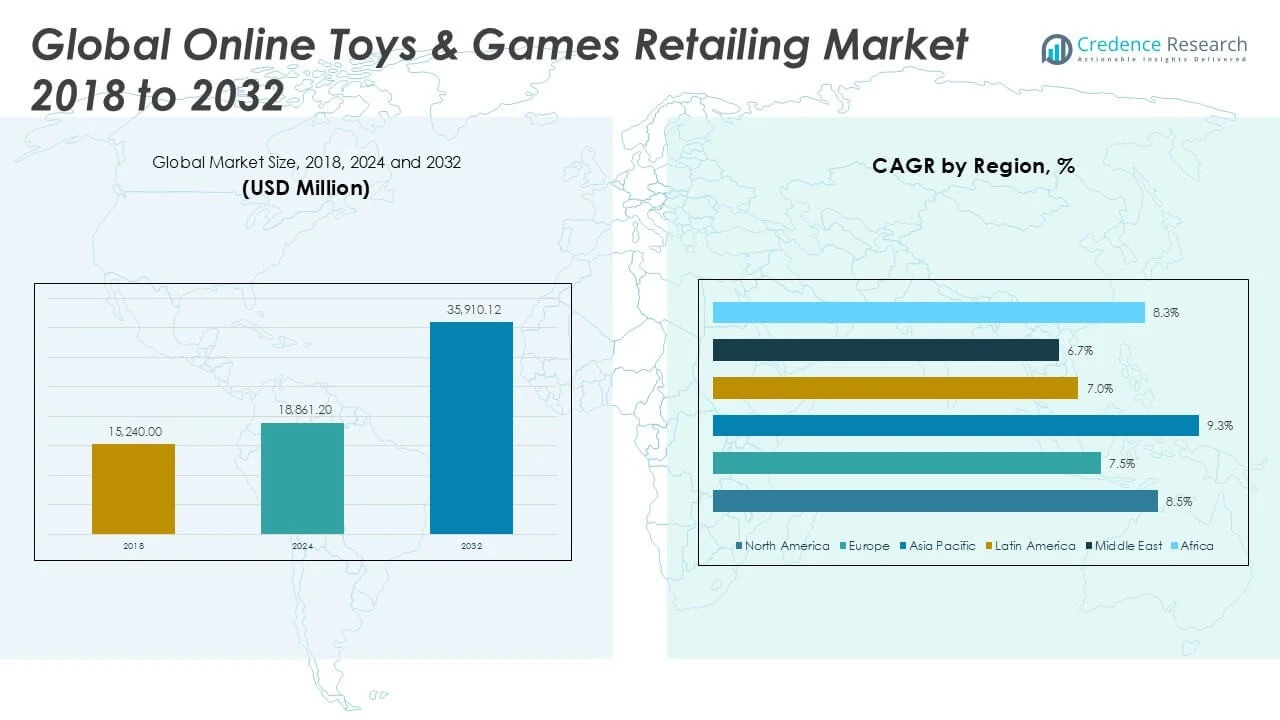
The Global Online Toys & Games Retailing Market is projected to grow from USD 18,861.20 million in 2024 to an estimated USD 35,910.12 million by 2032, reflecting a compound annual growth rate (CAGR) of 8.38% from 2025 to 2032.
Key drivers shaping the market include the growing demand for personalized and innovative toys that incorporate technology such as augmented reality (AR) and artificial intelligence (AI). The increasing influence of social media and digital marketing has enhanced consumer engagement and product visibility, further driving online sales. Market trends also show a shift towards sustainable and eco-friendly toys, aligning with consumer awareness about environmental impact. Moreover, the convenience of home delivery and improved logistics services has boosted consumer confidence in online purchases, reducing dependency on traditional brick-and-mortar stores.
Regionally, North America and Europe dominate the online toys and games retailing market due to well-established e-commerce infrastructure, high internet penetration, and substantial consumer spending power. The Asia Pacific region is emerging as the fastest-growing market, fueled by rapid urbanization, increasing digital literacy, and expanding middle-class populations in countries like China and India. Prominent key players in this market include Hasbro, Mattel, LEGO Group, Bandai Namco Holdings, and Spin Master, which leverage extensive product portfolios and global distribution networks to strengthen their market presence.
Market Insights
- The Global Online Toys & Games Retailing Market is projected to grow from USD 18,861.20 million in 2024 to USD 35,910.12 million by 2032, registering a CAGR of 8.38% from 2025 to 2032.
- Increasing consumer preference for online shopping, driven by convenience, wider product variety, and competitive pricing, serves as a primary market driver.
- Rising adoption of advanced technologies such as augmented reality (AR) and artificial intelligence (AI) in toys enhances product appeal and stimulates market growth.
- Market restraints include challenges related to product safety regulations, counterfeit products, and supply chain complexities that impact retailer operations.
- North America and Europe dominate the market due to mature e-commerce infrastructure, high internet penetration, and strong purchasing power.
- The Asia Pacific region emerges as the fastest-growing market, supported by rapid urbanization, expanding middle-class populations, and increasing digital literacy.
- Growing consumer demand for sustainable and eco-friendly toys influences product development and marketing strategies across regions.
Market Drivers
Rising Internet Penetration and Smartphone Adoption
The increasing penetration of the internet and widespread adoption of smartphones have significantly expanded the reach of online retail channels for toys and games. Consumers now have easier access to a broad range of products through user-friendly e-commerce platforms, driving higher online sales volumes. The Global Online Toys & Games Retailing Market benefits from enhanced connectivity, which enables consumers in remote and urban areas to purchase toys conveniently. The availability of secure payment gateways and improved digital infrastructure further supports this growth. It also allows retailers to implement targeted marketing strategies, increasing consumer engagement and conversion rates.
- For instance, the introduction of 5G services in 2022 accelerated mobile data adoption, with users averaging 20 GB per month per user in 2025.
Growing Demand for Interactive and Educational Toys
Consumer preference has shifted toward interactive and educational toys that support child development and learning. This demand fuels the market by encouraging manufacturers and retailers to offer innovative products integrating technology such as augmented reality and artificial intelligence. The Global Online Toys & Games Retailing Market leverages these trends to attract tech-savvy parents seeking value-added toys that combine entertainment with education. It encourages product differentiation and expands the variety available on digital platforms. This shift in consumer behavior drives sustained growth and attracts new customer segments to online stores.
- For instance, a survey conducted by the Toy Association in 2023 found that 94% of parents acknowledged the significant role of toys in their child's development, with 91% emphasizing the importance of educational toys in fostering learning.
Influence of Social Media and Digital Marketing
Social media platforms play a crucial role in shaping consumer purchasing decisions within the toys and games sector. Influencers, user reviews, and targeted advertisements create brand awareness and boost product visibility. The Global Online Toys & Games Retailing Market gains from the viral potential of social media campaigns that reach large, engaged audiences. Retailers and manufacturers use data analytics to tailor promotions and improve customer experience. It creates a direct communication channel between brands and consumers, fostering loyalty and repeat purchases.
Convenience and Efficiency of Online Shopping
Consumers increasingly prefer online shopping for toys and games due to the convenience it offers. Online retail eliminates the need for physical store visits, saving time and effort. The Global Online Toys & Games Retailing Market capitalizes on fast home delivery, easy return policies, and 24/7 availability to meet customer expectations. Efficient logistics and supply chain management further enhance the overall shopping experience. It enables retailers to expand their customer base by serving diverse geographic locations without the constraints of physical storefronts.
Market Trends
Increasing Integration of Technology in Toys Enhances Consumer Appeal
The Global Online Toys & Games Retailing Market experiences a strong trend toward integrating advanced technologies such as augmented reality (AR), artificial intelligence (AI), and Internet of Things (IoT) into toys and games. These features provide immersive and interactive experiences, attracting both children and parents who seek innovative play options. It encourages manufacturers to develop smart toys that adapt to user behavior and offer personalized learning. Retailers capitalize on this trend by promoting tech-enhanced products through digital channels. The incorporation of technology drives differentiation in a competitive market, boosting consumer interest and sales.
- For instance, the Indian toy industry has rapidly transformed through digital innovation, with interactive and connected toys incorporating IoT, AR, and AI becoming increasingly popular. In 2024, Toys"R"Us invested in multiple AI-driven product developments to enhance consumer engagement.
Shift Toward Sustainable and Eco-Friendly Toy Options Gains Traction
Consumer awareness of environmental impact has led to increased demand for sustainable and eco-friendly toys in the Global Online Toys & Games Retailing Market. Retailers and manufacturers respond by offering products made from biodegradable materials, recycled plastics, and responsibly sourced wood. It reflects a growing preference for ethical consumption and supports brand positioning focused on sustainability. This trend influences product design, packaging, and marketing strategies, encouraging innovation in environmentally conscious manufacturing. It also attracts a niche but expanding customer base that prioritizes green choices.
- For instance, the sustainable toys market has seen a surge in demand, with eco-friendly materials such as bamboo, organic cotton, and recycled plastics gaining traction.
Growth of Subscription-Based Models and Customized Toy Boxes
Subscription services and customized toy boxes represent a growing trend that reshapes how consumers purchase toys online. The Global Online Toys & Games Retailing Market benefits from these models by providing curated selections tailored to children’s age, preferences, and developmental needs. It offers convenience and variety, encouraging customer retention through regular deliveries. Retailers leverage data analytics to enhance personalization and improve customer satisfaction. This approach increases lifetime customer value and creates steady revenue streams beyond one-time purchases.
Expansion of Social Commerce and Influencer-Driven Sales Channels
Social commerce gains prominence in the Global Online Toys & Games Retailing Market, where platforms like Instagram, TikTok, and Facebook facilitate direct sales through shoppable posts and live streams. Influencers and content creators play a vital role in promoting toys, generating authentic engagement and driving conversions. It allows brands to reach targeted audiences efficiently and build trust with potential buyers. Retailers integrate social media strategies with e-commerce sites to create seamless shopping experiences. This trend accelerates market growth by blending entertainment and shopping into a unified customer journey.
Market Challenges
Complexities in Managing Supply Chain and Inventory for Diverse Product Portfolios
The Global Online Toys & Games Retailing Market faces significant challenges in managing supply chains due to the wide variety of products and seasonal demand fluctuations. Retailers must ensure timely procurement and delivery while avoiding overstocking or stockouts, which can impact customer satisfaction. It requires efficient coordination among manufacturers, distributors, and logistics providers to maintain seamless operations. Disruptions in raw material availability and transportation delays further complicate inventory management. Retailers must invest in advanced forecasting tools and real-time tracking systems to mitigate these risks and optimize stock levels.
- For instance, Amazon has implemented over 175 fulfillment centers worldwide, utilizing automated inventory management systems and AI-driven demand forecasting to streamline operations and reduce stock discrepancies
Concerns Regarding Product Safety, Counterfeiting, and Regulatory Compliance
Product safety remains a critical concern within the Global Online Toys & Games Retailing Market, with strict regulations governing toy quality and safety standards worldwide. Ensuring compliance across diverse regions challenges retailers, especially those sourcing from multiple manufacturers. It must implement robust quality control and verification processes to prevent counterfeit or substandard products from reaching consumers. Failure to comply with regulations can lead to legal penalties and damage brand reputation. Consumer trust hinges on transparent practices and guarantees of product authenticity, which demand ongoing vigilance and investment.
Market Opportunities
Expanding Market Reach Through Emerging Economies and Digital Infrastructure Development
The Global Online Toys & Games Retailing Market holds significant opportunities in emerging economies where rising disposable incomes and increasing internet penetration drive consumer demand. It can tap into large, underserved populations in regions such as Asia Pacific, Latin America, and Africa. Investments in digital infrastructure and mobile commerce facilitate easier access to online platforms for consumers in these areas. Retailers that localize product offerings and payment solutions can build strong brand loyalty. It also benefits from partnering with regional logistics providers to enhance last-mile delivery efficiency, broadening its customer base and accelerating revenue growth.
Leveraging Artificial Intelligence and Data Analytics for Personalized Shopping Experiences
The adoption of artificial intelligence (AI) and advanced data analytics presents a compelling opportunity to enhance customer engagement within the Global Online Toys & Games Retailing Market. It enables retailers to deliver personalized recommendations, tailor marketing campaigns, and optimize inventory based on consumer behavior insights. By integrating AI-powered chatbots and virtual assistants, retailers improve customer service and streamline the purchasing process. This technological advancement supports upselling and cross-selling strategies that increase average order value. Investing in data-driven decision-making strengthens competitive advantage and fosters long-term customer relatinships.
Market Segmentation Analysis
By Product
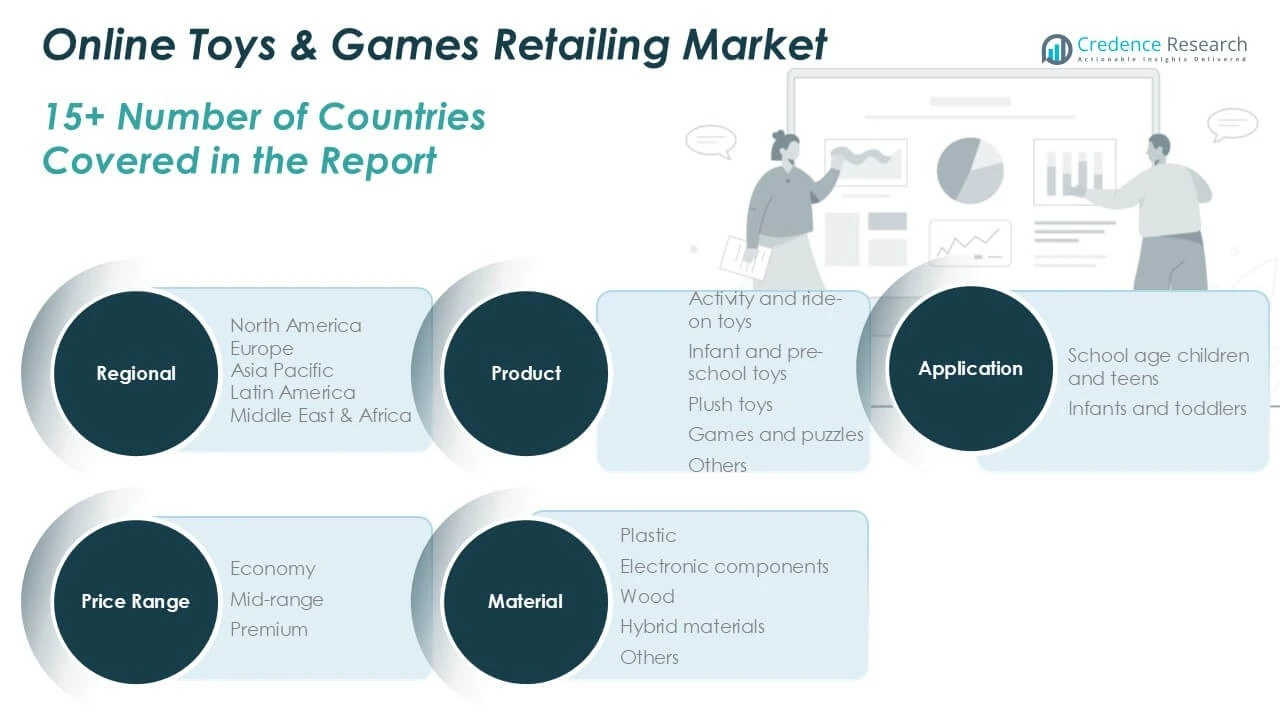
The Global Online Toys & Games Retailing Market categorizes its product offerings primarily into activity and ride-on toys, infant and pre-school toys, games and puzzles, and others. Activity and ride-on toys represent a significant share due to their appeal in promoting physical activity and outdoor play. Infant and pre-school toys focus on early childhood development and safety, attracting parents looking for educational and age-appropriate options. Games and puzzles gain traction for their role in cognitive development and family entertainment. The ‘others’ segment includes collectibles, dolls, and creative arts kits, which cater to niche interests and contribute to market diversity.
By Application
Market applications divide mainly between school-age children and teens, and infants and toddlers. The school-age children and teens segment dominates due to the demand for advanced, technology-integrated toys and games tailored to older children’s preferences. Infants and toddlers account for a substantial portion driven by the emphasis on safe, developmental products designed to support early learning milestones. It allows retailers to target specific age groups with curated assortments that meet varying developmental and entertainment needs.
By Price Range
The price range segmentation includes economy, mid-range, and premium categories. Economy products attract cost-conscious consumers seeking basic toys without compromising quality. Mid-range options balance affordability with enhanced features and brand recognition. Premium toys offer high-end materials, innovative designs, and licensed products appealing to affluent buyers and collectors. It enables market players to cater to a broad spectrum of consumer budgets and preferences, supporting inclusive growth.
By Material
Material-wise, the market segments into plastic, electronic components, wood, hybrid materials, and others. Plastic remains the dominant material due to its versatility, durability, and cost-effectiveness. Electronic components gain increasing importance with the rise of smart and interactive toys. Wood appeals to environmentally conscious consumers seeking sustainable and traditional options. Hybrid materials combine various substances to deliver enhanced functionality and aesthetic appeal. The ‘others’ category covers textiles and metal-based toys, which cater to specialized demands within the market.
Segments
Based on Product
- Activity and ride-on toys
- Infant and pre-school toys
- Games and puzzles
- Others
Based on Application
- School age children and teens
- Infants and toddlers
Based on Price Range
- Economy
- Mid-range
- Premium
Based on Material
- Plastic
- Electronic components
- Wood
- Hybrid materials
- Others
Based on Region
- North America
- U.S.
- Canada
- Mexico
- Europe
- UK
- France
- Germany
- Italy
- Spain
- Russia
- Belgium
- Netherlands
- Austria
- Sweden
- Poland
- Denmark
- Switzerland
- Rest of Europe
- Asia Pacific
- China
- Japan
- South Korea
- India
- Australia
- Thailand
- Indonesia
- Vietnam
- Malaysia
- Philippines
- Taiwan
- Rest of Asia Pacific
- Latin America
- Brazil
- Argentina
- Peru
- Chile
- Colombia
- Rest of Latin America
- Middle East
- UAE
- KSA
- Israel
- Turkey
- Iran
- Rest of Middle East
- Africa
- Egypt
- Nigeria
- Algeria
- Morocco
- Rest of Africa
Regional Analysis
North America Online Toys & Games Retailing Market
The North America Online Toys & Games Retailing Market holds a significant share, valued at USD 5,638.08 million in 2024 and projected to reach USD 10,800.15 million by 2032. It exhibits a compound annual growth rate (CAGR) of 8.5% during the forecast period. The region accounts for approximately 29.9% of the global market in 2024, driven by high internet penetration, advanced e-commerce infrastructure, and strong consumer purchasing power. The presence of major players and established retail networks further strengthen market growth. Consumers in the U.S. and Canada increasingly prefer online shopping for its convenience and variety. It benefits from rapid technological adoption and effective digital marketing strategies.
Europe Online Toys & Games Retailing Market
Europe accounts for about 22.5% of the global Online Toys & Games Retailing Market, with a market value of USD 4,239.48 million in 2024, expected to grow to USD 7,497.05 million by 2032 at a CAGR of 7.5%. The region’s growth benefits from rising digital literacy and increasing demand for educational and interactive toys. Countries such as Germany, the UK, and France lead in e-commerce adoption within this sector. It faces challenges related to regulatory compliance but compensates with strong consumer trust and loyalty towards online platforms. Sustainable and eco-friendly product trends also influence market preferences in this region.
Asia Pacific Online Toys & Games Retailing Market
Asia Pacific dominates the global Online Toys & Games Retailing Market, holding approximately 35.6% of the market share in 2024 with a valuation of USD 6,711.68 million. It is projected to grow to USD 13,650.98 million by 2032, registering the highest CAGR of 9.3%. Rapid urbanization, rising disposable incomes, and growing internet and smartphone penetration drive this growth. Countries such as China, India, Japan, and South Korea contribute substantially. The region attracts retailers by its large young population and expanding middle class. It encourages innovation in product offerings tailored to diverse cultural preferences.
Latin America Online Toys & Games Retailing Market
Latin America holds around 5.3% of the global market with a value of USD 1,007.00 million in 2024, expected to increase to USD 1,724.76 million by 2032 at a CAGR of 7.0%. The region benefits from rising e-commerce penetration, especially in Brazil and Mexico, which are key contributors. Consumers increasingly adopt online retail due to improved logistics and payment infrastructure. It faces challenges like economic fluctuations and limited digital infrastructure in rural areas. Growth potential remains strong with ongoing digital transformation efforts and increasing internet accessibility.
Middle East Online Toys & Games Retailing Market
The Middle East Online Toys & Games Retailing Market accounts for approximately 3.2% of the global market, valued at USD 605.32 million in 2024 and forecast to reach USD 1,008.84 million by 2032 with a CAGR of 6.7%. The region benefits from growing internet usage and rising youth population. Countries such as the UAE and Saudi Arabia lead in online retail adoption. It faces regulatory and logistical challenges but shows promise due to increased consumer spending on toys and digital entertainment. Retailers invest in localized marketing and tailored product assortments to capture market share.
Africa Online Toys & Games Retailing Market
Africa contributes roughly 3.5% to the global market, with a market value of USD 659.63 million in 2024, expected to grow to USD 1,228.34 million by 2032 at a CAGR of 8.3%. Increasing smartphone penetration and digital payment adoption drive online retail expansion. Key markets include South Africa, Nigeria, and Kenya. It faces infrastructure and logistics challenges but benefits from a young population and growing e-commerce awareness. Retailers focus on affordable pricing and localized offerings to enhance market penetration. It remains a promising region for long-term growth in the online toys and games sector.
Key players
- Alpha Group Animation
- com Inc.
- BFL Group
- Fat Brain Toys LLC
- Fishpond Ltd.
- Hasbro Inc.
- Kidding Around Toys
- Kohls Inc
- Le Toys Van Inc
- LEGO System AS
- Mary Arnold Toys
- Mattel Inc.
- Nordstrom Inc.
- Ravensburger AG
Competitive Analysis
The Online Toys & Games Retailing Market features intense competition among established global players and emerging regional companies. Leading firms focus on expanding product portfolios and enhancing online presence to capture larger market shares. It benefits from continuous innovation in product design and integration of digital technologies such as AI and AR to meet evolving consumer demands. Strategic partnerships, acquisitions, and mergers help companies strengthen distribution networks and enter new markets. The market emphasizes customer experience, offering personalized recommendations and convenient delivery services. Competitive pricing and promotional campaigns remain vital to attract and retain customers. It also faces challenges from counterfeit products and regulatory compliance, prompting companies to invest in quality assurance and brand protection. Robust supply chain management and responsiveness to consumer trends define the competitive landscape.
Recent Developments
- In January 2025, Alpha Group Animation appointed IKI Licensing as the exclusive licensing agent for its preschool property, Super Wings, in Indonesia. This partnership aims to expand the brand's reach beyond on-screen content to offer fans a variety of products and experiences throughout the region.
- In March 2025, Amazon's online toys and games retailing market size was projected to grow from \$18.18 billion in 2024 to \$19.99 billion in 2025, at a compound annual growth rate (CAGR) of 10.0%. This growth is attributed to factors such as a growing middle-class population worldwide, increasing children's TV and internet viewership, and a shift towards e-commerce platforms
- In February 2025, Fat Brain Toys added 1,264 new toys, games, and gifts to its product catalog, continuing to expand its offerings in the online toys and games retailing market.
- In March 2025, Hasbro reported that about 60% of its revenue already comes from customers aged 13 and over, a demographic that has become central to the company's turnaround plan. The company is focusing on the "kidult" market, targeting teens and adults to drive growth amid declining toy demand.
- In March 2025, LEGO achieved record revenue and operating profit for 2024, driven by strong demand for its diverse product portfolio and strategic initiatives. Revenue grew 13% to DKK 74.3 billion, and net profit increased by 5% to DKK 13.8 billion.
Market Concentration and Characteristics
The Online Toys & Games Retailing Market exhibits a moderately concentrated structure dominated by several key global players alongside numerous regional and niche competitors. It features a blend of established companies with extensive product portfolios and emerging brands focusing on innovation and specialized segments. Market leaders leverage strong e-commerce platforms, extensive distribution networks, and brand recognition to maintain competitive advantage. It experiences rapid technological integration, driving the development of interactive and smart toys that cater to evolving consumer preferences. The market also shows dynamic consumer behavior, with demand influenced by seasonal trends and product innovations. Retailers prioritize enhancing customer experience through personalized services and efficient logistics. Despite competition, barriers to entry remain moderate due to the growing demand and expanding online retail channels, encouraging new entrants to explore niche opportunities.
Report Coverage
The research report offers an in-depth analysis based on Product, Application, Price Range, Material and Region. It details leading market players, providing an overview of their business, product offerings, investments, revenue streams, and key applications. Additionally, the report includes insights into the competitive environment, SWOT analysis, current market trends, as well as the primary drivers and constraints. Furthermore, it discusses various factors that have driven market expansion in recent years. The report also explores market dynamics, regulatory scenarios, and technological advancements that are shaping the industry. It assesses the impact of external factors and global economic changes on market growth. Lastly, it provides strategic recommendations for new entrants and established companies to navigate the complexities of the market.
Future Outlook
- The Online Toys & Games Retailing Market will continue to grow steadily, driven by increasing internet penetration and rising consumer preference for online shopping convenience.
- Technological advancements such as augmented reality (AR) and artificial intelligence (AI) will shape product innovation, offering more interactive and personalized play experiences.
- The demand for sustainable and eco-friendly toys will gain momentum, pushing manufacturers and retailers to adopt green materials and ethical production practices.
- Emerging markets in Asia Pacific, Latin America, and Africa will represent key growth areas due to expanding middle-class populations and improved digital infrastructure.
- Subscription-based models and curated toy boxes will become more popular, providing consumers with personalized and hassle-free shopping options.
- Integration of advanced data analytics will enable retailers to refine marketing strategies, optimize inventory management, and enhance customer engagement.
- Social commerce and influencer marketing will play increasingly critical roles in driving sales and brand awareness across multiple digital platforms.
- Retailers will invest heavily in improving supply chain efficiency and last-mile delivery to meet rising consumer expectations for fast and reliable service.
- The market will witness increased competition, with established players focusing on mergers, acquisitions, and strategic partnerships to consolidate market position.
- Regulatory compliance and product safety will remain top priorities, compelling companies to strengthen quality control and authenticity verification processes.

Request a Free Sample
Fill in your details and we'll send you a free sample report.
- Sample data tables & charts
- Research methodology
Market Dynamics
Rising Internet Penetration and Smartphone Adoption
Greater access to the internet and smartphones has expanded the reach of online retail channels, making it easier for consumers in both urban and remote areas to shop for toys and games online. Improved digital infrastructure and secure payment gateways further support this growth.
Integration of Advanced Technologies in Toys
The adoption of augmented reality (AR), artificial intelligence (AI), and IoT in toys increases product appeal and attracts tech-savvy parents and children, driving higher online sales and encouraging innovation among manufacturers and retailers.
Influence of Social Media and Digital Marketing
Social media platforms and influencer-driven campaigns enhance product visibility and consumer engagement, enabling brands to reach large audiences and boost online sales through targeted promotions and authentic user reviews.
Shift Toward Sustainable and Eco-Friendly Toys
Growing consumer awareness of environmental impact is increasing demand for toys made from sustainable materials, prompting manufacturers and retailers to innovate and market eco-friendly products, which attracts environmentally conscious buyers.
Convenience and Efficiency of Online Shopping
The ease of home delivery, flexible return policies, and 24/7 availability make online shopping for toys and games highly attractive, reducing reliance on physical stores and expanding the customer base across diverse regions.
Need a Custom Version of This Report?
Tailor the scope, geography, or segments to your exact requirements.
- Custom geography or segment scope
- Direct access to our analyst team
Frequently Asked Questions
What was the market size of the Global Online Toys & Games Retailing Market in 2023, and what is the forecast for 2032?
What are the main factors driving growth in the Online Toys & Games Retailing Market?
Which regions dominate the Online Toys & Games Retailing Market, and why?
What market trends are shaping the future of Online Toys & Games Retailing?
Table of Content
Chapter 1 Market Segmentation
- 1.1 Segmentation Framework
- 1.1.1 Product and Service Classification
- 1.1.2 Application and End-Use Classification
- 1.1.3 Technology and Solution Classification
- 1.1.4 Customer and Distribution Channel Classification
- 1.1.5 Geographic Segmentation
- 1.1.6 Market Segment Definitions and Boundaries
- 1.2 By Product
- 1.2.1 Activity and ride-on toys
- 1.2.2 Infant and pre-school toys
- 1.2.3 Games and puzzles
- 1.2.4 Others
- 1.3 By Material
- 1.3.1 Plastic
- 1.3.2 Electronic components
- 1.3.3 Wood
- 1.3.4 Hybrid materials
- 1.3.5 Others
- 1.4 By Application
- 1.4.1 School age children and teens
- 1.4.2 Infants and toddlers
- 1.5 By Price Range
- 1.5.1 Economy
- 1.5.2 Mid-range
- 1.5.3 Premium
Chapter 2 Introduction
- 2.1 Report Objectives and Scope
- 2.2 Product Definition and Industry Terminology
- 2.3 Market Inclusions and Exclusions
- 2.4 Research Process
- 2.4.1 Primary Research and Expert Interviews
- 2.4.2 Secondary Research and Source Review
- 2.4.3 Top-Down and Bottom-Up Estimation
- 2.4.4 Data Triangulation and Verification
- 2.5 Market Size Measurement Basis
- 2.5.1 2024: USD 18,861.20 million → 2032: USD 35,910.12 million
- 2.6 Historical and Forecast Reference Periods
- 2.6.1 Base Year: 2024
- 2.6.2 Forecast Period: 2024-2032
- 2.7 Research Assumptions and Limitations
Chapter 3 Executive Summary
- 3.1 Market Snapshot and Key Findings
- 3.2 Base-Year Market Size, 2024
- 3.3 Forecast Market Size, 2032
- 3.4 Revenue and Volume Growth Outlook
- 3.5 Key Demand and Supply Indicators
- 3.6 Leading Market Segments
- 3.7 Fastest-Growing Market Opportunities
- 3.8 Regional Performance Highlights
- 3.9 Technology and Industry Transformation
- 3.10 Competitive Landscape Summary
- 3.11 Analyst View and Strategic Implications
Chapter 4 Global Online Toys and Games Retailing Market Trends and Developments
- 4.1 Historical Industry Development
- 4.2 Recent Market Trends and Developments
- 4.3 Demand and Customer Behavior Trends
- 4.4 Technology and Product Innovation
- 4.5 Artificial Intelligence, Automation and Digitalization
- 4.6 Local Manufacturing and Supply Chain Realignment
- 4.7 Industry Partnerships, Mergers and Acquisitions
- 4.8 Sustainability and Circular Economy Developments
- 4.9 Government and Private Sector Investment Trends
- 4.10 Emerging Business Models and Commercialization
- 4.11 Industry Developments and Announcements
Chapter 5 Global Online Toys and Games Retailing Market Production, Supply and Demand Analysis
- 5.1 Demand Trend and Consumption Analysis
- 5.2 Demand Forecast, 2024-2032
- 5.3 Production and Output Trend
- 5.4 Production and Output Forecast, 2024-2032
- 5.5 Installed Capacity and Capacity Utilization
- 5.6 Company-Wise Production Plants and Statistics
- 5.6.1 Installed Production Capacity
- 5.6.2 Actual Production
- 5.6.3 Planned Capacity and Expansion Targets
- 5.7 Supply Chain Structure and Procurement Trends
- 5.8 Supply-Demand Gap and Bottlenecks
- 5.9 Import Dependence and Sourcing Structure
- 5.10 Contract Manufacturing and Outsourcing
- 5.11 Regional Supply and Demand Concentration
Chapter 6 Global Online Toys and Games Retailing Market Pricing Analysis
- 6.1 Pricing Structure and Measurement
- 6.2 Historical Pricing Trends
- 6.3 Pricing Outlook, 2024-2032
- 6.4 Average Selling Price and Unit Economics
- 6.5 Pricing by Product and Market Segment
- 6.6 Geographic Pricing Differences
- 6.7 Key Input, Energy, Labor and Logistics Costs
- 6.8 Contract Pricing and Purchasing Models
- 6.9 Pricing Sensitivity and Competitive Positioning
- 6.10 Price, Margin and Profitability Implications
Chapter 7 Global Online Toys and Games Retailing Market Dynamics
- 7.1 Market Growth Drivers
- 7.1.1 Demand-Side Drivers
- 7.1.2 Technology and Innovation Drivers
- 7.1.3 Infrastructure and Investment Drivers
- 7.1.4 Regulatory and Policy Drivers
- 7.2 Market Restraints
- 7.2.1 Cost and Affordability Constraints
- 7.2.2 Technology and Adoption Barriers
- 7.2.3 Supply Chain and Operational Constraints
- 7.3 Market Challenges
- 7.3.1 Competitive Pressure and Margin Erosion
- 7.3.2 Skills, Infrastructure and Implementation Gaps
- 7.4 Emerging Market Opportunities
- 7.5 Market Dynamics Impact and Time-Horizon Assessment
Chapter 8 Global Online Toys and Games Retailing Value Chain Analysis
- 8.1 Industry Value Chain Overview
- 8.2 Upstream Suppliers and Critical Inputs
- 8.3 Technology and Component Providers
- 8.4 Manufacturing or Service Delivery
- 8.5 Distribution, Channel Partners and Integrators
- 8.6 Downstream Applications and End Users
- 8.7 Value Addition and Profit Pools
- 8.8 Vertical Integration and Outsourcing
- 8.9 Supplier Concentration and Risk
- 8.10 Supply Chain Localization and Resilience
Chapter 9 Global Online Toys and Games Retailing Market Regulations and Policies
- 9.1 Relevant Laws, Standards and Compliance Frameworks
- 9.2 Product, Service, Safety and Quality Requirements
- 9.3 Government Policies, Incentives and Subsidies
- 9.4 Imports, Exports and Trade Barriers
- 9.5 Public Procurement and Local Content Requirements
- 9.6 Environmental and Sustainability Compliance
- 9.7 Upcoming Policy Changes and Market Implications
Chapter 10 Global Online Toys and Games Retailing Market Hotspots and Opportunities
- 10.1 Market Opportunity Mapping and Growth Hotspots
- 10.2 High-Growth Applications and Customer Groups
- 10.3 Underserved Markets and White-Space Opportunities
- 10.4 Emerging Technology and Product Opportunities
- 10.5 New Capacity and Investment Hotspots
- 10.6 Market Entry and Expansion Opportunities
- 10.7 Distribution and Partnership Opportunities
- 10.8 Near-Term and Long-Term Commercial Potential
- 10.9 Opportunity Attractiveness and Execution Risks
Chapter 11 Global Online Toys and Games Retailing Market Outlook, 2024-2032
- 11.1 Market Size and Analysis
- 11.1.1 Revenue (Market Measurement: 2024: USD 18,861.20 million → 2032: USD 35,910.12 million)
- 11.1.2 Market Volume and Quantity Sold
- 11.1.3 Historical Market Size
- 11.1.4 Base-Year Market Size, 2024
- 11.2 Market Forecast, 2024-2032
- 11.2.1 Revenue Forecast to 2032
- 11.2.2 Volume Forecast to 2032
- 11.2.3 CAGR and Year-on-Year Growth
- 11.2.4 Incremental Revenue Opportunity
- 11.3 Forecast Assumptions and Scenario Analysis
- 11.3.1 Base-Case Forecast
- 11.3.2 Optimistic and Conservative Scenarios
- 11.3.3 Technology, Pricing and Policy Sensitivities
- 11.4 Market Attractiveness and Growth Outlook
Chapter 12 Global Online Toys and Games Retailing Market Segmentation and Outlook
- 12.1 Segmentation Summary and Market Shares, 2024
- 12.2 Largest and Fastest-Growing Segments
- 12.3 By Product - Market Size and Forecast, 2024-2032
- 12.3.1 Segment Definition and Scope
- 12.3.2 Historical Market Size
- 12.3.3 Revenue Forecast, 2024-2032
- 12.3.4 Volume Forecast, 2024-2032
- 12.3.5 Base-Year Market Share, 2024
- 12.3.6 Segment CAGR and Growth Drivers
- 12.3.7 Subsegment Market Size and Forecast
- 12.3.7.1 Activity and ride-on toys
- 12.3.7.2 Infant and pre-school toys
- 12.3.7.3 Games and puzzles
- 12.3.7.4 Others
- 12.3.8 Subsegment Pricing and Adoption Trends
- 12.3.9 Leading Suppliers and Competition
- 12.3.10 Regional Demand and Opportunities
- 12.4 By Material - Market Size and Forecast, 2024-2032
- 12.4.1 Segment Definition and Scope
- 12.4.2 Historical Market Size
- 12.4.3 Revenue Forecast, 2024-2032
- 12.4.4 Volume Forecast, 2024-2032
- 12.4.5 Base-Year Market Share, 2024
- 12.4.6 Segment CAGR and Growth Drivers
- 12.4.7 Subsegment Market Size and Forecast
- 12.4.7.1 Plastic
- 12.4.7.2 Electronic components
- 12.4.7.3 Wood
- 12.4.7.4 Hybrid materials
- 12.4.7.5 Others
- 12.4.8 Subsegment Pricing and Adoption Trends
- 12.4.9 Leading Suppliers and Competition
- 12.4.10 Regional Demand and Opportunities
- 12.5 By Application - Market Size and Forecast, 2024-2032
- 12.5.1 Segment Definition and Scope
- 12.5.2 Historical Market Size
- 12.5.3 Revenue Forecast, 2024-2032
- 12.5.4 Volume Forecast, 2024-2032
- 12.5.5 Base-Year Market Share, 2024
- 12.5.6 Segment CAGR and Growth Drivers
- 12.5.7 Subsegment Market Size and Forecast
- 12.5.7.1 School age children and teens
- 12.5.7.2 Infants and toddlers
- 12.5.8 Subsegment Pricing and Adoption Trends
- 12.5.9 Leading Suppliers and Competition
- 12.5.10 Regional Demand and Opportunities
- 12.6 By Price Range - Market Size and Forecast, 2024-2032
- 12.6.1 Segment Definition and Scope
- 12.6.2 Historical Market Size
- 12.6.3 Revenue Forecast, 2024-2032
- 12.6.4 Volume Forecast, 2024-2032
- 12.6.5 Base-Year Market Share, 2024
- 12.6.6 Segment CAGR and Growth Drivers
- 12.6.7 Subsegment Market Size and Forecast
- 12.6.7.1 Economy
- 12.6.7.2 Mid-range
- 12.6.7.3 Premium
- 12.6.8 Subsegment Pricing and Adoption Trends
- 12.6.9 Leading Suppliers and Competition
- 12.6.10 Regional Demand and Opportunities
- 12.7 Segment Growth Comparison
- 12.8 Segment Attractiveness and Priority Matrix
Chapter 13 Global Online Toys and Games Retailing End-Use and Application Market Outlook
- 13.1 End-Use Industry and Customer Demand Structure
- 13.2 Leading Applications and Customer Groups
- 13.3 End-Use Market Size, Share and Forecast
- 13.4 Major End-Use Industry Deep Dives
- 13.4.1 Customer Requirements and Use Cases
- 13.4.2 Demand and Replacement Cycles
- 13.4.3 Technical and Regulatory Considerations
- 13.4.4 Purchasing and Procurement Models
- 13.4.5 Leading Vendors and Distribution Channels
- 13.4.6 Forecast and Commercial Opportunities
- 13.5 Emerging Applications and Cross-Segment Demand
- 13.6 End-Use Industry Investment Priorities
Chapter 14 Global Online Toys and Games Retailing Geographic Market Outlook, 2024-2032
- 14.1 Regional Market Size and Share, 2024
- 14.2 Regional Market Forecast, 2024-2032
- 14.3 Regional Pricing, Production and Demand Differences
- 14.4 North America
- 14.4.1 United States
- 14.4.2 Canada
- 14.4.3 Mexico
- 14.5 Europe
- 14.5.1 Germany
- 14.5.2 France
- 14.5.3 Italy
- 14.5.4 United Kingdom
- 14.5.5 Spain
- 14.5.6 Poland
- 14.5.7 Russia
- 14.5.8 Netherlands
- 14.5.9 Belgium
- 14.5.10 Sweden
- 14.5.11 Denmark
- 14.5.12 Norway
- 14.5.13 Rest of Europe
- 14.6 Asia Pacific
- 14.6.1 China
- 14.6.2 India
- 14.6.3 Japan
- 14.6.4 South Korea
- 14.6.5 Thailand
- 14.6.6 Indonesia
- 14.6.7 Vietnam
- 14.6.8 Malaysia
- 14.6.9 Australia
- 14.6.10 Rest of Asia Pacific
- 14.7 Latin America
- 14.7.1 Brazil
- 14.7.2 Argentina
- 14.7.3 Colombia
- 14.7.4 Chile
- 14.7.5 Rest of Latin America
- 14.8 Middle East
- 14.8.1 Saudi Arabia
- 14.8.2 United Arab Emirates
- 14.8.3 Turkey
- 14.8.4 Israel
- 14.8.5 Iran
- 14.8.6 Rest of the Middle East
- 14.9 Africa
- 14.9.1 South Africa
- 14.9.2 Egypt
- 14.9.3 Nigeria
- 14.9.4 Morocco
- 14.9.5 Rest of Africa
- 14.10 Regional Investment, Policy and Supply Chain Differences
- 14.11 Regional Competitive Landscape
- 14.12 Geographic Growth Hotspots
Chapter 15 Global Online Toys and Games Retailing Technology, Innovation and Sustainability Outlook
- 15.1 Technology Landscape and Maturity
- 15.2 Product, Process and Service Innovation
- 15.3 AI, Automation and Digital Tools in the Industry
- 15.4 Technology Adoption and Performance Benchmarking
- 15.5 Innovation Pipeline and R&D Investment
- 15.6 Patent and Intellectual Property Trends
- 15.7 Energy Efficiency and Resource Management
- 15.8 Sustainability, Recycling and Circularity
- 15.9 Technology Roadmap, 2024-2032
- 15.10 Risks of Obsolescence and Technology Substitution
Chapter 16 Global Online Toys and Games Retailing Market Key Strategic Imperatives
- 16.1 Growth and Market Entry Priorities
- 16.2 High-Return Products and Segments
- 16.3 Pricing, Profitability and Cost Optimization
- 16.4 Technology Investment and Product Differentiation
- 16.5 Supply Chain Localization and Resilience
- 16.6 Distribution and Customer Acquisition
- 16.7 Partnership, Acquisition and Capacity Strategy
- 16.8 Regional Expansion Priorities
- 16.9 Short-, Medium- and Long-Term Actions
Chapter 17 Competition Outlook
- 17.1 Industry Competition Characteristics
- 17.2 Market Structure and Concentration
- 17.3 Market Share and Competitive Positioning, 2024
- 17.4 Company-Wise Revenue and Product Benchmarking
- 17.5 Production and Service Capacity Benchmarking
- 17.6 Technology, Pricing and Differentiation
- 17.7 Regional Footprint and Distribution Strength
- 17.8 Mergers, Acquisitions and Strategic Alliances
- 17.9 New Entrants and Competitive Threats
- 17.10 Porter's Five Forces and Industry Attractiveness
- 17.11 Competitive Outlook, 2024-2032
Chapter 18 Company Profiles
- 18.1 Company Coverage and Selection Criteria
- 18.2 Hasbro Inc.
- 18.2.1 Business Description
- 18.2.2 Company Ownership and Geographic Presence
- 18.2.3 Product and Service Portfolio
- 18.2.4 Manufacturing and Operating Footprint
- 18.2.5 Production Capacity and Expansion Plans
- 18.2.6 Financial Performance and Investment
- 18.2.7 Market Share and Competitive Position
- 18.2.8 Technology and Innovation Capabilities
- 18.2.9 Strategic Alliances or Partnerships
- 18.2.10 Recent Developments
- 18.2.11 Growth Strategy and Outlook
- 18.3 Mattel Inc.
- 18.4 LEGO Group
- 18.5 Bandai Namco Holdings
- 18.6 Spin Master
- 18.7 Fat Brain Toys LLC
- 18.8 Ravensburger AG
- 18.9 Amazon.com Inc.
- 18.10 Alpha Group Animation
- 18.11 Kohls Inc
- 18.12 Other Relevant Market Participants
Note: Every listed company is profiled on the structure shown under the first company. The company list is preliminary and may change based on research findings, market developments, data availability and client requirements.
Chapter 19 Disclaimer
- 19.1 Research and Forecast Disclaimer
- 19.2 Data Source and Estimation Limitations
Note: The depth of individual sections depends on data availability for this market. Volume, capacity, trade and other unit-based metrics are included where applicable.

