
| REPORT ATTRIBUTE | DETAILS |
|---|---|
| Historical Period | 2020-2023 |
| Base Year | 2024 |
| Forecast Period | 2025-2032 |
| Online Reputation Management Market Size 2024 | USD 4523 million |
| Online Reputation Management Market, CAGR | 16.19% |
| Online Reputation Management Market Size 2032 | USD 17456.02 million |
Market Overview:
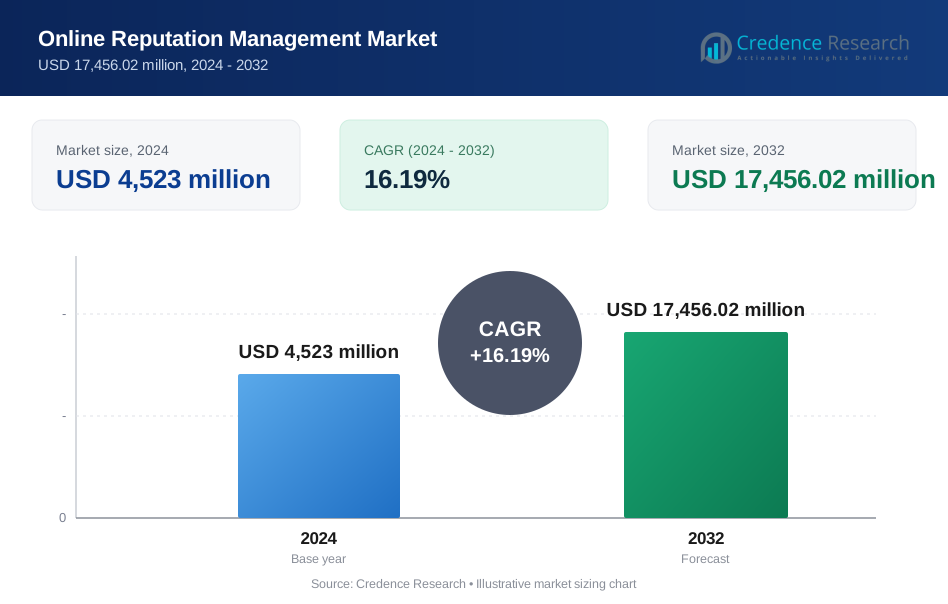
The Online Reputation Management Market is projected to grow from USD 4523 million in 2024 to an estimated USD 17456.02 million by 2032, with a compound annual growth rate (CAGR) of 16.19% from 2024 to 2032.
Several factors are propelling the expansion of the ORM market. The proliferation of social media platforms and online review sites has made it easier for consumers to share their experiences, both positive and negative, impacting public perception of brands. Businesses now face increased scrutiny, with consumers expecting transparency and timely responses. Consequently, businesses are increasingly investing in ORM services to monitor and manage their online presence proactively. Studies indicate that 85% of consumers trust online reviews as much as personal recommendations, and nearly 60% of consumers say that negative reviews made them not want to use a business. Additionally, regulatory pressures and the growing emphasis on data privacy have encouraged organizations to adopt ethical reputation management practices. The integration of artificial intelligence (AI) and machine learning technologies into ORM tools enables more efficient sentiment analysis and real-time monitoring, further driving market growth.
Geographically, North America holds a dominant position in the ORM market, accounting for over half of the total revenue in recent years. This dominance is attributed to the region's high internet penetration rates, advanced technological infrastructure, and the presence of major market players. The business culture in North America emphasizes brand image and customer engagement, fueling investments in sophisticated reputation management strategies. The Asia-Pacific region, however, is expected to witness the highest growth rate during the forecast period. Countries like India, China, and Japan are experiencing rapid digitalization, leading to an increased adoption of ORM services among small and medium-sized enterprises (SMEs) seeking to establish a positive online reputation. Growing smartphone penetration and expanding social media usage in these countries further accelerate market expansion. The increasing number of startups and e-commerce platforms in Asia-Pacific also contribute to a heightened demand for reputation management services.
Market Insights:
- The Online Reputation Management Market is projected to expand from USD 4,523 million in 2024 to USD 17,456.02 million by 2032, reflecting a robust CAGR of 16.19% driven by digital adoption and consumer behavior shifts.
- Increasing consumer reliance on online reviews and social media significantly influences purchasing decisions, prompting businesses to proactively manage and respond to online feedback to protect brand credibility.
- Brand image management has become a critical competitive differentiator, encouraging companies to invest in continuous monitoring and reputation protection strategies to sustain market position and enhance customer loyalty.
- Technological advancements, particularly in artificial intelligence and machine learning, enable real-time sentiment analysis and automated monitoring, allowing businesses to identify and address reputation risks swiftly and accurately.
- The rapid digital transformation across multiple industries-including e-commerce, healthcare, and finance-fuels demand for tailored reputation management solutions to safeguard extensive online brand exposure.
- Managing feedback across diverse and rapidly evolving digital platforms remains challenging due to platform fragmentation, algorithm changes, and resource constraints, especially for small and medium enterprises.
- Data privacy regulations and ethical considerations impose stringent compliance requirements on reputation management practices, necessitating transparent, responsible approaches to avoid legal risks and maintain consumer trust.
Market Drivers:
Increasing Consumer Reliance on Online Reviews and Social Media for Decision Making
The surge in digital connectivity has transformed how consumers evaluate products and services. Consumers rely heavily on online reviews and social media platforms to form opinions before making purchasing decisions. Positive reviews can boost brand credibility, while negative feedback can significantly damage reputation and sales. Businesses recognize this shift and prioritize managing their online presence to influence consumer perception proactively. The Online Reputation Management Market grows as companies seek to monitor and respond to reviews promptly to maintain trust. It helps brands capture real-time insights and manage customer sentiments effectively. Companies that fail to address online feedback risk losing competitive advantage and customer loyalty.
Rising Importance of Brand Image Management Amidst Intensified Competition
Brand image plays a crucial role in differentiating companies in highly competitive markets. Maintaining a favorable public image requires ongoing efforts to control the narrative around a brand's products and services. It involves continuous monitoring of digital channels to detect and address potential threats, including misinformation and negative publicity. Businesses invest in reputation management strategies to protect their market position and ensure long-term sustainability. The Online Reputation Management Market benefits from this trend as firms allocate resources to safeguard their brands from reputation risks. It enables organizations to craft positive stories, engage with customers, and build stronger relationships. Firms adopting proactive reputation management often witness improved customer retention and market share growth.
Technological Advancements Enabling Real-Time Monitoring and Sentiment Analysis
Technological innovations have revolutionized reputation management by introducing advanced tools that provide real-time data analytics and sentiment evaluation. Artificial intelligence (AI) and machine learning algorithms analyze vast amounts of online content quickly, enabling companies to identify emerging issues before they escalate. It empowers businesses to respond promptly to customer concerns, crisis situations, and emerging trends. The integration of automated monitoring systems enhances operational efficiency and accuracy, reducing manual workload. The Online Reputation Management Market experiences growth due to increasing adoption of these cutting-edge technologies. Companies utilize these solutions to gain actionable insights and maintain a positive digital footprint. Enhanced technological capabilities also improve reporting and decision-making processes related to reputation management.
- For instance, Sprinklr Social Listening, you can transform data from millions of conversations including 200 billion historical messages across 30+ digital channels into actionable insights for your entire business, giving you a single, unified, 360° view of your customers to drive faster, smarter business decisions.
Expanding Digital Presence Across Industries Driving Demand for Reputation Management
The rapid digital transformation across sectors has expanded the channels through which brands interact with customers. E-commerce, healthcare, hospitality, finance, and education sectors increasingly rely on digital platforms for marketing, sales, and customer service. This broad online exposure heightens the risk of negative content affecting a brand’s reputation. Businesses across industries recognize the necessity of protecting their online image to attract and retain customers. The Online Reputation Management Market capitalizes on this trend by offering tailored solutions addressing industry-specific needs. It supports firms in monitoring diverse digital channels, including social media, forums, blogs, and review websites. Effective reputation management contributes to enhanced customer trust and business growth in digitally focused markets.
- For example, Yext’s platform enables food service brands to monitor year-over-year changes in clicks for directions, providing actionable insights into how digital presence impacts offline customer visits.
Market Trends:
Integration of Artificial Intelligence and Machine Learning Enhances Reputation Insights
The Online Reputation Management Market increasingly incorporates artificial intelligence (AI) and machine learning technologies to refine data analysis and customer sentiment detection. These technologies allow real-time monitoring of vast digital content, enabling businesses to identify patterns and emerging risks quickly. It improves accuracy in distinguishing genuine reviews from fake or malicious content. AI-driven tools support automated responses, reducing response time and increasing engagement effectiveness. This trend empowers companies to adopt a more proactive approach in managing their digital reputation. It also provides predictive analytics that forecast potential reputation issues before they escalate. The adoption of AI boosts operational efficiency and strengthens decision-making within reputation management strategies.
Growing Focus on Social Media Platforms for Reputation Control and Brand Engagement
Social media continues to dominate as a key battleground for reputation management efforts across industries. Consumers use social channels not only to voice opinions but also to interact directly with brands. It compels businesses to monitor multiple platforms consistently and respond promptly to customer feedback. The Online Reputation Management Market benefits from expanding social media usage by offering specialized tools for engagement tracking and sentiment analysis. Brands increasingly invest in creating authentic and transparent social media presences to build trust. This trend includes harnessing influencer partnerships and user-generated content to enhance credibility. Social media’s evolving role demands constant adaptation of reputation management tactics to maintain positive brand images.
- For example, Brandwatch’s platform monitors millions of social media posts each day, allowing businesses to track engagement and sentiment shifts in real time.
Rising Importance of Mobile and Localized Reputation Management Strategies
Mobile device proliferation has shifted consumer interactions towards location-based and on-the-go decision-making. It drives demand for reputation management solutions that optimize local search results and address geographically relevant feedback. Businesses recognize the impact of local reviews and ratings on attracting nearby customers. The Online Reputation Management Market grows through the development of tools focused on hyper-local monitoring and response capabilities. It enables companies to tailor reputation efforts to specific markets or regions effectively. Enhanced mobile accessibility also supports real-time alerts, allowing swift action on critical reputation issues. Localization of reputation strategies helps firms maintain strong connections with diverse customer bases and improve community trust.
- For example, Yext’s mobile reputation management tools allow businesses to respond to local reviews and feedback in real time, improving customer satisfaction and driving local sales. Their platform supports hyper-local monitoring, enabling companies to customize their reputation strategies for different regions and communities effectively.
Emphasis on Comprehensive Multi-Channel Reputation Management Solutions
Consumers interact with brands through various digital touchpoints, including websites, review portals, forums, and messaging apps. Managing reputation across these multiple channels requires integrated solutions that provide centralized oversight. The Online Reputation Management Market adapts by offering platforms that consolidate data collection, analysis, and reporting from diverse sources. It enables businesses to maintain consistent messaging and swiftly address issues regardless of where they arise. Comprehensive multi-channel management improves transparency and customer satisfaction. Companies leveraging these solutions gain deeper insights into consumer perceptions and can coordinate effective reputation campaigns. This trend reflects the increasing complexity of the digital landscape and the need for holistic reputation control.
Market Challenges Analysis:
Complexity in Managing Diverse and Rapidly Evolving Digital Platforms
The Online Reputation Management Market faces challenges due to the growing number and variety of digital platforms where consumer opinions circulate. Businesses must monitor and manage feedback across social media, review sites, blogs, forums, and other channels simultaneously. This complexity requires sophisticated tools and skilled personnel capable of tracking and responding in real time. It increases operational costs and resource allocation, particularly for small and medium-sized enterprises with limited budgets. Rapid platform updates and changing algorithms add further difficulty to maintaining effective reputation strategies. Companies struggle to maintain consistent messaging and timely engagement across all relevant touchpoints. This fragmentation complicates the ability to control and influence overall brand perception efficiently.
Concerns Over Data Privacy, Legal Risks, and Ethical Considerations in Reputation Management
Data privacy regulations and legal frameworks impose strict requirements on how companies collect, process, and use consumer information for reputation management. The Online Reputation Management Market must navigate these evolving compliance landscapes carefully to avoid legal repercussions. It requires transparency and adherence to policies such as GDPR and CCPA, which limit data access and usage. Ethical considerations also arise around practices like review manipulation and suppression of negative feedback, which can damage trust if exposed. Balancing aggressive reputation management with ethical standards and legal compliance remains a persistent challenge. Companies must invest in compliance expertise and develop responsible strategies to protect their reputation without violating consumer rights. Failure to do so risks regulatory penalties and reputational damage.
Market Opportunities:
Expansion of Small and Medium-Sized Enterprises Embracing Digital Reputation Strategies
The growing number of small and medium-sized enterprises (SMEs) adopting digital channels presents significant opportunities for the Online Reputation Management Market. SMEs increasingly recognize the need to establish and maintain a positive online presence to compete effectively. It enables providers to offer scalable, cost-effective reputation management solutions tailored to the unique needs of smaller businesses. This segment often seeks tools that combine ease of use with robust functionality, creating demand for innovative and user-friendly platforms. Rising digital literacy among SMEs supports faster adoption of ORM services. Market players can capitalize on this trend by developing flexible packages and targeted marketing strategies. Supporting SMEs enhances overall market penetration and diversification.
Advancements in AI-Powered Analytics and Predictive Reputation Management Solutions
The integration of artificial intelligence (AI) and predictive analytics in reputation management tools offers vast growth potential. The Online Reputation Management Market benefits from innovations that enable early detection of reputation threats and data-driven decision making. It supports proactive strategies that minimize damage and optimize brand positioning. Enhanced analytics provide deeper customer insights, enabling personalized engagement and targeted reputation campaigns. Companies investing in AI-driven solutions can differentiate themselves with superior performance and real-time responsiveness. The continuous evolution of AI technologies creates opportunities to expand service portfolios and improve customer satisfaction. This technological progress promises to reshape reputation management with more precise and efficient approaches.
Market Segmentation Analysis:
The Online Reputation Management Market continues to grow, driven by rising digital engagement and increased brand scrutiny.
By component, the software segment holds a significant share due to automation, analytics, and AI-powered tools that streamline reputation tracking. The services segment sees strong demand from businesses seeking expert intervention in handling public perception and crisis response.
- For instance, Birdeye's AI-driven software automates review collection and sentiment analysis for over 60,000 businesses.
By deployment mode, cloud-based solutions lead the market. Businesses favor them for scalability, cost-efficiency, and remote accessibility. On-premises deployment appeals to organizations requiring greater control over data and security.
By organization size Large enterprises dominate by organization size, leveraging advanced tools and dedicated teams to manage complex reputational needs. SMEs are gaining traction, recognizing the value of reputation management in competitive digital landscapes.
By application, media and entertainment generate high demand due to constant public exposure. Retail and e-commerce follow closely, with customer reviews influencing purchasing decisions. Healthcare providers use ORM to build trust and ensure compliance with patient feedback regulations. Financial services rely on it to maintain credibility and investor confidence. The automotive, hospitality, and education sectors actively use ORM to strengthen consumer trust and brand loyalty. Government entities increasingly adopt ORM to manage public perception and transparency. Other sectors with growing online presence also contribute to market expansion.
- For instances, Yext’s platform is specifically built to help businesses leverage review management as a means to influence purchasing decisions, and this is validated by both internal data and independent industry analysis.
Segmentation:
By Component
- Software
- Services
By Deployment Mode
- Cloud-Based
- On-Premises
By Organization Size
- Large Enterprises
- Small and Medium-Sized Enterprises (SMEs)
By Application
- Healthcare
- Automotive
- Hospitality
- Financial Services
- Media & Entertainment
- Retail & E-commerce
- Education
- Government
- Others
By Region
- North America
- U.S.
- Canada
- Mexico
- Europe
- UK
- France
- Germany
- Italy
- Spain
- Russia
- Rest of Europe
- Asia Pacific
- China
- Japan
- South Korea
- India
- Australia
- Southeast Asia
- Rest of Asia Pacific
- Latin America
- Brazil
- Argentina
- Rest of Latin America
- Middle East
- GCC Countries
- Israel
- Turkey
- Rest of Middle East
- Africa
- South Africa
- Egypt
- Rest of Africa
Regional Analysis:
North America Dominates the Online Reputation Management Market with Significant Market Share
North America holds the largest share of the Online Reputation Management Market, accounting for approximately 45% of the global revenue. The region benefits from high internet penetration, widespread social media adoption, and advanced technological infrastructure. Leading market players and startups are concentrated in the United States and Canada, driving innovation and service expansion. Businesses in North America prioritize brand image and consumer trust, fueling strong demand for reputation management solutions. It also benefits from stringent regulatory frameworks that encourage transparent and responsible online practices. The region’s maturity and competitive landscape push continuous improvement in service offerings. These factors sustain North America’s leadership position in the ORM market.
Europe Maintains Steady Growth Driven by Increasing Digital Awareness and Regulations
Europe accounts for roughly 25% of the Online Reputation Management Market share and shows consistent growth due to rising digital awareness and strong data privacy regulations. Countries such as the United Kingdom, Germany, and France lead in adopting reputation management technologies to comply with laws like GDPR. It prompts companies to implement ethical reputation strategies and invest in compliance-driven solutions. European businesses focus on protecting consumer rights while maintaining a positive online image. The region’s diversified economy and increasing e-commerce activities contribute to sustained demand. Rising social media engagement further supports ORM adoption across various sectors. Europe remains an important market for both established players and emerging service providers.
Asia-Pacific Exhibits Rapid Growth Potential with Expanding Digitalization and SME Adoption
The Asia-Pacific region holds approximately 20% market share in the Online Reputation Management Market and is the fastest-growing region. Countries including China, India, Japan, and Australia drive growth due to rapid digital transformation and increased smartphone penetration. The expanding base of small and medium-sized enterprises (SMEs) adopting online channels creates substantial demand for ORM solutions tailored to local needs. It benefits from growing social media use and consumer reliance on online reviews. Government initiatives promoting digital infrastructure enhance opportunities for reputation management services. The region attracts investments from global and regional players aiming to capitalize on emerging markets. Asia-Pacific’s dynamic digital ecosystem promises to reshape the competitive landscape in coming years.
Key Player Analysis:
- BirdEye
- Brand24
- BrandYourself
- Gadook
- Hootsuite
- com
- LocalEdge
- NetReputation
- Neumann Paige Inc.
- Podium
- Reputation Rhino
- Reputation X
- com
- ReputationDefender
- ReviewTrackers
- SEO Image
- Sprout Social
- Thrive Internet Marketing Agency
- WebiMax
- Yext
Competitive Analysis:
The Online Reputation Management Market features a diverse range of players competing to deliver innovative and effective solutions. Leading companies focus on enhancing their product portfolios through technology integration such as artificial intelligence, machine learning, and data analytics to gain competitive advantage. It encourages continuous innovation to meet evolving customer demands and stay ahead in a highly dynamic environment. Strategic partnerships, mergers, and acquisitions help firms expand their market reach and service capabilities. Many players emphasize customizable solutions tailored to various industry needs, strengthening client relationships. Competitive differentiation also arises from global presence and robust customer support services. Firms investing in advanced monitoring tools and predictive analytics establish stronger market positions. The market's fragmented nature drives ongoing efforts to consolidate and capture larger shares, with key players actively pursuing growth through both organic development and strategic collaborations.
Recent Developments:
- In March 2024, Birdeye launched an AI-powered social platform designed specifically for multi-location brands. This platform enables businesses to manage their social media presence, engage with customers, and monitor online reputation across multiple locations from a single interface. The integration of AI tools aims to streamline social media management and enhance customer interactions, further solidifying Birdeye's position in the ORM market.
- In June 2023, Birdeye, a leading SaaS company in the digital customer experience space, announced that it surpassed $100 million in annual recurring revenue (ARR). This achievement underscores Birdeye's commitment to innovation and growth in the ORM sector. The company attributes this milestone to its expanding AI offerings and strategic partnerships, including integrations with Google Bard AI and Vertex AI. Birdeye's platform now serves over 100,000 businesses globally, providing tools for reputation management, customer experience, and marketing.
- In June 2022, ReviewTrackers, a provider of customer feedback and review monitoring solutions, was acquired by InMoment, a leader in Experience Improvement (XI). This acquisition enables InMoment to enhance its customer experience analytics by integrating ReviewTrackers' capabilities, allowing businesses to gain deeper insights into customer sentiment and improve their online reputation management strategies.
Market Concentration & Characteristics:
The Online Reputation Management Market exhibits a moderately fragmented structure with numerous small and mid-sized firms alongside a few dominant players. It features a competitive landscape where innovation and technology adoption play critical roles in gaining market share. Companies differentiate themselves by offering specialized solutions tailored to diverse industry requirements and client sizes. The market’s characteristics include rapid technological advancements, a strong emphasis on real-time monitoring, and integration of AI-driven analytics. It encourages collaboration between providers and clients to develop customized reputation strategies. Market participants face continuous pressure to enhance service quality and scalability while managing operational costs. This dynamic environment fosters ongoing consolidation through partnerships and acquisitions, gradually increasing concentration among leading firms. Overall, the market balances competitive diversity with growing dominance by technology-focused enterprises driving modernization and efficiency.
Report Coverage:
The research report offers an in-depth analysis based on Component, Deployment Mode, Organization Size and Application. It details leading market players, providing an overview of their business, product offerings, investments, revenue streams, and key applications. Additionally, the report includes insights into the competitive environment, SWOT analysis, current market trends, as well as the primary drivers and constraints. Furthermore, it discusses various factors that have driven market expansion in recent years. The report also explores market dynamics, regulatory scenarios, and technological advancements that are shaping the industry. It assesses the impact of external factors and global economic changes on market growth. Lastly, it provides strategic recommendations for new entrants and established companies to navigate the complexities of the market.
Future Outlook:
- Increasing digital transformation across industries will amplify demand for reputation management solutions.
- AI and machine learning advancements will enable more precise sentiment analysis and threat detection.
- Expansion of small and medium-sized enterprises adopting ORM tools will drive market growth.
- Growing consumer reliance on online reviews will heighten the importance of proactive reputation strategies.
- Enhanced integration of multi-channel monitoring will improve brand consistency and customer engagement.
- Rising regulatory scrutiny around data privacy will influence ethical reputation management practices.
- Mobile-first reputation management solutions will gain traction due to increased smartphone usage.
- Customized industry-specific ORM services will emerge to address unique sector challenges.
- Strategic collaborations and mergers will accelerate innovation and market consolidation.
- Increasing investment in real-time analytics will strengthen crisis management and reputation recovery efforts.
Request a Free Sample
Fill in your details and we'll send you a free sample report.
- Sample data tables & charts
- Research methodology
Market Dynamics
Increasing Consumer Reliance on Online Reviews and Social Media
Consumers are heavily influenced by online reviews and social media feedback when making purchasing decisions, prompting businesses to invest in ORM solutions to monitor, manage, and respond to public sentiment in real time.
Rising Importance of Brand Image Management
With intensified competition across industries, companies are prioritizing proactive brand image management to differentiate themselves, protect market share, and foster customer loyalty, driving demand for comprehensive ORM services.
Technological Advancements in AI and Machine Learning
The integration of AI and machine learning into ORM tools enables real-time sentiment analysis, automated monitoring, and predictive analytics, allowing businesses to identify and address reputation risks more efficiently and accurately.
Expanding Digital Presence Across Industries
As sectors like e-commerce, healthcare, and finance increase their digital footprint, the risk of negative online exposure grows, leading organizations to adopt ORM solutions to safeguard their reputation across multiple digital channels.
Regulatory Pressures and Data Privacy Concerns
Stricter data privacy regulations and the need for ethical reputation management practices are compelling organizations to implement compliant ORM strategies, further fueling market growth as companies seek to avoid legal risks and maintain consumer trust.
Need a Custom Version of This Report?
Tailor the scope, geography, or segments to your exact requirements.
- Custom geography or segment scope
- Direct access to our analyst team
Frequently Asked Questions
What is the current size of the Online Reputation Management Market?
What factors are driving the growth of the Online Reputation Management Market?
What are the key segments within the Online Reputation Management Market?
Who are the major players in the Online Reputation Management Market?
Table of Content
Chapter 1 Market Segmentation
- 1.1 Segmentation Framework
- 1.1.1 Product and Service Classification
- 1.1.2 Application and End-Use Classification
- 1.1.3 Technology and Solution Classification
- 1.1.4 Customer and Distribution Channel Classification
- 1.1.5 Geographic Segmentation
- 1.1.6 Market Segment Definitions and Boundaries
- 1.2 By Component
- 1.2.1 Software
- 1.2.2 Services
- 1.3 By Application
- 1.3.1 Healthcare
- 1.3.2 Automotive
- 1.3.3 Hospitality
- 1.3.4 Financial Services
- 1.3.5 Media & Entertainment
- 1.3.6 Retail & E-commerce
- 1.3.7 Education
- 1.3.8 Government
- 1.3.9 Others
- 1.4 By Deployment Mode
- 1.4.1 Cloud-Based
- 1.4.2 On-Premises
- 1.5 By Organization Size
- 1.5.1 Large Enterprises
- 1.5.2 Small and Medium-Sized Enterprises (SMEs)
Chapter 2 Introduction
- 2.1 Report Objectives and Scope
- 2.2 Product Definition and Industry Terminology
- 2.3 Market Inclusions and Exclusions
- 2.4 Research Process
- 2.4.1 Primary Research and Expert Interviews
- 2.4.2 Secondary Research and Source Review
- 2.4.3 Top-Down and Bottom-Up Estimation
- 2.4.4 Data Triangulation and Verification
- 2.5 Market Size Measurement Basis
- 2.5.1 2024: USD 4,523 million → 2032: USD 17,456.02 million
- 2.6 Historical and Forecast Reference Periods
- 2.6.1 Base Year: 2024
- 2.6.2 Forecast Period: 2024-2032
- 2.7 Research Assumptions and Limitations
Chapter 3 Executive Summary
- 3.1 Market Snapshot and Key Findings
- 3.2 Base-Year Market Size, 2024
- 3.3 Forecast Market Size, 2032
- 3.4 Revenue and Volume Growth Outlook
- 3.5 Key Demand and Supply Indicators
- 3.6 Leading Market Segments
- 3.7 Fastest-Growing Market Opportunities
- 3.8 Regional Performance Highlights
- 3.9 Technology and Industry Transformation
- 3.10 Competitive Landscape Summary
- 3.11 Analyst View and Strategic Implications
Chapter 4 Global Online Reputation Management Market Trends and Developments
- 4.1 Historical Industry Development
- 4.2 Recent Market Trends and Developments
- 4.3 Demand and Customer Behavior Trends
- 4.4 Technology and Product Innovation
- 4.5 Artificial Intelligence, Automation and Digitalization
- 4.6 Local Manufacturing and Supply Chain Realignment
- 4.7 Industry Partnerships, Mergers and Acquisitions
- 4.8 Sustainability and Circular Economy Developments
- 4.9 Government and Private Sector Investment Trends
- 4.10 Emerging Business Models and Commercialization
- 4.11 Industry Developments and Announcements
Chapter 5 Global Online Reputation Management Market Production, Supply and Demand Analysis
- 5.1 Demand Trend and Consumption Analysis
- 5.2 Demand Forecast, 2024-2032
- 5.3 Production and Output Trend
- 5.4 Production and Output Forecast, 2024-2032
- 5.5 Installed Capacity and Capacity Utilization
- 5.6 Company-Wise Production Plants and Statistics
- 5.6.1 Installed Production Capacity
- 5.6.2 Actual Production
- 5.6.3 Planned Capacity and Expansion Targets
- 5.7 Supply Chain Structure and Procurement Trends
- 5.8 Supply-Demand Gap and Bottlenecks
- 5.9 Import Dependence and Sourcing Structure
- 5.10 Contract Manufacturing and Outsourcing
- 5.11 Regional Supply and Demand Concentration
Chapter 6 Global Online Reputation Management Market Pricing Analysis
- 6.1 Pricing Structure and Measurement
- 6.2 Historical Pricing Trends
- 6.3 Pricing Outlook, 2024-2032
- 6.4 Average Selling Price and Unit Economics
- 6.5 Pricing by Product and Market Segment
- 6.6 Geographic Pricing Differences
- 6.7 Key Input, Energy, Labor and Logistics Costs
- 6.8 Contract Pricing and Purchasing Models
- 6.9 Pricing Sensitivity and Competitive Positioning
- 6.10 Price, Margin and Profitability Implications
Chapter 7 Global Online Reputation Management Market Dynamics
- 7.1 Market Growth Drivers
- 7.1.1 Demand-Side Drivers
- 7.1.2 Technology and Innovation Drivers
- 7.1.3 Infrastructure and Investment Drivers
- 7.1.4 Regulatory and Policy Drivers
- 7.2 Market Restraints
- 7.2.1 Cost and Affordability Constraints
- 7.2.2 Technology and Adoption Barriers
- 7.2.3 Supply Chain and Operational Constraints
- 7.3 Market Challenges
- 7.3.1 Competitive Pressure and Margin Erosion
- 7.3.2 Skills, Infrastructure and Implementation Gaps
- 7.4 Emerging Market Opportunities
- 7.5 Market Dynamics Impact and Time-Horizon Assessment
Chapter 8 Global Online Reputation Management Value Chain Analysis
- 8.1 Industry Value Chain Overview
- 8.2 Upstream Suppliers and Critical Inputs
- 8.3 Technology and Component Providers
- 8.4 Manufacturing or Service Delivery
- 8.5 Distribution, Channel Partners and Integrators
- 8.6 Downstream Applications and End Users
- 8.7 Value Addition and Profit Pools
- 8.8 Vertical Integration and Outsourcing
- 8.9 Supplier Concentration and Risk
- 8.10 Supply Chain Localization and Resilience
Chapter 9 Global Online Reputation Management Market Regulations and Policies
- 9.1 Relevant Laws, Standards and Compliance Frameworks
- 9.2 Product, Service, Safety and Quality Requirements
- 9.3 Government Policies, Incentives and Subsidies
- 9.4 Imports, Exports and Trade Barriers
- 9.5 Public Procurement and Local Content Requirements
- 9.6 Environmental and Sustainability Compliance
- 9.7 Data Protection, AI and Cybersecurity Compliance
- 9.8 Upcoming Policy Changes and Market Implications
Chapter 10 Global Online Reputation Management Market Hotspots and Opportunities
- 10.1 Market Opportunity Mapping and Growth Hotspots
- 10.2 High-Growth Applications and Customer Groups
- 10.3 Underserved Markets and White-Space Opportunities
- 10.4 Emerging Technology and Product Opportunities
- 10.5 New Capacity and Investment Hotspots
- 10.6 Market Entry and Expansion Opportunities
- 10.7 Distribution and Partnership Opportunities
- 10.8 Near-Term and Long-Term Commercial Potential
- 10.9 Opportunity Attractiveness and Execution Risks
Chapter 11 Global Online Reputation Management Market Outlook, 2024-2032
- 11.1 Market Size and Analysis
- 11.1.1 Revenue (Market Measurement: 2024: USD 4,523 million → 2032: USD 17,456.02 million)
- 11.1.2 Market Volume and Quantity Sold
- 11.1.3 Historical Market Size
- 11.1.4 Base-Year Market Size, 2024
- 11.2 Market Forecast, 2024-2032
- 11.2.1 Revenue Forecast to 2032
- 11.2.2 Volume Forecast to 2032
- 11.2.3 CAGR and Year-on-Year Growth
- 11.2.4 Incremental Revenue Opportunity
- 11.3 Forecast Assumptions and Scenario Analysis
- 11.3.1 Base-Case Forecast
- 11.3.2 Optimistic and Conservative Scenarios
- 11.3.3 Technology, Pricing and Policy Sensitivities
- 11.4 Market Attractiveness and Growth Outlook
Chapter 12 Global Online Reputation Management Market Segmentation and Outlook
- 12.1 Segmentation Summary and Market Shares, 2024
- 12.2 Largest and Fastest-Growing Segments
- 12.3 By Component - Market Size and Forecast, 2024-2032
- 12.3.1 Segment Definition and Scope
- 12.3.2 Historical Market Size
- 12.3.3 Revenue Forecast, 2024-2032
- 12.3.4 Volume Forecast, 2024-2032
- 12.3.5 Base-Year Market Share, 2024
- 12.3.6 Segment CAGR and Growth Drivers
- 12.3.7 Subsegment Market Size and Forecast
- 12.3.7.1 Software
- 12.3.7.2 Services
- 12.3.8 Subsegment Pricing and Adoption Trends
- 12.3.9 Leading Suppliers and Competition
- 12.3.10 Regional Demand and Opportunities
- 12.4 By Application - Market Size and Forecast, 2024-2032
- 12.4.1 Segment Definition and Scope
- 12.4.2 Historical Market Size
- 12.4.3 Revenue Forecast, 2024-2032
- 12.4.4 Volume Forecast, 2024-2032
- 12.4.5 Base-Year Market Share, 2024
- 12.4.6 Segment CAGR and Growth Drivers
- 12.4.7 Subsegment Market Size and Forecast
- 12.4.7.1 Healthcare
- 12.4.7.2 Automotive
- 12.4.7.3 Hospitality
- 12.4.7.4 Financial Services
- 12.4.7.5 Media & Entertainment
- 12.4.7.6 Retail & E-commerce
- 12.4.7.7 Education
- 12.4.7.8 Government
- 12.4.7.9 Others
- 12.4.8 Subsegment Pricing and Adoption Trends
- 12.4.9 Leading Suppliers and Competition
- 12.4.10 Regional Demand and Opportunities
- 12.5 By Deployment Mode - Market Size and Forecast, 2024-2032
- 12.5.1 Segment Definition and Scope
- 12.5.2 Historical Market Size
- 12.5.3 Revenue Forecast, 2024-2032
- 12.5.4 Volume Forecast, 2024-2032
- 12.5.5 Base-Year Market Share, 2024
- 12.5.6 Segment CAGR and Growth Drivers
- 12.5.7 Subsegment Market Size and Forecast
- 12.5.7.1 Cloud-Based
- 12.5.7.2 On-Premises
- 12.5.8 Subsegment Pricing and Adoption Trends
- 12.5.9 Leading Suppliers and Competition
- 12.5.10 Regional Demand and Opportunities
- 12.6 By Organization Size - Market Size and Forecast, 2024-2032
- 12.6.1 Segment Definition and Scope
- 12.6.2 Historical Market Size
- 12.6.3 Revenue Forecast, 2024-2032
- 12.6.4 Volume Forecast, 2024-2032
- 12.6.5 Base-Year Market Share, 2024
- 12.6.6 Segment CAGR and Growth Drivers
- 12.6.7 Subsegment Market Size and Forecast
- 12.6.7.1 Large Enterprises
- 12.6.7.2 Small and Medium-Sized Enterprises (SMEs)
- 12.6.8 Subsegment Pricing and Adoption Trends
- 12.6.9 Leading Suppliers and Competition
- 12.6.10 Regional Demand and Opportunities
- 12.7 Segment Growth Comparison
- 12.8 Segment Attractiveness and Priority Matrix
Chapter 13 Global Online Reputation Management End-Use and Application Market Outlook
- 13.1 End-Use Industry and Customer Demand Structure
- 13.2 Leading Applications and Customer Groups
- 13.3 End-Use Market Size, Share and Forecast
- 13.4 Major End-Use Industry Deep Dives
- 13.4.1 Customer Requirements and Use Cases
- 13.4.2 Demand and Replacement Cycles
- 13.4.3 Technical and Regulatory Considerations
- 13.4.4 Purchasing and Procurement Models
- 13.4.5 Leading Vendors and Distribution Channels
- 13.4.6 Forecast and Commercial Opportunities
- 13.5 Emerging Applications and Cross-Segment Demand
- 13.6 End-Use Industry Investment Priorities
Chapter 14 Global Online Reputation Management Geographic Market Outlook, 2024-2032
- 14.1 Regional Market Size and Share, 2024
- 14.2 Regional Market Forecast, 2024-2032
- 14.3 Regional Pricing, Production and Demand Differences
- 14.4 North America
- 14.4.1 United States
- 14.4.2 Canada
- 14.4.3 Mexico
- 14.5 Europe
- 14.5.1 Germany
- 14.5.2 France
- 14.5.3 Italy
- 14.5.4 United Kingdom
- 14.5.5 Spain
- 14.5.6 Poland
- 14.5.7 Russia
- 14.5.8 Netherlands
- 14.5.9 Belgium
- 14.5.10 Sweden
- 14.5.11 Denmark
- 14.5.12 Norway
- 14.5.13 Rest of Europe
- 14.6 Asia Pacific
- 14.6.1 China
- 14.6.2 India
- 14.6.3 Japan
- 14.6.4 South Korea
- 14.6.5 Thailand
- 14.6.6 Indonesia
- 14.6.7 Vietnam
- 14.6.8 Malaysia
- 14.6.9 Australia
- 14.6.10 Rest of Asia Pacific
- 14.7 Latin America
- 14.7.1 Brazil
- 14.7.2 Argentina
- 14.7.3 Colombia
- 14.7.4 Chile
- 14.7.5 Rest of Latin America
- 14.8 Middle East
- 14.8.1 Saudi Arabia
- 14.8.2 United Arab Emirates
- 14.8.3 Turkey
- 14.8.4 Israel
- 14.8.5 Iran
- 14.8.6 Rest of the Middle East
- 14.9 Africa
- 14.9.1 South Africa
- 14.9.2 Egypt
- 14.9.3 Nigeria
- 14.9.4 Morocco
- 14.9.5 Rest of Africa
- 14.10 Regional Investment, Policy and Supply Chain Differences
- 14.11 Regional Competitive Landscape
- 14.12 Geographic Growth Hotspots
Chapter 15 Global Online Reputation Management Technology, Innovation and Sustainability Outlook
- 15.1 Technology Landscape and Maturity
- 15.2 Product, Process and Service Innovation
- 15.3 AI, Automation and Digital Tools in the Industry
- 15.4 Technology Adoption and Performance Benchmarking
- 15.5 Innovation Pipeline and R&D Investment
- 15.6 Patent and Intellectual Property Trends
- 15.7 Energy Efficiency and Resource Management
- 15.8 Sustainability, Recycling and Circularity
- 15.9 Technology Roadmap, 2024-2032
- 15.10 Risks of Obsolescence and Technology Substitution
Chapter 16 Global Online Reputation Management Market Key Strategic Imperatives
- 16.1 Growth and Market Entry Priorities
- 16.2 High-Return Products and Segments
- 16.3 Pricing, Profitability and Cost Optimization
- 16.4 Technology Investment and Product Differentiation
- 16.5 Supply Chain Localization and Resilience
- 16.6 Distribution and Customer Acquisition
- 16.7 Partnership, Acquisition and Capacity Strategy
- 16.8 Regional Expansion Priorities
- 16.9 Short-, Medium- and Long-Term Actions
Chapter 17 Competition Outlook
- 17.1 Industry Competition Characteristics
- 17.2 Market Structure and Concentration
- 17.3 Market Share and Competitive Positioning, 2024
- 17.4 Company-Wise Revenue and Product Benchmarking
- 17.5 Production and Service Capacity Benchmarking
- 17.6 Technology, Pricing and Differentiation
- 17.7 Regional Footprint and Distribution Strength
- 17.8 Mergers, Acquisitions and Strategic Alliances
- 17.9 New Entrants and Competitive Threats
- 17.10 Porter's Five Forces and Industry Attractiveness
- 17.11 Competitive Outlook, 2024-2032
Chapter 18 Company Profiles
- 18.1 Company Coverage and Selection Criteria
- 18.2 Birdeye
- 18.2.1 Business Description
- 18.2.2 Company Ownership and Geographic Presence
- 18.2.3 Product and Service Portfolio
- 18.2.4 Manufacturing and Operating Footprint
- 18.2.5 Production Capacity and Expansion Plans
- 18.2.6 Financial Performance and Investment
- 18.2.7 Market Share and Competitive Position
- 18.2.8 Technology and Innovation Capabilities
- 18.2.9 Strategic Alliances or Partnerships
- 18.2.10 Recent Developments
- 18.2.11 Growth Strategy and Outlook
- 18.3 Yext
- 18.4 Sprout Social
- 18.5 Brand24
- 18.6 ReputationDefender
- 18.7 Podium
- 18.8 ReviewTrackers
- 18.9 Hootsuite
- 18.10 WebiMax
- 18.11 BrandYourself
- 18.12 Other Relevant Market Participants
Note: Every listed company is profiled on the structure shown under the first company. The company list is preliminary and may change based on research findings, market developments, data availability and client requirements.
Chapter 19 Disclaimer
- 19.1 Research and Forecast Disclaimer
- 19.2 Data Source and Estimation Limitations
Note: The depth of individual sections depends on data availability for this market. Volume, capacity, trade and other unit-based metrics are included where applicable.

