
Online Books Market Overview:
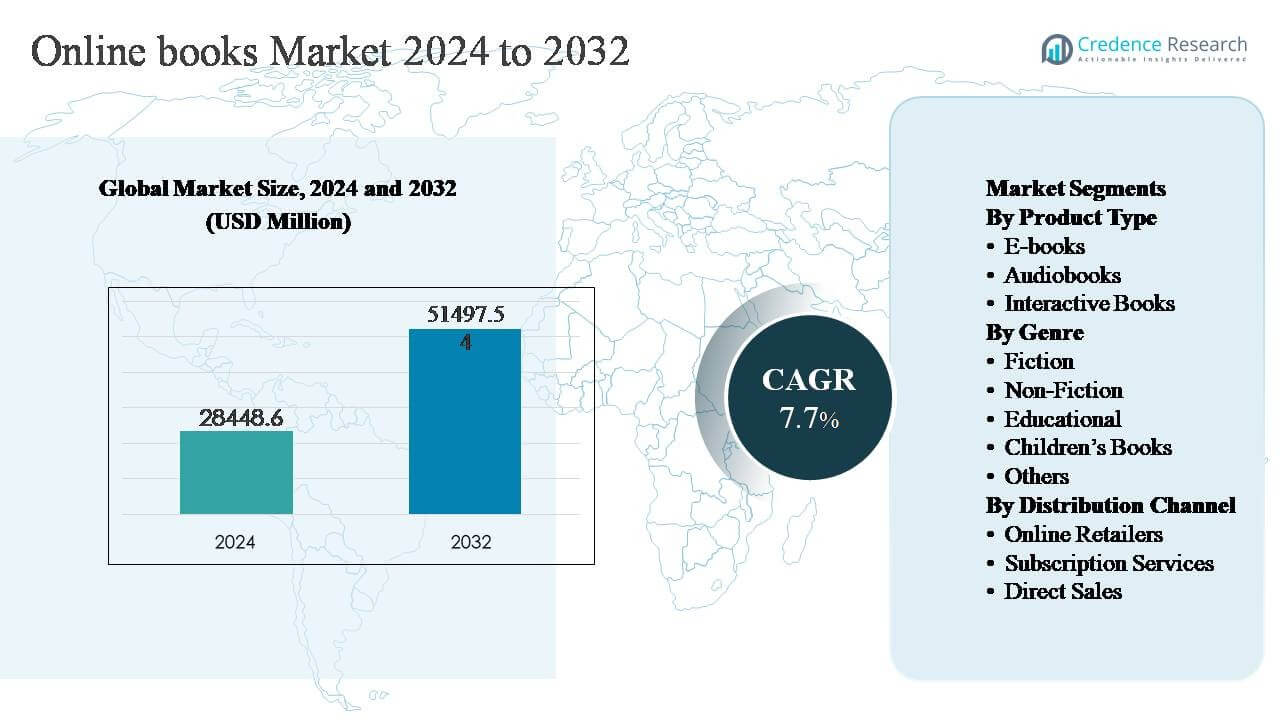
The global online books market size was valued at USD 28,448.6 million in 2024 and is anticipated to reach USD 51,497.54 million by 2032, expanding at a CAGR of 7.7% during the forecast period.
| REPORT ATTRIBUTE | DETAILS |
|---|---|
| Historical Period | 2020-2023 |
| Base Year | 2024 |
| Forecast Period | 2025-2032 |
| Online Books Market Size 2024 | USD 28,448.6 million |
| Online Books Market, CAGR | 7.7% |
| Online Books Market Size 2032 | USD 51,497.54 million |
Online Books Market Insights
- Market growth is driven by rising internet penetration, widespread smartphone adoption, and increasing preference for e-books and audiobooks due to convenience, instant access, and lower costs compared to physical books, with e-books holding around 55–60% segment share.
- Key trends include rapid growth of audiobooks, expansion of subscription-based reading services, and increasing use of AI-driven personalization, while fiction remains the leading genre with nearly 40–45% share, followed by educational digital content.
- The competitive landscape is led by global platforms such as Amazon Kindle, Apple Books, Google Play Books, and Kobo, which compete on catalog size, ecosystem integration, pricing, and subscription offerings, intensifying market consolidation.
- Regionally, North America leads with ~39% market share, followed by Europe at ~26% and Asia Pacific at ~23%, while Latin America and the Middle East & Africa collectively contribute the remaining share, driven by improving digital infrastructure and local-language content growth.
Online books market size Segmentation Analysis:
By Product Type:
By product type, e-books represent the dominant sub-segment in the online books market, accounting for an estimated around 55-60% market share. Their leadership is driven by instant accessibility, lower pricing compared to print formats, and compatibility across smartphones, tablets, and e-readers. E-books benefit strongly from academic, professional, and leisure reading demand, particularly in emerging digital economies. Audiobooks are the fastest-growing sub-segment, supported by multitasking lifestyles and rising adoption of voice-enabled devices, while interactive books remain niche but gain traction in educational and children-focused applications due to enhanced engagement features.
- For instance, Amazon reported that its Kindle ecosystem supports reading across more than 20 device types and apps, with Kindle Direct Publishing enabling authors to distribute titles globally and deliver files typically under 10 MB per book for rapid downloads even on low-bandwidth networks.
By Genre:
By genre, fiction dominates the online books market with approximately 40-45% share, supported by high consumption of novels, series, and genre-based content such as romance, fantasy, and thrillers. Strong digital discovery tools and personalized recommendations sustain repeat purchases in this segment. Educational books form a critical growth segment, driven by digital learning platforms, exam preparation, and institutional adoption of e-textbooks. Non-fiction benefits from professional and self-development demand, while children’s books and others increasingly leverage illustrated e-books and interactive storytelling to attract younger audiences.
- For instance, Elsevier’s ScienceDirect platform provides access to more than 18 million book chapters and reference entries, supporting keyword search, citation export, and chapter-level downloads for research-intensive users.
By Distribution Channel:
By distribution channel, online retailers hold the dominant position with an estimated 50-55% market share, supported by extensive title catalogs, competitive pricing, and advanced recommendation algorithms. Major platforms benefit from strong brand recognition and seamless payment ecosystems. Subscription services are the fastest-growing channel, driven by all-you-can-read models, audiobooks bundles, and recurring revenue appeal for frequent readers. Direct sales, primarily from publishers and authors, maintain a smaller share but gain relevance through exclusive releases, higher margins, and growing use of direct-to-consumer digital storefronts.
Key Growth Drivers
Expanding Digital Penetration and Mobile Accessibility
Rapid growth in internet connectivity and widespread smartphone adoption remain the primary drivers of the online books market. Affordable data plans and improved broadband infrastructure have enabled consistent access to digital reading platforms across both developed and emerging economies. Mobile-first consumption has expanded the reader base beyond traditional demographics, bringing in younger users and first-time digital readers. Cross-device synchronization, cloud libraries, and offline reading capabilities further enhance convenience and usage frequency. Educational institutions and professional users increasingly rely on digital formats for portability and instant updates, reinforcing sustained demand. These factors collectively accelerate the transition from physical to digital book consumption, supporting long-term market expansion.
- For instance, Google Play Books supports offline reading on Android and iOS, allowing users to download full titles locally, with individual e-book files commonly ranging from 2 MB to 20 MB to ensure usability on constrained mobile networks.
Rising Popularity of Subscription-Based Reading Models
Subscription services have emerged as a strong growth catalyst by reshaping consumer purchasing behavior. Unlimited-access or bundled reading models provide cost efficiency and convenience, encouraging higher content consumption. These platforms leverage personalized recommendations, reading analytics, and curated libraries to improve user engagement and retention. Audiobook subscriptions, in particular, benefit from increasing demand for hands-free and on-the-go content. Publishers also gain predictable recurring revenue and valuable user insights, enabling better content planning. The scalability of subscription platforms across regions and languages further strengthens their role as a major driver of online books market growth.
- For instance, Kindle Unlimited provides access to a rotating catalog comprising millions of digital titles, with cloud delivery enabling instant access across Kindle e-readers and mobile apps that support file downloads typically under 15 MB per e-book for offline use.
Growth of Digital Education and E-Learning Ecosystems
The expansion of e-learning, remote education, and professional upskilling platforms significantly drives demand for online books. Digital textbooks, reference materials, and exam-preparation content offer cost advantages, real-time updates, and easy distribution compared to printed alternatives. Universities, training institutes, and corporate learning programs increasingly adopt licensed digital libraries and e-book platforms. Integration with learning management systems and interactive features enhances engagement and learning outcomes. As governments and private institutions continue to invest in digital education infrastructure, online books remain a core content pillar supporting knowledge dissemination and lifelong learning.
Key Trends & Opportunities
Rapid Growth of Audiobooks and Voice-Enabled Content
Audiobooks represent a major growth opportunity within the online books market, driven by changing consumer lifestyles and increased multitasking. Commuters, professionals, and visually impaired users increasingly prefer audio formats for convenience and accessibility. Advances in voice-enabled devices, smart assistants, and in-car infotainment systems further expand listening environments. Publishers are investing in high-quality narration, multilingual audio libraries, and exclusive audio-first releases to differentiate offerings. This trend creates new monetization opportunities and broadens content reach beyond traditional reading audiences.
- For instance, Storytel operates multilingual audiobook libraries spanning more than 25 languages and produces thousands of original audio titles annually, each engineered with standardized mastering levels and chapter indexing to ensure consistent listening experiences across devices.
Personalization and AI-Driven Content Discovery
Artificial intelligence and data analytics are transforming how readers discover and consume online books. Recommendation engines analyze reading behavior, preferences, and completion rates to deliver personalized content suggestions. Dynamic pricing, targeted promotions, and curated reading lists improve conversion and user retention. AI also enables predictive demand forecasting, helping publishers optimize content investments. As platforms enhance personalization capabilities, they create opportunities to increase average revenue per user and strengthen long-term customer relationships.
- For instance, Amazon Kindle applies machine-learning models trained on billions of historical customer interactions across its retail and Kindle ecosystems, enabling features such as “Next in Series” and personalized home screens that refresh recommendations within seconds of new reading activity while synchronizing highlights and progress across multiple devices via Whispersync.
Expansion into Emerging Markets and Regional Languages
Emerging economies present significant growth opportunities as digital literacy and local-language content availability improve. Rising middle-class populations and government-backed digital education initiatives fuel demand for affordable online books. Publishers increasingly localize content, offer regional language catalogs, and partner with local platforms to expand reach. Flexible pricing models and mobile-optimized formats further support adoption. This regional expansion opens new revenue streams and diversifies market growth beyond mature regions.
Key Challenges
Digital Piracy and Copyright Infringement
Digital piracy remains a major challenge for the online books market, directly impacting publisher revenues and author earnings. Unauthorized downloads, file sharing, and illegal distribution platforms undermine legitimate sales. Despite the use of digital rights management technologies, enforcement remains difficult across jurisdictions. Smaller publishers and independent authors are particularly vulnerable, as piracy limits their ability to recover content development costs. Addressing this challenge requires stronger copyright enforcement, platform-level monitoring, and consumer awareness initiatives to protect intellectual property.
Pricing Pressure and Content Monetization Complexity
Intense competition among online platforms creates pricing pressure and challenges sustainable monetization. Discounting strategies and low-cost subscription models reduce per-unit revenue, impacting publisher margins. Balancing affordability with fair compensation for authors and content creators remains complex. Additionally, revenue-sharing models vary widely across platforms, creating uncertainty for publishers. Developing flexible pricing structures while maintaining content quality and profitability continues to be a critical challenge for market participants.
Regional Analysis
North America:
North America leads the online books market, accounting for approximately 38-40% of global market share. The region benefits from high digital literacy, strong broadband penetration, and early adoption of e-books and audiobooks. Subscription-based reading platforms and audiobook services are widely embraced, particularly among working professionals and commuters. Educational and professional content also contributes significantly, supported by digital learning ecosystems and institutional licensing models. The presence of major global online retailers and technology-driven recommendation engines enhances content discovery and user engagement, sustaining North America’s dominant position in the market.
Europe:
Europe represents around 25-27% of the global online books market share, driven by strong demand for digital fiction, non-fiction, and academic content. High adoption of e-readers, tablets, and smartphones supports consistent digital reading habits across Western and Northern Europe. Multilingual content availability and cross-border digital platforms strengthen regional growth. Subscription services continue to expand, particularly in audiobooks, while public and academic institutions increasingly adopt digital libraries. Regulatory support for digital education and copyright frameworks also helps stabilize publisher revenues, reinforcing Europe’s position as a mature but steadily growing market.
Asia Pacific:
Asia Pacific holds an estimated 22-24% market share and is the fastest-growing regional market for online books. Rapid expansion of smartphone users, affordable data access, and rising digital literacy are key growth enablers. Strong demand for educational e-books, exam preparation materials, and regional-language content drives volume growth. Countries such as China, India, and Japan contribute significantly due to large student populations and expanding e-learning ecosystems. Mobile-first platforms and flexible pricing models further accelerate adoption, positioning Asia Pacific as a major long-term growth engine.
Latin America:
Latin America accounts for approximately 6-7% of the global online books market share, supported by improving internet infrastructure and rising smartphone penetration. Growth is driven by increasing consumption of fiction, self-development, and educational digital content. Subscription-based models are gaining traction due to affordability and access to broad catalogs. Local-language content and regional authors play an important role in driving engagement. Although digital adoption varies across countries, ongoing investments in digital education and mobile connectivity are steadily expanding the addressable online reader base.
Middle East & Africa:
The Middle East & Africa region holds around 4-5% of the global market share, reflecting an emerging but gradually expanding online books market. Growth is supported by increasing internet access, government-led digital education initiatives, and rising demand for Arabic and regional-language content. Educational e-books and professional learning materials dominate consumption, particularly in urban centers. While challenges such as limited payment infrastructure and piracy persist, expanding mobile usage and improving digital platforms continue to create growth opportunities across select Middle Eastern and African economies.
Online books market size Segmentations:
By Product Type
- E-books
- Audiobooks
- Interactive Books
By Genre
- Fiction
- Non-Fiction
- Educational
- Children’s Books
- Others
By Distribution Channel
- Online Retailers
- Subscription Services
- Direct Sales
By Geography
- North America
- U.S.
- Canada
- Mexico
- Europe
- Germany
- France
- U.K.
- Italy
- Spain
- Rest of Europe
- Asia Pacific
- China
- Japan
- India
- South Korea
- South-east Asia
- Rest of Asia Pacific
- Latin America
- Brazil
- Argentina
- Rest of Latin America
- Middle East & Africa
- GCC Countries
- South Africa
- Rest of the Middle East and Africa
Competitive Landscape
The competitive landscape of the online books market is characterized by the presence of large global platforms, regional digital retailers, and specialized subscription-based service providers competing on content breadth, pricing models, and user experience. Market leaders leverage extensive digital catalogs, advanced recommendation algorithms, and seamless multi-device access to maintain strong customer engagement. Subscription platforms increasingly differentiate through exclusive titles, audiobook-first releases, and bundled access models. Publishers and independent authors are also strengthening direct-to-consumer channels to improve margins and retain greater control over distribution. Strategic partnerships with educational institutions, technology firms, and device manufacturers further enhance platform reach and ecosystem integration. Continuous investment in personalization, multilingual content expansion, and rights management technologies remains central to sustaining competitive advantage in this increasingly consolidated yet innovation-driven market.
Key Player Analysis
- Google Play Books
- Kobo Books
- Amazon Kindle
- Scribd
- Barnes & Noble Nook
- Apple Books
- Wattpad
- OverDrive
- Smashwords
- Bookmate
Recent Developments
- In May 2025,Google Play Books and the associated Android and iOS apps were updated to improve purchasing and access flows, enabling users to tap “Get Book” within the app, be redirected to complete the transaction on a web page, and then return to seamless reading access within the app. This update enhances immediacy of book acquisition and reading continuity across devices.
- In October 2024, Amazon unveiled an updated Kindle device lineup with a 7-inch Kindle Paperwhite display, expanded 16 GB storage, and the first Kindle Colorsoft Signature Edition using E-Ink Kaleido technology to enhance reading versatility and performance.
Report Coverage
The research report offers an in-depth analysis based on Product type, Genre, Distribution channel and Geography. It details leading market players, providing an overview of their business, product offerings, investments, revenue streams, and key applications. Additionally, the report includes insights into the competitive environment, SWOT analysis, current market trends, as well as the primary drivers and constraints. Furthermore, it discusses various factors that have driven market expansion in recent years. The report also explores market dynamics, regulatory scenarios, and technological advancements that are shaping the industry. It assesses the impact of external factors and global economic changes on market growth. Lastly, it provides strategic recommendations for new entrants and established companies to navigate the complexities of the market.
Future Outlook
- Digital reading will continue to replace physical formats as convenience, portability, and instant access drive consumer preference.
- Audiobooks will gain wider adoption as multitasking lifestyles and voice-enabled devices become more common.
- Subscription-based reading models will expand, supported by recurring revenue appeal and higher user engagement.
- Personalization powered by AI will improve content discovery and increase reader retention across platforms.
- Educational and professional e-books will see sustained demand from e-learning and upskilling initiatives.
- Regional language and localized content offerings will accelerate adoption in emerging markets.
- Direct-to-consumer publishing will grow as authors and publishers seek higher margins and audience control.
- Integration with smart devices and in-car infotainment systems will broaden content consumption touchpoints.
- Digital rights management and anti-piracy measures will strengthen to protect intellectual property.
- Platform consolidation and strategic partnerships will intensify competition while improving service quality.

Request a Free Sample
Fill in your details and we'll send you a free sample report.
- Sample data tables & charts
- Research methodology
Need a Custom Version of This Report?
Tailor the scope, geography, or segments to your exact requirements.
- Custom geography or segment scope
- Direct access to our analyst team
Frequently Asked Questions
What is the current market size for online books, and what is its projected size in 2032?
At what Compound Annual Growth Rate is the online books market projected to grow between 2024 and 2032?
Which online books segment held the largest share in 2024?
What are the primary factors fueling the growth of the online books market?
Who are the leading companies in the online books market?
Which region commanded the largest share of the online books market in 2024?
Table of Content
Chapter 1 Market Segmentation
- 1.1 Segmentation Framework
- 1.1.1 Product and Service Classification
- 1.1.2 Application and End-Use Classification
- 1.1.3 Technology and Solution Classification
- 1.1.4 Customer and Distribution Channel Classification
- 1.1.5 Geographic Segmentation
- 1.1.6 Market Segment Definitions and Boundaries
Chapter 2 Introduction
- 2.1 Report Objectives and Scope
- 2.2 Product Definition and Industry Terminology
- 2.3 Market Inclusions and Exclusions
- 2.4 Research Process
- 2.4.1 Primary Research and Expert Interviews
- 2.4.2 Secondary Research and Source Review
- 2.4.3 Top-Down and Bottom-Up Estimation
- 2.4.4 Data Triangulation and Verification
- 2.5 Market Size Measurement Basis
- 2.5.1 2024: USD 28,448.6 million → 2032: USD 51,497.54 million
- 2.6 Historical and Forecast Reference Periods
- 2.6.1 Base Year: 2024
- 2.6.2 Forecast Period: 2024-2032
- 2.7 Research Assumptions and Limitations
Chapter 3 Executive Summary
- 3.1 Market Snapshot and Key Findings
- 3.2 Base-Year Market Size, 2024
- 3.3 Forecast Market Size, 2032
- 3.4 Revenue and Volume Growth Outlook
- 3.5 Key Demand and Supply Indicators
- 3.6 Leading Market Segments
- 3.7 Fastest-Growing Market Opportunities
- 3.8 Regional Performance Highlights
- 3.9 Technology and Industry Transformation
- 3.10 Competitive Landscape Summary
- 3.11 Analyst View and Strategic Implications
Chapter 4 Global Online Books Market Trends and Developments
- 4.1 Historical Industry Development
- 4.2 Recent Market Trends and Developments
- 4.3 Demand and Customer Behavior Trends
- 4.4 Technology and Product Innovation
- 4.5 Artificial Intelligence, Automation and Digitalization
- 4.6 Local Manufacturing and Supply Chain Realignment
- 4.7 Industry Partnerships, Mergers and Acquisitions
- 4.8 Sustainability and Circular Economy Developments
- 4.9 Government and Private Sector Investment Trends
- 4.10 Emerging Business Models and Commercialization
- 4.11 Industry Developments and Announcements
Chapter 5 Global Online Books Market Production, Supply and Demand Analysis
- 5.1 Demand Trend and Consumption Analysis
- 5.2 Demand Forecast, 2024-2032
- 5.3 Production and Output Trend
- 5.4 Production and Output Forecast, 2024-2032
- 5.5 Installed Capacity and Capacity Utilization
- 5.6 Company-Wise Production Plants and Statistics
- 5.6.1 Installed Production Capacity
- 5.6.2 Actual Production
- 5.6.3 Planned Capacity and Expansion Targets
- 5.7 Supply Chain Structure and Procurement Trends
- 5.8 Supply-Demand Gap and Bottlenecks
- 5.9 Import Dependence and Sourcing Structure
- 5.10 Contract Manufacturing and Outsourcing
- 5.11 Regional Supply and Demand Concentration
Chapter 6 Global Online Books Market Pricing Analysis
- 6.1 Pricing Structure and Measurement
- 6.2 Historical Pricing Trends
- 6.3 Pricing Outlook, 2024-2032
- 6.4 Average Selling Price and Unit Economics
- 6.5 Pricing by Product and Market Segment
- 6.6 Geographic Pricing Differences
- 6.7 Key Input, Energy, Labor and Logistics Costs
- 6.8 Contract Pricing and Purchasing Models
- 6.9 Pricing Sensitivity and Competitive Positioning
- 6.10 Price, Margin and Profitability Implications
Chapter 7 Global Online Books Market Dynamics
- 7.1 Market Growth Drivers
- 7.1.1 Demand-Side Drivers
- 7.1.2 Technology and Innovation Drivers
- 7.1.3 Infrastructure and Investment Drivers
- 7.1.4 Regulatory and Policy Drivers
- 7.2 Market Restraints
- 7.2.1 Cost and Affordability Constraints
- 7.2.2 Technology and Adoption Barriers
- 7.2.3 Supply Chain and Operational Constraints
- 7.3 Market Challenges
- 7.3.1 Competitive Pressure and Margin Erosion
- 7.3.2 Skills, Infrastructure and Implementation Gaps
- 7.4 Emerging Market Opportunities
- 7.5 Market Dynamics Impact and Time-Horizon Assessment
Chapter 8 Global Online Books Value Chain Analysis
- 8.1 Industry Value Chain Overview
- 8.2 Upstream Suppliers and Critical Inputs
- 8.3 Technology and Component Providers
- 8.4 Manufacturing or Service Delivery
- 8.5 Distribution, Channel Partners and Integrators
- 8.6 Downstream Applications and End Users
- 8.7 Value Addition and Profit Pools
- 8.8 Vertical Integration and Outsourcing
- 8.9 Supplier Concentration and Risk
- 8.10 Supply Chain Localization and Resilience
Chapter 9 Global Online Books Market Regulations and Policies
- 9.1 Relevant Laws, Standards and Compliance Frameworks
- 9.2 Product, Service, Safety and Quality Requirements
- 9.3 Government Policies, Incentives and Subsidies
- 9.4 Imports, Exports and Trade Barriers
- 9.5 Public Procurement and Local Content Requirements
- 9.6 Environmental and Sustainability Compliance
- 9.7 Upcoming Policy Changes and Market Implications
Chapter 10 Global Online Books Market Hotspots and Opportunities
- 10.1 Market Opportunity Mapping and Growth Hotspots
- 10.2 High-Growth Applications and Customer Groups
- 10.3 Underserved Markets and White-Space Opportunities
- 10.4 Emerging Technology and Product Opportunities
- 10.5 New Capacity and Investment Hotspots
- 10.6 Market Entry and Expansion Opportunities
- 10.7 Distribution and Partnership Opportunities
- 10.8 Near-Term and Long-Term Commercial Potential
- 10.9 Opportunity Attractiveness and Execution Risks
Chapter 11 Global Online Books Market Outlook, 2024-2032
- 11.1 Market Size and Analysis
- 11.1.1 Revenue (Market Measurement: 2024: USD 28,448.6 million → 2032: USD 51,497.54 million)
- 11.1.2 Market Volume and Quantity Sold
- 11.1.3 Historical Market Size
- 11.1.4 Base-Year Market Size, 2024
- 11.2 Market Forecast, 2024-2032
- 11.2.1 Revenue Forecast to 2032
- 11.2.2 Volume Forecast to 2032
- 11.2.3 CAGR and Year-on-Year Growth
- 11.2.4 Incremental Revenue Opportunity
- 11.3 Forecast Assumptions and Scenario Analysis
- 11.3.1 Base-Case Forecast
- 11.3.2 Optimistic and Conservative Scenarios
- 11.3.3 Technology, Pricing and Policy Sensitivities
- 11.4 Market Attractiveness and Growth Outlook
Chapter 12 Global Online Books Market Segmentation and Outlook
- 12.1 Segmentation Summary and Market Shares, 2024
- 12.2 Largest and Fastest-Growing Segments
- 12.3 Segment Growth Comparison
- 12.4 Segment Attractiveness and Priority Matrix
Chapter 13 Global Online Books Geographic Market Outlook, 2024-2032
- 13.1 Regional Market Size and Share, 2024
- 13.2 Regional Market Forecast, 2024-2032
- 13.3 Regional Pricing, Production and Demand Differences
- 13.4 North America
- 13.4.1 United States
- 13.4.2 Canada
- 13.4.3 Mexico
- 13.5 Europe
- 13.5.1 Germany
- 13.5.2 France
- 13.5.3 Italy
- 13.5.4 United Kingdom
- 13.5.5 Spain
- 13.5.6 Poland
- 13.5.7 Russia
- 13.5.8 Netherlands
- 13.5.9 Belgium
- 13.5.10 Sweden
- 13.5.11 Denmark
- 13.5.12 Norway
- 13.5.13 Rest of Europe
- 13.6 Asia Pacific
- 13.6.1 China
- 13.6.2 India
- 13.6.3 Japan
- 13.6.4 South Korea
- 13.6.5 Thailand
- 13.6.6 Indonesia
- 13.6.7 Vietnam
- 13.6.8 Malaysia
- 13.6.9 Australia
- 13.6.10 Rest of Asia Pacific
- 13.7 Latin America
- 13.7.1 Brazil
- 13.7.2 Argentina
- 13.7.3 Colombia
- 13.7.4 Chile
- 13.7.5 Rest of Latin America
- 13.8 Middle East
- 13.8.1 Saudi Arabia
- 13.8.2 United Arab Emirates
- 13.8.3 Turkey
- 13.8.4 Israel
- 13.8.5 Iran
- 13.8.6 Rest of the Middle East
- 13.9 Africa
- 13.9.1 South Africa
- 13.9.2 Egypt
- 13.9.3 Nigeria
- 13.9.4 Morocco
- 13.9.5 Rest of Africa
- 13.10 Regional Investment, Policy and Supply Chain Differences
- 13.11 Regional Competitive Landscape
- 13.12 Geographic Growth Hotspots
Chapter 14 Global Online Books Technology, Innovation and Sustainability Outlook
- 14.1 Technology Landscape and Maturity
- 14.2 Product, Process and Service Innovation
- 14.3 AI, Automation and Digital Tools in the Industry
- 14.4 Technology Adoption and Performance Benchmarking
- 14.5 Innovation Pipeline and R&D Investment
- 14.6 Patent and Intellectual Property Trends
- 14.7 Energy Efficiency and Resource Management
- 14.8 Sustainability, Recycling and Circularity
- 14.9 Technology Roadmap, 2024-2032
- 14.10 Risks of Obsolescence and Technology Substitution
Chapter 15 Global Online Books Market Key Strategic Imperatives
- 15.1 Growth and Market Entry Priorities
- 15.2 High-Return Products and Segments
- 15.3 Pricing, Profitability and Cost Optimization
- 15.4 Technology Investment and Product Differentiation
- 15.5 Supply Chain Localization and Resilience
- 15.6 Distribution and Customer Acquisition
- 15.7 Partnership, Acquisition and Capacity Strategy
- 15.8 Regional Expansion Priorities
- 15.9 Short-, Medium- and Long-Term Actions
Chapter 16 Competition Outlook
- 16.1 Industry Competition Characteristics
- 16.2 Market Structure and Concentration
- 16.3 Market Share and Competitive Positioning, 2024
- 16.4 Company-Wise Revenue and Product Benchmarking
- 16.5 Production and Service Capacity Benchmarking
- 16.6 Technology, Pricing and Differentiation
- 16.7 Regional Footprint and Distribution Strength
- 16.8 Mergers, Acquisitions and Strategic Alliances
- 16.9 New Entrants and Competitive Threats
- 16.10 Porter's Five Forces and Industry Attractiveness
- 16.11 Competitive Outlook, 2024-2032
Chapter 17 Company Profiles
- 17.1 Company Coverage and Selection Criteria
- 17.2 Leading Market Participants – Standard Profile Structure
- 17.2.1 Business Description
- 17.2.2 Company Ownership and Geographic Presence
- 17.2.3 Product and Service Portfolio
- 17.2.4 Manufacturing and Operating Footprint
- 17.2.5 Production Capacity and Expansion Plans
- 17.2.6 Financial Performance and Investment
- 17.2.7 Market Share and Competitive Position
- 17.2.8 Technology and Innovation Capabilities
- 17.2.9 Strategic Alliances or Partnerships
- 17.2.10 Recent Developments
- 17.2.11 Growth Strategy and Outlook
- 17.3 Other Relevant Market Participants
Note: Every listed company is profiled on the structure shown under the first company. The company list is preliminary and may change based on research findings, market developments, data availability and client requirements.
Chapter 18 Disclaimer
- 18.1 Research and Forecast Disclaimer
- 18.2 Data Source and Estimation Limitations
Note: The depth of individual sections depends on data availability for this market. Volume, capacity, trade and other unit-based metrics are included where applicable.

