Market Overview
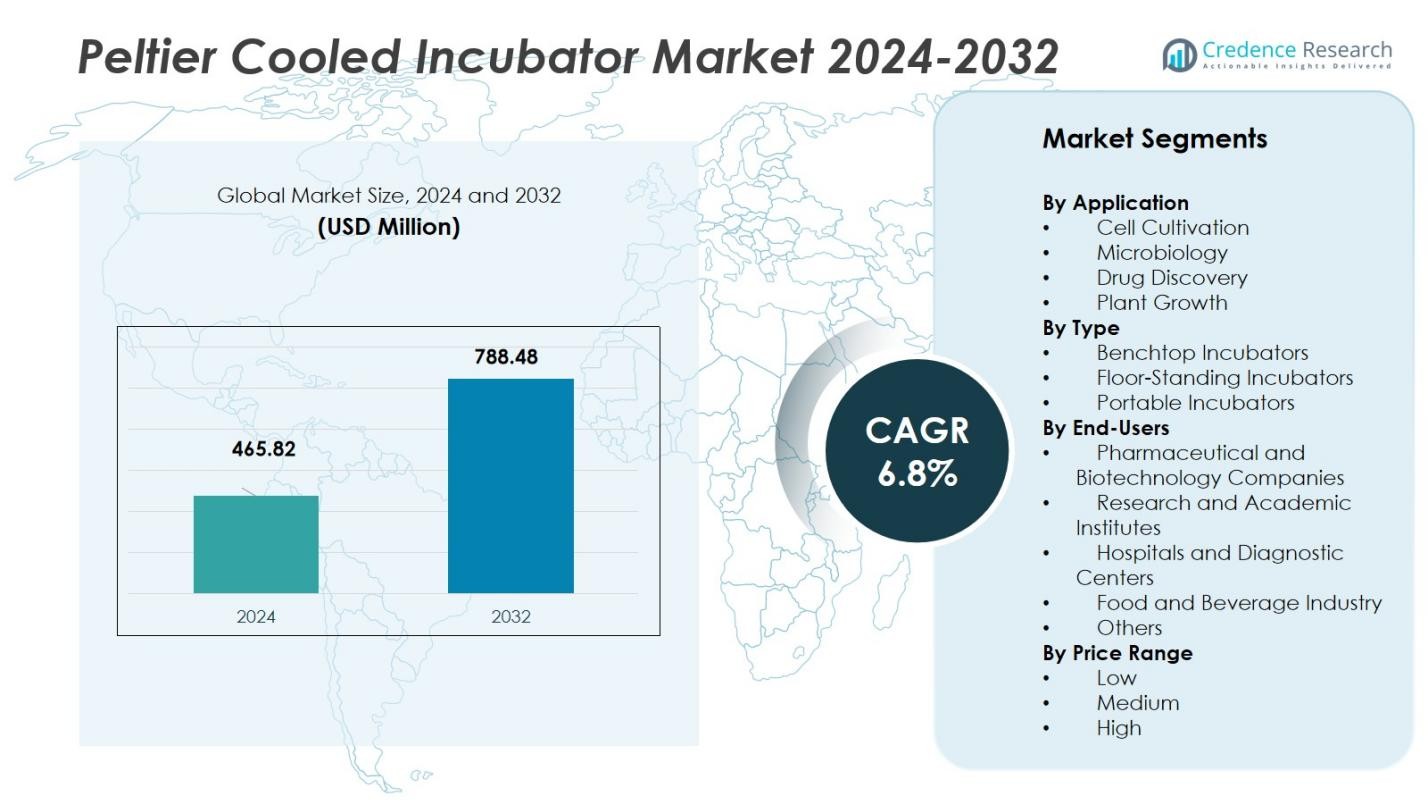
The Peltier Cooled Incubator Market size was valued at USD 465.82 million in 2024 and is anticipated to reach USD 788.48 million by 2032, at a CAGR of 6.8% during the forecast period.
| REPORT ATTRIBUTE |
DETAILS |
| Historical Period |
2020-2023 |
| Base Year |
2024 |
| Forecast Period |
2025-2032 |
| Peltier Cooled Incubator Market Size 2024 |
USD 465.82 Million |
| Peltier Cooled Incubator Market, CAGR |
6.8% |
| Peltier Cooled Incubator Market Size 2032 |
USD 788.48 Million |
The Peltier Cooled Incubator Market is primarily driven by key players such as Memmert GmbH & Co. KG, Thermo Fisher Scientific Inc., and BINDER GmbH, which together account for more than 50% of the market share. These companies focus on advancing temperature-control technology, energy efficiency, and expanding their global footprint. North America holds the largest market share at 35%, driven by the region’s strong pharmaceutical and biotechnology industries and high research and development investments. Europe follows with a 25% market share, supported by extensive life-science research and government funding. The Asia-Pacific region is growing rapidly and holds around 20% of the market, fueled by increased demand in emerging economies like China and India, along with significant investments in biotechnology and pharmaceutical manufacturing. The Middle East and Latin America hold smaller but growing shares, with steady increases in research and healthcare development.
Access crucial information at unmatched prices!
Request your sample report today & start making informed decisions powered by Credence Research Inc.!
Download Sample
Market Insights
- Global market size stood at USD 465.82 million in 2024 and is projected to reach USD 788.48 million by 2032, growing at a CAGR of 6.8%.
- Strong demand from biopharmaceuticals and cell‑culture research drives adoption, with the cell cultivation application segment capturing around 40% share and the microbiology segment approximately 30%.
- A notable trend is the increasing uptake of benchtop incubators, which dominate the type segment with about 50% market share, reflecting the shift toward compact, lab‑friendly formats.
- Key restraints include high upfront investment costs and limited cooling capacity for large‑scale production facilities, which challenge broader adoption and scalability.
- Regionally, North America leads with roughly 35% market share, followed by Europe at 25% and Asia‑Pacific around 20%, driven by mature research infrastructure in the former and rapid biotech growth in the latter.
Market Segmentation Analysis:
By Application
The Peltier Cooled Incubator Market is segmented by application into cell cultivation, microbiology, drug discovery, and plant growth. Among these, cell cultivation dominates the market, holding an estimated 40% market share due to its critical role in the production of biopharmaceuticals and cell-based therapies. This segment benefits from the increasing demand for cell culture techniques in biotechnology and pharmaceutical research. The microbiology application also holds a substantial share, accounting for around 30%, driven by the rising need for precise temperature control in microbial growth and testing environments. These applications are fueled by advancements in medical and research fields, enhancing market growth.
- For instance, Memmert’s Peltier-cooled incubators offer advanced temperature homogeneity, energy efficiency, and minimized sample drying risks, widely used in microbiological labs.
By Type
The market is further segmented by type into benchtop incubators, floor-standing incubators, and portable incubators. Benchtop incubators dominate the market with an estimated 50% share, owing to their compact size, affordability, and ease of use in laboratory settings. These incubators are widely used in research, academic institutes, and healthcare facilities for small-scale experiments and culture applications. Floor-standing incubators follow, capturing about 35% of the market share, driven by their higher capacity and versatility for industrial and large-scale research use. Portable incubators, though smaller in share, account for around 15%, driven by increasing demand in mobile diagnostics and fieldwork.
- For instance, Thermo Fisher Scientific offers benchtop incubators known for their advanced control systems and reliability, widely used in research laboratories for precise culture conditions.
By End-Users
The end-user segmentation includes pharmaceutical and biotechnology companies, research and academic institutes, hospitals and diagnostic centers, the food and beverage industry, and others. Pharmaceutical and biotechnology companies dominate this segment with an estimated 45% market share due to the critical need for temperature-controlled environments in drug development, testing, and production. The growing emphasis on biotechnology innovations, such as gene therapies, is fueling this dominance. Research and academic institutes follow closely, capturing around 30% of the market, driven by the rising demand for incubators in educational and experimental research applications, further expanding the market presence.
Key Growth Drivers
Increasing Demand for Biopharmaceuticals
The growing demand for biopharmaceuticals is a major driver of the Peltier Cooled Incubator Market. With the increasing prevalence of chronic diseases and the rising need for innovative therapies such as cell-based treatments and gene therapies, there is a growing emphasis on temperature-controlled environments in drug production and research. Peltier cooled incubators provide the precise temperature regulation required for the cultivation of cells and other sensitive biological materials, driving significant demand in the biopharmaceutical industry.
- For instance, Memmert’s Peltier-cooled incubators are favored in pharmaceutical and biopharmaceutical labs due to their noiseless operation, minimal vibration, and precise temperature control, critical for cultivating sensitive biological materials in cell-based therapy research.
Technological Advancements in Incubator Designs
Technological advancements in Peltier cooled incubators, such as enhanced temperature stability, energy efficiency, and integrated monitoring systems, are fueling market growth. Modern incubators are equipped with more sophisticated temperature control mechanisms, better insulation, and user-friendly interfaces, making them ideal for research labs, biotech firms, and pharmaceutical companies. These innovations not only improve performance but also reduce operational costs, attracting a wide range of users and pushing the market forward.
- For instance, Memmert’s IPPeco series uses advanced Peltier technology to achieve highly sensitive and stable temperature control with minimal fluctuations, ensuring sample integrity while being energy-efficient and virtually vibration-free.
Rising Research Activities in Biotechnology
Ongoing advancements in biotechnology are significantly contributing to the growth of the Peltier Cooled Incubator Market. Research activities related to drug discovery, stem cell research, and genetic engineering require precise environmental control for experiments and cultivation. Peltier cooled incubators, which offer reliable temperature control and energy efficiency, are essential tools in these research settings. As the global investment in biotechnology research continues to rise, demand for these incubators is expected to grow steadily, providing a substantial market opportunity.
Key Trends & Opportunities
Shift Toward Energy-Efficient Equipment
One key trend in the Peltier Cooled Incubator Market is the shift toward more energy-efficient equipment. As sustainability and operational cost savings become increasingly important for research institutions and biotech companies, there is a growing preference for energy-efficient incubators. Peltier cooling technology, which uses thermoelectric modules instead of traditional compressor-based systems, offers lower energy consumption and quieter operation, making it an attractive option. This shift creates significant growth opportunities for manufacturers focusing on green technologies in laboratory equipment.
- For instance, Pol-Eko’s STP 4 model eliminates compressors, reducing environmental impact and operational noise while providing stable and rapid temperature recovery.
Increasing Adoption in Emerging Markets
Emerging markets, particularly in Asia-Pacific and Latin America, are showing a rising demand for Peltier cooled incubators due to the growing focus on healthcare and research development. As pharmaceutical and biotechnology industries expand in these regions, the need for reliable and cost-effective laboratory equipment increases. The rising number of research institutes and clinical laboratories in these regions is creating new market opportunities for Peltier cooled incubators, providing a valuable avenue for market players to explore.
- For instance, China and India are rapidly industrializing with growing biotech and pharmaceutical industries that demand reliable, energy-efficient lab equipment to support advanced research and production.
Key Challenges
High Initial Investment Costs
One of the key challenges in the Peltier Cooled Incubator Market is the high initial investment required for purchasing advanced incubator models. While these incubators offer long-term operational savings and benefits in terms of energy efficiency and precise temperature control, their upfront costs can be a barrier, particularly for small laboratories and academic institutions with limited budgets. Overcoming this challenge requires manufacturers to offer flexible pricing models or financial incentives to make these incubators more accessible to a wider range of users.
Limited Cooling Capacity for Large-Scale Applications
Another challenge faced by the Peltier Cooled Incubator Market is the limited cooling capacity for large-scale applications. Peltier-based incubators, while efficient for small-scale use in research and biotechnology labs, may struggle to meet the demands of large-scale production facilities. Their relatively lower cooling capacity compared to traditional compressor-based systems limits their widespread adoption in industrial settings, particularly in pharmaceutical manufacturing. Addressing this limitation by enhancing the scalability and cooling performance of Peltier coolers will be crucial for expanding their market appeal.
Regional Analysis
North America
North America leads the market with a 35 % share, driven by high adoption of advanced laboratory equipment and a strong presence of pharmaceutical, biotech and research institutions. With well‑established infrastructure and consistent R&D investment, the region benefits from early technology uptake and stringent regulatory environments that prioritise precision instrumentation. Demand for energy‑efficient, compact incubators is reinforced by the significant number of academic and commercial laboratories in the United States and Canada, making North America a pivotal growth region.
Europe
Europe maintains a strong position in the market with 25 % share, underpinned by robust life‑science research activity, government funding and widespread laboratory infrastructure across Germany, the UK, France and other markets. Researchers’ focus on cell‑therapy, microbiology and plant‑growth applications in universities and private labs drives demand for Peltier‑cooled incubators. Adoption of sustainable and energy‑efficient equipment further reinforces this trend. The competitive environment and regulatory frameworks for lab equipment stimulate product innovation and sales in Europe.
Asia Pacific
Asia Pacific is emerging rapidly and currently holds 20 % market share, with the highest growth trajectory of all regions. Expansion of biotech and pharmaceutical manufacturing in China, India and Japan, combined with increasing research grants and infrastructure investments, bolster the uptake of Peltier‑cooled incubators. Cost advantages, local manufacturing and a growing number of research institutes further support market growth. The region’s large untapped potential for laboratory upgrades and mobile/portable systems also gives it a strong outlook.
Latin America
Latin America captures 10 % of the market share, supported by gradual growth in healthcare and research sectors in Brazil, Mexico and Argentina. Laboratory equipment investments are rising, although technology penetration remains lower compared with mature regions. Local distributors and regional partnerships are improving access to Peltier‑cooled incubators, but economic constraints and import costs continue to moderate growth rates. The Latin American market presents selective opportunities for cost‑competitive models.
Middle East & Africa (MEA)
The Middle East & Africa region accounts for 10 % of global share and is expanding steadily but at a more moderate pace. Investments in research infrastructure, diagnostics and plant‑growth research in the Gulf states and South Africa drive some demand, yet adoption is constrained by budgetary limitations and lower awareness of advanced lab‑equipment capabilities. Despite these hurdles, MEA offers opportunities for manufacturers through partnerships and lower‑cost portfolio options targeting emerging research hubs.
Market Segmentations:
By Application
- Cell Cultivation
- Microbiology
- Drug Discovery
- Plant Growth
By Type
- Benchtop Incubators
- Floor-Standing Incubators
- Portable Incubators
By End-Users
- Pharmaceutical and Biotechnology Companies
- Research and Academic Institutes
- Hospitals and Diagnostic Centers
- Food and Beverage Industry
- Others
By Price Range
By Region
- North America
- Europe
- Germany
- France
- U.K.
- Italy
- Spain
- Rest of Europe
- Asia Pacific
- China
- Japan
- India
- South Korea
- South-east Asia
- Rest of Asia Pacific
- Latin America
- Brazil
- Argentina
- Rest of Latin America
- Middle East & Africa
- GCC Countries
- South Africa
- Rest of the Middle East and Africa
Competitive Landscape
The competitive landscape of the Peltier Cooled Incubator Market is anchored by major key players such as Memmert GmbH & Co. KG, Thermo Fisher Scientific Inc., and BINDER GmbH, which together control more than 50% of the market share. These companies focus on product innovation, advanced temperature-control technologies, and expanding global distribution channels, positioning themselves ahead of smaller manufacturers. Their strategies include the introduction of energy-efficient Peltier-cooled models, partnerships with research institutions, and customization of lab-grade incubators for cell culture and microbiology applications. New entrants and niche players are also gaining ground by offering compact, portable solutions and targeting emerging markets, thereby intensifying competitive rivalry and pushing established players to accelerate innovation.
Shape Your Report to Specific Countries or Regions & Enjoy 30% Off!
Key Player Analysis
Recent Developments
- In April 2025, SRICO launched a new compact Peltier‑cooled incubator model aimed at microbiology and cell culture applications, offering enhanced temperature stability and eco‑friendly operation.
- In October 2024, Memmert GmbH & Co. KG announced a strategic partnership with Aralab to expand their life sciences and pharmaceutical stability portfolio across China and the USA.
- In 2022, VWR International expanded its INCU‑Line® Peltier cooled incubator portfolio with premium models incorporating Peltier technology, low‑energy consumption, and multi‑user program memory.
Report Coverage
The research report offers an in-depth analysis based on Application, Type, End User, Price Range and Region. It details leading market players, providing an overview of their business, product offerings, investments, revenue streams, and key applications. Additionally, the report includes insights into the competitive environment, SWOT analysis, current market trends, as well as the primary drivers and constraints. Furthermore, it discusses various factors that have driven market expansion in recent years. The report also explores market dynamics, regulatory scenarios, and technological advancements that are shaping the industry. It assesses the impact of external factors and global economic changes on market growth. Lastly, it provides strategic recommendations for new entrants and established companies to navigate the complexities of the market.
Future Outlook
- Growth in cell‑culture and microbiology research will drive increased demand for Peltier cooled incubators in laboratories and biotech operations.
- The shift toward compact benchtop and portable models will expand usage beyond traditional labs into field diagnostics and smaller R&D units.
- Rising investments in emerging markets such as Asia‑Pacific will open new distribution channels and growth opportunities for manufacturers.
- Energy‑efficiency and sustainability concerns will push adoption of Peltier‑based systems over compressor‑based models, enhancing market appeal.
- Customisable and application‑specific incubators (e.g., for drug‑discovery or plant‑growth) will allow suppliers to differentiate and capture niche segments.
- Integration of IoT and smart monitoring features will enhance usability and remote management, making products more attractive to modern labs.
- Collaborations between equipment suppliers and research institutions will facilitate technology updates and broaden market penetration.
- Price pressure from alternative technologies and second‑hand equipment will force innovation and cost‑reduction strategies among vendors.
- Regulatory drivers in food & beverage and diagnostics sectors will demand more reliable temperature‑controlled equipment, boosting demand.
- Market expansion into non‑traditional end‑users (e.g., industrial biotechnology, agritech) will diversify application scope and support long‑term growth.



