
| REPORT ATTRIBUTE | DETAILS |
|---|---|
| Historical Period | 2019-2022 |
| Base Year | 2023 |
| Forecast Period | 2024-2032 |
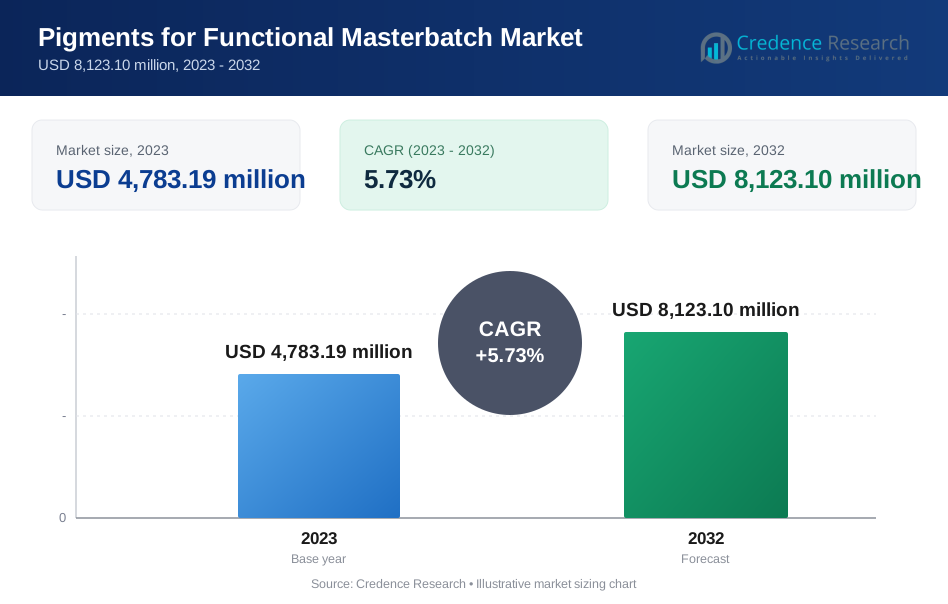
| Pigments for Functional Masterbatch Market Size 2023 | USD 4,783.19 Million |
| Pigments for Functional Masterbatch Market, CAGR | 5.73% |
| Pigments for Functional Masterbatch Market Size 2032 | USD 8,123.10 Million |
Market Overview
The Global Pigments for Functional Masterbatch Market is projected to grow from USD 4,783.19 million in 2023 to an estimated USD 8,123.10 million by 2032, with a compound annual growth rate (CAGR) of 5.73% from 2024 to 2032. This steady growth reflects the increasing demand for high-performance pigments across industries, particularly in sectors requiring enhanced color consistency, UV resistance, and durability.
Key drivers for this market include the rising demand for lightweight and sustainable materials in automotive, packaging, and consumer goods. In addition, trends such as increased regulatory focus on eco-friendly and non-toxic pigments are pushing manufacturers to innovate and adopt greener alternatives. The rapid growth of industries in emerging economies is further fueling market demand, as pigments for functional masterbatches find applications in sectors aiming to enhance product aesthetics and functionality.
Geographically, the Asia-Pacific region leads the market due to the robust growth of end-user industries and expanding production facilities in countries like China and India. North America and Europe follow, driven by a strong focus on quality standards and advanced manufacturing processes. Key players in the market include Clariant AG, Ampacet Corporation, Cabot Corporation, and BASF SE, each investing in R&D to meet evolving customer needs and regulatory standards.
Market Drivers
Growing Demand for Lightweight and Durable Materials Across End-Use Industries
One of the foremost drivers of the Global Pigments for Functional Masterbatch Market is the rising demand for lightweight, durable materials across diverse industries such as automotive, packaging, construction, and electronics. In the automotive sector, manufacturers are increasingly focused on reducing vehicle weight to enhance fuel efficiency and reduce emissions. For instance, a 10% reduction in vehicle weight can lead to a 6%-8% improvement in fuel economy. This is achieved by replacing traditional materials with lightweight alternatives such as high-strength steel, aluminum alloys, and carbon fiber composites, which can reduce the weight of vehicle components by up to 50%. Pigments for functional masterbatches play a critical role in producing lightweight polymer components that retain durability, color stability, and resistance to environmental factors. These enhanced masterbatches enable the creation of colored polymers that meet stringent industry requirements while maintaining structural integrity. The packaging industry, too, has seen substantial growth in demand for high-performance materials as brands seek sustainable, visually appealing, and resilient packaging solutions. Pigments for functional masterbatches provide aesthetic appeal as well as added durability, extending product life and supporting brand integrity.
Emphasis on Sustainable and Eco-Friendly Solutions
Environmental sustainability and compliance with regulatory standards are pivotal trends shaping the pigments for functional masterbatch market. Stringent regulations worldwide are pushing manufacturers to develop eco-friendly pigments that limit the environmental impact of industrial processes. In the European Union, for instance, REACH (Registration, Evaluation, Authorisation, and Restriction of Chemicals) regulations place strict controls on the use of hazardous substances, motivating manufacturers to innovate sustainable pigments for functional masterbatches. This shift is evident in the increased use of organic pigments derived from renewable resources like plants and minerals, which are less toxic and more biodegradable than their synthetic counterparts. Similarly, North America’s shift towards more sustainable materials reflects an increased awareness among consumers and industries alike. This trend is further driven by the demand for bio-based and recyclable polymers, particularly within consumer goods, packaging, and medical device sectors. Functional masterbatches formulated with sustainable pigments not only meet these regulatory standards but also position manufacturers as forward-thinking, eco-conscious entities in an increasingly competitive market.
Technological Advancements in Pigment and Polymer Additives
Ongoing innovations in pigment and polymer additive technologies are significantly driving market growth. These advancements enable the production of functional masterbatches that possess specialized properties, such as UV resistance, antimicrobial characteristics, and improved thermal stability, enhancing the performance and lifespan of products in demanding applications. For instance, UV-stabilized pigments for outdoor applications such as building materials and automotive exteriors are crucial because they prevent fading and degradation from sun exposure. Additionally, antimicrobial pigments are increasingly used in medical devices and packaging to inhibit bacterial growth, contributing to consumer safety by inhibiting bacterial growth. Such technological advancements allow manufacturers to meet the specific requirements of end-users across sectors, resulting in functional masterbatches that not only provide color but also protect and prolong product utility. Consequently, these innovations continue to push the boundaries of the pigments for functional masterbatch market, meeting the evolving needs of manufacturers and consumers alike.
Rising Industrialization and Growth in Emerging Economies
The expanding industrial landscape in emerging economies, particularly in Asia-Pacific and Latin America, has created substantial demand for pigments used in functional masterbatches. With rapid industrialization and urbanization, countries such as China, India, Brazil, and Mexico are experiencing robust growth in sectors like construction, automotive, electronics, and consumer goods. These industries are heavily reliant on high-performance polymer products to meet evolving consumer expectations, and functional masterbatches with specialized pigments are instrumental in enhancing the aesthetic and functional qualities of such products. Furthermore, the availability of cost-effective raw materials, skilled labor, and expanding manufacturing capacities in these regions is fostering increased production and consumption of pigments for functional masterbatches. Local manufacturers and multinational corporations are also investing in these regions to capture a share of the growing market, drawn by favorable government policies and incentives aimed at boosting industrial growth. This upward trajectory in emerging markets represents a significant driver, contributing to the steady global expansion of the pigments for functional masterbatch market.
Market Trends
Increased Adoption of Bio-Based and Sustainable Pigments
A leading trend in the pigments for functional masterbatch market is the shift toward bio-based and sustainable pigments. As industries strive to reduce environmental impact and adhere to stringent regulations, manufacturers are developing eco-friendly pigments that meet the demand for sustainable solutions. Bio-based pigments, derived from renewable resources, are gaining popularity across packaging, automotive, and consumer goods industries, aligning with global sustainability goals. For instance, bio-based pigments derived from renewable resources like plants and microorganisms are being increasingly used in various industries such as textiles, pharmaceuticals, and cosmetics. Companies like BASF SE and Clariant are investing in developing high-performance bio-based pigments to meet the rising demand for sustainable solutions. Major players in the market are investing in research and development to create pigments that not only reduce reliance on petrochemical-based products but also maintain high-performance standards. This shift is especially prevalent in regions with strong regulatory environments, such as Europe and North America, where consumers and businesses increasingly prioritize eco-friendly materials. In North America, the bio-based pigments market is significant due to increased biotechnology research and supportive government programs. The growing demand for sustainable pigments highlights an industry-wide commitment to environmental responsibility, further reinforced by evolving policies aimed at reducing carbon footprints and supporting circular economy initiatives.
Growing Demand for Functional Additives in High-Performance Applications
Another significant trend is the rising demand for functional additives within pigments that enhance product performance. Industries such as automotive, healthcare, construction, and electronics are increasingly incorporating functional masterbatches with specific additives—such as UV stabilizers, antimicrobial agents, and heat-resistant pigments—that offer extended durability, protection, and resilience. For instance, UV-stabilized pigments are crucial in outdoor applications such as automotive exteriors and construction materials. These pigments help prevent fading and degradation from sun exposure, enhancing product durability. Additionally, antimicrobial pigments are gaining traction in healthcare and food packaging industries due to their ability to inhibit bacterial growth, thereby enhancing safety. UV-stabilized pigments are highly sought after for outdoor applications, including automotive exteriors and construction materials, where they prevent fading and material degradation due to prolonged sun exposure. Antimicrobial pigments, on the other hand, are in high demand in healthcare and food packaging, as they provide enhanced safety by inhibiting bacterial growth. This focus on high-performance additives is driving innovation in functional masterbatches, enabling manufacturers to meet complex product requirements while ensuring longevity and quality. Research shows that UV stabilizers like Chimassorb 81 significantly improve color stability in pigmented elastomers, highlighting their importance in maintaining material quality under UV exposure. As industries continue to evolve, the demand for masterbatches with multifunctional properties is expected to rise, positioning these pigments as essential components in advanced material applications across sectors.
Market Restraints and Challenges
High Cost of Raw Materials and Complex Manufacturing Processes
A key restraint in the pigments for functional masterbatch market is the high cost associated with raw materials and complex manufacturing processes. The production of functional masterbatches often requires high-quality pigments and advanced additives, such as UV stabilizers or antimicrobial agents, which can be expensive. Additionally, fluctuating prices of raw materials like titanium dioxide, carbon black, and specialty chemicals directly impact production costs, creating pricing challenges for manufacturers. This volatility, combined with the intricate processes involved in producing masterbatches that meet stringent performance criteria, raises the overall cost structure. Manufacturers aiming to incorporate sustainable or bio-based pigments also face higher costs, which can deter adoption in price-sensitive markets, particularly in emerging economies. These cost-related challenges limit the accessibility of high-performance masterbatches, slowing overall market growth.
Regulatory Compliance and Environmental Concerns
Regulatory compliance is another significant challenge, as manufacturers must adhere to stringent environmental regulations, especially in regions like Europe and North America. Restrictions on the use of certain chemicals under regulations such as REACH (Registration, Evaluation, Authorisation, and Restriction of Chemicals) in the EU or similar standards in North America add to operational complexities. Adapting formulations to comply with these evolving regulations often requires additional research and testing, which can be time-consuming and costly. Furthermore, as consumers and regulatory bodies place more emphasis on sustainability, there is mounting pressure on manufacturers to limit emissions and reduce the environmental impact of their products. This focus on sustainability creates challenges for producers who may struggle to balance cost-efficiency with compliance. Navigating these regulatory requirements without compromising product performance presents an ongoing challenge, particularly for smaller players with limited resources for R&D and regulatory adjustments.
Market Segmentation Analysis
By Type
Organic pigments, derived from carbon-based molecules, are gaining popularity due to their eco-friendly and non-toxic nature, offering vibrant colors suitable for consumer goods, packaging, and food-contact products, where safety and sustainability are prioritized. However, their lower heat stability limits their use in high-temperature applications. On the other hand, inorganic pigments, derived from minerals and metals like titanium dioxide, iron oxide, and chromium compounds, are valued for their durability, opacity, and stability. They are ideal for high heat and UV-resistant applications, such as automotive parts and outdoor construction materials, making them essential in sectors requiring fade-resistant, long-lasting performance under challenging conditions.
By Application
Functional masterbatches are categorized into processing aid, antioxidant, and antistatic applications, each serving a critical role in enhancing product performance. Processing aid masterbatches improve polymer flow, enhance surface finish, and reduce manufacturing costs, with high demand in packaging and automotive sectors where efficient production and consistent quality are paramount. Antioxidant masterbatches prevent degradation, extending the lifespan of products exposed to heat and oxidation, making them essential for automotive, construction, and electronics industries. Antistatic masterbatches, meanwhile, mitigate static buildup, protecting product integrity and safety in sensitive applications like electronics and medical devices, requiring pigments that balance functional and aesthetic needs for high-tech use.
Segments
Based on Type
- Organic Pigments
- Inorganic Pigments
Based on Application
- Processing Aid Masterbatch
- Antioxidant Masterbatch
- Antistatic Masterbatch
Based on Region
- North America
- U.S.
- Canada
- Mexico
- Europe
- Germany
- France
- U.K.
- Italy
- Spain
- Rest of Europe
- Asia Pacific
- China
- Japan
- India
- South Korea
- South-east Asia
- Rest of Asia Pacific
- Latin America
- Brazil
- Argentina
- Rest of Latin America
- Middle East & Africa
- GCC Countries
- South Africa
- Rest of the Middle East and Africa
Regional Analysis
Asia-Pacific (40%)
The Asia-Pacific region holds the largest market share, accounting for approximately 40% of the Global Pigments for Functional Masterbatch Market. This dominance is driven by the rapid industrialization in countries like China, India, and Southeast Asia, which are experiencing robust growth in sectors such as automotive, construction, and consumer goods. The region’s expanding manufacturing base, along with cost-effective labor and favorable government policies, encourages increased production and consumption of functional masterbatches. Additionally, the rising middle-class population and urbanization in Asia-Pacific are fueling demand for high-quality consumer products, further increasing the need for functional masterbatches in packaging and durable goods. Local manufacturers are also investing heavily in R&D to develop region-specific solutions that cater to the growing demand for pigments in various industries, solidifying Asia-Pacific’s leading position in the global market.
North America (25%)
North America holds a significant share, capturing around 25% of the market. This region benefits from a strong focus on advanced manufacturing technologies and stringent regulatory standards. The United States and Canada drive demand for high-performance and eco-friendly pigments, particularly within the automotive, healthcare, and packaging industries. As sustainability and compliance with environmental regulations become more critical, manufacturers in North America are increasingly seeking bio-based and non-toxic pigments for functional masterbatches. The region’s emphasis on product innovation and quality standards supports the steady growth of the market, with a particular focus on applications that require durability and specialized properties, such as UV resistance and antimicrobial features.
Key players
- Heubach
- Oxerra
- LANXESS
- DIC Corporation
- TOMATEC
- Asahi Kasei Kogyo
- S. Pigments
- Tronox
- Kronos Worldwide
- Alabama Pigments
- DCL Corporation
- Toyo Ink
- Sudarshan
- Sunlour Pigment
- LB Group
- Gpro Titanium Industry
- CNNC HUA YUAN Titanium Dioxide
- Fulln Chemical
- Hunan Jufa Pigment
- Cadello
- ZhongLong Materials Limited
Competitive Analysis
The Global Pigments for Functional Masterbatch Market is highly competitive, driven by innovation, sustainability trends, and diverse customer demands. Key players such as Heubach, LANXESS, and Tronox lead the market with broad product portfolios, strong global reach, and extensive expertise in pigment technology. Companies like DIC Corporation and Sudarshan have built strong reputations for producing high-performance pigments, often leveraging advanced technologies to meet stringent regulatory requirements. Emerging players like Gpro Titanium Industry and ZhongLong Materials Limited are gaining traction, particularly in Asia-Pacific, due to cost-effective solutions and strategic regional focus. To remain competitive, market leaders invest heavily in R&D, sustainability initiatives, and strategic partnerships to cater to evolving industry trends, regulatory standards, and environmental considerations. This dynamic competitive landscape underscores the critical need for continuous innovation and adaptability.
Recent Developments
- In October 2024, Sudarshan Chemical Industries announced its acquisition of Heubach Group's global pigment business for €127.5 million (approximately Rs 1,180 crore). This acquisition will enhance Sudarshan's product portfolio and give it deeper access to customers across 19 sites globally.
- In July 2023, Cathay Industries, a leading global iron oxide pigment manufacturer, rebranded as Oxerra after completing the acquisition of Venator's color business. This acquisition positioned Oxerra as a global leader in the inorganic pigment industry, with a synthetic iron oxide manufacturing presence in both Europe and the United States.
- In July 2022, LANXESS completed the acquisition of International Flavors & Fragrances Inc. (IFF)'s microbial control business unit for approximately USD 1.3 billion. While not directly related to pigments, this acquisition strengthened LANXESS's position in antimicrobial active ingredients and formulations for material protection.
- In February 2024, DIC Corporation opened a Coating Resins Application Lab in India through its subsidiaries DIC South Asia Private Limited and IDEAL CHEMI PLAST PRIVATE LTD. This lab is dedicated to evaluating coating resins for automotive coatings and infrastructure applications.
- In September 2024, Asahi Kasei Pharma, a subsidiary of Asahi Kasei Kogyo, announced the transfer of its diagnostics business, Ohito Pharmaceuticals Plant, and Ohito Office to Nagase & Co., Ltd. While this is not directly related to pigments, it represents a significant change in Asahi Kasei's healthcare sector focus.
Market Concentration and Characteristics
The Global Pigments for Functional Masterbatch Market exhibits moderate to high market concentration, with several key players dominating a significant share through their advanced product offerings and global presence. The market is characterized by a blend of established multinational companies and emerging regional players, each striving for innovation and differentiation. Leading companies focus on sustainability, regulatory compliance, and high-performance functional pigments tailored to meet the diverse needs of industries such as automotive, packaging, construction, and electronics. While market leaders leverage R&D investments and strategic collaborations, smaller and regional players aim to capitalize on cost-effective manufacturing and niche market segments. This competitive landscape reflects a steady push toward eco-friendly solutions, technological advancements, and specialized applications to meet evolving customer and regulatory demands.
Report Coverage
The research report offers an in-depth analysis based on Type, Application, and Region. It details leading market players, providing an overview of their business, product offerings, investments, revenue streams, and key applications. Additionally, the report includes insights into the competitive environment, SWOT analysis, current market trends, as well as the primary drivers and constraints. Furthermore, it discusses various factors that have driven market expansion in recent years. The report also explores market dynamics, regulatory scenarios, and technological advancements that are shaping the industry. It assesses the impact of external factors and global economic changes on market growth. Lastly, it provides strategic recommendations for new entrants and established companies to navigate the complexities of the market.
Future Outlook
- Manufacturers will increasingly focus on bio-based and eco-friendly pigments, driven by regulatory pressures and consumer preference for sustainable materials.
- Advancements in additives, such as UV stabilizers and antimicrobial properties, will drive demand for functional masterbatches with enhanced durability and performance.
- Rapid industrialization and urbanization in regions such as Asia-Pacific, Latin America, and Africa will create significant growth opportunities for pigments in functional masterbatches.
- Lightweighting and sustainability goals will continue to drive demand for functional masterbatches in automotive and packaging applications, enhancing product aesthetics and durability.
- The market will increasingly align with circular economy principles, focusing on recyclable and reusable masterbatches that reduce environmental impact.
- Growing end-user requirements will push manufacturers to develop tailored masterbatches with specialized pigments, catering to unique industry needs and preferences.
- Leading companies will invest heavily in research and development to produce innovative, high-performance pigments, gaining a competitive edge and meeting regulatory requirements.
- Stricter regulations, particularly in North America and Europe, will push manufacturers to continuously innovate and adapt their formulations for compliance while maintaining performance standards.
- Price pressures and cost fluctuations of raw materials will lead to the development of cost-effective functional masterbatch solutions without compromising on quality.
- Strategic alliances between pigment manufacturers, research institutions, and end-user industries will foster innovation and speed the adoption of advanced pigments for functional masterbatches.
Request a Free Sample
Fill in your details and we'll send you a free sample report.
- Sample data tables & charts
- Research methodology
Need a Custom Version of This Report?
Tailor the scope, geography, or segments to your exact requirements.
- Custom geography or segment scope
- Direct access to our analyst team
Frequently Asked Questions
What is the projected market size of the Global Pigments for Functional Masterbatch Market in 2023 and 2032, and what is the CAGR?
What drives the growth of the Global Pigments for Functional Masterbatch Market?
Which regions lead the Global Pigments for Functional Masterbatch Market?
Which industries use functional masterbatches extensively?
What trends are shaping the Global Pigments for Functional Masterbatch Market?
Who are the key players in the Global Pigments for Functional Masterbatch Market?
Table of Content
Chapter 1. Report Introduction
- 1.1 Report Description & Purpose
- 1.1.1 Report Title & Market Definition
- 1.1.2 Unique Selling Propositions (USP) & Key Differentiators
- 1.1.3 Value Proposition for Stakeholders
- 1.2 Research Objectives
- 1.2.1 Market Sizing Objectives (Volume & Revenue)
- 1.2.2 Segmentation Objectives
- 1.2.3 Competitive Intelligence Objectives
- 1.2.4 Forecast & Scenario Objectives
- 1.3 Report Scope
- 1.3.1 Pigments for Functional Masterbatch Scope – Types & Subtypes Covered
- 1.3.2 Geographic Scope – Regions & Countries Covered
- 1.3.3 Historical Period, Base Year & Forecast Period (2023; forecast to 2032)
- 1.3.4 Inclusions & Exclusions
- 1.4 HS Code & Classification Framework
- 1.5 Currency, Units & Pricing Basis
- 1.6 Target Stakeholders
- 1.7 Limitations & Assumptions
Chapter 2. Executive Summary
- 2.1 Global Pigments for Functional Masterbatch Market Snapshot
- 2.1.1 Market Size – Historical (2023) & Forecast (2023-2032) (2023: USD 4,783.19 million → 2032: USD 8,123.10 million)
- 2.1.2 Volume & Revenue – Global Totals
- 2.1.3 Key Market Highlights – Top Five Facts
- 2.2 Pigments for Functional Masterbatch Market Segmentation Snapshot
- 2.2.1 Market Split by Region – 2023 vs. 2032
- 2.3 Competitive Snapshot
- 2.3.1 Top 10 Players by Revenue Share – 2023
- 2.3.2 Top 10 Players by Volume Share – 2023
- 2.3.3 Recent Strategic Developments (18-Month Summary)
- 2.4 Key Investment Highlights & Strategic Conclusions
Chapter 3. Pigments for Functional Masterbatch Market Dynamics & Industry Analysis
- 3.1 Market Overview & Context
- 3.1.1 Pigments for Functional Masterbatch Market Position in the Broader Automotive Value Chain
- 3.1.2 OEM vs. Replacement Market Dynamics
- 3.1.3 Market Maturity & Development Stage by Region
- 3.2 Pigments for Functional Masterbatch Market Drivers
- 3.3 Pigments for Functional Masterbatch Market Restraints & Challenges
- 3.4 Pigments for Functional Masterbatch Market Opportunities
- 3.5 Porter's Five Forces Analysis
- 3.5.1 Threat of New Entrants
- 3.5.2 Bargaining Power of Suppliers
- 3.5.3 Bargaining Power of Buyers
- 3.5.4 Threat of Substitutes
- 3.5.5 Competitive Rivalry – Intensity Assessment
- 3.6 Pigments for Functional Masterbatch Value Chain Analysis
- 3.6.1 Upstream – Raw Material/Input Suppliers
- 3.6.1.1 Raw Material/Input 1
- 3.6.1.2 Raw Material/Input 2
- 3.6.1.3 Raw Material/Input 3
- 3.6.2 Midstream – Production/Manufacturing/Service Delivery
- 3.6.2.1 Production/Process Overview
- 3.6.2.2 Key Facility Locations & Capacity by Manufacturer
- 3.6.3 Downstream – Distribution & End Consumer
- 3.6.3.1 Primary Channel – B2B/OEM
- 3.6.3.2 Secondary Channels – Dealer, Retail, Online, Direct
- 3.6.4 Value Chain Profitability Analysis
- 3.6.1 Upstream – Raw Material/Input Suppliers
- 3.7 PESTEL Analysis
- 3.7.1 Political Factors
- 3.7.2 Economic Factors
- 3.7.3 Social Factors
- 3.7.4 Technological Factors
- 3.7.5 Environmental Factors
- 3.7.6 Legal Factors
- 3.8 Pigments for Functional Masterbatch Supply Chain Analysis
- 3.8.1 Raw Material/Input Supply Risk Assessment
- 3.8.2 Manufacturing Concentration Risk (Geographic Exposure)
- 3.8.3 Trade Disruption Impact Analysis
- 3.9 Regulatory & Policy Landscape
Note: The regulatory and policy landscape section covers regulations based on their applicability to the market, Pigments for Functional Masterbatch category, geography, and scope of the study. Only regulatory frameworks with a material impact on operations, compliance, trade, sustainability, or market access are analyzed in detail.
Chapter 4. Key Investment Pockets & Opportunity Analysis
- 4.1 Pigments for Functional Masterbatch Market Attractiveness Analysis
- 4.1.1 By Region – Investment Attractiveness Matrix (Volume × CAGR)
- 4.2 Absolute Revenue Growth Opportunity
- 4.2.1 By Region – Absolute USD Growth Through 2032
- 4.3 Incremental Volume Opportunity
- 4.3.1 By Region – Incremental Volume Through 2032
- 4.3.2 Segment – Incremental Volume
- 4.4 Emerging Submarket Opportunity Deep Dive (Subject to Applicability)
- 4.5 Emerging Market Opportunity Scorecards
- 4.5.1 United States
- 4.5.2 Europe
- 4.5.3 Asia
- 4.5.4 Middle East & Africa
Note: Emerging Market Opportunity Scorecards will be included based on relevance and strategic importance. Regions listed are indicative and may vary depending on data availability and market dynamics.
Chapter 5. Pigments for Functional Masterbatch Import-Export Analysis & Trade Flows
- 5.1 Global Trade Overview
- 5.1.1 Global Export Value by Country (2023)
- 5.1.2 Global Export Volume by Country (2023)
- 5.1.3 Global Import Value by Country (2023)
- 5.1.4 Global Import Volume by Country (2023)
- 5.1.5 Net Trade Balance by Country (2023)
- 5.2 Export Analysis – Segment
- 5.2.1 Type 1 (HS Code)
- 5.2.2 Type 2 (HS Code)
- 5.2.3 Type 3 (HS Code)
- 5.2.4 Type 4 (HS Code)
- 5.2.5 Type 5 (HS Code)
- 5.3 Import Analysis – Segment
- 5.3.1 Type 1 (HS Code)
- 5.3.2 Type 2 (HS Code)
- 5.3.3 Type 3 (HS Code)
- 5.3.4 Type 4 (HS Code)
- 5.3.5 Type 5 (HS Code)
- 5.4 Average Unit Trade Prices
- 5.4.1 Average Export Price – Segment & Country
- 5.4.2 Average Import Price – Segment & Source Country
- 5.4.3 Price Trends (2023)
- 5.5 Key Trade Route Analysis
- 5.5.1 Trade Route 1
- 5.5.2 Trade Route 2
- 5.5.3 Trade Route 3
- 5.5.4 Trade Route 4
- 5.5.5 Trade Route 5
- 5.6 Trade Policy Impact Assessment
- 5.6.1 US Anti-Dumping & Section 301 Tariffs
- 5.6.2 EU Customs Union Impact
- 5.6.3 Major Free Trade Agreements
- 5.6.4 USMCA Rules of Origin
Note: Trade policy analysis will be included only where relevant to the Pigments for Functional Masterbatch market.
Chapter 6. Competitive Landscape & Company Benchmarking
- 6.1 Pigments for Functional Masterbatch Market Concentration & Structure
- 6.1.1 Herfindahl-Hirschman Index (HHI) – vs. 2023
- 6.1.2 Tier 1, Tier 2 & Tier 3 Market Structure
- 6.1.3 Global, Regional & Local Player Dynamics
- 6.2 Pigments for Functional Masterbatch Market Share Analysis – 2023
- 6.2.1 Global Revenue Share by Company
- 6.2.2 Global Volume Share by Company
- 6.2.3 Regional Revenue Share
- 6.2.4 Market Share Evolution ( vs. 2023)
- 6.2.5 OEM Segment Share by Company
- 6.2.6 Replacement Segment Share by Company
- 6.3 Production/Delivery Capacity & Facility Analysis
- 6.3.1 Global Installed Capacity
- 6.3.2 Capacity Utilization Rates
- 6.3.3 Production/Output Volume
- 6.3.4 Facility Locations & Capacity Map
- 6.3.5 Planned Capacity Additions
- 6.4 Pigments for Functional Masterbatch Competitive Benchmarking Matrix
- 6.4.1 Revenue, Volume, CAGR & Profitability Comparison
- 6.4.2 Channel Revenue Mix
- 6.4.3 Geographic Revenue Exposure
- 6.4.4 R&D Intensity
- 6.4.5 Sustainability Maturity
- 6.5 Strategic Developments in Pigments for Functional Masterbatch (Last 24 Months)
- 6.5.1 Mergers, Acquisitions & Divestments
- 6.5.2 New Pigments for Functional Masterbatch Launches
- 6.5.3 Facility Expansions
- 6.5.4 Strategic Alliances, Joint Ventures & Partnerships
- 6.5.5 Distribution Expansion & Market Entry
- 6.5.6 Sustainability & ESG Initiatives
- 6.6 Competitive Strategy Mapping
- 6.6.1 Leader, Challenger, Follower & Niche Classification
- 6.6.2 Pricing Strategy Comparison
- 6.6.3 Channel Strategy Matrix
Note: Strategic developments are included based on their materiality and the availability of reliable information.
Chapter 7. Global Pigments for Functional Masterbatch Market – By Distribution Channel
- 7.1 Segment Overview
- 7.1.1 Volume & Revenue Split by Channel (2023 & 2032)
- 7.1.2 Channel Mix Evolution (2023-2032)
Chapter 8. Regional Market Analysis – Global Overview
- 8.1 Global Regional Overview
- 8.1.1 Regional Volume Share
- 8.1.2 Regional Revenue Share
- 8.1.3 Regional Volume by Region
- 8.1.4 Regional Revenue by Region
- 8.1.5 Regional Forecast Through 2032
- 8.2 Cross-Regional Segment Analysis
- 8.2.1 By Distribution Channel
- 8.2.2 By Brand/Price Tier
Chapter 9. North America Pigments for Functional Masterbatch Market
- 9.1 United States
- 9.2 Canada
- 9.3 Mexico
Chapter 10. Europe Pigments for Functional Masterbatch Market
- 10.1 Germany
- 10.2 France
- 10.3 Italy
- 10.4 United Kingdom
- 10.5 Spain
- 10.6 Poland
- 10.7 Russia
- 10.8 Netherlands
- 10.9 Belgium
- 10.10 Sweden
- 10.11 Denmark
- 10.12 Norway
- 10.13 Rest of Europe
Chapter 11. Asia Pacific Pigments for Functional Masterbatch Market
- 11.1 China
- 11.2 India
- 11.3 Japan
- 11.4 South Korea
- 11.5 Thailand
- 11.6 Indonesia
- 11.7 Vietnam
- 11.8 Malaysia
- 11.9 Australia
- 11.10 Rest of Asia Pacific
Chapter 12. Latin America Pigments for Functional Masterbatch Market
- 12.1 Brazil
- 12.2 Argentina
- 12.3 Colombia
- 12.4 Chile
- 12.5 Rest of Latin America
Chapter 13. Middle East Pigments for Functional Masterbatch Market
- 13.1 Saudi Arabia
- 13.2 United Arab Emirates
- 13.3 Turkey
- 13.4 Israel
- 13.5 Iran
- 13.6 Rest of the Middle East
Chapter 14. Africa Pigments for Functional Masterbatch Market
- 14.1 South Africa
- 14.2 Egypt
- 14.3 Nigeria
- 14.4 Morocco
- 14.5 Rest of Africa
Chapter 15. Pigments for Functional Masterbatch Company Profiles
- 15.1 [Company 01]
- 15.1.1 Company Overview
- 15.1.2 Key Management Personnel
- 15.1.3 Products & Services Portfolio
- 15.1.4 Financial Performance
- 15.1.5 Key Market Focus & Geographic Presence
- 15.1.6 Recent Developments & Strategic Initiatives
Note: The company profile list is preliminary and may change based on research findings, market developments, data availability, and client requirements.
Chapter 16. Appendices
- Appendix A – List of Abbreviations & Acronyms
- Appendix B – Industry Classification Code Reference – Full Series
- Appendix C – Production & Capacity Data Tables
- Appendix D – End-Use & Demand Base Tables
- Appendix E – Consumption & Replacement Rate Assumptions
- Appendix F – ASP Reference Tables
- Appendix G – Manufacturing & Facility Database
- Appendix H – Import-Export Data Tables
- Appendix I – Regulatory Summary Tables
- Appendix J – Primary Research Participant List (Anonymized)
- Appendix K – Primary Research Questionnaire Framework
- Appendix L – Data Sources & Bibliography
- Appendix M – Market Size Divergence & Source Comparison
Chapter 17. Research Methodology
- 17.1 Research Framework & Philosophy
- 17.2 Secondary Research – Sources, Hierarchy & Data Extraction
- 17.3 Data Modeling – Bottom-Up & Top-Down Market Sizing
- 17.4 Primary Research – Stakeholder Framework, LOI & Sample Sizes
- 17.5 Forecast Methodology – Regression, Scenario & Sensitivity Analysis
- 17.6 Quality Control – Four-Layer Validation Framework
- 17.7 Limitations & Standard Assumptions
- 17.8 Disclaimer
