
| REPORT ATTRIBUTE | DETAILS |
|---|---|
| Historical Period | 2020-2023 |
| Base Year | 2024 |
| Forecast Period | 2025-2032 |
| Saudi Arabia Digital Oilfield Solutions Market Size 2024 | USD 78.70 million |
| Saudi Arabia Digital Oilfield Solutions Market, CAGR | 4.23% |
| Saudi Arabia Digital Oilfield Solutions Market Size 2032 | USD 109.63 million |
Market Overview
The Saudi Arabia Digital Oilfield Solutions Market is projected to grow from USD 78.70 million in 2024 to an estimated USD 109.63 million by 2032, with a compound annual growth rate (CAGR) of 4.23% from 2025 to 2032. This growth is driven by the increasing adoption of advanced technologies in the oil and gas industry, with a focus on optimizing operations and enhancing efficiency through digital solutions.
Several key factors are driving the growth of the digital oilfield solutions market in Saudi Arabia. The push for operational efficiency, cost reduction, and improved asset management is leading oil and gas companies to adopt advanced digital technologies such as IoT, artificial intelligence (AI), big data analytics, and cloud computing. Additionally, the rise in exploration and production activities and the need to optimize existing oilfield infrastructure are major trends boosting market demand. The ongoing digital transformation in the oil and gas sector is further enhancing the adoption of these solutions.
Geographically, Saudi Arabia stands as a dominant player in the Middle East’s oil and gas sector. The country’s vast oil reserves and the government’s focus on modernizing the oil industry provide a favorable environment for the growth of digital oilfield solutions. Key players in the market include major companies such as Schlumberger, Halliburton, Baker Hughes, and Saudi Aramco, all of which are actively investing in and deploying digital technologies to improve operational performance and maintain competitive advantage in the region.
Market Insights
- The Saudi Arabia Digital Oilfield Solutions Market is expected to grow from USD 78.70 million in 2024 to USD 109.63 million by 2032, driven by advancements in automation and data analytics.
- The Global Digital Oilfield Solutions Market is projected to grow from USD31,374.00 million in 2024 to USD 54,897.18 million by 2032, with a CAGR of 7.24% from 2025 to 2032.
- Increased demand for operational efficiency, cost reduction, and the adoption of AI, IoT, and big data analytics is fueling the growth of digital oilfield solutions in Saudi Arabia.
- The integration of smart technologies, including real-time monitoring and predictive maintenance, is enhancing the operational performance of oilfields across the country.
- High implementation costs and concerns about return on investment (ROI) can limit the widespread adoption of digital oilfield solutions, particularly for smaller players.
- The increasing reliance on digital technologies raises concerns about cybersecurity, particularly regarding the protection of sensitive operational data in oilfield management.
- The Eastern and Central regions dominate the market, with the majority of Saudi Arabia's oil reserves and infrastructure located in these areas, driving demand for digital solutions.
- Saudi Arabia’s Vision 2030 and national initiatives aimed at modernizing the oil sector provide a favorable environment for the continued growth of digital oilfield technologies.
Market Drivers
Government Support for Digital Transformation in the Oil and Gas Sector
Saudi Arabia’s government is actively supporting the digital transformation of its oil and gas sector, which is a major driver for the growth of digital oilfield solutions in the country. As part of its Vision 2030 initiative, the Saudi government aims to diversify its economy and modernize key industries, including oil and gas. This vision places a strong emphasis on adopting innovative technologies and digitization as key enablers of economic growth. The government has also introduced several initiatives to promote the integration of advanced technologies in the oil sector, such as the National Industrial Development and Logistics Program (NIDLP) and the establishment of various research and development hubs for technological innovation. These efforts are aligned with Saudi Arabia’s goal to improve oilfield productivity, reduce environmental impact, and enhance the sustainability of its oil and gas sector. Furthermore, the push for sustainability and efficient resource utilization has led to significant investments in digital oilfield technologies that can optimize exploration, production, and resource management. The Saudi government’s commitment to fostering a more technology-driven oil industry directly influences the increasing adoption of digital solutions by oil operators in the country.
Increasing Exploration and Production (E&P) Activities
Saudi Arabia continues to be one of the world’s largest oil producers, and its exploration and production (E&P) activities are a critical component of the national economy. With a substantial portion of global oil reserves located within its borders, Saudi Arabia faces the challenge of maintaining and enhancing oil production levels while managing mature fields. This challenge has made the adoption of digital oilfield solutions essential for the country’s energy sector. Digital solutions can play a key role in optimizing both new and mature fields, ensuring that production is maximized while minimizing costs and environmental impact. Advanced technologies, including seismic data analysis, real-time monitoring, and reservoir management tools, allow operators to gain better insights into reservoir behavior, production levels, and potential yield. As Saudi Arabia continues to invest in the development of new oilfields and the optimization of existing ones, the need for digital solutions to enhance exploration and production efficiency is expected to grow. Additionally, as global demand for oil remains strong, the need to increase production capacity while adhering to global sustainability standards further fuels the demand for digital oilfield solutions in the region.
Rising Demand for Operational Efficiency and Cost Reduction
The Saudi Arabia Digital Oilfield Solutions market is experiencing significant growth, driven by the oil and gas industry's need to enhance operational efficiency and reduce costs. Companies in the sector are under constant pressure to optimize production while minimizing expenses. Digital oilfield solutions address these challenges by automating processes, improving real-time monitoring, and enhancing asset management. Advanced technologies like Artificial Intelligence (AI), Machine Learning (ML), and Internet of Things (IoT) are central to these solutions, enabling predictive maintenance and resource optimization. For instance, the integration of predictive maintenance ensures that equipment is serviced proactively, preventing costly breakdowns and ensuring uninterrupted operations. These technologies also support data-driven decision-making, allowing operators to streamline workflows and cut unnecessary costs without compromising productivity. As a result, the adoption of digital solutions is becoming increasingly widespread across Saudi Arabia's oil and gas sector.
Technological Advancements in Automation and Data Analytics
Technological advancements in automation and data analytics are reshaping oilfield operations in Saudi Arabia, driving the adoption of digital oilfield solutions. Automation technologies allow operators to remotely monitor and control oilfield activities, reducing human error and improving responsiveness to dynamic conditions. The integration of big data analytics further enhances operational efficiency by processing vast amounts of sensor-generated data. For instance, real-time analysis of well performance and reservoir behavior provides actionable insights that help operators optimize production and reduce costs. These insights also enable the identification of areas for improvement, such as resource allocation or equipment utilization. By leveraging such advanced technologies, companies gain a competitive edge in the market. The ability to harness data for strategic decision-making has made digital oilfield solutions indispensable for achieving operational excellence in Saudi Arabia's energy sector.
Market Trends
Emphasis on Big Data Analytics for Optimizing Exploration and Production
The application of big data analytics is another major trend shaping the Saudi Arabia Digital Oilfield Solutions market. The oil and gas industry generates enormous amounts of data, from seismic surveys to production logs and reservoir monitoring. Big data analytics enables operators to process and analyze this vast amount of information to uncover insights that were previously difficult to obtain. In Saudi Arabia, where oil reserves are extensive but often require sophisticated extraction techniques, big data analytics is increasingly used to optimize exploration and production (E&P) activities. By applying advanced analytics, operators can better understand reservoir behavior, optimize drilling and production techniques, and improve recovery rates from mature fields. For instance, predictive analytics can identify optimal drilling locations and improve the accuracy of geological models, leading to more efficient resource extraction. Furthermore, data-driven decision-making enhances reservoir management by predicting reservoir performance under different scenarios, enabling better planning for future E&P activities. As Saudi Arabia continues to develop new oilfields and optimize existing ones, big data analytics is becoming a critical tool for ensuring that oil and gas operations are as efficient and cost-effective as possible. This trend is driving the demand for digital oilfield solutions that integrate data analytics capabilities to maximize resource extraction.
Adoption of Cloud-Based Platforms for Data Integration and Collaboration
Cloud computing is rapidly becoming a key enabler of digital oilfield solutions in Saudi Arabia. Cloud-based platforms provide the scalability, flexibility, and accessibility needed to manage the large volumes of data generated by oilfield operations. By storing and processing data in the cloud, oil and gas companies can centralize their data, making it easier for teams to access, analyze, and collaborate in real time. This trend is particularly important as the complexity of oilfield operations increases, and multiple stakeholders, including engineers, geologists, and operations managers, need access to the same data to make informed decisions. Cloud-based platforms also support the integration of various software tools and systems, enabling seamless communication between different departments and third-party service providers. In Saudi Arabia, where major oil companies are increasingly looking to modernize their operations and ensure that their data infrastructure supports digital innovation, cloud platforms are gaining popularity. These platforms not only facilitate enhanced collaboration but also provide high levels of security and data protection, ensuring that sensitive information is safeguarded while remaining accessible to authorized personnel. Furthermore, cloud-based solutions allow for the adoption of advanced analytics, AI, and IoT technologies, which rely on large amounts of data and computational power, thereby driving the digital transformation of the oil and gas sector in Saudi Arabia.
Integration of Artificial Intelligence (AI) and Machine Learning (ML) for Predictive Maintenance
One of the most notable trends in the Saudi Arabia Digital Oilfield Solutions market is the growing integration of Artificial Intelligence (AI) and Machine Learning (ML) technologies for predictive maintenance. For instance, Saudi Aramco has implemented AI-driven systems that use IoT sensors to collect real-time data from critical assets like pipelines and drilling rigs, enabling the prediction of equipment failures before they occur. This approach allows operators to optimize maintenance schedules, reducing downtime and operational risks. In a region where oil production equipment often operates in remote and harsh environments, such advancements are crucial for ensuring efficiency and reliability. Additionally, AI-powered analytics platforms process historical data to detect patterns indicative of wear and tear, extending the lifespan of machinery and lowering maintenance costs. These innovations highlight the shift toward data-driven strategies in oilfield operations, reflecting Saudi Arabia’s commitment to leveraging cutting-edge technologies for sustainable energy production.
Deployment of IoT for Real-Time Monitoring and Remote Operations
The Internet of Things (IoT) is playing a transformative role in the management of oilfields in Saudi Arabia. For instance, IoT-enabled systems deployed by companies like Petronash integrate sensors into equipment such as wellheads and pumps to collect real-time performance data. This data is analyzed to monitor asset health, detect anomalies, and enable immediate corrective actions. With IoT technologies, operators can remotely oversee multiple oilfield sites from centralized locations, reducing reliance on on-site personnel while ensuring continuous production. This capability is particularly relevant in Saudi Arabia, where oilfields are often located in challenging environments. Remote monitoring not only enhances safety by minimizing human intervention in hazardous areas but also reduces operational costs significantly. The adoption of IoT-based solutions is accelerating as companies aim to optimize resource utilization while improving decision-making through actionable insights derived from real-time data analytics.
Market Challenges
High Implementation Costs and Return on Investment (ROI) Concerns
One of the significant challenges facing the Saudi Arabia Digital Oilfield Solutions market is the high upfront cost associated with implementing advanced digital technologies. For instance, integrating solutions like AI, IoT, big data analytics, and cloud platforms into oilfield operations requires substantial investment in infrastructure, software, and skilled personnel. The process often involves retrofitting existing systems and workflows, which can lead to extended implementation timelines and increased costs. While the long-term benefits-such as enhanced operational efficiency and cost reduction-are evident, smaller and mid-sized companies may hesitate due to concerns about short-term ROI. Additionally, fluctuating oil prices contribute to financial uncertainty, further deterring investment in these technologies. Addressing this issue calls for showcasing successful pilot programs and case studies that provide clear evidence of long-term value. For example, companies like Saudi Aramco have demonstrated how digital transformation can reduce maintenance costs and improve operational efficiency through the use of IoT sensors and predictive analytics. Such examples can help build confidence among hesitant operators by illustrating tangible outcomes and fostering broader adoption of digital solutions across the sector.
Data Security and Integration Complexities
Another challenge in the Saudi Arabia Digital Oilfield Solutions market is ensuring data security and overcoming integration complexities. The increasing reliance on digital technologies in the oil and gas sector exposes sensitive operational and business data to potential cyber threats. As oilfields become more connected and reliant on IoT devices, cloud platforms, and AI-driven analytics, ensuring the protection of this data becomes a top priority. Cyberattacks targeting critical infrastructure, such as control systems and communication networks, could have devastating consequences, not only causing operational disruptions but also damaging the reputation of companies. Additionally, integrating new digital solutions into existing legacy systems presents technical challenges. Many oilfield operators still rely on older equipment and software that may not be fully compatible with advanced digital technologies. This integration issue requires specialized technical expertise and can delay the implementation process, making it difficult for companies to fully capitalize on the benefits of digital oilfield solutions. Addressing these challenges requires robust cybersecurity measures and a well-planned integration strategy that ensures seamless compatibility between new and existing technologies.
Market Opportunities
Expansion of Smart Oilfield Technologies
The growing demand for smart oilfields presents a significant opportunity for the Saudi Arabia Digital Oilfield Solutions market. Smart oilfields leverage technologies such as IoT, real-time data analytics, and AI to enhance operational efficiency, optimize production, and improve safety across oilfield operations. As Saudi Arabia continues to focus on modernizing its oil industry under Vision 2030, the adoption of smart technologies becomes crucial to managing the country's vast oil reserves effectively. There is a substantial opportunity for digital oilfield solutions providers to help operators transition from traditional practices to more data-driven, automated operations. By offering smart solutions that enable better decision-making, real-time monitoring, and predictive maintenance, companies can help operators maximize production efficiency, reduce downtime, and lower costs. This growing interest in smart technologies, especially in the country’s mature oilfields, creates a robust opportunity for providers of digital solutions to tap into the market and contribute to the sector’s digital transformation.
Government Initiatives for Digital Transformation in Oil and Gas
Saudi Arabia’s government is heavily invested in the digital transformation of its oil and gas sector, creating a favorable environment for digital oilfield solutions. Through initiatives like Vision 2030 and the National Industrial Development and Logistics Program (NIDLP), the government is actively encouraging the adoption of advanced technologies to enhance oilfield management, sustainability, and operational efficiency. These initiatives not only support the country's economic diversification efforts but also provide funding and incentives to oil and gas companies willing to invest in digital technologies. This creates a significant market opportunity for companies offering innovative solutions that align with the government's goals of modernizing the sector. By capitalizing on these initiatives, digital oilfield solutions providers can expand their footprint in Saudi Arabia and contribute to the nation’s long-term oil industry modernization efforts.
Market Segmentation Analysis
By Solution
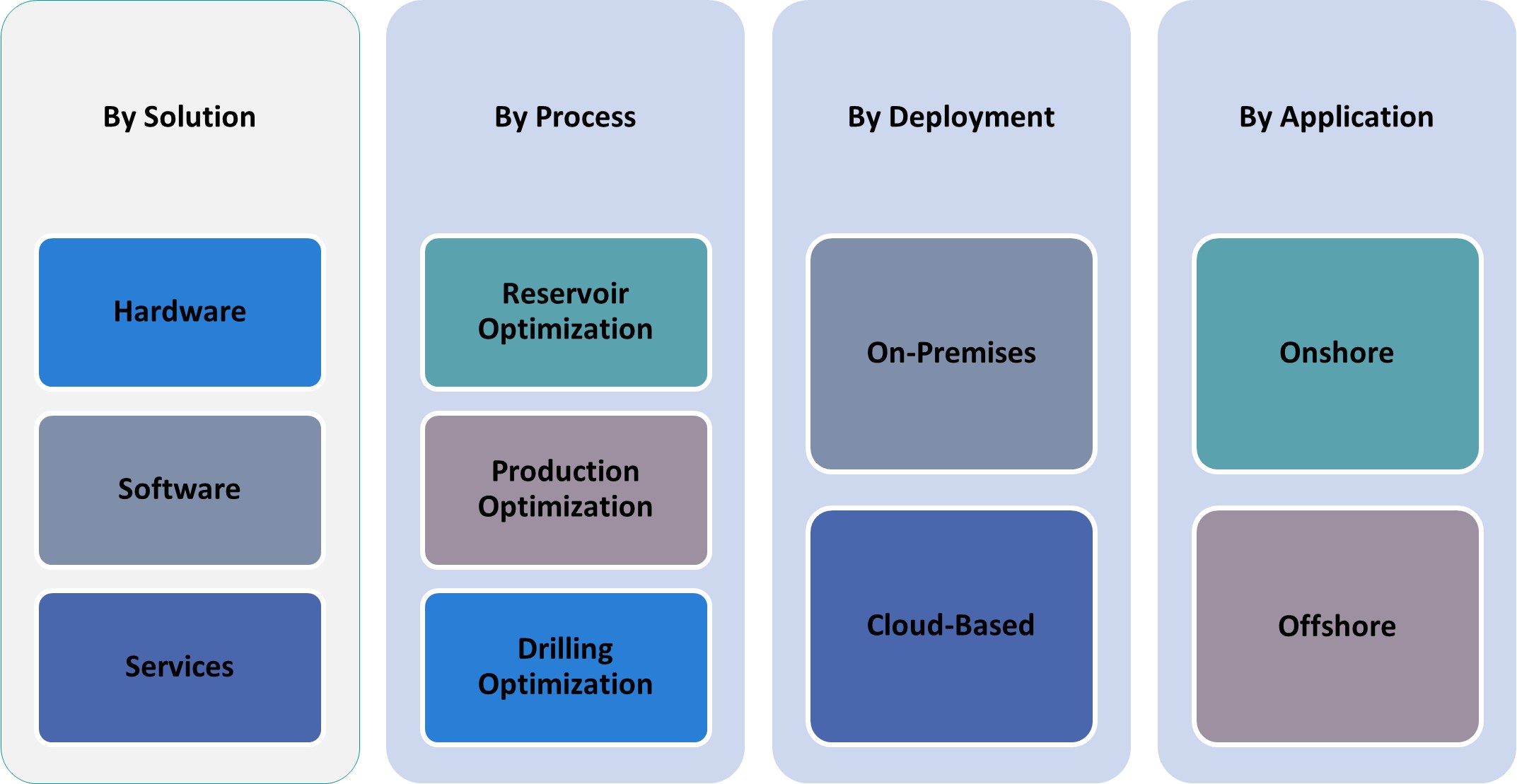
The market can be divided into three main solution types: Hardware, Software, and Services. Hardware solutions, which include sensors, controllers, and other physical devices, account for a significant share of the market due to the need for real-time monitoring and data acquisition in oilfields. These solutions are critical for gathering accurate data that supports decision-making in remote and harsh environments. Software solutions, such as AI-driven analytics, automation systems, and digital twin technologies, are rapidly gaining traction. These technologies enable better data analysis, improved operational efficiency, and optimization of production processes. Services include consulting, system integration, and maintenance, which are essential for ensuring that digital solutions are effectively implemented and maintained across oilfields.
By Application
The market is segmented by application into onshore and offshore operations. Onshore applications dominate the Saudi market due to the large number of onshore oilfields in the country. Onshore operations benefit significantly from digital oilfield solutions that improve operational efficiency, reduce maintenance costs, and enhance safety in more accessible environments. Offshore operations, while smaller in comparison, are growing steadily due to the increasing demand for deeper exploration and production capabilities. Offshore digital solutions are crucial for managing complex and remote oilfield operations, where advanced monitoring, automation, and real-time data analytics are essential for maximizing production and ensuring safety.
Segments
Based on Solution
- Hardware
- Software
- Services
Based on Application
- Onshore
- Offshore
Based on Process
- Reservoir Optimization
- Production Optimization
- Drilling Optimization
Based on Deployment
- On-Premises
- Cloud-Based
Based on Region
- Central Region
- Eastern Region
- Western Region
- Southern Region
Regional Analysis
Central Region (35%)
The Central Region of Saudi Arabia holds a significant share of the Digital Oilfield Solutions Market due to its proximity to Riyadh, the capital, and other major industrial hubs. This region is home to several oilfields operated by Saudi Aramco and other key industry players. Riyadh's strategic importance in driving technological advancements and government-led initiatives contributes to the region's dominance in the digital oilfield sector. The Central Region’s market growth is further supported by government programs under Vision 2030, which aim to modernize the oil and gas industry and encourage the adoption of digital solutions to optimize operations. As such, the Central region accounts for around 35% of the overall market share in Saudi Arabia.
Eastern Region (45%)
The Eastern Region is the largest contributor to the market, commanding approximately 45% of the market share. This region houses the bulk of Saudi Arabia's oil reserves, with key fields like the Ghawar and Safaniya fields located here. The Eastern Region is critical to the country’s oil production and exploration activities, making it the primary driver of demand for digital oilfield solutions. The increasing adoption of IoT, big data analytics, and AI-powered systems for real-time monitoring and operational optimization is significantly boosting the digital transformation of oilfield operations in this region. Moreover, the region's proximity to key infrastructure and the presence of large-scale refineries and production facilities further propel its share of the market.
Key players
- Schlumberger Limited
- Halliburton Company
- Baker Hughes Company
- Weatherford International plc
- Siemens AG
- Honeywell International Inc.
- Yokogawa Electric Corporation
- ABB Ltd.
- Emerson Electric Co.
- IBM Corporation
Competitive Analysis
The Saudi Arabia Digital Oilfield Solutions Market is highly competitive, with several global leaders playing a significant role in shaping market dynamics. Schlumberger, Halliburton, and Baker Hughes are the dominant players, offering comprehensive digital solutions ranging from IoT and AI-based tools to advanced data analytics platforms. These companies have established a strong presence due to their vast technological expertise, global reach, and ongoing investments in R&D. Siemens, Honeywell, and Yokogawa are also significant competitors, focusing on automation, control systems, and digitalization services that enhance operational efficiency. While larger players like Schlumberger and Halliburton lead in terms of market share, newer entrants such as IBM Corporation are increasingly making strides with innovative cloud-based solutions and AI applications. The competition revolves around technological advancements, integrated service offerings, and the ability to address the specific needs of the Saudi market, with a strong emphasis on reducing costs, optimizing production, and enhancing sustainability.
Recent Developments
- In March 2025, Schneider Electric unveiled the One Digital Grid Platform, an AI-powered platform designed to enhance grid resiliency and efficiency. This platform is set to be available later in 2025. The company announced a $700 million investment plan in the U.S. to enhance energy infrastructure and AI capabilities.
- In April 2025, ABB India delivered integrated automation and digital solutions for IndianOil's cross-country pipeline network, enhancing efficiency and safety through real-time monitoring and robust cybersecurity.
- In March 2025, Kongsberg Digital participated in the IPTC 2025, focusing on digital transformation in the oil and gas sector.
- In January 2025, SAP S/4HANA Cloud was highlighted as a key enabler for a smarter, more efficient energy ecosystem in the oil and gas industry.
- In April 2025, Schlumberger (SLB) announced a partnership with Shell to deploy Petrel™ subsurface software across Shell's global assets. This collaboration aims to enhance digital capabilities and operational efficiencies through advanced AI-driven seismic interpretation workflows. This development underscores SLB's ongoing commitment to advancing subsurface digital technology and fostering strategic partnerships in the energy sector.
Market Concentration and Characteristics
The Saudi Arabia Digital Oilfield Solutions Market is moderately concentrated, with a few key players such as Schlumberger, Halliburton, Baker Hughes, and Weatherford dominating the majority of the market share. These major players hold a competitive advantage due to their extensive technological expertise, established customer relationships, and significant investment in research and development. However, the market also offers opportunities for smaller, niche players to innovate and capture market share, especially through specialized solutions in AI, IoT, and data analytics. The market is characterized by a high degree of technological evolution, as companies continuously enhance their product portfolios with cutting-edge solutions to improve operational efficiency, reduce costs, and optimize oilfield production. With increasing government support under Vision 2030 and the ongoing digital transformation of the oil and gas sector, the market is expected to see both consolidation among major players and growth in the adoption of innovative technologies.
Report Coverage
The research report offers an in-depth analysis based on Solution, Application, Process, Deployment and Region. It details leading market players, providing an overview of their business, product offerings, investments, revenue streams, and key applications. Additionally, the report includes insights into the competitive environment, SWOT analysis, current market trends, as well as the primary drivers and constraints. Furthermore, it discusses various factors that have driven market expansion in recent years. The report also explores market dynamics, regulatory scenarios, and technological advancements that are shaping the industry. It assesses the impact of external factors and global economic changes on market growth. Lastly, it provides strategic recommendations for new entrants and established companies to navigate the complexities of the market.
Future Outlook
- The integration of AI and Machine Learning will continue to grow, enabling more accurate predictive maintenance and operational optimization. These technologies will drive efficiency and reduce downtime in oilfield operations.
- The market will see a significant rise in smart oilfield technologies that use real-time data analytics, automation, and IoT to optimize production processes. This will enhance operational efficiency and sustainability.
- With the continued push for modernization under Vision 2030, the Saudi government will incentivize digital solutions adoption to improve the productivity and sustainability of the oil sector. Increased funding and initiatives will encourage further adoption.
- The demand for cloud-based solutions will rise as companies seek flexible, scalable platforms for data storage, management, and analytics. Cloud platforms will enable better integration across oilfield operations.
- The Saudi oil and gas sector will focus more on sustainable operations by adopting digital solutions that reduce environmental impact. Digital oilfield solutions will play a key role in enhancing resource management and minimizing waste.
- As offshore oil production increases, the demand for digital solutions tailored for offshore environments will grow. Advanced technologies will help optimize operations and improve safety in remote offshore locations.
- Big data analytics will become integral to decision-making processes, enabling oil companies to gain deeper insights into reservoir management, production performance, and equipment health. This will enhance productivity.
- Automation technologies will dominate the market, with more oilfields adopting automated systems for drilling, monitoring, and production. This will reduce human intervention, enhance precision, and increase operational safety.
- Strategic partnerships between technology providers and oil companies will increase to deliver integrated, end-to-end solutions. Collaborative efforts will accelerate the development and deployment of innovative digital solutions.
- International players will continue to expand their operations in Saudi Arabia, seeking to capitalize on the market’s growth potential. Competition will intensify, driving innovation and improved offerings in digital oilfield solutions.

Request a Free Sample
Fill in your details and we'll send you a free sample report.
- Sample data tables & charts
- Research methodology
Need a Custom Version of This Report?
Tailor the scope, geography, or segments to your exact requirements.
- Custom geography or segment scope
- Direct access to our analyst team
Frequently Asked Questions
What is the market size of the Saudi Arabia Digital Oilfield Solutions Market in 2023 and 2032?
What are the main drivers of the Saudi Arabia Digital Oilfield Solutions Market?
Which companies are key players in the Saudi Arabia Digital Oilfield Solutions Market?
What role does AI and big data analytics play in the market?
Table of Content
Chapter 1. Report Introduction
- 1.1 Report Description & Purpose
- 1.1.1 Report Title & Market Definition
- 1.1.2 Unique Selling Propositions (USP) & Key Differentiators
- 1.1.3 Value Proposition for Stakeholders
- 1.2 Research Objectives
- 1.2.1 Market Sizing Objectives (Volume & Revenue) (Volume Where Applicable)
- 1.2.2 Segmentation Objectives
- 1.2.3 Competitive Intelligence Objectives
- 1.2.4 Forecast & Scenario Objectives
- 1.3 Report Scope
- 1.3.1 Saudi Arabia Digital Oilfield Solutions Scope – Segments & Subsegments Covered
- 1.3.2 Geographic Scope – Selected Country & Subnational Markets Covered
- 1.3.3 Historical Period, Base Year & Forecast Period (2024; forecast to 2032)
- 1.3.4 Inclusions & Exclusions
- 1.4 Industry Classification & Applicable Codes
- 1.5 Currency, Measurement Units & Valuation Basis
- 1.6 Target Stakeholders
- 1.7 Limitations & Assumptions
Chapter 2. Executive Summary
- 2.1 Saudi Arabia Digital Oilfield Solutions Snapshot
- 2.1.1 Market Size – Historical (2024) & Forecast (2024-2032) (2024: USD 78.70 million → 2032: USD 109.63 million)
- 2.1.2 Volume & Revenue – National Totals (Volume Where Applicable)
- 2.1.3 Key Market Highlights – Top Five Facts
- 2.2 Saudi Arabia Digital Oilfield Solutions Segmentation Snapshot
- 2.2.1 Market Split by Subnational Area – 2024 vs. 2032
- 2.3 Competitive Snapshot
- 2.3.1 Top 10 Players by Revenue Share – 2024
- 2.3.2 Top 10 Players by Volume Share – 2024 (Volume Where Applicable)
- 2.3.3 Recent Strategic Developments (18-Month Summary)
- 2.4 Key Investment Highlights & Strategic Conclusions
Chapter 3. Saudi Arabia Digital Oilfield Solutions Dynamics & Industry Analysis
- 3.1 Market Overview & Context
- 3.1.1 Saudi Arabia Digital Oilfield Solutions Position in the Broader Industry Value Chain
- 3.1.2 Demand Structure & Purchasing Dynamics
- 3.1.3 Market Maturity & Development Stage Across Domestic Markets
- 3.2 Saudi Arabia Digital Oilfield Solutions Drivers
- 3.3 Saudi Arabia Digital Oilfield Solutions Restraints & Challenges
- 3.4 Saudi Arabia Digital Oilfield Solutions Opportunities
- 3.5 Porter's Five Forces Analysis
- 3.5.1 Threat of New Entrants
- 3.5.2 Bargaining Power of Suppliers
- 3.5.3 Bargaining Power of Buyers
- 3.5.4 Threat of Substitutes
- 3.5.5 Competitive Rivalry – Intensity Assessment
- 3.6 Saudi Arabia Digital Oilfield Solutions Value Chain Analysis
- 3.6.1 Upstream – Key Inputs, Resources & Suppliers
- 3.6.1.1 Key Input/Resource 1
- 3.6.1.2 Key Input/Resource 2
- 3.6.1.3 Key Input/Resource 3
- 3.6.2 Midstream – Core Operations & Value Creation
- 3.6.2.1 Operating Model & Process Overview
- 3.6.2.2 Key Operating Locations & Capabilities by Company
- 3.6.3 Downstream – Market Channels & End Users
- 3.6.3.1 Direct Sales & Customer Engagement Channels
- 3.6.3.2 Indirect Sales, Intermediaries & Partner Channels
- 3.6.4 Value Chain Profitability Analysis
- 3.6.1 Upstream – Key Inputs, Resources & Suppliers
- 3.7 PESTEL Analysis
- 3.7.1 Political Factors
- 3.7.2 Economic Factors
- 3.7.3 Social Factors
- 3.7.4 Technological Factors
- 3.7.5 Environmental Factors
- 3.7.6 Legal Factors
- 3.8 Saudi Arabia Digital Oilfield Solutions Supply Chain Analysis
- 3.8.1 Critical Input & Resource Availability Risk Assessment
- 3.8.2 Supplier & Operational Concentration Risk (Geographic Exposure)
- 3.8.3 Supply & Service Disruption Impact Analysis
- 3.9 National & Subnational Regulatory Landscape
Note: The regulatory and policy landscape section covers regulations based on their applicability to the market, Saudi Arabia Digital Oilfield Solutions category, geography, and scope of the study. Only regulatory frameworks with a material impact on operations, compliance, trade, sustainability, or market access are analyzed in detail.
Chapter 4. Key Investment Pockets & Opportunity Analysis
- 4.1 Saudi Arabia Digital Oilfield Solutions Attractiveness Analysis
- 4.1.1 By Subnational Area – Investment Attractiveness Matrix (Market Size × CAGR)
- 4.2 Absolute Revenue Growth Opportunity
- 4.2.1 By Subnational Area – Absolute Revenue Growth Through 2032
- 4.3 Incremental Demand Opportunity
- 4.3.1 By Subnational Area – Incremental Demand Through 2032
- 4.3.2 Segment – Incremental Demand
- 4.4 Emerging Submarket Opportunity Deep Dive (Subject to Applicability)
- 4.5 Priority Domestic Market Opportunity Scorecards
- 4.5.1 Priority Domestic Market 1
- 4.5.2 Priority Domestic Market 2
- 4.5.3 Priority Domestic Market 3
- 4.5.4 Priority Domestic Market 4
Note: Domestic market scorecards cover relevant states, provinces, territories, cities, or economic zones within the selected country. Numbered entries are populated with market names suited to the national administrative structure and research scope. Geographic share tables use one consistent, nonoverlapping set of areas.
Chapter 5. Saudi Arabia Digital Oilfield Solutions Cross-Border Trade & Market Access Analysis
- 5.1 National Trade & International Partner Overview
- 5.1.1 Export Value by Destination Country (2024)
- 5.1.2 Export Volume by Destination Country (2024) (Where Applicable)
- 5.1.3 Import Value by Source Country (2024)
- 5.1.4 Import Volume by Source Country (2024) (Where Applicable)
- 5.1.5 National & Partner-Country Trade Balances (2024)
- 5.2 Export Analysis – Segment
- 5.2.1 Category 1 (Applicable Classification Code)
- 5.2.2 Category 2 (Applicable Classification Code)
- 5.2.3 Category 3 (Applicable Classification Code)
- 5.2.4 Category 4 (Applicable Classification Code)
- 5.2.5 Category 5 (Applicable Classification Code)
- 5.3 Import Analysis – Segment
- 5.3.1 Category 1 (Applicable Classification Code)
- 5.3.2 Category 2 (Applicable Classification Code)
- 5.3.3 Category 3 (Applicable Classification Code)
- 5.3.4 Category 4 (Applicable Classification Code)
- 5.3.5 Category 5 (Applicable Classification Code)
- 5.4 Cross-Border Pricing & Transaction Benchmarks
- 5.4.1 Export Pricing – Segment & Destination Country
- 5.4.2 Import Pricing – Segment & Source Country
- 5.4.3 Price Trends (2024)
- 5.5 Key Cross-Border Trade & Delivery Routes
- 5.5.1 Cross-Border Trade/Delivery Route 1
- 5.5.2 Cross-Border Trade/Delivery Route 2
- 5.5.3 Cross-Border Trade/Delivery Route 3
- 5.5.4 Cross-Border Trade/Delivery Route 4
- 5.5.5 Cross-Border Trade/Delivery Route 5
- 5.6 Trade Policy & Market Access Impact Assessment
- 5.6.1 Tariff & Non-Tariff Barriers
- 5.6.2 National Participation in Regional Trade & Economic Frameworks
- 5.6.3 Bilateral & Multilateral Trade Agreements
- 5.6.4 Cross-Border Operating, Licensing & Localization Requirements
Note: This chapter covers international trade relevant to Saudi Arabia Digital Oilfield Solutions in the selected country. Exports are analyzed by destination and imports by source. Domestic interregional flows are excluded from international trade totals. Goods, services, and digital offerings use applicable classifications; volume and route analyses apply only where meaningful.
Chapter 6. Competitive Landscape & Company Benchmarking
- 6.1 Saudi Arabia Digital Oilfield Solutions Concentration & Structure
- 6.1.1 Herfindahl-Hirschman Index (HHI) – vs. 2024
- 6.1.2 Leading, Mid-Sized & Emerging Player Structure
- 6.1.3 Multinational, National & Local Player Dynamics
- 6.2 Saudi Arabia Digital Oilfield Solutions Share Analysis – 2024
- 6.2.1 National Revenue Share by Company
- 6.2.2 National Volume Share by Company (Volume Where Applicable)
- 6.2.3 Company Revenue Share by Subnational Area
- 6.2.4 Market Share Evolution ( vs. 2024)
- 6.2.5 Company Market Share by Key Segment
- 6.2.6 Company Market Share by Customer Group
- 6.3 Operating Scale, Capacity & Infrastructure Analysis
- 6.3.1 National Operating Scale & Supply Capacity
- 6.3.2 Resource Utilization & Operating Efficiency
- 6.3.3 Output, Service Delivery & Activity Metrics
- 6.3.4 Operating Footprint & Infrastructure Map
- 6.3.5 Planned Operational & Capacity Expansion
- 6.4 Saudi Arabia Digital Oilfield Solutions Competitive Benchmarking Matrix
- 6.4.1 Revenue, Growth, Profitability & Operating Metric Comparison
- 6.4.2 Channel Revenue Mix
- 6.4.3 Revenue Exposure Across Domestic Markets
- 6.4.4 R&D Intensity
- 6.4.5 Sustainability Maturity
- 6.5 Strategic Developments in Saudi Arabia Digital Oilfield Solutions (Last 24 Months)
- 6.5.1 Mergers, Acquisitions & Divestments
- 6.5.2 New Products, Services & Solutions in Saudi Arabia Digital Oilfield Solutions
- 6.5.3 Operational & Infrastructure Expansions
- 6.5.4 Strategic Alliances, Joint Ventures & Partnerships
- 6.5.5 Distribution Expansion & Market Entry
- 6.5.6 Sustainability & ESG Initiatives
- 6.6 Competitive Strategy Mapping
- 6.6.1 Leader, Challenger, Follower & Niche Classification
- 6.6.2 Pricing Strategy Comparison
- 6.6.3 Channel Strategy Matrix
Note: Strategic developments are included based on their materiality and the availability of reliable information.
Chapter 7. Saudi Arabia Digital Oilfield Solutions – By Sales & Delivery Channel
- 7.1 Segment Overview
- 7.1.1 Volume & Revenue Split by Channel (2024 & 2032) (Volume Where Applicable)
- 7.1.2 Channel Mix Evolution (2024-2032)
Chapter 8. Subnational Market Analysis – Country Overview
- 8.1 Domestic Geographic Market Overview
- 8.1.1 Subnational Volume Share (Where Applicable)
- 8.1.2 Subnational Revenue Share
- 8.1.3 Market Volume by Subnational Area (Where Applicable)
- 8.1.4 Market Revenue by Subnational Area
- 8.1.5 Subnational Forecasts Through 2032
- 8.2 Cross-Area Segment Analysis Within the Country
- 8.2.1 By Sales & Delivery Channel
- 8.2.2 By Competitive Positioning & Price Tier
Chapter 9. Saudi Arabia Digital Oilfield Solutions – Priority Domestic Market 1
Chapter 10. Saudi Arabia Digital Oilfield Solutions – Priority Domestic Market 2
Chapter 11. Saudi Arabia Digital Oilfield Solutions – Priority Domestic Market 3
Chapter 12. Saudi Arabia Digital Oilfield Solutions – Priority Domestic Market 4
Chapter 13. Saudi Arabia Digital Oilfield Solutions Company Profiles
- 13.1 [Company 01]
- 13.1.1 Company Overview
- 13.1.2 Key Management Personnel
- 13.1.3 Products & Services Portfolio
- 13.1.4 Financial Performance
- 13.1.5 Domestic Market Focus & Local Operating Presence
- 13.1.6 Recent Developments & Strategic Initiatives
Note: The company profile list is preliminary and may change based on research findings, market developments, data availability, and client requirements.
Chapter 14. Appendices
- Appendix A – List of Abbreviations & Acronyms
- Appendix B – Industry Classification Code Reference – Full Series
- Appendix C – Supply, Output & Operating Capacity Data Tables
- Appendix D – End-Use & Demand Base Tables
- Appendix E – Demand, Adoption & Usage Assumptions
- Appendix F – Pricing & Revenue Metric Reference Tables
- Appendix G – Company Operations & Infrastructure Database
- Appendix H – Cross-Border Trade & Activity Data Tables (Where Applicable)
- Appendix I – Regulatory Summary Tables
- Appendix J – Primary Research Participant List (Anonymized)
- Appendix K – Primary Research Questionnaire Framework
- Appendix L – Data Sources & Bibliography
- Appendix M – Market Size Divergence & Source Comparison
Chapter 15. Research Methodology
- 15.1 Research Framework & Philosophy
- 15.2 Secondary Research – Sources, Hierarchy & Data Extraction
- 15.3 Data Modeling – National Market Sizing & Subnational Allocation
- 15.4 Primary Research – Stakeholder Framework, LOI & Sample Sizes
- 15.5 Forecast Methodology – Regression, Scenario & Sensitivity Analysis
- 15.6 Quality Control – Four-Layer Validation Framework
- 15.7 Limitations & Standard Assumptions
- 15.8 Disclaimer
