
| REPORT ATTRIBUTE | DETAILS |
|---|---|
| Historical Period | 2020-2023 |
| Base Year | 2024 |
| Forecast Period | 2025-2032 |
| Saudi Arabia Industrial Solvents Market Size 2024 | USD 86.95 Million |
| Saudi Arabia Industrial Solvents Market, CAGR | 4.23% |
| Saudi Arabia Industrial Solvents Market Size 2032 | USD 121.11 Million |
Market Overview
Saudi Arabia Industrial Solvents Market size was valued at USD 86.95 million in 2024 and is anticipated to reach USD 121.11 million by 2032, at a CAGR of 4.23% during the forecast period (2024-2032).
The Saudi Arabia industrial solvents market is driven by the growing demand for solvents in various sectors such as chemicals, paints, coatings, pharmaceuticals, and automotive. Increasing industrialization and the expansion of manufacturing activities in the region fuel this demand. Additionally, the shift toward environmentally friendly solvents and sustainable practices is encouraging the adoption of green solvents, enhancing market growth. The rise of the construction and automotive industries, coupled with advancements in the chemical manufacturing sector, further supports the market’s expansion. Government initiatives to diversify the economy and develop non-oil industries also contribute to the demand for industrial solvents. Key trends include the increasing use of bio-based solvents and the development of more efficient, low-toxicity alternatives that comply with stringent environmental regulations. The market is also benefiting from the growth of the pharmaceutical and cosmetics industries, which rely heavily on solvents for product formulations and manufacturing processes.
The Saudi Arabian industrial solvents market is geographically concentrated in key regions such as Riyadh, Jeddah, the Eastern Province, and other emerging areas. Riyadh, as the economic and industrial hub, leads in solvent demand, driven by expanding construction, automotive, and chemical sectors. Jeddah, with its strategic coastal location, is a major player in the solvents market, serving industries like packaging and printing. The Eastern Province, home to large petrochemical industries, plays a vital role due to its reliance on solvents for chemical and oil-based production. Additionally, smaller regions are witnessing growth in sectors like agriculture and food processing. Key players in the market include global giants such as Dow Inc., ExxonMobil Corporation, Eastman Chemical Company, and Huntsman Corporation. These companies provide a range of industrial solvents used across various industries, contributing significantly to the market's growth and innovation in Saudi Arabia.
Market Insights
- The Saudi Arabian industrial solvents market was valued at USD 86.95 million in 2024 and is expected to reach USD 121.11 million by 2032, growing at a CAGR of 4.23% from 2024 to 2032.
- The global industrial solvents market was valued at USD 34,660.50 million in 2024 and is expected to reach USD 60,647.79 million by 2032, growing at a CAGR of 7.24% during the forecast period (2024-2032).
- The market is driven by increasing demand from key sectors like chemicals, automotive, and construction, along with the rise of industrial activities.
- Environmental regulations are pushing the adoption of green and bio-based solvents, with a significant shift toward more eco-friendly alternatives.
- The growing pharmaceutical and healthcare sectors are contributing to the demand for high-purity solvents, particularly for drug formulation.
- Competitive pressure in the market is rising, with major global players like Dow Inc., ExxonMobil, and Eastman Chemical Company leading the market.
- Market restraints include fluctuating raw material prices and the challenges of transitioning to more sustainable solvent solutions.
- Riyadh, Jeddah, and the Eastern Province are key regions, with Riyadh being the leading hub for industrial solvent demand.
Report Scope
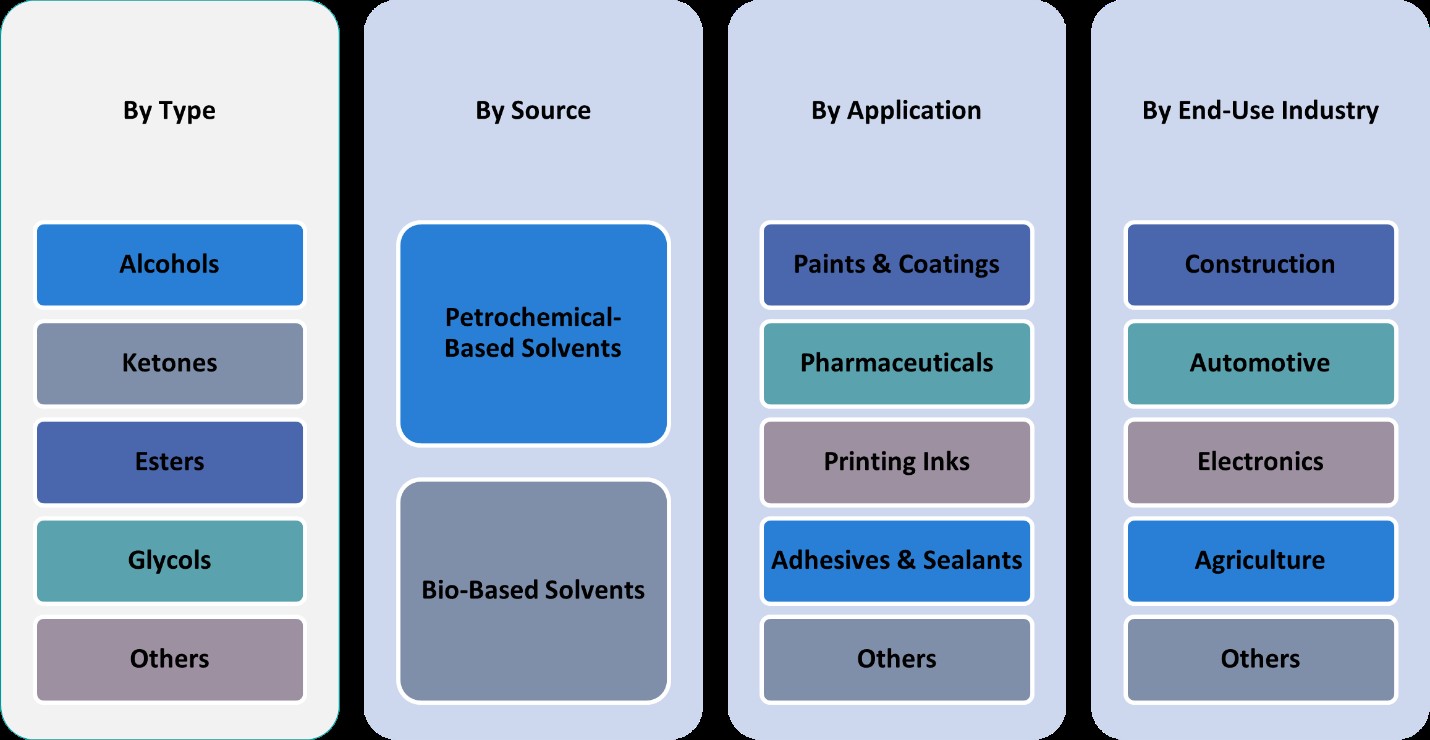
This report segments the Saudi Arabia Industrial Solvents market as follows:
Market Drivers
Growing Industrialization and Manufacturing Expansion
Saudi Arabia’s rapid industrialization and diversification efforts under Vision 2030 are major drivers of the industrial solvents market. The government's focus on transforming the country into a leading industrial hub has led to significant investments in sectors such as chemicals, petrochemicals, automotive, and construction. For instance, Saudi Arabia’s petrochemical production capacity is expected to double in the next five years, reinforcing its competitiveness as a global petrochemical leader. As these industries continue to expand, the demand for industrial solvents, which are essential in the production of paints, coatings, adhesives, and other chemical products, is increasing. The burgeoning manufacturing sector in Saudi Arabia necessitates the use of solvents for various industrial processes, further boosting market growth. This growth is particularly evident in the production of paints and coatings for infrastructure and construction projects, which require high volumes of solvents.
Environmental Regulations and the Shift to Green Solvents
The increasing focus on environmental sustainability and stringent government regulations on air quality and pollution are also driving the Saudi Arabia industrial solvents market. As global concerns over the environmental impact of volatile organic compounds (VOCs) intensify, there is a clear shift toward the adoption of eco-friendly or green solvents. Green solvents, which are derived from renewable resources and have lower toxicity and environmental impact, are gaining popularity in Saudi Arabia. The demand for bio-based and water-based solvents is increasing as industries are seeking alternatives to traditional, petrochemical-derived solvents. The adoption of green solvents aligns with Saudi Arabia’s long-term environmental goals and regulatory measures, providing both an economic and environmental incentive for industries to shift towards more sustainable practices.
Growth in the Construction and Automotive Sectors
The construction and automotive industries in Saudi Arabia are witnessing substantial growth, which is contributing to the demand for industrial solvents. The country’s aggressive infrastructure development projects, including residential, commercial, and industrial buildings, require significant quantities of paints, coatings, and adhesives, all of which depend on industrial solvents for formulation and application. For instance, Saudi Arabia’s automotive sector is undergoing a transformation, with the government aiming to establish 3-4 major car manufacturers and produce 400,000 vehicles annually by 2030. Additionally, the automotive sector’s expansion, driven by the increasing demand for vehicles and automotive refinishing products, further amplifies the need for solvents. As the automotive industry embraces more advanced coating techniques and finishes, the demand for high-performance solvents continues to rise. This growth in both sectors plays a pivotal role in the upward trajectory of the industrial solvents market in the region.
Advancements in the Chemical and Pharmaceutical Industries
Saudi Arabia’s chemical and pharmaceutical sectors are undergoing significant growth, which is bolstering the demand for industrial solvents. Solvents are crucial in the production of a wide range of pharmaceutical products, including tablets, creams, and injections, as they are used for dissolving active ingredients and enhancing formulation processes. With the increasing focus on healthcare and the development of the pharmaceutical industry in Saudi Arabia, driven by both local demand and export opportunities, the need for industrial solvents has grown. Similarly, advancements in the chemical sector, including the development of high-performance chemicals for various applications, continue to create opportunities for the solvent market. The growth of these sectors is not only sustaining existing demand but is also opening new avenues for innovation and product development in industrial solvents.
Market Trends
Surge in Green and Bio-Based Solvents
A prominent trend in the Saudi Arabian industrial solvents market is the growing demand for green and bio-based solvents. This shift is largely driven by increasing environmental awareness and tightening government regulations aimed at reducing industrial emissions and promoting sustainability. As industries in Saudi Arabia face rising pressure to reduce their environmental footprint, many are transitioning from traditional petrochemical-derived solvents to bio-based alternatives. These green solvents, such as ethanol, d-limonene, and bio-based acetone, offer several benefits, including lower toxicity, reduced volatility, and fewer emissions during production. The government's focus on sustainability, particularly through initiatives like Vision 2030, which emphasizes green technologies and sustainable industrial practices, is accelerating the adoption of these eco-friendly solvents. The demand for bio-based solvents is also spurred by consumer preferences for environmentally responsible products, particularly in industries like paints, coatings, and cleaning products, where solvent use is substantial.
Expansion of High Purity Solvents in Specialized Applications
Another key trend is the increasing demand for high-purity solvents, particularly in specialized sectors such as pharmaceuticals, biopharmaceuticals, and the chemical industry. High-purity solvents are critical in applications where precision and regulatory compliance are paramount, such as drug formulation and chemical analysis. As Saudi Arabia's pharmaceutical sector grows, driven by increased healthcare demands and the country's push to expand its domestic pharmaceutical manufacturing capacity, the need for ultra-pure solvents has surged. For instance, the Pharmaceuticals Export Promotion Council of India has highlighted Saudi Arabia’s regulatory framework and market growth, emphasizing the need for ultra-pure solvents in drug formulation and quality control. These solvents are essential for the production of high-quality pharmaceutical products, as they ensure the proper dissolution of active pharmaceutical ingredients and maintain the desired stability and efficacy of formulations. Additionally, the biopharmaceutical industry's growth, due to investments in research and development, is also driving the demand for these solvents. To meet this growing demand, manufacturers are increasingly turning to advanced purification technologies to produce ultra-pure solvents, ensuring that the solvents meet the stringent quality standards required by these highly regulated sectors.
Strategic Infrastructure Developments Supporting Market Growth
Strategic infrastructure developments in Saudi Arabia are providing a significant boost to the industrial solvents market. The government’s efforts to establish new industrial zones and economic cities, such as the King Salman International Complex for Maritime Industries and Services and Sudair Industrial City, are attracting investments and facilitating the growth of various manufacturing sectors. These zones are equipped with state-of-the-art facilities, advanced logistics, and easy access to raw materials, all of which are essential for solvent production. For instance, the Economic Cities and Special Zones Authority (ECZA) oversees these developments, ensuring that they provide a conducive environment for industrial growth. The availability of these resources and infrastructure encourages the establishment of solvent manufacturing plants and the expansion of related industries, such as paints, coatings, and chemicals, which heavily rely on solvents in their production processes. Furthermore, these industrial hubs create an environment conducive to research, development, and innovation, fostering the creation of more advanced solvent formulations and technologies.
Integration of Automation and Digitalization in Solvent Manufacturing
The integration of automation and digitalization is another significant trend shaping the Saudi Arabia industrial solvents market. With the growing demand for solvents and the pressure to meet both quality and regulatory standards, manufacturers are turning to advanced technologies to streamline production processes. Automation enables manufacturers to optimize production lines, enhance operational efficiency, and ensure better consistency in the quality of solvents produced. Furthermore, the adoption of digital technologies like data analytics, Internet of Things (IoT) devices, and artificial intelligence is enabling solvent manufacturers to monitor production processes in real-time, predict maintenance needs, and minimize downtime. These technologies not only enhance production efficiency but also contribute to cost savings and reduced environmental impact by minimizing waste and energy consumption. The move toward automation and digitalization is aligned with Saudi Arabia's Vision 2030, which promotes technological innovation and industrial modernization as part of the country’s diversification efforts.
Market Challenges Analysis
Regulatory Challenges and Environmental Concerns
One of the primary challenges facing the Saudi Arabian industrial solvents market is the growing complexity of environmental regulations. As the demand for solvents increases, particularly in high-volume industries like chemicals, paints, and coatings, the environmental impact of solvent production and use becomes a significant concern. Traditional petrochemical-derived solvents emit volatile organic compounds (VOCs), which contribute to air pollution and environmental degradation. In response, Saudi Arabia has implemented stricter environmental laws to curb emissions and encourage the adoption of greener practices. For instance, the Ministry of Environment, Water, and Agriculture has introduced Executive Regulations for Air Quality and Environmental Rehabilitation of Degraded Sites, aiming to reduce industrial pollution and promote sustainable practices. However, compliance with these regulations requires substantial investment in advanced technologies and infrastructure to reduce the environmental footprint of solvent production. Furthermore, the transition to bio-based and low-toxicity solvents, while beneficial, presents challenges in terms of cost, production scalability, and performance, making it a difficult shift for some manufacturers to undertake. Navigating these regulatory and environmental hurdles while maintaining profitability remains a key challenge for the market.
Supply Chain and Raw Material Availability
Another significant challenge for the Saudi Arabian industrial solvents market is the volatility in the availability and cost of raw materials. The majority of industrial solvents are derived from petrochemicals, and fluctuations in global oil prices can directly impact the cost of production. The reliance on imported raw materials for certain solvent formulations further exposes manufacturers to supply chain disruptions, particularly in the face of global economic uncertainties or geopolitical tensions. In addition, the development of bio-based solvents, while gaining traction, is constrained by the limited availability of renewable feedstocks and the high production costs associated with them. These supply chain issues and raw material constraints can lead to increased production costs, pricing instability, and challenges in meeting growing market demand. Ensuring a stable supply of quality raw materials while controlling costs is a critical concern for the continued growth of the industrial solvents market in Saudi Arabia.
Market Opportunities
The Saudi Arabian industrial solvents market presents significant growth opportunities driven by the country’s ongoing industrialization and economic diversification efforts. With the government’s Vision 2030 initiative focusing on reducing the economy’s dependency on oil, the expansion of sectors such as chemicals, pharmaceuticals, automotive, and construction is accelerating the demand for industrial solvents. As the manufacturing sector grows, particularly in the production of paints, coatings, adhesives, and cleaning products, there is an increasing need for solvents in various industrial applications. This presents a lucrative opportunity for solvent manufacturers to capitalize on the expanding demand in both traditional and emerging industries. Additionally, the government's push toward sustainability opens up opportunities for the development and adoption of green and bio-based solvents, catering to both environmental concerns and consumer preferences for eco-friendly products.
Furthermore, Saudi Arabia’s pharmaceutical and healthcare sectors offer substantial growth potential for the industrial solvents market. With rising healthcare demands and efforts to build a robust domestic pharmaceutical industry, the need for high-purity solvents, essential in drug formulation and production, is increasing. As the country invests in local pharmaceutical manufacturing and research, solvent suppliers can cater to this growing demand for specialized products. Additionally, the development of advanced manufacturing technologies and automation in solvent production offers opportunities for increased efficiency and product innovation. These advancements can drive down production costs while enhancing product quality, enabling manufacturers to meet the evolving demands of the market more effectively. By aligning with the trends of sustainable development and industrial modernization, the industrial solvents market in Saudi Arabia is poised for significant growth in the coming years.
Market Segmentation Analysis:
By Type:
The Saudi Arabian industrial solvents market is primarily segmented by type into alcohols, ketones, esters, glycols, and others. Among these, alcohols are the leading segment due to their versatility and widespread use in various applications, including paints and coatings, cleaning agents, and pharmaceuticals. Alcohols, particularly ethanol and isopropyl alcohol, are favored for their relatively low toxicity and ability to dissolve a wide range of substances. Ketones, such as acetone and methyl ethyl ketone (MEK), are also significant, especially in applications like paints, coatings, and adhesives, where their fast evaporation rate and excellent solvent properties are highly valued. Esters, including ethyl acetate and butyl acetate, are extensively used in the production of coatings, adhesives, and printing inks due to their favorable solvent power and low volatility. Glycols, such as ethylene glycol, are crucial in industrial applications where lower volatility and better solvency are required. The “others” segment, which includes solvents like toluene and xylene, plays a key role in industrial processes, particularly in chemical manufacturing and automotive industries.
By Application:
The industrial solvents market in Saudi Arabia is also analyzed based on application, with key segments including paints & coatings, pharmaceuticals, printing inks, adhesives & sealants, and others. The paints & coatings segment holds the largest market share, driven by rapid industrialization and infrastructure development in the country. The demand for high-quality paints and coatings for construction and automotive industries is a significant driver. The pharmaceuticals segment is another key application area, with solvents playing an essential role in drug formulation, particularly in the production of oral and injectable medicines. As the pharmaceutical sector in Saudi Arabia continues to expand, the demand for high-purity solvents is expected to grow. The printing inks segment is also expanding due to the growing packaging and printing industry, which heavily relies on solvents for ink formulation. Additionally, the adhesives & sealants segment is experiencing growth, driven by increased demand in construction and automotive industries. Other applications include cleaning products, agrochemicals, and personal care products, which are also contributing to market expansion.
Segments:
Based on Type:
- Alcohols
- Ketones
- Esters
- Glycols
- Others
Based on Application:
- Paints & Coatings
- Pharmaceuticals
- Printing Inks
- Adhesives & Sealants
- Others
Based on End- Use:
- Construction
- Automotive
- Electronics
- Agriculture
- Others
Based on Source:
- Petrochemical-Based Solvents
- Bio-Based Solvents
Based on the Geography:
- Riyadh
- Jeddah
- Eastern Province
- Other Regions
Regional Analysis
Riyadh
Riyadh, the capital and economic center of Saudi Arabia, holds the largest market share of approximately 35%. As the hub for government and business operations, Riyadh houses numerous industrial sectors that demand industrial solvents, particularly in the construction, chemicals, and automotive industries. The city's continued development, driven by both public and private sector investments, ensures that the demand for solvents will remain strong. The presence of various industries, including paints, coatings, and pharmaceuticals, further supports the market’s growth in this region.
Jeddah
Jeddah, the second-largest market in Saudi Arabia for industrial solvents, accounts for roughly 25% of the market share. Located on the Red Sea coast, Jeddah serves as a key commercial and logistics center for the country. Its strategic position as the gateway to the Holy City of Mecca also contributes to its economic importance. The industrial sectors in Jeddah, such as packaging, printing, and paints, are growing rapidly, driven by the expansion of the city's infrastructure and the increasing demand for consumer goods and automotive products. Additionally, Jeddah’s proximity to international shipping routes facilitates the import and export of raw materials, further boosting the market for solvents in the region.
Eastern Province
The Eastern Province, which includes industrial cities like Dammam, Jubail, and Khobar, holds about 20% of the Saudi Arabian industrial solvents market share. This region is the industrial powerhouse of the country, home to major petrochemical and chemical manufacturing plants. The Eastern Province is crucial for the production of a wide range of chemicals, including solvents used in the oil and gas sector, petrochemicals, and large-scale industrial processes. The continued growth of petrochemical industries and ongoing investments in infrastructure and industrial facilities in the Eastern Province are key drivers for solvent demand in this region.
Other regions
Other regions of Saudi Arabia, including smaller cities and rural areas, account for the remaining 20% of the market share. While these regions may not have the same level of industrialization as Riyadh, Jeddah, or the Eastern Province, they are witnessing growth in sectors such as agriculture, food processing, and small-scale manufacturing. As the government continues to push for regional development and economic diversification, the demand for industrial solvents in these areas is expected to rise steadily. Additionally, the expanding retail sector and local consumer markets contribute to the increasing demand for cleaning products and personal care items, further driving the growth of the solvents market in these regions.
Key Player Analysis
- Dow Inc.
- ExxonMobil Corporation
- Eastman Chemical Company
- Ashland Saudi Arabia Holdings Inc.
- Huntsman Corporation
- LyondellBasell Industries
- Celanese Corporation
- PPG Industries, Inc.
- Chevron Phillips Chemical Company
- DuPont de Nemours, Inc.
Competitive Analysis
The competitive landscape of the Saudi Arabian industrial solvents market is dominated by several key global players who have a significant presence in the region. Leading companies include Dow Inc., ExxonMobil Corporation, Eastman Chemical Company, Ashland Saudi Arabia Holdings Inc., Huntsman Corporation, LyondellBasell Industries, Celanese Corporation, PPG Industries, Inc., Chevron Phillips Chemical Company, and DuPont de Nemours, Inc. These companies are well-established in the global chemical industry and offer a wide range of industrial solvents used across multiple sectors, including paints, coatings, pharmaceuticals, and chemicals. The market is highly competitive, with players emphasizing product quality, customer relationships, and efficient supply chains to differentiate themselves. Strategic partnerships and collaborations with other industry leaders are also common as companies seek to enhance their capabilities in response to evolving market needs. Technological advancements in solvent production, such as automation, digitalization, and the development of high-purity solvents, are shaping the competitive dynamics. Companies that can efficiently leverage these technologies are able to reduce production costs and improve product consistency, giving them a competitive advantage. Additionally, the increasing emphasis on regulatory compliance and the shift toward greener alternatives is prompting businesses to innovate continuously. Price sensitivity remains a significant factor in the competition, with companies balancing cost-efficient production with high-quality outputs. The market’s competitiveness is also influenced by the geographical spread of players, with key regions like Riyadh, Jeddah, and the Eastern Province seeing heightened competition due to their industrial growth and strategic importance. The companies that can adapt to regional market demands, regulatory requirements, and sustainability goals are likely to maintain a strong position in the market.
Recent Developments
- In April 2025, Eastman announced off-list price increases for several EOD (Ethylene Oxide Derivatives) solvents, including Eastman™ DB Solvent, effective April 7, 2025, reflecting ongoing cost and market pressures.
- In March 2025, BASF reported generating approximately €11 billion in 2024 sales from products launched in the past five years, driven by R&D focused on sustainability, biodegradable materials, and digital transformation. The company filed 1,159 new patents in 2024, with 45% targeting sustainability. R&D investment in 2024 was €2.1 billion, with a similar budget planned for 2025.
- In March and April 2025, Shell is restructuring its global chemicals business to boost profitability and reduce capital spending by 2030. This includes exploring strategic partnerships in the U.S., potentially closing some European assets, and selling existing assets like the Singapore refinery and chemical complex. The company aims to streamline operations, focus on core businesses, and improve returns for shareholders.
- In March 2025, BASF is expanding its production capacity for aminic antioxidants at its Puebla, Mexico site, targeting the growing demand for long-life lubricants. The project is set for completion in 2026.
- In March 2025, ExxonMobil announced a $100 million upgrade to its Baton Rouge, Louisiana plant to produce ultra-high-purity (99.999%) isopropyl alcohol (IPA) for the semiconductor industry by 2027.
- In March 2024, Dow announced plans to invest in new ethylene derivatives capacity-including carbonate solvents-on the U.S. Gulf Coast. This investment, supported by the U.S. Department of Energy, aims to supply carbonate solvents for lithium-ion batteries, supporting the domestic EV and energy storage market. The facility will capture over 90% of CO₂ from ethylene oxide production, aligning with sustainability goals.
Market Concentration & Characteristics
The Saudi Arabian industrial solvents market exhibits moderate to high market concentration, with a few dominant players supplying a significant portion of the total demand. The market is characterized by the presence of well-established global manufacturers alongside a growing base of regional suppliers. These companies maintain strong distribution networks, diverse product portfolios, and advanced production capabilities, enabling them to serve various end-use sectors such as paints and coatings, pharmaceuticals, and adhesives. The market is highly quality-driven, with customers placing strong emphasis on product performance, compliance with safety standards, and environmental sustainability. In response to increasing regulatory pressures and evolving industrial needs, manufacturers are focusing on innovation, particularly in the development of bio-based and low-VOC solvent solutions. Additionally, the market demonstrates a shift toward integrated supply chains and localized production strategies to enhance responsiveness and reduce dependency on imports. Overall, the Saudi industrial solvents market is mature yet dynamic, offering opportunities for efficiency and sustainable growth.
Report Coverage
The research report offers an in-depth analysis based on Type, Application, End-Use, Source and Geography. It details leading market players, providing an overview of their business, product offerings, investments, revenue streams, and key applications. Additionally, the report includes insights into the competitive environment, SWOT analysis, current market trends, as well as the primary drivers and constraints. Furthermore, it discusses various factors that have driven market expansion in recent years. The report also explores market dynamics, regulatory scenarios, and technological advancements that are shaping the industry. It assesses the impact of external factors and global economic changes on market growth. Lastly, it provides strategic recommendations for new entrants and established companies to navigate the complexities of the market.
Future Outlook
- The industrial solvents market in Saudi Arabia is expected to grow steadily, driven by industrial expansion and infrastructure projects.
- Demand for eco-friendly and bio-based solvents will rise due to stricter environmental regulations.
- Growth in the pharmaceutical and healthcare sectors will boost the need for high-purity solvents.
- The paints and coatings industry will continue to be a major consumer of industrial solvents.
- Technological advancements in solvent manufacturing will improve efficiency and product quality.
- Local production capacity is likely to increase to reduce reliance on imports and strengthen supply chains.
- Strategic partnerships and joint ventures will play a key role in market expansion.
- Continued investments in research and development will support innovation in solvent formulations.
- Market players will focus more on regulatory compliance and sustainable practices.
- Regional demand will rise across both major industrial hubs and emerging areas in Saudi Arabia.

Request a Free Sample
Fill in your details and we'll send you a free sample report.
- Sample data tables & charts
- Research methodology
Need a Custom Version of This Report?
Tailor the scope, geography, or segments to your exact requirements.
- Custom geography or segment scope
- Direct access to our analyst team
Frequently Asked Questions
What is the current size of the Saudi Arabia Industrial Solvents?
What factors are driving the growth of the Saudi Arabia Industrial Solvents?
What are the key segments within the Saudi Arabia Industrial Solvents?
What are some challenges faced by the Saudi Arabia Industrial Solvents?
Who are the major players in the Saudi Arabia Industrial Solvents?
Table of Content
Chapter 1. Report Introduction
- 1.1 Report Description & Purpose
- 1.1.1 Report Title & Market Definition
- 1.1.2 Unique Selling Propositions (USP) & Key Differentiators
- 1.1.3 Value Proposition for Stakeholders
- 1.2 Research Objectives
- 1.2.1 Market Sizing Objectives (Volume & Revenue) (Volume Where Applicable)
- 1.2.2 Segmentation Objectives
- 1.2.3 Competitive Intelligence Objectives
- 1.2.4 Forecast & Scenario Objectives
- 1.3 Report Scope
- 1.3.1 Saudi Arabia Industrial Solvents Scope – Segments & Subsegments Covered
- 1.3.2 Geographic Scope – Selected Region & Countries Covered
- 1.3.3 Historical Period, Base Year & Forecast Period (2024; forecast to 2032)
- 1.3.4 Inclusions & Exclusions
- 1.4 Industry Classification & Applicable Codes
- 1.5 Currency, Measurement Units & Valuation Basis
- 1.6 Target Stakeholders
- 1.7 Limitations & Assumptions
Chapter 2. Executive Summary
- 2.1 Saudi Arabia Industrial Solvents Snapshot
- 2.1.1 Market Size – Historical (2024) & Forecast (2024-2032) (2024: USD 86.95 million → 2032: USD 121.11 million)
- 2.1.2 Volume & Revenue – Regional Totals (Volume Where Applicable)
- 2.1.3 Key Market Highlights – Top Five Facts
- 2.2 Saudi Arabia Industrial Solvents Segmentation Snapshot
- 2.2.1 Market Split by Country – 2024 vs. 2032
- 2.3 Competitive Snapshot
- 2.3.1 Top 10 Players by Revenue Share – 2024
- 2.3.2 Top 10 Players by Volume Share – 2024 (Volume Where Applicable)
- 2.3.3 Recent Strategic Developments (18-Month Summary)
- 2.4 Key Investment Highlights & Strategic Conclusions
Chapter 3. Saudi Arabia Industrial Solvents Dynamics & Industry Analysis
- 3.1 Market Overview & Context
- 3.1.1 Saudi Arabia Industrial Solvents Position in the Broader Industry Value Chain
- 3.1.2 Demand Structure & Purchasing Dynamics
- 3.1.3 Market Maturity & Development Stage by Country
- 3.2 Saudi Arabia Industrial Solvents Drivers
- 3.3 Saudi Arabia Industrial Solvents Restraints & Challenges
- 3.4 Saudi Arabia Industrial Solvents Opportunities
- 3.5 Porter's Five Forces Analysis
- 3.5.1 Threat of New Entrants
- 3.5.2 Bargaining Power of Suppliers
- 3.5.3 Bargaining Power of Buyers
- 3.5.4 Threat of Substitutes
- 3.5.5 Competitive Rivalry – Intensity Assessment
- 3.6 Saudi Arabia Industrial Solvents Value Chain Analysis
- 3.6.1 Upstream – Key Inputs, Resources & Suppliers
- 3.6.1.1 Key Input/Resource 1
- 3.6.1.2 Key Input/Resource 2
- 3.6.1.3 Key Input/Resource 3
- 3.6.2 Midstream – Core Operations & Value Creation
- 3.6.2.1 Operating Model & Process Overview
- 3.6.2.2 Key Operating Locations & Capabilities by Company
- 3.6.3 Downstream – Market Channels & End Users
- 3.6.3.1 Direct Sales & Customer Engagement Channels
- 3.6.3.2 Indirect Sales, Intermediaries & Partner Channels
- 3.6.4 Value Chain Profitability Analysis
- 3.6.1 Upstream – Key Inputs, Resources & Suppliers
- 3.7 PESTEL Analysis
- 3.7.1 Political Factors
- 3.7.2 Economic Factors
- 3.7.3 Social Factors
- 3.7.4 Technological Factors
- 3.7.5 Environmental Factors
- 3.7.6 Legal Factors
- 3.8 Saudi Arabia Industrial Solvents Supply Chain Analysis
- 3.8.1 Critical Input & Resource Availability Risk Assessment
- 3.8.2 Supplier & Operational Concentration Risk (Geographic Exposure)
- 3.8.3 Supply & Service Disruption Impact Analysis
- 3.9 Regional & Country Regulatory Landscape
Note: The regulatory and policy landscape section covers regulations based on their applicability to the market, Saudi Arabia Industrial Solvents category, geography, and scope of the study. Only regulatory frameworks with a material impact on operations, compliance, trade, sustainability, or market access are analyzed in detail.
Chapter 4. Key Investment Pockets & Opportunity Analysis
- 4.1 Saudi Arabia Industrial Solvents Attractiveness Analysis
- 4.1.1 By Country – Investment Attractiveness Matrix (Market Size × CAGR)
- 4.2 Absolute Revenue Growth Opportunity
- 4.2.1 By Country – Absolute Revenue Growth Through 2032
- 4.3 Incremental Demand Opportunity
- 4.3.1 By Country – Incremental Demand Through 2032
- 4.3.2 Segment – Incremental Demand
- 4.4 Emerging Submarket Opportunity Deep Dive (Subject to Applicability)
- 4.5 Priority Country Opportunity Scorecards
- 4.5.1 Priority Country 1
- 4.5.2 Priority Country 2
- 4.5.3 Priority Country 3
- 4.5.4 Priority Country 4
Note: Priority countries are selected from within the region covered by the study. Numbered entries are indicative and are populated with relevant country names based on market size, growth potential, and strategic relevance.
Chapter 5. Saudi Arabia Industrial Solvents Cross-Border Trade & Market Access Analysis
- 5.1 Intra-Regional & Extra-Regional Trade Overview
- 5.1.1 Regional Export Value by Country (2024)
- 5.1.2 Regional Export Volume by Country (2024) (Volume Where Applicable)
- 5.1.3 Regional Import Value by Country (2024)
- 5.1.4 Regional Import Volume by Country (2024) (Volume Where Applicable)
- 5.1.5 Net Trade Balance by Country (2024)
- 5.2 Export Analysis – Segment
- 5.2.1 Category 1 (Applicable Classification Code)
- 5.2.2 Category 2 (Applicable Classification Code)
- 5.2.3 Category 3 (Applicable Classification Code)
- 5.2.4 Category 4 (Applicable Classification Code)
- 5.2.5 Category 5 (Applicable Classification Code)
- 5.3 Import Analysis – Segment
- 5.3.1 Category 1 (Applicable Classification Code)
- 5.3.2 Category 2 (Applicable Classification Code)
- 5.3.3 Category 3 (Applicable Classification Code)
- 5.3.4 Category 4 (Applicable Classification Code)
- 5.3.5 Category 5 (Applicable Classification Code)
- 5.4 Cross-Border Pricing & Transaction Benchmarks
- 5.4.1 Export Pricing – Segment & Country
- 5.4.2 Import Pricing – Segment & Source Country
- 5.4.3 Price Trends (2024)
- 5.5 Key Cross-Border Trade & Delivery Routes
- 5.5.1 Cross-Border Trade/Delivery Route 1
- 5.5.2 Cross-Border Trade/Delivery Route 2
- 5.5.3 Cross-Border Trade/Delivery Route 3
- 5.5.4 Cross-Border Trade/Delivery Route 4
- 5.5.5 Cross-Border Trade/Delivery Route 5
- 5.6 Trade Policy & Market Access Impact Assessment
- 5.6.1 Tariff & Non-Tariff Barriers
- 5.6.2 Regional Trade & Economic Integration Frameworks
- 5.6.3 Bilateral & Multilateral Trade Agreements
- 5.6.4 Cross-Border Operating, Licensing & Localization Requirements
Note: Cross-border analysis applies where relevant to Saudi Arabia Industrial Solvents. Country trade flows distinguish intra-regional activity from trade with markets outside the region. Regional external trade totals exclude intra-regional flows to avoid double counting. Classifications and transaction measures follow the market scope; volume and route analyses apply only where meaningful.
Chapter 6. Competitive Landscape & Company Benchmarking
- 6.1 Saudi Arabia Industrial Solvents Concentration & Structure
- 6.1.1 Herfindahl-Hirschman Index (HHI) – vs. 2024
- 6.1.2 Leading, Mid-Sized & Emerging Player Structure
- 6.1.3 Global, Regional & Local Player Dynamics
- 6.2 Saudi Arabia Industrial Solvents Share Analysis – 2024
- 6.2.1 Regional Revenue Share by Company
- 6.2.2 Regional Volume Share by Company (Volume Where Applicable)
- 6.2.3 Company Revenue Share by Country
- 6.2.4 Market Share Evolution ( vs. 2024)
- 6.2.5 Company Market Share by Key Segment
- 6.2.6 Company Market Share by Customer Group
- 6.3 Operating Scale, Capacity & Infrastructure Analysis
- 6.3.1 Regional Operating Scale & Supply Capacity
- 6.3.2 Resource Utilization & Operating Efficiency
- 6.3.3 Output, Service Delivery & Activity Metrics
- 6.3.4 Operating Footprint & Infrastructure Map
- 6.3.5 Planned Operational & Capacity Expansion
- 6.4 Saudi Arabia Industrial Solvents Competitive Benchmarking Matrix
- 6.4.1 Revenue, Growth, Profitability & Operating Metric Comparison
- 6.4.2 Channel Revenue Mix
- 6.4.3 Revenue Exposure by Country Within the Region
- 6.4.4 R&D Intensity
- 6.4.5 Sustainability Maturity
- 6.5 Strategic Developments in Saudi Arabia Industrial Solvents (Last 24 Months)
- 6.5.1 Mergers, Acquisitions & Divestments
- 6.5.2 New Products, Services & Solutions in Saudi Arabia Industrial Solvents
- 6.5.3 Operational & Infrastructure Expansions
- 6.5.4 Strategic Alliances, Joint Ventures & Partnerships
- 6.5.5 Distribution Expansion & Market Entry
- 6.5.6 Sustainability & ESG Initiatives
- 6.6 Competitive Strategy Mapping
- 6.6.1 Leader, Challenger, Follower & Niche Classification
- 6.6.2 Pricing Strategy Comparison
- 6.6.3 Channel Strategy Matrix
Note: Strategic developments are included based on their materiality and the availability of reliable information.
Chapter 7. Saudi Arabia Industrial Solvents – By Sales & Delivery Channel
- 7.1 Segment Overview
- 7.1.1 Volume & Revenue Split by Channel (2024 & 2032) (Volume Where Applicable)
- 7.1.2 Channel Mix Evolution (2024-2032)
Chapter 8. Country Market Analysis – Regional Overview
- 8.1 Country Market Overview Within the Region
- 8.1.1 Country Volume Share Within the Region (Where Applicable)
- 8.1.2 Country Revenue Share Within the Region
- 8.1.3 Market Volume by Country (Where Applicable)
- 8.1.4 Market Revenue by Country
- 8.1.5 Country Forecasts Through 2032
- 8.2 Cross-Country Segment Analysis
- 8.2.1 By Sales & Delivery Channel
- 8.2.2 By Competitive Positioning & Price Tier
Chapter 9. Saudi Arabia Industrial Solvents – Priority Country 1
Chapter 10. Saudi Arabia Industrial Solvents – Priority Country 2
Chapter 11. Saudi Arabia Industrial Solvents – Priority Country 3
Chapter 12. Saudi Arabia Industrial Solvents – Priority Country 4
Chapter 13. Saudi Arabia Industrial Solvents Company Profiles
- 13.1 [Company 01]
- 13.1.1 Company Overview
- 13.1.2 Key Management Personnel
- 13.1.3 Products & Services Portfolio
- 13.1.4 Financial Performance
- 13.1.5 Regional Market Focus & Country Presence
- 13.1.6 Recent Developments & Strategic Initiatives
Note: The company profile list is preliminary and may change based on research findings, market developments, data availability, and client requirements.
Chapter 14. Appendices
- Appendix A – List of Abbreviations & Acronyms
- Appendix B – Industry Classification Code Reference – Full Series
- Appendix C – Supply, Output & Operating Capacity Data Tables
- Appendix D – End-Use & Demand Base Tables
- Appendix E – Demand, Adoption & Usage Assumptions
- Appendix F – Pricing & Revenue Metric Reference Tables
- Appendix G – Company Operations & Infrastructure Database
- Appendix H – Cross-Border Trade & Activity Data Tables (Where Applicable)
- Appendix I – Regulatory Summary Tables
- Appendix J – Primary Research Participant List (Anonymized)
- Appendix K – Primary Research Questionnaire Framework
- Appendix L – Data Sources & Bibliography
- Appendix M – Market Size Divergence & Source Comparison
Chapter 15. Research Methodology
- 15.1 Research Framework & Philosophy
- 15.2 Secondary Research – Sources, Hierarchy & Data Extraction
- 15.3 Data Modeling – Country-Level Estimates & Regional Aggregation
- 15.4 Primary Research – Stakeholder Framework, LOI & Sample Sizes
- 15.5 Forecast Methodology – Regression, Scenario & Sensitivity Analysis
- 15.6 Quality Control – Four-Layer Validation Framework
- 15.7 Limitations & Standard Assumptions
- 15.8 Disclaimer
