Market Overview:
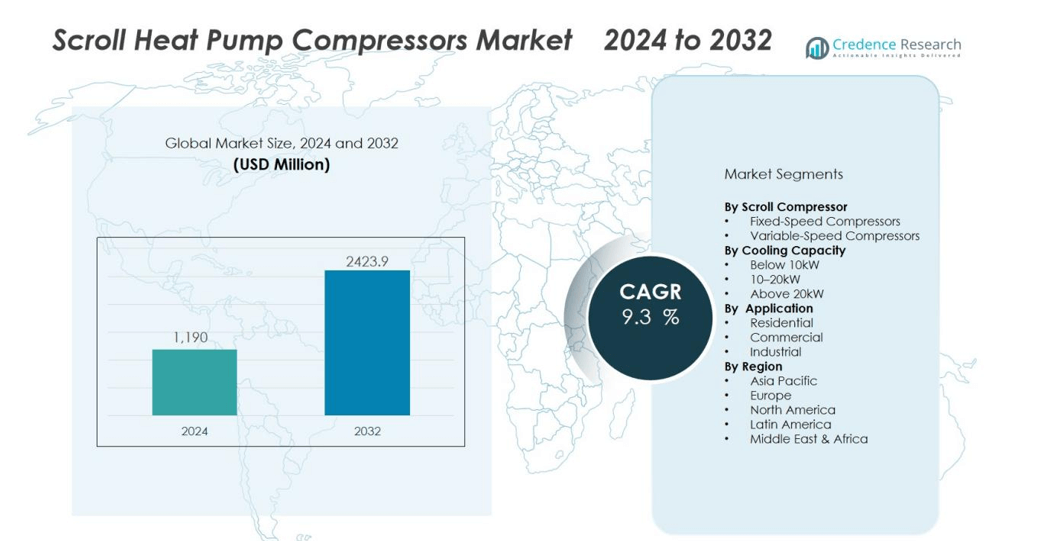
The scroll heat pump compressors market size was valued at USD 1,190 million in 2024 and is anticipated to reach USD 2423.9 million by 2032, at a CAGR of 9.3 % during the forecast period (2024-2032).
| REPORT ATTRIBUTE |
DETAILS |
| Historical Period |
2020-2023 |
| Base Year |
2024 |
| Forecast Period |
2025-2032 |
| Scroll Heat Pump Compressors Market Size 2024 |
USD 1,190 million |
| Scroll Heat Pump Compressors Market, CAGR |
9.3% |
| Scroll Heat Pump Compressors Market Size 2032 |
USD 2423.9 million |
Key drivers include the global shift toward energy conservation and reduced greenhouse gas emissions. The growing demand for space heating and cooling, coupled with the replacement of conventional compressors, accelerates adoption. Advancements in compressor design, such as improved efficiency, noise reduction, and longer operational life, also enhance market attractiveness. Supportive government incentives for renewable energy integration and eco-friendly systems further boost demand.
Regionally, Asia Pacific leads the market due to rapid urbanization, rising disposable incomes, and significant growth in construction activities. China, Japan, and South Korea remain key contributors, supported by large-scale manufacturing hubs. North America shows strong adoption of heat pump technology, driven by stricter environmental standards and energy efficiency regulations. Europe continues to expand, with increasing investments in sustainable heating solutions and strong uptake in residential retrofitting projects.
Market Insights:
- The scroll heat pump compressors market was valued at USD 1,190 million in 2024 and will reach USD 2,423.9 million by 2032.
- Rising demand for energy-efficient HVAC systems drives adoption across residential, commercial, and industrial sectors.
- Advancements in compressor design enhance efficiency, reduce noise, and extend operational life.
- Supportive government incentives and emission regulations encourage integration of renewable energy-based heating and cooling.
- Asia Pacific led with 42% market share in 2024, supported by urbanization and manufacturing strength.
- North America held 27% market share, driven by strict efficiency standards and retrofitting projects.
- Europe accounted for 21% market share, fueled by EU sustainability goals and residential retrofits.
Access crucial information at unmatched prices!
Request your sample report today & start making informed decisions powered by Credence Research Inc.!
Download Sample
Market Drivers:
Rising Demand for Energy-Efficient Heating and Cooling Solutions:
The scroll heat pump compressors market benefits from the growing preference for energy-efficient HVAC systems. Consumers and industries are focusing on lowering operational costs while meeting environmental targets. Governments promote adoption through tax incentives and energy-efficiency programs. It supports sustainability goals and accelerates the replacement of conventional compressor technologies.
- For example, Worx’s 4V cordless screwdriver features a USB-C fast charging port and selectable torque settings up to 44 in-lbs, making it ideal for varied tasks.
Expanding Adoption Across Residential and Commercial Sectors:
Wider application in residential housing and commercial infrastructure drives steady growth. Builders and property owners prefer systems that deliver reliable performance with reduced maintenance. The market meets demand by offering compact designs that fit diverse installations. It addresses comfort requirements while lowering carbon footprints for end users.
- For Instance, Daikin has sold approximately 58 million R-32 refrigerant mini-split systems globally. In total, approximately 370 million R-32 systems have been installed worldwide across all manufacturers.
Technological Advancements Enhancing Product Efficiency and Reliability:
Continuous innovation improves product reliability and user experience in the scroll heat pump compressors market. Features such as noise reduction, improved thermal efficiency, and longer service life strengthen competitiveness. Manufacturers invest in R&D to meet stricter environmental standards. It ensures consistent performance under varying load conditions while reducing energy consumption.
Supportive Policies and Focus on Carbon Emission Reduction:
Stringent regulations on emissions encourage industries and households to adopt sustainable technologies. The market gains from policies promoting renewable energy integration and eco-friendly heating solutions. Rising consumer awareness about climate change strengthens the shift toward low-carbon systems. It positions scroll heat pump compressors as a preferred choice for modern infrastructure.
Market Trends:
Growing Integration of Eco-Friendly Refrigerants and Sustainable Designs:
The scroll heat pump compressors market is witnessing a steady transition toward eco-friendly refrigerants that align with global climate regulations. Manufacturers are replacing high-GWP refrigerants with low-GWP alternatives to meet environmental standards. It strengthens long-term adoption by addressing regulatory compliance and consumer expectations for green technology. Sustainable product designs focus on minimizing lifecycle emissions and reducing power consumption. Companies highlight energy savings and enhanced performance to gain a competitive edge. Rising awareness of eco-conscious solutions encourages widespread adoption across both developed and emerging regions.
- For instance, Daikin has committed to R-32 across its Trailblazer AGZ-F scroll chillers and Maverick II rooftop units, contributing to over 280 million R-32 HVAC units installed worldwide.
Increasing Role of Smart Technologies and Advanced System Integration:
Smart control features and digital monitoring are becoming prominent in scroll heat pump compressors. The market emphasizes IoT-enabled solutions that improve operational efficiency through predictive maintenance and real-time performance tracking. It helps users optimize energy use while reducing downtime and repair costs. Manufacturers are also integrating variable speed technology to provide flexibility and improved load management. These innovations strengthen adoption in both residential and commercial applications. Growing demand for intelligent, connected HVAC systems positions the technology as a key element of future-ready infrastructure.
- For Instance, Johnson Controls’ Metasys® system employs real-time diagnostics and adaptive control algorithms to help foresee equipment anomalies, which is designed to reduce unplanned downtime for facilities.
Market Challenges Analysis:
High Initial Costs and Competitive Price Pressures:
The scroll heat pump compressors market faces challenges from high upfront costs that limit adoption in price-sensitive regions. Consumers in developing economies often prefer traditional systems due to lower initial investment. It creates barriers for wider deployment despite long-term energy savings. Intense competition among manufacturers also drives pricing pressures, reducing margins for suppliers. Smaller players find it difficult to balance affordability with quality improvements. Market growth requires strategies that lower installation costs and highlight clear value propositions for end users.
Technical Limitations and Dependence on Skilled Workforce:
Performance limitations under extreme temperatures restrict adoption in regions with very cold or hot climates. The market encounters setbacks when compressors fail to deliver consistent efficiency under varying conditions. It also depends on a skilled workforce for proper installation and maintenance, which remains unevenly distributed across regions. Lack of technical expertise leads to poor system performance and reduced consumer trust. Manufacturers must invest in training programs and technical support to overcome these barriers. Addressing these challenges is vital to strengthen the long-term competitiveness of the technology.
Market Opportunities:
Rising Demand for Renewable Energy Integration and Green Building Solutions:
The scroll heat pump compressors market holds strong opportunities through integration with renewable energy systems. Solar-assisted and geothermal heat pumps create demand for efficient compressors that support sustainability goals. It aligns with global initiatives promoting green buildings and net-zero energy projects. Developers and governments focus on energy-positive housing and infrastructure, driving wider adoption. Consumers seek technologies that lower energy bills while reducing emissions. Growing preference for eco-friendly housing provides a steady pipeline of opportunities for manufacturers.
Expansion Potential in Emerging Economies and Retrofitting Projects:
Emerging markets in Asia, Latin America, and Africa present untapped growth avenues for the technology. Rising urbanization and infrastructure development create demand for advanced HVAC solutions. The scroll heat pump compressors market can benefit from retrofitting projects in older buildings, where energy upgrades are gaining attention. It strengthens adoption in commercial and residential sectors aiming to improve efficiency. Government-backed incentives and financing programs further enhance market penetration. Expanding distribution networks and local manufacturing capabilities will help companies capture this opportunity.
Market Segmentation Analysis:
By Scroll Compressor:
The scroll heat pump compressors market includes fixed-speed and variable-speed compressors. Fixed-speed types dominate due to wide use in residential and small commercial systems. Variable-speed compressors gain momentum with their ability to deliver higher efficiency and better load management. It supports energy savings and longer operating life in advanced HVAC systems. Manufacturers emphasize compact design and durability to meet diverse installation needs.
- For instance, Copeland’s ZP series variable-speed scroll compressors feature a 900–7 200 rpm operating envelope, achieving a 26% reduction in cycling losses and a 16% increase in part-load efficiency compared to fixed-speed models.
By Application:
The market serves residential, commercial, and industrial applications with growing adoption across all three. Residential demand leads due to the need for efficient heating and cooling solutions in urban housing. Commercial applications expand with rising demand from offices, retail, and hospitality facilities. Industrial users adopt compressors for process cooling and large-scale climate control. It benefits from government incentives and stricter emission regulations that encourage sustainable adoption.
- For instance, Carrier’s Infinity 20 heat pump achieved a heating seasonal performance factor (HSPF) of 10.5.
By Cooling Capacity:
The scroll heat pump compressors market is segmented into below 10kW, 10–20kW, and above 20kW units. Below 10kW holds strong demand in residential use, supported by small-scale applications. Units in the 10–20kW range cater to commercial and mid-sized facilities requiring reliable efficiency. Above 20kW capacity serves industrial applications where high performance and consistent output are critical. It ensures flexibility by meeting diverse energy requirements across different end-user categories.
Segmentations:
By Scroll Compressor:
- Fixed-Speed Compressors
- Variable-Speed Compressors
By Application:
- Residential
- Commercial
- Industrial
By Cooling Capacity:
- Below 10kW
- 10–20kW
- Above 20kW
By Region:
- North America
- Europe
- UK
- France
- Germany
- Italy
- Spain
- Russia
- Belgium
- Netherlands
- Austria
- Sweden
- Poland
- Denmark
- Switzerland
- Rest of Europe
- Asia Pacific
- China
- Japan
- South Korea
- India
- Australia
- Thailand
- Indonesia
- Vietnam
- Malaysia
- Philippines
- Taiwan
- Rest of Asia Pacific
- Latin America
- Brazil
- Argentina
- Peru
- Chile
- Colombia
- Rest of Latin America
- Middle East
- UAE
- KSA
- Israel
- Turkey
- Iran
- Rest of Middle East
- Africa
- Egypt
- Nigeria
- Algeria
- Morocco
- Rest of Africa
Regional Analysis:
Asia Pacific :
Asia Pacific held 42% market share in the scroll heat pump compressors market in 2024. China, Japan, and South Korea remain leading contributors due to strong manufacturing bases and technology adoption. Rapid urbanization and expansion of residential and commercial infrastructure continue to drive demand. It benefits from government programs promoting energy-efficient HVAC systems and stricter emission targets. Local manufacturers invest in advanced designs to meet regional environmental standards. Rising disposable income also supports adoption across middle-class households.
North America:
North America accounted for 27% market share in 2024. The region benefits from strict energy efficiency regulations and federal incentives for sustainable heating solutions. The scroll heat pump compressors market grows steadily as residential retrofitting and commercial installations increase. It is supported by strong consumer awareness of climate-friendly technologies. U.S. manufacturers continue to invest in high-efficiency and low-emission compressor designs. Canada also shows rising demand due to cold climate applications where heat pumps improve energy savings.
Europe:
Europe held 21% market share in 2024, driven by strong policy frameworks and environmental commitments. Countries such as Germany, France, and the UK invest heavily in renewable energy integration within HVAC systems. The scroll heat pump compressors market benefits from large-scale residential retrofitting programs supported by EU sustainability goals. It also gains traction in commercial buildings adopting eco-friendly solutions to meet carbon reduction targets. Manufacturers in the region emphasize low-noise, high-efficiency systems tailored for dense urban areas. Government subsidies continue to support wider deployment across both households and industries.
Shape Your Report to Specific Countries or Regions & Enjoy 30% Off!
Key Player Analysis:
- Danfoss
- Emerson Electric Co
- BITZER
- Panasonic Industry Co. Ltd
- DAlKIN INDUSTRIESLtd.
- LG Electronics
- Samsung
- Mitsubishi Electric Corporation
- lnvoTech Scroll Technologies
Competitive Analysis:
The scroll heat pump compressors market is highly competitive with a mix of global leaders and regional players. Key participants include Danfoss, Emerson Electric Co., BITZER, Panasonic Industry Co. Ltd, Daikin Industries Ltd., LG Electronics, and Samsung. These companies focus on expanding product portfolios, enhancing efficiency, and meeting strict environmental regulations. It emphasizes innovation in eco-friendly refrigerants, variable-speed technology, and compact designs to strengthen competitiveness. Strategic alliances, R&D investments, and regional expansion remain common approaches to secure larger market presence. Players also compete on pricing strategies, customer support, and after-sales services to build long-term client relationships. The competitive landscape highlights strong commitment to sustainability and digital integration, driving differentiation across residential, commercial, and industrial applications.
Recent Developments:
- In Feb 2024, BITZER launched new models in its Orbit scroll compressor series designed for R290 (propane) refrigerant, and unveiled a redesigned CSHP compact screw compressor for use with propane (R290) and isobutane (R600a).
- In March 2025, Danfoss launched the EvoFlat 4.0 PRO flat station for heat pump integration and two new additions to the PICV portfolio, AB-QM 4.0 Flexo and AB-QM 4.0 CO6 Flexo, at ISH 2025.
- In March 2025, Emerson Electric Co completed its acquisition of all outstanding shares of Aspen Technology (AspenTech), turning AspenTech into a wholly owned subsidiary and significantly expanding its industrial software portfolio.
Report Coverage:
The research report offers an in-depth analysis based on Scroll Compressor, Application, Cooling Capacity and Region. It details leading Market players, providing an overview of their business, product offerings, investments, revenue streams, and key applications. Additionally, the report includes insights into the competitive environment, SWOT analysis, current Market trends, as well as the primary drivers and constraints. Furthermore, it discusses various factors that have driven Market expansion in recent years. The report also explores Market dynamics, regulatory scenarios, and technological advancements that are shaping the industry. It assesses the impact of external factors and global economic changes on Market growth. Lastly, it provides strategic recommendations for new entrants and established companies to navigate the complexities of the Market.
Future Outlook:
- The scroll heat pump compressors market will expand with rising demand for energy-efficient HVAC systems.
- Manufacturers will focus on eco-friendly refrigerants that align with global emission reduction targets.
- It will see stronger integration with renewable energy sources such as solar and geothermal systems.
- Smart controls and IoT-enabled monitoring will drive adoption in both residential and commercial sectors.
- Retrofitting of aging infrastructure will create consistent demand in developed economies.
- Emerging economies in Asia, Latin America, and Africa will open new growth avenues through urban development.
- Product innovations will emphasize noise reduction, durability, and higher seasonal efficiency ratings.
- Government policies supporting decarbonization will accelerate adoption across industrial and residential applications.
- Training programs and technical support will become vital to address skilled workforce shortages.
- Strategic collaborations between global and regional players will strengthen market penetration and product accessibility.



