
Market Overview
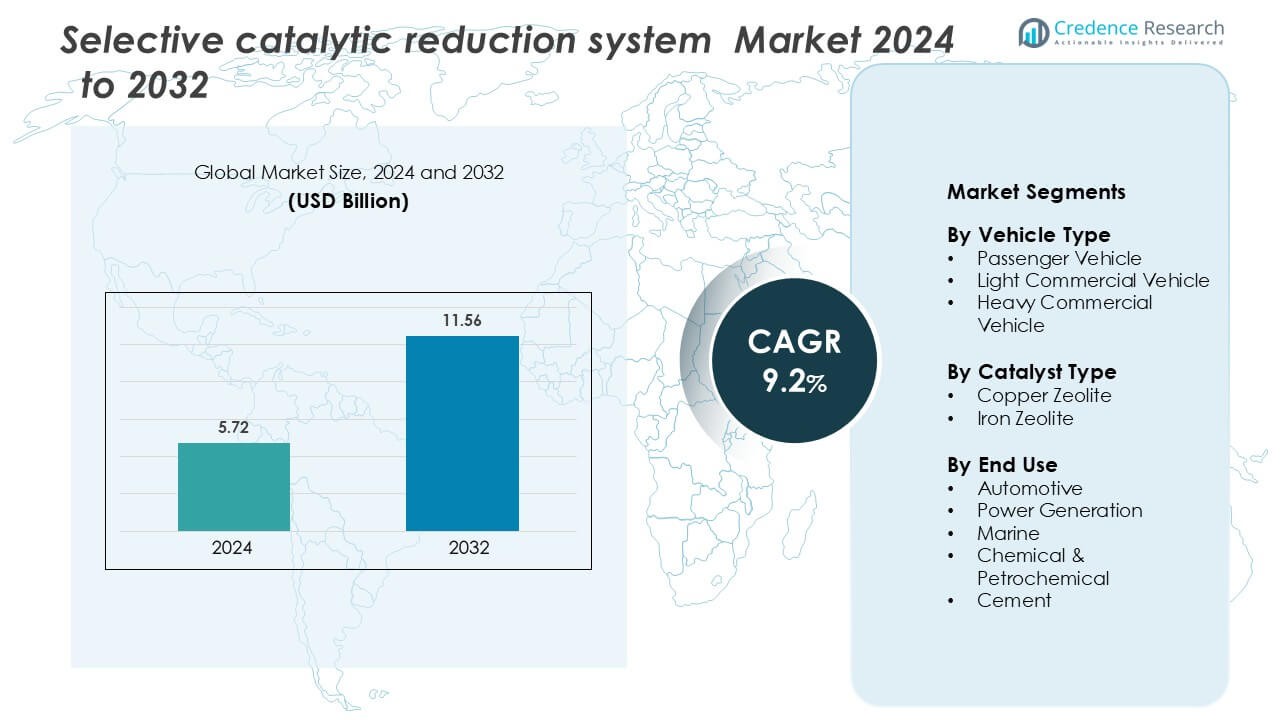
Selective catalytic reduction system market size was valued USD 5.72 billion in 2024 and is anticipated to reach USD 11.56 billion by 2032, at a CAGR of 9.2% during the forecast period.
| REPORT ATTRIBUTE | DETAILS |
|---|---|
| Historical Period | 2020-2023 |
| Base Year | 2024 |
| Forecast Period | 2025-2032 |
| Selective Catalytic Reduction (SCR) Market Size 2024 | USD 5.72 Billion |
| Selective Catalytic Reduction (SCR) Market, CAGR | 9.2% |
| Selective Catalytic Reduction (SCR) Market Size 2032 | USD 11.56 Billion |
The Selective Catalytic Reduction (SCR) System Market is dominated by leading players such as Johnson Matthey (U.K.), BOSCH (Germany), Cormetech (U.S.), Faurecia (France), Haldor Topsoe (Denmark), BASF (Germany), Bosal (Belgium), Envirotherm GmbH (Germany), Magneti Marelli SPA (Italy), and Ceram-Ibiden (Austria). These companies focus on developing high-efficiency catalysts, advanced dosing technologies, and lightweight system architectures to meet global emission standards. They invest heavily in R&D and strategic partnerships with OEMs to strengthen market positioning. Europe leads the global SCR system market with a 31% share, driven by stringent Euro VI regulations, robust automotive manufacturing infrastructure, and continuous innovation in emission control technologies across both passenger and commercial vehicle segments.
Market Insights
- The Selective Catalytic Reduction (SCR) System Market was valued at USD 5.72 billion in 2024 and is projected to reach USD 11.56 billion by 2032, growing at a CAGR of 9.2% during the forecast period.
- Rising emission regulations and growing adoption of diesel vehicles drive market growth, especially across heavy-duty transportation and industrial sectors.
- Technological advancements such as compact system design, smart urea dosing, and durable catalysts are shaping market trends.
- The market is highly competitive, with key players like Johnson Matthey, BOSCH, Faurecia, BASF, and Cormetech investing in R&D and expanding collaborations with OEMs to enhance emission control performance.
- Europe dominates with a 31% regional share due to strong environmental policies, while Asia-Pacific holds a 33% share driven by expanding automotive production; among segments, heavy commercial vehicles lead adoption, supported by high diesel usage and stricter compliance requirements in logistics and construction industries.
Market Segmentation Analysis:
By Vehicle Type
Heavy commercial vehicles dominate the Selective Catalytic Reduction (SCR) System Market with a major share, driven by stricter emission norms for diesel engines and increased freight transportation. These vehicles rely heavily on SCR technology to meet Euro VI and EPA standards while maintaining fuel efficiency. The demand for advanced NOx reduction systems has surged as logistics and construction sectors expand globally. Passenger and light commercial vehicles are also adopting compact SCR units to comply with regulatory targets, but heavy-duty trucks remain the key revenue contributor due to their higher diesel consumption and emission output.
- For instance, the Achates Power opposed-piston 10.6 L heavy-duty diesel engine project achieved a 90 % NOₓ reduction using SCR without a close-coupled light-off module.
By Catalyst Type
Copper zeolite catalysts hold the dominant market share in the SCR system segment due to their superior thermal stability and high efficiency in NOx reduction, especially under high-temperature diesel operations. Their enhanced durability and resistance to sulfur poisoning make them ideal for heavy-duty applications in commercial vehicles and industrial machinery. Iron zeolite catalysts, while cost-effective, find wider use in light vehicles and stationary systems operating at lower temperatures. The growing demand for fuel-efficient systems with lower ammonia slip continues to strengthen the adoption of copper-based catalysts across automotive and industrial sectors.
- For instance, the commercial Cu‑SSZ‑13 catalyst achieved over 90% NOₓ conversion at 300 °C under simulated diesel exhaust conditions.
By End Use
The automotive segment leads the SCR system market, supported by the large-scale deployment of emission control systems in diesel vehicles. Rising enforcement of stringent emission standards such as Euro VI and Bharat Stage VI drives widespread installation of SCR systems in passenger cars, buses, and trucks. Power generation and marine sectors also contribute significantly, integrating SCR units to reduce NOx from turbines and marine engines. The chemical and cement industries follow, where SCR technology helps meet industrial air quality mandates, ensuring compliance with environmental regulations while maintaining operational efficiency.
Key Growth Drivers
Rising Stringency of Emission Regulations
Stringent emission norms worldwide are the strongest catalyst for Selective Catalytic Reduction (SCR) system adoption. Governments across North America, Europe, and Asia-Pacific enforce standards such as Euro VI, EPA Tier 4, and Bharat Stage VI to curb nitrogen oxide (NOx) emissions from diesel engines. These regulations mandate advanced exhaust after-treatment solutions in commercial and passenger vehicles. Manufacturers are rapidly integrating SCR systems to comply without compromising performance. For instance, Cummins developed its Single Module™ SCR system to reduce NOx emissions by up to 90% while improving fuel efficiency. The enforcement of carbon-neutral transportation targets further amplifies SCR system demand in heavy-duty trucks, off-road machinery, and industrial engines.
- For instance, Cummins developed its Single Module™ aftertreatment system, which combines the DPF and SCR systems into a single unit. This system achieves high efficiency in emissions reduction, including over 99% particulate matter (PM) removal and up to a 96% conversion of NOₓ.
Expanding Commercial Vehicle Production and Freight Movement
The growing global logistics and construction industries are driving SCR demand due to the extensive use of diesel-powered commercial vehicles. Increasing freight transport, driven by e-commerce and cross-border trade, has accelerated heavy-duty vehicle production. OEMs are equipping these vehicles with compact and high-efficiency SCR systems to meet both performance and emission requirements. For instance, Volvo Trucks implemented an advanced SCR-based exhaust treatment across its entire Euro VI lineup, improving operational efficiency and meeting stringent emission limits. Developing countries such as India and China are witnessing strong growth in truck and bus manufacturing, supported by infrastructure investments. This expansion continues to propel SCR technology deployment across medium and heavy commercial vehicles.
- For instance, Volvo Trucks integrated its Selective Catalytic Reduction (SCR) exhaust treatment system in the Euro VI D13K engine family, achieving NOₓ emissions below 0.4 g/kWh while maintaining full power output of 500 hp under heavy-load conditions.
Growing Adoption in Industrial and Marine Applications
Beyond automotive use, SCR systems are gaining traction in stationary and marine sectors to comply with air quality regulations. Power plants, cement factories, and refineries are increasingly adopting SCR units to reduce NOx emissions from boilers and turbines. The marine industry is transitioning toward International Maritime Organization (IMO) Tier III compliance, driving SCR installations in ocean-going vessels. For instance, MAN Energy Solutions developed a high-efficiency marine SCR system that achieves up to 95% NOx reduction for large engines. These applications extend the technology’s market presence and diversify revenue streams. Industrial retrofitting projects and investments in cleaner maritime propulsion systems continue to expand SCR deployment globally.
Key Trends & Opportunities
Advancements in Catalyst Materials and Design
Ongoing R&D in catalyst chemistry is creating new opportunities for performance optimization in SCR systems. Innovations such as copper and iron zeolite catalysts enhance conversion efficiency and thermal durability across diverse temperature ranges. For instance, BASF’s Cu-CHA catalyst technology provides high NOx reduction efficiency even during cold-start conditions. Manufacturers are also developing compact and modular SCR units to meet space constraints in light-duty vehicles and non-road engines. The push for low-cost, sulfur-resistant catalysts opens new growth avenues for aftermarket players and component suppliers. These advancements not only improve operational reliability but also align with sustainability goals, reducing ammonia slip and maintenance frequency.
- For instance, BASF’s Cu-CHA catalyst achieved thermal ageing equivalence of 16 hours at 800 °C, which correlates to a vehicle mileage of roughly 135,000 miles before significant degradation.
Integration of Smart Monitoring and IoT-Based Control Systems
The integration of digital technologies is transforming SCR system operations and maintenance. IoT-enabled sensors, telematics, and data analytics enhance system diagnostics, ensuring optimal urea dosing and emission performance. For instance, Bosch introduced intelligent SCR dosing control units that automatically adjust to engine load and temperature conditions. Real-time monitoring helps fleet operators track emissions compliance, fuel consumption, and AdBlue usage, improving overall efficiency. This digital transformation trend aligns with the broader movement toward connected and automated vehicles. It also opens new opportunities for predictive maintenance, remote calibration, and long-term cost savings for both OEMs and end-users.
- For instance, an IoT-driven fleet health monitoring system (“IDHMS”) was deployed across more than 150 heavy vehicles in open-pit mines, providing real-time health data and intelligent dispatching via cloud analytics.
Key Challenges
High Installation and Maintenance Costs
The complex design and precision components of SCR systems contribute to high initial installation costs, especially in heavy-duty and retrofit applications. Regular maintenance, including urea refilling, catalyst replacement, and sensor calibration, further increases operational expenses. Small fleet operators and developing economies face challenges in managing these costs, leading to slower adoption. For instance, integrating SCR units into compact vehicles often demands design modifications and increased system weight. Moreover, fluctuations in urea (AdBlue) prices add to the total ownership burden. Manufacturers must innovate cost-effective solutions without compromising emission reduction efficiency to ensure wider market penetration.
Performance Sensitivity and Operational Challenges
SCR system efficiency depends heavily on precise urea dosing, exhaust temperature, and catalyst performance. Inconsistent dosing or low exhaust temperatures can reduce NOx conversion efficiency and cause ammonia slip, affecting compliance. Harsh operating environments such as off-road, mining, and marine applications also expose systems to higher thermal stress and vibration. For instance, poorly maintained dosing injectors can lead to crystallization and system clogging, impacting durability. The dependence on high-quality AdBlue and periodic inspection increases maintenance complexity. These performance sensitivities highlight the need for robust design optimization, advanced monitoring, and high-grade materials to ensure long-term system reliability.
Regional Analysis
North America North America holds a 28% share of the Selective Catalytic Reduction (SCR) System Market, driven by strict emission standards such as EPA Tier 4 and the California Air Resources Board (CARB) mandates. The United States leads regional adoption due to widespread deployment of SCR units in heavy-duty vehicles and industrial machinery. Strong regulatory enforcement across commercial transportation and power generation sectors supports market expansion. Major OEMs including Cummins, Caterpillar, and General Motors continue to integrate advanced SCR technologies to reduce NOx emissions and comply with environmental regulations across both on-road and off-road applications.
Europe
Europe commands a 31% market share, making it the leading region for SCR system adoption. The dominance stems from stringent Euro VI norms and the region’s commitment to carbon neutrality by 2050. Germany, France, and the United Kingdom are at the forefront, supported by established automotive manufacturing bases and clean mobility initiatives. Key players such as Bosch, Johnson Matthey, and Faurecia drive technological advancements in catalyst materials and dosing control systems. The growing shift toward electric and hybrid vehicles complements the SCR system’s use in diesel segments for improved efficiency and environmental compliance.
Asia-Pacific
Asia-Pacific accounts for a 33% market share, emerging as the fastest-growing region due to expanding vehicle production and industrialization. China, India, and Japan are key contributors, driven by the enforcement of China VI and Bharat Stage VI emission norms. The rapid growth of logistics, construction, and marine industries strengthens demand for SCR systems across both mobile and stationary applications. Leading regional manufacturers like Weifu Group and Tenneco are investing in localized SCR production. Increasing government incentives for emission control technology adoption further enhance the region’s dominance in the global market.
Latin America
Latin America captures a 5% market share, supported by gradual implementation of emission control frameworks in Brazil, Mexico, and Argentina. Rising demand for commercial vehicles in logistics and mining sectors fuels moderate growth. Brazil’s adoption of PROCONVE P8 standards, aligned with Euro VI regulations, has accelerated SCR system integration in heavy-duty vehicles. OEM collaborations with international SCR suppliers are increasing regional production capacity. Despite slower adoption in rural markets, expanding transportation infrastructure and urbanization are expected to create new opportunities for SCR deployment across the automotive and industrial sectors.
Middle East & Africa
The Middle East & Africa region holds a 3% market share, with steady adoption across the power generation, marine, and oil and gas sectors. Growing environmental awareness and regulatory initiatives in countries such as the UAE, Saudi Arabia, and South Africa drive market development. Industrial modernization projects and refinery upgrade further contribute to SCR deployment. For instance, regional utility providers are integrating SCR systems into gas turbines to meet emission reduction targets. While automotive adoption remains limited, increasing investment in cleaner industrial technologies is expected to boost long-term growth prospects.
Market Segmentations:
By Vehicle Type
- Passenger Vehicle
- Light Commercial Vehicle
- Heavy Commercial Vehicle
By Catalyst Type
- Copper Zeolite
- Iron Zeolite
By End Use
- Automotive
- Power Generation
- Marine
- Chemical & Petrochemical
- Cement
By Geography
- North America
- U.S.
- Canada
- Mexico
- Europe
- Germany
- France
- U.K.
- Italy
- Spain
- Rest of Europe
- Asia Pacific
- China
- Japan
- India
- South Korea
- South-east Asia
- Rest of Asia Pacific
- Latin America
- Brazil
- Argentina
- Rest of Latin America
- Middle East & Africa
- GCC Countries
- South Africa
- Rest of the Middle East and Africa
Competitive Landscape
The selective catalytic reduction (SCR) system market is dominated by established players such as Johnson Matthey, BOSCH, Cormetech, Faurecia, Haldor Topsoe, BASF, Bosal, Envirotherm GmbH, Magneti Marelli SPA, and Ceram-Ibiden. These companies focus on emission reduction technologies that comply with Euro VI, EPA, and other stringent global regulations. Strategic investments in advanced catalyst formulations and compact system designs are enhancing NOx conversion efficiency and fuel economy. Leading manufacturers are integrating digital monitoring and onboard diagnostics to improve real-time system performance. Collaborations with automotive OEMs and heavy-duty vehicle manufacturers strengthen supply chain integration and product customization. Continuous R&D efforts target longer catalyst life, lightweight substrates, and lower ammonia slip to optimize efficiency and durability. The competitive environment is further shaped by sustainability initiatives and the growing demand for cleaner diesel and hybrid powertrains in commercial and industrial vehicle fleets worldwide.
Key Player Analysis
- Johnson Matthey (U.K.)
- BOSCH (Germany)
- Cormetech (U.S.)
- Faurecia (France)
- Haldor Topsoe (Denmark)
- BASF (Germany)
- Bosal (Belgium)
- Envirotherm GmbH (Germany)
- Magneti Marelli SPA (Italy)
- Ceram-Ibiden (Austria)
Recent Developments
- In July 2025, YANMAR Marine International unveiled its SCR system. This system aims to drastically reduce NOx emissions from commercial vessels equipped with engines over 130 kW, especially in Emission Control Areas (ECAs). YANMAR's SCR system aligns with the International Maritime Organization's (IMO) Tier III emission standards.
- In June 2025, Northwestern University developed a method to integrate metal-sulfur active sites into metal-organic frameworks, significantly enhancing catalytic efficiency in hydrogenation reactions and providing new strategies for designing advanced SCR catalysts.
Report Coverage
The research report offers an in-depth analysis based on Vehicle Type, Catalyst Type, End-User and Geography. It details leading market players, providing an overview of their business, product offerings, investments, revenue streams, and key applications. Additionally, the report includes insights into the competitive environment, SWOT analysis, current market trends, as well as the primary drivers and constraints. Furthermore, it discusses various factors that have driven market expansion in recent years. The report also explores market dynamics, regulatory scenarios, and technological advancements that are shaping the industry. It assesses the impact of external factors and global economic changes on market growth. Lastly, it provides strategic recommendations for new entrants and established companies to navigate the complexities of the market.
Future Outlook
- The market will expand with rising enforcement of global emission regulations across industries.
- Adoption of SCR systems will grow in commercial and heavy-duty vehicles to meet stricter NOx limits.
- Advancements in catalyst technology will improve conversion efficiency and system durability.
- Integration of digital monitoring and IoT control will enhance real-time emission management.
- Growing use of SCR systems in marine and power generation sectors will widen application scope.
- Regional manufacturers will increase localized production to reduce import dependency and costs.
- Hybrid and clean-diesel technologies will continue to rely on SCR for emission compliance.
- Retrofitting opportunities will rise in existing industrial and transportation fleets.
- Strategic partnerships between OEMs and catalyst developers will accelerate product innovation.
- Government incentives for green technology adoption will sustain long-term market growth.

Request a Free Sample
Fill in your details and we'll send you a free sample report.
- Sample data tables & charts
- Research methodology
Market Dynamics
Rising Stringency of Emission Regulations
Global enforcement of stricter emission norms such as Euro VI, EPA Tier 4, and Bharat Stage VI is compelling OEMs and industries to adopt SCR systems to achieve significant NOx reduction without sacrificing engine performance. These regulations are especially impactful in heavy-duty vehicles and industrial applications, driving widespread SCR integration.
Expanding Commercial Vehicle Production and Freight Movement
Growth in logistics, construction, and e-commerce is increasing the production and use of diesel-powered commercial vehicles, which rely on SCR technology to meet emission standards. This trend is particularly strong in emerging markets like China and India, where infrastructure investments are boosting demand for compliant heavy-duty vehicles.
Technological Advancements in Catalyst Materials and System Design
Innovations in copper and iron zeolite catalysts, as well as compact and modular SCR system architectures, are improving NOx conversion efficiency, durability, and system integration. These advancements enable broader adoption across vehicle types and industrial sectors, while reducing maintenance and operational costs.
Integration of Smart Monitoring and IoT-Based Controls
The adoption of digital technologies such as IoT-enabled sensors and telematics is enhancing SCR system diagnostics, real-time emission monitoring, and predictive maintenance. This not only ensures regulatory compliance but also optimizes operational efficiency for fleet operators and industrial users.
Growing Adoption in Industrial and Marine Applications
SCR systems are increasingly used in power generation, marine, and heavy industry to comply with air quality mandates and international standards like IMO Tier III. This diversification beyond automotive applications is expanding the addressable market and creating new revenue streams for SCR technology providers.
Need a Custom Version of This Report?
Tailor the scope, geography, or segments to your exact requirements.
- Custom geography or segment scope
- Direct access to our analyst team
Frequently Asked Questions
What is the current market size for the Selective Catalytic Reduction (SCR) System Market, and what is its projected size in 2032?
At what Compound Annual Growth Rate is the Selective Catalytic Reduction (SCR) System Market projected to grow between 2025 and 2032?
Which Selective Catalytic Reduction (SCR) System Market segment held the largest share in 2024?
What are the primary factors fueling the growth of the Selective Catalytic Reduction (SCR) System Market?
Who are the leading companies in the Selective Catalytic Reduction (SCR) System Market?
Which region commanded the largest share of the Selective Catalytic Reduction (SCR) System Market in 2024?
Table of Content
Chapter 1 Market Segmentation
- 1.1 Segmentation Framework
- 1.1.1 Product and Service Classification
- 1.1.2 Application and End-Use Classification
- 1.1.3 Technology and Solution Classification
- 1.1.4 Customer and Distribution Channel Classification
- 1.1.5 Geographic Segmentation
- 1.1.6 Market Segment Definitions and Boundaries
- 1.2 By End Use
- 1.2.1 Automotive
- 1.2.2 Power Generation
- 1.2.3 Marine
- 1.2.4 Chemical & Petrochemical
- 1.2.5 Cement
- 1.3 By Vehicle Type
- 1.3.1 Passenger Vehicle
- 1.3.2 Light Commercial Vehicle
- 1.3.3 Heavy Commercial Vehicle
- 1.4 By Catalyst Type
- 1.4.1 Copper Zeolite
- 1.4.2 Iron Zeolite
Chapter 2 Introduction
- 2.1 Report Objectives and Scope
- 2.2 Product Definition and Industry Terminology
- 2.3 Market Inclusions and Exclusions
- 2.4 Research Process
- 2.4.1 Primary Research and Expert Interviews
- 2.4.2 Secondary Research and Source Review
- 2.4.3 Top-Down and Bottom-Up Estimation
- 2.4.4 Data Triangulation and Verification
- 2.5 Market Size Measurement Basis
- 2.5.1 2024: USD 5.72 billion → 2032: USD 11.56 billion
- 2.6 Historical and Forecast Reference Periods
- 2.6.1 Base Year: 2024
- 2.6.2 Forecast Period: 2024-2032
- 2.7 Research Assumptions and Limitations
Chapter 3 Executive Summary
- 3.1 Market Snapshot and Key Findings
- 3.2 Base-Year Market Size, 2024
- 3.3 Forecast Market Size, 2032
- 3.4 Revenue and Volume Growth Outlook
- 3.5 Key Demand and Supply Indicators
- 3.6 Leading Market Segments
- 3.7 Fastest-Growing Market Opportunities
- 3.8 Regional Performance Highlights
- 3.9 Technology and Industry Transformation
- 3.10 Competitive Landscape Summary
- 3.11 Analyst View and Strategic Implications
Chapter 4 Global Selective Catalytic Reduction (SCR) Market Trends and Developments
- 4.1 Historical Industry Development
- 4.2 Recent Market Trends and Developments
- 4.3 Demand and Customer Behavior Trends
- 4.4 Technology and Product Innovation
- 4.5 Artificial Intelligence, Automation and Digitalization
- 4.6 Local Manufacturing and Supply Chain Realignment
- 4.7 Industry Partnerships, Mergers and Acquisitions
- 4.8 Sustainability and Circular Economy Developments
- 4.9 Government and Private Sector Investment Trends
- 4.10 Emerging Business Models and Commercialization
- 4.11 Industry Developments and Announcements
Chapter 5 Global Selective Catalytic Reduction (SCR) Market Production, Supply and Demand Analysis
- 5.1 Demand Trend and Consumption Analysis
- 5.2 Demand Forecast, 2024-2032
- 5.3 Production and Output Trend
- 5.4 Production and Output Forecast, 2024-2032
- 5.5 Installed Capacity and Capacity Utilization
- 5.6 Company-Wise Production Plants and Statistics
- 5.6.1 Installed Production Capacity
- 5.6.2 Actual Production
- 5.6.3 Planned Capacity and Expansion Targets
- 5.7 Supply Chain Structure and Procurement Trends
- 5.8 Supply-Demand Gap and Bottlenecks
- 5.9 Import Dependence and Sourcing Structure
- 5.10 Contract Manufacturing and Outsourcing
- 5.11 Regional Supply and Demand Concentration
Chapter 6 Global Selective Catalytic Reduction (SCR) Market Pricing Analysis
- 6.1 Pricing Structure and Measurement
- 6.2 Historical Pricing Trends
- 6.3 Pricing Outlook, 2024-2032
- 6.4 Average Selling Price and Unit Economics
- 6.5 Pricing by Product and Market Segment
- 6.6 Geographic Pricing Differences
- 6.7 Key Input, Energy, Labor and Logistics Costs
- 6.8 Contract Pricing and Purchasing Models
- 6.9 Pricing Sensitivity and Competitive Positioning
- 6.10 Price, Margin and Profitability Implications
Chapter 7 Global Selective Catalytic Reduction (SCR) Market Dynamics
- 7.1 Market Growth Drivers
- 7.1.1 Demand-Side Drivers
- 7.1.2 Technology and Innovation Drivers
- 7.1.3 Infrastructure and Investment Drivers
- 7.1.4 Regulatory and Policy Drivers
- 7.2 Market Restraints
- 7.2.1 Cost and Affordability Constraints
- 7.2.2 Technology and Adoption Barriers
- 7.2.3 Supply Chain and Operational Constraints
- 7.3 Market Challenges
- 7.3.1 Competitive Pressure and Margin Erosion
- 7.3.2 Skills, Infrastructure and Implementation Gaps
- 7.4 Emerging Market Opportunities
- 7.5 Market Dynamics Impact and Time-Horizon Assessment
Chapter 8 Global Selective Catalytic Reduction (SCR) Value Chain Analysis
- 8.1 Industry Value Chain Overview
- 8.2 Upstream Suppliers and Critical Inputs
- 8.3 Technology and Component Providers
- 8.4 Manufacturing or Service Delivery
- 8.5 Distribution, Channel Partners and Integrators
- 8.6 Downstream Applications and End Users
- 8.7 Value Addition and Profit Pools
- 8.8 Vertical Integration and Outsourcing
- 8.9 Supplier Concentration and Risk
- 8.10 Supply Chain Localization and Resilience
Chapter 9 Global Selective Catalytic Reduction (SCR) Market Regulations and Policies
- 9.1 Relevant Laws, Standards and Compliance Frameworks
- 9.2 Product, Service, Safety and Quality Requirements
- 9.3 Government Policies, Incentives and Subsidies
- 9.4 Imports, Exports and Trade Barriers
- 9.5 Public Procurement and Local Content Requirements
- 9.6 Environmental and Sustainability Compliance
- 9.7 Upcoming Policy Changes and Market Implications
Chapter 10 Global Selective Catalytic Reduction (SCR) Market Hotspots and Opportunities
- 10.1 Market Opportunity Mapping and Growth Hotspots
- 10.2 High-Growth Applications and Customer Groups
- 10.3 Underserved Markets and White-Space Opportunities
- 10.4 Emerging Technology and Product Opportunities
- 10.5 New Capacity and Investment Hotspots
- 10.6 Market Entry and Expansion Opportunities
- 10.7 Distribution and Partnership Opportunities
- 10.8 Near-Term and Long-Term Commercial Potential
- 10.9 Opportunity Attractiveness and Execution Risks
Chapter 11 Global Selective Catalytic Reduction (SCR) Market Outlook, 2024-2032
- 11.1 Market Size and Analysis
- 11.1.1 Revenue (Market Measurement: 2024: USD 5.72 billion → 2032: USD 11.56 billion)
- 11.1.2 Market Volume and Quantity Sold
- 11.1.3 Historical Market Size
- 11.1.4 Base-Year Market Size, 2024
- 11.2 Market Forecast, 2024-2032
- 11.2.1 Revenue Forecast to 2032
- 11.2.2 Volume Forecast to 2032
- 11.2.3 CAGR and Year-on-Year Growth
- 11.2.4 Incremental Revenue Opportunity
- 11.3 Forecast Assumptions and Scenario Analysis
- 11.3.1 Base-Case Forecast
- 11.3.2 Optimistic and Conservative Scenarios
- 11.3.3 Technology, Pricing and Policy Sensitivities
- 11.4 Market Attractiveness and Growth Outlook
Chapter 12 Global Selective Catalytic Reduction (SCR) Market Segmentation and Outlook
- 12.1 Segmentation Summary and Market Shares, 2024
- 12.2 Largest and Fastest-Growing Segments
- 12.3 By End Use - Market Size and Forecast, 2024-2032
- 12.3.1 Segment Definition and Scope
- 12.3.2 Historical Market Size
- 12.3.3 Revenue Forecast, 2024-2032
- 12.3.4 Volume Forecast, 2024-2032
- 12.3.5 Base-Year Market Share, 2024
- 12.3.6 Segment CAGR and Growth Drivers
- 12.3.7 Subsegment Market Size and Forecast
- 12.3.7.1 Automotive
- 12.3.7.2 Power Generation
- 12.3.7.3 Marine
- 12.3.7.4 Chemical & Petrochemical
- 12.3.7.5 Cement
- 12.3.8 Subsegment Pricing and Adoption Trends
- 12.3.9 Leading Suppliers and Competition
- 12.3.10 Regional Demand and Opportunities
- 12.4 By Vehicle Type - Market Size and Forecast, 2024-2032
- 12.4.1 Segment Definition and Scope
- 12.4.2 Historical Market Size
- 12.4.3 Revenue Forecast, 2024-2032
- 12.4.4 Volume Forecast, 2024-2032
- 12.4.5 Base-Year Market Share, 2024
- 12.4.6 Segment CAGR and Growth Drivers
- 12.4.7 Subsegment Market Size and Forecast
- 12.4.7.1 Passenger Vehicle
- 12.4.7.2 Light Commercial Vehicle
- 12.4.7.3 Heavy Commercial Vehicle
- 12.4.8 Subsegment Pricing and Adoption Trends
- 12.4.9 Leading Suppliers and Competition
- 12.4.10 Regional Demand and Opportunities
- 12.5 By Catalyst Type - Market Size and Forecast, 2024-2032
- 12.5.1 Segment Definition and Scope
- 12.5.2 Historical Market Size
- 12.5.3 Revenue Forecast, 2024-2032
- 12.5.4 Volume Forecast, 2024-2032
- 12.5.5 Base-Year Market Share, 2024
- 12.5.6 Segment CAGR and Growth Drivers
- 12.5.7 Subsegment Market Size and Forecast
- 12.5.7.1 Copper Zeolite
- 12.5.7.2 Iron Zeolite
- 12.5.8 Subsegment Pricing and Adoption Trends
- 12.5.9 Leading Suppliers and Competition
- 12.5.10 Regional Demand and Opportunities
- 12.6 Segment Growth Comparison
- 12.7 Segment Attractiveness and Priority Matrix
Chapter 13 Global Selective Catalytic Reduction (SCR) End-Use and Application Market Outlook
- 13.1 End-Use Industry and Customer Demand Structure
- 13.2 Leading Applications and Customer Groups
- 13.3 End-Use Market Size, Share and Forecast
- 13.4 Major End-Use Industry Deep Dives
- 13.4.1 Customer Requirements and Use Cases
- 13.4.2 Demand and Replacement Cycles
- 13.4.3 Technical and Regulatory Considerations
- 13.4.4 Purchasing and Procurement Models
- 13.4.5 Leading Vendors and Distribution Channels
- 13.4.6 Forecast and Commercial Opportunities
- 13.5 Emerging Applications and Cross-Segment Demand
- 13.6 End-Use Industry Investment Priorities
Chapter 14 Global Selective Catalytic Reduction (SCR) Geographic Market Outlook, 2024-2032
- 14.1 Regional Market Size and Share, 2024
- 14.2 Regional Market Forecast, 2024-2032
- 14.3 Regional Pricing, Production and Demand Differences
- 14.4 North America
- 14.4.1 United States
- 14.4.2 Canada
- 14.4.3 Mexico
- 14.5 Europe
- 14.5.1 Germany
- 14.5.2 France
- 14.5.3 Italy
- 14.5.4 United Kingdom
- 14.5.5 Spain
- 14.5.6 Poland
- 14.5.7 Russia
- 14.5.8 Netherlands
- 14.5.9 Belgium
- 14.5.10 Sweden
- 14.5.11 Denmark
- 14.5.12 Norway
- 14.5.13 Rest of Europe
- 14.6 Asia Pacific
- 14.6.1 China
- 14.6.2 India
- 14.6.3 Japan
- 14.6.4 South Korea
- 14.6.5 Thailand
- 14.6.6 Indonesia
- 14.6.7 Vietnam
- 14.6.8 Malaysia
- 14.6.9 Australia
- 14.6.10 Rest of Asia Pacific
- 14.7 Latin America
- 14.7.1 Brazil
- 14.7.2 Argentina
- 14.7.3 Colombia
- 14.7.4 Chile
- 14.7.5 Rest of Latin America
- 14.8 Middle East
- 14.8.1 Saudi Arabia
- 14.8.2 United Arab Emirates
- 14.8.3 Turkey
- 14.8.4 Israel
- 14.8.5 Iran
- 14.8.6 Rest of the Middle East
- 14.9 Africa
- 14.9.1 South Africa
- 14.9.2 Egypt
- 14.9.3 Nigeria
- 14.9.4 Morocco
- 14.9.5 Rest of Africa
- 14.10 Regional Investment, Policy and Supply Chain Differences
- 14.11 Regional Competitive Landscape
- 14.12 Geographic Growth Hotspots
Chapter 15 Global Selective Catalytic Reduction (SCR) Technology, Innovation and Sustainability Outlook
- 15.1 Technology Landscape and Maturity
- 15.2 Product, Process and Service Innovation
- 15.3 AI, Automation and Digital Tools in the Industry
- 15.4 Technology Adoption and Performance Benchmarking
- 15.5 Innovation Pipeline and R&D Investment
- 15.6 Patent and Intellectual Property Trends
- 15.7 Energy Efficiency and Resource Management
- 15.8 Sustainability, Recycling and Circularity
- 15.9 Technology Roadmap, 2024-2032
- 15.10 Risks of Obsolescence and Technology Substitution
Chapter 16 Global Selective Catalytic Reduction (SCR) Market Key Strategic Imperatives
- 16.1 Growth and Market Entry Priorities
- 16.2 High-Return Products and Segments
- 16.3 Pricing, Profitability and Cost Optimization
- 16.4 Technology Investment and Product Differentiation
- 16.5 Supply Chain Localization and Resilience
- 16.6 Distribution and Customer Acquisition
- 16.7 Partnership, Acquisition and Capacity Strategy
- 16.8 Regional Expansion Priorities
- 16.9 Short-, Medium- and Long-Term Actions
Chapter 17 Competition Outlook
- 17.1 Industry Competition Characteristics
- 17.2 Market Structure and Concentration
- 17.3 Market Share and Competitive Positioning, 2024
- 17.4 Company-Wise Revenue and Product Benchmarking
- 17.5 Production and Service Capacity Benchmarking
- 17.6 Technology, Pricing and Differentiation
- 17.7 Regional Footprint and Distribution Strength
- 17.8 Mergers, Acquisitions and Strategic Alliances
- 17.9 New Entrants and Competitive Threats
- 17.10 Porter's Five Forces and Industry Attractiveness
- 17.11 Competitive Outlook, 2024-2032
Chapter 18 Company Profiles
- 18.1 Company Coverage and Selection Criteria
- 18.2 Johnson Matthey
- 18.2.1 Business Description
- 18.2.2 Company Ownership and Geographic Presence
- 18.2.3 Product and Service Portfolio
- 18.2.4 Manufacturing and Operating Footprint
- 18.2.5 Production Capacity and Expansion Plans
- 18.2.6 Financial Performance and Investment
- 18.2.7 Market Share and Competitive Position
- 18.2.8 Technology and Innovation Capabilities
- 18.2.9 Strategic Alliances or Partnerships
- 18.2.10 Recent Developments
- 18.2.11 Growth Strategy and Outlook
- 18.3 BOSCH
- 18.4 Cormetech
- 18.5 Faurecia
- 18.6 Haldor Topsoe
- 18.7 BASF
- 18.8 Bosal
- 18.9 Envirotherm GmbH
- 18.10 Magneti Marelli SPA
- 18.11 Ceram-Ibiden
- 18.12 Other Relevant Market Participants
Note: Every listed company is profiled on the structure shown under the first company. The company list is preliminary and may change based on research findings, market developments, data availability and client requirements.
Chapter 19 Disclaimer
- 19.1 Research and Forecast Disclaimer
- 19.2 Data Source and Estimation Limitations
Note: The depth of individual sections depends on data availability for this market. Volume, capacity, trade and other unit-based metrics are included where applicable.

