
Market Overview
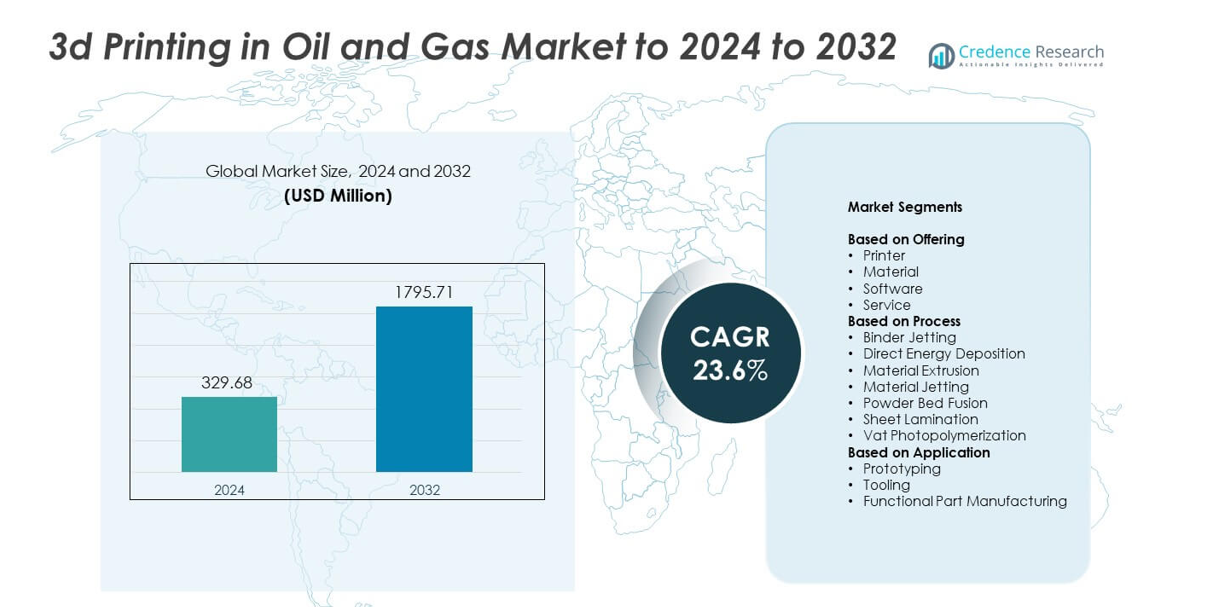
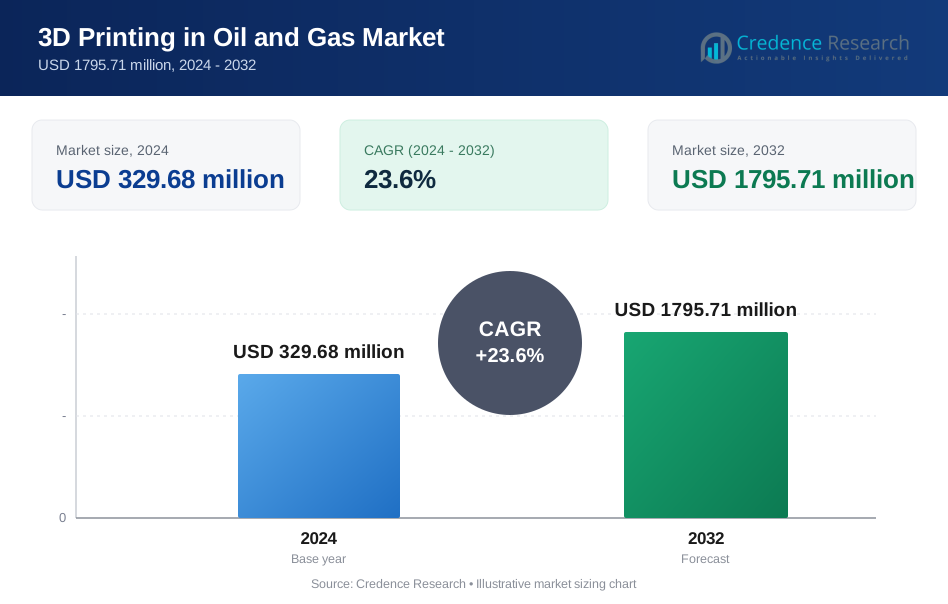
3d Printing in Oil and Gas Market size was valued at USD 329.68 million in 2024 and is anticipated to reach USD 1795.71 million by 2032, at a CAGR of 23.6% during the forecast period.
| REPORT ATTRIBUTE | DETAILS |
|---|---|
| Historical Period | 2020-2023 |
| Base Year | 2024 |
| Forecast Period | 2025-2032 |
| 3D Printing in Oil and Gas Market Size 2024 | USD 329.68 million |
| 3D Printing in Oil and Gas Market, CAGR | 23.6% |
| 3D Printing in Oil and Gas Market Size 2032 | USD 1795.71 million |
The 3d Printing in Oil and Gas Market is shaped by key players such as Proto Labs, Inc., Voxeljet AG, Stratasys Ltd., Materialise NV, Optomec Inc., Envisiontec GmbH, The Exone Company, Arcam Group, 3D Systems Corporation, and SLM Solutions Group AG. These companies enhance adoption through advanced metal printing systems, improved design software, and stronger service capabilities tailored for demanding oilfield environments. North America led the market in 2024 with about 38% share, supported by strong technological infrastructure and higher investment in digital manufacturing. Europe followed with nearly 27% share, driven by offshore development and rapid industrial innovation.
Market Insights
- The 3d Printing in Oil and Gas Market was valued at USD 329.68 million in 2024 and is projected to reach USD 1795.71 million by 2032, growing at a CAGR of 23.6%.
- Demand rises as operators use additive manufacturing to cut lead times and speed prototyping, with printers holding about 46% share due to strong use in tool design and field maintenance.
- Powder bed fusion remains a major trend with nearly 39% share because it supports high-strength metal parts for drilling and refinery operations.
- Competition intensifies as major players invest in stronger metal materials and advanced printing systems to improve accuracy, durability, and on-site production capabilities.
- North America led with about 38% share in 2024, followed by Europe at nearly 27%, while prototyping dominated applications with about 48% share as companies accelerated design cycles and reduced downtime across upstream and midstream activities.
Market Segmentation Analysis:
By Offering
Printers dominated the 3D Printing in Oil and Gas Market in 2024 with about 46% share. Oilfield operators favored advanced printers because they support rapid production of complex geometries for drilling tools, pump parts, and refinery components. Printers also help reduce lead times for replacements during field maintenance. Materials and software grew steadily as companies improved metal powders, polymers, and simulation platforms for harsh environments. Service-based offerings expanded with rising demand for outsourced additive manufacturing, but hardware sales remained the core revenue driver due to continuous upgrades in industrial-grade printer capabilities.
- For instance, Baker Hughes utilizes additive manufacturing to improve and simplify the supply chain and has developed over 1,500 qualified part numbers.
By Process
Powder bed fusion led the process segment in 2024 with nearly 39% share. Energy firms adopted this process widely because it delivers high-strength metal parts needed for high-pressure and high-temperature oilfield conditions. Powder bed fusion supports intricate internal channels, making it suitable for valves, downhole tools, and heat-resistant components. Binder jetting and material extrusion gained traction for low-cost and fast prototyping, while direct energy deposition advanced in repair applications. Despite growth across processes, powder bed fusion remained the preferred option due to superior precision and material compatibility.
- For instance, TotalEnergies deployed a WAAM-produced waterbushing on its EIG well, a pressure-containing component about 1.2 meters high and 220 kilograms that passed more than 150 qualification tests before offshore installation in 2021.
By Application
Prototyping dominated the application segment in 2024 with about 48% share. Companies used additive manufacturing to speed product development for drilling tools, flow equipment, and safety devices. Prototyping reduced design cycles and allowed engineers to test complex shapes before mass deployment. Tooling and functional part manufacturing increased as metal additive systems matured, enabling production of durable components for rigs and refineries. Functional part manufacturing showed strong momentum, but prototyping stayed ahead because it required lower cost, faster iterations, and supported innovation efforts across upstream and midstream operations.
Key Growth Drivers
Rising demand for rapid prototyping and reduced lead times
The market grows as energy companies depend on additive manufacturing to speed design cycles and reduce long wait periods for critical components. Rapid prototyping helps engineers test new geometries, improve part performance, and cut delays in drilling and refinery operations. This demand strengthens adoption because operators face rising pressure to optimize maintenance and minimize downtime. Faster turnaround also supports innovation in tool design, making this factor one of the strongest growth drivers in the 3D Printing in Oil and Gas Market.
- For instance, JOME Engineering replaced casting with robotic metal 3D printing for stainless-steel sampling valves, cutting production time from 60 days to under 48 hours by printing a 20.5-kilogram valve body rated to 5 bar in about 7.5 hours.
Growing adoption of lightweight and complex components
Oil and gas firms increasingly use 3D printing to create complex and lightweight metal parts that cannot be produced through conventional manufacturing. These components improve flow efficiency, reduce equipment loads, and enhance durability in harsh operating environments. The shift toward weight reduction and precision engineering drives steady adoption across upstream and midstream activities. As companies search for improved performance, the capability to fabricate intricate internal channels and optimized structures becomes a major driver for the 3D Printing in Oil and Gas Market.
- For instance, Siemens tested 3D-printed turbine blades for its SGT-400 gas turbine, running the blades at around 13,000 revolutions per minute in gas temperatures near 1,250 degrees Celsius on a 13-megawatt machine while validating intricate internal cooling channels.
Rising digitalization and integration with advanced design tools
Digital transformation pushes operators to integrate additive manufacturing with simulation, digital twins, and automated design platforms. This integration helps companies customize parts faster, optimize production workflows, and improve operational reliability. Digital tools also support predictive maintenance by allowing rapid on-demand production of replacement components. The strong link between digital strategy and advanced manufacturing makes this a key growth driver for the 3D Printing in Oil and Gas Market.
Key Trends and Opportunities
Expansion of metal additive manufacturing capabilities
Advances in metal powders, high-temperature alloys, and industrial printers create new opportunities for producing robust components used in drilling systems and refinery plants. Operators seek stronger and more corrosion-resistant parts to manage extreme field conditions, pushing metal AM adoption forward. As supply chains shift toward localized production, the ability to manufacture heavy-duty metal components near operation sites becomes a major trend in the 3D Printing in Oil and Gas Market.
- For instance, F3nice reported supplying recycled metal feedstock for Equinor, which produced 4,000 additively manufactured parts from fully recycled material
Increasing use of additive manufacturing for part repair and refurbishment
A growing trend involves using direct energy deposition and similar processes to rebuild worn components rather than replacing them. This shift helps companies reduce material waste, extend equipment life, and cut procurement delays. Refurbishment supports cost-effective maintenance in remote fields where replacement parts are difficult to source. The opportunity to lower operational expenses while improving equipment readiness strengthens this trend within the 3D Printing in Oil and Gas Market.
- For instance, Kongsberg Ferrotech integrated subsea additive repair into its Nautilus IMR robot, designed to rebuild damaged metal structures layer by layer on pipelines at sea depths up to 1,500 meters under Norway’s PETROMAKS 2 program.
Growth of distributed and on-site manufacturing models
Energy operators increasingly explore decentralized production setups using compact industrial printers at or near field locations. These setups enable quick access to spare parts, reduced inventory loads, and improved resilience against supply chain disruptions. Offshore rigs, desert fields, and remote pipelines benefit most from this model. As interest in localized production rises, distributed manufacturing becomes an important opportunity in the 3D Printing in Oil and Gas Market.
Key Challenges
High material and equipment costs
Additive manufacturing systems, specialty metal powders, and high-temperature alloys remain expensive compared with traditional machining. These costs slow adoption among operators with limited capital budgets or lower production volumes. Maintenance, calibration, and post-processing requirements add further expenses to overall operating costs. The financial burden keeps many firms cautious, making high cost a major challenge for the 3D Printing in Oil and Gas Market.
Limited standardization and certification frameworks
The sector struggles with inconsistent standards and slow approval processes for safety-critical printed components. Oil and gas operations require strict material testing, durability checks, and regulatory validation, which can delay deployment. Limited certification pathways also restrict large-scale adoption across drilling, refining, and pipeline operations. This lack of unified standards remains a key challenge for the 3D Printing in Oil and Gas Market and slows wider commercial use.
Regional Analysis
North America
North America held the leading position in the 3d Printing in Oil and Gas Market in 2024 with about 38% share. Strong adoption came from major operators in the United States and Canada who used additive manufacturing to support rapid prototyping, downhole tool optimization, and localized production of replacement parts. The region benefited from advanced industrial 3D printing infrastructure and deeper integration of digital engineering tools. Growing shale activity, higher investment in complex metal printing, and strong collaboration between oilfield service firms and technology suppliers continued to strengthen regional dominance.
Europe
Europe accounted for around 27% share of the 3d Printing in Oil and Gas Market in 2024. Regional growth was supported by strong research capabilities and early adoption of advanced metal printing technologies across North Sea operations. Energy companies focused on lightweight, corrosion-resistant components for offshore platforms and subsea systems. Strict sustainability goals also encouraged localized production to reduce logistics emissions. Partnerships between equipment makers, engineering firms, and additive manufacturing specialists helped expand applications in prototyping, tooling, and functional part fabrication across major oil-producing countries in the region.
Asia Pacific
Asia Pacific held nearly 24% share of the 3d Printing in Oil and Gas Market in 2024. The region grew due to expanding upstream investment in China, India, and Southeast Asia, where operators sought faster part turnaround and reduced dependency on imported components. Adoption increased as national oil companies integrated additive systems into maintenance and tooling operations. Improvements in metal powder manufacturing and government support for industrial 3D printing strengthened the ecosystem. Rising offshore exploration activity and higher demand for customized drilling tools further supported regional expansion.
Latin America
Latin America captured about 7% share of the 3d Printing in Oil and Gas Market in 2024. Growth was driven by modernization efforts in Brazil, Mexico, and Argentina, where companies adopted additive manufacturing to reduce equipment delays and improve field maintenance. Offshore projects in Brazil encouraged the use of advanced metal printing for high-strength components. Adoption remained slower compared with larger regions due to budget limitations, but interest increased as operators recognized benefits in prototyping and localized production. Gradual technology integration supported steady market progress.
Middle East and Africa
Middle East and Africa accounted for roughly 4% share of the 3d Printing in Oil and Gas Market in 2024. National oil companies in the Gulf region explored additive manufacturing for spare parts, drilling tools, and high-temperature components to support refinery and upstream operations. Countries like Saudi Arabia and the UAE invested in industrial 3D printing hubs to enhance supply chain resilience. Adoption in Africa remained limited but showed potential in offshore fields. Despite a smaller share, rising digital transformation initiatives supported long-term regional growth.
Market Segmentations:
By Offering
- Printer
- Material
- Software
- Service
By Process
- Binder Jetting
- Direct Energy Deposition
- Material Extrusion
- Material Jetting
- Powder Bed Fusion
- Sheet Lamination
- Vat Photopolymerization
By Application
- Prototyping
- Tooling
- Functional Part Manufacturing
By Geography
- North America
- U.S.
- Canada
- Mexico
- Europe
- Germany
- France
- U.K.
- Italy
- Spain
- Rest of Europe
- Asia Pacific
- China
- Japan
- India
- South Korea
- South-east Asia
- Rest of Asia Pacific
- Latin America
- Brazil
- Argentina
- Rest of Latin America
- Middle East & Africa
- GCC Countries
- South Africa
- Rest of the Middle East and Africa
Competitive Landscape
The 3d Printing in Oil and Gas Market features major players such as Proto Labs, Inc., Voxeljet AG, Stratasys Ltd., Materialise NV, Optomec Inc., Envisiontec GmbH, The Exone Company, Arcam Group, 3D Systems Corporation, and SLM Solutions Group AG. These companies compete by advancing metal additive technologies, improving design software, and expanding industrial-grade printer capabilities tailored for harsh oilfield conditions. Their strategies focus on enhancing accuracy, material strength, and reliability to meet upstream and refinery requirements. Many players invest in research to support high-temperature alloys and corrosion-resistant materials. Partnerships with oilfield service firms and engineering contractors help expand adoption across prototyping, tooling, and functional part manufacturing. Firms also strengthen service portfolios through on-site printing support and digital integration, aiming to reduce downtime and improve operational efficiency for energy operators.
Key Player Analysis
- Proto Labs, Inc.
- Voxeljet AG
- Stratasys Ltd.
- Materialise NV
- Optomec Inc.
- Envisiontec GmbH
- The Exone Company
- Arcam Group
- 3D Systems Corporation
- SLM Solutions Group AG
Recent Developments
- In 2025, 3D Systems advanced its presence in the oil and gas sector through its joint venture NAMI with Dussur, deploying advanced 3D printing solutions across Saudi Arabia's energy sector.
- In 2025, Nikon SLM Solutions partnered with ExxonMobil and LSU Engineering students, along with Howco Additive, to redesign a critical machinery component using metal 3D printing for oil and gas applications.
- In April 2025, 3D Systems announce the new scanning technology module for its EXT 1070 Titan Pellet and EXT 1270 Titan Pellet printers.
Report Coverage
The research report offers an in-depth analysis based on Offering, Process, Application and Geography. It details leading market players, providing an overview of their business, product offerings, investments, revenue streams, and key applications. Additionally, the report includes insights into the competitive environment, SWOT analysis, current market trends, as well as the primary drivers and constraints. Furthermore, it discusses various factors that have driven market expansion in recent years. The report also explores market dynamics, regulatory scenarios, and technological advancements that are shaping the industry. It assesses the impact of external factors and global economic changes on market growth. Lastly, it provides strategic recommendations for new entrants and established companies to navigate the complexities of the market.
Future Outlook
- The market will expand as operators adopt additive manufacturing for faster part production.
- Metal printing demand will rise due to growing need for durable and heat-resistant components.
- On-site and distributed manufacturing models will gain wider acceptance in remote fields.
- Digital integration will strengthen as companies link 3D printing with simulation and digital twins.
- Prototyping usage will increase as firms accelerate design cycles for drilling and refinery tools.
- Repair and refurbishment applications will grow with better deposition and rebuilding technologies.
- Supply chains will shift toward localized production to reduce delays and dependency on imports.
- New materials will emerge to improve corrosion resistance and performance in harsh conditions.
- Collaboration between oilfield service providers and technology firms will intensify.
- Certification standards will develop further, enabling broader use of printed functional parts.
Request a Free Sample
Fill in your details and we'll send you a free sample report.
- Sample data tables & charts
- Research methodology
Need a Custom Version of This Report?
Tailor the scope, geography, or segments to your exact requirements.
- Custom geography or segment scope
- Direct access to our analyst team
Frequently Asked Questions
What is the current market size for 3d Printing in Oil and Gas Market, and what is its projected size in 2032?
At what Compound Annual Growth Rate is the 3d Printing in Oil and Gas Market projected to grow between 2025 and 2032?
In terms of manufacturing components, which market category is in the lead?
Which segment is leading the market in terms of supply chain optimization?
Which reducing weight and enhancing performance segment is estimated to have the highest CAGR throughout the forecast period?
Who are the leading companies in the 3d Printing in Oil and Gas Market?
Table of Content
Chapter 1. Report Introduction
- 1.1 Report Description & Purpose
- 1.1.1 Report Title & Market Definition
- 1.1.2 Unique Selling Propositions (USP) & Key Differentiators
- 1.1.3 Value Proposition for Stakeholders
- 1.2 Research Objectives
- 1.2.1 Market Sizing Objectives (Volume & Revenue)
- 1.2.2 Segmentation Objectives
- 1.2.3 Competitive Intelligence Objectives
- 1.2.4 Forecast & Scenario Objectives
- 1.3 Report Scope
- 1.3.1 3D Printing in Oil and Gas Scope – Types & Subtypes Covered
- 1.3.2 Geographic Scope – Regions & Countries Covered
- 1.3.3 Historical Period, Base Year & Forecast Period (2024; forecast to 2032)
- 1.3.4 Inclusions & Exclusions
- 1.4 HS Code & Classification Framework
- 1.5 Currency, Units & Pricing Basis
- 1.6 Target Stakeholders
- 1.7 Limitations & Assumptions
Chapter 2. Executive Summary
- 2.1 Global 3D Printing in Oil and Gas Market Snapshot
- 2.1.1 Market Size – Historical (2024) & Forecast (2024-2032) (2024: USD 329.68 million → 2032: USD 1795.71 million)
- 2.1.2 Volume & Revenue – Global Totals
- 2.1.3 Key Market Highlights – Top Five Facts
- 2.2 3D Printing in Oil and Gas Market Segmentation Snapshot
- 2.2.1 Market Split by Region – 2024 vs. 2032
- 2.3 Competitive Snapshot
- 2.3.1 Top 10 Players by Revenue Share – 2024
- 2.3.2 Top 10 Players by Volume Share – 2024
- 2.3.3 Recent Strategic Developments (18-Month Summary)
- 2.4 Key Investment Highlights & Strategic Conclusions
Chapter 3. 3D Printing in Oil and Gas Market Dynamics & Industry Analysis
- 3.1 Market Overview & Context
- 3.1.1 3D Printing in Oil and Gas Market Position in the Broader Automotive Value Chain
- 3.1.2 OEM vs. Replacement Market Dynamics
- 3.1.3 Market Maturity & Development Stage by Region
- 3.2 3D Printing in Oil and Gas Market Drivers
- 3.3 3D Printing in Oil and Gas Market Restraints & Challenges
- 3.4 3D Printing in Oil and Gas Market Opportunities
- 3.5 Porter's Five Forces Analysis
- 3.5.1 Threat of New Entrants
- 3.5.2 Bargaining Power of Suppliers
- 3.5.3 Bargaining Power of Buyers
- 3.5.4 Threat of Substitutes
- 3.5.5 Competitive Rivalry – Intensity Assessment
- 3.6 3D Printing in Oil and Gas Value Chain Analysis
- 3.6.1 Upstream – Raw Material/Input Suppliers
- 3.6.1.1 Raw Material/Input 1
- 3.6.1.2 Raw Material/Input 2
- 3.6.1.3 Raw Material/Input 3
- 3.6.2 Midstream – Production/Manufacturing/Service Delivery
- 3.6.2.1 Production/Process Overview
- 3.6.2.2 Key Facility Locations & Capacity by Manufacturer
- 3.6.3 Downstream – Distribution & End Consumer
- 3.6.3.1 Primary Channel – B2B/OEM
- 3.6.3.2 Secondary Channels – Dealer, Retail, Online, Direct
- 3.6.4 Value Chain Profitability Analysis
- 3.6.1 Upstream – Raw Material/Input Suppliers
- 3.7 PESTEL Analysis
- 3.7.1 Political Factors
- 3.7.2 Economic Factors
- 3.7.3 Social Factors
- 3.7.4 Technological Factors
- 3.7.5 Environmental Factors
- 3.7.6 Legal Factors
- 3.8 3D Printing in Oil and Gas Supply Chain Analysis
- 3.8.1 Raw Material/Input Supply Risk Assessment
- 3.8.2 Manufacturing Concentration Risk (Geographic Exposure)
- 3.8.3 Trade Disruption Impact Analysis
- 3.9 Regulatory & Policy Landscape
Note: The regulatory and policy landscape section covers regulations based on their applicability to the market, 3D Printing in Oil and Gas category, geography, and scope of the study. Only regulatory frameworks with a material impact on operations, compliance, trade, sustainability, or market access are analyzed in detail.
Chapter 4. Key Investment Pockets & Opportunity Analysis
- 4.1 3D Printing in Oil and Gas Market Attractiveness Analysis
- 4.1.1 By Region – Investment Attractiveness Matrix (Volume × CAGR)
- 4.2 Absolute Revenue Growth Opportunity
- 4.2.1 By Region – Absolute USD Growth Through 2032
- 4.3 Incremental Volume Opportunity
- 4.3.1 By Region – Incremental Volume Through 2032
- 4.3.2 Segment – Incremental Volume
- 4.4 Emerging Submarket Opportunity Deep Dive (Subject to Applicability)
- 4.5 Emerging Market Opportunity Scorecards
- 4.5.1 United States
- 4.5.2 Europe
- 4.5.3 Asia
- 4.5.4 Middle East & Africa
Note: Emerging Market Opportunity Scorecards will be included based on relevance and strategic importance. Regions listed are indicative and may vary depending on data availability and market dynamics.
Chapter 5. 3D Printing in Oil and Gas Import-Export Analysis & Trade Flows
- 5.1 Global Trade Overview
- 5.1.1 Global Export Value by Country (2024)
- 5.1.2 Global Export Volume by Country (2024)
- 5.1.3 Global Import Value by Country (2024)
- 5.1.4 Global Import Volume by Country (2024)
- 5.1.5 Net Trade Balance by Country (2024)
- 5.2 Export Analysis – Segment
- 5.2.1 Type 1 (HS Code)
- 5.2.2 Type 2 (HS Code)
- 5.2.3 Type 3 (HS Code)
- 5.2.4 Type 4 (HS Code)
- 5.2.5 Type 5 (HS Code)
- 5.3 Import Analysis – Segment
- 5.3.1 Type 1 (HS Code)
- 5.3.2 Type 2 (HS Code)
- 5.3.3 Type 3 (HS Code)
- 5.3.4 Type 4 (HS Code)
- 5.3.5 Type 5 (HS Code)
- 5.4 Average Unit Trade Prices
- 5.4.1 Average Export Price – Segment & Country
- 5.4.2 Average Import Price – Segment & Source Country
- 5.4.3 Price Trends (2024)
- 5.5 Key Trade Route Analysis
- 5.5.1 Trade Route 1
- 5.5.2 Trade Route 2
- 5.5.3 Trade Route 3
- 5.5.4 Trade Route 4
- 5.5.5 Trade Route 5
- 5.6 Trade Policy Impact Assessment
- 5.6.1 US Anti-Dumping & Section 301 Tariffs
- 5.6.2 EU Customs Union Impact
- 5.6.3 Major Free Trade Agreements
- 5.6.4 USMCA Rules of Origin
Note: Trade policy analysis will be included only where relevant to the 3D Printing in Oil and Gas market.
Chapter 6. Competitive Landscape & Company Benchmarking
- 6.1 3D Printing in Oil and Gas Market Concentration & Structure
- 6.1.1 Herfindahl-Hirschman Index (HHI) – vs. 2024
- 6.1.2 Tier 1, Tier 2 & Tier 3 Market Structure
- 6.1.3 Global, Regional & Local Player Dynamics
- 6.2 3D Printing in Oil and Gas Market Share Analysis – 2024
- 6.2.1 Global Revenue Share by Company
- 6.2.2 Global Volume Share by Company
- 6.2.3 Regional Revenue Share
- 6.2.4 Market Share Evolution ( vs. 2024)
- 6.2.5 OEM Segment Share by Company
- 6.2.6 Replacement Segment Share by Company
- 6.3 Production/Delivery Capacity & Facility Analysis
- 6.3.1 Global Installed Capacity
- 6.3.2 Capacity Utilization Rates
- 6.3.3 Production/Output Volume
- 6.3.4 Facility Locations & Capacity Map
- 6.3.5 Planned Capacity Additions
- 6.4 3D Printing in Oil and Gas Competitive Benchmarking Matrix
- 6.4.1 Revenue, Volume, CAGR & Profitability Comparison
- 6.4.2 Channel Revenue Mix
- 6.4.3 Geographic Revenue Exposure
- 6.4.4 R&D Intensity
- 6.4.5 Sustainability Maturity
- 6.5 Strategic Developments in 3D Printing in Oil and Gas (Last 24 Months)
- 6.5.1 Mergers, Acquisitions & Divestments
- 6.5.2 New 3D Printing in Oil and Gas Launches
- 6.5.3 Facility Expansions
- 6.5.4 Strategic Alliances, Joint Ventures & Partnerships
- 6.5.5 Distribution Expansion & Market Entry
- 6.5.6 Sustainability & ESG Initiatives
- 6.6 Competitive Strategy Mapping
- 6.6.1 Leader, Challenger, Follower & Niche Classification
- 6.6.2 Pricing Strategy Comparison
- 6.6.3 Channel Strategy Matrix
Note: Strategic developments are included based on their materiality and the availability of reliable information.
Chapter 7. Global 3D Printing in Oil and Gas Market – By Distribution Channel
- 7.1 Segment Overview
- 7.1.1 Volume & Revenue Split by Channel (2024 & 2032)
- 7.1.2 Channel Mix Evolution (2024-2032)
Chapter 8. Regional Market Analysis – Global Overview
- 8.1 Global Regional Overview
- 8.1.1 Regional Volume Share
- 8.1.2 Regional Revenue Share
- 8.1.3 Regional Volume by Region
- 8.1.4 Regional Revenue by Region
- 8.1.5 Regional Forecast Through 2032
- 8.2 Cross-Regional Segment Analysis
- 8.2.1 By Distribution Channel
- 8.2.2 By Brand/Price Tier
Chapter 9. North America 3D Printing in Oil and Gas Market
- 9.1 United States
- 9.2 Canada
- 9.3 Mexico
Chapter 10. Europe 3D Printing in Oil and Gas Market
- 10.1 Germany
- 10.2 France
- 10.3 Italy
- 10.4 United Kingdom
- 10.5 Spain
- 10.6 Poland
- 10.7 Russia
- 10.8 Netherlands
- 10.9 Belgium
- 10.10 Sweden
- 10.11 Denmark
- 10.12 Norway
- 10.13 Rest of Europe
Chapter 11. Asia Pacific 3D Printing in Oil and Gas Market
- 11.1 China
- 11.2 India
- 11.3 Japan
- 11.4 South Korea
- 11.5 Thailand
- 11.6 Indonesia
- 11.7 Vietnam
- 11.8 Malaysia
- 11.9 Australia
- 11.10 Rest of Asia Pacific
Chapter 12. Latin America 3D Printing in Oil and Gas Market
- 12.1 Brazil
- 12.2 Argentina
- 12.3 Colombia
- 12.4 Chile
- 12.5 Rest of Latin America
Chapter 13. Middle East 3D Printing in Oil and Gas Market
- 13.1 Saudi Arabia
- 13.2 United Arab Emirates
- 13.3 Turkey
- 13.4 Israel
- 13.5 Iran
- 13.6 Rest of the Middle East
Chapter 14. Africa 3D Printing in Oil and Gas Market
- 14.1 South Africa
- 14.2 Egypt
- 14.3 Nigeria
- 14.4 Morocco
- 14.5 Rest of Africa
Chapter 15. 3D Printing in Oil and Gas Company Profiles
- 15.1 [Company 01]
- 15.1.1 Company Overview
- 15.1.2 Key Management Personnel
- 15.1.3 Products & Services Portfolio
- 15.1.4 Financial Performance
- 15.1.5 Key Market Focus & Geographic Presence
- 15.1.6 Recent Developments & Strategic Initiatives
Note: The company profile list is preliminary and may change based on research findings, market developments, data availability, and client requirements.
Chapter 16. Appendices
- Appendix A – List of Abbreviations & Acronyms
- Appendix B – Industry Classification Code Reference – Full Series
- Appendix C – Production & Capacity Data Tables
- Appendix D – End-Use & Demand Base Tables
- Appendix E – Consumption & Replacement Rate Assumptions
- Appendix F – ASP Reference Tables
- Appendix G – Manufacturing & Facility Database
- Appendix H – Import-Export Data Tables
- Appendix I – Regulatory Summary Tables
- Appendix J – Primary Research Participant List (Anonymized)
- Appendix K – Primary Research Questionnaire Framework
- Appendix L – Data Sources & Bibliography
- Appendix M – Market Size Divergence & Source Comparison
Chapter 17. Research Methodology
- 17.1 Research Framework & Philosophy
- 17.2 Secondary Research – Sources, Hierarchy & Data Extraction
- 17.3 Data Modeling – Bottom-Up & Top-Down Market Sizing
- 17.4 Primary Research – Stakeholder Framework, LOI & Sample Sizes
- 17.5 Forecast Methodology – Regression, Scenario & Sensitivity Analysis
- 17.6 Quality Control – Four-Layer Validation Framework
- 17.7 Limitations & Standard Assumptions
- 17.8 Disclaimer
