
| REPORT ATTRIBUTE | DETAILS |
|---|---|
| Historical Period | 2020-2023 |
| Base Year | 2024 |
| Forecast Period | 2025-2032 |
| Sugarcane Harvester Market Size 2024 | USD 902.4 million |
| Sugarcane Harvester Market, CAGR | 5.10% |
| Sugarcane Harvester Market Size 2032 | USD 1,345.1 million |
Market Overview:
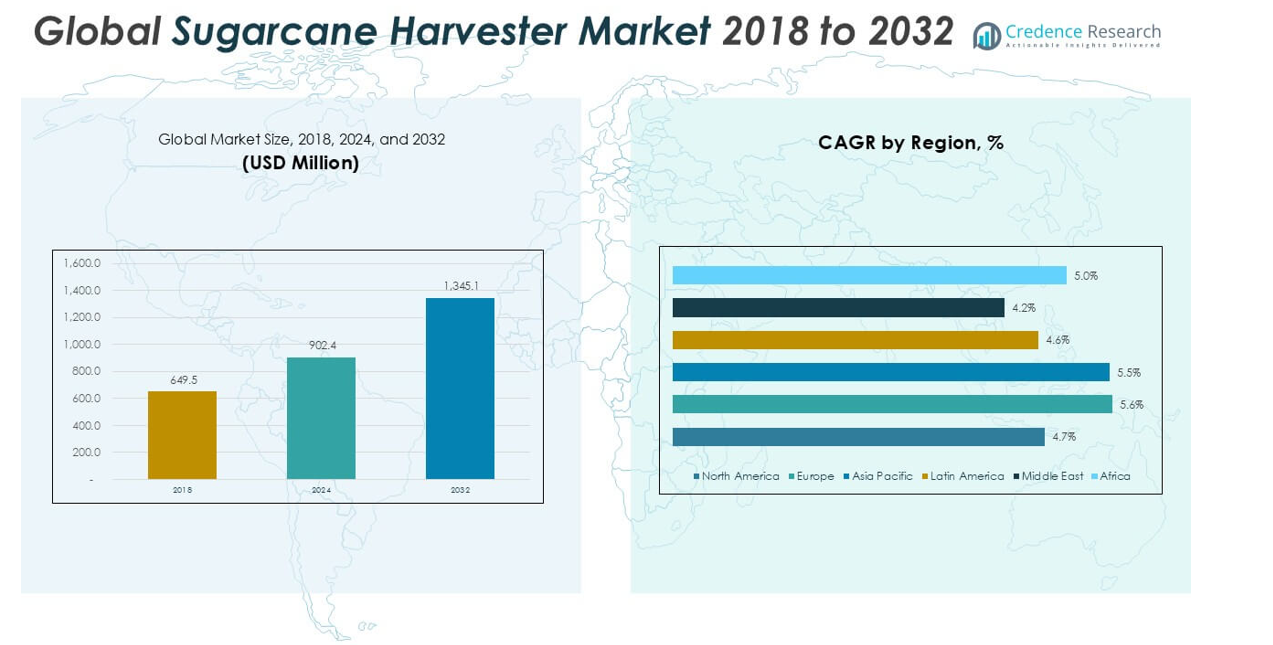
The Sugarcane Harvester market size was valued at USD 649.5 million in 2018, reached USD 902.4 million in 2024, and is anticipated to reach USD 1,345.1 million by 2032, at a CAGR of 5.10% during the forecast period.
Leading companies in the sugarcane harvester market include Deere & Company, CNH Industrial N.V., AGCO Corporation, CLAAS KGaA mbH, Massey Ferguson, Tirth Agro Technology, Zoomlion Heavy Machinery, Weldcraft Industries, Valtra Inc., Canetec Pty, Ltd., and Simon Group. These key players leverage advanced technologies, diversified product lines, and strong dealer networks to strengthen their market presence globally. Asia Pacific is the dominant region, accounting for 33.7% of the global market share in 2024, supported by extensive sugarcane cultivation and rapid mechanization across major producers such as India, China, and Thailand.
Market Insights
- The global sugarcane harvester market reached USD 902.4 million in 2024 and is expected to grow to USD 1,345.1 million by 2032, with a CAGR of 5.10%.
- Rising labor shortages, increasing wage costs, and government support for farm mechanization are driving the adoption of sugarcane harvesters worldwide.
- A key market trend is the shift toward chopper harvesters, which accounted for 68% segment share in 2024, thanks to their higher efficiency and versatility in large-scale operations.
- The competitive landscape features global leaders such as Deere & Company, CNH Industrial N.V., AGCO Corporation, and regional specialists like Tirth Agro Technology and Canetec Pty, Ltd., but high initial investment and maintenance costs remain significant restraints, particularly for small and medium farmers.
- Asia Pacific leads the market with 33.7% regional share in 2024, followed by North America at 20.6% and Europe at 18.5%, driven by extensive cultivation and mechanization in major producing countries
Market Segmentation Analysis:
By Type:
Within the sugarcane harvester market, chopper harvesters dominate the segment, accounting for approximately 68% of total revenue share in 2024. Their widespread adoption stems from superior field efficiency, adaptability to various terrains, and the ability to deliver cleaner, uniformly cut cane. These harvesters are preferred in both large- and medium-scale sugarcane operations due to their capacity to reduce manual labor and operational costs. Technological advancements, such as integrated cleaning systems and telematics, further drive demand for chopper harvesters in key sugarcane-producing regions.
- For instance, John Deere’s CH570 sugarcane harvester is equipped with an advanced cleaning chamber and telematics, enabling operators to process up to 100 tons of sugarcane per day while reducing trash content to less than 4 kilograms per ton.
By Number of Rows:
The multiple row segment leads the market, capturing an estimated 63% market share in 2024. This dominance is attributed to the higher productivity and operational efficiency of multiple row harvesters, which significantly reduce harvesting time per hectare. Large commercial farms and corporate plantations prefer these machines to optimize labor and fuel usage. Increased mechanization, the need for cost-effective harvesting solutions, and the push toward higher throughput are key drivers supporting the continued adoption of multiple row sugarcane harvesters globally.
- For instance, the Case IH Austoft 8800 Multi-Row Harvester enables operators to harvest up to 2.1 hectares per hour, achieving fuel savings of 15 liters per hectare compared to single-row models.
Market Overview
Mechanization of Agriculture
Growing labor shortages and increasing wage costs in major sugarcane-producing regions drive the mechanization of harvesting operations. Farmers and agribusinesses seek efficient, reliable machinery to enhance productivity and reduce dependency on manual labor. Governments also support this shift with subsidies and incentives for purchasing agricultural equipment, making sugarcane harvesters a preferred choice for medium and large farms. This trend significantly boosts market growth by enabling faster, more consistent harvesting and lowering operational costs.
- For instance, Tirth Agro Technology’s Shaktiman Sugarcane Harvester has been adopted by more than 2,300 farms in India, helping reduce manual labor requirements by 80% and cutting harvesting time by up to 60 hours per hectare.
Technological Advancements
The integration of advanced technologies such as GPS guidance, telematics, and automated control systems improves the efficiency and precision of sugarcane harvesters. Modern machines offer features like real-time performance monitoring, automated cutting adjustments, and enhanced residue management, which reduce crop losses and optimize yields. These innovations not only streamline field operations but also appeal to large-scale producers focused on maximizing output, thus driving higher adoption rates and supporting market expansion.
- For instance, CLAAS’s Jaguar series harvesters equipped with CEMOS AUTO PERFORMANCE technology automatically adjust engine output and ground speed, achieving throughput of 380 tons per 8-hour shift while cutting fuel use by 24 liters per shift.
Expansion of Commercial Sugarcane Farming
Rising global demand for sugar and bioethanol fuels the expansion of commercial sugarcane plantations, particularly in Asia-Pacific and Latin America. Larger farm sizes and the need for timely, large-scale harvesting create strong demand for high-capacity, durable harvesting machinery. Investment by agribusinesses in modernizing their fleets to improve profitability and meet processing timelines further accelerates harvester sales, cementing the market’s upward trajectory.
Key Trends & Opportunities
Sustainable and Eco-Friendly Harvesters
Manufacturers increasingly focus on developing sugarcane harvesters with reduced emissions, lower fuel consumption, and minimal soil compaction to support sustainable agriculture. Demand for “green” machinery rises as producers seek to comply with environmental regulations and enhance their eco-credentials. This trend creates new opportunities for companies investing in alternative powertrains, precision agriculture tools, and biodegradable materials, which can set their products apart in an evolving market.
- For instance, AGCO Corporation’s Massey Ferguson MF 9790 harvester features a Tier 4 Final engine that emits 0.4 grams of nitrogen oxide per kilowatt-hour, with a frame design that limits soil compaction to 37 kilopascals.
Digitalization and Data-Driven Farming
The adoption of digital platforms and precision agriculture technologies, such as remote monitoring and yield mapping, is transforming sugarcane harvesting. Data analytics allow producers to optimize harvester routes, improve maintenance scheduling, and maximize field productivity. This trend opens new opportunities for technology providers and equipment manufacturers offering integrated digital solutions that deliver actionable insights and greater operational efficiency for large-scale sugarcane farms.
- For instance, CNH Industrial’s PLM Connect telematics platform facilitates real-time yield monitoring and predictive maintenance, increasing field efficiency by 8 hectares per day and reducing unscheduled maintenance events by 4 instances per month in large fleet operations.
Key Challenges
High Initial Investment Costs
The significant upfront cost of purchasing advanced sugarcane harvesters poses a challenge for small and medium-sized farms. Despite long-term operational savings, many growers face financial constraints or limited access to credit, making it difficult to invest in mechanization. This barrier restricts broader adoption, particularly in emerging markets, and slows market penetration outside large commercial operations.
Complex Maintenance and Skill Requirements
Modern sugarcane harvesters require specialized technical knowledge for operation and maintenance. A shortage of skilled operators and service technicians in rural areas can lead to equipment downtime, reduced efficiency, and increased operational costs. Addressing this challenge requires investment in training programs and after-sales support networks to ensure reliable machine performance in the field.
Fluctuating Commodity Prices
Volatility in global sugar and bioethanol prices can impact investment decisions for producers and agribusinesses. Uncertain market returns often prompt farmers to delay or reduce capital expenditures on new machinery, including harvesters. This challenge introduces cyclical demand patterns in the sugarcane harvester market and may hinder consistent growth across some regions.
Regional Analysis
North America
North America’s sugarcane harvester market was valued at USD 137.11 million in 2018, rising to USD 186.21 million in 2024 and projected to reach USD 269.01 million by 2032, reflecting a CAGR of 4.7%. The region represents 20.6% of global market share in 2024. Mechanization trends, advanced harvesting technology adoption, and substantial commercial farming in the U.S. and Canada drive market growth. Continued support from government programs and demand for efficiency further cement North America’s position as a leading regional market.
Europe
Europe recorded a market size of USD 116.78 million for sugarcane harvesters in 2018, expanding to USD 166.63 million in 2024, with an outlook of USD 257.04 million by 2032 and a CAGR of 5.6%. The region holds around 18.5% of the market share in 2024. Expansion is propelled by modernization in southern European farms, incentives for sustainable equipment upgrades, and growing bioenergy production. These factors foster steady growth and ongoing technological adoption across Europe’s sugarcane sector.
Asia Pacific
Asia Pacific led the global sugarcane harvester market with a value of USD 213.61 million in 2018, reaching USD 304.12 million in 2024 and set to grow to USD 467.81 million by 2032, at a CAGR of 5.5%. The region accounts for 33.7% of the total market share in 2024. Key contributors include India, China, and Thailand, where government mechanization drives, plantation expansion, and rising productivity needs continue to stimulate robust demand for advanced harvesters.
Latin America
Latin America’s market size for sugarcane harvesters was USD 89.50 million in 2018, increasing to USD 121.07 million in 2024 and forecast to reach USD 173.92 million by 2032, representing a CAGR of 4.6%. In 2024, the region holds a 13.4% market share. Brazil dominates regional demand, underpinned by its global leadership in sugar and bioethanol. Investments in high-efficiency machinery and a shift toward large-scale, commercialized harvesting bolster long-term growth prospects.
Middle East
The Middle East saw its sugarcane harvester market valued at USD 55.60 million in 2018, which grew to USD 73.54 million in 2024 and is anticipated to reach USD 102.22 million by 2032, posting a CAGR of 4.2%. Holding an 8.2% market share in 2024, the region’s growth is driven by agricultural modernization in countries like Egypt and Sudan, where expanding irrigation and technology adoption fuel demand for modern harvesting solutions.
Africa
Africa’s sugarcane harvester market started at USD 36.89 million in 2018, advancing to USD 50.87 million in 2024 and projected to reach USD 75.05 million by 2032, with a CAGR of 5.0%. The continent accounts for 5.6% of global market share in 2024. Growth is supported by increased sugar and ethanol production, foreign investment in agricultural development, and a move toward mechanized harvesting to address labor shortages and improve productivity across key African markets.
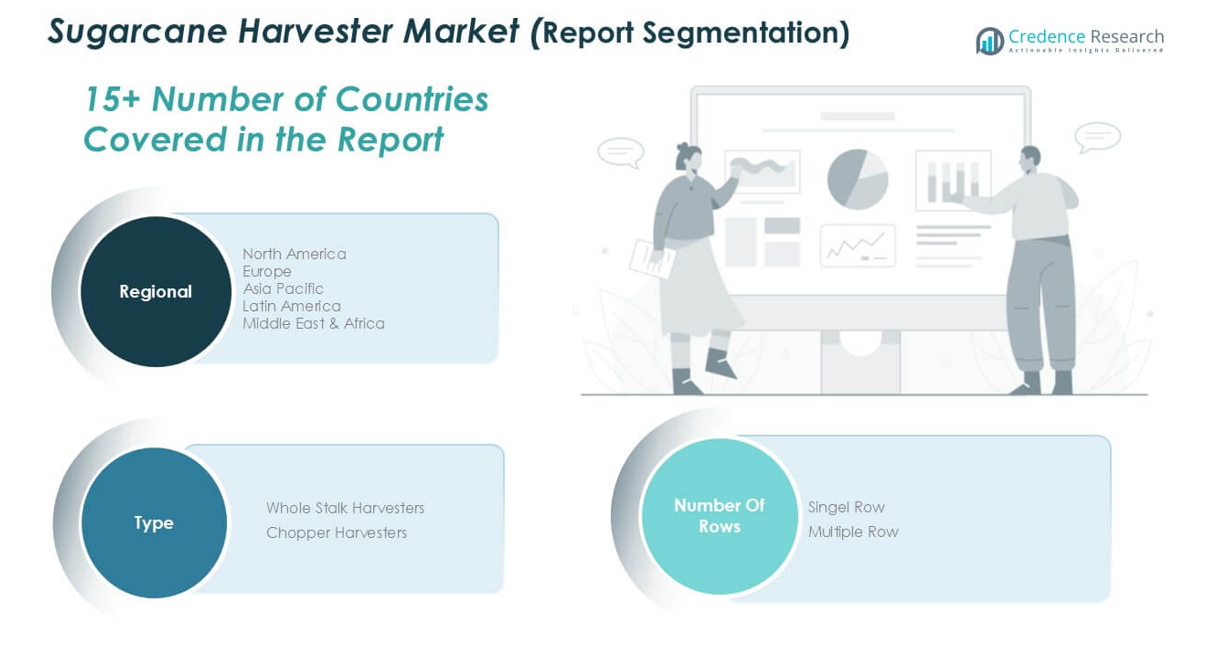
Market Segmentations:
By Type:
- Whole Stalk Harvesters
- Chopper Harvesters
By Number of Rows:
- Single Row
- Multiple Row
By Geography:
- North America
- U.S.
- Canada
- Mexico
- Europe
- Germany
- France
- U.K.
- Italy
- Spain
- Rest of Europe
- Asia Pacific
- China
- Japan
- India
- South Korea
- South-east Asia
- Rest of Asia Pacific
- Latin America
- Brazil
- Argentina
- Rest of Latin America
- Middle East & Africa
- GCC Countries
- South Africa
- Rest of the Middle East and Africa
Competitive Landscape
The competitive landscape of the sugarcane harvester market is characterized by the presence of both global machinery giants and specialized regional players, driving innovation and operational efficiency. Leading companies such as Deere & Company, CNH Industrial N.V., AGCO Corporation, CLAAS KGaA mbH, and Massey Ferguson maintain a strong market position by continuously expanding their product portfolios and investing in advanced technologies, including precision guidance systems and telematics. Recent years have seen a focus on strategic collaborations, product launches, and capacity expansions to enhance market reach and service networks. Companies emphasize customer support, aftersales service, and dealer partnerships to build brand loyalty and secure long-term growth. Intense competition encourages ongoing R&D investment, while the increasing adoption of sustainable and smart harvesting equipment sets the stage for further market differentiation.
Key Player Analysis
- Tirth Agro Technology
- Zoomlion Heavy Machinery
- Weldcraft Industries
- CNH Industrial N.V.
- AGCO Corporation
- CLAAS KGaA mbH
- Deere & Company
- Valtra Inc.
- Canetec Pty, Ltd.
- Simon Group
- Massey Ferguson
Recent Developments
- In June 2025, Zoomlion launched China's first hybrid power harvester, the TE100-DH, featuring an electric motor for enhanced responsiveness and fuel efficiency, as well as AI-driven automation for unmanned harvesting. The harvester boasts a 30% fuel savings compared to traditional models and integrates technologies like BeiDou positioning and AI-driven path planning. Additionally, Zoomlion upgraded its service infrastructure with digitalized spare parts logistics and 24/7 support.
- In May 2025, Zoomlion showcased new intelligent harvesters at the Colombia Bucaramanga Agricultural Exhibition, emphasizing localization and customization for diverse markets.
- In December 2024, CLAASenhanced its JAGUAR 900 series forage harvester with the new V-FLEX chopping cylinder. This optional upgrade focuses on improved productivity, flexibility, and efficiency, especially for sugarcane and other high-biomass crops. The V-FLEX knives feature a 23mm anti-wear coating and a new geometry for a precise cut and extended service life.
- In August 2024, Yanmar Holdings acquired CLAAS India, aiming to expand its presence in the Indian agribusiness sector and integrate CLAAS’s expertise in combine and sugarcane harvester manufacturing.
Market Concentration & Characteristics
The Sugarcane Harvester market demonstrates moderate to high concentration, with a select group of multinational companies and regional players holding significant market shares. Major manufacturers such as Deere & Company, CNH Industrial N.V., AGCO Corporation, CLAAS KGaA mbH, and Massey Ferguson lead in technology development, innovation, and global reach, shaping industry standards and customer expectations. Regional players including Tirth Agro Technology and Canetec Pty, Ltd. supply specialized equipment tailored to local agronomic conditions, enhancing market diversity. The market features high barriers to entry, driven by substantial capital investment, sophisticated engineering requirements, and strong brand loyalty among established customers. Product differentiation depends on advanced technology integration, fuel efficiency, operational reliability, and aftersales support. The sector shows a growing trend toward mechanization in emerging economies, reflecting government incentives and the need for improved productivity. The market structure supports ongoing innovation, robust dealer networks, and competitive pricing strategies, while responding to evolving regulatory standards and sustainability demands.
Report Coverage
The research report offers an in-depth analysis based on Type, Number of Rows and Geography. It details leading market players, providing an overview of their business, product offerings, investments, revenue streams, and key applications. Additionally, the report includes insights into the competitive environment, SWOT analysis, current market trends, as well as the primary drivers and constraints. Furthermore, it discusses various factors that have driven market expansion in recent years. The report also explores market dynamics, regulatory scenarios, and technological advancements that are shaping the industry. It assesses the impact of external factors and global economic changes on market growth. Lastly, it provides strategic recommendations for new entrants and established companies to navigate the complexities of the market.
Future Outlook
- Expansion of precision agriculture technologies will enhance the efficiency and accuracy of harvesting operations.
- Manufacturers will integrate telematics and IoT systems to enable real-time monitoring and predictive maintenance.
- Demand for electric and hybrid-powered harvesters will grow to meet sustainability and emissions regulations.
- Partnerships between equipment manufacturers and technology firms will accelerate innovation in automation.
- Leasing and rental business models will increase accessibility for smaller farms and reduce upfront costs.
- Growth in biofuel production will boost investment in high-capacity harvesting machinery.
- Governments will expand subsidy programs to support mechanization and rural productivity.
- New entrants will focus on regional adaptations to meet diverse crop and field conditions.
- Dealer networks and after-sales service will become critical factors in market competitiveness.
- Manufacturers will invest in operator training programs to address skill gaps and ensure optimal harvester usage.

Request a Free Sample
Fill in your details and we'll send you a free sample report.
- Sample data tables & charts
- Research methodology
Market Dynamics
Mechanization of Agriculture
Labor shortages and rising wage costs in major sugarcane-producing regions are pushing farmers to adopt mechanized harvesting solutions, enabling faster, more consistent harvesting and reducing dependency on manual labor.
Technological Advancements
Integration of GPS guidance, telematics, and automated control systems in sugarcane harvesters increases operational efficiency, reduces crop losses, and appeals to large-scale producers seeking to maximize yields.
Government Support and Subsidies
Many governments offer subsidies and incentives for farm mechanization, making it more financially viable for medium and large farms to invest in advanced sugarcane harvesters and boosting overall market growth.
Expansion of Commercial Sugarcane Farming
Growing global demand for sugar and bioethanol is driving the expansion of large-scale commercial plantations, which require high-capacity, durable harvesting machinery to meet processing timelines and improve profitability.
Sustainability and Eco-Friendly Equipment
Increasing focus on reducing emissions, fuel consumption, and soil compaction is driving demand for sustainable and eco-friendly sugarcane harvesters, especially as producers aim to comply with environmental regulations and enhance their sustainability credentials.
Need a Custom Version of This Report?
Tailor the scope, geography, or segments to your exact requirements.
- Custom geography or segment scope
- Direct access to our analyst team
Frequently Asked Questions
What is the current size of the Sugarcane Harvester Market?
What factors are driving the growth of the Sugarcane Harvester Market?
What are some challenges faced by the Sugarcane Harvester Market?
Who are the major players in the Sugarcane Harvester Market?
Table of Content
Chapter 1 Market Segmentation
- 1.1 Segmentation Framework
- 1.1.1 Product and Service Classification
- 1.1.2 Application and End-Use Classification
- 1.1.3 Technology and Solution Classification
- 1.1.4 Customer and Distribution Channel Classification
- 1.1.5 Geographic Segmentation
- 1.1.6 Market Segment Definitions and Boundaries
- 1.2 By Type
- 1.2.1 Whole Stalk Harvesters
- 1.2.2 Chopper Harvesters
- 1.3 By Power Source
- 1.3.1 Diesel-powered
- 1.3.2 Hybrid-powered
- 1.3.3 Electric-powered
- 1.4 By Number of Rows
- 1.4.1 Single Row
- 1.4.2 Multiple Row
Chapter 2 Introduction
- 2.1 Report Objectives and Scope
- 2.2 Product Definition and Industry Terminology
- 2.3 Market Inclusions and Exclusions
- 2.4 Research Process
- 2.4.1 Primary Research and Expert Interviews
- 2.4.2 Secondary Research and Source Review
- 2.4.3 Top-Down and Bottom-Up Estimation
- 2.4.4 Data Triangulation and Verification
- 2.5 Market Size Measurement Basis
- 2.5.1 2024: USD 902.4 million → 2032: USD 1,345.1 million
- 2.6 Historical and Forecast Reference Periods
- 2.6.1 Base Year: 2024
- 2.6.2 Forecast Period: 2024-2032
- 2.7 Research Assumptions and Limitations
Chapter 3 Executive Summary
- 3.1 Market Snapshot and Key Findings
- 3.2 Base-Year Market Size, 2024
- 3.3 Forecast Market Size, 2032
- 3.4 Revenue and Volume Growth Outlook
- 3.5 Key Demand and Supply Indicators
- 3.6 Leading Market Segments
- 3.7 Fastest-Growing Market Opportunities
- 3.8 Regional Performance Highlights
- 3.9 Technology and Industry Transformation
- 3.10 Competitive Landscape Summary
- 3.11 Analyst View and Strategic Implications
Chapter 4 Global Sugarcane Harvester Market Trends and Developments
- 4.1 Historical Industry Development
- 4.2 Recent Market Trends and Developments
- 4.3 Demand and Customer Behavior Trends
- 4.4 Technology and Product Innovation
- 4.5 Artificial Intelligence, Automation and Digitalization
- 4.6 Local Manufacturing and Supply Chain Realignment
- 4.7 Industry Partnerships, Mergers and Acquisitions
- 4.8 Sustainability and Circular Economy Developments
- 4.9 Government and Private Sector Investment Trends
- 4.10 Emerging Business Models and Commercialization
- 4.11 Industry Developments and Announcements
Chapter 5 Global Sugarcane Harvester Market Production, Supply and Demand Analysis
- 5.1 Demand Trend and Consumption Analysis
- 5.2 Demand Forecast, 2024-2032
- 5.3 Production and Output Trend
- 5.4 Production and Output Forecast, 2024-2032
- 5.5 Installed Capacity and Capacity Utilization
- 5.6 Company-Wise Production Plants and Statistics
- 5.6.1 Installed Production Capacity
- 5.6.2 Actual Production
- 5.6.3 Planned Capacity and Expansion Targets
- 5.7 Supply Chain Structure and Procurement Trends
- 5.8 Supply-Demand Gap and Bottlenecks
- 5.9 Import Dependence and Sourcing Structure
- 5.10 Contract Manufacturing and Outsourcing
- 5.11 Regional Supply and Demand Concentration
Chapter 6 Global Sugarcane Harvester Market Pricing Analysis
- 6.1 Pricing Structure and Measurement
- 6.2 Historical Pricing Trends
- 6.3 Pricing Outlook, 2024-2032
- 6.4 Average Selling Price and Unit Economics
- 6.5 Pricing by Product and Market Segment
- 6.6 Geographic Pricing Differences
- 6.7 Key Input, Energy, Labor and Logistics Costs
- 6.8 Contract Pricing and Purchasing Models
- 6.9 Pricing Sensitivity and Competitive Positioning
- 6.10 Price, Margin and Profitability Implications
Chapter 7 Global Sugarcane Harvester Market Dynamics
- 7.1 Market Growth Drivers
- 7.1.1 Demand-Side Drivers
- 7.1.2 Technology and Innovation Drivers
- 7.1.3 Infrastructure and Investment Drivers
- 7.1.4 Regulatory and Policy Drivers
- 7.2 Market Restraints
- 7.2.1 Cost and Affordability Constraints
- 7.2.2 Technology and Adoption Barriers
- 7.2.3 Supply Chain and Operational Constraints
- 7.3 Market Challenges
- 7.3.1 Competitive Pressure and Margin Erosion
- 7.3.2 Skills, Infrastructure and Implementation Gaps
- 7.4 Emerging Market Opportunities
- 7.5 Market Dynamics Impact and Time-Horizon Assessment
Chapter 8 Global Sugarcane Harvester Value Chain Analysis
- 8.1 Industry Value Chain Overview
- 8.2 Upstream Suppliers and Critical Inputs
- 8.3 Technology and Component Providers
- 8.4 Manufacturing or Service Delivery
- 8.5 Distribution, Channel Partners and Integrators
- 8.6 Downstream Applications and End Users
- 8.7 Value Addition and Profit Pools
- 8.8 Vertical Integration and Outsourcing
- 8.9 Supplier Concentration and Risk
- 8.10 Supply Chain Localization and Resilience
Chapter 9 Global Sugarcane Harvester Market Regulations and Policies
- 9.1 Relevant Laws, Standards and Compliance Frameworks
- 9.2 Product, Service, Safety and Quality Requirements
- 9.3 Government Policies, Incentives and Subsidies
- 9.4 Imports, Exports and Trade Barriers
- 9.5 Public Procurement and Local Content Requirements
- 9.6 Environmental and Sustainability Compliance
- 9.7 Upcoming Policy Changes and Market Implications
Chapter 10 Global Sugarcane Harvester Market Hotspots and Opportunities
- 10.1 Market Opportunity Mapping and Growth Hotspots
- 10.2 High-Growth Applications and Customer Groups
- 10.3 Underserved Markets and White-Space Opportunities
- 10.4 Emerging Technology and Product Opportunities
- 10.5 New Capacity and Investment Hotspots
- 10.6 Market Entry and Expansion Opportunities
- 10.7 Distribution and Partnership Opportunities
- 10.8 Near-Term and Long-Term Commercial Potential
- 10.9 Opportunity Attractiveness and Execution Risks
Chapter 11 Global Sugarcane Harvester Market Outlook, 2024-2032
- 11.1 Market Size and Analysis
- 11.1.1 Revenue (Market Measurement: 2024: USD 902.4 million → 2032: USD 1,345.1 million)
- 11.1.2 Market Volume and Quantity Sold
- 11.1.3 Historical Market Size
- 11.1.4 Base-Year Market Size, 2024
- 11.2 Market Forecast, 2024-2032
- 11.2.1 Revenue Forecast to 2032
- 11.2.2 Volume Forecast to 2032
- 11.2.3 CAGR and Year-on-Year Growth
- 11.2.4 Incremental Revenue Opportunity
- 11.3 Forecast Assumptions and Scenario Analysis
- 11.3.1 Base-Case Forecast
- 11.3.2 Optimistic and Conservative Scenarios
- 11.3.3 Technology, Pricing and Policy Sensitivities
- 11.4 Market Attractiveness and Growth Outlook
Chapter 12 Global Sugarcane Harvester Market Segmentation and Outlook
- 12.1 Segmentation Summary and Market Shares, 2024
- 12.2 Largest and Fastest-Growing Segments
- 12.3 By Type - Market Size and Forecast, 2024-2032
- 12.3.1 Segment Definition and Scope
- 12.3.2 Historical Market Size
- 12.3.3 Revenue Forecast, 2024-2032
- 12.3.4 Volume Forecast, 2024-2032
- 12.3.5 Base-Year Market Share, 2024
- 12.3.6 Segment CAGR and Growth Drivers
- 12.3.7 Subsegment Market Size and Forecast
- 12.3.7.1 Whole Stalk Harvesters
- 12.3.7.2 Chopper Harvesters
- 12.3.8 Subsegment Pricing and Adoption Trends
- 12.3.9 Leading Suppliers and Competition
- 12.3.10 Regional Demand and Opportunities
- 12.4 By Power Source - Market Size and Forecast, 2024-2032
- 12.4.1 Segment Definition and Scope
- 12.4.2 Historical Market Size
- 12.4.3 Revenue Forecast, 2024-2032
- 12.4.4 Volume Forecast, 2024-2032
- 12.4.5 Base-Year Market Share, 2024
- 12.4.6 Segment CAGR and Growth Drivers
- 12.4.7 Subsegment Market Size and Forecast
- 12.4.7.1 Diesel-powered
- 12.4.7.2 Hybrid-powered
- 12.4.7.3 Electric-powered
- 12.4.8 Subsegment Pricing and Adoption Trends
- 12.4.9 Leading Suppliers and Competition
- 12.4.10 Regional Demand and Opportunities
- 12.5 By Number of Rows - Market Size and Forecast, 2024-2032
- 12.5.1 Segment Definition and Scope
- 12.5.2 Historical Market Size
- 12.5.3 Revenue Forecast, 2024-2032
- 12.5.4 Volume Forecast, 2024-2032
- 12.5.5 Base-Year Market Share, 2024
- 12.5.6 Segment CAGR and Growth Drivers
- 12.5.7 Subsegment Market Size and Forecast
- 12.5.7.1 Single Row
- 12.5.7.2 Multiple Row
- 12.5.8 Subsegment Pricing and Adoption Trends
- 12.5.9 Leading Suppliers and Competition
- 12.5.10 Regional Demand and Opportunities
- 12.6 Segment Growth Comparison
- 12.7 Segment Attractiveness and Priority Matrix
Chapter 13 Global Sugarcane Harvester Geographic Market Outlook, 2024-2032
- 13.1 Regional Market Size and Share, 2024
- 13.2 Regional Market Forecast, 2024-2032
- 13.3 Regional Pricing, Production and Demand Differences
- 13.4 North America
- 13.4.1 United States
- 13.4.2 Canada
- 13.4.3 Mexico
- 13.5 Europe
- 13.5.1 Germany
- 13.5.2 France
- 13.5.3 Italy
- 13.5.4 United Kingdom
- 13.5.5 Spain
- 13.5.6 Poland
- 13.5.7 Russia
- 13.5.8 Netherlands
- 13.5.9 Belgium
- 13.5.10 Sweden
- 13.5.11 Denmark
- 13.5.12 Norway
- 13.5.13 Rest of Europe
- 13.6 Asia Pacific
- 13.6.1 China
- 13.6.2 India
- 13.6.3 Japan
- 13.6.4 South Korea
- 13.6.5 Thailand
- 13.6.6 Indonesia
- 13.6.7 Vietnam
- 13.6.8 Malaysia
- 13.6.9 Australia
- 13.6.10 Rest of Asia Pacific
- 13.7 Latin America
- 13.7.1 Brazil
- 13.7.2 Argentina
- 13.7.3 Colombia
- 13.7.4 Chile
- 13.7.5 Rest of Latin America
- 13.8 Middle East
- 13.8.1 Saudi Arabia
- 13.8.2 United Arab Emirates
- 13.8.3 Turkey
- 13.8.4 Israel
- 13.8.5 Iran
- 13.8.6 Rest of the Middle East
- 13.9 Africa
- 13.9.1 South Africa
- 13.9.2 Egypt
- 13.9.3 Nigeria
- 13.9.4 Morocco
- 13.9.5 Rest of Africa
- 13.10 Regional Investment, Policy and Supply Chain Differences
- 13.11 Regional Competitive Landscape
- 13.12 Geographic Growth Hotspots
Chapter 14 Global Sugarcane Harvester Technology, Innovation and Sustainability Outlook
- 14.1 Technology Landscape and Maturity
- 14.2 Product, Process and Service Innovation
- 14.3 AI, Automation and Digital Tools in the Industry
- 14.4 Technology Adoption and Performance Benchmarking
- 14.5 Innovation Pipeline and R&D Investment
- 14.6 Patent and Intellectual Property Trends
- 14.7 Energy Efficiency and Resource Management
- 14.8 Sustainability, Recycling and Circularity
- 14.9 Technology Roadmap, 2024-2032
- 14.10 Risks of Obsolescence and Technology Substitution
Chapter 15 Global Sugarcane Harvester Market Key Strategic Imperatives
- 15.1 Growth and Market Entry Priorities
- 15.2 High-Return Products and Segments
- 15.3 Pricing, Profitability and Cost Optimization
- 15.4 Technology Investment and Product Differentiation
- 15.5 Supply Chain Localization and Resilience
- 15.6 Distribution and Customer Acquisition
- 15.7 Partnership, Acquisition and Capacity Strategy
- 15.8 Regional Expansion Priorities
- 15.9 Short-, Medium- and Long-Term Actions
Chapter 16 Competition Outlook
- 16.1 Industry Competition Characteristics
- 16.2 Market Structure and Concentration
- 16.3 Market Share and Competitive Positioning, 2024
- 16.4 Company-Wise Revenue and Product Benchmarking
- 16.5 Production and Service Capacity Benchmarking
- 16.6 Technology, Pricing and Differentiation
- 16.7 Regional Footprint and Distribution Strength
- 16.8 Mergers, Acquisitions and Strategic Alliances
- 16.9 New Entrants and Competitive Threats
- 16.10 Porter's Five Forces and Industry Attractiveness
- 16.11 Competitive Outlook, 2024-2032
Chapter 17 Company Profiles
- 17.1 Company Coverage and Selection Criteria
- 17.2 Deere & Company
- 17.2.1 Business Description
- 17.2.2 Company Ownership and Geographic Presence
- 17.2.3 Product and Service Portfolio
- 17.2.4 Manufacturing and Operating Footprint
- 17.2.5 Production Capacity and Expansion Plans
- 17.2.6 Financial Performance and Investment
- 17.2.7 Market Share and Competitive Position
- 17.2.8 Technology and Innovation Capabilities
- 17.2.9 Strategic Alliances or Partnerships
- 17.2.10 Recent Developments
- 17.2.11 Growth Strategy and Outlook
- 17.3 CNH Industrial N.V.
- 17.4 AGCO Corporation
- 17.5 CLAAS KGaA mbH
- 17.6 Massey Ferguson
- 17.7 Tirth Agro Technology
- 17.8 Zoomlion Heavy Machinery
- 17.9 Weldcraft Industries
- 17.10 Canetec Pty, Ltd.
- 17.11 Simon Group
- 17.12 Other Relevant Market Participants
Note: Every listed company is profiled on the structure shown under the first company. The company list is preliminary and may change based on research findings, market developments, data availability and client requirements.
Chapter 18 Disclaimer
- 18.1 Research and Forecast Disclaimer
- 18.2 Data Source and Estimation Limitations
Note: The depth of individual sections depends on data availability for this market. Volume, capacity, trade and other unit-based metrics are included where applicable.

