
| REPORT ATTRIBUTE | DETAILS |
|---|---|
| Historical Period | 2019-2022 |
| Base Year | 2023 |
| Forecast Period | 2024-2032 |
| Telecom Billing and Revenue Management Market Size 2024 | USD 15940 Million |
| Telecom Billing and Revenue Management Market, CAGR | 9.7% |
| Telecom Billing and Revenue Management Market Size 2032 | USD 33430.38 Million |
Market Overview:
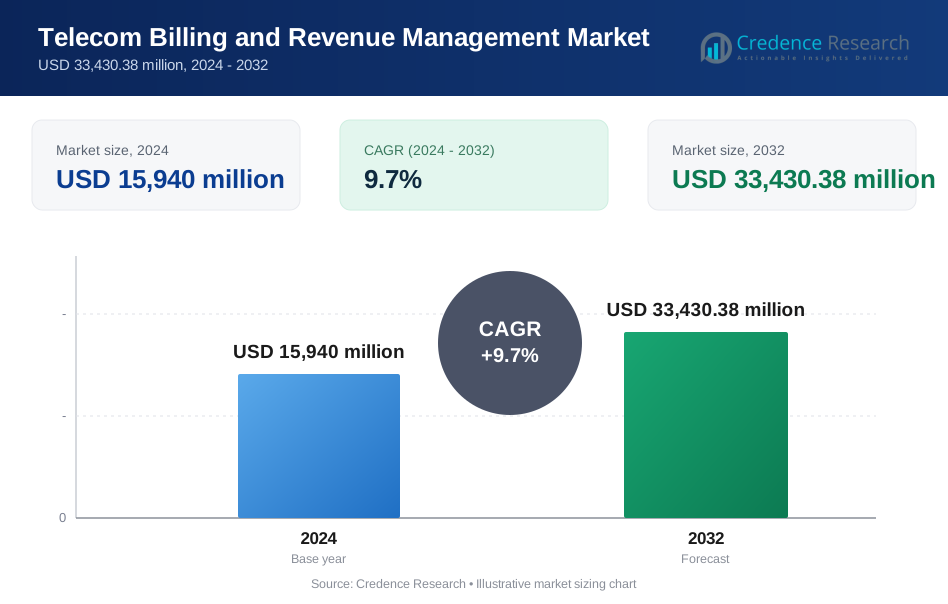
The Telecom Billing and Revenue Management Market is projected to grow from USD 15940 million in 2024 to an estimated USD 33430.38 million by 2032, with a compound annual growth rate (CAGR) of 9.7% from 2024 to 2032.
Key market drivers include the rapid expansion of the telecommunications industry, driven by increasing smartphone penetration, the rollout of 5G networks, and the proliferation of IoT devices. The growing complexity of telecom service bundles, including voice, data, and value-added services, necessitates sophisticated billing solutions that ensure accuracy, transparency, and compliance. Additionally, the shift toward digital transformation has led to the adoption of cloud-based and AI-driven billing and revenue management systems, offering scalability, real-time analytics, and enhanced customer experience. Furthermore, the growing emphasis on fraud prevention and revenue assurance drives demand for integrated solutions that minimize revenue leakage and optimize operational efficiency. These trends underscore the need for advanced telecom billing and revenue management solutions across the sector.
Regional analysis highlights North America as the leading market, supported by a well-established telecommunications infrastructure and early adoption of advanced billing technologies. Europe follows, driven by regulatory mandates and increasing adoption of digital solutions. The Asia-Pacific region is poised to experience the fastest growth, fueled by rapid urbanization, increasing smartphone penetration, and the rollout of 5G networks in countries like China and India. Meanwhile, Latin America and the Middle East & Africa are witnessing steady growth as telecom operators invest in modernizing their billing and revenue management systems to cater to expanding subscriber bases and improve operational efficiencies. These regional dynamics reflect the global shift toward advanced telecom billing and revenue management solutions.
Market Insights:
- The market is projected to grow from USD 15,940 million in 2024 to USD 33,430.38 million by 2032, reflecting a robust CAGR of 7%, driven by 5G rollouts and IoT device proliferation.
- Increasing complexity in bundled telecom services, including voice, data, and value-added offerings, necessitates sophisticated billing systems to ensure accuracy and transparency.
- The shift toward cloud-based and AI-driven platforms enhances scalability, real-time analytics, and fraud prevention, driving adoption across operators globally.
- North America leads the market with a 35% share due to its advanced telecommunications infrastructure and early adoption of innovative billing technologies.
- Asia-Pacific is the fastest-growing region, projected to exceed 30% market share by 2032, fueled by rapid urbanization and expanding 5G networks in China, India, and Japan.
- Emerging markets in Latin America and MEA present opportunities as telecom operators invest in modernizing infrastructure and expanding subscriber bases.
- Key challenges include high implementation costs, integration issues with legacy systems, and stringent regulatory compliance, requiring focused innovation and strategic investments.
Market Drivers:
Rising Complexity of Telecom Services
The increasing complexity of telecom services is a significant driver for the Telecom Billing and Revenue Management Market. With the advent of bundled offerings, including voice, data, and value-added services, telecom operators require robust billing systems to ensure accuracy and transparency. Additionally, the introduction of new services such as 5G connectivity, IoT integrations, and OTT (Over-The-Top) services has further complicated billing and revenue management processes. For instance, Ericsson's Billing and Revenue Management solutions support multi-service offerings and can handle over 1 billion transactions per day, ensuring scalability and reliability. Advanced solutions capable of handling diverse billing scenarios are essential to maintain customer trust and operational efficiency, driving the demand for sophisticated systems.
Growing Emphasis on Digital Transformation
Digital transformation across the telecom sector is reshaping billing and revenue management practices. Cloud-based solutions and AI-driven systems are becoming increasingly popular for their scalability, cost efficiency, and real-time capabilities. These technologies enable telecom providers to automate billing, reduce errors, and deliver personalized customer experiences. Moreover, real-time analytics offered by advanced platforms empower operators to make informed decisions, identify revenue leakage, and improve overall financial performance. This shift toward digital solutions underscores the importance of integrating advanced billing systems into telecom operations.
Increasing Focus on Fraud Prevention and Revenue Assurance
Telecom operators are increasingly prioritizing fraud prevention and revenue assurance as critical aspects of their operations. Revenue leakage due to fraudulent activities or billing inaccuracies can significantly impact profitability. As a result, there is growing demand for integrated solutions that combine billing, revenue management, and fraud detection capabilities. For instance, Infosys' Fraud Management and Revenue Assurance solutions leverage AI and machine learning to detect anomalies and predict risks, helping operators save up to $30 billion annually in uncollected revenue. Advanced systems equipped with AI and machine learning algorithms can identify anomalies, predict risks, and ensure compliance with regulatory standards, providing operators with a secure and reliable framework for managing their revenues.
Expansion of Telecom Networks in Emerging Markets
Emerging markets represent a significant growth driver for the telecom billing and revenue management sector. Rapid urbanization, increasing smartphone penetration, and the rollout of 5G networks in regions like Asia-Pacific, Latin America, and the Middle East are driving demand for advanced billing solutions. Telecom operators in these regions are investing in modernizing their infrastructure to cater to expanding subscriber bases and deliver seamless services. For example, the World Bank reports that investments in 5G infrastructure in emerging markets could generate up to $1.2 trillion in economic value by 2035. Additionally, regulatory requirements and competitive pressures are compelling operators to adopt efficient billing and revenue management systems to maintain their market positions.
Market Trends:
Shift Toward Subscription-Based Models
One prominent trend in the Telecom Billing and Revenue Management Market is the growing shift toward subscription-based business models. As telecom operators increasingly offer bundled services that combine voice, data, and OTT platforms, subscription plans have become central to their revenue strategies. These models require advanced billing solutions capable of handling recurring payments, usage-based pricing, and real-time adjustments. For instance, Amdocs' MarketONE platform supports subscription billing by integrating with various digital services, enabling telecom operators to manage complex billing scenarios efficiently. The rise of streaming services, cloud-based applications, and IoT devices further drives the demand for subscription management features, positioning billing systems as a critical enabler for this evolving ecosystem.
Adoption of AI and Machine Learning in Revenue Management
The integration of artificial intelligence (AI) and machine learning (ML) is revolutionizing telecom billing and revenue management. These technologies enhance predictive analytics, enabling telecom operators to forecast usage patterns, identify revenue leakage, and optimize pricing strategies. AI-driven chatbots and virtual assistants are increasingly being used for customer interactions, streamlining the billing process and improving user satisfaction. Additionally, ML algorithms are proving valuable in fraud detection, helping operators identify anomalies and mitigate risks in real-time. The adoption of AI and ML reflects the industry’s commitment to leveraging cutting-edge tools to enhance operational efficiency and decision-making.
Rise of Cloud-Based Solutions
The transition to cloud-based billing systems is a notable trend shaping the market. Cloud solutions offer scalability, cost-effectiveness, and real-time capabilities, making them an attractive option for telecom operators of all sizes. These systems facilitate faster deployment, easier updates, and seamless integration with existing infrastructure. As telecom operators aim to enhance their agility in responding to market demands, the adoption of cloud-based platforms is accelerating. This trend is particularly pronounced in emerging markets, where operators are looking to modernize their infrastructure while minimizing upfront investments.
Increasing Focus on Customer Experience
Customer experience has become a critical factor in the telecom sector, driving innovations in billing and revenue management systems. Telecom providers are prioritizing user-friendly interfaces, transparent billing practices, and real-time account management features to enhance customer satisfaction and retention. Personalization, enabled by advanced analytics, is playing a vital role in offering tailored plans and promotions. As competition intensifies, operators are leveraging their billing systems to create differentiated customer experiences, underscoring the strategic importance of these platforms in gaining a competitive edge.
Market Challenges Analysis:
High Implementation Costs
One of the major restraints in the Telecom Billing and Revenue Management Market is the high implementation cost associated with advanced systems. Deploying sophisticated billing platforms, particularly those leveraging AI, machine learning, and cloud technologies, requires substantial investment in infrastructure, software, and skilled personnel. These costs can be prohibitive for smaller telecom operators, particularly in emerging markets, where budget constraints often limit technology adoption. Additionally, ongoing maintenance and updates add to the financial burden, creating a barrier to widespread implementation.
Complexity in Integration with Legacy Systems
The integration of modern billing and revenue management solutions with existing legacy systems is a significant challenge for telecom operators. Many providers operate with outdated infrastructure that is incompatible with advanced technologies, making upgrades complex and time-consuming. This challenge is compounded by the need to maintain uninterrupted services during the transition, requiring careful planning and resource allocation. Ensuring seamless interoperability between new and legacy systems is critical but remains a complex task that slows the adoption of advanced solutions.
Regulatory Compliance and Data Security Concerns
Stringent regulatory requirements governing telecom operations and data management pose another challenge for the market. Operators must ensure compliance with varying regional and international regulations, which often necessitate extensive customization of billing systems. Additionally, the growing prevalence of cyber threats raises concerns about data security and customer privacy. Ensuring robust protection against breaches and maintaining compliance with data protection laws require significant investment, further complicating implementation efforts.
Skill Gap and Workforce Training
The rapid evolution of billing and revenue management technologies highlights a skill gap within the telecom workforce. Operators often face challenges in hiring and retaining personnel with expertise in advanced platforms, such as AI, cloud-based systems, and real-time analytics. Training existing staff to operate and manage these sophisticated tools requires time and resources, further delaying adoption.
Market Opportunities:
The Telecom Billing and Revenue Management Market presents significant growth opportunities as the global telecommunications sector undergoes rapid transformation. The ongoing rollout of 5G networks and the increasing adoption of Internet of Things (IoT) devices are driving the demand for advanced billing solutions capable of handling complex and dynamic pricing models. Telecom operators are capitalizing on this opportunity by investing in scalable platforms that offer real-time analytics, usage-based billing, and personalized customer experiences. The integration of AI and machine learning into billing systems enhances fraud detection and revenue assurance, enabling providers to maximize profitability and minimize operational risks. These technological advancements are creating opportunities for solution providers to offer innovative tools that cater to the evolving needs of the telecom industry.
Emerging markets in Asia-Pacific, Latin America, and the Middle East & Africa represent untapped potential for the market. Rapid urbanization, increasing smartphone penetration, and expanding internet access in these regions are driving the demand for modern telecom billing and revenue management systems. Governments and regulatory bodies in these markets are also encouraging the adoption of advanced solutions to streamline operations and enhance compliance. The growing preference for cloud-based platforms offers additional opportunities for providers to deliver cost-effective and scalable solutions to smaller operators with limited resources. By focusing on these emerging trends, industry players can position themselves to capture new revenue streams and foster long-term growth in this dynamic market.
Market Segmentation Analysis:
The Telecom Billing and Revenue Management Market is segmented based on solutions, telecom operator types, deployment types, and regions, reflecting its adaptability to diverse operational needs and regional dynamics.
By Solution, the market is divided into software and services. The software segment includes mediation, billing and charging, partner and interconnect management, revenue assurance, and fraud management. These software solutions address the complexity of managing diverse service bundles and ensure revenue protection. The services segment, comprising professional services and managed services, supports seamless system integration, customization, and ongoing management, catering to both small-scale and large telecom operators.
By Telecom Operator Type, the market is categorized into mobile operators, internet service providers, satellite communication providers, and cable network providers. Mobile operators dominate this segment, driven by the rollout of 5G networks and increasing smartphone penetration. Internet service providers are also significant contributors as broadband demand continues to rise globally.
By Deployment Type, the market is divided into cloud and on-premises solutions. Cloud-based systems are gaining traction due to their scalability, cost efficiency, and ease of integration, making them ideal for dynamic and growing telecom environments. On-premises solutions, preferred for their control and data security, remain relevant for operators with stringent regulatory requirements.
By Region, North America leads the market with advanced infrastructure and high technology adoption, while Asia-Pacific is the fastest-growing region due to rapid urbanization and expanding telecom networks. Europe, Latin America, and MEA are also contributing steadily, with investments in modernization and digital transformation initiatives. This segmentation highlights the market's broad scope and ability to address the diverse needs of the global telecom industry.
Segmentation:
By Solution:
- Software
- Mediation
- Billing and Charging
- Partner and Interconnect Management
- Revenue Assurance
- Fraud Management
- Services
- Professional Services
- Managed Services
By Telecom Operator Type:
- Mobile Operators
- Internet Service Providers
- Satellite Communication Providers
- Cable Network Providers
By Deployment Type:
- Cloud
- On-Premises
By Region:
- North America
- U.S.
- Canada
- Mexico
- Europe
- Germany
- France
- U.K.
- Italy
- Spain
- Rest of Europe
- Asia Pacific
- China
- Japan
- India
- South Korea
- South-east Asia
- Rest of Asia Pacific
- Latin America
- Brazil
- Argentina
- Rest of Latin America
- Middle East & Africa
- GCC Countries
- South Africa
- Rest of the Middle East and Africa
Regional Analysis:
The Telecom Billing and Revenue Management Market showcases varying growth dynamics across major regions, shaped by factors such as technological adoption, regulatory frameworks, and industry maturity. The key regions analyzed include North America, Europe, Asia-Pacific, Latin America, and the Middle East & Africa (MEA), each contributing uniquely to the market's overall expansion.
North America leads the market, holding approximately 35% of the global share in 2024. This dominance is driven by the region’s well-established telecommunications infrastructure, early adoption of advanced technologies, and high penetration of 5G networks. The United States is at the forefront, with telecom operators leveraging AI-driven and cloud-based billing systems to optimize revenue streams and enhance customer experiences. Regulatory mandates for transparency in billing and fraud prevention further support market growth in this region.
Europe captures around 25% of the market share, benefiting from stringent regulatory frameworks and widespread adoption of digital solutions. Countries such as Germany, the UK, and France are leading adopters of sophisticated billing platforms to manage complex service bundles and ensure compliance with data protection laws. The region's focus on sustainability and innovation drives the adoption of energy-efficient and scalable telecom solutions, fostering steady market growth.
Asia-Pacific is the fastest-growing region, projected to increase its market share from 20% in 2024 to over 30% by 2032. Rapid urbanization, growing smartphone penetration, and the rollout of 5G networks in countries like China, India, and Japan fuel demand for advanced billing and revenue management systems. The region’s telecom operators are investing heavily in modernizing their infrastructure to cater to a massive and growing subscriber base. Government initiatives promoting digital transformation and expanding internet access further accelerate market adoption.
Latin America accounts for approximately 10% of the market, with growth driven by increasing internet connectivity and smartphone adoption. Brazil and Mexico are key contributors, focusing on modernizing their telecom infrastructure and adopting cloud-based solutions to improve operational efficiency and customer engagement.
The Middle East & Africa (MEA) holds the remaining 10% market share, showcasing steady growth due to expanding telecom services and rising investments in infrastructure. Countries like Saudi Arabia, the UAE, and South Africa are embracing advanced billing systems to meet the demands of an increasingly connected population and ensure revenue assurance.
Key Player Analysis:
- Comviva
- CSG Systems, Inc.
- Amdocs
- Cerillion Technologies Ltd
- Comarch SA
- Formula Telecom Solutions Ltd
- Huawei Technologies Co., Ltd
- Oracle
- SAP SE
- Intracom Telecom
- Netcracker
- Optiva, Inc.
- STL Tech
- SUBEX
- Telefonaktiebolaget LM Ericsson
Competitive Analysis:
The Telecom Billing and Revenue Management Market is highly competitive, with global and regional players vying to address the dynamic needs of the telecommunications industry. Leading companies such as Amdocs, Oracle Corporation, Ericsson, and Huawei Technologies dominate the market with their comprehensive portfolios of advanced billing and revenue management solutions. These players leverage innovative technologies, including AI, machine learning, and cloud-based platforms, to deliver scalable and efficient systems that cater to complex telecom service offerings. Regional players and niche providers also contribute significantly by offering tailored solutions for specific markets, particularly in emerging economies. Strategic initiatives such as mergers, acquisitions, and partnerships are common, allowing companies to expand their reach and strengthen their technological capabilities. The rising focus on customer-centric solutions and regulatory compliance drives competition further, as market participants strive to differentiate themselves through innovation, service quality, and cost efficiency.
Recent Developments:
- In May 2024, Ooredoo, a leading multinational telecommunications provider based in Qatar, expanded its partnership with Netcracker, a prominent player in telecom billing and revenue management. Ooredoo leverages Netcracker's digital BSS product suite and managed services support to enhance its operational efficiency and service offerings in the Middle East.
- In April 2024, Optiva Inc., a key provider of cloud-native billing and revenue management solutions, partnered with GDi Group, a digital technology and software organization. The collaboration aims to deliver pre-integrated and tested BSS and OSS software solutions to communication service providers (CSPs), streamlining their operations and enabling advanced service delivery.
- In March 2023, Spectrum Enterprise, a division of Charter Communications, expanded its partnership with Netcracker Technology. Spectrum Enterprise selected Netcracker Revenue Management as its unified billing platform, enabling streamlined operations, enhanced efficiency, and improved customer service for its scalable fiber technology solutions.
- In January 2023, Ericsson collaborated with Ooredoo Kuwait to implement Ericsson's billing system across Ooredoo’s network. This upgrade supported the rollout of competitive marketing plans for 5G products and facilitated the evolution of 5G technology across the network.
- In July 2022, CommScope Holding Company Inc. partnered with Microsoft Inc. to develop converged private wireless solutions. Utilizing Microsoft Azure Private MEC, CommScope integrated its CBRS access points to deliver a cloud-connected private wireless network, enhancing operational efficiency and agility in manufacturing processes.
- In June 2022, Altice Europe N.V. selected Netcracker Technology, a subsidiary of NEC Corporation, to provide Netcracker Cloud BSS and professional services. These SaaS-based solutions improved revenue management capabilities across Altice’s divisions in France, Israel, Portugal, the Dominican Republic, and the USA, advancing the company's digital transformation efforts.
Market Concentration & Characteristics:
The Telecom Billing and Revenue Management Market is moderately concentrated, with a mix of established global players and emerging regional providers. Dominant companies like Amdocs, Oracle Corporation, Ericsson, and Huawei Technologies hold significant market shares, leveraging their robust portfolios and strong presence across multiple regions. These players drive innovation through investments in cloud-based, AI-driven, and scalable billing solutions, catering to the growing complexity of telecom services. The market is characterized by rapid technological advancements, particularly in real-time analytics, fraud prevention, and personalized customer billing systems. Competition is further fueled by niche players addressing specific regional or operational requirements, particularly in emerging economies. Regulatory compliance and data security concerns significantly influence market offerings, compelling providers to design flexible and customizable solutions. The focus on operational efficiency, customer experience, and revenue optimization defines the evolving dynamics of the telecom billing and revenue management sector.
Report Coverage:
The research report offers an in-depth analysis based on By Solution, By Telecom Operator Type, By Deployment Type and By Region. It details leading market players, providing an overview of their business, product offerings, investments, revenue streams, and key applications. Additionally, the report includes insights into the competitive environment, SWOT analysis, current market trends, as well as the primary drivers and constraints. Furthermore, it discusses various factors that have driven market expansion in recent years. The report also explores market dynamics, regulatory scenarios, and technological advancements that are shaping the industry. It assesses the impact of external factors and global economic changes on market growth. Lastly, it provides strategic recommendations for new entrants and established companies to navigate the complexities of the market.
Future Outlook:
- Expansion of 5G networks will drive demand for advanced billing systems capable of managing dynamic pricing and complex service bundles.
- Increasing adoption of IoT devices will require scalable solutions to handle diverse and interconnected billing scenarios.
- AI and machine learning will play a larger role in fraud detection, revenue assurance, and customer personalization.
- Growth in subscription-based models for telecom services will create opportunities for platforms with recurring billing capabilities.
- Cloud-based solutions will dominate due to their scalability, cost efficiency, and real-time processing capabilities.
- Emerging markets in Asia-Pacific, Latin America, and MEA will offer significant growth potential due to urbanization and expanding telecom infrastructure.
- Enhanced data security features will become critical as regulatory requirements for privacy and compliance evolve globally.
- Increasing focus on customer-centric strategies will drive demand for platforms that enable real-time account management and tailored services.
- Partnerships between telecom operators and technology providers will accelerate innovation and deployment of advanced billing solutions.
- Competitive pressures will encourage continuous improvement in operational efficiency, ensuring sustained market growth.
Request a Free Sample
Fill in your details and we'll send you a free sample report.
- Sample data tables & charts
- Research methodology
Need a Custom Version of This Report?
Tailor the scope, geography, or segments to your exact requirements.
- Custom geography or segment scope
- Direct access to our analyst team
Frequently Asked Questions
What is the projected growth of the Telecom Billing and Revenue Management Market?
What are the key drivers of market growth?
Which region dominates the market?
What challenges does the market face?
Table of Content
Chapter 1. Report Introduction
- 1.1 Report Description & Purpose
- 1.1.1 Report Title & Market Definition
- 1.1.2 Unique Selling Propositions (USP) & Key Differentiators
- 1.1.3 Value Proposition for Stakeholders
- 1.2 Research Objectives
- 1.2.1 Market Sizing Objectives (Volume & Revenue)
- 1.2.2 Segmentation Objectives
- 1.2.3 Competitive Intelligence Objectives
- 1.2.4 Forecast & Scenario Objectives
- 1.3 Report Scope
- 1.3.1 Telecom Billing and Revenue Management Scope – Types & Subtypes Covered
- 1.3.2 Geographic Scope – Regions & Countries Covered
- 1.3.3 Historical Period, Base Year & Forecast Period (2024; forecast to 2032)
- 1.3.4 Inclusions & Exclusions
- 1.4 HS Code & Classification Framework
- 1.5 Currency, Units & Pricing Basis
- 1.6 Target Stakeholders
- 1.7 Limitations & Assumptions
Chapter 2. Executive Summary
- 2.1 Global Telecom Billing and Revenue Management Market Snapshot
- 2.1.1 Market Size – Historical (2024) & Forecast (2024-2032) (2024: USD 15,940 million → 2032: USD 33,430.38 million)
- 2.1.2 Volume & Revenue – Global Totals
- 2.1.3 Key Market Highlights – Top Five Facts
- 2.2 Telecom Billing and Revenue Management Market Segmentation Snapshot
- 2.2.1 Market Split by Region – 2024 vs. 2032
- 2.3 Competitive Snapshot
- 2.3.1 Top 10 Players by Revenue Share – 2024
- 2.3.2 Top 10 Players by Volume Share – 2024
- 2.3.3 Recent Strategic Developments (18-Month Summary)
- 2.4 Key Investment Highlights & Strategic Conclusions
Chapter 3. Telecom Billing and Revenue Management Market Dynamics & Industry Analysis
- 3.1 Market Overview & Context
- 3.1.1 Telecom Billing and Revenue Management Market Position in the Broader Automotive Value Chain
- 3.1.2 OEM vs. Replacement Market Dynamics
- 3.1.3 Market Maturity & Development Stage by Region
- 3.2 Telecom Billing and Revenue Management Market Drivers
- 3.3 Telecom Billing and Revenue Management Market Restraints & Challenges
- 3.4 Telecom Billing and Revenue Management Market Opportunities
- 3.5 Porter's Five Forces Analysis
- 3.5.1 Threat of New Entrants
- 3.5.2 Bargaining Power of Suppliers
- 3.5.3 Bargaining Power of Buyers
- 3.5.4 Threat of Substitutes
- 3.5.5 Competitive Rivalry – Intensity Assessment
- 3.6 Telecom Billing and Revenue Management Value Chain Analysis
- 3.6.1 Upstream – Raw Material/Input Suppliers
- 3.6.1.1 Raw Material/Input 1
- 3.6.1.2 Raw Material/Input 2
- 3.6.1.3 Raw Material/Input 3
- 3.6.2 Midstream – Production/Manufacturing/Service Delivery
- 3.6.2.1 Production/Process Overview
- 3.6.2.2 Key Facility Locations & Capacity by Manufacturer
- 3.6.3 Downstream – Distribution & End Consumer
- 3.6.3.1 Primary Channel – B2B/OEM
- 3.6.3.2 Secondary Channels – Dealer, Retail, Online, Direct
- 3.6.4 Value Chain Profitability Analysis
- 3.6.1 Upstream – Raw Material/Input Suppliers
- 3.7 PESTEL Analysis
- 3.7.1 Political Factors
- 3.7.2 Economic Factors
- 3.7.3 Social Factors
- 3.7.4 Technological Factors
- 3.7.5 Environmental Factors
- 3.7.6 Legal Factors
- 3.8 Telecom Billing and Revenue Management Supply Chain Analysis
- 3.8.1 Raw Material/Input Supply Risk Assessment
- 3.8.2 Manufacturing Concentration Risk (Geographic Exposure)
- 3.8.3 Trade Disruption Impact Analysis
- 3.9 Regulatory & Policy Landscape
Note: The regulatory and policy landscape section covers regulations based on their applicability to the market, Telecom Billing and Revenue Management category, geography, and scope of the study. Only regulatory frameworks with a material impact on operations, compliance, trade, sustainability, or market access are analyzed in detail.
Chapter 4. Key Investment Pockets & Opportunity Analysis
- 4.1 Telecom Billing and Revenue Management Market Attractiveness Analysis
- 4.1.1 By Region – Investment Attractiveness Matrix (Volume × CAGR)
- 4.2 Absolute Revenue Growth Opportunity
- 4.2.1 By Region – Absolute USD Growth Through 2032
- 4.3 Incremental Volume Opportunity
- 4.3.1 By Region – Incremental Volume Through 2032
- 4.3.2 Segment – Incremental Volume
- 4.4 Emerging Submarket Opportunity Deep Dive (Subject to Applicability)
- 4.5 Emerging Market Opportunity Scorecards
- 4.5.1 United States
- 4.5.2 Europe
- 4.5.3 Asia
- 4.5.4 Middle East & Africa
Note: Emerging Market Opportunity Scorecards will be included based on relevance and strategic importance. Regions listed are indicative and may vary depending on data availability and market dynamics.
Chapter 5. Telecom Billing and Revenue Management Import-Export Analysis & Trade Flows
- 5.1 Global Trade Overview
- 5.1.1 Global Export Value by Country (2024)
- 5.1.2 Global Export Volume by Country (2024)
- 5.1.3 Global Import Value by Country (2024)
- 5.1.4 Global Import Volume by Country (2024)
- 5.1.5 Net Trade Balance by Country (2024)
- 5.2 Export Analysis – Segment
- 5.2.1 Type 1 (HS Code)
- 5.2.2 Type 2 (HS Code)
- 5.2.3 Type 3 (HS Code)
- 5.2.4 Type 4 (HS Code)
- 5.2.5 Type 5 (HS Code)
- 5.3 Import Analysis – Segment
- 5.3.1 Type 1 (HS Code)
- 5.3.2 Type 2 (HS Code)
- 5.3.3 Type 3 (HS Code)
- 5.3.4 Type 4 (HS Code)
- 5.3.5 Type 5 (HS Code)
- 5.4 Average Unit Trade Prices
- 5.4.1 Average Export Price – Segment & Country
- 5.4.2 Average Import Price – Segment & Source Country
- 5.4.3 Price Trends (2024)
- 5.5 Key Trade Route Analysis
- 5.5.1 Trade Route 1
- 5.5.2 Trade Route 2
- 5.5.3 Trade Route 3
- 5.5.4 Trade Route 4
- 5.5.5 Trade Route 5
- 5.6 Trade Policy Impact Assessment
- 5.6.1 US Anti-Dumping & Section 301 Tariffs
- 5.6.2 EU Customs Union Impact
- 5.6.3 Major Free Trade Agreements
- 5.6.4 USMCA Rules of Origin
Note: Trade policy analysis will be included only where relevant to the Telecom Billing and Revenue Management market.
Chapter 6. Competitive Landscape & Company Benchmarking
- 6.1 Telecom Billing and Revenue Management Market Concentration & Structure
- 6.1.1 Herfindahl-Hirschman Index (HHI) – vs. 2024
- 6.1.2 Tier 1, Tier 2 & Tier 3 Market Structure
- 6.1.3 Global, Regional & Local Player Dynamics
- 6.2 Telecom Billing and Revenue Management Market Share Analysis – 2024
- 6.2.1 Global Revenue Share by Company
- 6.2.2 Global Volume Share by Company
- 6.2.3 Regional Revenue Share
- 6.2.4 Market Share Evolution ( vs. 2024)
- 6.2.5 OEM Segment Share by Company
- 6.2.6 Replacement Segment Share by Company
- 6.3 Production/Delivery Capacity & Facility Analysis
- 6.3.1 Global Installed Capacity
- 6.3.2 Capacity Utilization Rates
- 6.3.3 Production/Output Volume
- 6.3.4 Facility Locations & Capacity Map
- 6.3.5 Planned Capacity Additions
- 6.4 Telecom Billing and Revenue Management Competitive Benchmarking Matrix
- 6.4.1 Revenue, Volume, CAGR & Profitability Comparison
- 6.4.2 Channel Revenue Mix
- 6.4.3 Geographic Revenue Exposure
- 6.4.4 R&D Intensity
- 6.4.5 Sustainability Maturity
- 6.5 Strategic Developments in Telecom Billing and Revenue Management (Last 24 Months)
- 6.5.1 Mergers, Acquisitions & Divestments
- 6.5.2 New Telecom Billing and Revenue Management Launches
- 6.5.3 Facility Expansions
- 6.5.4 Strategic Alliances, Joint Ventures & Partnerships
- 6.5.5 Distribution Expansion & Market Entry
- 6.5.6 Sustainability & ESG Initiatives
- 6.6 Competitive Strategy Mapping
- 6.6.1 Leader, Challenger, Follower & Niche Classification
- 6.6.2 Pricing Strategy Comparison
- 6.6.3 Channel Strategy Matrix
Note: Strategic developments are included based on their materiality and the availability of reliable information.
Chapter 7. Global Telecom Billing and Revenue Management Market – By Distribution Channel
- 7.1 Segment Overview
- 7.1.1 Volume & Revenue Split by Channel (2024 & 2032)
- 7.1.2 Channel Mix Evolution (2024-2032)
Chapter 8. Regional Market Analysis – Global Overview
- 8.1 Global Regional Overview
- 8.1.1 Regional Volume Share
- 8.1.2 Regional Revenue Share
- 8.1.3 Regional Volume by Region
- 8.1.4 Regional Revenue by Region
- 8.1.5 Regional Forecast Through 2032
- 8.2 Cross-Regional Segment Analysis
- 8.2.1 By Distribution Channel
- 8.2.2 By Brand/Price Tier
Chapter 9. North America Telecom Billing and Revenue Management Market
- 9.1 United States
- 9.2 Canada
- 9.3 Mexico
Chapter 10. Europe Telecom Billing and Revenue Management Market
- 10.1 Germany
- 10.2 France
- 10.3 Italy
- 10.4 United Kingdom
- 10.5 Spain
- 10.6 Poland
- 10.7 Russia
- 10.8 Netherlands
- 10.9 Belgium
- 10.10 Sweden
- 10.11 Denmark
- 10.12 Norway
- 10.13 Rest of Europe
Chapter 11. Asia Pacific Telecom Billing and Revenue Management Market
- 11.1 China
- 11.2 India
- 11.3 Japan
- 11.4 South Korea
- 11.5 Thailand
- 11.6 Indonesia
- 11.7 Vietnam
- 11.8 Malaysia
- 11.9 Australia
- 11.10 Rest of Asia Pacific
Chapter 12. Latin America Telecom Billing and Revenue Management Market
- 12.1 Brazil
- 12.2 Argentina
- 12.3 Colombia
- 12.4 Chile
- 12.5 Rest of Latin America
Chapter 13. Middle East Telecom Billing and Revenue Management Market
- 13.1 Saudi Arabia
- 13.2 United Arab Emirates
- 13.3 Turkey
- 13.4 Israel
- 13.5 Iran
- 13.6 Rest of the Middle East
Chapter 14. Africa Telecom Billing and Revenue Management Market
- 14.1 South Africa
- 14.2 Egypt
- 14.3 Nigeria
- 14.4 Morocco
- 14.5 Rest of Africa
Chapter 15. Telecom Billing and Revenue Management Company Profiles
- 15.1 [Company 01]
- 15.1.1 Company Overview
- 15.1.2 Key Management Personnel
- 15.1.3 Products & Services Portfolio
- 15.1.4 Financial Performance
- 15.1.5 Key Market Focus & Geographic Presence
- 15.1.6 Recent Developments & Strategic Initiatives
Note: The company profile list is preliminary and may change based on research findings, market developments, data availability, and client requirements.
Chapter 16. Appendices
- Appendix A – List of Abbreviations & Acronyms
- Appendix B – Industry Classification Code Reference – Full Series
- Appendix C – Production & Capacity Data Tables
- Appendix D – End-Use & Demand Base Tables
- Appendix E – Consumption & Replacement Rate Assumptions
- Appendix F – ASP Reference Tables
- Appendix G – Manufacturing & Facility Database
- Appendix H – Import-Export Data Tables
- Appendix I – Regulatory Summary Tables
- Appendix J – Primary Research Participant List (Anonymized)
- Appendix K – Primary Research Questionnaire Framework
- Appendix L – Data Sources & Bibliography
- Appendix M – Market Size Divergence & Source Comparison
Chapter 17. Research Methodology
- 17.1 Research Framework & Philosophy
- 17.2 Secondary Research – Sources, Hierarchy & Data Extraction
- 17.3 Data Modeling – Bottom-Up & Top-Down Market Sizing
- 17.4 Primary Research – Stakeholder Framework, LOI & Sample Sizes
- 17.5 Forecast Methodology – Regression, Scenario & Sensitivity Analysis
- 17.6 Quality Control – Four-Layer Validation Framework
- 17.7 Limitations & Standard Assumptions
- 17.8 Disclaimer
