
Market Overview
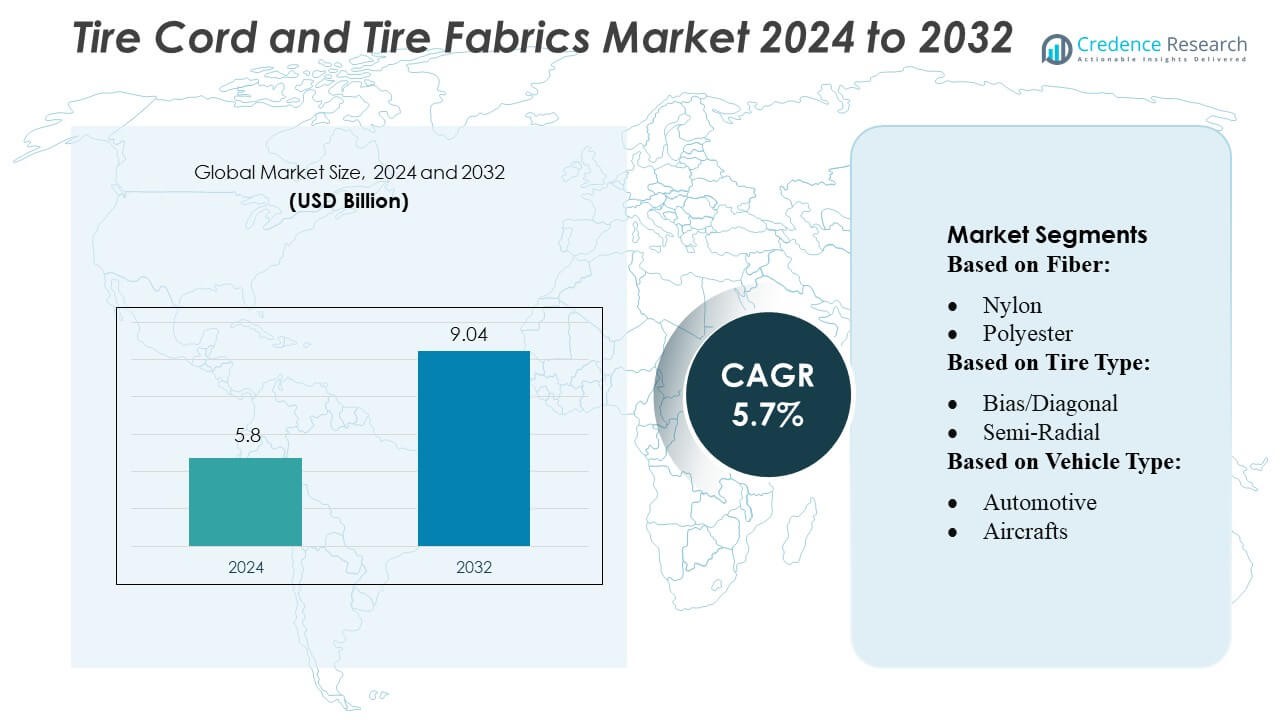
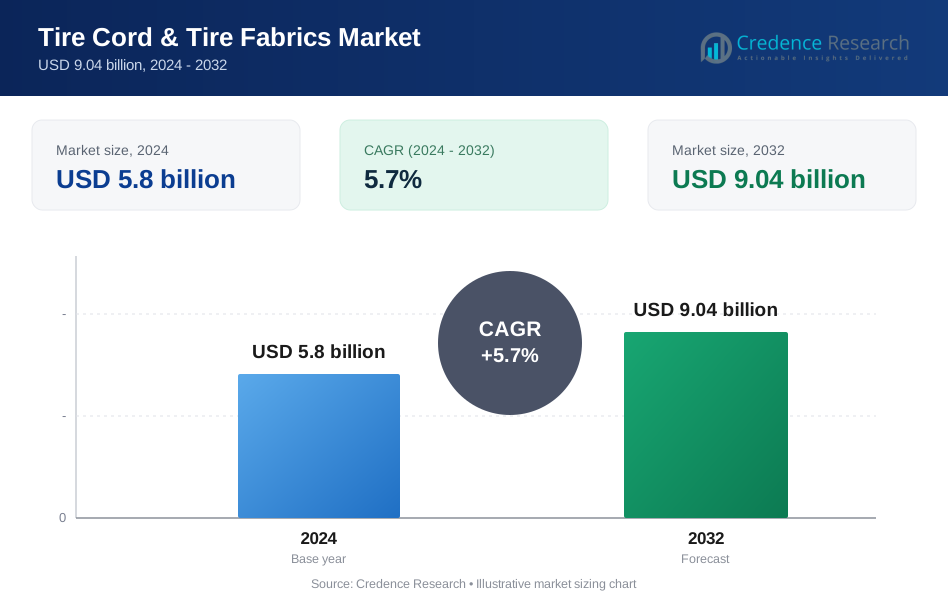
Tire Cord and Tire Fabrics Market size was valued USD 5.8 billion in 2024 and is anticipated to reach USD 9.04 billion by 2032, at a CAGR of 5.7% during the forecast period.
| REPORT ATTRIBUTE | DETAILS |
|---|---|
| Historical Period | 2020-2023 |
| Base Year | 2024 |
| Forecast Period | 2025-2032 |
| Switchable Smart Film Market Size 2024 | USD 5.8 Billion |
| Tire Cord and Tire Fabrics Market, CAGR | 5.7% |
| Tire Cord and Tire Fabrics Market Size 2032 | USD 9.04 Billion |
The tire cord and tire fabrics market including Toray Industries, Hengli Petrochemical, Far Eastern New Century, Eclat Textile, Vardhman Textiles, Chargeurs SA, Sasa Polyester, Shenzhou International, Inditex, and TJX Companies — actively compete on innovation, quality, and global scale. These leaders invest in high-strength polyester, nylon, and aramid fibers to meet demanding OEM specifications and advance tire performance. Many firms expand capacity, improve dipping technologies, and form strategic partnerships to optimize cost and sustainability. The Asia-Pacific region leads the market, accounting for approximately 45 % of global demand, driven by surging vehicle production, expanding electric-vehicle adoption, and robust tire manufacturing infrastructure across China, India, and Southeast Asia.
Market Insights
- The tire cord and tire fabrics market reached USD 5.8 billion in 2024 and is projected to hit USD 9.04 billion by 2032, growing at a CAGR of 5.7%, supported by rising demand for durable and high-performance tire reinforcement materials.
- Increasing vehicle production and the shift toward radial and electric-vehicle tires drive strong demand for high-strength polyester, nylon, and aramid cords across both OEM and replacement tire segments.
- Advanced material innovations, capacity expansions, and improved dipping technologies strengthen competition as leading companies focus on durability, sustainability, and cost efficiency.
- Challenges arise from fluctuating raw-material prices, high production costs, and the need for continuous quality upgrades, which pressure manufacturers to improve efficiency and adopt modern processing systems.
- The Asia-Pacific region holds about 45% of the global market share and remains the fastest-growing region, while the polyester cord segment leads overall consumption, driven by its cost-effectiveness, strength, and wide applicability in passenger and commercial vehicle tires.
Market Segmentation Analysis:
By Fiber
Nylon dominates the Tire Cord and Tire Fabrics market, holding the largest share due to its high tensile strength, fatigue resistance, and suitability for heavy-duty applications. Its strong adhesion to rubber compounds and cost-effectiveness drive extensive use in truck, bus, and two-wheeler tires. Polyester follows as a rapidly expanding segment because of its dimensional stability and lower shrinkage, supporting its adoption in passenger car tires. Rayon, aramid, glass, and PVA fibers serve niche applications where enhanced heat resistance, superior stiffness, or premium reinforcement is required, further diversifying material demand across tire categories.
- For instance, high-tenacity nylon 6 tire cord fabrics from various manufacturers generally exhibit a tenacity within the typical industry range of about 7.8–8.5 cN/tex for standard specifications. Meanwhile, in high-denier tire cords, a common specification like a 1260/3 nylon cord typically achieves an average breaking strength of around 303–305 N/end across the industry.
By Tire Type
Radial tires account for the dominant market share, propelled by their superior fuel efficiency, reduced rolling resistance, and longer service life. Their strong preference in passenger vehicles, commercial fleets, and off-road equipment reinforces sustained demand for radial-specific cords and fabrics. Bias/diagonal tires continue to hold measurable adoption in agricultural machinery, industrial vehicles, and select off-road segments due to their durability and load-bearing capability. Semi-radial tires represent a smaller but steadily developing category as manufacturers explore hybrid structures that balance flexibility and strength for targeted performance needs.
- For instance, Eagle Roofing Products launched Secure Guard 60, a self-adhering polymer-modified bituminous underlayment, in 2024. The product is indeed called Secure Guard 60, a 60 mil self-adhering, polymer-modified bituminous underlayment.
By Vehicle Type
The automotive segment leads the market with the highest share, driven by large-scale global tire production for passenger cars, SUVs, and commercial vehicles. Rising vehicle parc, replacement tire demand, and OEM emphasis on lightweight reinforcement materials strengthen this dominance. Aircraft tires contribute a specialized segment requiring high-strength aramid and nylon cords to withstand extreme landing forces and thermal stress. Industrial products—including forklifts, mining machinery, and construction equipment—maintain consistent demand due to heavy load cycles, while the “others” category supports specialty applications such as bicycles, defense vehicles, and high-performance racing tires.
Key Growth Drivers
- Rising Global Tire Production and Replacement Demand Growing vehicle ownership across emerging and developed markets continues to accelerate tire production volumes, directly boosting demand for tire cords and fabrics. The increasing replacement cycle of passenger and commercial tires further supports consistent procurement of reinforcement materials. Manufacturers prioritize materials that enhance durability, improve load-bearing capacity, and reduce rolling resistance, strengthening the use of advanced fiber reinforcements. Expanding logistics networks and e-commerce activities also drive higher commercial vehicle utilization, amplifying tire wear rates and reinforcing long-term demand for high-performance tire cords.
- For instance, Eagle Roofing's Secure Guard 60 is a 60-mil thick, self-adhering underlayment launched in July 2024 to serve as a robust leak barrier for steep-slope roofs.
- Shift Toward High-Performance and Fuel-Efficient Tires Automakers and tire manufacturers increasingly adopt reinforcement materials that support low rolling resistance and lightweight construction to meet stringent fuel-efficiency and emission standards. High-modulus polyester, aramid, and hybrid composite cords gain traction due to their ability to enhance tire strength while reducing weight. This shift aligns with the rising adoption of radial tires in passenger and commercial vehicles. Technological improvements in cord-fabric bonding, thermal stability, and fatigue resistance further encourage the integration of advanced fabrics in next-generation tires designed for superior performance and safety.
- For instance, Arctech (full name: Arctech Solar Holding Co., Ltd.) has deployed more than 100 GW of solar tracking and racking systems globally, with utility-level projects accounting for the majority of this capacity, showcasing its technological ability to scale renewable integration.
- Expansion of Electric and Off-Highway Vehicle Markets The growing electrification of mobility significantly influences tire design, with EVs requiring stronger reinforcement materials to handle higher torque, heavier battery loads, and increased heat generation. Tire cords with enhanced stiffness and improved cyclic endurance witness rising adoption in EV tire production. Parallelly, the expansion of construction, agriculture, and mining sectors accelerates demand for off-highway tires that require heavy-duty reinforcement fabrics. These specialized applications stimulate innovation in nylon, polyester, and aramid cords optimized for extreme operating conditions, promoting sustained market growth.
Key Trends & Opportunities
- Rapid Adoption of High-Strength Synthetic and Hybrid Materials A key trend shaping the market is the increased use of advanced fiber blends and hybrid cords that combine materials such as aramid, rayon, and nylon to achieve optimized stiffness and fatigue resistance. Manufacturers explore hybrid reinforcement technologies to meet performance requirements for high-speed, ultra-high-performance, and EV tires. This trend creates opportunities for material innovation and strategic partnerships between fiber producers and tire companies. The push toward enhanced durability, thermal stability, and sustainability fosters further development of next-generation synthetic reinforcement systems.
- For instance, AllEarth Renewables’ Fixed Ground Mount system supports between 12 and 60 solar modules per structure, with system widths ranging from 18.8 feet to 93.8 feet and a maximum installed height of 7.5 feet, demonstrating a scalable and durable solution for cost-effective deployment.
- Growing Focus on Sustainable and Eco-Efficient Manufacturing Sustainability initiatives across the tire industry drive opportunities for bio-based fibers, recyclable reinforcement materials, and energy-efficient production processes. Tire manufacturers seek materials with lower environmental impact while maintaining strength and performance. Polyester made from recycled PET bottles and emerging bio-rayon fibers gains attention as viable alternatives. Improving process efficiency in dipping, weaving, and bonding also supports reduced emissions and waste. These trends open new avenues for environmentally conscious suppliers and position sustainability as a competitive differentiator in the reinforcement materials market.
- For instance, Product datasheets and reports confirm that panels in the LG NeON H series typically came in configurations of 120 or 144 half-cells [1, 4]. LG NeON H BiFacial 72-cell module (equivalent to 144 half-cells) was a specific product configuration.
- Increasing Automation and Digitalization in Fabric Production Manufacturers increasingly integrate automated weaving, precision dipping, and AI-enabled quality control systems to improve consistency and reduce material waste. Advanced digital monitoring solutions enhance real-time defect detection, optimizing throughput and ensuring uniform fiber reinforcement. These technologies support higher productivity, lower operational costs, and improved tensile quality of tire fabrics. As tire companies demand tighter performance tolerances, automation and smart manufacturing create a significant opportunity for suppliers to upgrade production capabilities and deliver premium, high-precision reinforcement materials.
Key Challenges
- Volatile Raw Material Prices and Supply Chain Pressures Fluctuations in the prices of nylon, polyester, rayon, and aramid feedstock impose cost pressures on manufacturers. Supply disruptions stemming from geopolitical factors, energy price volatility, or logistical constraints further complicate procurement planning. Since tire cords require specialized chemical treatments and precision manufacturing, any instability in raw material availability increases production costs and affects profitability. Manufacturers must balance price volatility with consistent quality standards, making long-term strategic sourcing and supply chain resilience critical challenges for the industry.
- Increasing Performance Requirements and Compliance Standards Tire manufacturers face stricter performance, safety, and sustainability regulations, pushing reinforcement material suppliers to continually upgrade their product specifications. Meeting advanced heat resistance, fatigue endurance, and bonding requirements demands substantial investment in R&D and process optimization. Additionally, tires for EVs, aircraft, and heavy-duty vehicles require highly specialized reinforcement fabrics, raising the technical complexity of production. Ensuring consistent quality at scale while complying with global regulatory frameworks remains a significant operational and financial challenge for market participants.
Regional Analysis
North America
North America holds about 18–25% of the tire cord and tire fabrics market, supported by strong automobile production and a large replacement-tire sector. The region shows steady demand for durable polyester, nylon, and steel cords due to growing usage of light trucks, SUVs, and electric vehicles. Manufacturers benefit from strict safety standards that encourage high-quality reinforcing materials. The presence of major tire companies and advanced manufacturing facilities further supports consistent growth. Additionally, increasing consumer preference for premium and high-performance tires boosts the adoption of advanced tire fabrics.
Europe
Europe accounts for roughly 20–23% of the global market, driven by strong demand from premium car manufacturers and a well-established tire industry. The region increasingly adopts advanced polyester and aramid-based tire cords due to fuel-efficiency and sustainability targets. Strict EU regulations promote lightweight and durable materials, supporting growth in high-strength reinforcing fabrics. Countries including Germany, France, and Italy lead consumption. Demand also grows from the growing electric-vehicle segment, which requires high-performance tire construction. Europe’s focus on innovation and environmentally responsible materials reinforces its stable market position.
Asia-Pacific
Asia-Pacific dominates the market with about 40–50% share, making it the largest regional contributor. Rapid vehicle production in China, India, Japan, and Southeast Asia significantly drives tire cord and fabric consumption. The region benefits from large manufacturing bases, easy raw-material access, and growing passenger and commercial vehicle fleets. Rising demand for radial tires and expanding electric-vehicle adoption further boost growth. Many global and local tire manufacturers continue to invest in new facilities across Asia, strengthening supply capability. Asia-Pacific’s strong economic activity and cost-efficient production keep it the primary growth engine.
Latin America
Latin America holds around 5–8% of the market, with demand mainly supported by Brazil, Mexico, and Argentina. Vehicle ownership continues to rise, and the region shows growing need for replacement tires, which drives consumption of tire cords and fabrics. Although local production capacities are limited, imports fill much of the regional requirement. Development of logistics and commercial fleets increases demand for durable reinforcing materials. Economic improvements and expansion in automotive servicing networks further support steady growth. The region remains an emerging but promising market for global suppliers.
Middle East & Africa
The Middle East & Africa region contributes about 5–10% of the market, driven by rising infrastructure development, expanding logistics activity, and growth in commercial vehicles. Countries like Saudi Arabia, UAE, Turkey, and South Africa lead consumption. Most tire cord and fabric demand is met through imports due to low local production capacity. Increasing construction and transport needs continue to boost tire usage, especially for heavy-duty vehicles. Steady urbanization and economic diversification efforts across the region support gradual market growth, making MEA a developing but steadily expanding segment.
Market Segmentations:
By Fiber:
- Nylon
- Polyester
By Tire Type:
- Bias/Diagonal
- Semi-Radial
By Vehicle Type:
- Automotive
- Aircrafts
By Geography
- North America
- U.S.
- Canada
- Mexico
- Europe
- Germany
- France
- U.K.
- Italy
- Spain
- Rest of Europe
- Asia Pacific
- China
- Japan
- India
- South Korea
- South-east Asia
- Rest of Asia Pacific
- Latin America
- Brazil
- Argentina
- Rest of Latin America
- Middle East & Africa
- GCC Countries
- South Africa
- Rest of the Middle East and Africa
Competitive Landscape
The competitive landscape of the Tire Cord and Tire Fabrics Market players such as TJX Companies, Toray Industries, Inc., Chargeurs SA, Far Eastern New Century Corporation, Hengli Petrochemical Co., Ltd., Eclat Textile Co. Ltd, Vardhman Textiles, Shenzhou International Group Holdings Ltd, Inditex, and Sasa Polyester Sanayi A.S. The Tire Cord and Tire Fabrics Market is shaped by continuous innovation, capacity expansion, and strong integration across the tire manufacturing value chain. Companies actively invest in high-performance materials such as advanced polyester, nylon, rayon, and aramid fibers to meet the growing demand for radial tires and durable reinforcement structures. Competition intensifies as manufacturers focus on improving tensile strength, heat resistance, and fatigue performance to support evolving automotive requirements, including electric vehicles and high-load commercial fleets. Many firms enhance production efficiency through automated spinning, dipping, and weaving technologies while strengthening global supply networks to ensure consistent delivery. Sustainability is also becoming a key differentiator, with producers increasing the use of recycled polymers and adopting cleaner manufacturing processes. Overall, the market remains highly competitive, driven by performance optimization, cost efficiency, and long-term partnerships with major tire producers worldwide.
Key Player Analysis
- TJX Companies
- Toray Industries, Inc.
- Chargeurs SA
- Far Eastern New Century Corporation
- Hengli Petrochemical Co., Ltd.
- Eclat Textile Co. Ltd
- Vardhman Textiles
- Shenzhou International Group Holdings Ltd
- Inditex
- Sasa Polyester Sanayi A.S.
Recent Developments
- In January 2025, Kolon Industries announced a investment to expand its tire-cord production in Vietnam. The project aims to increase the plant's annual output from 36,000 to 57,000 tons leveraging repurposed equipment from a recently closed plant in China to cut costs.
- In May 2024, Chargeurs SA's acquisition of two business units from Cilander, which was initially included the shirting fabrics business and the technical textiles finishing activities.
- In January 2023, Century Enka Limited commenced commercializing a nylon tire cord fabric crafted entirely from fully recycled nylon waste. Apollo Tyres Ltd. will utilize this new environment-friendly material for specific product lines across various market sectors.
Report Coverage
The research report offers an in-depth analysis based on Fiber, Tire Type, Vehicle Type and Geography. It details leading market players, providing an overview of their business, product offerings, investments, revenue streams, and key applications. Additionally, the report includes insights into the competitive environment, SWOT analysis, current market trends, as well as the primary drivers and constraints. Furthermore, it discusses various factors that have driven market expansion in recent years. The report also explores market dynamics, regulatory scenarios, and technological advancements that are shaping the industry. It assesses the impact of external factors and global economic changes on market growth. Lastly, it provides strategic recommendations for new entrants and established companies to navigate the complexities of the market.
Future Outlook
- The market will continue shifting toward high-performance polyester, nylon, and aramid cords to support advanced tire designs.
- Manufacturers will increase investment in lightweight reinforcement materials to enhance fuel efficiency and vehicle handling.
- Demand for durable tire fabrics will rise as electric vehicles require stronger and heat-resistant tire structures.
- Automation and digital monitoring will improve production efficiency and reduce defects in cord and fabric manufacturing.
- Sustainability initiatives will encourage wider adoption of recycled fibers and eco-friendly dipping chemicals.
- Growth in commercial transportation will drive higher consumption of heavy-duty tire cords.
- Regional tire producers will expand capacity to strengthen supply chain resilience and reduce import dependence.
- Advanced coating and surface-treatment technologies will enhance bonding performance with rubber compounds.
- Partnerships between tire manufacturers and material suppliers will accelerate product innovation.
- Emerging markets will see rapid demand growth as vehicle ownership and infrastructure development expand.
Request a Free Sample
Fill in your details and we'll send you a free sample report.
- Sample data tables & charts
- Research methodology
Need a Custom Version of This Report?
Tailor the scope, geography, or segments to your exact requirements.
- Custom geography or segment scope
- Direct access to our analyst team
Frequently Asked Questions
What is the current market size for the Tire Cord and Tire Fabrics Market, and what is its projected size in 2032?
At what Compound Annual Growth Rate is the Tire Cord and Tire Fabrics Market projected to grow between 2025 and 2032?
Which Tire Cord and Tire Fabrics Market segment held the largest share in 2024?
What are the primary factors fueling the growth of the Tire Cord and Tire Fabrics Market?
Who are the leading companies in the Tire Cord and Tire Fabrics Market?
Which region commanded the largest share of the Tire Cord and Tire Fabrics Market in 2024?
Table of Content
Chapter 1. Report Introduction
- 1.1 Report Description & Purpose
- 1.1.1 Report Title & Market Definition
- 1.1.2 Unique Selling Propositions (USP) & Key Differentiators
- 1.1.3 Value Proposition for Stakeholders
- 1.2 Research Objectives
- 1.2.1 Market Sizing Objectives (Volume & Revenue)
- 1.2.2 Segmentation Objectives
- 1.2.3 Competitive Intelligence Objectives
- 1.2.4 Forecast & Scenario Objectives
- 1.3 Report Scope
- 1.3.1 Tire Cord & Tire Fabrics Scope – Types & Subtypes Covered
- 1.3.2 Geographic Scope – Regions & Countries Covered
- 1.3.3 Historical Period, Base Year & Forecast Period (2024; forecast to 2032)
- 1.3.4 Inclusions & Exclusions
- 1.4 HS Code & Classification Framework
- 1.5 Currency, Units & Pricing Basis
- 1.6 Target Stakeholders
- 1.7 Limitations & Assumptions
Chapter 2. Executive Summary
- 2.1 Global Tire Cord & Tire Fabrics Market Snapshot
- 2.1.1 Market Size – Historical (2024) & Forecast (2024-2032) (2024: USD 5.8 billion → 2032: USD 9.04 billion)
- 2.1.2 Volume & Revenue – Global Totals
- 2.1.3 Key Market Highlights – Top Five Facts
- 2.2 Tire Cord & Tire Fabrics Market Segmentation Snapshot
- 2.2.1 Market Split by Region – 2024 vs. 2032
- 2.3 Competitive Snapshot
- 2.3.1 Top 10 Players by Revenue Share – 2024
- 2.3.2 Top 10 Players by Volume Share – 2024
- 2.3.3 Recent Strategic Developments (18-Month Summary)
- 2.4 Key Investment Highlights & Strategic Conclusions
Chapter 3. Tire Cord & Tire Fabrics Market Dynamics & Industry Analysis
- 3.1 Market Overview & Context
- 3.1.1 Tire Cord & Tire Fabrics Market Position in the Broader Automotive Value Chain
- 3.1.2 OEM vs. Replacement Market Dynamics
- 3.1.3 Market Maturity & Development Stage by Region
- 3.2 Tire Cord & Tire Fabrics Market Drivers
- 3.3 Tire Cord & Tire Fabrics Market Restraints & Challenges
- 3.4 Tire Cord & Tire Fabrics Market Opportunities
- 3.5 Porter's Five Forces Analysis
- 3.5.1 Threat of New Entrants
- 3.5.2 Bargaining Power of Suppliers
- 3.5.3 Bargaining Power of Buyers
- 3.5.4 Threat of Substitutes
- 3.5.5 Competitive Rivalry – Intensity Assessment
- 3.6 Tire Cord & Tire Fabrics Value Chain Analysis
- 3.6.1 Upstream – Raw Material/Input Suppliers
- 3.6.1.1 Raw Material/Input 1
- 3.6.1.2 Raw Material/Input 2
- 3.6.1.3 Raw Material/Input 3
- 3.6.2 Midstream – Production/Manufacturing/Service Delivery
- 3.6.2.1 Production/Process Overview
- 3.6.2.2 Key Facility Locations & Capacity by Manufacturer
- 3.6.3 Downstream – Distribution & End Consumer
- 3.6.3.1 Primary Channel – B2B/OEM
- 3.6.3.2 Secondary Channels – Dealer, Retail, Online, Direct
- 3.6.4 Value Chain Profitability Analysis
- 3.6.1 Upstream – Raw Material/Input Suppliers
- 3.7 PESTEL Analysis
- 3.7.1 Political Factors
- 3.7.2 Economic Factors
- 3.7.3 Social Factors
- 3.7.4 Technological Factors
- 3.7.5 Environmental Factors
- 3.7.6 Legal Factors
- 3.8 Tire Cord & Tire Fabrics Supply Chain Analysis
- 3.8.1 Raw Material/Input Supply Risk Assessment
- 3.8.2 Manufacturing Concentration Risk (Geographic Exposure)
- 3.8.3 Trade Disruption Impact Analysis
- 3.9 Regulatory & Policy Landscape
Note: The regulatory and policy landscape section covers regulations based on their applicability to the market, Tire Cord & Tire Fabrics category, geography, and scope of the study. Only regulatory frameworks with a material impact on operations, compliance, trade, sustainability, or market access are analyzed in detail.
Chapter 4. Key Investment Pockets & Opportunity Analysis
- 4.1 Tire Cord & Tire Fabrics Market Attractiveness Analysis
- 4.1.1 By Region – Investment Attractiveness Matrix (Volume × CAGR)
- 4.2 Absolute Revenue Growth Opportunity
- 4.2.1 By Region – Absolute USD Growth Through 2032
- 4.3 Incremental Volume Opportunity
- 4.3.1 By Region – Incremental Volume Through 2032
- 4.3.2 Segment – Incremental Volume
- 4.4 Emerging Submarket Opportunity Deep Dive (Subject to Applicability)
- 4.5 Emerging Market Opportunity Scorecards
- 4.5.1 United States
- 4.5.2 Europe
- 4.5.3 Asia
- 4.5.4 Middle East & Africa
Note: Emerging Market Opportunity Scorecards will be included based on relevance and strategic importance. Regions listed are indicative and may vary depending on data availability and market dynamics.
Chapter 5. Tire Cord & Tire Fabrics Import-Export Analysis & Trade Flows
- 5.1 Global Trade Overview
- 5.1.1 Global Export Value by Country (2024)
- 5.1.2 Global Export Volume by Country (2024)
- 5.1.3 Global Import Value by Country (2024)
- 5.1.4 Global Import Volume by Country (2024)
- 5.1.5 Net Trade Balance by Country (2024)
- 5.2 Export Analysis – Segment
- 5.2.1 Type 1 (HS Code)
- 5.2.2 Type 2 (HS Code)
- 5.2.3 Type 3 (HS Code)
- 5.2.4 Type 4 (HS Code)
- 5.2.5 Type 5 (HS Code)
- 5.3 Import Analysis – Segment
- 5.3.1 Type 1 (HS Code)
- 5.3.2 Type 2 (HS Code)
- 5.3.3 Type 3 (HS Code)
- 5.3.4 Type 4 (HS Code)
- 5.3.5 Type 5 (HS Code)
- 5.4 Average Unit Trade Prices
- 5.4.1 Average Export Price – Segment & Country
- 5.4.2 Average Import Price – Segment & Source Country
- 5.4.3 Price Trends (2024)
- 5.5 Key Trade Route Analysis
- 5.5.1 Trade Route 1
- 5.5.2 Trade Route 2
- 5.5.3 Trade Route 3
- 5.5.4 Trade Route 4
- 5.5.5 Trade Route 5
- 5.6 Trade Policy Impact Assessment
- 5.6.1 US Anti-Dumping & Section 301 Tariffs
- 5.6.2 EU Customs Union Impact
- 5.6.3 Major Free Trade Agreements
- 5.6.4 USMCA Rules of Origin
Note: Trade policy analysis will be included only where relevant to the Tire Cord & Tire Fabrics market.
Chapter 6. Competitive Landscape & Company Benchmarking
- 6.1 Tire Cord & Tire Fabrics Market Concentration & Structure
- 6.1.1 Herfindahl-Hirschman Index (HHI) – vs. 2024
- 6.1.2 Tier 1, Tier 2 & Tier 3 Market Structure
- 6.1.3 Global, Regional & Local Player Dynamics
- 6.2 Tire Cord & Tire Fabrics Market Share Analysis – 2024
- 6.2.1 Global Revenue Share by Company
- 6.2.2 Global Volume Share by Company
- 6.2.3 Regional Revenue Share
- 6.2.4 Market Share Evolution ( vs. 2024)
- 6.2.5 OEM Segment Share by Company
- 6.2.6 Replacement Segment Share by Company
- 6.3 Production/Delivery Capacity & Facility Analysis
- 6.3.1 Global Installed Capacity
- 6.3.2 Capacity Utilization Rates
- 6.3.3 Production/Output Volume
- 6.3.4 Facility Locations & Capacity Map
- 6.3.5 Planned Capacity Additions
- 6.4 Tire Cord & Tire Fabrics Competitive Benchmarking Matrix
- 6.4.1 Revenue, Volume, CAGR & Profitability Comparison
- 6.4.2 Channel Revenue Mix
- 6.4.3 Geographic Revenue Exposure
- 6.4.4 R&D Intensity
- 6.4.5 Sustainability Maturity
- 6.5 Strategic Developments in Tire Cord & Tire Fabrics (Last 24 Months)
- 6.5.1 Mergers, Acquisitions & Divestments
- 6.5.2 New Tire Cord & Tire Fabrics Launches
- 6.5.3 Facility Expansions
- 6.5.4 Strategic Alliances, Joint Ventures & Partnerships
- 6.5.5 Distribution Expansion & Market Entry
- 6.5.6 Sustainability & ESG Initiatives
- 6.6 Competitive Strategy Mapping
- 6.6.1 Leader, Challenger, Follower & Niche Classification
- 6.6.2 Pricing Strategy Comparison
- 6.6.3 Channel Strategy Matrix
Note: Strategic developments are included based on their materiality and the availability of reliable information.
Chapter 7. Global Tire Cord & Tire Fabrics Market – By Distribution Channel
- 7.1 Segment Overview
- 7.1.1 Volume & Revenue Split by Channel (2024 & 2032)
- 7.1.2 Channel Mix Evolution (2024-2032)
Chapter 8. Regional Market Analysis – Global Overview
- 8.1 Global Regional Overview
- 8.1.1 Regional Volume Share
- 8.1.2 Regional Revenue Share
- 8.1.3 Regional Volume by Region
- 8.1.4 Regional Revenue by Region
- 8.1.5 Regional Forecast Through 2032
- 8.2 Cross-Regional Segment Analysis
- 8.2.1 By Distribution Channel
- 8.2.2 By Brand/Price Tier
Chapter 9. North America Tire Cord & Tire Fabrics Market
- 9.1 United States
- 9.2 Canada
- 9.3 Mexico
Chapter 10. Europe Tire Cord & Tire Fabrics Market
- 10.1 Germany
- 10.2 France
- 10.3 Italy
- 10.4 United Kingdom
- 10.5 Spain
- 10.6 Poland
- 10.7 Russia
- 10.8 Netherlands
- 10.9 Belgium
- 10.10 Sweden
- 10.11 Denmark
- 10.12 Norway
- 10.13 Rest of Europe
Chapter 11. Asia Pacific Tire Cord & Tire Fabrics Market
- 11.1 China
- 11.2 India
- 11.3 Japan
- 11.4 South Korea
- 11.5 Thailand
- 11.6 Indonesia
- 11.7 Vietnam
- 11.8 Malaysia
- 11.9 Australia
- 11.10 Rest of Asia Pacific
Chapter 12. Latin America Tire Cord & Tire Fabrics Market
- 12.1 Brazil
- 12.2 Argentina
- 12.3 Colombia
- 12.4 Chile
- 12.5 Rest of Latin America
Chapter 13. Middle East Tire Cord & Tire Fabrics Market
- 13.1 Saudi Arabia
- 13.2 United Arab Emirates
- 13.3 Turkey
- 13.4 Israel
- 13.5 Iran
- 13.6 Rest of the Middle East
Chapter 14. Africa Tire Cord & Tire Fabrics Market
- 14.1 South Africa
- 14.2 Egypt
- 14.3 Nigeria
- 14.4 Morocco
- 14.5 Rest of Africa
Chapter 15. Tire Cord & Tire Fabrics Company Profiles
- 15.1 [Company 01]
- 15.1.1 Company Overview
- 15.1.2 Key Management Personnel
- 15.1.3 Products & Services Portfolio
- 15.1.4 Financial Performance
- 15.1.5 Key Market Focus & Geographic Presence
- 15.1.6 Recent Developments & Strategic Initiatives
Note: The company profile list is preliminary and may change based on research findings, market developments, data availability, and client requirements.
Chapter 16. Appendices
- Appendix A – List of Abbreviations & Acronyms
- Appendix B – Industry Classification Code Reference – Full Series
- Appendix C – Production & Capacity Data Tables
- Appendix D – End-Use & Demand Base Tables
- Appendix E – Consumption & Replacement Rate Assumptions
- Appendix F – ASP Reference Tables
- Appendix G – Manufacturing & Facility Database
- Appendix H – Import-Export Data Tables
- Appendix I – Regulatory Summary Tables
- Appendix J – Primary Research Participant List (Anonymized)
- Appendix K – Primary Research Questionnaire Framework
- Appendix L – Data Sources & Bibliography
- Appendix M – Market Size Divergence & Source Comparison
Chapter 17. Research Methodology
- 17.1 Research Framework & Philosophy
- 17.2 Secondary Research – Sources, Hierarchy & Data Extraction
- 17.3 Data Modeling – Bottom-Up & Top-Down Market Sizing
- 17.4 Primary Research – Stakeholder Framework, LOI & Sample Sizes
- 17.5 Forecast Methodology – Regression, Scenario & Sensitivity Analysis
- 17.6 Quality Control – Four-Layer Validation Framework
- 17.7 Limitations & Standard Assumptions
- 17.8 Disclaimer
