
| REPORT ATTRIBUTE | DETAILS |
|---|---|
| Historical Period | 2019-2022 |
| Base Year | 2023 |
| Forecast Period | 2024-2032 |
| Wood Based Panel Market Size 2023 | USD 182,643.28 Million |
| Wood Based Panel Market, CAGR | 6.75% |
| Wood Based Panel Market Size 2032 | USD 328,787.01 Million |
Market Overview
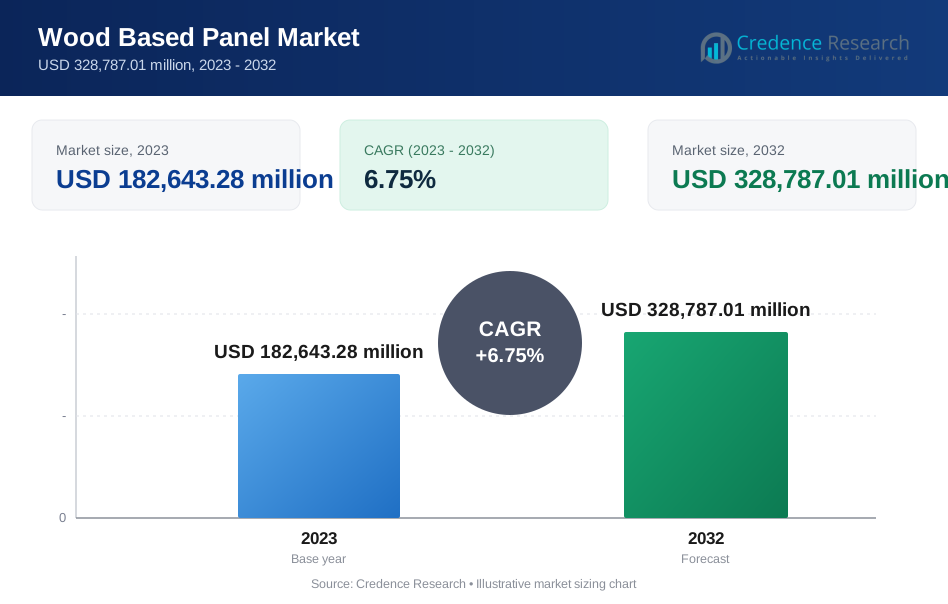
The Global Wood Based Panel Market is anticipated to grow from USD 182,643.28 million in 2023 to USD 328,787.01 million by 2032, with a compound annual growth rate (CAGR) of 6.75%.
The Global Wood Based Panel Market is driven by several key factors and trends. Increasing urbanization and construction activities worldwide propel the demand for wood-based panels in various applications such as furniture, flooring, and building materials. Moreover, the rising focus on sustainable construction materials due to environmental concerns fosters the market growth. Technological advancements in manufacturing processes enhance the efficiency and quality of wood-based panels, meeting evolving consumer preferences for durable and aesthetically pleasing products. Additionally, innovations in adhesive technologies and raw material sourcing contribute to market expansion, catering to the diverse needs of industries reliant on wood-based panel solutions.
In geographical analysis of the Global Wood Based Panel Market, key players strategically position themselves across regions to capitalize on varying demand dynamics. Asia Pacific emerges as a dominant region due to rapid urbanization, construction activities, and furniture manufacturing hubs in countries like China and India. Europe follows closely, driven by stringent regulations promoting sustainable construction materials. North America maintains a significant market share, supported by the robust residential construction sector. Key players such as Georgia-Pacific LLC, Norbord Inc., Kronospan Holdings Limited, and Arauco dominate the market, leveraging their global presence, diverse product portfolios, and technological innovations to maintain competitive advantages across regions.
Market Drivers
Growth in Construction Industry:
The Global Wood Based Panel Market benefits significantly from a thriving construction sector worldwide. Wood-based panels find extensive usage in both residential and commercial construction applications, including walls, ceilings, flooring, and furniture, contributing to the sector's growth trajectory. In terms of volume, the market is expected to surpass 500 million cubic meters by 2027. The construction sector’s growth, particularly in emerging economies, is a significant driver for this market. For example, in India, the government’s initiative to build 20 million affordable houses by 2022 under the ‘Pradhan Mantri Awas Yojana’ scheme is expected to boost the demand for wood-based panels. Similarly, China’s urbanization plan, which aims to increase the urban population by 60% by 2020, has led to an increase in construction activities, thereby propelling the demand for wood-based panels. Moreover, the shift towards sustainable building materials is also contributing to the market growth. Wood-based panels are considered more environmentally friendly than concrete and steel due to their lower carbon footprint and the fact that wood is a renewable resource. The increasing adoption of green building standards, such as LEED and BREEAM, is expected to further drive the demand for wood-based panels in construction applications.
Cost-Effectiveness and Sustainability Considerations:
Wood-based panels emerge as a cost-effective and sustainable alternative to solid wood, offering desirable properties such as strength, durability, and workability. In terms of sustainability, over 80% of wood panels are now produced using adhesives with reduced formaldehyde emissions, and the use of wood from FSC-certified forests has increased by 50% in the past five years. This shift is driven by consumer demand, where 60% of consumers are willing to pay more for products that are sustainably sourced and environmentally friendly. Additionally, the adoption of wood-based panels in green building practices has seen a 35% increase, as they contribute to LEED certification points. These data points underscore the significant role wood-based panels play in the movement towards sustainable construction and design.
Versatility and Expanding Applications:
The versatility of wood-based panels, available in various types such as plywood, MDF (medium-density fiberboard), and OSB (oriented strand board), enables their widespread use across diverse applications. For instance, the global production of MDF has seen an increase of 5% annually, reaching approximately 98 million cubic meters in 2023. The plywood market is also expanding, with a projected growth rate of 4.5% over the next five years, driven by its versatility and strength. OSB, known for its structural integrity, has become a preferred choice in the construction industry, with its market size expected to grow by 6% annually, reaching a volume of 75 million cubic meters by 2025. In the furniture sector, MDF is particularly popular due to its smooth finish and ease of customization, accounting for 30% of all wood-based panels used in furniture production. The interior design market has embraced decorative plywood for its aesthetic appeal, with a 25% increase in its use for high-end finishes. Moreover, the transportation industry has seen a 40% rise in the adoption of lightweight wood-based panels, such as OSB, for vehicle interiors, contributing to fuel efficiency and sustainability goals.
Lightweight Construction Trends:
A notable trend in the construction industry is the shift towards lightweight building materials, driven by factors such as enhanced structural performance and cost savings. Wood-based panels, being lighter than solid wood, play a pivotal role in this trend by contributing to lighter structures, thereby reducing overall building weight and potentially lowering construction costs, particularly in high-rise buildings. As the demand for lightweight construction materials continues to grow, wood-based panels are poised to witness increased adoption, further stimulating market growth.
Market Trends
Focus on Sustainability and Eco-Friendliness:
Environmental consciousness drives the Global Wood Based Panel Market, with a growing emphasis on sustainability and eco-friendliness. For instance, the demand for wood-based panels with recycled wood fibers has increased by 40% in the last two years, with some manufacturers now offering products that contain up to 70% recycled content. This trend is supported by data showing that 65% of consumers prefer to purchase from companies that advocate for sustainability. In terms of emissions, the industry has made significant strides in reducing formaldehyde levels, with 85% of wood-based panel producers now using adhesives that meet the strictest emission standards, such as the E0 and E1 classifications. This has led to a 30% reduction in indoor air pollutants from these products. Forestry certifications like the FSC (Forest Stewardship Council) and PEFC (Programme for the Endorsement of Forest Certification) have seen a 50% increase in issuance over the past decade, ensuring that over 75% of wood used in panel production comes from sustainably managed forests. This commitment to environmental stewardship is crucial as it not only supports responsible forestry practices but also resonates with the 78% of global consumers who express a preference for eco-certified products.
Advancements in Wood-Plastic Composites (WPCs):
Wood-Plastic Composites (WPCs) are witnessing increased popularity in the Global Wood Based Panel Market, offering a viable alternative for outdoor applications such as decks, fences, and cladding. WPCs are particularly favored for outdoor applications due to their moisture resistance and durability, with decking being one of the most important applications. The advancements in WPC technology have led to a surge in their use, with a 5% increase in the WPC market projected during the forecast period. Manufacturers are innovating to improve the visual appeal of WPCs, which has resulted in a 25% increase in their use for aesthetic purposes in outdoor applications. The focus on sustainability is also evident, as WPCs are increasingly made with recycled materials, contributing to a more sustainable construction industry. This aligns with the growing consumer demand for eco-friendly products, with 65% of consumers preferring to purchase from companies that advocate for sustainability. As a result, WPCs not only offer a practical solution for outdoor construction but also support the market’s shift towards environmentally responsible materials.
Market Challenges Analysis
Sustainable Sourcing and Supply Chain Concerns:
Balancing rising demand with sustainable forestry practices presents a significant challenge in the Global Wood Based Panel Market. As demand for wood-based panels continues to increase, ensuring a reliable supply of wood from sustainably managed forests becomes crucial. However, achieving this balance can be challenging, especially amidst tightening regulations and heightened competition for forest resources. Manufacturers face the task of navigating complex supply chains to source wood responsibly while meeting consumer demands for eco-friendly products. Additionally, maintaining transparency and accountability throughout the supply chain is essential to uphold sustainable sourcing practices and mitigate environmental impacts.
Fluctuations in Raw Material Prices:
The Global Wood Based Panel Market is susceptible to fluctuations in raw material prices, including wood, resin adhesives, and other essential components. These fluctuations can significantly impact production costs and overall profitability for wood-based panel manufacturers, leading to market uncertainty. The volatility in raw material prices poses challenges for manufacturers in managing production costs and pricing strategies effectively. Moreover, sudden price fluctuations may disrupt supply chains and strain relationships with suppliers, further complicating the manufacturing process. To mitigate the impact of raw material price fluctuations, manufacturers may explore strategies such as diversifying suppliers, implementing efficient inventory management systems, and investing in alternative materials or technologies.
Market Segmentation Analysis:
By Product Type:
The Global Wood Based Panel Market exhibits a diverse range of product types catering to various applications. Medium Density Fibreboard (MDF) and High-Density Fibreboard (HDF) emerge as prominent segments, valued for their uniformity, smooth surface, and versatility across furniture, flooring, and construction applications. Particle board, characterized by its affordability and suitability for furniture and interior applications, constitutes another significant segment. Fiberboard, renowned for its strength and durability, finds extensive usage in furniture and construction sectors. Plywood, known for its structural integrity and resistance to warping, remains a staple in construction and packaging industries. Additionally, the market encompasses other specialized products like oriented strand board and poplar wood panels, each offering unique properties suited for specific applications. The segmentation based on product type allows manufacturers to tailor their offerings to meet diverse consumer preferences and industry requirements, ensuring a comprehensive market coverage and sustained growth opportunities.
By Application:
The Global Wood Based Panel Market is segmented based on application, reflecting the wide array of end-use sectors leveraging wood panels for various purposes. The furniture segment emerges as a prominent consumer of wood panels, driven by the demand for aesthetically pleasing and durable furniture solutions across residential and commercial spaces. Flooring applications witness significant uptake of wood panels, owing to their durability, ease of installation, and aesthetic appeal. In the construction sector, wood panels find extensive usage in wall paneling, roofing, and structural components, owing to their strength, versatility, and sustainability. Packaging emerges as another crucial application segment, with wood panels offering lightweight and cost-effective solutions for packaging materials. Additionally, wood panels cater to diverse applications beyond the primary segments, including interior décor, automotive interiors, and artistic installations, reflecting their versatility and adaptability across various industries. This comprehensive segmentation facilitates targeted marketing strategies and product development initiatives, enabling manufacturers to capitalize on emerging opportunities and enhance market penetration.
Segments:
Based on Product Type
- Medium Density Fibreboard (MDF)/High-Density Fibreboard (HDF)
- Particle Board
- Fiberboard
- Plywood
- Others such as oriented strand board, poplar wood panels,etc
Based on Application
- Furniture
- Flooring
- Construction
- Packaging
- Others
Based on the Geography:
- North America
- The U.S.
- Canada
- Mexico
- Europe
- Germany
- France
- The U.K.
- Italy
- Spain
- Rest of Europe
- Asia Pacific
- China
- Japan
- India
- South Korea
- South-east Asia
- Rest of Asia Pacific
- Latin America
- Brazil
- Argentina
- Rest of Latin America
- Middle East & Africa
- GCC Countries
- South Africa
- Rest of the Middle East and Africa
Regional Analysis
Asia-Pacific
Asia-Pacific commands the largest market share, accounting for approximately 45% of the global revenue. This region's dominance can be attributed to the rapid urbanization and infrastructure development witnessed in countries like China, India, and Southeast Asian nations. The surging demand for residential and commercial construction, coupled with the growing furniture industry, has propelled the adoption of wood-based panels in this region.
Europe
Europe follows closely, holding a market share of around 25%. The region's well-established construction and furniture industries, along with the emphasis on sustainable building practices, have driven the demand for wood-based panels. Major economies such as Germany, France, and Italy significantly contribute to the market's growth through their robust manufacturing sectors and the increasing popularity of wood-based interior design elements.
Key Player Analysis
- Georgia-Pacific LLC (Koch Industries)
- West Fraser Timber Co. Ltd.
- Weyerhaeuser Company
- Norbord Inc.
- Arauco
- Louisiana-Pacific Corporation (LP)
- EGGER Group
- Kronospan
- U.S. Lumber Group LLC
- Swiss Krono Group
- Roseburg Forest Products
- Ainsworth Lumber Co. Ltd.
- Panels & Furniture Group (PFM Group)
- Boise Cascade Company
- Pfleiderer Group S.A.
Competitive Analysis
In the competitive landscape of the Global Wood Based Panel Market, several leading players vie for market dominance, each leveraging unique strengths and strategies to maintain their position. Georgia-Pacific LLC, a subsidiary of Koch Industries, stands out for its extensive product portfolio and global presence, offering a wide range of wood-based panel solutions tailored to diverse customer needs. West Fraser Timber Co. Ltd. is renowned for its vertically integrated operations and focus on sustainable forestry practices, ensuring a consistent supply of high-quality wood panels. Weyerhaeuser Company, with its strong distribution network and technological advancements, remains a key player in the market, offering innovative panel solutions for various applications. Norbord Inc. is notable for its expertise in oriented strand board (OSB) production, catering to the construction and packaging sectors. Arauco, a leading producer of sustainable forestry products, emphasizes innovation and sustainability, driving the development of eco-friendly wood panels. Other significant players include Louisiana-Pacific Corporation (LP), EGGER Group, Kronospan, U.S. Lumber Group LLC, Swiss Krono Group, Roseburg Forest Products, Ainsworth Lumber Co. Ltd., Panels & Furniture Group (PFM Group), Boise Cascade Company, and Pfleiderer Group S.A. Each player contributes unique capabilities and market insights to the competitive landscape, fostering innovation and driving market growth.
Recent Developments
In December 2023, Century Plyboards (India) Ltd inaugurated India's largest integrated wood panel manufacturing plant at Badvel in Andhra Pradesh. The company invested about INR 1,000 crore (~USD 121 million) in the construction of the new plant.
In April 2023, Kronospan announced an investment of USD 350 million for the construction of a new Oriented Strand Board (OSB) manufacturing plant on its 460-acre site in Oxford, Alabama, United States.
In September 2022, LP Building Solutions completed a million-dollar conversion and expansion project to produce LP SmartSide Trim and Siding products at its New Limerick, Maine facility. In December 2022, EGGER acquired 60% of the shares in Italian wood-based materials manufacturer SAIB. This acquisition helps broaden market access, increase capacity and expand the portfolio. This opens up further expansion and synergies for the company to process.
Market Concentration & Characteristics
The Global Wood Based Panel Market exhibits characteristics of moderate to high market concentration, with a select group of key players dominating a significant portion of the market share. Companies such as Georgia-Pacific LLC, West Fraser Timber Co. Ltd., and Weyerhaeuser Company hold prominent positions due to their extensive product portfolios, technological advancements, and robust distribution networks. These leading players benefit from vertical integration, allowing them to control various stages of the supply chain, from timber harvesting to panel manufacturing and distribution. Additionally, the market is characterized by continuous innovation in product development, driven by the growing emphasis on sustainability, cost-effectiveness, and performance. As demand for wood-based panels continues to rise, particularly in sectors like construction, furniture, and packaging, market players are expected to focus on differentiation strategies, including product innovation, strategic partnerships, and mergers and acquisitions, to strengthen their market positions and capitalize on emerging opportunities.
Report Coverage
The research report offers an in-depth analysis based on Product Type, Application, and Geography. It details leading market players, providing an overview of their business, product offerings, investments, revenue streams, and key applications. Additionally, the report includes insights into the competitive environment, SWOT analysis, current market trends, as well as the primary drivers and constraints. Furthermore, it discusses various factors that have driven market expansion in recent years. The report also explores market dynamics, regulatory scenarios, and technological advancements that are shaping the industry. It assesses the impact of external factors and global economic changes on market growth. Lastly, it provides strategic recommendations for new entrants and established companies to navigate the complexities of the market.
Future Outlook
- Continued Growth: The Global Wood Based Panel Market is poised for steady expansion, driven by increasing demand from the construction, furniture, and packaging sectors.
- Sustainability Focus: Environmental concerns will shape market dynamics, with a growing emphasis on sustainable sourcing practices and eco-friendly manufacturing processes.
- Technological Advancements: Ongoing innovations in panel manufacturing technologies will lead to the development of more efficient and versatile wood-based panels.
- Demand for Specialty Panels: There will be a rising demand for specialty panels with enhanced properties such as moisture resistance, fire retardancy, and acoustic insulation.
- Emerging Applications: Wood-based panels will find new applications in sectors like automotive interiors, marine construction, and renewable energy infrastructure.
- Regional Market Growth: Emerging economies will drive market growth, supported by rapid urbanization, infrastructure development, and increasing disposable incomes.
- Regulatory Impact: Stringent regulations related to emissions, forestry practices, and product standards will influence market dynamics and product innovation.
- Competition and Consolidation: Market competition will intensify, leading to mergers, acquisitions, and strategic alliances among key players to strengthen their market positions.
- Digitalization and Automation: Adoption of digitalization and automation in manufacturing processes will improve efficiency, quality, and productivity in panel production.
- Market Fragmentation: The market will witness increased fragmentation with the entry of new players and the diversification of product offerings to cater to evolving consumer preferences and market demands.
Request a Free Sample
Fill in your details and we'll send you a free sample report.
- Sample data tables & charts
- Research methodology
Need a Custom Version of This Report?
Tailor the scope, geography, or segments to your exact requirements.
- Custom geography or segment scope
- Direct access to our analyst team
Frequently Asked Questions
What is the current size of the Global Wood Based Panel Market?
What factors are driving the growth of the Global Wood Based Panel Market?
What are the key segments within the Global Wood Based Panel Market?
What are some challenges faced by the Global Wood Based Panel Market?
Who are the major players in the Global Wood Based Panel Market?
Table of Content
Chapter 1. Report Introduction
- 1.1 Report Description & Purpose
- 1.1.1 Report Title & Market Definition
- 1.1.2 Unique Selling Propositions (USP) & Key Differentiators
- 1.1.3 Value Proposition for Stakeholders
- 1.2 Research Objectives
- 1.2.1 Market Sizing Objectives (Volume & Revenue)
- 1.2.2 Segmentation Objectives
- 1.2.3 Competitive Intelligence Objectives
- 1.2.4 Forecast & Scenario Objectives
- 1.3 Report Scope
- 1.3.1 Wood Based Panel Scope – Types & Subtypes Covered
- 1.3.2 Geographic Scope – Regions & Countries Covered
- 1.3.3 Historical Period, Base Year & Forecast Period (2023; forecast to 2032)
- 1.3.4 Inclusions & Exclusions
- 1.4 HS Code & Classification Framework
- 1.5 Currency, Units & Pricing Basis
- 1.6 Target Stakeholders
- 1.7 Limitations & Assumptions
Chapter 2. Executive Summary
- 2.1 Global Wood Based Panel Market Snapshot
- 2.1.1 Market Size – Historical (2023) & Forecast (2023-2032) (2023: USD 182,643.28 million → 2032: USD 328,787.01 million)
- 2.1.2 Volume & Revenue – Global Totals
- 2.1.3 Key Market Highlights – Top Five Facts
- 2.2 Wood Based Panel Market Segmentation Snapshot
- 2.2.1 Market Split by Region – 2023 vs. 2032
- 2.3 Competitive Snapshot
- 2.3.1 Top 10 Players by Revenue Share – 2023
- 2.3.2 Top 10 Players by Volume Share – 2023
- 2.3.3 Recent Strategic Developments (18-Month Summary)
- 2.4 Key Investment Highlights & Strategic Conclusions
Chapter 3. Wood Based Panel Market Dynamics & Industry Analysis
- 3.1 Market Overview & Context
- 3.1.1 Wood Based Panel Market Position in the Broader Automotive Value Chain
- 3.1.2 OEM vs. Replacement Market Dynamics
- 3.1.3 Market Maturity & Development Stage by Region
- 3.2 Wood Based Panel Market Drivers
- 3.3 Wood Based Panel Market Restraints & Challenges
- 3.4 Wood Based Panel Market Opportunities
- 3.5 Porter's Five Forces Analysis
- 3.5.1 Threat of New Entrants
- 3.5.2 Bargaining Power of Suppliers
- 3.5.3 Bargaining Power of Buyers
- 3.5.4 Threat of Substitutes
- 3.5.5 Competitive Rivalry – Intensity Assessment
- 3.6 Wood Based Panel Value Chain Analysis
- 3.6.1 Upstream – Raw Material/Input Suppliers
- 3.6.1.1 Raw Material/Input 1
- 3.6.1.2 Raw Material/Input 2
- 3.6.1.3 Raw Material/Input 3
- 3.6.2 Midstream – Production/Manufacturing/Service Delivery
- 3.6.2.1 Production/Process Overview
- 3.6.2.2 Key Facility Locations & Capacity by Manufacturer
- 3.6.3 Downstream – Distribution & End Consumer
- 3.6.3.1 Primary Channel – B2B/OEM
- 3.6.3.2 Secondary Channels – Dealer, Retail, Online, Direct
- 3.6.4 Value Chain Profitability Analysis
- 3.6.1 Upstream – Raw Material/Input Suppliers
- 3.7 PESTEL Analysis
- 3.7.1 Political Factors
- 3.7.2 Economic Factors
- 3.7.3 Social Factors
- 3.7.4 Technological Factors
- 3.7.5 Environmental Factors
- 3.7.6 Legal Factors
- 3.8 Wood Based Panel Supply Chain Analysis
- 3.8.1 Raw Material/Input Supply Risk Assessment
- 3.8.2 Manufacturing Concentration Risk (Geographic Exposure)
- 3.8.3 Trade Disruption Impact Analysis
- 3.9 Regulatory & Policy Landscape
Note: The regulatory and policy landscape section covers regulations based on their applicability to the market, Wood Based Panel category, geography, and scope of the study. Only regulatory frameworks with a material impact on operations, compliance, trade, sustainability, or market access are analyzed in detail.
Chapter 4. Key Investment Pockets & Opportunity Analysis
- 4.1 Wood Based Panel Market Attractiveness Analysis
- 4.1.1 By Region – Investment Attractiveness Matrix (Volume × CAGR)
- 4.2 Absolute Revenue Growth Opportunity
- 4.2.1 By Region – Absolute USD Growth Through 2032
- 4.3 Incremental Volume Opportunity
- 4.3.1 By Region – Incremental Volume Through 2032
- 4.3.2 Segment – Incremental Volume
- 4.4 Emerging Submarket Opportunity Deep Dive (Subject to Applicability)
- 4.5 Emerging Market Opportunity Scorecards
- 4.5.1 United States
- 4.5.2 Europe
- 4.5.3 Asia
- 4.5.4 Middle East & Africa
Note: Emerging Market Opportunity Scorecards will be included based on relevance and strategic importance. Regions listed are indicative and may vary depending on data availability and market dynamics.
Chapter 5. Wood Based Panel Import-Export Analysis & Trade Flows
- 5.1 Global Trade Overview
- 5.1.1 Global Export Value by Country (2023)
- 5.1.2 Global Export Volume by Country (2023)
- 5.1.3 Global Import Value by Country (2023)
- 5.1.4 Global Import Volume by Country (2023)
- 5.1.5 Net Trade Balance by Country (2023)
- 5.2 Export Analysis – Segment
- 5.2.1 Type 1 (HS Code)
- 5.2.2 Type 2 (HS Code)
- 5.2.3 Type 3 (HS Code)
- 5.2.4 Type 4 (HS Code)
- 5.2.5 Type 5 (HS Code)
- 5.3 Import Analysis – Segment
- 5.3.1 Type 1 (HS Code)
- 5.3.2 Type 2 (HS Code)
- 5.3.3 Type 3 (HS Code)
- 5.3.4 Type 4 (HS Code)
- 5.3.5 Type 5 (HS Code)
- 5.4 Average Unit Trade Prices
- 5.4.1 Average Export Price – Segment & Country
- 5.4.2 Average Import Price – Segment & Source Country
- 5.4.3 Price Trends (2023)
- 5.5 Key Trade Route Analysis
- 5.5.1 Trade Route 1
- 5.5.2 Trade Route 2
- 5.5.3 Trade Route 3
- 5.5.4 Trade Route 4
- 5.5.5 Trade Route 5
- 5.6 Trade Policy Impact Assessment
- 5.6.1 US Anti-Dumping & Section 301 Tariffs
- 5.6.2 EU Customs Union Impact
- 5.6.3 Major Free Trade Agreements
- 5.6.4 USMCA Rules of Origin
Note: Trade policy analysis will be included only where relevant to the Wood Based Panel market.
Chapter 6. Competitive Landscape & Company Benchmarking
- 6.1 Wood Based Panel Market Concentration & Structure
- 6.1.1 Herfindahl-Hirschman Index (HHI) – vs. 2023
- 6.1.2 Tier 1, Tier 2 & Tier 3 Market Structure
- 6.1.3 Global, Regional & Local Player Dynamics
- 6.2 Wood Based Panel Market Share Analysis – 2023
- 6.2.1 Global Revenue Share by Company
- 6.2.2 Global Volume Share by Company
- 6.2.3 Regional Revenue Share
- 6.2.4 Market Share Evolution ( vs. 2023)
- 6.2.5 OEM Segment Share by Company
- 6.2.6 Replacement Segment Share by Company
- 6.3 Production/Delivery Capacity & Facility Analysis
- 6.3.1 Global Installed Capacity
- 6.3.2 Capacity Utilization Rates
- 6.3.3 Production/Output Volume
- 6.3.4 Facility Locations & Capacity Map
- 6.3.5 Planned Capacity Additions
- 6.4 Wood Based Panel Competitive Benchmarking Matrix
- 6.4.1 Revenue, Volume, CAGR & Profitability Comparison
- 6.4.2 Channel Revenue Mix
- 6.4.3 Geographic Revenue Exposure
- 6.4.4 R&D Intensity
- 6.4.5 Sustainability Maturity
- 6.5 Strategic Developments in Wood Based Panel (Last 24 Months)
- 6.5.1 Mergers, Acquisitions & Divestments
- 6.5.2 New Wood Based Panel Launches
- 6.5.3 Facility Expansions
- 6.5.4 Strategic Alliances, Joint Ventures & Partnerships
- 6.5.5 Distribution Expansion & Market Entry
- 6.5.6 Sustainability & ESG Initiatives
- 6.6 Competitive Strategy Mapping
- 6.6.1 Leader, Challenger, Follower & Niche Classification
- 6.6.2 Pricing Strategy Comparison
- 6.6.3 Channel Strategy Matrix
Note: Strategic developments are included based on their materiality and the availability of reliable information.
Chapter 7. Global Wood Based Panel Market – By Distribution Channel
- 7.1 Segment Overview
- 7.1.1 Volume & Revenue Split by Channel (2023 & 2032)
- 7.1.2 Channel Mix Evolution (2023-2032)
Chapter 8. Regional Market Analysis – Global Overview
- 8.1 Global Regional Overview
- 8.1.1 Regional Volume Share
- 8.1.2 Regional Revenue Share
- 8.1.3 Regional Volume by Region
- 8.1.4 Regional Revenue by Region
- 8.1.5 Regional Forecast Through 2032
- 8.2 Cross-Regional Segment Analysis
- 8.2.1 By Distribution Channel
- 8.2.2 By Brand/Price Tier
Chapter 9. North America Wood Based Panel Market
- 9.1 United States
- 9.2 Canada
- 9.3 Mexico
Chapter 10. Europe Wood Based Panel Market
- 10.1 Germany
- 10.2 France
- 10.3 Italy
- 10.4 United Kingdom
- 10.5 Spain
- 10.6 Poland
- 10.7 Russia
- 10.8 Netherlands
- 10.9 Belgium
- 10.10 Sweden
- 10.11 Denmark
- 10.12 Norway
- 10.13 Rest of Europe
Chapter 11. Asia Pacific Wood Based Panel Market
- 11.1 China
- 11.2 India
- 11.3 Japan
- 11.4 South Korea
- 11.5 Thailand
- 11.6 Indonesia
- 11.7 Vietnam
- 11.8 Malaysia
- 11.9 Australia
- 11.10 Rest of Asia Pacific
Chapter 12. Latin America Wood Based Panel Market
- 12.1 Brazil
- 12.2 Argentina
- 12.3 Colombia
- 12.4 Chile
- 12.5 Rest of Latin America
Chapter 13. Middle East Wood Based Panel Market
- 13.1 Saudi Arabia
- 13.2 United Arab Emirates
- 13.3 Turkey
- 13.4 Israel
- 13.5 Iran
- 13.6 Rest of the Middle East
Chapter 14. Africa Wood Based Panel Market
- 14.1 South Africa
- 14.2 Egypt
- 14.3 Nigeria
- 14.4 Morocco
- 14.5 Rest of Africa
Chapter 15. Wood Based Panel Company Profiles
- 15.1 [Company 01]
- 15.1.1 Company Overview
- 15.1.2 Key Management Personnel
- 15.1.3 Products & Services Portfolio
- 15.1.4 Financial Performance
- 15.1.5 Key Market Focus & Geographic Presence
- 15.1.6 Recent Developments & Strategic Initiatives
Note: The company profile list is preliminary and may change based on research findings, market developments, data availability, and client requirements.
Chapter 16. Appendices
- Appendix A – List of Abbreviations & Acronyms
- Appendix B – Industry Classification Code Reference – Full Series
- Appendix C – Production & Capacity Data Tables
- Appendix D – End-Use & Demand Base Tables
- Appendix E – Consumption & Replacement Rate Assumptions
- Appendix F – ASP Reference Tables
- Appendix G – Manufacturing & Facility Database
- Appendix H – Import-Export Data Tables
- Appendix I – Regulatory Summary Tables
- Appendix J – Primary Research Participant List (Anonymized)
- Appendix K – Primary Research Questionnaire Framework
- Appendix L – Data Sources & Bibliography
- Appendix M – Market Size Divergence & Source Comparison
Chapter 17. Research Methodology
- 17.1 Research Framework & Philosophy
- 17.2 Secondary Research – Sources, Hierarchy & Data Extraction
- 17.3 Data Modeling – Bottom-Up & Top-Down Market Sizing
- 17.4 Primary Research – Stakeholder Framework, LOI & Sample Sizes
- 17.5 Forecast Methodology – Regression, Scenario & Sensitivity Analysis
- 17.6 Quality Control – Four-Layer Validation Framework
- 17.7 Limitations & Standard Assumptions
- 17.8 Disclaimer
