| REPORT ATTRIBUTE | DETAILS |
|---|---|
| Historical Period | 2019-2022 |
| Base Year | 2023 |
| Forecast Period | 2024-2032 |
| Anti Counterfeit Packaging Technologies Market Size 2024 | USD 161495 Million |
| Anti Counterfeit Packaging Technologies Market, CAGR | 11.7% |
| Anti Counterfeit Packaging Technologies Market Size 2032 | USD 391367.23 Million |
Market Overview:
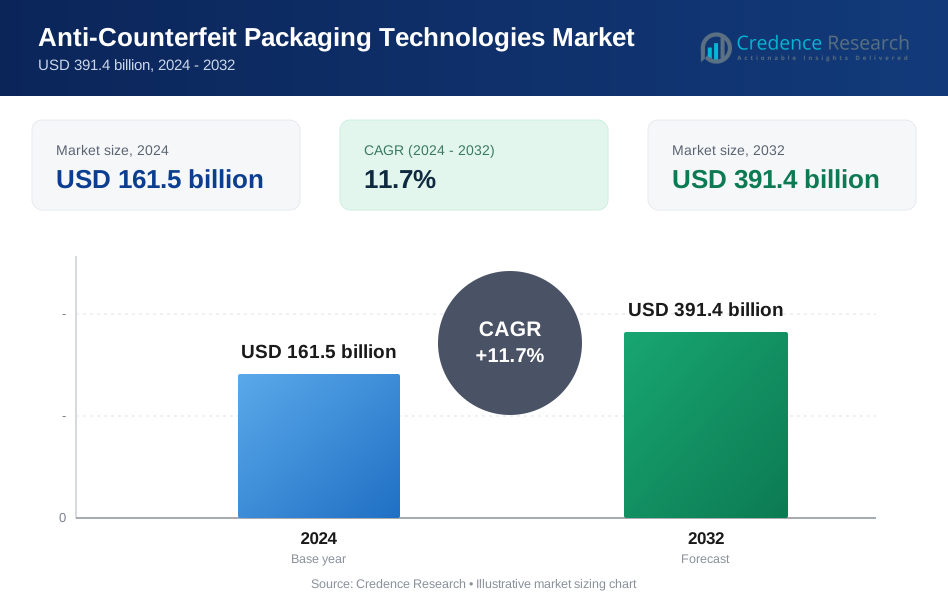
The Anti Counterfeit Packaging Technologies Market is projected to grow from USD 161495 million in 2024 to an estimated USD 391367.23 million by 2032, with a compound annual growth rate (CAGR) of 11.7% from 2024 to 2032.
Market drivers for anti-counterfeit packaging technologies are primarily rooted in the rising cases of counterfeiting and the growing awareness among consumers about product safety and authenticity. Industries such as pharmaceuticals and food and beverages are highly regulated, with strict laws requiring manufacturers to implement secure packaging solutions. This is further propelled by the increasing globalization of trade, where counterfeit goods pose significant risks to companies’ reputations and revenues. The emergence of e-commerce and online sales platforms has also accelerated demand for anti-counterfeit packaging, as products are more vulnerable to tampering and duplication when sold and transported over long distances. Innovations in technologies, including RFID (Radio Frequency Identification), barcodes, holograms, and blockchain, are key enablers of this market, offering companies effective tools to combat counterfeiting.
In terms of regional analysis, North America holds a significant market share due to the presence of strict regulations and high consumer awareness about product authenticity, particularly in the pharmaceutical and food sectors. The Asia-Pacific region, however, is expected to witness the highest growth rate over the forecast period. This can be attributed to the booming retail industry, rapid industrialization, and increased government initiatives to curb the spread of counterfeit goods, particularly in China and India. Europe also represents a mature market, where the demand for anti-counterfeit packaging is driven by stringent regulations, especially in the luxury goods and cosmetics sectors.
Market Drivers:
Increasing Incidences of Counterfeiting:
One of the most significant drivers of the anti-counterfeit packaging technologies market is the rising incidences of counterfeit products across various industries. Counterfeiting has become a global challenge, particularly in sectors such as pharmaceuticals, food and beverages, and consumer electronics. For instance, in 2021, approximately 6,000 pharmaceutical crime incidents were recorded globally, marking a 38% increase from the previous year. With counterfeit goods potentially harming both consumers and brands, the need for secure and reliable packaging solutions has intensified. In the pharmaceutical industry, counterfeit drugs can lead to severe health risks, prompting regulators and companies to adopt advanced technologies that ensure product authenticity. The global trade in counterfeit goods was valued at over USD 500 billion in recent years, making it critical for businesses to invest in effective anti-counterfeit measures.
Regulatory Requirements and Compliance:
Governments and regulatory bodies across the world are enforcing stricter regulations to combat the rise of counterfeit products. Many industries, especially those dealing with sensitive products like medicines, foods, and beverages, are subject to compliance requirements to ensure consumer safety and trust. For instance, regulatory frameworks such as the FDA's Drug Supply Chain Security Act (DSCSA) and the Falsified Medicines Directive (FMD) in the European Union mandate the implementation of traceability and verification technologies across the supply chain. These laws are driving companies to adopt advanced anti-counterfeit packaging solutions, such as serialization, barcodes, and tamper-evident packaging, to meet regulatory standards and protect their market share.
Consumer Demand for Product Authenticity:
A significant shift in consumer behavior is also fueling demand for anti-counterfeit packaging technologies. In today’s increasingly globalized marketplace, consumers are more aware of the dangers associated with counterfeit products, particularly in high-risk industries such as pharmaceuticals, food, and personal care products. With growing concerns about product safety and authenticity, consumers are demanding more transparency and traceability from brands. This has led companies to adopt packaging technologies like QR codes, holograms, and radio-frequency identification (RFID) that allow customers to verify the authenticity of products before purchase. The rise of e-commerce, which increases the risk of counterfeit goods entering supply chains, has further amplified the need for advanced packaging technologies to maintain consumer trust.
Technological Advancements in Packaging Solutions:
Technological innovation is a major driver in the anti-counterfeit packaging technologies market. With the development of more sophisticated packaging solutions, companies are better equipped to safeguard their products from counterfeiting. Emerging technologies such as blockchain, artificial intelligence (AI), and machine learning are enabling companies to enhance traceability and improve product security throughout the supply chain. Blockchain, for example, allows for the creation of immutable records of product origins and movements, making it difficult for counterfeit goods to infiltrate the supply chain. Additionally, advancements in smart packaging-which integrates sensors and digital markers into packaging-provide real-time verification capabilities, ensuring product authenticity from manufacturer to consumer. As these technologies continue to evolve, they will play a crucial role in the ongoing efforts to combat counterfeiting globally.
Market Trends:
Growing Adoption of Smart Packaging Solutions:
A notable trend in the anti-counterfeit packaging technologies market is the increasing adoption of smart packaging solutions. These advanced technologies integrate sensors, RFID tags, and near-field communication (NFC) chips into product packaging, allowing real-time tracking and verification throughout the supply chain. Smart packaging not only enhances product security but also provides consumers with instant access to product information, which can be verified via smartphones or other digital devices. For instance, Walmart demonstrated this impact by reducing their product tracing time for mangoes from 6 days, 18 hours, and 26 minutes to just 2.2 seconds through their blockchain implementation. This trend is particularly prevalent in industries such as pharmaceuticals and food, where consumers and regulators demand higher levels of transparency and safety. The integration of such technologies into packaging has the potential to revolutionize supply chain management by reducing fraud, theft, and counterfeit products.
Surge in Blockchain Technology Implementation:
The integration of blockchain technology in anti-counterfeit packaging is gaining significant momentum. Blockchain offers a decentralized and immutable ledger system that provides full traceability of products from the point of manufacture to the consumer. By utilizing blockchain, companies can ensure that the information related to product origin, handling, and transport is securely recorded and accessible to all stakeholders. This is especially critical in industries like luxury goods, pharmaceuticals, and electronics, where counterfeit products can easily infiltrate the supply chain. The transparency and security that blockchain provides make it a powerful tool in fighting counterfeiting, and many companies are now exploring its potential to enhance their packaging solutions. As this technology matures, its application is expected to expand further across various sectors.
Increasing Role of E-commerce in Packaging Security:
The rapid growth of e-commerce is significantly influencing the anti-counterfeit packaging technologies market. With the global expansion of online retail, counterfeit products are more easily distributed through complex and less regulated supply chains. E-commerce platforms, being a major channel for product sales, are particularly vulnerable to counterfeiting, and this has led companies to invest heavily in secure packaging technologies. Anti-counterfeit solutions such as tamper-evident seals, holograms, and unique identifiers are being increasingly integrated into product packaging to ensure authenticity when products reach consumers. The rise of e-commerce has also spurred the adoption of track-and-trace technologies, which allow both companies and consumers to verify the legitimacy of products at various stages of delivery.
Rise in Customized and Industry-Specific Solutions:
Another key trend in the anti-counterfeit packaging technologies market is the growing demand for customized and industry-specific solutions. Different industries face varying challenges when it comes to counterfeit goods, and as a result, there is an increasing need for tailored packaging technologies that address the specific requirements of each sector. For example, the pharmaceutical industry may prioritize solutions like serialization and RFID for tracking individual drug units, while the food and beverage industry may focus on tamper-evident packaging and quick response (QR) codes to maintain product integrity and consumer trust. This trend toward customization allows businesses to deploy the most effective technologies for their particular market, ensuring optimal protection against counterfeiting while meeting regulatory and consumer expectations.
Market Restraints and Challenges:
High Implementation Costs:
One of the primary restraints in the anti-counterfeit packaging technologies market is the high cost associated with implementing advanced packaging solutions. Technologies such as RFID tags, holograms, blockchain, and smart packaging require significant investment in both hardware and software. For many small and medium-sized enterprises (SMEs), the financial burden of adopting these solutions may outweigh the benefits, especially if the threat of counterfeiting is perceived to be low in their market segment. Additionally, the cost of integrating these systems into existing production lines, coupled with ongoing maintenance and upgrades, can pose a challenge even for larger corporations, limiting widespread adoption.
Complexity in Supply Chain Integration:
Another challenge facing the market is the complexity involved in integrating anti-counterfeit packaging technologies into global supply chains. Many companies operate across multiple geographies and work with various suppliers and distributors, each with their own set of standards and capabilities. Ensuring seamless coordination between different stakeholders to implement consistent anti-counterfeit measures can be difficult. Moreover, the adoption of these technologies requires significant collaboration across all levels of the supply chain, from raw material suppliers to retailers, which can slow down the deployment process and create operational inefficiencies.
Limited Awareness in Emerging Markets:
While developed regions such as North America and Europe have seen widespread adoption of anti-counterfeit packaging technologies, emerging markets are still lagging behind. In regions like Africa, parts of Asia, and Latin America, there is limited awareness among consumers and businesses about the importance of secure packaging solutions. Furthermore, regulatory frameworks in these regions are often underdeveloped, making it harder to enforce anti-counterfeit measures. This presents a challenge for market growth, as the potential for counterfeit goods is higher in regions where awareness and regulations are weaker.
Market Segmentation Analysis:
By packaging format, key segments include bottles and jars, vials and ampoules, blisters, trays, pouches and sachets, and others such as tubes and syringes. Bottles and jars hold a significant share, especially in the food and beverage and healthcare sectors, driven by the need for tamper-evident solutions. Pouches and sachets are widely adopted in personal care and cosmetics due to their convenience and cost-efficiency.
By technology, the market spans RFID, security inks and coatings, security seals, holograms, mass encryption, barcodes, and mass serialization. RFID and mass serialization are critical in the healthcare sector for tracking pharmaceuticals and preventing counterfeit drugs. Holograms and security seals are commonly employed in the personal care and cosmetics industries for product authentication and brand protection.
By end-use industry, the food and beverage and healthcare industries dominate the market due to stringent regulations and the need to protect consumer safety. The automotive sector also sees growth in this market as it seeks to ensure the authenticity of parts and components. Other industrial applications, including electrical and electronics, are increasingly adopting anti-counterfeit technologies to safeguard high-value goods.
Segmentation:
By Packaging Format:
- Bottles and Jars
- Vials & Ampoules
- Blisters
- Trays
- Pouches & Sachets
- Others (Tubes, Syringes, etc.)
By Technology:
- RFID
- Security Inks & Coatings
- Security Seals
- Holograms
- Mass Encryption
- Barcode
- Mass Serialization
By End-use Industry:
-
- Food and Beverage
- Healthcare
- Automotive
- Personal care & Cosmetics
- Electrical & Electronics
- Other Industrial
Regional Analysis:
The global anti-counterfeit packaging technologies market exhibits significant regional variations, with market growth driven by varying regulatory environments, industry demands, and technological adoption. The primary regions include North America, Europe, Asia-Pacific, Latin America, and the Middle East & Africa.
North America
North America holds a substantial share of the anti-counterfeit packaging technologies market, accounting for approximately 35% of the global market share. The region's leadership is attributed to stringent regulations in industries such as healthcare and food and beverage, as well as the early adoption of advanced technologies like RFID and mass serialization. The United States is the largest contributor, driven by the strong presence of pharmaceutical, personal care, and food companies focused on safeguarding their products. Government regulations such as the Drug Supply Chain Security Act (DSCSA) further promote the use of anti-counterfeit packaging technologies.
Europe
Europe follows closely, contributing around 30% to the global market. This region’s growth is spurred by stringent regulations from the European Union, especially in the healthcare and automotive sectors. Countries like Germany, France, and the UK are leading markets, with a strong focus on preventing counterfeit pharmaceuticals and luxury goods. The pharmaceutical sector in Europe is a significant driver, with the Falsified Medicines Directive (FMD) enforcing the use of serialization and other anti-counterfeit measures. Additionally, the personal care and cosmetics industry is adopting holograms and security seals to protect brand reputation and ensure product authenticity.
Asia-Pacific
Asia-Pacific is one of the fastest-growing regions in the anti-counterfeit packaging technologies market, with a market share of around 25%. The rapid industrialization, expanding pharmaceutical, and food and beverage industries in countries like China, India, and Japan contribute to this growth. The rising instances of counterfeiting, especially in healthcare and automotive industries, have prompted governments and companies to invest in anti-counterfeit solutions. Increasing consumer awareness regarding product safety and brand authenticity also supports the adoption of advanced packaging technologies in this region.
Latin America
Latin America holds a smaller but growing share of the market, contributing approximately 6%. Brazil and Mexico are the key markets, driven by increasing government regulations and a rising demand for secure packaging in the healthcare and personal care sectors. The food and beverage industry also plays a critical role in driving the adoption of anti-counterfeit technologies as manufacturers aim to protect their brands from counterfeiting.
Middle East & Africa
The Middle East & Africa region contributes around 4% of the global market. This region is witnessing a gradual increase in the adoption of anti-counterfeit packaging technologies, particularly in the healthcare and automotive sectors. While the market is still developing, countries like the UAE and South Africa are expected to experience notable growth as awareness of counterfeit products and the need for secure packaging solutions increases.
Key Player Analysis:
- 3M
- AlpVision SA
- Applied DNA Sciences
- Atlantic Zeiser GmbH
- Authentix
- AVERY DENNISON CORPORATION
- CCL Industries
- DuPont
- ITL Group
- SATO Holdings Corporation
- SICPA HOLDING SA
- SML Group
- Systech International
- Zebra Technologies Corp.
Competitive Analysis:
The anti-counterfeit packaging technologies market is highly competitive, with several key players driving innovation and technological advancements. Major companies, including Avery Dennison, 3M, DuPont, Sicpa Holdings, and Zebra Technologies, dominate the market, offering a wide range of solutions such as RFID, holograms, security inks, and mass serialization. These companies maintain a competitive edge through strategic partnerships, mergers, and acquisitions to expand their product portfolios and global reach. Innovation in technology plays a critical role in maintaining competitiveness. For example, advancements in smart packaging and integration of blockchain for enhanced traceability are increasingly becoming differentiators. Smaller players and startups are also entering the market, focusing on niche technologies and affordable solutions to meet the growing demand in developing regions. Overall, the market’s competitive landscape is defined by technological innovation, regulatory compliance, and the ability to provide scalable, cost-effective solutions for different industries.
Recent Developments:
- In April 2024, Avery Dennison expanded its AD Pure range, introducing inlays and tags that are completely free of PET plastic. These 100% plastic-free tags and inlays use innovative antenna manufacturing technology, where the antenna and chips are applied directly to paper for sustainable production.
- In January 2024, Avery Dennison launched the AD 2Metal Rock M781 RFID tag, designed for harsh environments. This tag is ideal for tagging metal, liquid, and difficult-to-tag non-metal objects, featuring a flexible, thin structure that works well on curved and flat surfaces.
- In October 2023, Avery Dennison signed an agreement to acquire Silver Crystal Group, a leader in sports apparel customization and application across various platforms, including e-commerce and direct-to-business.
- In May 2023, SATO Holdings Corporation's subsidiary, SATO International America, Inc., acquired Stafford Press, Inc., a North American company specializing in inkjet color on-demand horticulture tags and labels.
- In April 2023, Avery Dennison acquired Lion Brothers, a Maryland-based apparel brand embellishment manufacturer.
- In April 2023, CCL Industries Inc. acquired eAgile Inc. and the intellectual property of Alert Systems ApS.
- In January 2023, Avery Dennison acquired Thermopatch, a leader in industrial laundry labeling and heat transfers, to enhance its growth in external embellishments.
Market Concentration & Characteristics:
The anti-counterfeit packaging technologies market is moderately concentrated, with a mix of large, established players and smaller, innovative companies. Major firms such as Avery Dennison, 3M, Sicpa Holdings, and CCL Industries dominate the market through their extensive portfolios and strong global presence. These key players leverage advanced technologies like RFID, holograms, and mass serialization to meet regulatory requirements and protect products across various industries. The market is characterized by rapid technological advancements, driven by increasing demand for enhanced product security and brand protection. Innovation plays a central role, with companies focusing on sustainable solutions, such as plastic-free packaging, and integrating smart technologies like blockchain for traceability. Despite the dominance of large companies, smaller firms are gaining traction by offering niche and cost-effective solutions, particularly in developing regions. The competitive landscape is shaped by a combination of regulatory pressures, technological evolution, and the need for scalable, customizable solutions.
Report Coverage:
The research report offers an in-depth analysis based on By Packaging Format, By Technology and By End-use Industry. It details leading market players, providing an overview of their business, product offerings, investments, revenue streams, and key applications. Additionally, the report includes insights into the competitive environment, SWOT analysis, current market trends, as well as the primary drivers and constraints. Furthermore, it discusses various factors that have driven market expansion in recent years. The report also explores market dynamics, regulatory scenarios, and technological advancements that are shaping the industry. It assesses the impact of external factors and global economic changes on market growth. Lastly, it provides strategic recommendations for new entrants and established companies to navigate the complexities of the market.
Future Outlook:
- Growing regulatory demands, especially in healthcare and food industries, will drive adoption of anti-counterfeit packaging technologies.
- Technological advancements in RFID, blockchain, and serialization will enhance product traceability and authentication.
- Increasing consumer awareness of product authenticity will push brands to invest in advanced packaging solutions.
- Sustainable and eco-friendly packaging, such as plastic-free inlays, will become a key focus for companies.
- Emerging markets in Asia-Pacific and Latin America will see rapid growth due to rising industrialization and counterfeiting concerns.
- Strategic acquisitions and partnerships among key players will foster innovation and expand global market reach.
- The integration of smart packaging technologies will offer new opportunities for real-time product tracking and anti-tampering solutions.
- The automotive and electronics sectors will increasingly adopt anti-counterfeit technologies to ensure the integrity of high-value products.
- Smaller, specialized players will continue to grow by offering cost-effective, niche solutions in developing regions.
- Government and industry collaborations will further strengthen global anti-counterfeiting efforts, especially in pharmaceuticals and personal care.
Request a Free Sample
Fill in your details and we'll send you a free sample report.
- Sample data tables & charts
- Research methodology
Market Dynamics
Increasing Incidences of Counterfeiting
The surge in counterfeit products across industries such as pharmaceuticals, food, and electronics is compelling companies to adopt advanced packaging technologies to protect brand reputation and consumer safety, fueling market growth.
Regulatory Requirements and Compliance
Stringent regulations like the FDA's DSCSA and the EU's Falsified Medicines Directive are mandating traceability and authentication measures, driving widespread adoption of anti-counterfeit packaging technologies, especially in highly regulated sectors.
Consumer Demand for Product Authenticity
Growing consumer awareness about the risks of counterfeit goods is pushing brands to implement packaging solutions that enable easy verification of authenticity, such as QR codes and RFID, to maintain trust and loyalty.
Technological Advancements in Packaging Solutions
Innovations in RFID, blockchain, and smart packaging are making it easier for companies to track products and prevent tampering, enhancing supply chain security and supporting the expansion of anti-counterfeit packaging technologies.
Growth of E-commerce and Global Trade
The expansion of online retail and global supply chains increases the risk of counterfeit goods entering the market, prompting manufacturers and retailers to invest in secure packaging solutions to ensure product integrity during distribution.
Need a Custom Version of This Report?
Tailor the scope, geography, or segments to your exact requirements.
- Custom geography or segment scope
- Direct access to our analyst team
Frequently Asked Questions
What is the projected growth of the Anti-Counterfeit Packaging Technologies Market?
What are the key drivers of market growth?
Which regions are leading the market?
What challenges does the anti-counterfeit packaging market face?
Table of Content
Chapter 1 Market Segmentation
- 1.1 Segmentation Framework
- 1.1.1 Product and Service Classification
- 1.1.2 Application and End-Use Classification
- 1.1.3 Technology and Solution Classification
- 1.1.4 Customer and Distribution Channel Classification
- 1.1.5 Geographic Segmentation
- 1.1.6 Market Segment Definitions and Boundaries
- 1.2 By Technology
- 1.2.1 RFID
- 1.2.2 Security Inks & Coatings
- 1.2.3 Security Seals
- 1.2.4 Holograms
- 1.2.5 Mass Encryption
- 1.2.6 Barcode
- 1.2.7 Mass Serialization
- 1.3 By End-use Industry
- 1.3.1 Food and Beverage
- 1.3.2 Healthcare
- 1.3.3 Automotive
- 1.3.4 Personal Care & Cosmetics
- 1.3.5 Electrical & Electronics
- 1.3.6 Other Industrial
- 1.4 By Packaging Format
- 1.4.1 Bottles and Jars
- 1.4.2 Vials & Ampoules
- 1.4.3 Blisters
- 1.4.4 Trays
- 1.4.5 Pouches & Sachets
- 1.4.6 Others (Tubes, Syringes, etc.)
Chapter 2 Introduction
- 2.1 Report Objectives and Scope
- 2.2 Product Definition and Industry Terminology
- 2.3 Market Inclusions and Exclusions
- 2.4 Research Process
- 2.4.1 Primary Research and Expert Interviews
- 2.4.2 Secondary Research and Source Review
- 2.4.3 Top-Down and Bottom-Up Estimation
- 2.4.4 Data Triangulation and Verification
- 2.5 Market Size Measurement Basis
- 2.5.1 2024: USD 161.5 billion → 2032: USD 391.4 billion
- 2.6 Historical and Forecast Reference Periods
- 2.6.1 Base Year: 2024
- 2.6.2 Forecast Period: 2024-2032
- 2.7 Research Assumptions and Limitations
Chapter 3 Executive Summary
- 3.1 Market Snapshot and Key Findings
- 3.2 Base-Year Market Size, 2024
- 3.3 Forecast Market Size, 2032
- 3.4 Revenue and Volume Growth Outlook
- 3.5 Key Demand and Supply Indicators
- 3.6 Leading Market Segments
- 3.7 Fastest-Growing Market Opportunities
- 3.8 Regional Performance Highlights
- 3.9 Technology and Industry Transformation
- 3.10 Competitive Landscape Summary
- 3.11 Analyst View and Strategic Implications
Chapter 4 Global Anti-Counterfeit Packaging Technologies Market Trends and Developments
- 4.1 Historical Industry Development
- 4.2 Recent Market Trends and Developments
- 4.3 Demand and Customer Behavior Trends
- 4.4 Technology and Product Innovation
- 4.5 Artificial Intelligence, Automation and Digitalization
- 4.6 Local Manufacturing and Supply Chain Realignment
- 4.7 Industry Partnerships, Mergers and Acquisitions
- 4.8 Sustainability and Circular Economy Developments
- 4.9 Government and Private Sector Investment Trends
- 4.10 Emerging Business Models and Commercialization
- 4.11 Industry Developments and Announcements
Chapter 5 Global Anti-Counterfeit Packaging Technologies Market Production, Supply and Demand Analysis
- 5.1 Demand Trend and Consumption Analysis
- 5.2 Demand Forecast, 2024-2032
- 5.3 Production and Output Trend
- 5.4 Production and Output Forecast, 2024-2032
- 5.5 Installed Capacity and Capacity Utilization
- 5.6 Company-Wise Production Plants and Statistics
- 5.6.1 Installed Production Capacity
- 5.6.2 Actual Production
- 5.6.3 Planned Capacity and Expansion Targets
- 5.7 Supply Chain Structure and Procurement Trends
- 5.8 Supply-Demand Gap and Bottlenecks
- 5.9 Import Dependence and Sourcing Structure
- 5.10 Contract Manufacturing and Outsourcing
- 5.11 Regional Supply and Demand Concentration
Chapter 6 Global Anti-Counterfeit Packaging Technologies Market Pricing Analysis
- 6.1 Pricing Structure and Measurement
- 6.2 Historical Pricing Trends
- 6.3 Pricing Outlook, 2024-2032
- 6.4 Average Selling Price and Unit Economics
- 6.5 Pricing by Product and Market Segment
- 6.6 Geographic Pricing Differences
- 6.7 Key Input, Energy, Labor and Logistics Costs
- 6.8 Contract Pricing and Purchasing Models
- 6.9 Pricing Sensitivity and Competitive Positioning
- 6.10 Price, Margin and Profitability Implications
Chapter 7 Global Anti-Counterfeit Packaging Technologies Market Dynamics
- 7.1 Market Growth Drivers
- 7.1.1 Demand-Side Drivers
- 7.1.2 Technology and Innovation Drivers
- 7.1.3 Infrastructure and Investment Drivers
- 7.1.4 Regulatory and Policy Drivers
- 7.2 Market Restraints
- 7.2.1 Cost and Affordability Constraints
- 7.2.2 Technology and Adoption Barriers
- 7.2.3 Supply Chain and Operational Constraints
- 7.3 Market Challenges
- 7.3.1 Competitive Pressure and Margin Erosion
- 7.3.2 Skills, Infrastructure and Implementation Gaps
- 7.4 Emerging Market Opportunities
- 7.5 Market Dynamics Impact and Time-Horizon Assessment
Chapter 8 Global Anti-Counterfeit Packaging Technologies Value Chain Analysis
- 8.1 Industry Value Chain Overview
- 8.2 Upstream Suppliers and Critical Inputs
- 8.3 Technology and Component Providers
- 8.4 Manufacturing or Service Delivery
- 8.5 Distribution, Channel Partners and Integrators
- 8.6 Downstream Applications and End Users
- 8.7 Value Addition and Profit Pools
- 8.8 Vertical Integration and Outsourcing
- 8.9 Supplier Concentration and Risk
- 8.10 Supply Chain Localization and Resilience
Chapter 9 Global Anti-Counterfeit Packaging Technologies Market Regulations and Policies
- 9.1 Relevant Laws, Standards and Compliance Frameworks
- 9.2 Product, Service, Safety and Quality Requirements
- 9.3 Government Policies, Incentives and Subsidies
- 9.4 Imports, Exports and Trade Barriers
- 9.5 Public Procurement and Local Content Requirements
- 9.6 Environmental and Sustainability Compliance
- 9.7 Upcoming Policy Changes and Market Implications
Chapter 10 Global Anti-Counterfeit Packaging Technologies Market Hotspots and Opportunities
- 10.1 Market Opportunity Mapping and Growth Hotspots
- 10.2 High-Growth Applications and Customer Groups
- 10.3 Underserved Markets and White-Space Opportunities
- 10.4 Emerging Technology and Product Opportunities
- 10.5 New Capacity and Investment Hotspots
- 10.6 Market Entry and Expansion Opportunities
- 10.7 Distribution and Partnership Opportunities
- 10.8 Near-Term and Long-Term Commercial Potential
- 10.9 Opportunity Attractiveness and Execution Risks
Chapter 11 Global Anti-Counterfeit Packaging Technologies Market Outlook, 2024-2032
- 11.1 Market Size and Analysis
- 11.1.1 Revenue (Market Measurement: 2024: USD 161.5 billion → 2032: USD 391.4 billion)
- 11.1.2 Market Volume and Quantity Sold
- 11.1.3 Historical Market Size
- 11.1.4 Base-Year Market Size, 2024
- 11.2 Market Forecast, 2024-2032
- 11.2.1 Revenue Forecast to 2032
- 11.2.2 Volume Forecast to 2032
- 11.2.3 CAGR and Year-on-Year Growth
- 11.2.4 Incremental Revenue Opportunity
- 11.3 Forecast Assumptions and Scenario Analysis
- 11.3.1 Base-Case Forecast
- 11.3.2 Optimistic and Conservative Scenarios
- 11.3.3 Technology, Pricing and Policy Sensitivities
- 11.4 Market Attractiveness and Growth Outlook
Chapter 12 Global Anti-Counterfeit Packaging Technologies Market Segmentation and Outlook
- 12.1 Segmentation Summary and Market Shares, 2024
- 12.2 Largest and Fastest-Growing Segments
- 12.3 By Technology - Market Size and Forecast, 2024-2032
- 12.3.1 Segment Definition and Scope
- 12.3.2 Historical Market Size
- 12.3.3 Revenue Forecast, 2024-2032
- 12.3.4 Volume Forecast, 2024-2032
- 12.3.5 Base-Year Market Share, 2024
- 12.3.6 Segment CAGR and Growth Drivers
- 12.3.7 Subsegment Market Size and Forecast
- 12.3.7.1 RFID
- 12.3.7.2 Security Inks & Coatings
- 12.3.7.3 Security Seals
- 12.3.7.4 Holograms
- 12.3.7.5 Mass Encryption
- 12.3.7.6 Barcode
- 12.3.7.7 Mass Serialization
- 12.3.8 Subsegment Pricing and Adoption Trends
- 12.3.9 Leading Suppliers and Competition
- 12.3.10 Regional Demand and Opportunities
- 12.4 By End-use Industry - Market Size and Forecast, 2024-2032
- 12.4.1 Segment Definition and Scope
- 12.4.2 Historical Market Size
- 12.4.3 Revenue Forecast, 2024-2032
- 12.4.4 Volume Forecast, 2024-2032
- 12.4.5 Base-Year Market Share, 2024
- 12.4.6 Segment CAGR and Growth Drivers
- 12.4.7 Subsegment Market Size and Forecast
- 12.4.7.1 Food and Beverage
- 12.4.7.2 Healthcare
- 12.4.7.3 Automotive
- 12.4.7.4 Personal Care & Cosmetics
- 12.4.7.5 Electrical & Electronics
- 12.4.7.6 Other Industrial
- 12.4.8 Subsegment Pricing and Adoption Trends
- 12.4.9 Leading Suppliers and Competition
- 12.4.10 Regional Demand and Opportunities
- 12.5 By Packaging Format - Market Size and Forecast, 2024-2032
- 12.5.1 Segment Definition and Scope
- 12.5.2 Historical Market Size
- 12.5.3 Revenue Forecast, 2024-2032
- 12.5.4 Volume Forecast, 2024-2032
- 12.5.5 Base-Year Market Share, 2024
- 12.5.6 Segment CAGR and Growth Drivers
- 12.5.7 Subsegment Market Size and Forecast
- 12.5.7.1 Bottles and Jars
- 12.5.7.2 Vials & Ampoules
- 12.5.7.3 Blisters
- 12.5.7.4 Trays
- 12.5.7.5 Pouches & Sachets
- 12.5.7.6 Others (Tubes, Syringes, etc.)
- 12.5.8 Subsegment Pricing and Adoption Trends
- 12.5.9 Leading Suppliers and Competition
- 12.5.10 Regional Demand and Opportunities
- 12.6 Segment Growth Comparison
- 12.7 Segment Attractiveness and Priority Matrix
Chapter 13 Global Anti-Counterfeit Packaging Technologies End-Use and Application Market Outlook
- 13.1 End-Use Industry and Customer Demand Structure
- 13.2 Leading Applications and Customer Groups
- 13.3 End-Use Market Size, Share and Forecast
- 13.4 Major End-Use Industry Deep Dives
- 13.4.1 Customer Requirements and Use Cases
- 13.4.2 Demand and Replacement Cycles
- 13.4.3 Technical and Regulatory Considerations
- 13.4.4 Purchasing and Procurement Models
- 13.4.5 Leading Vendors and Distribution Channels
- 13.4.6 Forecast and Commercial Opportunities
- 13.5 Emerging Applications and Cross-Segment Demand
- 13.6 End-Use Industry Investment Priorities
Chapter 14 Global Anti-Counterfeit Packaging Technologies Geographic Market Outlook, 2024-2032
- 14.1 Regional Market Size and Share, 2024
- 14.2 Regional Market Forecast, 2024-2032
- 14.3 Regional Pricing, Production and Demand Differences
- 14.4 North America
- 14.4.1 United States
- 14.4.2 Canada
- 14.4.3 Mexico
- 14.5 Europe
- 14.5.1 Germany
- 14.5.2 France
- 14.5.3 Italy
- 14.5.4 United Kingdom
- 14.5.5 Spain
- 14.5.6 Poland
- 14.5.7 Russia
- 14.5.8 Netherlands
- 14.5.9 Belgium
- 14.5.10 Sweden
- 14.5.11 Denmark
- 14.5.12 Norway
- 14.5.13 Rest of Europe
- 14.6 Asia Pacific
- 14.6.1 China
- 14.6.2 India
- 14.6.3 Japan
- 14.6.4 South Korea
- 14.6.5 Thailand
- 14.6.6 Indonesia
- 14.6.7 Vietnam
- 14.6.8 Malaysia
- 14.6.9 Australia
- 14.6.10 Rest of Asia Pacific
- 14.7 Latin America
- 14.7.1 Brazil
- 14.7.2 Argentina
- 14.7.3 Colombia
- 14.7.4 Chile
- 14.7.5 Rest of Latin America
- 14.8 Middle East
- 14.8.1 Saudi Arabia
- 14.8.2 United Arab Emirates
- 14.8.3 Turkey
- 14.8.4 Israel
- 14.8.5 Iran
- 14.8.6 Rest of the Middle East
- 14.9 Africa
- 14.9.1 South Africa
- 14.9.2 Egypt
- 14.9.3 Nigeria
- 14.9.4 Morocco
- 14.9.5 Rest of Africa
- 14.10 Regional Investment, Policy and Supply Chain Differences
- 14.11 Regional Competitive Landscape
- 14.12 Geographic Growth Hotspots
Chapter 15 Global Anti-Counterfeit Packaging Technologies Technology, Innovation and Sustainability Outlook
- 15.1 Technology Landscape and Maturity
- 15.2 Product, Process and Service Innovation
- 15.3 AI, Automation and Digital Tools in the Industry
- 15.4 Technology Adoption and Performance Benchmarking
- 15.5 Innovation Pipeline and R&D Investment
- 15.6 Patent and Intellectual Property Trends
- 15.7 Energy Efficiency and Resource Management
- 15.8 Sustainability, Recycling and Circularity
- 15.9 Technology Roadmap, 2024-2032
- 15.10 Risks of Obsolescence and Technology Substitution
Chapter 16 Global Anti-Counterfeit Packaging Technologies Market Key Strategic Imperatives
- 16.1 Growth and Market Entry Priorities
- 16.2 High-Return Products and Segments
- 16.3 Pricing, Profitability and Cost Optimization
- 16.4 Technology Investment and Product Differentiation
- 16.5 Supply Chain Localization and Resilience
- 16.6 Distribution and Customer Acquisition
- 16.7 Partnership, Acquisition and Capacity Strategy
- 16.8 Regional Expansion Priorities
- 16.9 Short-, Medium- and Long-Term Actions
Chapter 17 Competition Outlook
- 17.1 Industry Competition Characteristics
- 17.2 Market Structure and Concentration
- 17.3 Market Share and Competitive Positioning, 2024
- 17.4 Company-Wise Revenue and Product Benchmarking
- 17.5 Production and Service Capacity Benchmarking
- 17.6 Technology, Pricing and Differentiation
- 17.7 Regional Footprint and Distribution Strength
- 17.8 Mergers, Acquisitions and Strategic Alliances
- 17.9 New Entrants and Competitive Threats
- 17.10 Porter's Five Forces and Industry Attractiveness
- 17.11 Competitive Outlook, 2024-2032
Chapter 18 Company Profiles
- 18.1 Company Coverage and Selection Criteria
- 18.2 Avery Dennison Corporation
- 18.2.1 Business Description
- 18.2.2 Company Ownership and Geographic Presence
- 18.2.3 Product and Service Portfolio
- 18.2.4 Manufacturing and Operating Footprint
- 18.2.5 Production Capacity and Expansion Plans
- 18.2.6 Financial Performance and Investment
- 18.2.7 Market Share and Competitive Position
- 18.2.8 Technology and Innovation Capabilities
- 18.2.9 Strategic Alliances or Partnerships
- 18.2.10 Recent Developments
- 18.2.11 Growth Strategy and Outlook
- 18.3 3M
- 18.4 SICPA HOLDING SA
- 18.5 CCL Industries
- 18.6 DuPont
- 18.7 Zebra Technologies Corp.
- 18.8 AlpVision SA
- 18.9 Authentix
- 18.10 SATO Holdings Corporation
- 18.11 SML Group
- 18.12 Other Relevant Market Participants
Note: Every listed company is profiled on the structure shown under the first company. The company list is preliminary and may change based on research findings, market developments, data availability and client requirements.
Chapter 19 Disclaimer
- 19.1 Research and Forecast Disclaimer
- 19.2 Data Source and Estimation Limitations
Note: The depth of individual sections depends on data availability for this market. Volume, capacity, trade and other unit-based metrics are included where applicable.