
| REPORT ATTRIBUTE | DETAILS |
|---|---|
| Historical Period | 2019-2022 |
| Base Year | 2023 |
| Forecast Period | 2024-2032 |
| Apheresis Equipment Market Size 2023 | USD 2815.2 Million |
| Apheresis Equipment Market, CAGR | 11.50% |
| Apheresis Equipment Market Size 2032 | USD 7498.6 Million |
Market Insights
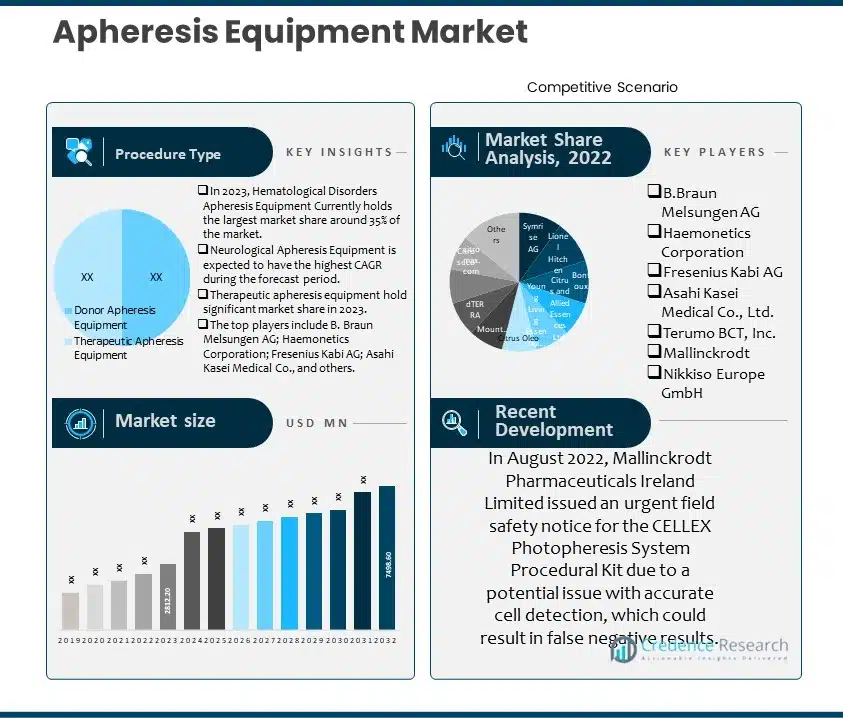
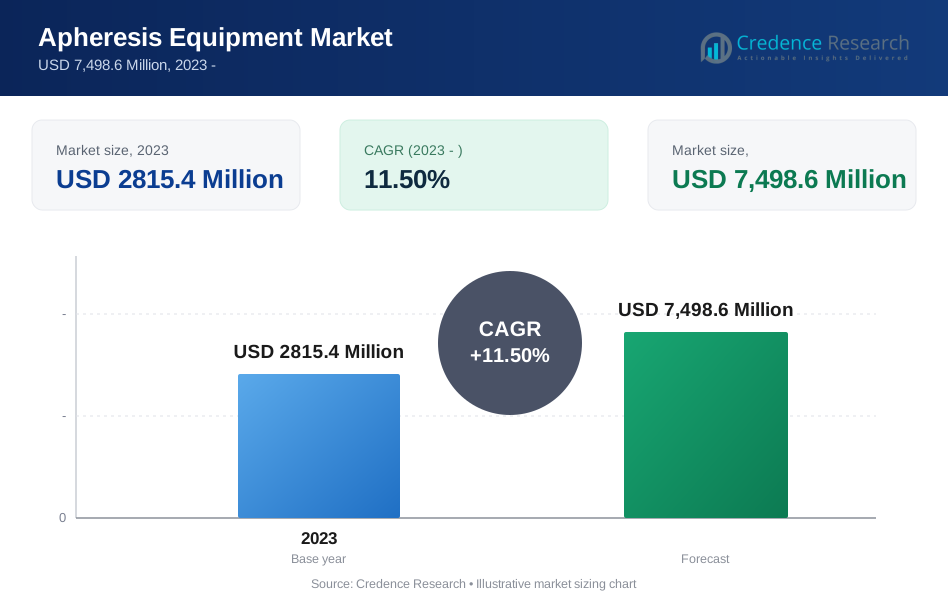
- The global demand for Apheresis Equipment was valued at USD 2815.2 Million in 2023 and is expected to reach USD 7498.6 Million in 2032, growing at a CAGR of 11.50% between 2024 and 2032.
- The Plasmapheresis Equipment sector is the market leader by equipment type, accounting for more than 31% of total value in 2023, while the Plateletpheresis Equipment segment is expected to grow rapidly throughout the forecast period.
- Hospitals and Clinics segment currently holds the largest market share due to the robust healthcare investment, government support policy and handle diverse treatments requiring apheresis, from managing hematological disorders to neurologic conditions.
- The neurological Apheresis Equipment sector is predicted to grow fastest over the projection period, while the Hematological Disorders Apheresis Equipment segment will have a market share of more than 35% in 2023.
- Over the projection period, the Membrane Filtration Apheresis Equipment category is expected to expand at the highest rate, while the Centrifugation Apheresis Equipment category will dominate the market in 2023 with a 25% share.
- Therapeutic apheresis treats various conditions like autoimmune disorders, blood disorders, and neurological diseases drive the market share in this segment.
- Disposable Apheresis Equipment currently holds the largest market in 2023. Eliminating cleaning and sterilization saves time, minimizes infection risks, and streamlines workflows for healthcare professionals drive the market growth.
- North America is fueling the growth of the Apheresis Equipment industry with over one-third share in 2023, while Asia Pacific and Europe collectively account for just under 55% share in 2023. Europe held over 20% share in 2023.
- Due to limitations in alternatives like pharmaceutical treatments, the market for Apheresis Equipment is driven by rising demand for specialized therapies and increased adoption of apheresis procedures.
Executive Summary
Market Definition
The Apheresis Equipment Market is the market for medical devices used in apheresis procedures. Apheresis is a medical procedure that involves removing specific components from a patient's blood and returning the rest to the patient's body. This process is commonly used in various medical treatments, including the collection of blood components for transfusion, the removal of disease-causing substances from the blood, and the treatment of certain autoimmune disorders.
Apheresis equipment includes machines and devices such as centrifuges, separators, pumps, and disposable kits used to perform these procedures. The market for apheresis equipment encompasses both the devices themselves as well as the associated consumables and accessories.
Market Overview
The global demand for Apheresis Equipment was valued at USD 2815.2 Million in 2023 and is expected to reach USD 7498.6 Million in 2032, growing at a CAGR of 11.50% between 2024 and 2032.
The key driver boosting the growth rate of the Apheresis Equipment Market is the rising acceptance of apheresis procedures due to their efficacy in treating various medical conditions. Increased demand for blood components for transfusions, removal of disease-causing substances from the blood, and treatment of autoimmune disorders are positively impacting the expansion of the Apheresis Equipment Market. Additionally, the market is experiencing growth due to the rising prevalence of hematological disorders and neurological diseases, which require apheresis procedures for treatment.
Furthermore, the expansion of the Apheresis Equipment Market is actively driven by the consistency and efficiency of apheresis procedures, which provide targeted removal of specific blood components. The market is expected to grow significantly during the forecast period due to the increasing adoption of apheresis equipment in clinical practice and the development of new applications for therapeutic apheresis.
In addition, the increased use of apheresis equipment in new treatments and medical applications, such as cellular therapies and regenerative medicine, will create several new opportunities for the Apheresis Equipment Market to expand during the forecast period.
Segmentation by Apheresis Equipment Types
- Plasmapheresis Equipment Currently holds the largest market share 40%-50% of the market. This dominance is driven by increased demand for plasma-derived therapies (such as immunoglobulins) for autoimmune diseases and immune deficiencies And rising incidence of neurological disorders like Guillain-Barre syndrome, where plasmapheresis is a primary treatment.
- Plateletpheresis Equipment is projected to witness the highest CAGR during the forecast period. Increasing demand for platelets in transfusions due to cancer treatments and trauma surgeries drives the market growth in future.
Segmentation by Technology-Based Segments
- Membrane Filtration Apheresis Equipment holds the largest share of the citrus essential oil market, accounting for over 50% in 2023. Membrane technology allows for more precise and targeted separation of specific blood components, which is crucial for some therapeutic applications further drive the market growth.
- Centrifugation Apheresis Equipment is projected to witness the highest CAGR during the forecast period. Technological advancements in apheresis technology, such as continuous flow centrifugation, closed-system processing, and real-time monitoring, have improved procedural efficiency, driving the adoption of centrifugal apheresis equipment in clinical practice.
Segmentation by Application-Specific Apheresis Equipment
- Hematological Disorders Apheresis Equipment Currently holds the largest market share around 35% of the market. The dominance of hematological disorders in the apheresis equipment market is due to several factors like high prevalence of hemolytic disorders such as sickle cell disease and thalassemia, which require frequent apheresis procedures. Moreover, apheresis plays a crucial role in managing various cancers and their complications, leading to increasing demand for apheresis equipment.
- Neurological Apheresis Equipment is expected to have the highest CAGR during the forecast period. Early detection and improved diagnostic tools lead to more apheresis applications drives the segment growth.
- Therapeutic apheresis equipment hold significant market share in 2023. Therapeutic apheresis equipment refers to devices that perform extracorporeal blood purification techniques, such as plasma exchange, double filtration, and selective double filtration, to remove pathogenic substances from the blood of patients.
Segmentation by End-User
- Hospitals and Clinics segment currently holds the largest market share due to the robust healthcare investment, government support policy and handle diverse treatments requiring apheresis, from managing hematological disorders to neurologic conditions.
- Ambulatory Surgical Centers (ASCs) is projected to witness the highest CAGR during the forecast period owing to shift towards outpatient care and technological advancement.
- Blood Donation Centers hold significant market share in 2023 and gowing at a considerable CAGR during the forecast period.
Segmentation by Procedure Type
- Therapeutic apheresis treats various conditions like autoimmune disorders, blood disorders, and neurological diseases drive the market share in this segment.
- Donor Apheresis Equipment is expected to see the higher CAGR during the forecast period.
Segmentation by Disposable vs. Reusable Apheresis Equipment
- Disposable Apheresis Equipment currently holds the largest market in 2023. Eliminating cleaning and sterilization saves time, minimizes infection risks, and streamlines workflows for healthcare professionals drive the market growth.
- Reusable Apheresis Equipment is projected to witness the highest CAGR during the forecast period owing to environment concern and governmnet rules.
Segmentation by Region
- North America held significant share around 42% of the market in 2023. This dominance is attributed to the increased demand for Apheresis Equipments in the North America healthcare industry, as well as the blood donation centers.
- Asia Pacific and Europe collectively account for just under 55% share in 2023, with Europe holding over 20% share in the same year.
- The rest of the world, including Latin America, the Middle East, and Africa, supplies the remaining demand for Apheresis Equipment.
Technological advancements within the Apheresis Equipment industry, such as the emergence of more efficient and sustainable products, are also contributing to market growth.
The demand for apheresis equipment in North America is anticipated to increase due to several factors, including the growing number of apheresis procedures and centers, as well as improved access to advanced healthcare infrastructure. The United States accounts for the majority share of the regional market, and the country's market expansion is fueled by the rising number of plasma exchange treatments and neurological disorders. Moreover, the Mexican market is poised to experience growth opportunities owing to the development of better healthcare facilities. Notably, the American National Red Cross reports that there is a constant need for blood and its components in the U.S., with approximately 29,000 units of red blood cells required daily. Additionally, around 16 million blood components are transfused annually in the country, highlighting the significance of apheresis equipment in the region.
The European apheresis equipment market is expected to grow due to several factors, including the increasing prevalence of chronic diseases such as cancer, autoimmune disorders, and blood disorders, which require apheresis procedures for treatment and management. The market is also driven by growing access to well-developed healthcare infrastructure, particularly in countries like Germany, France, and the United Kingdom. The demand for source plasma from biopharmaceutical businesses is another factor driving market expansion. Advancements in technology leading to improved efficiency and safety of apheresis procedures, the presence of key players in the European market, government initiatives and investments in healthcare, and the presence of a strong research and development environment are other factors contributing to the growth of the European apheresis equipment market. The market is highly competitive, with key players such as B. Braun Melsungen AG, Haemonetics Corporation, Fresenius Kabi AG, Asahi Kasei Medical Co., Ltd., Terumo BCT, Inc., Mallinckrodt, and Nikkiso Europe GmbH competing globally to provide a range of apheresis equipment and related products and services. For instance, April 2023, Fresenius Kabi introduced a new single-needle venous access feature for their Amicus® ECP System, aiming to enhance patient comfort and convenience during extracorporeal photopheresis treatments.
Key Highlights of the Report
The global Apheresis Equipment Market is segmented by equipment type, end users, application-specific apheresis equipment, technology, procedure type, disposable vs. reusable equipment, and region. Plasmapheresis equipment stands out as the most prevalent type, with hospitals and clinics being the primary end users. High-speed equipment and medium-range procedures are the most commonly utilized categories. Original equipment manufacturers (OEMs) and medium price ranges dominate the market, with North America leading in market growth.
One of the main factors propelling the global market for Apheresis Equipment is the increasing prevalence of blood-related disorders and chronic diseases, driving the need for apheresis procedures. The growing demand for therapeutic apheresis equipment for conditions such as autoimmune disorders, blood disorders, and neurological diseases is another factor boosting the market size. Additionally, the rising adoption of apheresis equipment for plasma exchange treatments and neurological disorders contributes to market expansion.
Nonetheless, North America is anticipated to have the greatest share of the worldwide Apheresis Equipment Market due to the region's well-developed healthcare infrastructure and increasing investments in medical technology. Furthermore, the market is anticipated to expand at the highest rate in the Asia-Pacific (APAC) region due to the presence of numerous medical device manufacturing firms and the growing demand for advanced healthcare solutions.
What Are The Main Drivers Of The Global Apheresis Equipment Market?
The global Apheresis Equipment market is driven by several factors, rising prevalence of blood-related disorders and chronic diseases, such as autoimmune diseases and cancer, which increase the demand for apheresis procedures. The availability of favorable government initiatives and reimbursement frameworks, which boost demand for apheresis equipment.
What Are The Major Challenges Faced By The Global Apheresis Equipment Market?
The main factors limiting the growth of Apheresis Equipment is High cost of apheresis equipment and procedures, which limits their accessibility to patients. Additionally, safety concerns related to apheresis procedures, such as the risk of infection and adverse reactions to anticoagulants.
What Are The Growth Opportunities In The Global Apheresis Equipment Market?
The global Apheresis Equipment market presents several growth opportunities, driven by increasing prevalence of blood-related disorders and chronic diseases, which drive demand for apheresis procedures.
Market Drivers
The global Apheresis Equipment market is driven by several factors. The following are the key drivers of the global Apheresis Equipment market:
Collaboration and Partnership Among Market Players
The major companies serving the global Apheresis Equipment Market are Haemonetics Corporation; Fresenius Kabi AG; Asahi Kasei Medical Co., Ltd.;NIKKISO EUROPE and Estor S.p.A. The market players are considerably contributing to the market growth by the adoption of various strategies including mergers & acquisitions, collaborations, funding, and new product launches, to stay competitive in the market. For instance, in October 2023, Nikkiso Europe Group and Estor S.p.A formed a strategic partnership to distribute the ProLUNG® Extracorporeal CO2 Removal System in select countries, enhancing the capabilities of Nikkiso's Aquarius system for continuous blood purification therapies.
Market Restraints
The global Apheresis Equipment market faces some challenges that may hinder its growth. These include the following:
High Cost Of Apheresis Equipment And Procedures
The high cost of apheresis equipment and procedures is a significant challenge for the apheresis equipment market, as it may limit access to some patients and healthcare facilities. The cost of apheresis equipment and procedures is high due to the complexity of the equipment and the need for highly trained specialists to operate it. The high cost of apheresis equipment and procedures can also lead to limited reimbursement from insurance companies, which can further limit access to these procedures. Additionally, the high cost of apheresis equipment and procedures can be a barrier to entry for new players in the market, which can limit competition and innovation.
Opportunities
The global Apheresis Equipment market offers significant growth opportunities. These include the following:
Rising Demand for Specialized Biospecimens
The growth of the Apheresis Equipment Market is attributed to the increasing demand for specialized biospecimens, such as those obtained through procedures like plasmapheresis, plateletpheresis, and leukapheresis. These techniques involve the separation of blood components, including plasma, platelets, and white blood cells, which are used for various purposes, such as treating disorders and manufacturing therapies. Plasmapheresis involves the removal and reinfusion of plasma, which is the liquid component of blood. This process is used for treating conditions like multiple sclerosis, Guillain-Barré syndrome, and immune thrombocytopenic purpura. Plasma-derived therapies, such as immunoglobulins, are also manufactured using this technique.
Competitive Landscape
Key Players
The global Apheresis Equipment market is highly competitive, with several key players. Some of the major players in the market and their market share are as follows:
- B.Braun Melsungen AG
- Haemonetics Corporation
- Fresenius Kabi AG
- Asahi Kasei Medical Co., Ltd.
- Terumo BCT, Inc.
- Mallinckrodt
- Nikkiso Europe GmbH
- Others
These organizations prioritize product innovation, distribution channel expansion, and mergers and acquisitions to stay competitive.
The global Apheresis Equipment market's key players continually seek to stay ahead by offering new products and developments.
In August 2023, Fresenius Medical Care received FDA clearance for its VersiHD with GuideMe Software, a new user-friendly interface for its chronic home hemodialysis system, aiming to improve the patient and nurse experience. This marks another milestone for the company, building on its extensive experience in providing HHD solutions for millions of patients worldwide.
In August 2022, Mallinckrodt Pharmaceuticals Ireland Limited issued an urgent field safety notice for the CELLEX Photopheresis System Procedural Kit due to a potential issue with accurate cell detection, which could result in false negative results. The CELLEX Photopheresis System Procedural Kit is used for autologous hematopoietic stem cell collection, which is a process that involves collecting and processing a patient's own blood cells for transplantation. This product is used in the field of apheresis, which is the process of removing blood components, such as platelets, plasma, or stem cells, from the body.
Summary of Key Findings
- The Apheresis Equipment Market is witnessing increased demand driven by the rising prevalence of blood-related disorders and chronic diseases, necessitating advanced blood component separation methods.
- The market is segmented based on equipment type, end users, application-specific apheresis equipment, technology, procedure type, disposable vs. reusable equipment, and region.
- Plasmapheresis equipment holds a significant market share, with hospitals and clinics being the primary end users. Therapeutic apheresis equipment is witnessing high demand for treating autoimmune disorders, blood disorders, and neurological diseases.
- North America dominates the market, driven by well-established healthcare infrastructure and increasing investments in medical technology. The Asia Pacific region is experiencing rapid growth due to the presence of numerous medical device manufacturing firms and growing demand for advanced healthcare solutions.
- Key players in the market include B. Braun Melsungen AG, Haemonetics Corporation, Fresenius Kabi AG, Asahi Kasei Medical Co., Ltd., Terumo BCT, Inc., Mallinckrodt, Nikkiso Europe GmbH, and others, actively contributing to market growth through innovation and strategic partnerships.
Future Outlook
- Positive outlook for the Apheresis Equipment Market with significant growth potential in the North American region, driven by the region's robust healthcare infrastructure and increasing investments in medical technology.
- One of the main factors promoting the market's expansion is the healthcare sector's reliance on apheresis procedures for treating various medical conditions, including blood-related disorders, autoimmune diseases, and neurological disorders.
- During the forecast period, the increasing adoption of alternative medical treatments and therapies may pose a challenge to the growth of the Apheresis Equipment Market. However, advancements in apheresis technology and the development of new applications are expected to mitigate this impact.
- Key firms in the Apheresis Equipment Market must focus on product innovation, expanding their market reach, and maintaining competitive pricing to stay ahead of the competition and capitalize on the growing demand for apheresis equipment worldwide.
How CXOs Can Benefit from the Credence Research Apheresis Equipment Networks Market Report
The Credence Research Apheresis Equipment Networks Market Report provides CXOs with a comprehensive overview of the market, including:
- Market size and growth forecast: The report provides detailed estimates of the global Apheresis Equipment networks market size, segmented by equipment type, end users, application-specific apheresis equipment, technology, procedure type, disposable vs. reusable equipment, and region. It also includes forecasts for the market through 2032, based on key trends and drivers.
- Market segmentation: The report segments the Apheresis Equipment networks market by equipment type, end users, application-specific apheresis equipment, technology, procedure type, disposable vs. reusable equipment, and region. The increasing demand for advanced solutions is driven. This segmentation provides CXOs with a granular understanding of the market and the opportunities in each segment.
- Competitive landscape: The report profiles the key players in the Apheresis Equipment networks market and provides insights into their strategies, product offerings, and financial performance. This information can help CXOs to identify and assess their competition.
- Key trends and drivers: The report identifies and analyzes the key trends and drivers that are shaping the Apheresis Equipment networks market. This information can help CXOs to make informed decisions about their investments and strategies.
CXOs can use the insights from the Credence Research Apheresis Equipment Networks Market Report to:
- Identify growth opportunities: The report can help CXOs to identify new growth opportunities in the Apheresis Equipment networks market. For example, the report identifies the growing demand for Apheresis Equipment networks from cloud computing providers and telecom companies as a key opportunity.
- Make informed investment decisions: The report can help CXOs to make informed investment decisions about Apheresis Equipment networks. For example, the report provides insights into the key factors to consider when evaluating Apheresis Equipment providers and selecting Apheresis Equipment solutions.
- Develop competitive strategies: The report can help CXOs to develop competitive strategies for their Apheresis Equipment networks businesses. For example, the report identifies the key strategies that Apheresis Equipment providers are using to differentiate themselves from their competitors.
- Track market developments: The report can help CXOs to track market developments and stay ahead of the curve. For example, the report provides insights into the latest trends and innovations in the Apheresis Equipment networks market.
Overall, the Credence Research Apheresis Equipment Networks Market Report is a valuable resource for CXOs who are looking to gain a deeper understanding of the market and identify opportunities for growth.
Segmentation
- By Apheresis Equipment Types:
- Plasmapheresis Equipment
- Plateletpheresis Equipment
- Leukapheresis Equipment
- Erythrocytapheresis Equipment
- Therapeutic Apheresis Equipment
- By Technology-Based Segments:
- Centrifugation Apheresis Equipment
- Membrane Filtration Apheresis Equipment
- By Application-Specific Apheresis Equipment:
- Renal (Kidney) Apheresis Equipment
- Neurological Apheresis Equipment
- Hematological Disorders Apheresis Equipment
- Autoimmune Disorders Apheresis Equipment
- By End-User:
- Hospitals and Clinics
- Blood Donation Centers
- Ambulatory Surgical Centers (ASCs)
- Research and Academic Institutes
- By Procedure Type:
- Donor Apheresis Equipment
- Therapeutic Apheresis Equipment
- By Disposable vs. Reusable Apheresis Equipment:
- Disposable Apheresis Equipment
- Reusable Apheresis Equipment
- By Region
- North America
- The U.S.
- Canada
- Mexico
- Europe
- Germany
- France
- The U.K.
- Italy
- Spain
- Rest of Europe
- Asia Pacific
- China
- Japan
- India
- South Korea
- South-east Asia
- Rest of Asia Pacific
- Latin America
- Brazil
- Argentina
- Rest of Latin America
- Middle East & Africa
- GCC Countries
- South Africa
- Rest of Middle East and Africa
- North America
Request a Free Sample
Fill in your details and we'll send you a free sample report.
- Sample data tables & charts
- Research methodology
Need a Custom Version of This Report?
Tailor the scope, geography, or segments to your exact requirements.
- Custom geography or segment scope
- Direct access to our analyst team
Frequently Asked Questions
What is the current size of the global Apheresis Equipment market?
What is the expected growth rate of the Apheresis Equipment market between 2024 and 2032?
Which segment is leading the market share in terms of Apheresis Equipment Types?
Which Technology-Based Segments governs the demand for Apheresis Equipments in the world?
Who are the major players in the global Apheresis Equipment market?
Table of Content
Chapter 1. Report Introduction
- 1.1 Report Description & Purpose
- 1.1.1 Report Title & Market Definition
- 1.1.2 Unique Selling Propositions (USP) & Key Differentiators
- 1.1.3 Value Proposition for Stakeholders
- 1.2 Research Objectives
- 1.2.1 Market Sizing Objectives (Volume & Revenue)
- 1.2.2 Segmentation Objectives
- 1.2.3 Competitive Intelligence Objectives
- 1.2.4 Forecast & Scenario Objectives
- 1.3 Report Scope
- 1.3.1 Apheresis Equipment Scope – Types & Subtypes Covered
- 1.3.2 Geographic Scope – Regions & Countries Covered
- 1.3.3 Historical Period, Base Year & Forecast Period (2023; forecast to the forecast period)
- 1.3.4 Inclusions & Exclusions
- 1.4 HS Code & Classification Framework
- 1.5 Currency, Units & Pricing Basis
- 1.6 Target Stakeholders
- 1.7 Limitations & Assumptions
Chapter 2. Executive Summary
- 2.1 Global Apheresis Equipment Market Snapshot
- 2.1.1 Market Size – Historical (2023) & Forecast (the forecast period) (2023: USD 2815.4 Million → forecast year: USD 7,498.6 Million)
- 2.1.2 Volume & Revenue – Global Totals
- 2.1.3 Key Market Highlights – Top Five Facts
- 2.2 Apheresis Equipment Market Segmentation Snapshot
- 2.2.1 Market Split by Region – 2023 vs.
- 2.3 Competitive Snapshot
- 2.3.1 Top 10 Players by Revenue Share – 2023
- 2.3.2 Top 10 Players by Volume Share – 2023
- 2.3.3 Recent Strategic Developments (18-Month Summary)
- 2.4 Key Investment Highlights & Strategic Conclusions
Chapter 3. Apheresis Equipment Market Dynamics & Industry Analysis
- 3.1 Market Overview & Context
- 3.1.1 Apheresis Equipment Market Position in the Broader Automotive Value Chain
- 3.1.2 OEM vs. Replacement Market Dynamics
- 3.1.3 Market Maturity & Development Stage by Region
- 3.2 Apheresis Equipment Market Drivers
- 3.3 Apheresis Equipment Market Restraints & Challenges
- 3.4 Apheresis Equipment Market Opportunities
- 3.5 Porter's Five Forces Analysis
- 3.5.1 Threat of New Entrants
- 3.5.2 Bargaining Power of Suppliers
- 3.5.3 Bargaining Power of Buyers
- 3.5.4 Threat of Substitutes
- 3.5.5 Competitive Rivalry – Intensity Assessment
- 3.6 Apheresis Equipment Value Chain Analysis
- 3.6.1 Upstream – Raw Material/Input Suppliers
- 3.6.1.1 Raw Material/Input 1
- 3.6.1.2 Raw Material/Input 2
- 3.6.1.3 Raw Material/Input 3
- 3.6.2 Midstream – Production/Manufacturing/Service Delivery
- 3.6.2.1 Production/Process Overview
- 3.6.2.2 Key Facility Locations & Capacity by Manufacturer
- 3.6.3 Downstream – Distribution & End Consumer
- 3.6.3.1 Primary Channel – B2B/OEM
- 3.6.3.2 Secondary Channels – Dealer, Retail, Online, Direct
- 3.6.4 Value Chain Profitability Analysis
- 3.6.1 Upstream – Raw Material/Input Suppliers
- 3.7 PESTEL Analysis
- 3.7.1 Political Factors
- 3.7.2 Economic Factors
- 3.7.3 Social Factors
- 3.7.4 Technological Factors
- 3.7.5 Environmental Factors
- 3.7.6 Legal Factors
- 3.8 Apheresis Equipment Supply Chain Analysis
- 3.8.1 Raw Material/Input Supply Risk Assessment
- 3.8.2 Manufacturing Concentration Risk (Geographic Exposure)
- 3.8.3 Trade Disruption Impact Analysis
- 3.9 Regulatory & Policy Landscape
Note: The regulatory and policy landscape section covers regulations based on their applicability to the market, Apheresis Equipment category, geography, and scope of the study. Only regulatory frameworks with a material impact on operations, compliance, trade, sustainability, or market access are analyzed in detail.
Chapter 4. Key Investment Pockets & Opportunity Analysis
- 4.1 Apheresis Equipment Market Attractiveness Analysis
- 4.1.1 By Region – Investment Attractiveness Matrix (Volume × CAGR)
- 4.2 Absolute Revenue Growth Opportunity
- 4.2.1 By Region – Absolute USD Growth Through the forecast period
- 4.3 Incremental Volume Opportunity
- 4.3.1 By Region – Incremental Volume Through the forecast period
- 4.3.2 Segment – Incremental Volume
- 4.4 Emerging Submarket Opportunity Deep Dive (Subject to Applicability)
- 4.5 Emerging Market Opportunity Scorecards
- 4.5.1 United States
- 4.5.2 Europe
- 4.5.3 Asia
- 4.5.4 Middle East & Africa
Note: Emerging Market Opportunity Scorecards will be included based on relevance and strategic importance. Regions listed are indicative and may vary depending on data availability and market dynamics.
Chapter 5. Apheresis Equipment Import-Export Analysis & Trade Flows
- 5.1 Global Trade Overview
- 5.1.1 Global Export Value by Country (2023)
- 5.1.2 Global Export Volume by Country (2023)
- 5.1.3 Global Import Value by Country (2023)
- 5.1.4 Global Import Volume by Country (2023)
- 5.1.5 Net Trade Balance by Country (2023)
- 5.2 Export Analysis – Segment
- 5.2.1 Type 1 (HS Code)
- 5.2.2 Type 2 (HS Code)
- 5.2.3 Type 3 (HS Code)
- 5.2.4 Type 4 (HS Code)
- 5.2.5 Type 5 (HS Code)
- 5.3 Import Analysis – Segment
- 5.3.1 Type 1 (HS Code)
- 5.3.2 Type 2 (HS Code)
- 5.3.3 Type 3 (HS Code)
- 5.3.4 Type 4 (HS Code)
- 5.3.5 Type 5 (HS Code)
- 5.4 Average Unit Trade Prices
- 5.4.1 Average Export Price – Segment & Country
- 5.4.2 Average Import Price – Segment & Source Country
- 5.4.3 Price Trends (2023)
- 5.5 Key Trade Route Analysis
- 5.5.1 Trade Route 1
- 5.5.2 Trade Route 2
- 5.5.3 Trade Route 3
- 5.5.4 Trade Route 4
- 5.5.5 Trade Route 5
- 5.6 Trade Policy Impact Assessment
- 5.6.1 US Anti-Dumping & Section 301 Tariffs
- 5.6.2 EU Customs Union Impact
- 5.6.3 Major Free Trade Agreements
- 5.6.4 USMCA Rules of Origin
Note: Trade policy analysis will be included only where relevant to the Apheresis Equipment market.
Chapter 6. Competitive Landscape & Company Benchmarking
- 6.1 Apheresis Equipment Market Concentration & Structure
- 6.1.1 Herfindahl-Hirschman Index (HHI) – vs. 2023
- 6.1.2 Tier 1, Tier 2 & Tier 3 Market Structure
- 6.1.3 Global, Regional & Local Player Dynamics
- 6.2 Apheresis Equipment Market Share Analysis – 2023
- 6.2.1 Global Revenue Share by Company
- 6.2.2 Global Volume Share by Company
- 6.2.3 Regional Revenue Share
- 6.2.4 Market Share Evolution ( vs. 2023)
- 6.2.5 OEM Segment Share by Company
- 6.2.6 Replacement Segment Share by Company
- 6.3 Production/Delivery Capacity & Facility Analysis
- 6.3.1 Global Installed Capacity
- 6.3.2 Capacity Utilization Rates
- 6.3.3 Production/Output Volume
- 6.3.4 Facility Locations & Capacity Map
- 6.3.5 Planned Capacity Additions
- 6.4 Apheresis Equipment Competitive Benchmarking Matrix
- 6.4.1 Revenue, Volume, CAGR & Profitability Comparison
- 6.4.2 Channel Revenue Mix
- 6.4.3 Geographic Revenue Exposure
- 6.4.4 R&D Intensity
- 6.4.5 Sustainability Maturity
- 6.5 Strategic Developments in Apheresis Equipment (Last 24 Months)
- 6.5.1 Mergers, Acquisitions & Divestments
- 6.5.2 New Apheresis Equipment Launches
- 6.5.3 Facility Expansions
- 6.5.4 Strategic Alliances, Joint Ventures & Partnerships
- 6.5.5 Distribution Expansion & Market Entry
- 6.5.6 Sustainability & ESG Initiatives
- 6.6 Competitive Strategy Mapping
- 6.6.1 Leader, Challenger, Follower & Niche Classification
- 6.6.2 Pricing Strategy Comparison
- 6.6.3 Channel Strategy Matrix
Note: Strategic developments are included based on their materiality and the availability of reliable information.
Chapter 7. Global Apheresis Equipment Market – By Distribution Channel
- 7.1 Segment Overview
- 7.1.1 Volume & Revenue Split by Channel (2023 & )
- 7.1.2 Channel Mix Evolution (the forecast period)
Chapter 8. Regional Market Analysis – Global Overview
- 8.1 Global Regional Overview
- 8.1.1 Regional Volume Share
- 8.1.2 Regional Revenue Share
- 8.1.3 Regional Volume by Region
- 8.1.4 Regional Revenue by Region
- 8.1.5 Regional Forecast Through the forecast period
- 8.2 Cross-Regional Segment Analysis
- 8.2.1 By Distribution Channel
- 8.2.2 By Brand/Price Tier
Chapter 9. North America Apheresis Equipment Market
- 9.1 United States
- 9.2 Canada
- 9.3 Mexico
Chapter 10. Europe Apheresis Equipment Market
- 10.1 Germany
- 10.2 France
- 10.3 Italy
- 10.4 United Kingdom
- 10.5 Spain
- 10.6 Poland
- 10.7 Russia
- 10.8 Netherlands
- 10.9 Belgium
- 10.10 Sweden
- 10.11 Denmark
- 10.12 Norway
- 10.13 Rest of Europe
Chapter 11. Asia Pacific Apheresis Equipment Market
- 11.1 China
- 11.2 India
- 11.3 Japan
- 11.4 South Korea
- 11.5 Thailand
- 11.6 Indonesia
- 11.7 Vietnam
- 11.8 Malaysia
- 11.9 Australia
- 11.10 Rest of Asia Pacific
Chapter 12. Latin America Apheresis Equipment Market
- 12.1 Brazil
- 12.2 Argentina
- 12.3 Colombia
- 12.4 Chile
- 12.5 Rest of Latin America
Chapter 13. Middle East Apheresis Equipment Market
- 13.1 Saudi Arabia
- 13.2 United Arab Emirates
- 13.3 Turkey
- 13.4 Israel
- 13.5 Iran
- 13.6 Rest of the Middle East
Chapter 14. Africa Apheresis Equipment Market
- 14.1 South Africa
- 14.2 Egypt
- 14.3 Nigeria
- 14.4 Morocco
- 14.5 Rest of Africa
Chapter 15. Apheresis Equipment Company Profiles
- 15.1 [Company 01]
- 15.1.1 Company Overview
- 15.1.2 Key Management Personnel
- 15.1.3 Products & Services Portfolio
- 15.1.4 Financial Performance
- 15.1.5 Key Market Focus & Geographic Presence
- 15.1.6 Recent Developments & Strategic Initiatives
Note: The company profile list is preliminary and may change based on research findings, market developments, data availability, and client requirements.
Chapter 16. Appendices
- Appendix A – List of Abbreviations & Acronyms
- Appendix B – Industry Classification Code Reference – Full Series
- Appendix C – Production & Capacity Data Tables
- Appendix D – End-Use & Demand Base Tables
- Appendix E – Consumption & Replacement Rate Assumptions
- Appendix F – ASP Reference Tables
- Appendix G – Manufacturing & Facility Database
- Appendix H – Import-Export Data Tables
- Appendix I – Regulatory Summary Tables
- Appendix J – Primary Research Participant List (Anonymized)
- Appendix K – Primary Research Questionnaire Framework
- Appendix L – Data Sources & Bibliography
- Appendix M – Market Size Divergence & Source Comparison
Chapter 17. Research Methodology
- 17.1 Research Framework & Philosophy
- 17.2 Secondary Research – Sources, Hierarchy & Data Extraction
- 17.3 Data Modeling – Bottom-Up & Top-Down Market Sizing
- 17.4 Primary Research – Stakeholder Framework, LOI & Sample Sizes
- 17.5 Forecast Methodology – Regression, Scenario & Sensitivity Analysis
- 17.6 Quality Control – Four-Layer Validation Framework
- 17.7 Limitations & Standard Assumptions
- 17.8 Disclaimer
