
| REPORT ATTRIBUTE | DETAILS |
|---|---|
| Historical Period | 2019-2022 |
| Base Year | 2023 |
| Forecast Period | 2024-2032 |
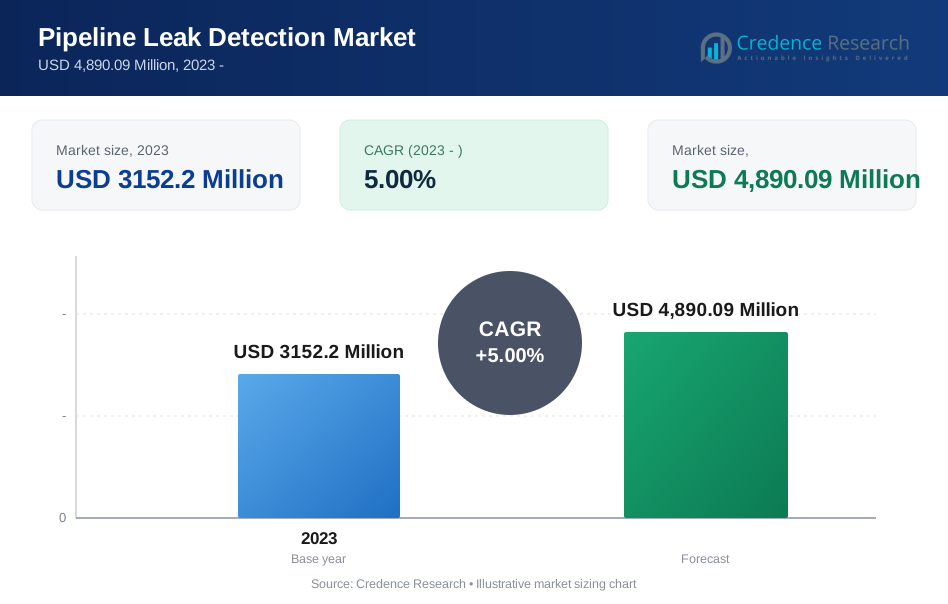
| Pipeline Leak Detection Market Size 2023 | USD 3152.2 Million |
| Pipeline Leak Detection Market, CAGR | 5.00% |
| Pipeline Leak Detection Market Size 2032 | USD 4890.09 Million |
Market Insights
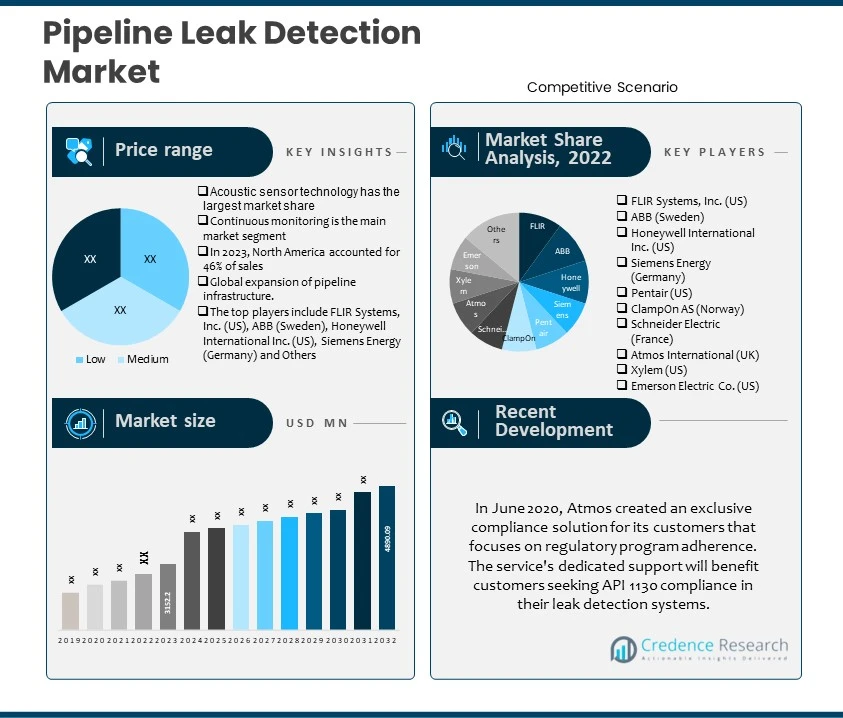
- The global demand for Pipeline Leak Detection was valued at USD 3152.2 Million in 2023 and is expected to reach USD 4890.09 Million in 2032, growing at a CAGR of 5.00% between 2024 and 2032.
- Acoustic sensor technology has the largest market share, while other sensors have a significant market share.
- In 2023, the oil and gas category led the whole market, with a revenue share of 68.6%. Water and Wastewater Pipelines is predicted to rise at a CAGR of 7.5% over the projection period.
- Continuous Monitoring is the dominating market sector, while Remote Monitoring is the fastest growing market category.
- Pipeline operators are the most popular group, while oil and gas firms make up a sizable market share.
- In 2023, North America had the highest revenue share (46%), while the Asia Pacific market is expected to grow rapidly throughout the forecast period.
- Increased worldwide energy consumption propels the pipeline leak detection industry.
- Technical issues with leak detectors impede market expansion.
Executive Summary
Market Definition
The word leak or leakage refers to an unexpected crack, hole, or porosity in an encapsulating wall or junction of pipelines, batteries, sealed items, chambers, or storage containers that must contain/transfer various fluids and gases. These fissures or holes allow fluids and gasses to exit a closed media.
Market Overview
The global Pipeline Leak Detection Market has witnessed steady growth in recent years and is expected to grow at a CAGR of 5.00% between 2024 and 2032. The market was valued at USD 3152.2 million in 2023 and is expected to reach USD 4890.09 million in 2032.
The Global Pipeline Leak Detection Systems market is expanding due to the growing demand for efficient water management solutions to prevent water waste caused by underground pipeline breaks. The increasing urbanization and industrialization, together with population growth, are likely to drive up demand for leak detection systems. The increased awareness of water conservation and the desire to reduce water losses is another important factor driving the market for Leak Detection Systems.
Furthermore, the growing demand for automated leak detection systems due to their low cost, increased accuracy, and quick reaction time is expected to drive market expansion. The introduction of innovative leak detection technologies such as acoustic leak detection systems, smart trenchless leak detection systems, and infrared thermal imaging systems is likely to open up attractive market growth potential.
However, the expensive cost of leak detection systems, as well as the complexity of their installation and maintenance, are limiting market expansion. Furthermore, problems such as a lack of awareness about modern leak detection technologies and a shortage of experienced staff to run and maintain these systems are projected to impede market growth.
Segmentation By Type of Detection Technology
- Acoustic sensor technology has the biggest market share. It is a key component of leak detection because it detects the leak's noise.
- Other sensors, such as cable sensors and vapor sensors, have a considerable market share due to the increased integration of modern technologies, such as the Internet of Things (IoT).
Segmentation By Application
- The oil and gas category dominated the total market in 2023, with a revenue share of 68.6%, and is expected to grow at a CAGR of more than 8% during the forecast period. The oil and gas segment includes crude oil, natural gas, biogas fuels, petroleum, and refineries. A pipeline is the foundation for transportation in the oil and gas industry.
- Water and Wastewater Pipelines is expected to develop at a CAGR of 7.5% over the projection period.
Segmentation by Method of Detection
- Continuous Monitoring is the dominant market sector. Continuous Monitoring is the real-time monitoring of pipelines for leaks or irregularities, with quick notifications for prompt action. This segment is dominant because of its proactive approach to pipeline safety and leak prevention.
- On the other hand, Remote Monitoring is the fastest expanding market category. Remote monitoring allows pipelines to be monitored from a distance, often using advanced technologies such as IoT and AI.
Segmentation By End-User
- Pipeline operators are the most popular segment. Pipeline operators are essential industry participants in charge of pipeline management and maintenance, making them an important target market for leak detection technologies. Their focus on pipeline integrity and safety increases the market for effective leak detection systems.
- Additionally, oil and gas companies constitute a significant market segment.
Segmentation by Region
- In 2023, North America had the greatest revenue share at 46%.
- The Asia Pacific regional market is predicted to increase significantly over the forecast period.
- The rest of the world, including Latin America, the Middle East, and Africa, supplies the remaining demand for Pipeline Leak Detection.
North America emerged as the leading participant in 2023, with the highest market share. North America has a huge network of oil and gas pipelines. These pipelines play critical roles in transferring hydrocarbons from production sites to refineries, distribution centers, and end consumers, meeting the region's energy needs. Notably, North America has some of the world's most stringent environmental rules. Regulatory authorities, such as the United States Environmental Protection Agency (EPA) and Canada's National Energy Board, require the installation of advanced leak detection systems. As a result, pipeline operators in the region are constantly investing in cutting-edge technologies to maintain compliance with these rules, creating attractive prospects for technology providers.
Moreover, The Asia Pacific regional market is predicted to increase significantly over the forecast period. The growing demand for oil and oil products in Asia Pacific countries is likely to drive up demand for LDAR among utility companies in the region. The increased production of natural gas in nations such as China is driving the demand for leak detection and repair systems. The subsequent expansion of oil and gas pipelines is likely to propel market growth in the region.
Key Highlights of the Report
Type of Detection Technology, Application, Method of Detection, End-User, and region segment of the global Pipeline Leak Detection Market. In 2023, the oil and gas category led the whole market, with Remote Monitoring being the fastest-growing market segment. Additionally, pipeline operators are the most popular group, and other sensors have a significant market share and North America, leading the market growth.
Growing worries about pipeline safety and environmental protection, Stringent laws mandating the use of leak detection systems, as well as technological breakthroughs that improve the accuracy and effectiveness of leak detection solutions, are the primary market drivers. In addition, technical complexities and issues with leak detection technology, a drop in global oil prices hurting investment in pipeline maintenance, and the high initial expenses involved with installing advanced leak detection technologies are major market limitations. Also, the market's significant potential include rising demand for pipeline infrastructure construction, increased awareness of the need of leak detection for operational efficiency, and the expansion of pipeline networks in emerging regions.
North America emerged as the main participant in 2023, with the largest market share. North America has an extensive network of oil and gas pipelines. These pipelines perform crucial roles in transporting hydrocarbons from production sites to refineries, distribution centers, and end users, thereby meeting the region's energy demands. Furthermore, the Asia-Pacific regional market is expected to grow significantly throughout the forecast period. The rising demand for oil and oil products in Asia Pacific countries is projected to drive greater demand for LDAR among the region's utility businesses.
What Are The Main Drivers Of The Global Pipeline Leak Detection Market?
Growing concerns about pipeline safety and environmental protection are driving the pipeline leak detection market. With a growing emphasis on leak prevention and environmental stewardship, the demand for effective leak detection systems is increasing. Furthermore, rigorous laws requiring the usage of leak detection devices in pipelines fuel the market growth.
What Are The Major Challenges Faced By The Global Pipeline Leak Detection Market?
Despite the strong growth factors, the Pipeline Leak Detection Market has some challenges. The technical complexities and limitations associated with leak detection equipment significantly impede market growth. Inaccuracies and false alarms can also impede timely leak detection, reducing the overall effectiveness of monitoring systems.
What Are The Growth Opportunities In The Global Pipeline Leak Detection Market?
Despite the challenges, the Pipeline Leak Detection Market offers numerous chances for growth. The rising need for pipeline infrastructure expansion, particularly in emerging nations, presents a substantial opportunity for the industry to grow. As people become more aware of the necessity of leak detection for operational efficiency, there will be an increased need for effective leak detection solutions.
Market Drivers
Several factors drive the global Pipeline Leak Detection Market. The following are the key drivers of the global Pipeline Leak Detection Market:
Increasing Global Energy
Energy consumption is the amount of energy used or consumed by individuals, businesses, or governments for various purposes. Oil and gas pipeline leak detectors detect leaks quickly and precisely, reducing the loss of vital oil and gas resources. Leaks are minimized to ensure that energy transferred through pipelines reaches its destination without loss.
For instance, according to the Energy Information Administration (EIA), a US-based government organization, in 2022, the primary energy consumption in the United States was 100.4 quadrillion British thermal units (quads), which represented a 3% increase from the previous year. Fossil fuels accounted for 79% of total consumption, with petroleum being the leading source of energy, followed by natural gas and coal. As a result, the rise in worldwide energy consumption is driving the expansion of the oil and gas pipeline leak detector market.
Market Restraints
The global Pipeline Leak Detection Market faces some challenges that may hinder its growth. These include the following:
Leak Detectors Come With Technical Problems
The technical challenges connected with leak detectors are a significant limitation in the Pipeline Leak Detection market. These technical issues, such as errors or false alarms, might limit the accurate and timely detection of pipeline leaks. When leak detectors encounter technological difficulties, they may not perform properly, resulting in delays in discovering and resolving leaks efficiently. This can lead to significant safety risks, environmental issues, and operational difficulties for pipeline operators. Addressing these technical complexity and guaranteeing the dependability of leak detection systems is critical to maintaining pipeline network integrity and safety while avoiding costly occurrences in the Pipeline Leak Detection Market.
Opportunities
The global Pipeline Leak Detection Market offers significant growth opportunities. These include the following:
Rising Oil And Gas Consumption
Oil and gas refers to the external drilling, production, collection, processing, distribution, and transportation of oil and gas. As oil and gas consumption rises, so does the system's requirement to track data such as pressure, flow rates, temperature, and whether valves are open or closed via a variety of sensors.
For instance, in April 2023, according to a study published by the US Energy Information Administration, a federal statistics system for acquiring, analyzing, and disseminating energy data, oil consumption increased by 5.3 million barrels per day (b/d) from 2021. Global liquid fuel consumption is predicted to increase by 1.4 million barrels per day in 2023 and 1.8 million barrels per day in 2024. As a result, an increase in oil and gas consumption is driving the expansion of the oil and gas pipeline leak detector market moving ahead.
Competitive Landscape
Key Players
The global Pipeline Leak Detection Market is highly competitive, with several key players. Some of the major players in the market and their market share are as follows:
- FLIR Systems, Inc. (US)
- ABB (Sweden)
- Honeywell International Inc. (US)
- Siemens Energy (Germany)
- Pentair (US)
- ClampOn AS (Norway)
- Schneider Electric (France)
- Atmos International (UK)
- Xylem (US)
- Emerson Electric Co. (US)
- KROHNE Messtechnik GmbH (Germany)
- PERMA-PIPE International Holdings, Inc. (US)
- TTK (India), PSI Software AG (Germany), HIMA (India)
- AVEVA Group plc (UK)
- Yokogawa Electric Corporation (Japan)
- INFICON (Switzerland)
- Fotech Group Ltd. (UK)
- Asel-Tech Inc. (US)
- MAGNUM Pirex AG / MAGNUM LEO-Pipe GmbH (Germany)
- Hawk Measurement Systems (Australia)
- OptaSense Ltd. (US), among others
These organizations prioritize product innovation, Method of Detection expansion, and mergers and acquisitions to stay competitive.
The global Pipeline Leak Detection Market's key players continually seek to stay ahead by offering new products and developments.
In November 2021, Schneider Electric, a French energy and automation digital solution provider, and Prisma Photonics, an Israeli next-generation fiber sensing company for smart infrastructure, have announced a collaboration to provide real-time intelligence and precise monitoring of oil and infrastructure.
In October 2020, ABB announced its pioneering gas leak detection solution for utilities, with the goal of improving city population safety. The breakthrough ABB MicroGuard system, along with ABB's MobileGuard, accurately detects hazardous gas leakage. The use of this proprietary laser-based technology allows for faster and more efficient detection, resulting in fewer fatalities, reduced environmental impact, and material loss.
Summary of Key Findings
- Rising oil and gas consumption drives the pipeline leak detection market.
- The market is segmented by Type of Detection Technology, Continuous Monitoring is the largest market sector
- Pipeline operators are the most popular segment
- The oncology category dominated the mAb applications market.
- North America is leading in market growth; the market is highly competitive, with key players including FLIR Systems, Inc. (US), ABB (Sweden), Honeywell International Inc. (US), Siemens Energy (Germany) and Others.
Future Outlook
- Increased use of modern technologies.
- Increased emphasis on pipeline safety and environmental standards.
- Growing demand for effective leak detection solutions.
- Global expansion of pipeline infrastructure.
How CXOs Can Benefit from the Credence Research Pipeline Leak Detection Market Report
The Credence Research Pipeline Leak Detection Market Report provides CXOs with a comprehensive overview of the market, including:
- Market size and growth forecast: The report provides detailed estimates of the global Pipeline Leak Detection Market size, segmented By Type of Detection Technology, Application, Method of Detection, End-User and region. It also includes forecasts for the market through 2032 based on key trends and drivers.
- Market segmentation: The report segments the Pipeline Leak Detection Market By Type of Detection Technology, Application, Method of Detection, End-User and region. This segmentation provides CXOs with a granular understanding of the market and the opportunities in each segment.
- Competitive Landscape: The report profiles the key players in the Pipeline Leak Detection Market and provides insights into their strategies, product offerings, and financial performance. This information can help CXOs to identify and assess their competition.
- Key trends and drivers: The report identifies and analyzes the key trends and drivers that are shaping the Pipeline Leak Detection Market. This information can help CXOs to make informed decisions about their investments and strategies.
CXOs can use the insights from the Credence Research Pipeline Leak Detection Market Report to:
- Identify growth opportunities: The report can help CXOs to identify new growth opportunities in the Pipeline Leak Detection Market. For example, by analyzing the data and trends in the report, they can make informed decisions on where to invest and expand their business.
- Make informed investment decisions: The report can help CXOs make informed investment decisions about Pipeline Leak Detection. For example, it may provide useful insights into market trends, customer preferences, the competitive landscape, and growth prospects in the mobile accessories business..
- Develop competitive strategies: The report can help CXOs develop competitive strategies for their Pipeline Leak Detection businesses. For example, by analyzing market trends, client preferences, and the competitive environment mentioned in the report, CXOs can fine-tune their strategies, differentiate their offers, and effectively position their firms in the marketplace.
- Track market developments: The report can help CXOs monitor market developments and stay ahead of the curve. For example, it provides insights into the latest trends and innovations in the Pipeline Leak Detection Market.
Overall, the Credence Research Pipeline Leak Detection Market Report is a valuable resource for CXOs who are looking to gain a deeper understanding of the market and identify .opportunities for growth.
Segmentation
- By Type of Detection Technology:
- Murine Monoclonal Antibodies
- Chimeric Monoclonal Antibodies
- Humanized Monoclonal Antibodies
- Fully Human Monoclonal Antibodies
- By Application:
- Oncology
- Autoimmune Diseases
- Infectious Diseases
- Neurological Disorders
- Cardiovascular Diseases
- Others
- By Method of Detection:
- Epidermal Growth Factor Receptor (EGFR) Inhibitors
- Programmed Cell Death Protein 1 (PD-1) Inhibitors
- Human Epidermal Growth Factor Receptor 2 (HER2) Inhibitors
- Tumor Necrosis Factor-alpha (TNF-α) Inhibitors
- Interleukin (IL) Inhibitors
- CD20 Inhibitors
- Others
- By End-User:
- Intravenous (IV) Administration
- Subcutaneous (SC) Administration
- Others
- By Region
- North America
- The U.S.
- Canada
- Mexico
- Europe
- Germany
- France
- The U.K.
- Italy
- Spain
- Rest of Europe
- Asia Pacific
- China
- Japan
- India
- South Korea
- South-east Asia
- Rest of Asia Pacific
- Latin America
- Brazil
- Argentina
- Rest of Latin America
- Middle East & Africa
- GCC Countries
- South Africa
- Rest of the Middle East and Africa
- North America
Request a Free Sample
Fill in your details and we'll send you a free sample report.
- Sample data tables & charts
- Research methodology
Need a Custom Version of This Report?
Tailor the scope, geography, or segments to your exact requirements.
- Custom geography or segment scope
- Direct access to our analyst team
Frequently Asked Questions
What is the current size of the global Pipeline Leak Detection Market?
What is the expected growth rate of the Pipeline Leak Detection Market between 2024 and 2032?
Which segment is leading the market share in terms of Application?
Which End-User segment governs the demand for Pipeline Leak Detection in the world?
Who are the major players in the global Pipeline Leak Detection Market?
Table of Content
Chapter 1. Report Introduction
- 1.1 Report Description & Purpose
- 1.1.1 Report Title & Market Definition
- 1.1.2 Unique Selling Propositions (USP) & Key Differentiators
- 1.1.3 Value Proposition for Stakeholders
- 1.2 Research Objectives
- 1.2.1 Market Sizing Objectives (Volume & Revenue)
- 1.2.2 Segmentation Objectives
- 1.2.3 Competitive Intelligence Objectives
- 1.2.4 Forecast & Scenario Objectives
- 1.3 Report Scope
- 1.3.1 Pipeline Leak Detection Scope – Types & Subtypes Covered
- 1.3.2 Geographic Scope – Regions & Countries Covered
- 1.3.3 Historical Period, Base Year & Forecast Period (2023; forecast to the forecast period)
- 1.3.4 Inclusions & Exclusions
- 1.4 HS Code & Classification Framework
- 1.5 Currency, Units & Pricing Basis
- 1.6 Target Stakeholders
- 1.7 Limitations & Assumptions
Chapter 2. Executive Summary
- 2.1 Global Pipeline Leak Detection Market Snapshot
- 2.1.1 Market Size – Historical (2023) & Forecast (the forecast period) (2023: USD 3152.2 Million → forecast year: USD 4,890.09 Million)
- 2.1.2 Volume & Revenue – Global Totals
- 2.1.3 Key Market Highlights – Top Five Facts
- 2.2 Pipeline Leak Detection Market Segmentation Snapshot
- 2.2.1 Market Split by Region – 2023 vs.
- 2.3 Competitive Snapshot
- 2.3.1 Top 10 Players by Revenue Share – 2023
- 2.3.2 Top 10 Players by Volume Share – 2023
- 2.3.3 Recent Strategic Developments (18-Month Summary)
- 2.4 Key Investment Highlights & Strategic Conclusions
Chapter 3. Pipeline Leak Detection Market Dynamics & Industry Analysis
- 3.1 Market Overview & Context
- 3.1.1 Pipeline Leak Detection Market Position in the Broader Automotive Value Chain
- 3.1.2 OEM vs. Replacement Market Dynamics
- 3.1.3 Market Maturity & Development Stage by Region
- 3.2 Pipeline Leak Detection Market Drivers
- 3.3 Pipeline Leak Detection Market Restraints & Challenges
- 3.4 Pipeline Leak Detection Market Opportunities
- 3.5 Porter's Five Forces Analysis
- 3.5.1 Threat of New Entrants
- 3.5.2 Bargaining Power of Suppliers
- 3.5.3 Bargaining Power of Buyers
- 3.5.4 Threat of Substitutes
- 3.5.5 Competitive Rivalry – Intensity Assessment
- 3.6 Pipeline Leak Detection Value Chain Analysis
- 3.6.1 Upstream – Raw Material/Input Suppliers
- 3.6.1.1 Raw Material/Input 1
- 3.6.1.2 Raw Material/Input 2
- 3.6.1.3 Raw Material/Input 3
- 3.6.2 Midstream – Production/Manufacturing/Service Delivery
- 3.6.2.1 Production/Process Overview
- 3.6.2.2 Key Facility Locations & Capacity by Manufacturer
- 3.6.3 Downstream – Distribution & End Consumer
- 3.6.3.1 Primary Channel – B2B/OEM
- 3.6.3.2 Secondary Channels – Dealer, Retail, Online, Direct
- 3.6.4 Value Chain Profitability Analysis
- 3.6.1 Upstream – Raw Material/Input Suppliers
- 3.7 PESTEL Analysis
- 3.7.1 Political Factors
- 3.7.2 Economic Factors
- 3.7.3 Social Factors
- 3.7.4 Technological Factors
- 3.7.5 Environmental Factors
- 3.7.6 Legal Factors
- 3.8 Pipeline Leak Detection Supply Chain Analysis
- 3.8.1 Raw Material/Input Supply Risk Assessment
- 3.8.2 Manufacturing Concentration Risk (Geographic Exposure)
- 3.8.3 Trade Disruption Impact Analysis
- 3.9 Regulatory & Policy Landscape
Note: The regulatory and policy landscape section covers regulations based on their applicability to the market, Pipeline Leak Detection category, geography, and scope of the study. Only regulatory frameworks with a material impact on operations, compliance, trade, sustainability, or market access are analyzed in detail.
Chapter 4. Key Investment Pockets & Opportunity Analysis
- 4.1 Pipeline Leak Detection Market Attractiveness Analysis
- 4.1.1 By Region – Investment Attractiveness Matrix (Volume × CAGR)
- 4.2 Absolute Revenue Growth Opportunity
- 4.2.1 By Region – Absolute USD Growth Through the forecast period
- 4.3 Incremental Volume Opportunity
- 4.3.1 By Region – Incremental Volume Through the forecast period
- 4.3.2 Segment – Incremental Volume
- 4.4 Emerging Submarket Opportunity Deep Dive (Subject to Applicability)
- 4.5 Emerging Market Opportunity Scorecards
- 4.5.1 United States
- 4.5.2 Europe
- 4.5.3 Asia
- 4.5.4 Middle East & Africa
Note: Emerging Market Opportunity Scorecards will be included based on relevance and strategic importance. Regions listed are indicative and may vary depending on data availability and market dynamics.
Chapter 5. Pipeline Leak Detection Import-Export Analysis & Trade Flows
- 5.1 Global Trade Overview
- 5.1.1 Global Export Value by Country (2023)
- 5.1.2 Global Export Volume by Country (2023)
- 5.1.3 Global Import Value by Country (2023)
- 5.1.4 Global Import Volume by Country (2023)
- 5.1.5 Net Trade Balance by Country (2023)
- 5.2 Export Analysis – Segment
- 5.2.1 Type 1 (HS Code)
- 5.2.2 Type 2 (HS Code)
- 5.2.3 Type 3 (HS Code)
- 5.2.4 Type 4 (HS Code)
- 5.2.5 Type 5 (HS Code)
- 5.3 Import Analysis – Segment
- 5.3.1 Type 1 (HS Code)
- 5.3.2 Type 2 (HS Code)
- 5.3.3 Type 3 (HS Code)
- 5.3.4 Type 4 (HS Code)
- 5.3.5 Type 5 (HS Code)
- 5.4 Average Unit Trade Prices
- 5.4.1 Average Export Price – Segment & Country
- 5.4.2 Average Import Price – Segment & Source Country
- 5.4.3 Price Trends (2023)
- 5.5 Key Trade Route Analysis
- 5.5.1 Trade Route 1
- 5.5.2 Trade Route 2
- 5.5.3 Trade Route 3
- 5.5.4 Trade Route 4
- 5.5.5 Trade Route 5
- 5.6 Trade Policy Impact Assessment
- 5.6.1 US Anti-Dumping & Section 301 Tariffs
- 5.6.2 EU Customs Union Impact
- 5.6.3 Major Free Trade Agreements
- 5.6.4 USMCA Rules of Origin
Note: Trade policy analysis will be included only where relevant to the Pipeline Leak Detection market.
Chapter 6. Competitive Landscape & Company Benchmarking
- 6.1 Pipeline Leak Detection Market Concentration & Structure
- 6.1.1 Herfindahl-Hirschman Index (HHI) – vs. 2023
- 6.1.2 Tier 1, Tier 2 & Tier 3 Market Structure
- 6.1.3 Global, Regional & Local Player Dynamics
- 6.2 Pipeline Leak Detection Market Share Analysis – 2023
- 6.2.1 Global Revenue Share by Company
- 6.2.2 Global Volume Share by Company
- 6.2.3 Regional Revenue Share
- 6.2.4 Market Share Evolution ( vs. 2023)
- 6.2.5 OEM Segment Share by Company
- 6.2.6 Replacement Segment Share by Company
- 6.3 Production/Delivery Capacity & Facility Analysis
- 6.3.1 Global Installed Capacity
- 6.3.2 Capacity Utilization Rates
- 6.3.3 Production/Output Volume
- 6.3.4 Facility Locations & Capacity Map
- 6.3.5 Planned Capacity Additions
- 6.4 Pipeline Leak Detection Competitive Benchmarking Matrix
- 6.4.1 Revenue, Volume, CAGR & Profitability Comparison
- 6.4.2 Channel Revenue Mix
- 6.4.3 Geographic Revenue Exposure
- 6.4.4 R&D Intensity
- 6.4.5 Sustainability Maturity
- 6.5 Strategic Developments in Pipeline Leak Detection (Last 24 Months)
- 6.5.1 Mergers, Acquisitions & Divestments
- 6.5.2 New Pipeline Leak Detection Launches
- 6.5.3 Facility Expansions
- 6.5.4 Strategic Alliances, Joint Ventures & Partnerships
- 6.5.5 Distribution Expansion & Market Entry
- 6.5.6 Sustainability & ESG Initiatives
- 6.6 Competitive Strategy Mapping
- 6.6.1 Leader, Challenger, Follower & Niche Classification
- 6.6.2 Pricing Strategy Comparison
- 6.6.3 Channel Strategy Matrix
Note: Strategic developments are included based on their materiality and the availability of reliable information.
Chapter 7. Global Pipeline Leak Detection Market – By Distribution Channel
- 7.1 Segment Overview
- 7.1.1 Volume & Revenue Split by Channel (2023 & )
- 7.1.2 Channel Mix Evolution (the forecast period)
Chapter 8. Regional Market Analysis – Global Overview
- 8.1 Global Regional Overview
- 8.1.1 Regional Volume Share
- 8.1.2 Regional Revenue Share
- 8.1.3 Regional Volume by Region
- 8.1.4 Regional Revenue by Region
- 8.1.5 Regional Forecast Through the forecast period
- 8.2 Cross-Regional Segment Analysis
- 8.2.1 By Distribution Channel
- 8.2.2 By Brand/Price Tier
Chapter 9. North America Pipeline Leak Detection Market
- 9.1 United States
- 9.2 Canada
- 9.3 Mexico
Chapter 10. Europe Pipeline Leak Detection Market
- 10.1 Germany
- 10.2 France
- 10.3 Italy
- 10.4 United Kingdom
- 10.5 Spain
- 10.6 Poland
- 10.7 Russia
- 10.8 Netherlands
- 10.9 Belgium
- 10.10 Sweden
- 10.11 Denmark
- 10.12 Norway
- 10.13 Rest of Europe
Chapter 11. Asia Pacific Pipeline Leak Detection Market
- 11.1 China
- 11.2 India
- 11.3 Japan
- 11.4 South Korea
- 11.5 Thailand
- 11.6 Indonesia
- 11.7 Vietnam
- 11.8 Malaysia
- 11.9 Australia
- 11.10 Rest of Asia Pacific
Chapter 12. Latin America Pipeline Leak Detection Market
- 12.1 Brazil
- 12.2 Argentina
- 12.3 Colombia
- 12.4 Chile
- 12.5 Rest of Latin America
Chapter 13. Middle East Pipeline Leak Detection Market
- 13.1 Saudi Arabia
- 13.2 United Arab Emirates
- 13.3 Turkey
- 13.4 Israel
- 13.5 Iran
- 13.6 Rest of the Middle East
Chapter 14. Africa Pipeline Leak Detection Market
- 14.1 South Africa
- 14.2 Egypt
- 14.3 Nigeria
- 14.4 Morocco
- 14.5 Rest of Africa
Chapter 15. Pipeline Leak Detection Company Profiles
- 15.1 [Company 01]
- 15.1.1 Company Overview
- 15.1.2 Key Management Personnel
- 15.1.3 Products & Services Portfolio
- 15.1.4 Financial Performance
- 15.1.5 Key Market Focus & Geographic Presence
- 15.1.6 Recent Developments & Strategic Initiatives
Note: The company profile list is preliminary and may change based on research findings, market developments, data availability, and client requirements.
Chapter 16. Appendices
- Appendix A – List of Abbreviations & Acronyms
- Appendix B – Industry Classification Code Reference – Full Series
- Appendix C – Production & Capacity Data Tables
- Appendix D – End-Use & Demand Base Tables
- Appendix E – Consumption & Replacement Rate Assumptions
- Appendix F – ASP Reference Tables
- Appendix G – Manufacturing & Facility Database
- Appendix H – Import-Export Data Tables
- Appendix I – Regulatory Summary Tables
- Appendix J – Primary Research Participant List (Anonymized)
- Appendix K – Primary Research Questionnaire Framework
- Appendix L – Data Sources & Bibliography
- Appendix M – Market Size Divergence & Source Comparison
Chapter 17. Research Methodology
- 17.1 Research Framework & Philosophy
- 17.2 Secondary Research – Sources, Hierarchy & Data Extraction
- 17.3 Data Modeling – Bottom-Up & Top-Down Market Sizing
- 17.4 Primary Research – Stakeholder Framework, LOI & Sample Sizes
- 17.5 Forecast Methodology – Regression, Scenario & Sensitivity Analysis
- 17.6 Quality Control – Four-Layer Validation Framework
- 17.7 Limitations & Standard Assumptions
- 17.8 Disclaimer
