
Market Overview
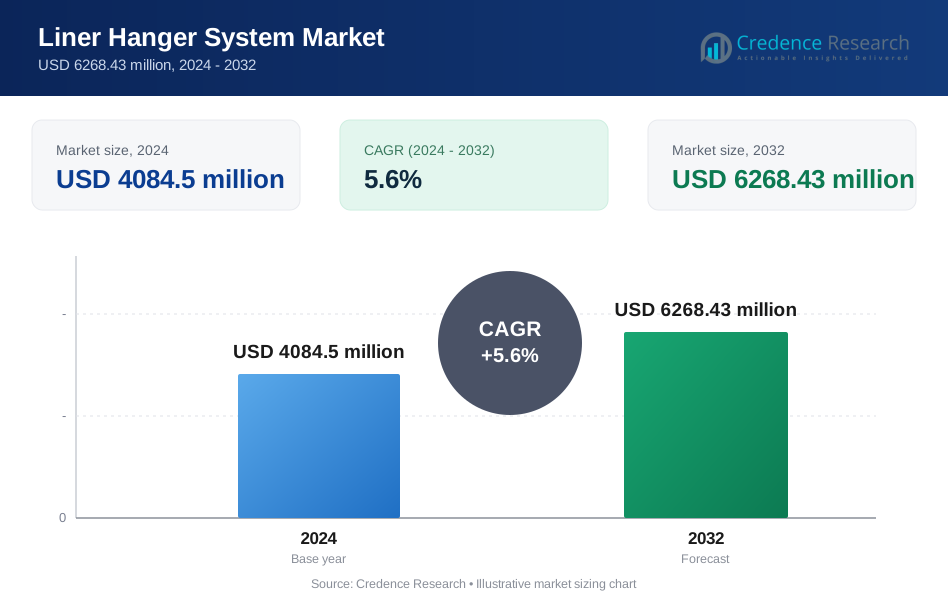
Liner Hanger System Market size was valued at USD 4084.5 million in 2024 and is anticipated to reach USD 6268.42 million by 2032, growing at a CAGR of 5.6% during the forecast period.
| REPORT ATTRIBUTE | DETAILS |
|---|---|
| Historical Period | 2020-2023 |
| Base Year | 2024 |
| Forecast Period | 2025-2032 |
| Liner Hanger System Market Size 2024 | USD 4084.5 million |
| Liner Hanger System Market, CAGR | 5.6% |
| Liner Hanger System Market Size 2032 | USD 6268.42 million |
Market Insights
- Market growth is driven by rising drilling activity in unconventional reservoirs and expanding deepwater exploration, with conventional liner hangers holding about 38% share in 2024.
- Trends include increased adoption of expandable hanger systems and wider use of digital tools that improve completion accuracy and reduce operational risk.
- Competition intensifies as leading companies invest in advanced materials, high-pressure technologies, and automated deployment tools to improve system reliability.
- North America led the regional landscape with about 34% share in 2024, followed by Asia Pacific at 28% and Europe at 22%, supported by strong offshore and onshore development programs.
Market Segmentation Analysis:
By Type
Conventional liner hangers led the market in 2024, accounting for about 38% of total revenue, supported by their reliable design, broad compatibility, and lower operational complexity across standard well configurations. They remained the preferred option in mature oil and gas fields where operators prioritized cost-efficient completions and reduced deployment risk. Mechanical liner hangers gained traction as drilling activity expanded into deeper wells, while hydraulic liner hangers saw stronger adoption in high-pressure environments that required greater setting force and sealing reliability. Expandable liner hangers also recorded growing demand in complex wellbores because they improved zonal isolation and helped maximize internal diameter. Other liner hanger types maintained steady demand in specialized drilling applications.
For instance, the Top Drive Cementing Head used with Wellcare liner hanger systems is rated for high-pressure applications of up to 10,000 psi, according to associated product literature.
By Well Type
Horizontal and directional wells dominated the market in 2024 with about 61% share, driven by rising drilling activity in unconventional reservoirs, longer lateral sections, and greater completion complexity that increased demand for advanced liner hanger systems. These wells required stronger load-bearing capacity, dependable sealing performance, and precise deployment under challenging downhole conditions. Vertical wells continued to generate steady demand across conventional fields, where simpler well structures and lower-cost completion strategies supported the use of standard liner hanger solutions. The horizontal and directional segment also continued to strengthen as operators targeted deeper and more technically demanding wells to improve recovery rates and optimize field productivity.
By Location of Deployment
Onshore deployments accounted for nearly 63% of the market in 2024, supported by high drilling volumes across shale plays, tight reservoirs, and brownfield redevelopment projects. Operators favored onshore installations because they offered lower deployment costs, easier logistics, and shorter completion cycles. The segment also benefited from rising unconventional drilling activity in the U.S., China, and the Middle East. Offshore deployments expanded as deepwater and ultra-deepwater wells required advanced liner hanger technologies capable of operating in high-pressure, high-temperature environments, which increased demand for hydraulic and expandable systems.
For instance, Halliburton reported one of its deepest liner hanger installations in Norway, where the top of the liner was set between 6,744 meters and 6,858 meters measured depth in offshore fields.
Key Growth Drivers
Rising Drilling Activities in Unconventional Reservoirs
Shale, tight oil, and gas developments continue to expand, and this growth increases demand for liner hanger systems that support complex well geometries. Operators use these systems to enhance well integrity and manage higher pressures during deeper drilling. Unconventional fields also require frequent multi-stage completions, which boosts purchasing volume. The shift toward horizontal drilling further supports this demand, as liner hangers help maintain stability in long lateral sections. These factors combine to make unconventional activity a major growth driver.
- For instance, the Enventure SET Expandable Liner Hanger system was successfully deployed in the Williston Basin with a 16,150-foot conventional liner to address challenges in a long horizontal lateral.
Expansion of Deepwater and Ultra-Deepwater Projects
More investments in offshore exploration, especially in regions like the Gulf of Mexico, Brazil, and West Africa, drive steady adoption of advanced liner hanger systems. Offshore wells often face extreme pressure and temperature, increasing the need for hydraulic and expandable technologies. Operators prefer high-reliability designs because they reduce risk and support long-term field productivity. As offshore reserves become key contributors to global output, deepwater development remains a strong driver for the market.
- For instance, Weatherford’s Xpress XT pressure-balanced liner system carries an API 19LH VS1 rating and is qualified for operation up to 10,000 psi and 400°F in demanding offshore wells.
Growing Focus on Well Integrity and Zonal Isolation
Energy companies are prioritizing better wellbore stability and long-term production efficiency, pushing demand for high-performance liner hanger systems. These systems help maintain structural integrity, reduce leakage risks, and improve completion quality. Stricter regulations related to well safety also accelerate adoption of enhanced designs. Advanced hanger technologies provide stronger sealing mechanisms, which support both conventional and high-pressure applications. This growing emphasis on secure and durable completions serves as a critical growth driver.
Key Trends and Opportunities
Shift Toward Expandable and High-Performance Systems
Operators increasingly adopt expandable liner hangers because they maximize internal diameter, reduce clearance issues, and support complex well architectures. This trend creates opportunities for manufacturers to introduce lighter, stronger, and more reliable alloys. The industry is also moving toward high-performance systems designed for extreme temperature and pressure environments. As drilling becomes more challenging, suppliers offering advanced materials and corrosion-resistant solutions gain a competitive advantage. This shift positions expandable systems as a major opportunity segment.
- For instance, Baker Hughes’ ZXtreme liner-top packer is qualified for HPHT service to 15,000 psi at temperatures from 100°F to 450°F, demonstrating the performance envelope targeted by modern high-end liner systems.
Digitalization and Automation in Well Completion
Automation tools such as real-time monitoring, digital torque control, and predictive failure systems are gaining relevance in liner hanger deployment. These technologies reduce human error, improve operational accuracy, and shorten installation cycles. Oilfield service providers use digital analytics to optimize hanger setting operations and identify potential risks early. The growing use of automated running tools creates opportunities for technology-driven product lines. Digitalization enhances both efficiency and safety, making it a key trend with strong long-term potential.
- For instance, NOV boasts over 2,000 liner hanger systems installed worldwide, and its engineering group has completed API 19LH and/or API 11D1 testing to 10,000 psi with gas-tight requirements on an extensive range of sizes.
Rising Investments in Enhanced Oil Recovery Fields
Mature field redevelopment is increasing, pushing demand for liner hanger systems used in re-completion and workover operations. Enhanced oil recovery programs require secure liner placement to support injection zones and maintain pressure control. Operators see these installations as an affordable way to extend field life, which creates a steady opportunity for market suppliers. As more countries prioritize maximizing existing reserves, this trend supports recurring demand for hanger upgrades and replacement systems.
Key Challenges
High Operational Costs in Offshore and Complex Wells
Deepwater and ultra-deepwater wells require advanced liner hanger technologies that come with higher procurement and installation costs. Complex reservoirs also need specialized tools, increasing the financial burden for operators. Smaller drilling companies often delay these investments during price-sensitive periods. High operational cost remains a major challenge, especially when crude oil prices fluctuate and project budgets tighten. The expense of specialized hanger designs continues to limit adoption in some regions.
Technical Failures and Reliability Concerns in Extreme Conditions
Liner hanger systems face heavy loads, corrosion, and high-temperature environments, raising the risk of mechanical failures. Any malfunction can cause costly delays, loss of well integrity, or safety hazards. Operators demand flawless reliability, but performance varies depending on reservoir conditions and equipment quality. Maintaining consistent performance in deep and high-pressure wells remains a key challenge. Suppliers must invest in better materials, testing standards, and design improvements to overcome reliability issues.
Regional Analysis
North America
North America held the largest share in 2024 with about 34% due to strong drilling activity across shale formations in the United States and Canada. The region benefited from high spending on horizontal wells, multi-stage completions, and redevelopment of mature basins. Advanced liner hanger systems saw strong adoption as operators focused on efficiency and well integrity in unconventional projects. Growing investment in deepwater fields in the Gulf of Mexico also supported demand. Technology upgrades and stable drilling programs kept North America the leading regional market.
Europe
Europe accounted for nearly 22% share in 2024, supported by activity in the North Sea, the United Kingdom Continental Shelf, and offshore Norway. Operators in this region favored high-reliability liner hanger systems to handle harsh offshore conditions and stricter well safety regulations. Redevelopment of mature fields and growing interest in extended-reach drilling contributed to steady demand. The region also adopted expandable liner hangers for complex wellbore geometries. Europe maintained a strong market presence due to consistent investment in offshore maintenance and enhanced recovery programs.
Asia Pacific
Asia Pacific captured about 28% share in 2024, driven by rising drilling operations in China, India, Indonesia, and Australia. National oil companies expanded exploration programs across deepwater basins and unconventional fields, supporting wider use of advanced liner hanger systems. The region saw increased adoption of hydraulic and expandable hangers to improve well integrity in high-pressure environments. Growing energy demand and redevelopment of aging fields further boosted installations. Asia Pacific continued to strengthen its position with expanding offshore projects and supportive government exploration policies.
Latin America
Latin America held close to 10% share in 2024, with Brazil, Mexico, and Argentina leading installation volumes. Deepwater developments in Brazil’s pre-salt fields drove strong demand for high-performance hanger systems capable of handling extreme pressure conditions. Mexico’s offshore reform activities and Argentina’s unconventional drilling in Vaca Muerta added to market growth. The region relied heavily on advanced hydraulic and expandable systems to support complex well structures. Although investments fluctuated due to regulatory changes, Latin America showed steady long-term potential.
Middle East and Africa
Middle East and Africa accounted for nearly 6% share in 2024, supported by extensive drilling in Saudi Arabia, the UAE, Kuwait, and offshore West Africa. Operators focused on maintaining high production levels, which increased demand for reliable liner hanger systems in both conventional and sour gas wells. Complex deep reservoirs in Africa required robust hanger solutions for well integrity and zonal isolation. Rising investment in offshore projects, including fields in Angola and Nigeria, added momentum. The region maintained stable demand through continuous field development programs.
Market Segmentations:
By Type
- Conventional Liner Hangers
- Mechanical Liner Hangers
- Hydraulic Liner Hangers
- Expandable Liner Hangers
- Others
By Well Type:
- Vertical
- Horizontal/Directional
By Location of Deployment
- Onshore
- Offshore
By Geography
- North America
- U.S.
- Canada
- Mexico
- Europe
- Germany
- France
- U.K.
- Italy
- Spain
- Rest of Europe
- Asia Pacific
- China
- Japan
- India
- South Korea
- South-east Asia
- Rest of Asia Pacific
- Latin America
- Brazil
- Argentina
- Rest of Latin America
- Middle East & Africa
- GCC Countries
- South Africa
- Rest of the Middle East and Africa
Competitive Landscape
The competitive landscape of the liner hanger system market features key players such as JC Petro, Schlumberger Limited, Innovex Downhole Solutions, Inc., Weatherford International plc, NOV Inc., NCS Multistage, Dril-Quip, Inc., Allamon Tool Company, Packers Plus Energy Services Inc., Baker Hughes Company, and Halliburton Company. Market competition is shaped by continuous investments in high-performance liner hanger technologies designed for deeper, hotter, and more complex well environments.
Companies focus on developing expandable and hydraulic systems that improve well integrity and streamline completion operations. Many providers strengthen their portfolios through advanced materials, digital monitoring tools, and automated running equipment that enhance installation accuracy. Strategic expansion into high-growth offshore regions also plays a major role, supported by partnerships with national oil companies and large integrated operators. Service providers emphasize reliability, strong field support, and optimized supply chains to maintain customer loyalty and secure multi-well contracts across global markets.
Key Player Analysis
- JC Petro
- Schlumberger Limited
- Innovex Downhole Solutions, Inc.
- Weatherford International plc
- NOV Inc.
- NCS Multistage
- Dril-Quip, Inc.
- Allamon Tool Company
- Packers Plus Energy Services Inc.
- Baker Hughes Company
- Halliburton Company
Recent Developments
- In August 2025, Enventure Global Technology announced the successful deployment of its 4-1/2 in. x 7 in., 32 ppf SET expandable liner hanger system for an independent operator in the Williston Basin, where it was run with a 16,150 ft conventional liner. In August 2025, the development mattered because it showed expandable liner hanger technology being used in a long-liner application that typically puts pressure on reliability, liner support, and installation simplicity in demanding well designs.
- In August 2025, Enventure also reported a separate milestone installation of its expandable liner hanger for an operator in the Permian Basin, saying the system was manufactured to the well’s specific requirements in just two weeks. In August 2025, the company framed this as an operational breakthrough because the rapid customization timeline highlighted the modular design of the system and its ability to support fast-turnaround field execution in active shale basins.
- In October 2025, Halliburton published a field-performance update showing that its XtremeGrip expandable liner hanger system was successfully deployed in harsh Oman well conditions where conventional liner hanger operations would have struggled to progress. In October 2025, Halliburton said the operator was able to use higher circulation pressure, flow rates, compression, and torque to work through tight spots, reach liner setting depth, and complete the job with zero downtime, making it a noteworthy technology-validation milestone for expandable liner hanger performance in difficult hole conditions.
- In October 2025, Halliburton highlighted the expanded role of its XtremeGrip integrated expandable liner hanger system for multilateral, deepwater, HP/HT, and geothermal applications, emphasizing its compliant metal-to-metal seal and ISO 14310 V0-tested gas-tight sealing performance. In October 2025, the update represented an important product-level advance in the liner hanger segment because it positioned the system as a higher-specification solution for long liners and extreme-pressure, extreme-temperature wells where sealing reliability and hanging capacity are critical to well integrity.
Report Coverage
The research report offers an in-depth analysis based on By Type, By Location of Deployment, By Well Type and Geography. It details leading market players, providing an overview of their business, product offerings, investments, revenue streams, and key applications. Additionally, the report includes insights into the competitive environment, SWOT analysis, current market trends, as well as the primary drivers and constraints. Furthermore, it discusses various factors that have driven market expansion in recent years. The report also explores market dynamics, regulatory scenarios, and technological advancements that are shaping the industry. It assesses the impact of external factors and global economic changes on market growth. Lastly, it provides strategic recommendations for new entrants and established companies to navigate the complexities of the market.
Request a Free Sample
Fill in your details and we'll send you a free sample report.
- Sample data tables & charts
- Research methodology
Need a Custom Version of This Report?
Tailor the scope, geography, or segments to your exact requirements.
- Custom geography or segment scope
- Direct access to our analyst team
Frequently Asked Questions
What is the current market size for Liner Hanger System Market, and what is its projected size in 2032?
At what Compound Annual Growth Rate is the Liner Hanger System Market projected to grow between 2025 and 2032?
Who are the major players in the global liner hanger system market?
What is the major market driver of the liner hanger system industry?
What are the major market restraints of the liner hanger system industry?
What are the major market opportunities of the liner hanger system industry?
Who are the leading companies in the Liner Hanger System Market?
Table of Content
Chapter 1. Report Introduction
- 1.1 Report Description & Purpose
- 1.1.1 Report Title & Market Definition
- 1.1.2 Unique Selling Propositions (USP) & Key Differentiators
- 1.1.3 Value Proposition for Stakeholders
- 1.2 Research Objectives
- 1.2.1 Market Sizing Objectives (Volume & Revenue)
- 1.2.2 Segmentation Objectives
- 1.2.3 Competitive Intelligence Objectives
- 1.2.4 Forecast & Scenario Objectives
- 1.3 Report Scope
- 1.3.1 Liner Hanger System Scope – Types & Subtypes Covered
- 1.3.2 Geographic Scope – Regions & Countries Covered
- 1.3.3 Historical Period, Base Year & Forecast Period (2024; forecast to 2032)
- 1.3.4 Inclusions & Exclusions
- 1.4 HS Code & Classification Framework
- 1.5 Currency, Units & Pricing Basis
- 1.6 Target Stakeholders
- 1.7 Limitations & Assumptions
Chapter 2. Executive Summary
- 2.1 Global Liner Hanger System Market Snapshot
- 2.1.1 Market Size – Historical (2024) & Forecast (2024-2032) (2024: USD 4084.5 million → 2032: USD 6268.43 million)
- 2.1.2 Volume & Revenue – Global Totals
- 2.1.3 Key Market Highlights – Top Five Facts
- 2.2 Liner Hanger System Market Segmentation Snapshot
- 2.2.1 Market Split by Region – 2024 vs. 2032
- 2.3 Competitive Snapshot
- 2.3.1 Top 10 Players by Revenue Share – 2024
- 2.3.2 Top 10 Players by Volume Share – 2024
- 2.3.3 Recent Strategic Developments (18-Month Summary)
- 2.4 Key Investment Highlights & Strategic Conclusions
Chapter 3. Liner Hanger System Market Dynamics & Industry Analysis
- 3.1 Market Overview & Context
- 3.1.1 Liner Hanger System Market Position in the Broader Automotive Value Chain
- 3.1.2 OEM vs. Replacement Market Dynamics
- 3.1.3 Market Maturity & Development Stage by Region
- 3.2 Liner Hanger System Market Drivers
- 3.3 Liner Hanger System Market Restraints & Challenges
- 3.4 Liner Hanger System Market Opportunities
- 3.5 Porter's Five Forces Analysis
- 3.5.1 Threat of New Entrants
- 3.5.2 Bargaining Power of Suppliers
- 3.5.3 Bargaining Power of Buyers
- 3.5.4 Threat of Substitutes
- 3.5.5 Competitive Rivalry – Intensity Assessment
- 3.6 Liner Hanger System Value Chain Analysis
- 3.6.1 Upstream – Raw Material/Input Suppliers
- 3.6.1.1 Raw Material/Input 1
- 3.6.1.2 Raw Material/Input 2
- 3.6.1.3 Raw Material/Input 3
- 3.6.2 Midstream – Production/Manufacturing/Service Delivery
- 3.6.2.1 Production/Process Overview
- 3.6.2.2 Key Facility Locations & Capacity by Manufacturer
- 3.6.3 Downstream – Distribution & End Consumer
- 3.6.3.1 Primary Channel – B2B/OEM
- 3.6.3.2 Secondary Channels – Dealer, Retail, Online, Direct
- 3.6.4 Value Chain Profitability Analysis
- 3.6.1 Upstream – Raw Material/Input Suppliers
- 3.7 PESTEL Analysis
- 3.7.1 Political Factors
- 3.7.2 Economic Factors
- 3.7.3 Social Factors
- 3.7.4 Technological Factors
- 3.7.5 Environmental Factors
- 3.7.6 Legal Factors
- 3.8 Liner Hanger System Supply Chain Analysis
- 3.8.1 Raw Material/Input Supply Risk Assessment
- 3.8.2 Manufacturing Concentration Risk (Geographic Exposure)
- 3.8.3 Trade Disruption Impact Analysis
- 3.9 Regulatory & Policy Landscape
Note: The regulatory and policy landscape section covers regulations based on their applicability to the market, Liner Hanger System category, geography, and scope of the study. Only regulatory frameworks with a material impact on operations, compliance, trade, sustainability, or market access are analyzed in detail.
Chapter 4. Key Investment Pockets & Opportunity Analysis
- 4.1 Liner Hanger System Market Attractiveness Analysis
- 4.1.1 By Region – Investment Attractiveness Matrix (Volume × CAGR)
- 4.2 Absolute Revenue Growth Opportunity
- 4.2.1 By Region – Absolute USD Growth Through 2032
- 4.3 Incremental Volume Opportunity
- 4.3.1 By Region – Incremental Volume Through 2032
- 4.3.2 Segment – Incremental Volume
- 4.4 Emerging Submarket Opportunity Deep Dive (Subject to Applicability)
- 4.5 Emerging Market Opportunity Scorecards
- 4.5.1 United States
- 4.5.2 Europe
- 4.5.3 Asia
- 4.5.4 Middle East & Africa
Note: Emerging Market Opportunity Scorecards will be included based on relevance and strategic importance. Regions listed are indicative and may vary depending on data availability and market dynamics.
Chapter 5. Liner Hanger System Import-Export Analysis & Trade Flows
- 5.1 Global Trade Overview
- 5.1.1 Global Export Value by Country (2024)
- 5.1.2 Global Export Volume by Country (2024)
- 5.1.3 Global Import Value by Country (2024)
- 5.1.4 Global Import Volume by Country (2024)
- 5.1.5 Net Trade Balance by Country (2024)
- 5.2 Export Analysis – Segment
- 5.2.1 Type 1 (HS Code)
- 5.2.2 Type 2 (HS Code)
- 5.2.3 Type 3 (HS Code)
- 5.2.4 Type 4 (HS Code)
- 5.2.5 Type 5 (HS Code)
- 5.3 Import Analysis – Segment
- 5.3.1 Type 1 (HS Code)
- 5.3.2 Type 2 (HS Code)
- 5.3.3 Type 3 (HS Code)
- 5.3.4 Type 4 (HS Code)
- 5.3.5 Type 5 (HS Code)
- 5.4 Average Unit Trade Prices
- 5.4.1 Average Export Price – Segment & Country
- 5.4.2 Average Import Price – Segment & Source Country
- 5.4.3 Price Trends (2024)
- 5.5 Key Trade Route Analysis
- 5.5.1 Trade Route 1
- 5.5.2 Trade Route 2
- 5.5.3 Trade Route 3
- 5.5.4 Trade Route 4
- 5.5.5 Trade Route 5
- 5.6 Trade Policy Impact Assessment
- 5.6.1 US Anti-Dumping & Section 301 Tariffs
- 5.6.2 EU Customs Union Impact
- 5.6.3 Major Free Trade Agreements
- 5.6.4 USMCA Rules of Origin
Note: Trade policy analysis will be included only where relevant to the Liner Hanger System market.
Chapter 6. Competitive Landscape & Company Benchmarking
- 6.1 Liner Hanger System Market Concentration & Structure
- 6.1.1 Herfindahl-Hirschman Index (HHI) – vs. 2024
- 6.1.2 Tier 1, Tier 2 & Tier 3 Market Structure
- 6.1.3 Global, Regional & Local Player Dynamics
- 6.2 Liner Hanger System Market Share Analysis – 2024
- 6.2.1 Global Revenue Share by Company
- 6.2.2 Global Volume Share by Company
- 6.2.3 Regional Revenue Share
- 6.2.4 Market Share Evolution ( vs. 2024)
- 6.2.5 OEM Segment Share by Company
- 6.2.6 Replacement Segment Share by Company
- 6.3 Production/Delivery Capacity & Facility Analysis
- 6.3.1 Global Installed Capacity
- 6.3.2 Capacity Utilization Rates
- 6.3.3 Production/Output Volume
- 6.3.4 Facility Locations & Capacity Map
- 6.3.5 Planned Capacity Additions
- 6.4 Liner Hanger System Competitive Benchmarking Matrix
- 6.4.1 Revenue, Volume, CAGR & Profitability Comparison
- 6.4.2 Channel Revenue Mix
- 6.4.3 Geographic Revenue Exposure
- 6.4.4 R&D Intensity
- 6.4.5 Sustainability Maturity
- 6.5 Strategic Developments in Liner Hanger System (Last 24 Months)
- 6.5.1 Mergers, Acquisitions & Divestments
- 6.5.2 New Liner Hanger System Launches
- 6.5.3 Facility Expansions
- 6.5.4 Strategic Alliances, Joint Ventures & Partnerships
- 6.5.5 Distribution Expansion & Market Entry
- 6.5.6 Sustainability & ESG Initiatives
- 6.6 Competitive Strategy Mapping
- 6.6.1 Leader, Challenger, Follower & Niche Classification
- 6.6.2 Pricing Strategy Comparison
- 6.6.3 Channel Strategy Matrix
Note: Strategic developments are included based on their materiality and the availability of reliable information.
Chapter 7. Global Liner Hanger System Market – By Distribution Channel
- 7.1 Segment Overview
- 7.1.1 Volume & Revenue Split by Channel (2024 & 2032)
- 7.1.2 Channel Mix Evolution (2024-2032)
Chapter 8. Regional Market Analysis – Global Overview
- 8.1 Global Regional Overview
- 8.1.1 Regional Volume Share
- 8.1.2 Regional Revenue Share
- 8.1.3 Regional Volume by Region
- 8.1.4 Regional Revenue by Region
- 8.1.5 Regional Forecast Through 2032
- 8.2 Cross-Regional Segment Analysis
- 8.2.1 By Distribution Channel
- 8.2.2 By Brand/Price Tier
Chapter 9. North America Liner Hanger System Market
- 9.1 United States
- 9.2 Canada
- 9.3 Mexico
Chapter 10. Europe Liner Hanger System Market
- 10.1 Germany
- 10.2 France
- 10.3 Italy
- 10.4 United Kingdom
- 10.5 Spain
- 10.6 Poland
- 10.7 Russia
- 10.8 Netherlands
- 10.9 Belgium
- 10.10 Sweden
- 10.11 Denmark
- 10.12 Norway
- 10.13 Rest of Europe
Chapter 11. Asia Pacific Liner Hanger System Market
- 11.1 China
- 11.2 India
- 11.3 Japan
- 11.4 South Korea
- 11.5 Thailand
- 11.6 Indonesia
- 11.7 Vietnam
- 11.8 Malaysia
- 11.9 Australia
- 11.10 Rest of Asia Pacific
Chapter 12. Latin America Liner Hanger System Market
- 12.1 Brazil
- 12.2 Argentina
- 12.3 Colombia
- 12.4 Chile
- 12.5 Rest of Latin America
Chapter 13. Middle East Liner Hanger System Market
- 13.1 Saudi Arabia
- 13.2 United Arab Emirates
- 13.3 Turkey
- 13.4 Israel
- 13.5 Iran
- 13.6 Rest of the Middle East
Chapter 14. Africa Liner Hanger System Market
- 14.1 South Africa
- 14.2 Egypt
- 14.3 Nigeria
- 14.4 Morocco
- 14.5 Rest of Africa
Chapter 15. Liner Hanger System Company Profiles
- 15.1 [Company 01]
- 15.1.1 Company Overview
- 15.1.2 Key Management Personnel
- 15.1.3 Products & Services Portfolio
- 15.1.4 Financial Performance
- 15.1.5 Key Market Focus & Geographic Presence
- 15.1.6 Recent Developments & Strategic Initiatives
Note: The company profile list is preliminary and may change based on research findings, market developments, data availability, and client requirements.
Chapter 16. Appendices
- Appendix A – List of Abbreviations & Acronyms
- Appendix B – Industry Classification Code Reference – Full Series
- Appendix C – Production & Capacity Data Tables
- Appendix D – End-Use & Demand Base Tables
- Appendix E – Consumption & Replacement Rate Assumptions
- Appendix F – ASP Reference Tables
- Appendix G – Manufacturing & Facility Database
- Appendix H – Import-Export Data Tables
- Appendix I – Regulatory Summary Tables
- Appendix J – Primary Research Participant List (Anonymized)
- Appendix K – Primary Research Questionnaire Framework
- Appendix L – Data Sources & Bibliography
- Appendix M – Market Size Divergence & Source Comparison
Chapter 17. Research Methodology
- 17.1 Research Framework & Philosophy
- 17.2 Secondary Research – Sources, Hierarchy & Data Extraction
- 17.3 Data Modeling – Bottom-Up & Top-Down Market Sizing
- 17.4 Primary Research – Stakeholder Framework, LOI & Sample Sizes
- 17.5 Forecast Methodology – Regression, Scenario & Sensitivity Analysis
- 17.6 Quality Control – Four-Layer Validation Framework
- 17.7 Limitations & Standard Assumptions
- 17.8 Disclaimer
