
| REPORT ATTRIBUTE | DETAILS |
|---|---|
| Historical Period | 2019-2022 |
| Base Year | 2023 |
| Forecast Period | 2024-2032 |
| Reprocessed Medical Devices Market Size 2023 | USD 2154.2 Million |
| Reprocessed Medical Devices Market, CAGR | 17.50% |
| Reprocessed Medical Devices Market Size 2032 | USD 9196.5 Million |
Market Insights
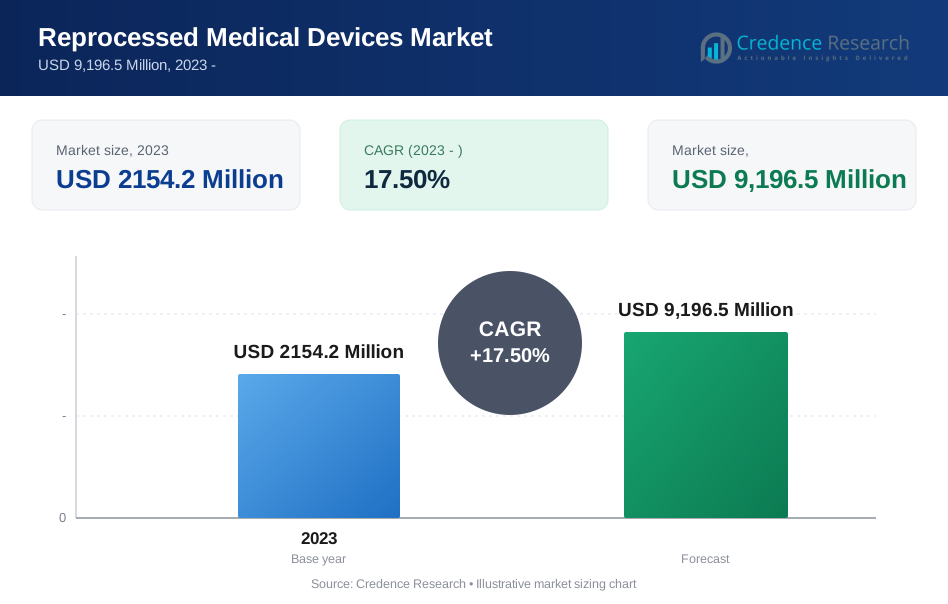
- The global demand for Reprocessed Medical Devices was valued at USD 2154.2 Million in 2023 and is expected to reach USD 9196.5 Million in 2032, growing at a CAGR of 17.50% between 2024 and 2032.
- In 2023, the cardiovascular medical devices category had the largest market share of more than 55%, followed by the laparoscopic devices category.
- In 2023, hospitals accounted for more than 40% of the whole market. Clinics are another important market segment.
- The leading segment is Single-Use Device (SUD) Reprocessing.
- Class II devices have a significant market presence.
- In 2023, the third-party reprocessing segment earned the greatest revenue, accounting for more than 84 percent.
- The Critical sector frequently has the largest market demand, while Semi-Critical Devices is the fastest expanding segment.
- In 2023, North America had the biggest revenue share (almost 46%), while Asia Pacific is predicted to grow the quickest during the forecast period.
- Increasing supply chain cost savings in healthcare facilities fuels market expansion.
- The increased risk of hospital-acquired infections impedes industry growth.
Executive Summary
Market Definition
The Reprocessed Medical Devices Market refers to the market for medical devices that have undergone a process of reprocessing, which involves cleaning, disinfection, sterilization, and testing to ensure their safety and effectiveness for reuse. Reprocessed medical devices offer a cost-effective and environmentally friendly alternative to new devices, as they can be safely used again without compromising patient safety. This market plays a crucial role in reducing healthcare costs and promoting sustainability in the healthcare industry.
Market Overview
The global Reprocessed Medical Devices Market has witnessed steady growth in recent years and is expected to grow at a CAGR of 17.50% between 2024 and 2032. The market was valued at USD 2154.2 million in 2023 and is expected to reach USD 9196.5 million in 2032.
The market for reprocessed medical devices has been experiencing steady growth in recent years. This can be attributed to factors such as the increasing demand for cost-effective healthcare solutions, growing awareness about environmental sustainability, and the need to reduce medical waste. Reprocessed medical devices offer significant cost savings for healthcare facilities without compromising on quality and safety. Additionally, advancements in reprocessing technologies and stringent regulatory standards have further boosted the market growth.
Segmentation by Device Type
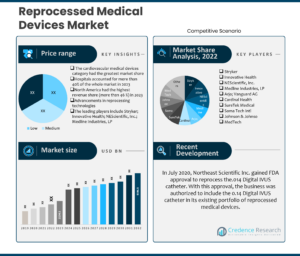
- The cardiovascular medical devices category had the greatest market share of over 55% in 2023 due to the widespread use of these goods in cardiovascular procedures and diagnostics. Blood pressure cuffs, cardiac positioning, and stabilization devices, blood pressure monitors, electrophysiology cables, and diagnostic electrophysiology catheters are some examples of these devices.
- In 2023, the Laparoscopic Devices category held the second-largest market share in the business. The large amount of waste generated as a result of the use of disposable equipment is boosting the demand for reprocessed laparoscopic instruments.
Segmentation by End-User
- Hospitals accounted for more than 40% of the whole market in 2023. This can be due to the rising demand for the use of reprocessed medical devices in order to reduce the cost and medical waste generated by original medical equipment.
- Another attractive market sector is
Segmentation by Type of Reprocessing
- The leading segment is Single-Use Device (SUD) Reprocessing. This category focuses on reprocessing single-use medical devices such as catheters, surgical instruments, and syringes. Reprocessing these devices enables their safe and effective reuse, lowering waste and healthcare expenses.
- On the other hand, Multiple-Use Devices (MUD) Reprocessing refers to the reprocessing of multi-use devices such as endoscopes and electrosurgical tools.
Segmentation by Regulatory Class
- Class II devices have a strong market presence. Class II devices are regarded to be moderate to high risk, necessitating more strict regulatory controls than Class I devices, which are low risk. Reprocessing Class II devices, such as orthopedic implants, cardiac catheters, and surgical equipment, allows for cost reductions and sustainability while ensuring patient safety.
Segmentation by Service Provider
- In 2023, the third-party reprocessing segment generated the most revenue, accounting for more than 84%. These third-party players take used medical devices that would otherwise be thrown as medical waste and utilize a variety of cleaning, sterilizing, and refurbishment processes to prepare them for reuse. It is expected that AMDR member firms reprocess a wide range of clinical devices used in orthopedics, cardiology, and respiratory therapy, as well as outpatient surgical clinics and hospitals.In-house reprocessing is the practice of a healthcare establishment, such as a hospital, sterilizing and reconditioning medical instruments for reuse on its own grounds.
Segmentation by Product Complexity
- The Critical segment is often where the highest market demand occurs. Critical devices are those that come into direct touch with sterile tissues or the circulatory system, such as surgical instruments used during invasive procedures. Reprocessing these devices reduces costs and environmental impact while ensuring their safety and performance.
- The fastest growing segment is Semi-Critical Devices.
Segmentation by Region
- North America had the highest revenue share (more than 46 %) in 2023
- Asia Pacific is expected to grow at the fastest rate over the projection period.
- The rest of the world, including Latin America, the Middle East, and Africa, supplies the remaining demand for Reprocessed Medical Devices.
North America has the highest revenue share of the worldwide market. The growing need to decrease hospital waste, as well as the potential environmental damage caused by the region's expanding waste landfills, are important market drivers. Furthermore, favorable government initiatives and strategic activities undertaken by healthcare institutions to raise awareness about equipment reprocessing are projected to present considerable potential possibilities for this market. For instance, Practice Greenhealth, a famous sustainable healthcare organization, provides environmental solutions to a large network of over 1,500 hospitals and health systems in the United States and Canada.
On the other hand, Asia Pacific is predicted to increase at the fastest rate during the forecast period. The developing regional market for reprocessed medical equipment has been fueled by the expanding economy, rising prevalence of chronic illnesses, and the growing demand to reduce hospital expenses. Developing countries, such as China and India, have seen an increase in the prevalence of chronic diseases, as has the rest of the world. This has resulted in a greater emphasis on healthcare, with governments investing in healthcare infrastructure yet limited in their spending. As a result, product demand has increased significantly.
Key Highlights of the Report
Device Type, End-User, Type of Reprocessing, Regulatory Class, Type, Product Complexity, and region segment of the global Reprocessed Medical Devices Market. The main section is Single-Use Device (SUD) Reprocessing, and the cardiovascular medical devices category has the largest market. Furthermore, Class II devices have a significant market presence, and the Critical sector is frequently where the biggest market demand arises. Additionally, the Laparoscopic Devices category had the second-largest market share in the business, with North America leading the market growth.
Cost-effectiveness, environmental sustainability, and technological developments in reprocessing are key industry drivers. Furthermore, the industry's key limits are regulatory problems, perception and trust issues, and limited device eligibility. Furthermore, the market's important potential include increased demand for sustainable healthcare solutions, development into emerging countries, and technological advances.
Nonetheless, North America has the biggest revenue share, accounting for over 46% of the global market. The growing need to reduce hospital waste, as well as the potential environmental impact of the region's burgeoning waste landfills, are significant market drivers. During the projection period, Asia Pacific is expected to grow at the fastest rate.
What Are The Main Drivers Of The Global Reprocessed Medical Devices Market?
One of the key drivers for the Reprocessed Medical Devices Market is the cost-effectiveness they offer. Reprocessed medical devices provide significant cost savings for healthcare facilities, allowing them to allocate their resources more efficiently. Another driver is the growing emphasis on environmental sustainability. By reusing medical devices, the healthcare industry can reduce the amount of medical waste generated, contributing to a more sustainable healthcare system.
What Are The Major Challenges Faced By The Global Reprocessed Medical Devices Market?
While the Reprocessed Medical Devices Market has been growing, it does face certain restraints. One of these is the regulatory challenges associated with reprocessing. Compliance with stringent regulatory standards can be complex and time-consuming for reprocessing companies, which may pose obstacles to market growth. Another restraint is the perception and trust surrounding reprocessed devices. Some healthcare providers and patients may have concerns about the safety and efficacy of these devices compared to new ones. Addressing these concerns and building trust is essential for the market's continued expansion. Additionally, not all medical devices are eligible for reprocessing, which limits the market potential.
What Are The Growth Opportunities In The Global Reprocessed Medical Devices Market?
here are several opportunities for the Reprocessed Medical Devices Market. One significant opportunity lies in the growing demand for sustainable healthcare solutions. As awareness about environmental impact increases, there is a greater emphasis on adopting practices that reduce waste and promote sustainability. Reprocessed medical devices align with these goals, presenting a significant opportunity for market growth. Another opportunity lies in expanding into emerging markets. These markets often have a high demand for cost-effective healthcare solutions and can serve as untapped potential for the adoption of reprocessed devices.
Market Drivers
Increasing The Supply Chain Cost Savings In Healthcare Facilities
Reprocessing medical devices and equipment has received a lot of interest in recent years, not just from healthcare organizations looking to save millions of dollars each year, but also from manufacturers who see it as a way to gain a considerable competitive edge. According to the Association of Medical Devices Reprocessors (AMDR, US), reprocessed medical devices are 30% to 50% less expensive than new ones; as a result, medical device reprocessing has become one of the most popular supply chain cost-cutting strategies among hospitals, surgical centers, and other healthcare providers. This frees up monies for end users to recruit more people, modernize their systems, and increase healthcare quality, among other things.
Market Restraints
Increased Risk Of Hospital-Acquired Infections
Hospital-acquired infections (HAls) are nosocomial infections that develop during a patient's stay in hospitals and other healthcare institutions. HAls are not detected at admission but are a major source of morbidity and mortality worldwide.
Despite the existence of reprocessing guidelines and advances in device reprocessing methods, inadequate reprocessing of medical devices accounts for a significant proportion of hospital-acquired infections, with 22% of all surgical site infections (SSls), one of the most common types of HAls cases, being related to equipment reprocessing.
Opportunities
Regulatory Reforms That Promote Medical Device Reprocessing
Changing dynamics in several countries, including France, Japan, and the Middle East and Africa, are likely to create considerable growth prospects for medical device reprocessing.
According to the AMDR, Japan is the most recent country to take steps to provide hospitals with remanufactured (commercially reprocessed) single-use medical devices. AMDR views this as a significant step for the global remanufacturing medical device business, as Japan joins a growing list of nations that have established a clear legislative framework for remanufactured single-use devices. Thus, the establishment of regulatory requirements for reprocessing medical devices in these nations creates considerable opportunity for market participants to expand their regional presence and gain a greater portion of the medical device reprocessing market in the future.
Competitive Landscape
Key Players
The global Reprocessed Medical Devices Market is highly competitive, with several key players. Some of the major players in the market and their market share are as follows:
- Stryker
- Innovative Health
- NEScientific, Inc.
- Medline Industries, LP
- Arjo; Vanguard AG
- Cardinal Health
- SureTek Medical
- Soma Tech Intl
- Johnson & Johnso
- MedTech
These organizations prioritize product innovation, Type of Reprocessing expansion, and mergers and acquisitions to stay competitive.
The global Reprocessed Medical Devices Market's key players continually seek to stay ahead by offering new products and developments.
In September 2019, Innovative Health, an advanced, FDA-regulated reprocessing company specializing in electrophysiological devices, cooperated with Medline, a private healthcare corporation based in the United States, on a single-use device reprocessing program for hospitals. The collaborative reprocessing project intends to improve the effectiveness of medical device reprocessing programs, which frequently do not yield the best savings returns for hospitals.
In May 2022, Innovative Health, a specialty cardiology reprocessing company, has acquired approval from the United States Food and Drug Administration (FDA) to reprocess the Philips Eagle Eye Platinum digital intravascular ultrasonography (IVUS) catheter. This clearance effectively marks the company's entry into the cath lab area, broadening the company's medical device reprocessing market reach in cardiovascular applications.
Summary of Key Findings
- Regulatory reforms to encourage medical device reprocessing
- Market segmented by Device Type, End-User, Type of Reprocessing, Regulatory Class, Type, Product Complexity, and region.
- Class II devices have a substantial market presence.
- In 2023, hospitals accounted for more than 40% of the total market
- North America is leading market growth; the market is highly competitive with key players including Stryker; Innovative Health; NEScientific, Inc.; Medline Industries, LP; Arjo; Vanguard AG and Others.
Future Outlook
- Increasing demand for cost-effective healthcare solutions
- Growing awareness about environmental sustainability
- Advancements in reprocessing technologies
- Stringent regulatory standards
- Recognition of the benefits of reusing medical devices
- Continued market expansion in the coming years
How CXOs Can Benefit from the Credence Research Reprocessed Medical Devices MarketReport
The Credence Research Reprocessed Medical Devices MarketReport provides CXOs with a comprehensive overview of the market, including:
- Market size and growth forecast:The report provides detailed estimates of the global Reprocessed Medical Devices Market size, segmented by Device Type, End-User, Type of Reprocessing, Regulatory Class, Type, Product Complexity, and Region. It also includes forecasts for the market through 2032 based on key trends and drivers.
- Market segmentation:The report segments the Reprocessed Medical Devices Market by Device Type, End-User, Type of Reprocessing, Regulatory Class, Type, Product Complexity, and Region. This segmentation provides CXOs with a granular understanding of the market and the opportunities in each segment.
- Competitive Landscape: The report profiles the key players in the Reprocessed Medical Devices market and provides insights into their strategies, product offerings, and financial performance. This information can help CXOs to identify and assess their competition.
- Key trends and drivers:The report identifies and analyzes the key trends and drivers that are shaping the Reprocessed Medical Devices Market. This information can help CXOs to make informed decisions about their investments and strategies.
CXOs can use the insights from the Credence Research Reprocessed Medical Devices MarketReport to:
- Identify growth opportunities:The report can help CXOs to identify new growth opportunities in the Reprocessed Medical Devices Market. For example, it can provide insights into emerging markets where the demand for reprocessed devices is increasing.
- Make informed investment decisions:The report can help CXOs to make informed investment decisions about Reprocessed Medical Devices. For example, the report can provide CXOs with valuable insights and data on the current market trends, competitive landscape, and growth potential of the Reprocessed Medical Devices industry.
- Develop competitive strategies:The report can help CXOs to develop competitive strategies for their Reprocessed Medical Devices businesses. For example, it can offer insights into the strategies adopted by key players, market trends, and customer preferences.
- Track market developments:The report can help CXOs track market developments and stay ahead of the curve. For example, the report provides insights into the latest trends and innovations in the Reprocessed Medical Devices Market.
Overall, the Credence Research Breast Cancer.Treatment Market Report is a valuable resource for CXOs who are looking to gain a deeper understanding of the market and identify opportunities for growth.
Segmentation
- By Device Type:
- Catheters
- Balloon Inflation Devices
- Electrophysiology Cables
- Others
- Biopsy Forceps
- Snares
- Cannulas
- Others
- Scissors
- Graspers
- Trocars
- Others
- Drill Bits
- Saws
- Reamers
- Others
- Scalpels
- Scissors
- Specula
- Others
- Others
- Hospitals
- Ambulatory Surgical Centers (ASCs)
- Clinics
- Others
- Single-Use Device (SUD) Reprocessing
- Multiple-Use Device (MUD) Reprocessing
- Class I
- Class II
- Class III
- Original Equipment Manufacturer (OEM) Providers
- Third-Party Reprocessors
- Critical
- Semi-Critical
- Non-Critical
- North America
- US
- Canada
- Mexico
- Europe
- Germany
- France
- UK
- Italy
- Spain
- Rest of Europe
- Asia Pacific
- China
- Japan
- India
- South Korea
- South-east Asia
- Rest of Asia Pacific
- Latin America
- Brazil
- Argentina
- Rest of Latin America
- Middle East & Africa
- GCC Countries
- South Africa
- Rest of Middle East and Africa
Adjacent Markets
In the Reprocessed Medical Devices Market, several adjacent markets have high revenue growth opportunities. The key adjacent markets for Reprocessed Medical Devices Market–
Adjacent Markets |
||
| Refurbished Electronics Market | Ethanol Market | Reclaimed Wood Market |
| Pre-owned Luxury Goods Market | Quaternary Ammonium Compounds Market | Upcycled Home Goods Market |
| Second-hand Car Market | Recycled Paper Market | Rental Equipment Market |
Request a Free Sample
Fill in your details and we'll send you a free sample report.
- Sample data tables & charts
- Research methodology
Need a Custom Version of This Report?
Tailor the scope, geography, or segments to your exact requirements.
- Custom geography or segment scope
- Direct access to our analyst team
Frequently Asked Questions
What is the current size of the global Reprocessed Medical Devices Market?
What is the expected growth rate of the Reprocessed Medical Devices Marketbetween2024 and 2032?
Which segment is leading the market share in terms of Device Type?
Which Product Complexity segment governs the demand for Reprocessed Medical Devices in the world?
Which region is fueling the growth of the Reprocessed Medical Devices industry?
Who are the major players in the global Reprocessed Medical Devices Market?
What are the major market drivers of the Reprocessed Medical Devices industry?
What are the major market opportunities of the Reprocessed Medical Devices industry?
Table of Content
Chapter 1. Report Introduction
- 1.1 Report Description & Purpose
- 1.1.1 Report Title & Market Definition
- 1.1.2 Unique Selling Propositions (USP) & Key Differentiators
- 1.1.3 Value Proposition for Stakeholders
- 1.2 Research Objectives
- 1.2.1 Market Sizing Objectives (Volume & Revenue)
- 1.2.2 Segmentation Objectives
- 1.2.3 Competitive Intelligence Objectives
- 1.2.4 Forecast & Scenario Objectives
- 1.3 Report Scope
- 1.3.1 Reprocessed Medical Devices Scope – Types & Subtypes Covered
- 1.3.2 Geographic Scope – Regions & Countries Covered
- 1.3.3 Historical Period, Base Year & Forecast Period (2023; forecast to the forecast period)
- 1.3.4 Inclusions & Exclusions
- 1.4 HS Code & Classification Framework
- 1.5 Currency, Units & Pricing Basis
- 1.6 Target Stakeholders
- 1.7 Limitations & Assumptions
Chapter 2. Executive Summary
- 2.1 Global Reprocessed Medical Devices Market Snapshot
- 2.1.1 Market Size – Historical (2023) & Forecast (the forecast period) (2023: USD 2154.2 Million → forecast year: USD 9,196.5 Million)
- 2.1.2 Volume & Revenue – Global Totals
- 2.1.3 Key Market Highlights – Top Five Facts
- 2.2 Reprocessed Medical Devices Market Segmentation Snapshot
- 2.2.1 Market Split by Region – 2023 vs.
- 2.3 Competitive Snapshot
- 2.3.1 Top 10 Players by Revenue Share – 2023
- 2.3.2 Top 10 Players by Volume Share – 2023
- 2.3.3 Recent Strategic Developments (18-Month Summary)
- 2.4 Key Investment Highlights & Strategic Conclusions
Chapter 3. Reprocessed Medical Devices Market Dynamics & Industry Analysis
- 3.1 Market Overview & Context
- 3.1.1 Reprocessed Medical Devices Market Position in the Broader Automotive Value Chain
- 3.1.2 OEM vs. Replacement Market Dynamics
- 3.1.3 Market Maturity & Development Stage by Region
- 3.2 Reprocessed Medical Devices Market Drivers
- 3.3 Reprocessed Medical Devices Market Restraints & Challenges
- 3.4 Reprocessed Medical Devices Market Opportunities
- 3.5 Porter's Five Forces Analysis
- 3.5.1 Threat of New Entrants
- 3.5.2 Bargaining Power of Suppliers
- 3.5.3 Bargaining Power of Buyers
- 3.5.4 Threat of Substitutes
- 3.5.5 Competitive Rivalry – Intensity Assessment
- 3.6 Reprocessed Medical Devices Value Chain Analysis
- 3.6.1 Upstream – Raw Material/Input Suppliers
- 3.6.1.1 Raw Material/Input 1
- 3.6.1.2 Raw Material/Input 2
- 3.6.1.3 Raw Material/Input 3
- 3.6.2 Midstream – Production/Manufacturing/Service Delivery
- 3.6.2.1 Production/Process Overview
- 3.6.2.2 Key Facility Locations & Capacity by Manufacturer
- 3.6.3 Downstream – Distribution & End Consumer
- 3.6.3.1 Primary Channel – B2B/OEM
- 3.6.3.2 Secondary Channels – Dealer, Retail, Online, Direct
- 3.6.4 Value Chain Profitability Analysis
- 3.6.1 Upstream – Raw Material/Input Suppliers
- 3.7 PESTEL Analysis
- 3.7.1 Political Factors
- 3.7.2 Economic Factors
- 3.7.3 Social Factors
- 3.7.4 Technological Factors
- 3.7.5 Environmental Factors
- 3.7.6 Legal Factors
- 3.8 Reprocessed Medical Devices Supply Chain Analysis
- 3.8.1 Raw Material/Input Supply Risk Assessment
- 3.8.2 Manufacturing Concentration Risk (Geographic Exposure)
- 3.8.3 Trade Disruption Impact Analysis
- 3.9 Regulatory & Policy Landscape
Note: The regulatory and policy landscape section covers regulations based on their applicability to the market, Reprocessed Medical Devices category, geography, and scope of the study. Only regulatory frameworks with a material impact on operations, compliance, trade, sustainability, or market access are analyzed in detail.
Chapter 4. Key Investment Pockets & Opportunity Analysis
- 4.1 Reprocessed Medical Devices Market Attractiveness Analysis
- 4.1.1 By Region – Investment Attractiveness Matrix (Volume × CAGR)
- 4.2 Absolute Revenue Growth Opportunity
- 4.2.1 By Region – Absolute USD Growth Through the forecast period
- 4.3 Incremental Volume Opportunity
- 4.3.1 By Region – Incremental Volume Through the forecast period
- 4.3.2 Segment – Incremental Volume
- 4.4 Emerging Submarket Opportunity Deep Dive (Subject to Applicability)
- 4.5 Emerging Market Opportunity Scorecards
- 4.5.1 United States
- 4.5.2 Europe
- 4.5.3 Asia
- 4.5.4 Middle East & Africa
Note: Emerging Market Opportunity Scorecards will be included based on relevance and strategic importance. Regions listed are indicative and may vary depending on data availability and market dynamics.
Chapter 5. Reprocessed Medical Devices Import-Export Analysis & Trade Flows
- 5.1 Global Trade Overview
- 5.1.1 Global Export Value by Country (2023)
- 5.1.2 Global Export Volume by Country (2023)
- 5.1.3 Global Import Value by Country (2023)
- 5.1.4 Global Import Volume by Country (2023)
- 5.1.5 Net Trade Balance by Country (2023)
- 5.2 Export Analysis – Segment
- 5.2.1 Type 1 (HS Code)
- 5.2.2 Type 2 (HS Code)
- 5.2.3 Type 3 (HS Code)
- 5.2.4 Type 4 (HS Code)
- 5.2.5 Type 5 (HS Code)
- 5.3 Import Analysis – Segment
- 5.3.1 Type 1 (HS Code)
- 5.3.2 Type 2 (HS Code)
- 5.3.3 Type 3 (HS Code)
- 5.3.4 Type 4 (HS Code)
- 5.3.5 Type 5 (HS Code)
- 5.4 Average Unit Trade Prices
- 5.4.1 Average Export Price – Segment & Country
- 5.4.2 Average Import Price – Segment & Source Country
- 5.4.3 Price Trends (2023)
- 5.5 Key Trade Route Analysis
- 5.5.1 Trade Route 1
- 5.5.2 Trade Route 2
- 5.5.3 Trade Route 3
- 5.5.4 Trade Route 4
- 5.5.5 Trade Route 5
- 5.6 Trade Policy Impact Assessment
- 5.6.1 US Anti-Dumping & Section 301 Tariffs
- 5.6.2 EU Customs Union Impact
- 5.6.3 Major Free Trade Agreements
- 5.6.4 USMCA Rules of Origin
Note: Trade policy analysis will be included only where relevant to the Reprocessed Medical Devices market.
Chapter 6. Competitive Landscape & Company Benchmarking
- 6.1 Reprocessed Medical Devices Market Concentration & Structure
- 6.1.1 Herfindahl-Hirschman Index (HHI) – vs. 2023
- 6.1.2 Tier 1, Tier 2 & Tier 3 Market Structure
- 6.1.3 Global, Regional & Local Player Dynamics
- 6.2 Reprocessed Medical Devices Market Share Analysis – 2023
- 6.2.1 Global Revenue Share by Company
- 6.2.2 Global Volume Share by Company
- 6.2.3 Regional Revenue Share
- 6.2.4 Market Share Evolution ( vs. 2023)
- 6.2.5 OEM Segment Share by Company
- 6.2.6 Replacement Segment Share by Company
- 6.3 Production/Delivery Capacity & Facility Analysis
- 6.3.1 Global Installed Capacity
- 6.3.2 Capacity Utilization Rates
- 6.3.3 Production/Output Volume
- 6.3.4 Facility Locations & Capacity Map
- 6.3.5 Planned Capacity Additions
- 6.4 Reprocessed Medical Devices Competitive Benchmarking Matrix
- 6.4.1 Revenue, Volume, CAGR & Profitability Comparison
- 6.4.2 Channel Revenue Mix
- 6.4.3 Geographic Revenue Exposure
- 6.4.4 R&D Intensity
- 6.4.5 Sustainability Maturity
- 6.5 Strategic Developments in Reprocessed Medical Devices (Last 24 Months)
- 6.5.1 Mergers, Acquisitions & Divestments
- 6.5.2 New Reprocessed Medical Devices Launches
- 6.5.3 Facility Expansions
- 6.5.4 Strategic Alliances, Joint Ventures & Partnerships
- 6.5.5 Distribution Expansion & Market Entry
- 6.5.6 Sustainability & ESG Initiatives
- 6.6 Competitive Strategy Mapping
- 6.6.1 Leader, Challenger, Follower & Niche Classification
- 6.6.2 Pricing Strategy Comparison
- 6.6.3 Channel Strategy Matrix
Note: Strategic developments are included based on their materiality and the availability of reliable information.
Chapter 7. Global Reprocessed Medical Devices Market – By Distribution Channel
- 7.1 Segment Overview
- 7.1.1 Volume & Revenue Split by Channel (2023 & )
- 7.1.2 Channel Mix Evolution (the forecast period)
Chapter 8. Regional Market Analysis – Global Overview
- 8.1 Global Regional Overview
- 8.1.1 Regional Volume Share
- 8.1.2 Regional Revenue Share
- 8.1.3 Regional Volume by Region
- 8.1.4 Regional Revenue by Region
- 8.1.5 Regional Forecast Through the forecast period
- 8.2 Cross-Regional Segment Analysis
- 8.2.1 By Distribution Channel
- 8.2.2 By Brand/Price Tier
Chapter 9. North America Reprocessed Medical Devices Market
- 9.1 United States
- 9.2 Canada
- 9.3 Mexico
Chapter 10. Europe Reprocessed Medical Devices Market
- 10.1 Germany
- 10.2 France
- 10.3 Italy
- 10.4 United Kingdom
- 10.5 Spain
- 10.6 Poland
- 10.7 Russia
- 10.8 Netherlands
- 10.9 Belgium
- 10.10 Sweden
- 10.11 Denmark
- 10.12 Norway
- 10.13 Rest of Europe
Chapter 11. Asia Pacific Reprocessed Medical Devices Market
- 11.1 China
- 11.2 India
- 11.3 Japan
- 11.4 South Korea
- 11.5 Thailand
- 11.6 Indonesia
- 11.7 Vietnam
- 11.8 Malaysia
- 11.9 Australia
- 11.10 Rest of Asia Pacific
Chapter 12. Latin America Reprocessed Medical Devices Market
- 12.1 Brazil
- 12.2 Argentina
- 12.3 Colombia
- 12.4 Chile
- 12.5 Rest of Latin America
Chapter 13. Middle East Reprocessed Medical Devices Market
- 13.1 Saudi Arabia
- 13.2 United Arab Emirates
- 13.3 Turkey
- 13.4 Israel
- 13.5 Iran
- 13.6 Rest of the Middle East
Chapter 14. Africa Reprocessed Medical Devices Market
- 14.1 South Africa
- 14.2 Egypt
- 14.3 Nigeria
- 14.4 Morocco
- 14.5 Rest of Africa
Chapter 15. Reprocessed Medical Devices Company Profiles
- 15.1 [Company 01]
- 15.1.1 Company Overview
- 15.1.2 Key Management Personnel
- 15.1.3 Products & Services Portfolio
- 15.1.4 Financial Performance
- 15.1.5 Key Market Focus & Geographic Presence
- 15.1.6 Recent Developments & Strategic Initiatives
Note: The company profile list is preliminary and may change based on research findings, market developments, data availability, and client requirements.
Chapter 16. Appendices
- Appendix A – List of Abbreviations & Acronyms
- Appendix B – Industry Classification Code Reference – Full Series
- Appendix C – Production & Capacity Data Tables
- Appendix D – End-Use & Demand Base Tables
- Appendix E – Consumption & Replacement Rate Assumptions
- Appendix F – ASP Reference Tables
- Appendix G – Manufacturing & Facility Database
- Appendix H – Import-Export Data Tables
- Appendix I – Regulatory Summary Tables
- Appendix J – Primary Research Participant List (Anonymized)
- Appendix K – Primary Research Questionnaire Framework
- Appendix L – Data Sources & Bibliography
- Appendix M – Market Size Divergence & Source Comparison
Chapter 17. Research Methodology
- 17.1 Research Framework & Philosophy
- 17.2 Secondary Research – Sources, Hierarchy & Data Extraction
- 17.3 Data Modeling – Bottom-Up & Top-Down Market Sizing
- 17.4 Primary Research – Stakeholder Framework, LOI & Sample Sizes
- 17.5 Forecast Methodology – Regression, Scenario & Sensitivity Analysis
- 17.6 Quality Control – Four-Layer Validation Framework
- 17.7 Limitations & Standard Assumptions
- 17.8 Disclaimer
