Home » Chemicals » Strippable Coatings Market

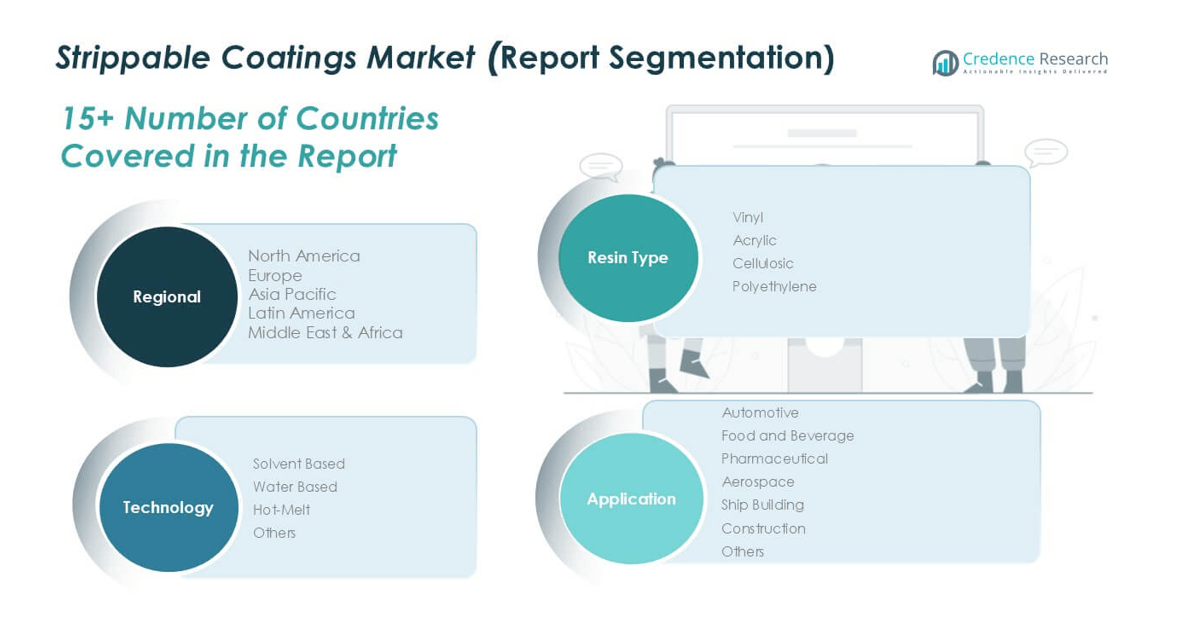
Strippable Coatings Market By Resin Type (Vinyl, Acrylic, Cellulosic, Polyethylene); By Technology (Solvent Based, Water Based, Hot-Melt, Others); By Application (Automotive, Food and Beverage, Pharmaceutical, Aerospace, Ship Building, Construction, Others) – Growth, Share, Opportunities & Competitive Analysis, 2024 – 2032

Report ID: 9854 | Report Format : Excel, PDF

Market Overview

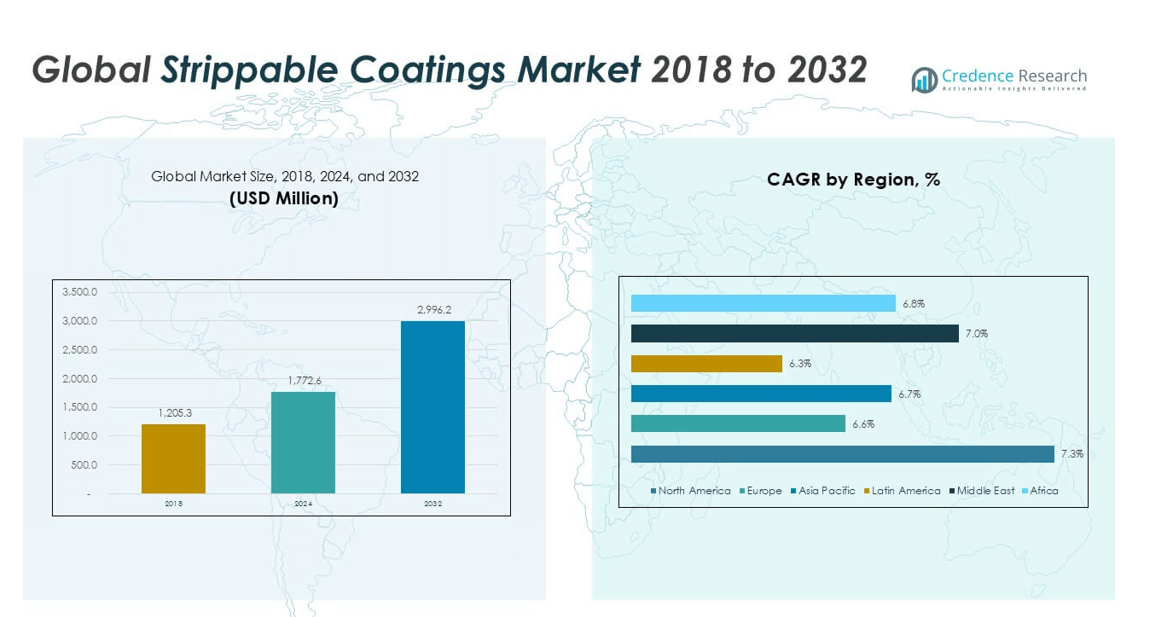
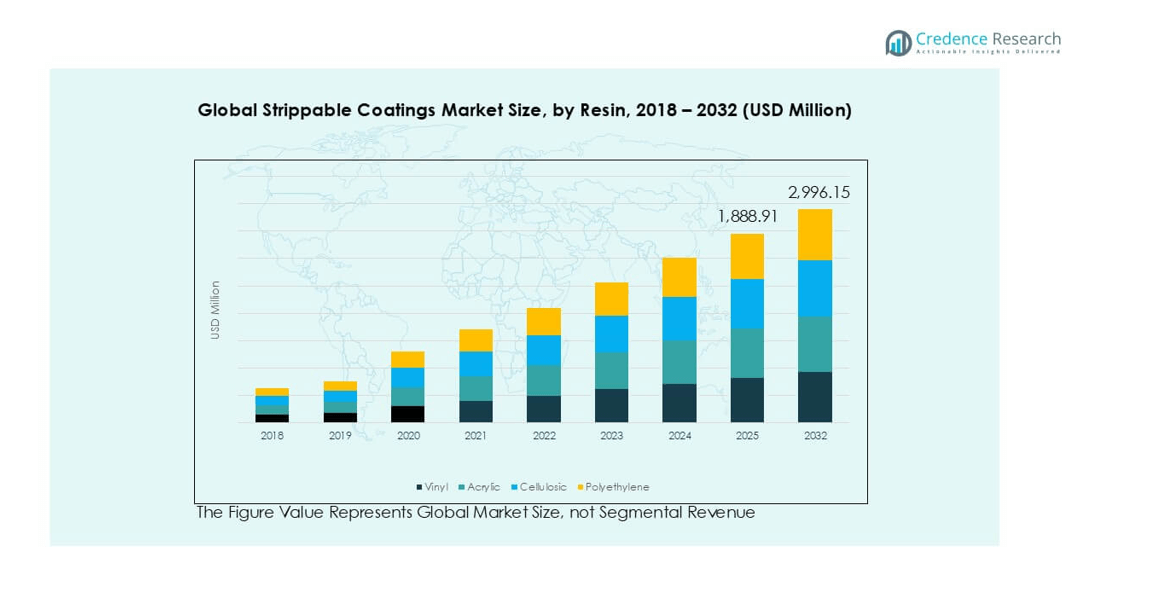
Global Strippable Coatings market size was valued at USD 1,205.3 million in 2018 to USD 1,772.6 million in 2024 and is anticipated to reach USD 2,996.2 million by 2032, at a CAGR of 6.81% during the forecast period.

REPORT ATTRIBUTE DETAILS
Historical Period 2020-2023
Base Year 2024
Forecast Period 2025-2032
Strippable Coatings Market Size 2024 USD 1,772.6 million
Strippable Coatings Market, CAGR 6.81%
Strippable Coatings Market Size 2032 USD 2,996.2 million


The global strippable coatings market features a mix of large chemical producers and specialized coating manufacturers. Key players include Wacker GmbH, DuPont, PPG Industries, Sherwin-Williams, Covestro, Spraylat International, Cal-West Specialty Coatings, Bemis Company, Evans Coatings, General Chemical Corporation, and Kraton Corporation. These companies compete through formulation performance, regulatory compliance, and application-specific solutions. Asia Pacific leads the market with an exact 34.1% share, driven by high manufacturing output and infrastructure activity. Europe follows with 28.6% share, supported by strong automotive and industrial bases. North America holds 21.7% share, backed by automotive, aerospace, and construction demand. This regional balance shapes competitive strategies across global and local suppliers.

Strippable Coatings Market size

Market Insights

  • The global strippable coatings market reached USD 1,772.6 million in 2024 and is projected to grow to USD 2,996.2 million by 2032, registering a CAGR of 6.81% during the forecast period, supported by steady industrial and construction demand.
  • Market growth is driven by rising need for temporary surface protection in automotive, construction, aerospace, and shipbuilding, where coatings reduce surface damage, rework costs, and cleaning time during manufacturing and transport.
  • Key trends include growing adoption of water-based coatings due to low VOC benefits, increasing customization for industry-specific applications, and rising use in infrastructure and renovation projects, while vinyl resin remains the dominant segment due to strong peelability.
  • The competitive landscape includes global players and specialized suppliers competing on performance, regulatory compliance, and formulation innovation, with water-based technology holding the largest technology segment share.
  • Asia Pacific leads with 34.1% market share, followed by Europe at 28.6% and North America at 21.7%, while automotive remains the leading application segment across regions.

Access crucial information at unmatched prices!

Request your sample report today & start making informed decisions powered by Credence Research Inc.!

Download Sample

Market Segmentation Analysis:

By Resin Type:

The resin type segment shows strong preference for vinyl-based strippable coatings, which hold the dominant market share. Vinyl resins lead due to strong film formation, easy peelability, and broad surface compatibility. Automotive and construction users favor vinyl for temporary surface protection during processing and transport. Acrylic resins follow, supported by UV resistance and clarity benefits. Cellulosic coatings serve niche industrial uses requiring fast drying. Polyethylene resins gain attention for moisture resistance, though adoption remains limited due to higher processing constraints.

  • For instance, Spraylat’s vinyl-based strippable coatings form films with tensile strength above 10 MPa and peel cleanly in single sheets after curing on metal and glass surfaces.

By Technology:

Water-based strippable coatings account for the largest share within the technology segment. Regulatory pressure on VOC emissions and safer workplace requirements drive strong adoption. Manufacturers prefer water-based systems for easy application, low odor, and simplified cleanup. Solvent-based coatings maintain usage in heavy-duty industrial settings where fast curing is critical. Hot-melt technologies address specific high-temperature needs but remain limited in scale. Other technologies support specialized applications, though limited flexibility and higher costs restrict broader commercial penetration.

  • For instance, some specialized solvent-based spray booth coatings can be handled in 15 minutes and are hard in 30 minutes at ambient temperatures for a typical film thickness, supporting rapid handling cycles; however, a full cure (maximum durability) for most solvent-based coatings usually takes one to two weeks.

By Application:

The automotive segment dominates application demand for strippable coatings, holding the highest market share. Vehicle manufacturers use these coatings to protect painted surfaces, trims, and glass during assembly and logistics. High production volumes and strict surface quality standards support sustained demand. Construction follows, driven by protection of windows, floors, and metal fixtures. Aerospace and shipbuilding adopt coatings for corrosion prevention during fabrication. Food, beverage, and pharmaceutical segments rely on clean peel performance for equipment protection during maintenance cycles.

Key Growth Drivers

Rising Demand for Temporary Surface Protection Across Industries

Growing use of temporary surface protection drives steady demand for strippable coatings. Automotive, construction, aerospace, and shipbuilding industries rely on these coatings to prevent scratches, corrosion, and contamination during manufacturing and transport. Complex production lines increase the risk of surface damage. Strippable coatings offer peelable protection without residue, reducing rework and quality losses. Manufacturers value reduced cleaning time and lower defect rates. High-value surfaces such as painted panels, glass, and metal parts require consistent protection. Expanding infrastructure projects further support demand. Industrial users also prefer coatings that adapt to varied substrates. This driver remains strong as industries prioritize surface integrity, cost control, and operational efficiency across production cycles.

  • For instance, Sherwin-Williams offers a range of strippable protective coatings designed to protect metal and painted surfaces temporarily during various stages of storage and transport. These coatings are designed to peel cleanly after use.

Expansion of Automotive and Transportation Manufacturing

Automotive and transportation manufacturing strongly support market growth. Vehicle production requires protection of exterior panels, trims, and displays throughout assembly and logistics stages. Strippable coatings help maintain surface finish standards before final delivery. Electric vehicle manufacturing adds new protection needs for battery casings and lightweight components. Tier-one suppliers adopt these coatings to reduce transit damage between facilities. High production volumes increase recurring consumption. The shift toward premium vehicle finishes also raises protection requirements. Rail, marine, and commercial vehicle manufacturing further contribute to demand. This driver strengthens as manufacturers focus on quality assurance and cost-effective damage prevention solutions.

  • For instance, Spraylat temporary protective coatings are applied on automotive body panels during logistics and withstand handling across more than 15 internal assembly stages without tearing.

Increasing Preference for Low-VOC and Environment-Friendly Solutions

Environmental regulations accelerate adoption of compliant coating solutions. Industries increasingly replace traditional protective films and solvent-heavy products. Water-based strippable coatings gain preference due to low VOC emissions and safer handling. Manufacturers align product portfolios with sustainability goals and regulatory standards. End users value reduced worker exposure and simplified disposal. Green building practices also support adoption in construction projects. Environmental certifications influence purchasing decisions across industries. This driver supports long-term growth as sustainability becomes a core operational requirement rather than a compliance add-on.

Strippable Coatings Market share

Key Trends & Opportunities

Shift Toward Water-Based and Advanced Formulations

The market shows a clear shift toward water-based and advanced formulations. Manufacturers invest in improving peel strength, drying time, and durability of water-based coatings. These products match performance needs while meeting environmental standards. Advanced formulations also improve adhesion control across metals, plastics, and glass. Opportunities exist in developing coatings for sensitive electronics and high-gloss surfaces. Demand rises for products that perform under temperature and humidity variation. Suppliers that balance performance with compliance gain competitive advantage. This trend supports innovation-driven differentiation.

  • For instance, Caplugs Shercon offers comprehensive precision masking solutions, including Ultrabake™ silicone caps and plugs designed to withstand temperatures up to 315°C (600°F) during powder coating, e-coating, plating, and anodizing processes.

Growing Adoption in Construction and Infrastructure Projects

Construction and infrastructure projects create new growth avenues. Large-scale developments require protection of windows, façades, flooring, and fixtures during installation. Strippable coatings reduce cleaning costs and project delays. Urban redevelopment and commercial construction increase usage volumes. Contractors favor coatings that apply quickly and remove cleanly. Temporary protection needs rise with longer project timelines. This trend opens opportunities for suppliers to offer site-specific formulations. Custom solutions improve adoption across varied construction environments.

Customization for Industry-Specific Applications

Customization emerges as a key opportunity area. End users demand coatings tailored to application methods, surface types, and removal conditions. Aerospace and electronics sectors require precise peel behavior. Shipbuilding needs corrosion resistance during long exposure periods. Customized solutions strengthen supplier-client relationships. Value-added services support premium pricing. This trend encourages technical collaboration and long-term contracts.

Key Challenges

Performance Limitations Under Extreme Conditions

Strippable coatings face challenges in extreme temperature, humidity, and exposure environments. Poor peelability or residue formation can reduce user confidence. Heavy-duty industrial users require consistent performance over extended periods. Coatings may fail under prolonged UV or chemical exposure. Performance variation across substrates also limits adoption. Addressing these issues requires higher formulation costs. Suppliers must balance durability with ease of removal. This challenge slows adoption in some high-stress applications.

Cost Sensitivity and Competition from Alternative Protection Methods

Cost sensitivity remains a major restraint, especially in price-driven industries. Traditional plastic films and tapes compete on upfront cost. Some users resist switching despite higher long-term benefits. Application and removal labor costs also influence decisions. Smaller contractors prefer low-cost alternatives. Intense supplier competition pressures margins. Educating users on lifecycle cost savings remains essential. Overcoming this challenge requires performance validation and clear value communication.

Regional Analysis

North America:

North America accounted for about 21.7% market share in 2018, with a market size of USD 261.20 million. The region expanded to USD 395.74 million in 2024 and is projected to reach USD 695.11 million by 2032, growing at a CAGR of 7.3%. Strong automotive manufacturing, aerospace production, and renovation activity drive demand. Manufacturers use strippable coatings to protect painted panels, glass, and metal components. Strict quality standards and high labor costs favor peelable solutions that reduce rework. Environmental compliance also supports adoption of advanced and water-based formulations across industries.

Europe:

Europe held nearly 28.6% market share in 2018, supported by a market value of USD 344.25 million. The market reached USD 499.57 million in 2024 and is forecast to grow to USD 829.34 million by 2032, at a CAGR of 6.6%. Automotive production, industrial equipment manufacturing, and construction renovation projects sustain demand. European users prioritize surface quality and regulatory compliance. Strong environmental policies accelerate adoption of low-VOC coatings. High-value exports also increase the need for transit protection. Mature industrial bases across Germany, France, and Italy maintain steady consumption levels.

Asia Pacific:

Asia Pacific dominated the market with about 34.1% share in 2018, valued at USD 411.14 million. The region expanded to USD 602.12 million in 2024 and is expected to reach USD 1,012.10 million by 2032, registering a CAGR of 6.7%. Rapid industrialization, automotive production growth, and infrastructure expansion drive demand. Large manufacturing hubs in China, Japan, South Korea, and India use strippable coatings for surface protection during mass production. Cost efficiency and high output volumes support recurring usage. Growing quality awareness further strengthens regional adoption.

Latin America:

Latin America represented around 7.3% market share in 2018, with a market size of USD 88.23 million. The market increased to USD 126.49 million in 2024 and is projected to reach USD 206.44 million by 2032, growing at a CAGR of 6.3%. Automotive assembly, construction activity, and appliance manufacturing support demand. Brazil and Mexico lead regional consumption due to strong industrial bases. Manufacturers adopt strippable coatings to reduce damage during transport and installation. Gradual industrial modernization and foreign investments continue to support steady market expansion.

Middle East:

The Middle East accounted for nearly 5.8% market share in 2018, valued at USD 69.67 million. The market reached USD 103.44 million in 2024 and is expected to grow to USD 177.07 million by 2032, at a CAGR of 7.0%. Construction, shipbuilding, and infrastructure projects drive demand. Large-scale commercial developments increase the need for temporary surface protection. Harsh climate conditions also encourage protective coatings during installation phases. Gulf countries lead adoption due to high-value construction and industrial projects supported by government investments.

Africa:

Africa held approximately 2.6% market share in 2018, with a market size of USD 30.86 million. The market expanded to USD 45.23 million in 2024 and is forecast to reach USD 76.10 million by 2032, growing at a CAGR of 6.8%. Infrastructure development, mining equipment manufacturing, and urban construction support demand. South Africa remains a key contributor. Strippable coatings help protect surfaces during long project timelines. Rising industrial activity and gradual adoption of modern construction practices continue to support regional market growth.

Strippable Coatings Market segmentation

Market Segmentations:

By Resin Type

  • Vinyl
  • Acrylic
  • Cellulosic
  • Polyethylene

By Technology

  • Solvent Based
  • Water Based
  • Hot-Melt
  • Others

By Application

  • Automotive
  • Food and Beverage
  • Pharmaceutical
  • Aerospace
  • Ship Building
  • Construction
  • Others

By Geography

  • North America
    • U.S.
    • Canada
    • Mexico
  • Europe
    • Germany
    • France
    • U.K.
    • Italy
    • Spain
    • Rest of Europe
  • Asia Pacific
    • China
    • Japan
    • India
    • South Korea
    • South-east Asia
    • Rest of Asia Pacific
  • Latin America
    • Brazil
    • Argentina
    • Rest of Latin America
  • Middle East & Africa
    • GCC Countries
    • South Africa
    • Rest of the Middle East and Africa

Competitive Landscape

The global strippable coatings market shows a moderately fragmented competitive landscape, with both multinational chemical companies and specialized coating suppliers actively competing. Leading players focus on product performance, regulatory compliance, and application versatility to strengthen market presence. Companies invest in water-based and low-VOC formulations to align with environmental standards and customer requirements. Strategic partnerships with automotive, construction, and industrial manufacturers support stable demand. Product customization and technical service act as key differentiation factors. Regional players compete through cost efficiency and application-specific solutions. Capacity expansion and portfolio diversification remain common strategies. Continuous innovation in peelability, durability, and surface compatibility helps companies maintain competitiveness in both mature and emerging regional markets.

Shape Your Report to Specific Countries or Regions & Enjoy 30% Off!

Key Player Analysis

  • Wacker GmbH
  • Bemis Company
  • General Chemical Corporation
  • DuPont
  • Cal-West Specialty Coatings
  • Spraylat International
  • PPG Industries
  • Sherwin-Williams
  • Covestro
  • Evans Coatings
  • Kraton Corporatio

Recent Developments

  • In November 2025, Covestro and Nippon Paint announced a strategic partnership to co-develop low-carbon automotive and industrial coatings.
  • In April 2025, CRTS Global LLC acquired RAE Energy’s Coatings Business expanding CRTS’s coating portfolio including protective coatings for pipelines (though not strictly “strippable,” this reflects consolidation in the coatings sector)

Report Coverage

The research report offers an in-depth analysis based on Resin Type, Technology, Application and Geography. It details leading market players, providing an overview of their business, product offerings, investments, revenue streams, and key applications. Additionally, the report includes insights into the competitive environment, SWOT analysis, current market trends, as well as the primary drivers and constraints. Furthermore, it discusses various factors that have driven market expansion in recent years. The report also explores market dynamics, regulatory scenarios, and technological advancements that are shaping the industry. It assesses the impact of external factors and global economic changes on market growth. Lastly, it provides strategic recommendations for new entrants and established companies to navigate the complexities of the market.

Future Outlook

  1. The market will expand steadily due to rising industrial surface protection needs.
  2. Manufacturers will increase focus on water-based and low-VOC coating solutions.
  3. Automotive production growth will continue to support strong demand.
  4. Construction and infrastructure projects will raise application volumes.
  5. Asia Pacific will remain the leading regional market by consumption share.
  6. Product innovation will improve peelability and surface compatibility.
  7. Custom formulations will gain importance across specialized industries.
  8. Regulatory pressure will accelerate adoption of eco-friendly technologies.
  9. Competitive intensity will increase through portfolio expansion strategies.
  10. Emerging economies will create new growth opportunities across end-use sectors.
  1. CHAPTER NO. 1 :      GENESIS OF THE MARKET            1.1 Market Prelude – Introduction & Scope1.2 The Big Picture – Objectives & Vision1.3 Strategic Edge – Unique Value Proposition

    1.4 Stakeholder Compass – Key Beneficiaries

    CHAPTER NO. 2 :      EXECUTIVE LENS

    2.1 Pulse of the Industry – Market Snapshot

    2.2 Growth Arc – Revenue Projections (USD Million)

    2.3. Premium Insights – Based on Primary Interviews

    CHAPTER NO. 3 :      STRIPPABLE COATINGS MARKET FORCES & INDUSTRY PULSE

    3.1 Foundations of Change – Market Overview
    3.2 Catalysts of Expansion – Key Market Drivers
    3.2.1 Momentum Boosters – Growth Triggers
    3.2.2 Innovation Fuel – Disruptive Technologies
    3.3 Headwinds & Crosswinds – Market Restraints
    3.3.1 Regulatory Tides – Compliance Challenges
    3.3.2 Economic Frictions – Inflationary Pressures
    3.4 Untapped Horizons – Growth Potential & Opportunities
    3.5 Strategic Navigation – Industry Frameworks
    3.5.1 Market Equilibrium – Porter’s Five Forces
    3.5.2 Ecosystem Dynamics – Value Chain Analysis
    3.5.3 Macro Forces – PESTEL Breakdown

    CHAPTER NO. 4 : KEY INVESTMENT EPICENTER        

    4.1 Regional Goldmines – High-Growth Geographies

    4.2 Product Frontiers – Lucrative Resin Type Categories

    4.3 Application Sweet Spots – Emerging Demand Segments

    CHAPTER NO. 5: REVENUE TRAJECTORY & WEALTH MAPPING

    5.1 Momentum Metrics – Forecast & Growth Curves

    5.2 Regional Revenue Footprint – Market Share Insights

    5.3 Segmental Wealth Flow – Resin Type, Technology, and Application Revenue

    CHAPTER NO. 6 : TRADE & COMMERCE ANALYSIS    

    6.1.      Import Analysis By Region

    6.1.1.    Global Strippable Coatings Market Import Revenue By Region

    6.2.      Export Analysis By Region

    6.2.1.    Global Strippable Coatings Market Export Revenue By Region

    CHAPTER NO. 7 :      COMPETITION ANALYSIS 

    7.1.      Company Market Share Analysis

    7.1.1.    Global Strippable Coatings Market: Company Market Share

    7.2.      Global Strippable Coatings Market Company Revenue Market Share

    7.3.      Strategic Developments

    7.3.1.    Acquisitions & Mergers

    7.3.2.    New Product Launch

    7.3.3.    Regional Expansion

    7.4.      Competitive Dashboard

    7.5.      Company Assessment Metrics, 2024

    CHAPTER NO. 8 : STRIPPABLE COATINGS MARKET – BY RESIN TYPE SEGMENT ANALYSIS

    8.1.      Strippable Coatings Market Overview By Resin Type Segment

    8.1.1.    Strippable Coatings Market Revenue Share By Resin Type

    8.2.       Vinyl

    8.3.       Acrylic

    8.4.       Cellulosic

    PolyethyleneCHAPTER NO. 9 : STRIPPABLE COATINGS MARKET – BY TECHNOLOGY SEGMENT ANALYSIS

    9.1.      Strippable Coatings Market Overview By Technology Segment

    9.1.1.    Strippable Coatings Market Revenue Share By Technology

    9.2.      Solvent Based

    9.3.     Water Based

    9.4.     Hot-Melt

    9.5.     Others

    CHAPTER NO. 10 : STRIPPABLE COATINGS MARKET – BY APPLICATION SEGMENT ANALYSIS

    10.1.     Strippable Coatings Market Overview By Application Segment

    10.1.1.  Strippable Coatings Market Revenue Share By Application

    10.2.    Automotive

    10.3.    Food and Beverage

    10.4.    Pharmaceutical

    10.5.    Aerospace

    10.6.    Ship Building

    10.7.    Construction

    10.8.    Others

    CHAPTER NO. 11 : STRIPPABLE COATINGS MARKET – REGIONAL ANALYSIS

    11.1.     Strippable Coatings Market Overview By Region Segment

    11.1.1.  Global Strippable Coatings Market Revenue Share By Region

    10.1.2.  Regions

    11.1.3.  Global Strippable Coatings Market Revenue By Region

    11.1.4.  Resin Type

    11.1.5.  Global Strippable Coatings Market Revenue By Resin Type

    11.1.6.  Technology

    11.1.7. Global Strippable Coatings Market Revenue By Technology

    11.1.8.  Application

    11.1.9. Global Strippable Coatings Market Revenue By Application

    CHAPTER NO. 12 : NORTH AMERICA STRIPPABLE COATINGS MARKET – COUNTRY ANALYSIS

    12.1.     North America Strippable Coatings Market Overview By Country Segment

    12.1.1.  North America Strippable Coatings Market Revenue Share By Region

    12.2.     North America

    12.2.1.  North America Strippable Coatings Market Revenue By Country

    12.2.2.  Resin Type

    12.2.3.  North America Strippable Coatings Market Revenue By Resin Type

    12.2.4.  Technology

    12.2.5.  North America Strippable Coatings Market Revenue By Technology

    12.2.6.  Application

    12.2.7.  North America Strippable Coatings Market Revenue By Application

    12.3.     U.S.

    12.4.     Canada

    12.5.     Mexico

    CHAPTER NO. 13 : EUROPE STRIPPABLE COATINGS MARKET – COUNTRY ANALYSIS

    13.1.     Europe Strippable Coatings Market Overview By Country Segment

    13.1.1.  Europe Strippable Coatings Market Revenue Share By Region

    13.2.     Europe

    13.2.1.  Europe Strippable Coatings Market Revenue By Country

    13.2.2.  Resin Type

    13.2.3.  Europe Strippable Coatings Market Revenue By Resin Type

    13.2.4.  Technology

    13.2.5.  Europe Strippable Coatings Market Revenue By Technology

    13.2.6.  Application

    13.2.7.  Europe Strippable Coatings Market Revenue By Application

    13.3.     UK

    13.4.     France

    13.5.     Germany

    13.6.     Italy

    13.7.     Spain

    13.8.     Russia

    13.9.    Rest of Europe

    CHAPTER NO. 14 : ASIA PACIFIC STRIPPABLE COATINGS MARKET – COUNTRY ANALYSIS

    14.1.     Asia Pacific Strippable Coatings Market Overview By Country Segment

    14.1.1.  Asia Pacific Strippable Coatings Market Revenue Share By Region

    14.2.     Asia Pacific

    14.2.1.  Asia Pacific Strippable Coatings Market Revenue By Country

    14.2.2.  Resin Type

    14.2.3.  Asia Pacific Strippable Coatings Market Revenue By Resin Type

    14.2.4.  Technology

    14.2.5.  Asia Pacific Strippable Coatings Market Revenue By Technology

    14.2.6.  Application

    14.2.7.  Asia Pacific Strippable Coatings Market Revenue By Application

    14.3.     China

    14.4.     Japan

    14.5.     South Korea

    14.6.     India

    14.7.     Australia

    14.8.     Southeast Asia

    14.9.     Rest of Asia Pacific

    CHAPTER NO. 15 : LATIN AMERICA STRIPPABLE COATINGS MARKET – COUNTRY ANALYSIS

    15.1.     Latin America Strippable Coatings Market Overview By Country Segment

    15.1.1.  Latin America Strippable Coatings Market Revenue Share By Region

    15.2.     Latin America

    15.2.1.  Latin America Strippable Coatings Market Revenue By Country

    15.2.2.  Resin Type

    15.2.3.  Latin America Strippable Coatings Market Revenue By Resin Type

    15.2.4.  Technology

    15.2.5.  Latin America Strippable Coatings Market Revenue By Technology

    15.2.6.  Application

    15.2.7.  Latin America Strippable Coatings Market Revenue By Application

    15.3.     Brazil

    15.4.     Argentina

    15.5.     Rest of Latin America

    CHAPTER NO. 16 : MIDDLE EAST STRIPPABLE COATINGS MARKET – COUNTRY ANALYSIS

    16.1.     Middle East Strippable Coatings Market Overview By Country Segment

    16.1.1.  Middle East Strippable Coatings Market Revenue Share By Region

    16.2.     Middle East

    16.2.1.  Middle East Strippable Coatings Market Revenue By Country

    16.2.2.  Resin Type

    16.2.3.  Middle East Strippable Coatings Market Revenue By Resin Type

    16.2.4.  Technology

    16.2.5.  Middle East Strippable Coatings Market Revenue By Technology

    16.2.6.  Application

    16.2.7.  Middle East Strippable Coatings Market Revenue By Application

    16.3.     GCC Countries

    16.4.     Israel

    16.5.     Turkey

    16.6.     Rest of Middle East

    CHAPTER NO. 17 : AFRICA STRIPPABLE COATINGS MARKET – COUNTRY ANALYSIS

    17.1.     Africa Strippable Coatings Market Overview By Country Segment

    17.1.1.  Africa Strippable Coatings Market Revenue Share By Region

    17.2.     Africa

    17.2.1.  Africa Strippable Coatings Market Revenue By Country

    17.2.2.  Resin Type

    17.2.3.  Africa Strippable Coatings Market Revenue By Resin Type

    17.2.4.  Technology

    17.2.5.  Africa Strippable Coatings Market Revenue By Technology

    17.2.6.  Application

    17.2.7.  Africa Strippable Coatings Market Revenue By Application

    17.3.     South Africa

    17.4.     Egypt

    17.5.     Rest of Africa

    CHAPTER NO. 18 : COMPANY PROFILES

    18.1.      Wacker GmBH

    18.1.1.  Company Overview

    18.1.2.  Product Portfolio

    18.1.3.  Financial Overview

    18.1.4.  Recent Developments

    18.1.5.  Growth Strategy

    18.1.6.  SWOT Analysis

    18.2.    Bemis Company

    18.3.    General Chemical Corporation

    18.4.    DuPont

    18.5.     Cal-West Specialty Coatings

    18.6.   Spraylat International

    18.7.   PPG Industries

    18.8.   Sherwin-Williams

    18.9.   Covestro

    18.10. Evans Coatings

    18.11. Kraton Corporation

    18.12.  Other Key Players

Request Free Sample

We prioritize the confidentiality and security of your data. Our promise: your information remains private.

Ready to Transform Data into Decisions?

Request Your Sample Report and Start Your Journey of Informed Choices


Providing the strategic compass for industry titans.

cr-clients-logos

Frequently Asked Question:

What is the current market size for Strippable Coatings Market, and what is its projected size in 2032?

The market was valued at USD 1,772.6 million in 2024 and is projected to reach USD 2,996.2 million by 2032.

At what Compound Annual Growth Rate is the Strippable Coatings Market projected to grow between 2024 and 2032?

The market is expected to grow at a CAGR of 6.81% during the forecast period.

Who are the major players in this market?

Wacker GmBH, Bemis Company, General Chemical Corporation, DuPont, Cal-West Specialty Coatings, Spraylat International, PPG Industries, Sherwin-Williams, Covestro, Evans Coatings, Kraton Corporation. are some of the major players in the global market.

What are the primary factors fueling the growth of the Strippable Coatings Market?

Strippable Coatings Market growth is fueled by rising demand for temporary surface protection in aerospace, automotive, and electronics, along with adoption of eco-friendly water-based formulations.

Who are the leading companies in the Strippable Coatings Market?

Leading companies in the Strippable Coatings Market include Spraylat International, DuPont, Kraton Corporation, PPG Industries, Covestro, Bemis Company, Wacker GmBH, Cal-West Specialty Coatings, Sherwin-Williams, and General Chemical Corporation.

About Author

Shweta Bisht

Shweta Bisht

Healthcare & Biotech Analyst

Shweta is a healthcare and biotech researcher with strong analytical skills in chemical and agri domains.

View Profile


Related Reports

Automotive Adhesive Market

The Global Automotive Adhesive Market size was valued at USD 4,472.30 million in 2018 to USD 6,458.40 million in 2024 and is anticipated to reach USD 9,766.80 million by 2032, at a CAGR of 5.26% during the forecast period.

Pool Water Treatment Chemicals Market

The Pool water treatment chemicals market is projected to grow from USD 1,333 million in 2024 to an estimated USD 1,954.2 million by 2032, at a CAGR of 4.9% during the forecast period.

Polyisobutylene Market

The Polyisobutylene market is projected to grow from USD 2,193 million in 2024 to USD 2,863 million by 2032. The market is expected to expand at a CAGR of 3.39% from 2024 to 2032.

Polyvinylpyrrolidone Market

The Polyvinylpyrrolidone market is projected to grow from USD 2,803 million in 2024 to USD 5,692.2 million by 2032, registering a CAGR of 9.26% during the forecast period.

Polyurea Coatings Market

The Polyurea coating market is projected to grow from USD 1,501 million in 2024 to USD 3,245.5 million by 2032, at a CAGR of 10.12% during the forecast period.

Polytetrafluoroethylene Market

The Polytetrafluoroethylene market is projected to grow from USD 3,843 million in 2024 to USD 5,826.3 million by 2032. The market is expected to expand at a CAGR of 5.34% from 2024 to 2032.

Polystyrene Resin Recycling Market

The Polystyrene resin recycling market is projected to grow from USD 449.9 million in 2024 to an estimated USD 662.2 million by 2032, with a compound annual growth rate of 4.95% during the forecast period.

Polystyrene Market

The Polystyrene market is projected to grow from USD 34,843 million in 2024 to an estimated USD 47,355.7 million by 2032. The market is expected to expand at a compound annual growth rate of 3.91% from 2024 to 2032.

Polymer 3D Printing Market

The Polymer 3D printing market is projected to grow from USD 2,853 million in 2024 to USD 7,594.8 million by 2032. The market is expected to expand at a CAGR of 13.02% during the forecast period.

Polyester Film Market

The Polyester film market is projected to grow from USD 35,113 million in 2024 to USD 55,837.9 million by 2032, registering a CAGR of 5.97% during the forecast period.

Structural Foam Market

Structural Foam Market size was valued at USD 85,047.51 million in 2024 and is anticipated to reach USD 118,196.16 million by 2032, at a CAGR of 4.2% during the forecast period.

Structural Bonding Agents Market

Structural Bonding Agents Market size was valued at USD 8,789.6 Million in 2024 and is anticipated to reach USD 13,085.52 Million by 2032, at a CAGR of 5.1% during the forecast period.

Licence Option

The report comes as a view-only PDF document, optimized for individual clients. This version is recommended for personal digital use and does not allow printing. Use restricted to one purchaser only.
$4999

To meet the needs of modern corporate teams, our report comes in two formats: a printable PDF and a data-rich Excel sheet. This package is optimized for internal analysis. Unlimited users allowed within one corporate location (e.g., regional office).
$6999

The report will be delivered in printable PDF format along with the report’s data Excel sheet. This license offers 100 Free Analyst hours where the client can utilize Credence Research Inc. research team. Permitted for unlimited global use by all users within the purchasing corporation, such as all employees of a single company.
$12999

Report delivery within 24 to 48 hours

Europe

North America

Email

Smallform of Sample request
User Review

Thank you for the data! The numbers are exactly what we asked for and what we need to build our business case.

Materials Scientist
(privacy requested)

User Review

The report was an excellent overview of the Industrial Burners market. This report does a great job of breaking everything down into manageable chunks.

Imre Hof
Management Assistant, Bekaert

cr-clients-logos

Request Sample