
Market Overview:
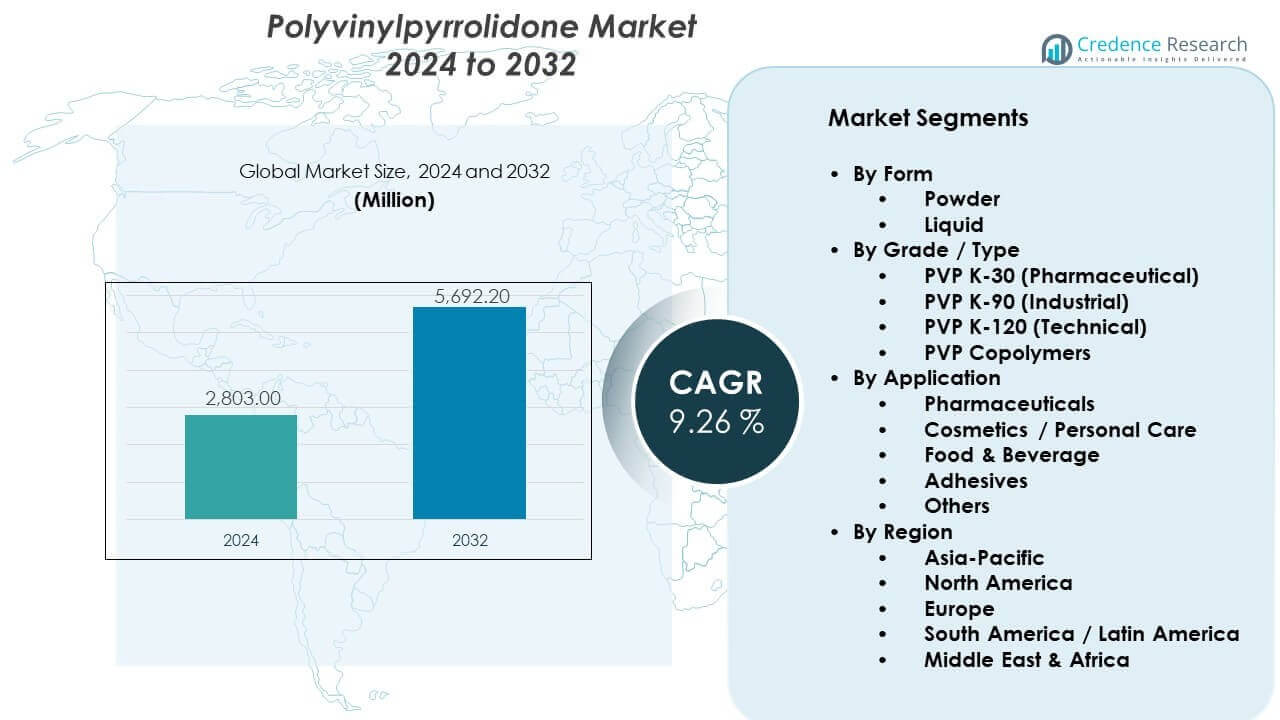
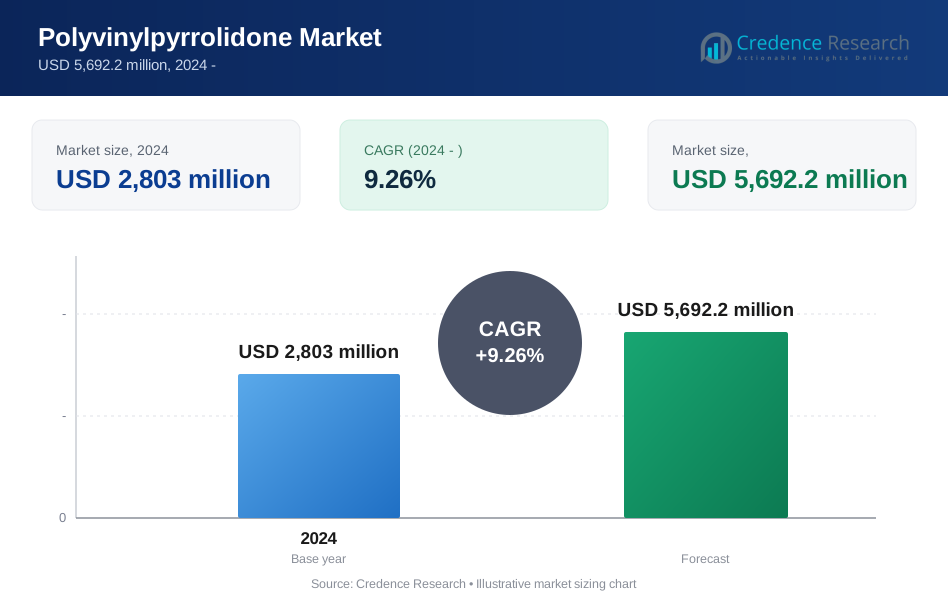
The Polyvinylpyrrolidone market is projected to grow from USD 2,803 million in 2024 to USD 5,692.2 million by 2032, registering a CAGR of 9.26% during the forecast period.
| REPORT ATTRIBUTE | DETAILS |
|---|---|
| Historical Period | 2020-2023 |
| Base Year | 2024 |
| Forecast Period | 2025-2032 |
| Polyvinylpyrrolidone Market Size 2024 | USD 2,803 million |
| Polyvinylpyrrolidone Market , CAGR | 9.26% |
| Polyvinylpyrrolidone Market Size 2032 | USD 5,692.2 million |
Market growth is driven by extensive use of polyvinylpyrrolidone in pharmaceutical formulations. Drug manufacturers rely on the polymer for binding, solubility enhancement, and controlled release. Personal care producers use it for film-forming and texture control. Food and beverage applications support demand through stabilizing functions. Industrial users apply it in adhesives, coatings, and specialty chemicals. High-purity grades enable injectable drug use. Rising healthcare spending supports consumption. Product safety and performance build supplier trust.
North America leads due to strong pharmaceutical manufacturing and research activity. The United States shows high demand from drug formulation and medical applications. Europe follows with stable use in healthcare and cosmetics sectors. Germany and France benefit from regulated manufacturing strength. Asia Pacific emerges as a high-growth region driven by expanding pharmaceutical and personal care production. China and India increase output capacity. Cost-efficient manufacturing supports regional supply growth. Latin America and the Middle East record gradual adoption.
Market Insights:
- The Polyvinylpyrrolidone market was valued at USD 2,803 million in 2024 and is projected to reach USD 5,692.2 million by 2032, growing at a CAGR of 9.26% during the forecast period.
- North America leads with about 34% share due to strong pharmaceutical manufacturing, followed by Asia-Pacific at nearly 32% driven by large-scale drug production, and Europe at around 22% supported by regulated healthcare and cosmetic industries.
- Asia-Pacific is the fastest-growing region with close to 32% share, supported by expanding generic drug manufacturing, cost-efficient production, and rising personal care demand in China and India.
- By grade, pharmaceutical-grade PVP K-30 accounts for nearly 45% share due to extensive use in drug formulations and strict quality requirements.
- By form, powder polyvinylpyrrolidone holds around 60% share, supported by ease of handling, storage stability, and preference in solid dosage manufacturing.
Market Drivers:
Rising Pharmaceutical Demand For Solubility Enhancement And Binding Functions
The Polyvinylpyrrolidone market benefits from strong pharmaceutical demand. Drug formulators use the polymer for solubility control. Tablets require reliable binding performance. Injectable drugs depend on high purity grades. Controlled release systems favor stable excipients. Formulation consistency supports regulatory compliance. Expanding generic drug production raises usage. Research pipelines support long-term demand. Healthcare growth sustains consumption.
- For instance, BASF supplies Kollidon® grades meeting USP–NF and Ph. Eur. standards.
Expanding Use In Personal Care And Cosmetic Product Formulations
Personal care brands adopt polyvinylpyrrolidone for film formation. Hair styling products rely on strong hold properties. Skin care formulations benefit from smooth texture. Product clarity improves visual appeal. Compatibility with active ingredients supports use. Consumer demand favors performance ingredients. Brand differentiation drives formulation upgrades. Premium cosmetics increase polymer intake. This driver supports volume growth.
- For instance, Ashland confirms PVP clarity in alcohol-based cosmetic systems.
Increasing Industrial Applications Across Adhesives And Specialty Chemicals
Industrial users value polyvinylpyrrolidone versatility. Adhesive formulations need stable bonding agents. Coatings benefit from improved dispersion control. Electronics applications require consistent polymer behavior. Manufacturing processes favor predictable performance. Specialty chemical producers expand use cases. Quality control drives material preference. Industrial diversification strengthens demand. This driver supports steady expansion.
Growth In Food And Beverage Processing Applications
Food processors use polyvinylpyrrolidone as a stabilizer. Beverage clarification benefits from polymer properties. Processing efficiency improves product quality. Compliance with food safety standards supports adoption. Clean-label trends favor proven additives. Shelf life extension adds value. Consistent supply supports production planning. Food demand growth supports usage. This segment adds stability.
Market Trends:
Shift Toward High-Purity And Pharmaceutical-Grade Polymer Variants
Manufacturers increase focus on high-purity grades. Pharmaceutical buyers demand strict quality control. Advanced purification methods gain importance. Traceability supports regulatory audits. Suppliers invest in quality assurance systems. Product differentiation improves margins. High-grade variants attract premium pricing. This trend shapes supplier strategies. Market quality standards continue to rise.
- For instance, BASF operates ISO 9001 and GMP-aligned PVP production lines.
Rising Adoption In Advanced Drug Delivery Systems
Drug delivery innovation supports polymer demand. Modified release systems gain traction. Polyvinylpyrrolidone supports uniform dispersion. Bioavailability enhancement remains a priority. Research collaborations drive formulation advances. Specialty polymers gain attention. Technology-driven demand grows steadily. Innovation supports long-term relevance. This trend reshapes applications.
- For instance, Ashland highlights PVP-enabled bioavailability improvements in oral formulations.
Increasing Focus On Process Efficiency And Formulation Stability
Manufacturers seek process consistency. Polyvinylpyrrolidone supports stable formulations. Reduced batch variability improves output. Efficiency gains lower production risk. Quality-focused buyers favor proven materials. Supply reliability influences sourcing decisions. Process optimization drives material choice. This trend supports repeat purchases. Operational focus strengthens demand.
Growing Preference For Multi-Functional Excipients Across Industries
End users prefer versatile ingredients. Polyvinylpyrrolidone offers multiple functional benefits. Single-material solutions reduce complexity. Inventory management improves with multifunctional use. Formulators value flexibility. Cost control supports consolidation. Product development timelines shorten. This trend supports wider adoption. Market penetration expands.
Market Challenges Analysis:
Raw Material Price Volatility And Production Cost Sensitivity
The Polyvinylpyrrolidone market faces cost pressure from raw materials. Feedstock price volatility affects margins. Energy costs influence polymer production. Manufacturers manage pricing risks carefully. Smaller suppliers face profitability challenges. Long-term contracts limit flexibility. Buyers seek cost stability. Price swings impact planning. This challenge affects competitiveness.
Regulatory Compliance Complexity Across End-Use Industries
Regulatory requirements vary by application. Pharmaceutical standards require extensive documentation. Food regulations demand safety validation. Compliance costs increase operational burden. Approval timelines slow market entry. Smaller players face entry barriers. Quality audits require investment. Global standards differ by region. Regulatory complexity remains a hurdle.
Market Opportunities:
Expansion Of Pharmaceutical Manufacturing In Emerging Economies
Emerging markets expand drug production capacity. Local manufacturing reduces import reliance. Polyvinylpyrrolidone demand grows with formulation output. Government support boosts healthcare investment. Contract manufacturers increase sourcing needs. Quality excipients gain priority. Regional supply chains develop rapidly. Market access improves. This opportunity supports volume growth.
Innovation In Specialty Grades And Customized Polymer Solutions
Manufacturers develop application-specific grades. Customized polymers support niche formulations. Client collaboration improves product fit. Performance optimization creates value. Specialty offerings improve margins. Innovation strengthens competitive position. Research investment drives differentiation. Customer loyalty increases. This opportunity supports long-term growth.
Market Segmentation Analysis:
By Form
The Polyvinylpyrrolidone market shows clear demand across powder and liquid forms. Powder form dominates due to ease of handling and long shelf stability. Pharmaceutical manufacturers prefer powder for solid dosage formulations. Liquid form supports use in coatings, adhesives, and cosmetic solutions. Liquid grades offer faster dispersion and uniform mixing. Industrial users value process efficiency from liquid variants. Form selection depends on application method and storage needs. Both forms support diverse end-use requirements.
- For instance, BASF supplies powder PVP with multi-year stability under controlled storage.
By Grade / Type
PVP K-30 leads due to wide pharmaceutical use as a binder and solubility enhancer. High purity supports compliance with strict drug standards. PVP K-90 serves industrial applications requiring higher molecular weight. Adhesives and coatings benefit from strong film formation. PVP K-120 supports technical uses where viscosity control matters. Copolymers address specialized performance needs in cosmetics and drug delivery. Grade selection depends on molecular weight and functional role. This segmentation reflects performance-driven purchasing behavior.
Segmentation:
By Form- Powder
- Liquid
- PVP K-30 (Pharmaceutical)
- PVP K-90 (Industrial)
- PVP K-120 (Technical)
- PVP Copolymers
- Pharmaceuticals
- Cosmetics / Personal Care
- Food & Beverage
- Adhesives
- Others
- North America
- U.S.
- Canada
- Mexico
- Europe
- Germany
- France
- U.K.
- Italy
- Spain
- Rest of Europe
- Asia Pacific
- China
- Japan
- India
- South Korea
- South-east Asia
- Rest of Asia Pacific
- Latin America
- Brazil
- Argentina
- Rest of Latin America
- Middle East & Africa
- GCC Countries
- South Africa
- Rest of the Middle East and Africa
Regional Analysis:
North America
North America holds the largest share of the Polyvinylpyrrolidone market at around 34%. The region benefits from a strong pharmaceutical and healthcare manufacturing base. The United States drives demand through drug formulation and medical research activity. High adoption of premium excipients supports stable consumption. Cosmetic and personal care brands also contribute to volume demand. Strict quality standards favor established suppliers. Advanced R&D infrastructure sustains regional leadership.
Asia-Pacific
Asia-Pacific accounts for nearly 32% of the market and shows the fastest expansion pace. China leads due to large-scale pharmaceutical and chemical production capacity. India follows with growing generic drug manufacturing and export activity. Cost-efficient production supports competitive supply. Rising personal care consumption adds incremental demand. Government support for healthcare manufacturing strengthens adoption. Regional players continue to expand capacity and grades.
Europe, South America, And Middle East & Africa
Europe represents about 22% share driven by regulated pharmaceutical and cosmetic industries. Germany and France lead due to strong compliance-focused manufacturing. Demand remains steady for high-purity grades. South America holds close to 7% share supported by pharmaceutical growth in Brazil. Middle East & Africa account for nearly 5% share with gradual adoption. Healthcare investment improves regional uptake. These regions offer stable and emerging growth opportunities.
Key Player Analysis:
- BASF SE
- Ashland (Global Holdings Inc.)
- Boai NKY Pharmaceuticals Ltd.
- Sichuan Tianhua Chemical Group Co., Ltd.
- JH Nanhang Life Sciences Co., Ltd.
Competitive Analysis:
The Polyvinylpyrrolidone market shows moderate to high competitive intensity. Global chemical companies lead through scale and technical expertise. These players focus on pharmaceutical and cosmetic grade consistency. Strong quality control supports long-term customer contracts. Asian manufacturers compete on cost and volume supply. Product portfolios cover multiple grades and forms. Technical support strengthens buyer relationships. Entry barriers remain high due to regulatory compliance. It favors suppliers with proven manufacturing standards. Strategic capacity expansion shapes competition.
Recent Developments:
- 2023 – New 10,000-ton Production Capacity Operational: Boai NKY launched a new 10,000-ton annual production line in Jiaozuo, China, specifically engineered to serve energy storage and electric vehicle (EV) battery manufacturers including CATL and BYD. This capacity expansion underscores the company's strategic pivot toward the rapidly growing lithium-ion battery sector.
- 2024 – PVP K30 for Lithium Battery Development Completed: Throughout 2024, Boai NKY completed the production process development of PVP K30 powder specifically formulated for lithium-ion battery applications. Additionally, the company achieved significant intellectual property milestones, obtaining 3 international PCT patents and 13 Chinese invention patents, demonstrating its commitment to innovation in polymer chemistry and new material applications. The company's share of China's PVP market stands at approximately 22%.
- 2024 – Shanghai International Polymer Materials R&D Center Established: Boai NKY established its Shanghai International Polymer Materials R&D Center in 2024, marking a significant expansion of its research capabilities. This facility focuses on long-term business growth and collaborates with international customers to address specific application requirements. The center joins the company's existing R&D infrastructure in Boai and Tianjin, creating a comprehensive innovation ecosystem across multiple regions of China. As the first PVP manufacturer in China with over 27 years of production experience, Boai NKY maintains the position of largest domestic PVP producer and third-largest globally.
Report Coverage:
The research report offers an in-depth analysis based on By Form and By Grade / Type segments. It details leading market players, providing an overview of their business, product offerings, investments, revenue streams, and key applications. Additionally, the report includes insights into the competitive environment, SWOT analysis, current market trends, as well as the primary drivers and constraints. Furthermore, it discusses various factors that have driven market expansion in recent years. The report also explores market dynamics, regulatory scenarios, and technological advancements that are shaping the industry. It assesses the impact of external factors and global economic changes on market growth. Lastly, it provides strategic recommendations for new entrants and established companies to navigate the complexities of the market.
Future Outlook:
- Pharmaceutical demand will remain the primary growth driver.
- High-purity grades will gain stronger preference.
- Generic drug production will support volume expansion.
- Personal care applications will show steady uptake.
- Asian manufacturing capacity will continue to rise.
- Supply chain reliability will gain importance.
- Customized grades will support niche formulations.
- Regulatory compliance will shape supplier selection.
- Industrial uses will expand gradually.
- Strategic partnerships will influence market structure.
Request a Free Sample
Fill in your details and we'll send you a free sample report.
- Sample data tables & charts
- Research methodology
Need a Custom Version of This Report?
Tailor the scope, geography, or segments to your exact requirements.
- Custom geography or segment scope
- Direct access to our analyst team
Frequently Asked Questions
What is the current market size for Polyvinylpyrrolidone market, and what is its projected size in 2032?
At what Compound Annual Growth Rate is the Polyvinylpyrrolidone market projected to grow between 2025 and 2032?
Which Polyvinylpyrrolidone market segment held the largest share in 2024?
What are the primary factors fueling the growth of the Polyvinylpyrrolidone market?
Who are the leading companies in the Polyvinylpyrrolidone market?
Which region commanded the largest share of the Polyvinylpyrrolidone market in 2024?
Table of Content
Chapter 1. Report Introduction
- 1.1 Report Description & Purpose
- 1.1.1 Report Title & Market Definition
- 1.1.2 Unique Selling Propositions (USP) & Key Differentiators
- 1.1.3 Value Proposition for Stakeholders
- 1.2 Research Objectives
- 1.2.1 Market Sizing Objectives (Volume & Revenue)
- 1.2.2 Segmentation Objectives
- 1.2.3 Competitive Intelligence Objectives
- 1.2.4 Forecast & Scenario Objectives
- 1.3 Report Scope
- 1.3.1 Polyvinylpyrrolidone Scope – Types & Subtypes Covered
- 1.3.2 Geographic Scope – Regions & Countries Covered
- 1.3.3 Historical Period, Base Year & Forecast Period (2024; forecast to the forecast period)
- 1.3.4 Inclusions & Exclusions
- 1.4 HS Code & Classification Framework
- 1.5 Currency, Units & Pricing Basis
- 1.6 Target Stakeholders
- 1.7 Limitations & Assumptions
Chapter 2. Executive Summary
- 2.1 Global Polyvinylpyrrolidone Market Snapshot
- 2.1.1 Market Size – Historical (2024) & Forecast (the forecast period) (2024: USD 2,803 million → forecast year: USD 5,692.2 million)
- 2.1.2 Volume & Revenue – Global Totals
- 2.1.3 Key Market Highlights – Top Five Facts
- 2.2 Polyvinylpyrrolidone Market Segmentation Snapshot
- 2.2.1 Market Split by Region – 2024 vs.
- 2.3 Competitive Snapshot
- 2.3.1 Top 10 Players by Revenue Share – 2024
- 2.3.2 Top 10 Players by Volume Share – 2024
- 2.3.3 Recent Strategic Developments (18-Month Summary)
- 2.4 Key Investment Highlights & Strategic Conclusions
Chapter 3. Polyvinylpyrrolidone Market Dynamics & Industry Analysis
- 3.1 Market Overview & Context
- 3.1.1 Polyvinylpyrrolidone Market Position in the Broader Automotive Value Chain
- 3.1.2 OEM vs. Replacement Market Dynamics
- 3.1.3 Market Maturity & Development Stage by Region
- 3.2 Polyvinylpyrrolidone Market Drivers
- 3.3 Polyvinylpyrrolidone Market Restraints & Challenges
- 3.4 Polyvinylpyrrolidone Market Opportunities
- 3.5 Porter's Five Forces Analysis
- 3.5.1 Threat of New Entrants
- 3.5.2 Bargaining Power of Suppliers
- 3.5.3 Bargaining Power of Buyers
- 3.5.4 Threat of Substitutes
- 3.5.5 Competitive Rivalry – Intensity Assessment
- 3.6 Polyvinylpyrrolidone Value Chain Analysis
- 3.6.1 Upstream – Raw Material/Input Suppliers
- 3.6.1.1 Raw Material/Input 1
- 3.6.1.2 Raw Material/Input 2
- 3.6.1.3 Raw Material/Input 3
- 3.6.2 Midstream – Production/Manufacturing/Service Delivery
- 3.6.2.1 Production/Process Overview
- 3.6.2.2 Key Facility Locations & Capacity by Manufacturer
- 3.6.3 Downstream – Distribution & End Consumer
- 3.6.3.1 Primary Channel – B2B/OEM
- 3.6.3.2 Secondary Channels – Dealer, Retail, Online, Direct
- 3.6.4 Value Chain Profitability Analysis
- 3.6.1 Upstream – Raw Material/Input Suppliers
- 3.7 PESTEL Analysis
- 3.7.1 Political Factors
- 3.7.2 Economic Factors
- 3.7.3 Social Factors
- 3.7.4 Technological Factors
- 3.7.5 Environmental Factors
- 3.7.6 Legal Factors
- 3.8 Polyvinylpyrrolidone Supply Chain Analysis
- 3.8.1 Raw Material/Input Supply Risk Assessment
- 3.8.2 Manufacturing Concentration Risk (Geographic Exposure)
- 3.8.3 Trade Disruption Impact Analysis
- 3.9 Regulatory & Policy Landscape
Note: The regulatory and policy landscape section covers regulations based on their applicability to the market, Polyvinylpyrrolidone category, geography, and scope of the study. Only regulatory frameworks with a material impact on operations, compliance, trade, sustainability, or market access are analyzed in detail.
Chapter 4. Key Investment Pockets & Opportunity Analysis
- 4.1 Polyvinylpyrrolidone Market Attractiveness Analysis
- 4.1.1 By Region – Investment Attractiveness Matrix (Volume × CAGR)
- 4.2 Absolute Revenue Growth Opportunity
- 4.2.1 By Region – Absolute USD Growth Through the forecast period
- 4.3 Incremental Volume Opportunity
- 4.3.1 By Region – Incremental Volume Through the forecast period
- 4.3.2 Segment – Incremental Volume
- 4.4 Emerging Submarket Opportunity Deep Dive (Subject to Applicability)
- 4.5 Emerging Market Opportunity Scorecards
- 4.5.1 United States
- 4.5.2 Europe
- 4.5.3 Asia
- 4.5.4 Middle East & Africa
Note: Emerging Market Opportunity Scorecards will be included based on relevance and strategic importance. Regions listed are indicative and may vary depending on data availability and market dynamics.
Chapter 5. Polyvinylpyrrolidone Import-Export Analysis & Trade Flows
- 5.1 Global Trade Overview
- 5.1.1 Global Export Value by Country (2024)
- 5.1.2 Global Export Volume by Country (2024)
- 5.1.3 Global Import Value by Country (2024)
- 5.1.4 Global Import Volume by Country (2024)
- 5.1.5 Net Trade Balance by Country (2024)
- 5.2 Export Analysis – Segment
- 5.2.1 Type 1 (HS Code)
- 5.2.2 Type 2 (HS Code)
- 5.2.3 Type 3 (HS Code)
- 5.2.4 Type 4 (HS Code)
- 5.2.5 Type 5 (HS Code)
- 5.3 Import Analysis – Segment
- 5.3.1 Type 1 (HS Code)
- 5.3.2 Type 2 (HS Code)
- 5.3.3 Type 3 (HS Code)
- 5.3.4 Type 4 (HS Code)
- 5.3.5 Type 5 (HS Code)
- 5.4 Average Unit Trade Prices
- 5.4.1 Average Export Price – Segment & Country
- 5.4.2 Average Import Price – Segment & Source Country
- 5.4.3 Price Trends (2024)
- 5.5 Key Trade Route Analysis
- 5.5.1 Trade Route 1
- 5.5.2 Trade Route 2
- 5.5.3 Trade Route 3
- 5.5.4 Trade Route 4
- 5.5.5 Trade Route 5
- 5.6 Trade Policy Impact Assessment
- 5.6.1 US Anti-Dumping & Section 301 Tariffs
- 5.6.2 EU Customs Union Impact
- 5.6.3 Major Free Trade Agreements
- 5.6.4 USMCA Rules of Origin
Note: Trade policy analysis will be included only where relevant to the Polyvinylpyrrolidone market.
Chapter 6. Competitive Landscape & Company Benchmarking
- 6.1 Polyvinylpyrrolidone Market Concentration & Structure
- 6.1.1 Herfindahl-Hirschman Index (HHI) – vs. 2024
- 6.1.2 Tier 1, Tier 2 & Tier 3 Market Structure
- 6.1.3 Global, Regional & Local Player Dynamics
- 6.2 Polyvinylpyrrolidone Market Share Analysis – 2024
- 6.2.1 Global Revenue Share by Company
- 6.2.2 Global Volume Share by Company
- 6.2.3 Regional Revenue Share
- 6.2.4 Market Share Evolution ( vs. 2024)
- 6.2.5 OEM Segment Share by Company
- 6.2.6 Replacement Segment Share by Company
- 6.3 Production/Delivery Capacity & Facility Analysis
- 6.3.1 Global Installed Capacity
- 6.3.2 Capacity Utilization Rates
- 6.3.3 Production/Output Volume
- 6.3.4 Facility Locations & Capacity Map
- 6.3.5 Planned Capacity Additions
- 6.4 Polyvinylpyrrolidone Competitive Benchmarking Matrix
- 6.4.1 Revenue, Volume, CAGR & Profitability Comparison
- 6.4.2 Channel Revenue Mix
- 6.4.3 Geographic Revenue Exposure
- 6.4.4 R&D Intensity
- 6.4.5 Sustainability Maturity
- 6.5 Strategic Developments in Polyvinylpyrrolidone (Last 24 Months)
- 6.5.1 Mergers, Acquisitions & Divestments
- 6.5.2 New Polyvinylpyrrolidone Launches
- 6.5.3 Facility Expansions
- 6.5.4 Strategic Alliances, Joint Ventures & Partnerships
- 6.5.5 Distribution Expansion & Market Entry
- 6.5.6 Sustainability & ESG Initiatives
- 6.6 Competitive Strategy Mapping
- 6.6.1 Leader, Challenger, Follower & Niche Classification
- 6.6.2 Pricing Strategy Comparison
- 6.6.3 Channel Strategy Matrix
Note: Strategic developments are included based on their materiality and the availability of reliable information.
Chapter 7. Global Polyvinylpyrrolidone Market – By Distribution Channel
- 7.1 Segment Overview
- 7.1.1 Volume & Revenue Split by Channel (2024 & )
- 7.1.2 Channel Mix Evolution (the forecast period)
Chapter 8. Regional Market Analysis – Global Overview
- 8.1 Global Regional Overview
- 8.1.1 Regional Volume Share
- 8.1.2 Regional Revenue Share
- 8.1.3 Regional Volume by Region
- 8.1.4 Regional Revenue by Region
- 8.1.5 Regional Forecast Through the forecast period
- 8.2 Cross-Regional Segment Analysis
- 8.2.1 By Distribution Channel
- 8.2.2 By Brand/Price Tier
Chapter 9. North America Polyvinylpyrrolidone Market
- 9.1 United States
- 9.2 Canada
- 9.3 Mexico
Chapter 10. Europe Polyvinylpyrrolidone Market
- 10.1 Germany
- 10.2 France
- 10.3 Italy
- 10.4 United Kingdom
- 10.5 Spain
- 10.6 Poland
- 10.7 Russia
- 10.8 Netherlands
- 10.9 Belgium
- 10.10 Sweden
- 10.11 Denmark
- 10.12 Norway
- 10.13 Rest of Europe
Chapter 11. Asia Pacific Polyvinylpyrrolidone Market
- 11.1 China
- 11.2 India
- 11.3 Japan
- 11.4 South Korea
- 11.5 Thailand
- 11.6 Indonesia
- 11.7 Vietnam
- 11.8 Malaysia
- 11.9 Australia
- 11.10 Rest of Asia Pacific
Chapter 12. Latin America Polyvinylpyrrolidone Market
- 12.1 Brazil
- 12.2 Argentina
- 12.3 Colombia
- 12.4 Chile
- 12.5 Rest of Latin America
Chapter 13. Middle East Polyvinylpyrrolidone Market
- 13.1 Saudi Arabia
- 13.2 United Arab Emirates
- 13.3 Turkey
- 13.4 Israel
- 13.5 Iran
- 13.6 Rest of the Middle East
Chapter 14. Africa Polyvinylpyrrolidone Market
- 14.1 South Africa
- 14.2 Egypt
- 14.3 Nigeria
- 14.4 Morocco
- 14.5 Rest of Africa
Chapter 15. Polyvinylpyrrolidone Company Profiles
- 15.1 [Company 01]
- 15.1.1 Company Overview
- 15.1.2 Key Management Personnel
- 15.1.3 Products & Services Portfolio
- 15.1.4 Financial Performance
- 15.1.5 Key Market Focus & Geographic Presence
- 15.1.6 Recent Developments & Strategic Initiatives
Note: The company profile list is preliminary and may change based on research findings, market developments, data availability, and client requirements.
Chapter 16. Appendices
- Appendix A – List of Abbreviations & Acronyms
- Appendix B – Industry Classification Code Reference – Full Series
- Appendix C – Production & Capacity Data Tables
- Appendix D – End-Use & Demand Base Tables
- Appendix E – Consumption & Replacement Rate Assumptions
- Appendix F – ASP Reference Tables
- Appendix G – Manufacturing & Facility Database
- Appendix H – Import-Export Data Tables
- Appendix I – Regulatory Summary Tables
- Appendix J – Primary Research Participant List (Anonymized)
- Appendix K – Primary Research Questionnaire Framework
- Appendix L – Data Sources & Bibliography
- Appendix M – Market Size Divergence & Source Comparison
Chapter 17. Research Methodology
- 17.1 Research Framework & Philosophy
- 17.2 Secondary Research – Sources, Hierarchy & Data Extraction
- 17.3 Data Modeling – Bottom-Up & Top-Down Market Sizing
- 17.4 Primary Research – Stakeholder Framework, LOI & Sample Sizes
- 17.5 Forecast Methodology – Regression, Scenario & Sensitivity Analysis
- 17.6 Quality Control – Four-Layer Validation Framework
- 17.7 Limitations & Standard Assumptions
- 17.8 Disclaimer
