
Market Overview:
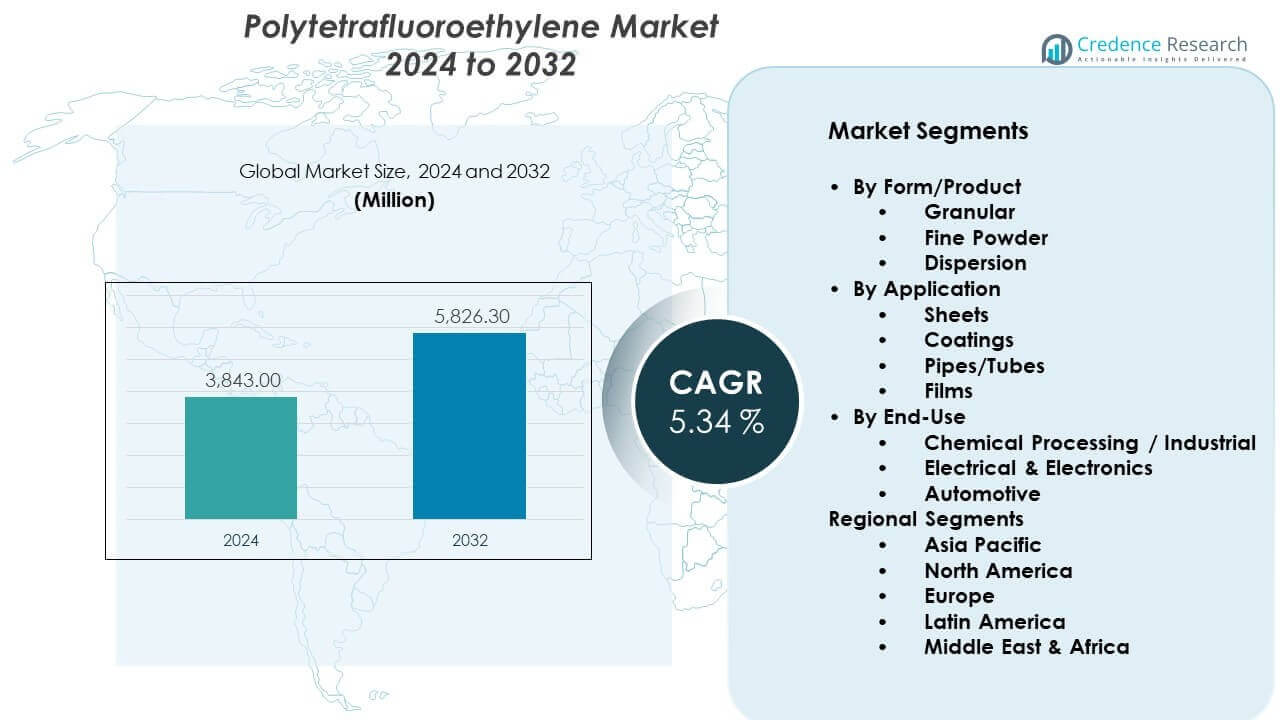
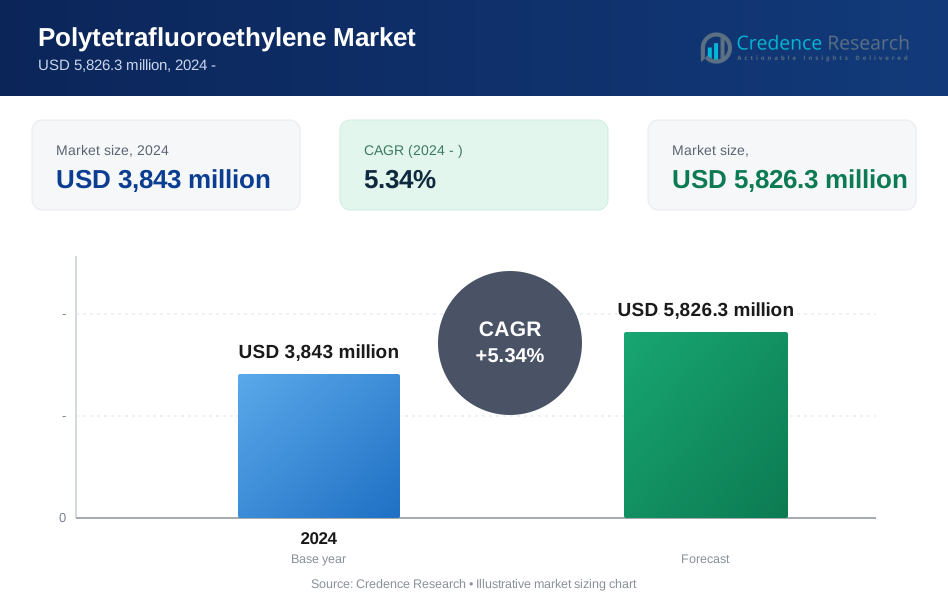
The Polytetrafluoroethylene market is projected to grow from USD 3,843 million in 2024 to USD 5,826.3 million by 2032. The market is expected to expand at a CAGR of 5.34% from 2024 to 2032.
| REPORT ATTRIBUTE | DETAILS |
|---|---|
| Historical Period | 2020-2023 |
| Base Year | 2024 |
| Forecast Period | 2025-2032 |
| Polytetrafluoroethylene Market Size 2024 | USD 3,843 million |
| Polytetrafluoroethylene Market, CAGR | 5.34% |
| Polytetrafluoroethylene Market Size 2032 | USD 5,826.3 million |
The Polytetrafluoroethylene market grows due to rising use in high-temperature and corrosive environments. Chemical processing plants rely on PTFE linings, seals, and gaskets for safety and durability. Electronics makers use PTFE in wires and cables for insulation stability. Automotive producers adopt PTFE coatings to reduce wear and friction. Medical device demand also supports growth through tubing and implant components. Strong replacement demand and strict performance standards sustain long-term adoption across industries.
Asia Pacific leads the Polytetrafluoroethylene market due to strong manufacturing activity and chemical production capacity. China dominates regional demand through fluoropolymer output and electronics manufacturing. Japan and South Korea support growth through advanced electronics and automotive engineering. North America remains a key market driven by aerospace, medical devices, and industrial upgrades. Europe shows stable demand from chemical processing and renewable energy equipment. Emerging regions gain traction as infrastructure and industrial investments expand.
Market Insights:
- The Polytetrafluoroethylene market reached USD 3,843 million in 2024 and is projected to reach USD 5,826.3 million by 2032, growing at a CAGR of 5.34% due to steady industrial and electronics demand.
- Asia Pacific (45%), North America (25%), and Europe (20%) dominate the market, supported by strong manufacturing bases, advanced electronics production, and mature chemical processing industries.
- Asia Pacific is also the fastest-growing region, driven by capacity expansion in China and India, rising electronics output, and cost-efficient fluoropolymer manufacturing ecosystems.
- By end-use, Chemical Processing / Industrial applications account for nearly 40% share, supported by demand for corrosion-resistant linings, seals, and gaskets in harsh operating environments.
- By form and application, Granular and Fine Powder PTFE together hold about 55% share, while Sheets and Coatings contribute nearly 45%, reflecting wide use in insulation, surface protection, and industrial components.
Market Drivers:
Rising Demand From High-Performance Industrial Applications
The Polytetrafluoroethylene market benefits from strong demand in harsh industrial environments. Chemical plants rely on PTFE for corrosion resistance and long service life. Refineries prefer PTFE seals for stable performance under pressure. Power generation facilities use PTFE insulation for thermal stability. Industrial users value low friction in moving components. Manufacturers prioritize materials that reduce maintenance downtime. PTFE meets strict safety and reliability standards. This demand supports steady industrial consumption.
- For instance, The Chemours Company reports that its Teflon™ PTFE grades operate continuously above 260 °C and resist over 95% of industrial chemicals.
Expansion Of Electrical And Electronics Manufacturing Base
Electronics production drives consistent PTFE material use across global markets. Wire and cable insulation requires high dielectric strength and thermal stability. PTFE supports miniaturized and high-frequency electronic designs. Semiconductor equipment depends on clean and stable polymer components. Consumer electronics demand reliable heat-resistant materials. Electrical safety norms favor fluoropolymer adoption. The Polytetrafluoroethylene market gains from ongoing technology upgrades. This sector ensures recurring volume demand.
- For instance, Daikin Industries supplies PTFE grades with dielectric constants near 2.1 and volume resistivity above 10¹⁸ ohm·cm, meeting advanced electronics needs.
Growing Adoption In Automotive And Transportation Systems
Automotive systems require durable and lightweight materials for efficiency. PTFE coatings reduce friction in engine and brake components. Fuel systems rely on chemical-resistant PTFE parts. Electric vehicles increase demand for thermal insulation solutions. Automakers focus on efficiency and component longevity. PTFE supports noise and vibration control needs. Global vehicle production sustains material demand. Transportation diversification strengthens market stability.
Increasing Use In Medical And Pharmaceutical Equipment
Healthcare sectors demand inert and biocompatible materials for safety. PTFE supports tubing, catheters, and implant components. Sterilization processes require polymers with high heat resistance. Pharmaceutical plants prefer contamination-free contact surfaces. Regulatory standards favor proven polymer performance. Medical device makers seek long material lifecycles. The Polytetrafluoroethylene market aligns with healthcare growth. This application ensures premium-grade demand.
Market Trends:
Shift Toward High-Purity And Specialty PTFE Grades
Manufacturers focus on refined PTFE material grades for critical uses. High-purity variants meet sensitive electronics requirements. Specialty grades support aerospace and medical precision needs. Producers invest in controlled processing techniques. Customers demand consistent molecular performance. Quality differentiation strengthens supplier positioning. The Polytetrafluoroethylene market evolves toward specialization. This trend improves margin potential.
- For instance, AGC Chemicals produces high-purity PTFE with metal impurities controlled below single-digit ppm levels for semiconductor processes.
Rising Focus On Lightweight And Design Flexibility
Industries prefer lighter materials with strong mechanical properties. PTFE supports compact and complex component designs. Engineers favor polymers that ease assembly processes. Design flexibility improves overall product performance. PTFE replaces heavier metal parts in select applications. Material substitution supports efficiency goals. The Polytetrafluoroethylene market adapts to modern designs. Innovation shapes long-term material adoption.
- For instance, Saint-Gobain uses PTFE components to replace metal parts, cutting component weight by over 40% in selected industrial assemblies.
Growing Preference For Long-Life And Low-Maintenance Materials
End users seek materials with extended service cycles. PTFE reduces wear in high-motion applications. Low friction limits frequent component replacement. Maintenance cost control influences purchasing decisions. Industrial operators value predictable material behavior. PTFE delivers stable performance over time. The Polytetrafluoroethylene market aligns with lifecycle value. Durability becomes a key selection factor.
Advancement In Processing And Fabrication Techniques
Producers improve molding and extrusion capabilities to meet demand. Advanced processing enhances product consistency. Fabrication supports tighter dimensional tolerances. Custom PTFE components gain wider acceptance. Manufacturers expand value-added product offerings. Processing efficiency supports cost optimization. The Polytetrafluoroethylene market benefits from technical progress. Manufacturing innovation sustains competitiveness.
Market Challenges Analysis:
High Production Costs And Complex Manufacturing Processes
PTFE production requires specialized equipment and technical expertise. Raw material sourcing involves fluorine-based inputs. Energy-intensive processes increase operational costs. Manufacturing complexity limits rapid capacity expansion. Cost pressure affects price-sensitive end users. Small producers face high entry barriers. The Polytetrafluoroethylene market faces margin sensitivity. Cost control remains a critical challenge.
Environmental And Regulatory Pressure On Fluoropolymers
Regulatory scrutiny affects fluoropolymer production worldwide. Environmental rules increase compliance requirements. Waste handling and emissions control raise operating costs. Policy uncertainty affects long-term investment plans. Public concerns influence material selection decisions. Producers invest in cleaner production methods. The Polytetrafluoroethylene market navigates evolving regulations. Compliance shapes future growth strategies.
Market Opportunities:
Expansion In Electric Vehicles And Renewable Energy Systems
Electric mobility creates demand for advanced thermal insulation. PTFE supports battery systems and power electronics. Renewable energy equipment requires durable polymer components. Wind and solar installations demand weather-resistant materials. Energy transition supports advanced material demand. PTFE meets performance expectations in clean energy systems. The Polytetrafluoroethylene market aligns with energy shifts. This opportunity supports future volume growth.
Growth In Advanced Medical Devices And High-End Electronics
Medical innovation increases demand for precision polymer materials. PTFE suits minimally invasive device designs. High-end electronics require stable insulation solutions. Wearable and implantable devices support polymer use. Manufacturers seek trusted material performance. Product miniaturization favors fluoropolymers. The Polytetrafluoroethylene market benefits from innovation. Technology advancement opens new application areas.
Market Segmentation Analysis:
By Form / Product
Granular PTFE holds strong demand due to ease of processing and consistent performance. Manufacturers use granular grades in molding and extrusion for industrial components. Fine powder serves applications that need thin walls and precise shapes. Producers favor fine powder for paste extrusion and specialty parts. Dispersion grades support coating and film production. These grades enable uniform surface coverage and controlled thickness. The Polytetrafluoroethylene market benefits from balanced demand across all product forms. Each form supports distinct processing and performance needs.
- For instance, Gujarat Fluorochemicals reports fine powder PTFE grades enabling wall thickness below 0.5 mm in tubing applications.
By Application
Sheets represent a core application due to use in linings and insulation. Industrial users select PTFE sheets for chemical resistance and durability. Coatings gain traction for friction reduction and surface protection. Pipes and tubes serve fluid handling in corrosive environments. Chemical plants rely on PTFE tubing for safety and purity. Films support electrical insulation and flexible components. Application diversity strengthens demand stability. Performance reliability drives long-term adoption.
By End-Use
Chemical processing remains the largest end-use segment. PTFE supports seals, gaskets, and linings in aggressive conditions. Electrical and electronics demand centers on insulation and dielectric stability. High-frequency systems rely on consistent polymer behavior. Automotive use focuses on friction control and heat resistance. Fuel and brake systems favor PTFE components. The Polytetrafluoroethylene market aligns with industrial and technology-driven sectors. End-use diversity supports steady consumption.
Segmentation:
By Form/Product- Granular
- Fine Powder
- Dispersion
- Sheets
- Coatings
- Pipes/Tubes
- Films
- Chemical Processing / Industrial
- Electrical & Electronics
- Automotive
Regional Segments
- North America
- U.S.
- Canada
- Mexico
- Europe
- Germany
- France
- U.K.
- Italy
- Spain
- Rest of Europe
- Asia Pacific
- China
- Japan
- India
- South Korea
- South-east Asia
- Rest of Asia Pacific
- Latin America
- Brazil
- Argentina
- Rest of Latin America
- Middle East & Africa
- GCC Countries
- South Africa
- Rest of the Middle East and Africa
Regional Analysis:
Asia Pacific
Asia Pacific holds the largest share of the global market at around 45%. China leads regional demand due to strong fluorochemical production and broad industrial use. Japan supports growth through electronics, automotive, and precision manufacturing sectors. South Korea contributes through semiconductor and electrical insulation demand. India shows rising consumption from chemical processing and infrastructure expansion. Local production capacity supports supply security. The Polytetrafluoroethylene market benefits from cost-efficient manufacturing and high-volume end-use demand in this region.
North America And Europe
North America accounts for nearly 25% of global demand, supported by aerospace, medical devices, and advanced manufacturing. The United States drives consumption through high-performance industrial and healthcare applications. Europe represents about 20% of the market, led by Germany, France, and the UK. Chemical processing and automotive manufacturing anchor regional demand. Strict quality standards favor premium PTFE grades. Research-driven industries sustain stable consumption. The Polytetrafluoroethylene market remains well supported by mature industrial ecosystems in these regions.
Latin America And Middle East & Africa
Latin America holds close to 6% of global market share, led by Brazil and Mexico. Industrial expansion and chemical processing projects support demand growth. Middle East & Africa accounts for around 4% of consumption. Oil and gas operations rely on PTFE for corrosion resistance. Infrastructure development supports steady material adoption. Import dependence remains high across these regions. The Polytetrafluoroethylene market gains gradual traction through industrial diversification and capacity upgrades.
Key Player Analysis:
- The Chemours Company
- Daikin Industries, Ltd.
- AGC Inc.
- Gujarat Fluorochemicals Limited
- 3M Company
- Dongyue Group
Competitive Analysis:
The Polytetrafluoroethylene market features a moderately consolidated competitive structure with global and regional producers. Leading companies focus on scale, product consistency, and application-specific grades. Strong control over fluorochemical supply chains supports cost stability. Producers invest in process optimization to improve purity and performance. Product portfolios cover granular, fine powder, and dispersion forms. End-use alignment with chemical, electronics, and automotive sectors shapes competition. Strategic capacity expansion strengthens regional presence. The Polytetrafluoroethylene market remains driven by technical capability and long-term customer contracts.
Recent Developments:
- In November 2025 (announced December 10, 2025), AGC achieved a world-first milestone by completing third-party verification under the UL 2809 standard for its Fluon® PTFE G grade manufactured using recycled fluorite as the primary raw material. UL 2809 verification, based on ISO 14021 protocols, certifies self-declared percentages of recycled content in products through standardized third-party validation procedures. This represents the first instance globally where a fluoropolymer PTFE resin has achieved such verification, with the Fluon® PTFE G grade—widely utilized in semiconductor manufacturing—being the inaugural product in AGC's portfolio to attain this certification. The achievement underscores AGC's commitment to advancing a circular economy for fluorine resources; the company has successfully improved the quality of recycled fluorite recovered from manufacturing waste using proprietary purification technologies and now incorporates this recycled material into commercial products. AGC plans to expand UL 2809 verification to other fluoropolymer products in its portfolio and is exploring initiatives to reuse recycled fluorite from waste materials generated at other manufacturers' facilities, aligning with its medium-term management plan, AGC plus-2026
- On July 18, 2025, AGC Inc. announced the commercial launch of innovative surfactant-free and fluorinated polymerization solvent-free grades within its AFLAS™ FFKM fluoroelastomer series. These new products, manufactured using AGC's proprietary Surfactant-Free & Fluoro Solvent-Free Technology, deliver high-performance equivalent to conventional fluoroelastomers while addressing the semiconductor industry's growing demand for manufacturing processes that eliminate surfactants and fluorinated polymerization solvents. Historically, these chemical additives were considered essential for enhancing fluorinated monomer reactivity and manufacturing efficiency; however, achieving high-performance standards without them represented a significant technical challenge that AGC successfully overcame. The new SF (surfactant-free) grades, initially available for high-temperature-resistant FFKM variants designed for semiconductor manufacturing equipment, are entering commercial availability immediately, with progressive expansion to other FFKM types planned as part of the ongoing development roadmap. The AFLAS™ FFKM series is recognized as an industrial elastomer offering exceptional resistance to chemicals, heat, and plasma, making it an indispensable sealing and etching material in semiconductor fabrication where its plasma resistance properties significantly extend maintenance intervals and enhance operational safety.
- In May 2025, The Chemours Company announced a strategic manufacturing agreement with Navin Fluorine International Limited, an Indian fluorochemicals producer, to manufacture its proprietary Opteon™ two-phase immersion cooling fluid. This partnership represents a critical milestone in Chemours' expanded Liquid Cooling Venture, which leverages over 90 years of thermal management expertise to address the cooling demands of next-generation data centers and AI hardware. The Opteon™ fluid, a hydrofluoroolefin-based dielectric solution, offers exceptional performance characteristics including an ultra-low global warming potential (GWP) of just 10 and a power usage effectiveness (PUE) approaching 1. Compared to conventional cooling systems, it nearly eliminates water usage, reduces space requirements by 60%, and decreases energy consumption by up to 40%, while cutting cooling energy use by up to 90%. Commercialization of the Opteon™ two-phase immersion cooling fluid through Navin Fluorine's manufacturing facilities is scheduled to begin in 2026, with production sites located in Surat, Dahej (both in Western India), and Dewas (Central India).
Report Coverage:
The research report offers an in-depth analysis based on By Form/Product, By Application, and By End-Use segments. It details leading market players, providing an overview of their business, product offerings, investments, revenue streams, and key applications. Additionally, the report includes insights into the competitive environment, SWOT analysis, current market trends, as well as the primary drivers and constraints. Furthermore, it discusses various factors that have driven market expansion in recent years. The report also explores market dynamics, regulatory scenarios, and technological advancements that are shaping the industry. It assesses the impact of external factors and global economic changes on market growth. Lastly, it provides strategic recommendations for new entrants and established companies to navigate the complexities of the market.
Future Outlook:
- Industrial demand will continue to anchor long-term growth across chemical and manufacturing sectors.
- Electronics production will increase the use of high-purity and specialty PTFE grades.
- Electric vehicle expansion will raise demand for thermal and electrical insulation materials.
- Medical device innovation will support steady uptake of biocompatible PTFE components.
- Producers will focus on process efficiency to manage cost and quality requirements.
- Sustainability pressure will encourage cleaner and compliant fluoropolymer production methods.
- Asia Pacific will strengthen its position through capacity expansion and export growth.
- Custom-engineered PTFE solutions will gain preference across high-performance applications.
- Long-term supply agreements will improve demand visibility for major producers.
- Technological advancement will enhance product reliability and application scope.
Request a Free Sample
Fill in your details and we'll send you a free sample report.
- Sample data tables & charts
- Research methodology
Need a Custom Version of This Report?
Tailor the scope, geography, or segments to your exact requirements.
- Custom geography or segment scope
- Direct access to our analyst team
Frequently Asked Questions
What is the current market size for Polytetrafluoroethylene market, and what is its projected size in 2032?
At what Compound Annual Growth Rate is the Polytetrafluoroethylene market projected to grow between 2025 and 2032?
Which Polytetrafluoroethylene market segment held the largest share in 2024?
What are the primary factors fueling the growth of the Polytetrafluoroethylene market?
Who are the leading companies in the Polytetrafluoroethylene market?
Which region commanded the largest share of the Polytetrafluoroethylene market in 2024?
Table of Content
Chapter 1. Report Introduction
- 1.1 Report Description & Purpose
- 1.1.1 Report Title & Market Definition
- 1.1.2 Unique Selling Propositions (USP) & Key Differentiators
- 1.1.3 Value Proposition for Stakeholders
- 1.2 Research Objectives
- 1.2.1 Market Sizing Objectives (Volume & Revenue)
- 1.2.2 Segmentation Objectives
- 1.2.3 Competitive Intelligence Objectives
- 1.2.4 Forecast & Scenario Objectives
- 1.3 Report Scope
- 1.3.1 Polytetrafluoroethylene Scope – Types & Subtypes Covered
- 1.3.2 Geographic Scope – Regions & Countries Covered
- 1.3.3 Historical Period, Base Year & Forecast Period (2024; forecast to the forecast period)
- 1.3.4 Inclusions & Exclusions
- 1.4 HS Code & Classification Framework
- 1.5 Currency, Units & Pricing Basis
- 1.6 Target Stakeholders
- 1.7 Limitations & Assumptions
Chapter 2. Executive Summary
- 2.1 Global Polytetrafluoroethylene Market Snapshot
- 2.1.1 Market Size – Historical (2024) & Forecast (the forecast period) (2024: USD 3,843 million → forecast year: USD 5,826.3 million)
- 2.1.2 Volume & Revenue – Global Totals
- 2.1.3 Key Market Highlights – Top Five Facts
- 2.2 Polytetrafluoroethylene Market Segmentation Snapshot
- 2.2.1 Market Split by Region – 2024 vs.
- 2.3 Competitive Snapshot
- 2.3.1 Top 10 Players by Revenue Share – 2024
- 2.3.2 Top 10 Players by Volume Share – 2024
- 2.3.3 Recent Strategic Developments (18-Month Summary)
- 2.4 Key Investment Highlights & Strategic Conclusions
Chapter 3. Polytetrafluoroethylene Market Dynamics & Industry Analysis
- 3.1 Market Overview & Context
- 3.1.1 Polytetrafluoroethylene Market Position in the Broader Automotive Value Chain
- 3.1.2 OEM vs. Replacement Market Dynamics
- 3.1.3 Market Maturity & Development Stage by Region
- 3.2 Polytetrafluoroethylene Market Drivers
- 3.3 Polytetrafluoroethylene Market Restraints & Challenges
- 3.4 Polytetrafluoroethylene Market Opportunities
- 3.5 Porter's Five Forces Analysis
- 3.5.1 Threat of New Entrants
- 3.5.2 Bargaining Power of Suppliers
- 3.5.3 Bargaining Power of Buyers
- 3.5.4 Threat of Substitutes
- 3.5.5 Competitive Rivalry – Intensity Assessment
- 3.6 Polytetrafluoroethylene Value Chain Analysis
- 3.6.1 Upstream – Raw Material/Input Suppliers
- 3.6.1.1 Raw Material/Input 1
- 3.6.1.2 Raw Material/Input 2
- 3.6.1.3 Raw Material/Input 3
- 3.6.2 Midstream – Production/Manufacturing/Service Delivery
- 3.6.2.1 Production/Process Overview
- 3.6.2.2 Key Facility Locations & Capacity by Manufacturer
- 3.6.3 Downstream – Distribution & End Consumer
- 3.6.3.1 Primary Channel – B2B/OEM
- 3.6.3.2 Secondary Channels – Dealer, Retail, Online, Direct
- 3.6.4 Value Chain Profitability Analysis
- 3.6.1 Upstream – Raw Material/Input Suppliers
- 3.7 PESTEL Analysis
- 3.7.1 Political Factors
- 3.7.2 Economic Factors
- 3.7.3 Social Factors
- 3.7.4 Technological Factors
- 3.7.5 Environmental Factors
- 3.7.6 Legal Factors
- 3.8 Polytetrafluoroethylene Supply Chain Analysis
- 3.8.1 Raw Material/Input Supply Risk Assessment
- 3.8.2 Manufacturing Concentration Risk (Geographic Exposure)
- 3.8.3 Trade Disruption Impact Analysis
- 3.9 Regulatory & Policy Landscape
Note: The regulatory and policy landscape section covers regulations based on their applicability to the market, Polytetrafluoroethylene category, geography, and scope of the study. Only regulatory frameworks with a material impact on operations, compliance, trade, sustainability, or market access are analyzed in detail.
Chapter 4. Key Investment Pockets & Opportunity Analysis
- 4.1 Polytetrafluoroethylene Market Attractiveness Analysis
- 4.1.1 By Region – Investment Attractiveness Matrix (Volume × CAGR)
- 4.2 Absolute Revenue Growth Opportunity
- 4.2.1 By Region – Absolute USD Growth Through the forecast period
- 4.3 Incremental Volume Opportunity
- 4.3.1 By Region – Incremental Volume Through the forecast period
- 4.3.2 Segment – Incremental Volume
- 4.4 Emerging Submarket Opportunity Deep Dive (Subject to Applicability)
- 4.5 Emerging Market Opportunity Scorecards
- 4.5.1 United States
- 4.5.2 Europe
- 4.5.3 Asia
- 4.5.4 Middle East & Africa
Note: Emerging Market Opportunity Scorecards will be included based on relevance and strategic importance. Regions listed are indicative and may vary depending on data availability and market dynamics.
Chapter 5. Polytetrafluoroethylene Import-Export Analysis & Trade Flows
- 5.1 Global Trade Overview
- 5.1.1 Global Export Value by Country (2024)
- 5.1.2 Global Export Volume by Country (2024)
- 5.1.3 Global Import Value by Country (2024)
- 5.1.4 Global Import Volume by Country (2024)
- 5.1.5 Net Trade Balance by Country (2024)
- 5.2 Export Analysis – Segment
- 5.2.1 Type 1 (HS Code)
- 5.2.2 Type 2 (HS Code)
- 5.2.3 Type 3 (HS Code)
- 5.2.4 Type 4 (HS Code)
- 5.2.5 Type 5 (HS Code)
- 5.3 Import Analysis – Segment
- 5.3.1 Type 1 (HS Code)
- 5.3.2 Type 2 (HS Code)
- 5.3.3 Type 3 (HS Code)
- 5.3.4 Type 4 (HS Code)
- 5.3.5 Type 5 (HS Code)
- 5.4 Average Unit Trade Prices
- 5.4.1 Average Export Price – Segment & Country
- 5.4.2 Average Import Price – Segment & Source Country
- 5.4.3 Price Trends (2024)
- 5.5 Key Trade Route Analysis
- 5.5.1 Trade Route 1
- 5.5.2 Trade Route 2
- 5.5.3 Trade Route 3
- 5.5.4 Trade Route 4
- 5.5.5 Trade Route 5
- 5.6 Trade Policy Impact Assessment
- 5.6.1 US Anti-Dumping & Section 301 Tariffs
- 5.6.2 EU Customs Union Impact
- 5.6.3 Major Free Trade Agreements
- 5.6.4 USMCA Rules of Origin
Note: Trade policy analysis will be included only where relevant to the Polytetrafluoroethylene market.
Chapter 6. Competitive Landscape & Company Benchmarking
- 6.1 Polytetrafluoroethylene Market Concentration & Structure
- 6.1.1 Herfindahl-Hirschman Index (HHI) – vs. 2024
- 6.1.2 Tier 1, Tier 2 & Tier 3 Market Structure
- 6.1.3 Global, Regional & Local Player Dynamics
- 6.2 Polytetrafluoroethylene Market Share Analysis – 2024
- 6.2.1 Global Revenue Share by Company
- 6.2.2 Global Volume Share by Company
- 6.2.3 Regional Revenue Share
- 6.2.4 Market Share Evolution ( vs. 2024)
- 6.2.5 OEM Segment Share by Company
- 6.2.6 Replacement Segment Share by Company
- 6.3 Production/Delivery Capacity & Facility Analysis
- 6.3.1 Global Installed Capacity
- 6.3.2 Capacity Utilization Rates
- 6.3.3 Production/Output Volume
- 6.3.4 Facility Locations & Capacity Map
- 6.3.5 Planned Capacity Additions
- 6.4 Polytetrafluoroethylene Competitive Benchmarking Matrix
- 6.4.1 Revenue, Volume, CAGR & Profitability Comparison
- 6.4.2 Channel Revenue Mix
- 6.4.3 Geographic Revenue Exposure
- 6.4.4 R&D Intensity
- 6.4.5 Sustainability Maturity
- 6.5 Strategic Developments in Polytetrafluoroethylene (Last 24 Months)
- 6.5.1 Mergers, Acquisitions & Divestments
- 6.5.2 New Polytetrafluoroethylene Launches
- 6.5.3 Facility Expansions
- 6.5.4 Strategic Alliances, Joint Ventures & Partnerships
- 6.5.5 Distribution Expansion & Market Entry
- 6.5.6 Sustainability & ESG Initiatives
- 6.6 Competitive Strategy Mapping
- 6.6.1 Leader, Challenger, Follower & Niche Classification
- 6.6.2 Pricing Strategy Comparison
- 6.6.3 Channel Strategy Matrix
Note: Strategic developments are included based on their materiality and the availability of reliable information.
Chapter 7. Global Polytetrafluoroethylene Market – By Distribution Channel
- 7.1 Segment Overview
- 7.1.1 Volume & Revenue Split by Channel (2024 & )
- 7.1.2 Channel Mix Evolution (the forecast period)
Chapter 8. Regional Market Analysis – Global Overview
- 8.1 Global Regional Overview
- 8.1.1 Regional Volume Share
- 8.1.2 Regional Revenue Share
- 8.1.3 Regional Volume by Region
- 8.1.4 Regional Revenue by Region
- 8.1.5 Regional Forecast Through the forecast period
- 8.2 Cross-Regional Segment Analysis
- 8.2.1 By Distribution Channel
- 8.2.2 By Brand/Price Tier
Chapter 9. North America Polytetrafluoroethylene Market
- 9.1 United States
- 9.2 Canada
- 9.3 Mexico
Chapter 10. Europe Polytetrafluoroethylene Market
- 10.1 Germany
- 10.2 France
- 10.3 Italy
- 10.4 United Kingdom
- 10.5 Spain
- 10.6 Poland
- 10.7 Russia
- 10.8 Netherlands
- 10.9 Belgium
- 10.10 Sweden
- 10.11 Denmark
- 10.12 Norway
- 10.13 Rest of Europe
Chapter 11. Asia Pacific Polytetrafluoroethylene Market
- 11.1 China
- 11.2 India
- 11.3 Japan
- 11.4 South Korea
- 11.5 Thailand
- 11.6 Indonesia
- 11.7 Vietnam
- 11.8 Malaysia
- 11.9 Australia
- 11.10 Rest of Asia Pacific
Chapter 12. Latin America Polytetrafluoroethylene Market
- 12.1 Brazil
- 12.2 Argentina
- 12.3 Colombia
- 12.4 Chile
- 12.5 Rest of Latin America
Chapter 13. Middle East Polytetrafluoroethylene Market
- 13.1 Saudi Arabia
- 13.2 United Arab Emirates
- 13.3 Turkey
- 13.4 Israel
- 13.5 Iran
- 13.6 Rest of the Middle East
Chapter 14. Africa Polytetrafluoroethylene Market
- 14.1 South Africa
- 14.2 Egypt
- 14.3 Nigeria
- 14.4 Morocco
- 14.5 Rest of Africa
Chapter 15. Polytetrafluoroethylene Company Profiles
- 15.1 [Company 01]
- 15.1.1 Company Overview
- 15.1.2 Key Management Personnel
- 15.1.3 Products & Services Portfolio
- 15.1.4 Financial Performance
- 15.1.5 Key Market Focus & Geographic Presence
- 15.1.6 Recent Developments & Strategic Initiatives
Note: The company profile list is preliminary and may change based on research findings, market developments, data availability, and client requirements.
Chapter 16. Appendices
- Appendix A – List of Abbreviations & Acronyms
- Appendix B – Industry Classification Code Reference – Full Series
- Appendix C – Production & Capacity Data Tables
- Appendix D – End-Use & Demand Base Tables
- Appendix E – Consumption & Replacement Rate Assumptions
- Appendix F – ASP Reference Tables
- Appendix G – Manufacturing & Facility Database
- Appendix H – Import-Export Data Tables
- Appendix I – Regulatory Summary Tables
- Appendix J – Primary Research Participant List (Anonymized)
- Appendix K – Primary Research Questionnaire Framework
- Appendix L – Data Sources & Bibliography
- Appendix M – Market Size Divergence & Source Comparison
Chapter 17. Research Methodology
- 17.1 Research Framework & Philosophy
- 17.2 Secondary Research – Sources, Hierarchy & Data Extraction
- 17.3 Data Modeling – Bottom-Up & Top-Down Market Sizing
- 17.4 Primary Research – Stakeholder Framework, LOI & Sample Sizes
- 17.5 Forecast Methodology – Regression, Scenario & Sensitivity Analysis
- 17.6 Quality Control – Four-Layer Validation Framework
- 17.7 Limitations & Standard Assumptions
- 17.8 Disclaimer
