
Market Overview:
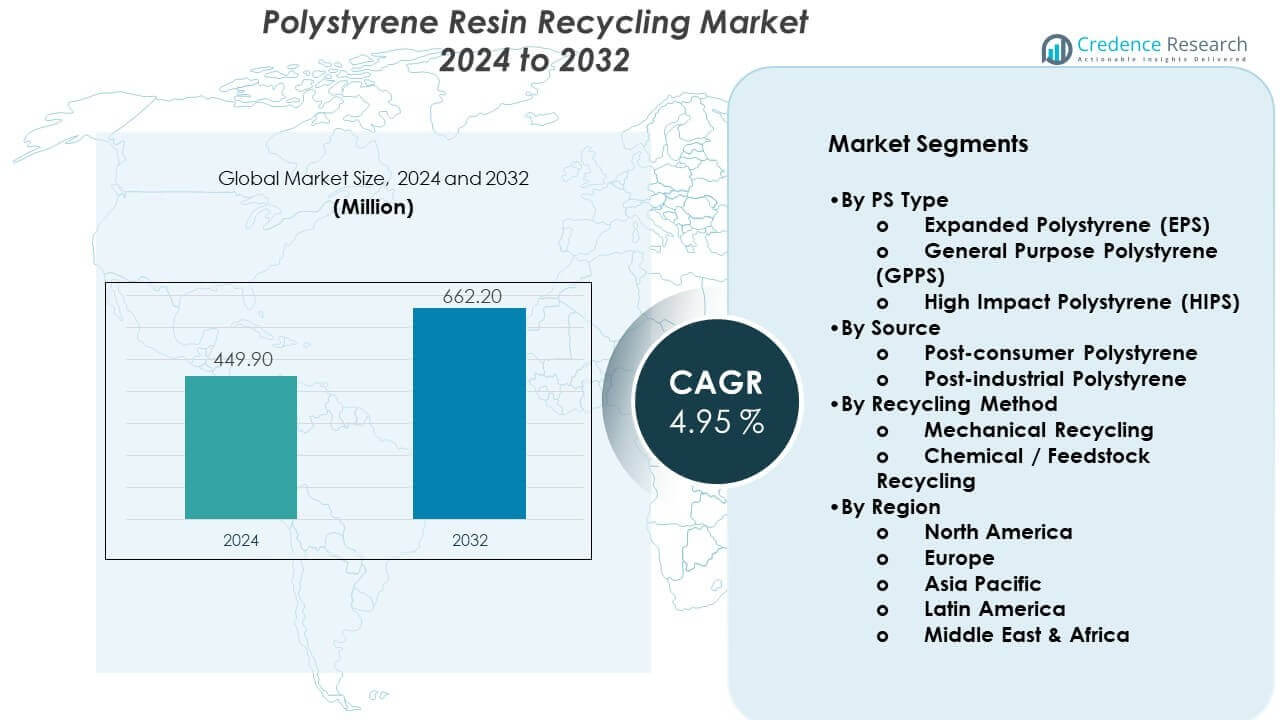
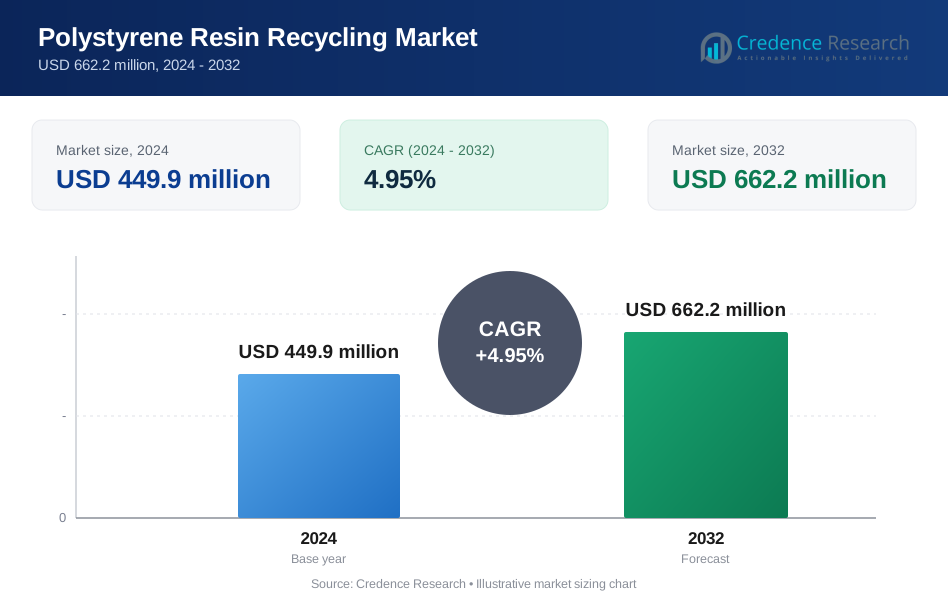
The Polystyrene resin recycling market is projected to grow from USD 449.9 million in 2024 to an estimated USD 662.2 million by 2032, with a compound annual growth rate of 4.95% during the forecast period.
| REPORT ATTRIBUTE | DETAILS |
|---|---|
| Historical Period | 2020-2023 |
| Base Year | 2024 |
| Forecast Period | 2025-2032 |
| Polystyrene Resin Recycling Market Size 2024 | USD 449.9 million |
| Polystyrene Resin Recycling Market, CAGR | 4.95% |
| Polystyrene Resin Recycling Market Size 2032 | USD 662.2 million |
Market growth is driven by rising environmental rules targeting single-use plastics and landfill waste. Brand owners increase recycled content use to meet sustainability pledges. Food service and packaging sectors adopt recycled polystyrene to cut virgin resin use. Improved mechanical recycling raises material quality and end-use acceptance. Chemical recycling expands feedstock recovery from contaminated waste. Cost pressure from virgin resin price swings supports recycling demand. Public awareness also lifts collection and recycling rates.
North America leads due to strong recycling systems and strict waste policies. Europe follows with extended producer responsibility programs and recycling mandates. Countries like Germany and France support advanced recycling investments. Asia Pacific emerges as a high-growth region due to rising plastic consumption. Japan and South Korea adopt efficient recycling technologies. China improves waste sorting infrastructure. Developing economies expand capacity as urban waste volumes increase.
Market Insights:
- The Polystyrene resin recycling market was valued at USD 449.9 million in 2024 and is projected to reach USD 662.2 million by 2032, growing at a CAGR of 4.95% during the forecast period.
- Asia Pacific (38%), Europe (30%), and North America (24%) dominate due to high waste volumes, strict regulations, and mature recycling infrastructure.
- Asia Pacific is the fastest-growing region with a 38% share, driven by policy support, urban waste growth, and capacity expansion in China and Japan.
- By PS type, Expanded Polystyrene (EPS) holds about 55% share due to heavy use in packaging and food service applications.
- By recycling method, mechanical recycling accounts for nearly 65% share, supported by lower costs and established processing systems.
Market Drivers:
Rising Regulatory Pressure On Plastic Waste Reduction And Circular Economy Adoption
The Polystyrene resin recycling market benefits from strict waste control laws worldwide. Governments restrict landfill disposal of foam plastics. Recycling targets push industries toward circular material use. Compliance needs increase demand for recycled polystyrene. Municipal programs expand collection systems for post-consumer waste. Policy support improves recycling economics. Producers adapt operations to meet regulatory benchmarks. This shift strengthens long-term market stability.
- For instance, Veolia operates polystyrene recycling facilities in Europe capable of processing over 50,000 tonnes of EPS waste annually, supporting compliance with EU landfill diversion directives.
Growing Brand Commitments Toward Sustainable Packaging And Materials
Consumer brands commit to lower plastic footprints. Packaging teams seek recycled resin to meet public goals. The Polystyrene resin recycling market gains from corporate sustainability plans. Retailers demand proof of recycled content use. Food service firms redesign packaging for recyclability. Supplier audits favor recycled material sourcing. Brand pressure influences upstream resin choices. This behavior supports steady recycling demand.
- For instance, Trinseo supplies recycled polystyrene (rPS) grades for food service and consumer packaging featuring 30% recycled content, validated via ISCC PLUS certification and compliant with EU 2022/1616 food safety standards.
Cost Volatility Of Virgin Polystyrene Resin Supporting Recycling Economics
Virgin resin prices face energy and feedstock risks. Buyers seek cost control through recycled alternatives. The Polystyrene resin recycling market offers price stability benefits. Recycled resin reduces exposure to oil price swings. Long-term supply contracts favor recycled inputs. Cost planning improves for packaging converters. Procurement teams view recycling as a hedge. This factor improves market attractiveness.
Advancements In Sorting And Recycling Process Efficiency
Recycling systems improve output quality and yield. Optical sorting raises material purity levels. The Polystyrene resin recycling market benefits from better recovery rates. Process upgrades reduce contamination losses. Higher quality resin enters broader applications. Equipment innovation lowers operating costs. Facilities scale faster with reliable output. Technology progress supports market expansion.
Market Trends:
Shift Toward High-Quality Recycled Polystyrene For Value Applications
End users demand better recycled resin performance. The Polystyrene resin recycling market aligns with this quality focus. Recyclers target food-grade and durable uses. Material consistency gains priority. Process control receives higher investment. Buyers accept recycled resin in premium products. Quality benchmarks tighten across supply chains. This trend reshapes product positioning.
- For instance, BASF demonstrated recycled polystyrene suitability for consumer goods by producing certified materials that meet EU food-contact migration limits below 10 mg/dm² under controlled recycling conditions.
Growing Adoption Of Chemical Recycling For Complex Waste Streams
Mechanical recycling faces feedstock limits. Chemical methods address contaminated polystyrene waste. The Polystyrene resin recycling market adopts depolymerization routes. Output matches virgin resin properties. Technology pilots move toward commercial scale. Industry partnerships accelerate adoption. Chemical routes widen usable waste pools. This trend expands long-term capacity.
- For instance, Agilyx operates a commercial polystyrene depolymerization facility in Oregon with capacity to process 10 tonnes of post-consumer PS per day, converting waste into purified styrene oil.
Integration Of Recycling Operations With Downstream Manufacturing
Manufacturers integrate recycling into production lines. The Polystyrene resin recycling market supports closed-loop systems. In-house recycling cuts logistics costs. Supply security improves for converters. Production planning aligns with recycled feedstock availability. Vertical integration improves margin control. Firms gain traceability advantages. This structure becomes more common.
Increased Focus On Traceability And Certification Standards
Buyers demand proof of recycled content claims. The Polystyrene resin recycling market responds with certification adoption. Traceability systems track waste sources. Audits ensure material integrity. Compliance builds buyer trust. Digital tools support documentation. Certified products gain preference. Transparency becomes a market norm.
Market Challenges Analysis:
Feedstock Collection Limitations And Contamination Issues Across Regions
Polystyrene waste collection remains uneven. Lightweight foam complicates transport economics. The Polystyrene resin recycling market faces feedstock shortages. Contamination lowers recycling efficiency. Food residue affects material quality. Sorting infrastructure varies by region. Recovery rates remain inconsistent. These issues constrain supply reliability.
Economic And Technical Barriers In Scaling Advanced Recycling Facilities
Capital needs remain high for new plants. Technology risks deter smaller players. The Polystyrene resin recycling market faces scale-up hurdles. Energy use impacts operating costs. Process stability needs skilled labor. Regulatory approvals delay projects. Financing access varies by region. These barriers slow rapid expansion.
Market Opportunities:
Expansion Of Recycling Capacity In Emerging Urban And Industrial Regions
Urban waste volumes rise sharply in developing regions. The Polystyrene resin recycling market can tap unmet recycling needs. Cities invest in modern waste systems. Industrial parks seek local recycled materials. Infrastructure funding improves collection coverage. Early entrants gain scale advantages. Regional demand supports new facilities. This expansion offers strong growth potential.
Development Of Closed-Loop Partnerships With Packaging And Food Service Firms
Brands seek stable recycled resin supply. The Polystyrene resin recycling market supports long-term partnerships. Closed-loop models secure feedstock access. Offtake agreements reduce market risk. Joint investment lowers capital burden. Product design aligns with recyclability goals. Collaboration improves material recovery rates. These partnerships unlock durable opportunities.
Market Segmentation Analysis:
By PS Type
Expanded Polystyrene leads due to wide use in packaging and food service products. Collection volumes remain high across retail and logistics channels. The Polystyrene resin recycling market benefits from EPS densification and improved handling systems. General Purpose Polystyrene supports demand from consumer goods and electronics housings. Recycling streams for GPPS stay cleaner and easier to process. High Impact Polystyrene serves appliances and automotive uses. HIPS recycling depends on consistent industrial waste supply. Material performance needs guide end-use adoption.
- For instance, INEOS Styrolution operates EPS recycling programs capable of compacting EPS waste at up to 50:1 volume reduction, improving collection economics.
By Source
Post-consumer Polystyrene drives volume growth due to rising packaging disposal. Municipal collection programs expand recovery rates. The Polystyrene resin recycling market relies on sorting quality to control contamination. Post-industrial Polystyrene offers stable and cleaner feedstock. Manufacturers recycle production scrap internally. Supply predictability improves operational planning. Quality consistency supports higher-value applications. Source mix shapes cost and output quality.
- For instance, MBA Polymers recovers over 30,000 tonnes of post-consumer mixed plastics per year, using automated optical sorting systems that achieve polymer purity levels above 95%.
By Recycling Method
Mechanical Recycling holds a strong share due to lower cost and proven processes. It suits clean and sorted waste streams. The Polystyrene resin recycling market uses this method for packaging and insulation reuse. Chemical and feedstock recycling address mixed or contaminated waste. Output quality matches virgin resin standards. Capital needs remain higher for chemical routes. Scale-up attracts strategic partnerships. Method choice depends on waste quality and end-use needs.
Segmentation:
- By PS Type
- Expanded Polystyrene (EPS)
- General Purpose Polystyrene (GPPS)
- High Impact Polystyrene (HIPS)
- By Source
- Post-consumer Polystyrene
- Post-industrial Polystyrene
- By Recycling Method
- Mechanical Recycling
- Chemical / Feedstock Recycling
- By Region
- North America
- U.S.
- Canada
- Mexico
- Europe
- Germany
- France
- U.K.
- Italy
- Spain
- Rest of Europe
- Asia Pacific
- China
- Japan
- India
- South Korea
- South-east Asia
- Rest of Asia Pacific
- Latin America
- Brazil
- Argentina
- Rest of Latin America
- Middle East & Africa
- GCC Countries
- South Africa
- Rest of the Middle East and Africa
- North America
Regional Analysis:
Asia Pacific
Asia Pacific holds the largest share of the Polystyrene resin recycling market at around 38%. China leads due to scale, policy support, and expanding recycling capacity. Japan supports high-quality recycling through advanced sorting systems. South Korea invests in efficient mechanical and chemical recycling plants. Packaging and electronics waste volumes stay high across the region. Urban growth improves feedstock availability. Regional scale supports cost efficiency.
Europe And North America
Europe accounts for nearly 30% share, supported by strict waste rules and producer responsibility programs. Germany, France, and the Netherlands lead regional adoption. The Polystyrene resin recycling market benefits from strong collection systems in these countries. North America holds close to 24% share, led by the United States. Corporate sustainability targets support recycled resin use. Infrastructure favors mechanical recycling. Innovation activity remains strong.
Latin America And Middle East & Africa
Latin America represents about 5% share, with growth led by Brazil and Mexico. Collection systems expand slowly across major cities. The Polystyrene resin recycling market gains from rising packaging waste volumes. Middle East & Africa holds nearly 3% share. Recycling activity remains limited but improves in urban hubs. Policy focus on waste reduction increases interest. Early-stage investments support long-term potential.
Key Player Analysis:
- Agilyx
- Veolia
- SUEZ
- MBA Polymers
- Trinseo
- INEOS Styrolution
- BASF
Competitive Analysis:
The Polystyrene resin recycling market shows moderate consolidation, led by firms with advanced processing and global reach. Key players focus on mechanical and chemical recycling capabilities to secure diverse feedstock. Scale, technology depth, and collection access shape competitive strength. Companies invest in partnerships with packaging and waste firms. Product quality and consistency remain key differentiators. Cost control influences buyer preference across applications. Regional presence supports supply reliability. Competition centers on technology efficiency and long-term contracts.
Recent Developments:
- On October 15, 2025, Agilyx completed its acquisition of 44% of GreenDot Global, Europe's largest waste plastic recycling platform. The transaction, announced on July 17, 2025, involved Agilyx contributing EUR 7 million to a EUR 27 million investment round. Following closing and a capital increase in GreenDot, Agilyx owns approximately 44% of all issued shares in the platform. This transformative investment significantly strengthens Agilyx's presence in the European market and creates a global platform for sourcing and supplying feedstock to the advanced recycling industry. GreenDot was awarded a 10-year feedstock supply contract from a third-party advanced recycling facility, representing 20,000-34,000 tons per annum, and has entered into an agreement to purchase a mechanical recycling facility in Italy specializing in bottle-to-bottle recycling.
- On July 9, 2025, Veolia announced a £70 million investment to transform a disused industrial facility in Battlefield, Shropshire into a state-of-the-art plastics sorting and recycling facility. The facility represents the UK's first innovative "tray to tray" closed-loop PET 1 recycling facility and will process 80,000 tonnes of mixed plastics annually. Construction has begun with plans for operational status by early 2026. The initiative forms part of Veolia's broader commitment to the circular economy in the UK, with total investments set to reach around £1 billion by 2030. The announcement coincided with French President Emmanuel Macron's state visit to the UK and highlights Veolia's leadership in pioneer circular economy solutions.
- In March 2025, Agilyx ASA announced its participation in a new joint venture called Plastyx Ltd., based in Dublin. The venture partners include Luxembourg-based Circular Resources and plastics recycling executive Carlos Monreal, founder and former CEO of United Kingdom-based Plastic Energy. The newly formed Plastyx JV aims to be Europe's leading feedstock supplier to the advanced plastic recycling market, addressing a critical gap in the supply of consistent, high-quality feedstock for advanced recycling technologies. The company's objective is to source and execute memoranda of understanding for 200,000 metric tons of recyclable plastic by the end of 2025. By linking Cyclyx's feedstock management capabilities with Plastyx through Agilyx's shared ownership, the partnership launches a strategic initiative in the critical feedstock sourcing market segment.
Report Coverage:
The research report offers an in-depth analysis based on By PS Type and By Recycling Method segments. It details leading market players, providing an overview of their business, product offerings, investments, revenue streams, and key applications. Additionally, the report includes insights into the competitive environment, SWOT analysis, current market trends, as well as the primary drivers and constraints. Furthermore, it discusses various factors that have driven market expansion in recent years. The report also explores market dynamics, regulatory scenarios, and technological advancements that are shaping the industry. It assesses the impact of external factors and global economic changes on market growth. Lastly, it provides strategic recommendations for new entrants and established companies to navigate the complexities of the market.
Future Outlook:
- Recycling capacity will expand across major urban and industrial centers.
- Chemical recycling will gain wider adoption for mixed and contaminated polystyrene waste.
- Brand sustainability commitments will continue to support recycled resin demand.
- Closed-loop supply agreements will strengthen feedstock security for recyclers.
- Process automation will improve output quality and cost control.
- Regional regulations will guide investment and technology choices.
- Partnerships between recyclers and packaging firms will increase.
- End-use applications will expand beyond packaging into durable goods.
- Traceability and certification will influence supplier selection.
- Market entry barriers will remain moderate for technology-focused players.
Request a Free Sample
Fill in your details and we'll send you a free sample report.
- Sample data tables & charts
- Research methodology
Need a Custom Version of This Report?
Tailor the scope, geography, or segments to your exact requirements.
- Custom geography or segment scope
- Direct access to our analyst team
Frequently Asked Questions
What is the current market size for Polystyrene resin recycling market, and what is its projected size in 2032?
At what Compound Annual Growth Rate is the Polystyrene resin recycling market projected to grow between 2025 and 2032?
Which Polystyrene resin recycling market segment held the largest share in 2024?
What are the primary factors fueling the growth of the Polystyrene resin recycling market?
Who are the leading companies in the Polystyrene resin recycling market?
Which region commanded the largest share of the Polystyrene resin recycling market in 2024?
Table of Content
Chapter 1. Report Introduction
- 1.1 Report Description & Purpose
- 1.1.1 Report Title & Market Definition
- 1.1.2 Unique Selling Propositions (USP) & Key Differentiators
- 1.1.3 Value Proposition for Stakeholders
- 1.2 Research Objectives
- 1.2.1 Market Sizing Objectives (Volume & Revenue)
- 1.2.2 Segmentation Objectives
- 1.2.3 Competitive Intelligence Objectives
- 1.2.4 Forecast & Scenario Objectives
- 1.3 Report Scope
- 1.3.1 Polystyrene Resin Recycling Scope – Types & Subtypes Covered
- 1.3.2 Geographic Scope – Regions & Countries Covered
- 1.3.3 Historical Period, Base Year & Forecast Period (2024; forecast to 2032)
- 1.3.4 Inclusions & Exclusions
- 1.4 HS Code & Classification Framework
- 1.5 Currency, Units & Pricing Basis
- 1.6 Target Stakeholders
- 1.7 Limitations & Assumptions
Chapter 2. Executive Summary
- 2.1 Global Polystyrene Resin Recycling Market Snapshot
- 2.1.1 Market Size – Historical (2024) & Forecast (2024-2032) (2024: USD 449.9 million → 2032: USD 662.2 million)
- 2.1.2 Volume & Revenue – Global Totals
- 2.1.3 Key Market Highlights – Top Five Facts
- 2.2 Polystyrene Resin Recycling Market Segmentation Snapshot
- 2.2.1 Market Split by Region – 2024 vs. 2032
- 2.3 Competitive Snapshot
- 2.3.1 Top 10 Players by Revenue Share – 2024
- 2.3.2 Top 10 Players by Volume Share – 2024
- 2.3.3 Recent Strategic Developments (18-Month Summary)
- 2.4 Key Investment Highlights & Strategic Conclusions
Chapter 3. Polystyrene Resin Recycling Market Dynamics & Industry Analysis
- 3.1 Market Overview & Context
- 3.1.1 Polystyrene Resin Recycling Market Position in the Broader Automotive Value Chain
- 3.1.2 OEM vs. Replacement Market Dynamics
- 3.1.3 Market Maturity & Development Stage by Region
- 3.2 Polystyrene Resin Recycling Market Drivers
- 3.3 Polystyrene Resin Recycling Market Restraints & Challenges
- 3.4 Polystyrene Resin Recycling Market Opportunities
- 3.5 Porter's Five Forces Analysis
- 3.5.1 Threat of New Entrants
- 3.5.2 Bargaining Power of Suppliers
- 3.5.3 Bargaining Power of Buyers
- 3.5.4 Threat of Substitutes
- 3.5.5 Competitive Rivalry – Intensity Assessment
- 3.6 Polystyrene Resin Recycling Value Chain Analysis
- 3.6.1 Upstream – Raw Material/Input Suppliers
- 3.6.1.1 Raw Material/Input 1
- 3.6.1.2 Raw Material/Input 2
- 3.6.1.3 Raw Material/Input 3
- 3.6.2 Midstream – Production/Manufacturing/Service Delivery
- 3.6.2.1 Production/Process Overview
- 3.6.2.2 Key Facility Locations & Capacity by Manufacturer
- 3.6.3 Downstream – Distribution & End Consumer
- 3.6.3.1 Primary Channel – B2B/OEM
- 3.6.3.2 Secondary Channels – Dealer, Retail, Online, Direct
- 3.6.4 Value Chain Profitability Analysis
- 3.6.1 Upstream – Raw Material/Input Suppliers
- 3.7 PESTEL Analysis
- 3.7.1 Political Factors
- 3.7.2 Economic Factors
- 3.7.3 Social Factors
- 3.7.4 Technological Factors
- 3.7.5 Environmental Factors
- 3.7.6 Legal Factors
- 3.8 Polystyrene Resin Recycling Supply Chain Analysis
- 3.8.1 Raw Material/Input Supply Risk Assessment
- 3.8.2 Manufacturing Concentration Risk (Geographic Exposure)
- 3.8.3 Trade Disruption Impact Analysis
- 3.9 Regulatory & Policy Landscape
Note: The regulatory and policy landscape section covers regulations based on their applicability to the market, Polystyrene Resin Recycling category, geography, and scope of the study. Only regulatory frameworks with a material impact on operations, compliance, trade, sustainability, or market access are analyzed in detail.
Chapter 4. Key Investment Pockets & Opportunity Analysis
- 4.1 Polystyrene Resin Recycling Market Attractiveness Analysis
- 4.1.1 By Region – Investment Attractiveness Matrix (Volume × CAGR)
- 4.2 Absolute Revenue Growth Opportunity
- 4.2.1 By Region – Absolute USD Growth Through 2032
- 4.3 Incremental Volume Opportunity
- 4.3.1 By Region – Incremental Volume Through 2032
- 4.3.2 Segment – Incremental Volume
- 4.4 Emerging Submarket Opportunity Deep Dive (Subject to Applicability)
- 4.5 Emerging Market Opportunity Scorecards
- 4.5.1 United States
- 4.5.2 Europe
- 4.5.3 Asia
- 4.5.4 Middle East & Africa
Note: Emerging Market Opportunity Scorecards will be included based on relevance and strategic importance. Regions listed are indicative and may vary depending on data availability and market dynamics.
Chapter 5. Polystyrene Resin Recycling Import-Export Analysis & Trade Flows
- 5.1 Global Trade Overview
- 5.1.1 Global Export Value by Country (2024)
- 5.1.2 Global Export Volume by Country (2024)
- 5.1.3 Global Import Value by Country (2024)
- 5.1.4 Global Import Volume by Country (2024)
- 5.1.5 Net Trade Balance by Country (2024)
- 5.2 Export Analysis – Segment
- 5.2.1 Type 1 (HS Code)
- 5.2.2 Type 2 (HS Code)
- 5.2.3 Type 3 (HS Code)
- 5.2.4 Type 4 (HS Code)
- 5.2.5 Type 5 (HS Code)
- 5.3 Import Analysis – Segment
- 5.3.1 Type 1 (HS Code)
- 5.3.2 Type 2 (HS Code)
- 5.3.3 Type 3 (HS Code)
- 5.3.4 Type 4 (HS Code)
- 5.3.5 Type 5 (HS Code)
- 5.4 Average Unit Trade Prices
- 5.4.1 Average Export Price – Segment & Country
- 5.4.2 Average Import Price – Segment & Source Country
- 5.4.3 Price Trends (2024)
- 5.5 Key Trade Route Analysis
- 5.5.1 Trade Route 1
- 5.5.2 Trade Route 2
- 5.5.3 Trade Route 3
- 5.5.4 Trade Route 4
- 5.5.5 Trade Route 5
- 5.6 Trade Policy Impact Assessment
- 5.6.1 US Anti-Dumping & Section 301 Tariffs
- 5.6.2 EU Customs Union Impact
- 5.6.3 Major Free Trade Agreements
- 5.6.4 USMCA Rules of Origin
Note: Trade policy analysis will be included only where relevant to the Polystyrene Resin Recycling market.
Chapter 6. Competitive Landscape & Company Benchmarking
- 6.1 Polystyrene Resin Recycling Market Concentration & Structure
- 6.1.1 Herfindahl-Hirschman Index (HHI) – vs. 2024
- 6.1.2 Tier 1, Tier 2 & Tier 3 Market Structure
- 6.1.3 Global, Regional & Local Player Dynamics
- 6.2 Polystyrene Resin Recycling Market Share Analysis – 2024
- 6.2.1 Global Revenue Share by Company
- 6.2.2 Global Volume Share by Company
- 6.2.3 Regional Revenue Share
- 6.2.4 Market Share Evolution ( vs. 2024)
- 6.2.5 OEM Segment Share by Company
- 6.2.6 Replacement Segment Share by Company
- 6.3 Production/Delivery Capacity & Facility Analysis
- 6.3.1 Global Installed Capacity
- 6.3.2 Capacity Utilization Rates
- 6.3.3 Production/Output Volume
- 6.3.4 Facility Locations & Capacity Map
- 6.3.5 Planned Capacity Additions
- 6.4 Polystyrene Resin Recycling Competitive Benchmarking Matrix
- 6.4.1 Revenue, Volume, CAGR & Profitability Comparison
- 6.4.2 Channel Revenue Mix
- 6.4.3 Geographic Revenue Exposure
- 6.4.4 R&D Intensity
- 6.4.5 Sustainability Maturity
- 6.5 Strategic Developments in Polystyrene Resin Recycling (Last 24 Months)
- 6.5.1 Mergers, Acquisitions & Divestments
- 6.5.2 New Polystyrene Resin Recycling Launches
- 6.5.3 Facility Expansions
- 6.5.4 Strategic Alliances, Joint Ventures & Partnerships
- 6.5.5 Distribution Expansion & Market Entry
- 6.5.6 Sustainability & ESG Initiatives
- 6.6 Competitive Strategy Mapping
- 6.6.1 Leader, Challenger, Follower & Niche Classification
- 6.6.2 Pricing Strategy Comparison
- 6.6.3 Channel Strategy Matrix
Note: Strategic developments are included based on their materiality and the availability of reliable information.
Chapter 7. Global Polystyrene Resin Recycling Market – By Distribution Channel
- 7.1 Segment Overview
- 7.1.1 Volume & Revenue Split by Channel (2024 & 2032)
- 7.1.2 Channel Mix Evolution (2024-2032)
Chapter 8. Regional Market Analysis – Global Overview
- 8.1 Global Regional Overview
- 8.1.1 Regional Volume Share
- 8.1.2 Regional Revenue Share
- 8.1.3 Regional Volume by Region
- 8.1.4 Regional Revenue by Region
- 8.1.5 Regional Forecast Through 2032
- 8.2 Cross-Regional Segment Analysis
- 8.2.1 By Distribution Channel
- 8.2.2 By Brand/Price Tier
Chapter 9. North America Polystyrene Resin Recycling Market
- 9.1 United States
- 9.2 Canada
- 9.3 Mexico
Chapter 10. Europe Polystyrene Resin Recycling Market
- 10.1 Germany
- 10.2 France
- 10.3 Italy
- 10.4 United Kingdom
- 10.5 Spain
- 10.6 Poland
- 10.7 Russia
- 10.8 Netherlands
- 10.9 Belgium
- 10.10 Sweden
- 10.11 Denmark
- 10.12 Norway
- 10.13 Rest of Europe
Chapter 11. Asia Pacific Polystyrene Resin Recycling Market
- 11.1 China
- 11.2 India
- 11.3 Japan
- 11.4 South Korea
- 11.5 Thailand
- 11.6 Indonesia
- 11.7 Vietnam
- 11.8 Malaysia
- 11.9 Australia
- 11.10 Rest of Asia Pacific
Chapter 12. Latin America Polystyrene Resin Recycling Market
- 12.1 Brazil
- 12.2 Argentina
- 12.3 Colombia
- 12.4 Chile
- 12.5 Rest of Latin America
Chapter 13. Middle East Polystyrene Resin Recycling Market
- 13.1 Saudi Arabia
- 13.2 United Arab Emirates
- 13.3 Turkey
- 13.4 Israel
- 13.5 Iran
- 13.6 Rest of the Middle East
Chapter 14. Africa Polystyrene Resin Recycling Market
- 14.1 South Africa
- 14.2 Egypt
- 14.3 Nigeria
- 14.4 Morocco
- 14.5 Rest of Africa
Chapter 15. Polystyrene Resin Recycling Company Profiles
- 15.1 [Company 01]
- 15.1.1 Company Overview
- 15.1.2 Key Management Personnel
- 15.1.3 Products & Services Portfolio
- 15.1.4 Financial Performance
- 15.1.5 Key Market Focus & Geographic Presence
- 15.1.6 Recent Developments & Strategic Initiatives
Note: The company profile list is preliminary and may change based on research findings, market developments, data availability, and client requirements.
Chapter 16. Appendices
- Appendix A – List of Abbreviations & Acronyms
- Appendix B – Industry Classification Code Reference – Full Series
- Appendix C – Production & Capacity Data Tables
- Appendix D – End-Use & Demand Base Tables
- Appendix E – Consumption & Replacement Rate Assumptions
- Appendix F – ASP Reference Tables
- Appendix G – Manufacturing & Facility Database
- Appendix H – Import-Export Data Tables
- Appendix I – Regulatory Summary Tables
- Appendix J – Primary Research Participant List (Anonymized)
- Appendix K – Primary Research Questionnaire Framework
- Appendix L – Data Sources & Bibliography
- Appendix M – Market Size Divergence & Source Comparison
Chapter 17. Research Methodology
- 17.1 Research Framework & Philosophy
- 17.2 Secondary Research – Sources, Hierarchy & Data Extraction
- 17.3 Data Modeling – Bottom-Up & Top-Down Market Sizing
- 17.4 Primary Research – Stakeholder Framework, LOI & Sample Sizes
- 17.5 Forecast Methodology – Regression, Scenario & Sensitivity Analysis
- 17.6 Quality Control – Four-Layer Validation Framework
- 17.7 Limitations & Standard Assumptions
- 17.8 Disclaimer
